








In This Article
- What are Bitcoin ETFs: Summary
- Before Bitcoin ETFs
- What is an ETF?
- How to Choose a Bitcoin ETF
2026 Update: ETF Flows & New Entrants
- U.S. Spot Bitcoin ETFs Finally Got Approved
- Compare the Most Popular Bitcoin ETFs
- Options Trading Is Now Available on Bitcoin ETFs
- How Spot Bitcoin ETFs Actually Work (With a New Twist)
- Who Holds the Bitcoin Behind the ETFs?
- Important Note on Tax and Structure
- What You Don’t Get With a Bitcoin ETF
- Global Update: UK and Hong Kong Join In
- How Bitcoin ETFs Impact Bitcoin's Price
- Conclusion
It is hard to overstate how much Bitcoin exchange‑traded funds have changed the way mainstream investors get exposure to crypto. For years, buying Bitcoin meant opening a special account on a crypto exchange, learning how to manage private keys, and living with the constant fear of losing coins to hacks, mistakes, or misplaced seed phrases. Bitcoin ETFs flip that script by wrapping BTC exposure in a familiar, brokerage‑friendly format that can sit alongside stocks and bonds in an IRA, 401(k), or standard investment account.
At their core, Bitcoin ETFs are publicly traded investment funds whose value is tied to the price of Bitcoin, but whose shares trade on traditional stock exchanges just like any other ETF. Some hold “spot” Bitcoin directly in custody, while others use futures or other derivatives to track the price, each structure coming with its own nuances around tracking error, fees, and risk. This guide breaks down how those structures work under the hood, the pros and cons of ETFs, some of the popular choices available, and how you can safely acquire them.
By the end, you will understand not only what Bitcoin ETFs are, but also when they make sense, when direct coin ownership might be better, and how to blend both approaches into a coherent strategy that matches your risk tolerance and long‑term goals.
What are Bitcoin ETFs: Summary
Bitcoin ETFs are investment funds that provide shares supported by real Bitcoin and are traded on standard stock exchanges. They allow regular investors and institutions to invest in Bitcoin through regulated markets.
Although this supports wider Bitcoin adoption and investment, it’s generally better to buy and hold your own real Bitcoin. With real Bitcoin, you can safely keep it in your own wallet, allowing you full control. With ETFs, you don’t possess the actual coins and depend on your chosen broker.
That’s Bitcoin ETFs in a nutshell. If you’d like a more detailed overview of what Bitcoin ETFs are, how they work, how to buy a Bitcoin ETF, as well as where to find more information on how to buy Bitcoin for beginners, continue reading.
Before Bitcoin ETFs
The first U.S.-listed Bitcoin ETFs were approved on January 10, 2024. Up until this point, most methods to buy Bitcoin have involved crypto exchanges or brokers, and self-custody.
With self-custody, an investor has to personally find and select a crypto exchange, buy their Bitcoin directly, and then store the coins in a wallet they choose. It is then up to them to maintain the security of their assets.
As you may know, this entire process needs a certain degree of skill and confidence from the investor. Finding a reliable exchange with fair fees takes time, and keeping Bitcoin in cold storage (which means storing crypto offline for safety) like a hardware wallet requires some understanding and effort and comes with risks.
Before the U.S.’s spot Bitcoin ETF approvals, most investors could not invest in Bitcoin through their traditional financial broker or allocate part of their retirement fund to the cryptocurrency.
Investors can now safely and easily acquire Bitcoin ETF shares through traditional brokerages like Fidelity or Charles Schwab and through multi-purpose investment platforms like Robinhood and eToro. Please note that U.S. customers on eToro can only invest in Ethereum, Bitcoin, and Bitcoin Cash.
What is an ETF?
An ETF, or exchange-traded fund, is a publicly traded fund that tracks the performance of one or more different underlying assets. These can be purchased through typical financial services companies like Charles Schwab, Fidelity, and Vanguard. That means investors can buy ETFs in their traditional brokerage accounts right next to the other assets in their retirement portfolio.
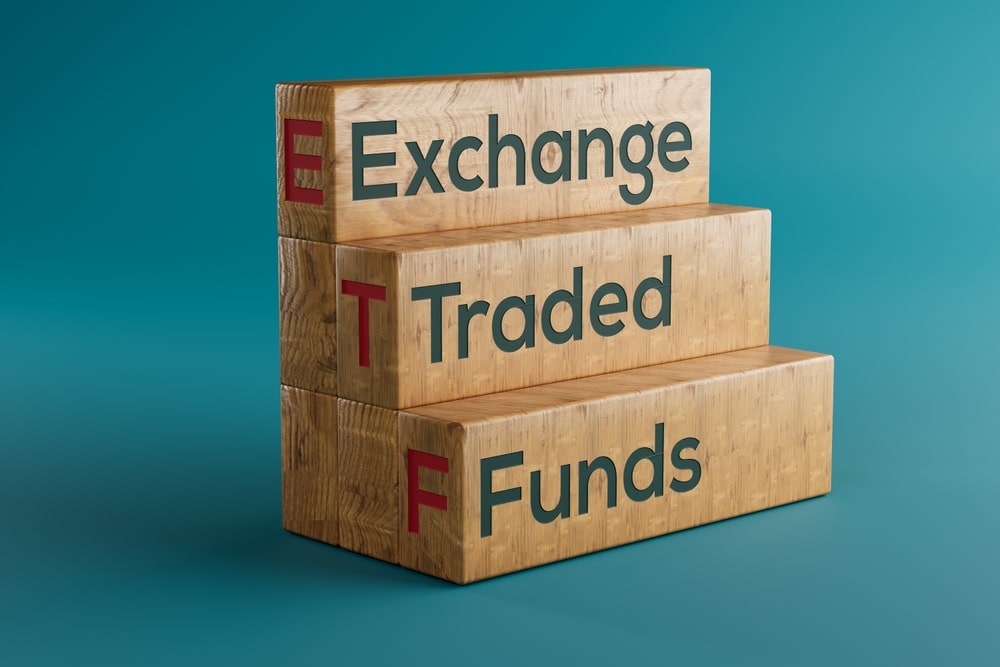
Let’s break down the ETF abbreviation into its components to see more closely how it works:
Since they often hold a collection of several assets, ETFs can be similar to mutual funds, but trade on stock exchanges like individual stocks.
ETFs provide investors with exposure to the underlying asset(s) without needing to buy them directly. This is most useful when the ETF tracks a “basket” of different assets or a single asset that is difficult to invest in directly.
Gold ETFs are an example of this. If you, as an investor, want exposure to the gold market, it’s easier and more convenient to buy into a gold ETF than to purchase (and store) your own physical gold bars.
The same thinking applies to other common types of ETFs, including silver, real estate, crude oil, and natural gas.
It’s important to note that the U.S. Securities and Exchange Commission (SEC), an independent federal agency, regulates ETFs in the United States. This means that the government oversees the trading of ETFs to ensure investors’ safety and prevent fraud.
Overall, ETFs have a good reputation for being flexible, having great liquidity, and often lower fees than other investment options. Plus, you aren’t burdened by the need to store the actual asset you’re investing in.
What is a Bitcoin ETF?
Here’s Bitcoin ETF explained.
Like a traditional ETF, a Bitcoin ETF provides investors with a regulated investment vehicle. It enables them to invest in the Bitcoin market without purchasing actual Bitcoin and storing it themselves.

Unlike cryptocurrencies that are traded on crypto exchanges like Kraken, ETFs are traded on traditional securities exchanges, such as the New York Stock Exchange and Nasdaq. In Canada, Bitcoin ETFs are traded on the Toronto Stock Exchange (TSX). They are traded on the Euronext Stock Exchange (ENX) in Europe.
When you invest in a Bitcoin ETF, you’re not directly purchasing Bitcoin. Instead, you’re buying shares in a fund that holds Bitcoin. Think of it like buying a ticket or voucher that officially declares you own X amount of Y asset.
Like gold and silver ETFs, this is designed to make it easier for traditional investors to get exposure to Bitcoin’s price movements without buying and storing it themselves.
How do Bitcoin ETFs Work?
An ETF issuer, usually an asset management company, like BlackRock or Franklin Templeton, buys the underlying Bitcoin and stores it securely with a custodian. Then, it issues the fund shares, providing investors with access to the underlying coins.
For an annual management fee, the company manages the purchase and storage of Bitcoin on behalf of the ETF’s investors.
Coinbase has been chosen as one of the primary custodians for securely storing Bitcoin for several large financial management companies that issued Bitcoin ETFs, such as BlackRock, Grayscale, Franklin Templeton, and others.
Spot Bitcoin ETF vs. Bitcoin Futures ETF
A Spot Bitcoin ETF refers to a note or financial instrument that follows the current price of Bitcoin. This differs from a Futures ETF, which tracks predictions or, more technically, speculations about Bitcoin’s price at a later date.
How to Buy Bitcoin ETF
So, where and how to buy Bitcoin ETF? To buy a Spot Bitcoin ETF, you can use an online broker such as Robinhood, eToro, Fidelity, WeBull, and Charles Schwab. You can also ask for a Bitcoin ETF to be included in your traditional IRA, Roth IRA, or 401(k) plan.
You may be wondering, “Does an ETF track the price of Bitcoin to a tee?”
The answer is—not exactly.
Although the ETF seeks to replicate Bitcoin’s performance, ETFs often face tracking errors that result in a difference between the ETF’s price and the real price of Bitcoin. These tracking errors can happen because of market conditions, the strategy of the ETF management, or the fees linked to the ETF.
Bitcoin ETF Pros and Cons
As you may have gathered so far, there are plenty of benefits to buying a Bitcoin ETF instead of buying Bitcoin directly on your own. There are also some important negatives to consider, which I’ll go over below.
The Pros of Bitcoin ETFs
The positives include the convenience of buying and selling through a traditional securities broker that you may already be signed up with (like Fidelity or Charles Schwab), not having to find (and vet) a crypto exchange to buy actual Bitcoin, and not needing to store the coins securely yourself afterward.
This makes ETFs much more accessible to the general public, as acquiring them requires little technical know-how. When you buy an ETF, you don’t have to worry about getting a Bitcoin wallet, creating a backup of your seed phrase, or keeping your wallet in a safe place.
Additionally, ETFs enable exposure through investment funds such as retirement funds, something not easily done through other methods.
The bottom line: if all you want is investment exposure to the Bitcoin market and aren’t interested in any of its use cases, then buying Bitcoin ETFs through traditional brokers, Robinhood, or eToro is simple and convenient.
Of course, there are also plenty of downsides to Bitcoin ETFs.
The Cons of Bitcoin ETFs
Buying a Bitcoin ETF can be more expensive than buying actual Bitcoin outright due to brokerage and issuer fees—often charged annually and with each purchase and sale.
Traditional markets also have limited trading hours, which don’t exist for real crypto markets, which are open 24/7. This could easily lead to missing out on big price moves.
Additionally, when Bitcoin’s price becomes extremely volatile, some ETFs might not be available for buying or selling as a protective measure from the ETF issuer. This means that you may be unable to take advantage of big price swings when they happen.
When you purchase a Bitcoin ETF, the underlying Bitcoin is kept in the hands of a third party, which comes with its own risks. We’re entering uncharted territory with investment into digital assets, and if your ETF provider or their Bitcoin custodian is hacked, how will that be resolved? Just something to consider, as opposed to safely storing actual Bitcoin yourself.
This last point is worth mentioning: Bitcoin ETFs go against the spirit of what Bitcoin was reputedly created for—decentralization of money, privacy, anonymity, etc.
The actual Bitcoin that backs the issued ETF shares is held by one company (centralized). When you purchase a Bitcoin ETF, there is nothing anonymous or private about it. Your financial services provider knows who you are and exactly what you purchased.
Plus, with Bitcoin ETFs, you can’t use them how you would normal Bitcoin; you can’t send them anywhere (to family or friends) or buy any goods or services with them. They are vouchers, redeemable only from exactly where you bought them: your brokerage.
If you store your own actual Bitcoin in a wallet under your full control, you can do all of these things, and it’s private and anonymous and maintains the decentralized spirit of Bitcoin.
How to Choose a Bitcoin ETF
Today, there are 11 different Spot Bitcoin ETF options available in the U.S. I’ll start by saying there’s no such thing as a perfect ETF. Choosing an ETF is based on personal preferences as much as it is based on hard data.
Here’s a list of things you’d want to consider before choosing your ETF:
Notable Bitcoin ETFs
The notable Bitcoin ETFs below are all available on typical financial services platforms:

iShares Bitcoin Trust
BlackRock’s Bitcoin ETF is known as the iShares Bitcoin Trust and trades on the Nasdaq under the ticker IBIT. It has a notable expense ratio of 0.25%, which is among the lowest fees for competing products.
The iShares Bitcoin Trust is targeting a broad audience, emphasizing the appeal to the next generation of clients, including millennials and high-net-worth individuals.
The underlying Bitcoin behind BlackRock’s IBIT ETF is held in custody by Coinbase.
Grayscale Bitcoin ETF
Grayscale’s Bitcoin ETF, the Grayscale Bitcoin Trust, trades on the New York Stock Exchange under the ticker GBTC. Due to being previously established as an investable trust, it started off as the world’s largest Bitcoin ETF by assets under management.
The original Grayscale Bitcoin Trust, created in 2013, was the first publicly traded Bitcoin fund, showcasing the longest operational history in the space. Grayscale had a long-running battle with the U.S. Securities and Exchange Commission (SEC) as it sought to convert its fund into an ETF.
GBTC has some of the highest fees on the market, with an expense ratio of 1.5%. The ETF uses Coinbase as its custodian and BNY Mellon for fund accounting and administration.
Bitwise Bitcoin ETF
The Bitwise Bitcoin ETF trades on the New York Stock Exchange under the ticker BITB. With a compellingly low expense ratio of 0.20%, it is currently the most cost-effective option for investors seeking exposure to Bitcoin.
It is competitively priced and distinguishes itself by donating 10% of its proceeds to BTC developers, aligning with the broader crypto community.
BITB is backed by Bitwise’s specialist expertise and a robust six-year track record managing crypto assets for leading institutional investors.
The trust is administered by BNY Mellon, with coin custody also handled by Coinbase.
Fidelity Wise Origin Bitcoin Fund
The Fidelity Wise Origin Bitcoin Fund, listed on the New York Stock Exchange under the symbol FBTC, has a competitive expense ratio of 0.25%. It seeks to offer a familiar investment structure, standard reporting, and transparent pricing for easy incorporation into client portfolios.
Fidelity has conducted extensive research on Bitcoin and blockchain solutions since 2014, adding a layer of expertise to the fund.
The fund has no lockups and is administered by Fidelity Service Company, with its Bitcoin custody handled by Fidelity Digital Asset Services, LLC. In other words, instead of choosing Coinbase to custody their Bitcoin, Fidelity has chosen to self-custody their Bitcoin, or manage its security and storage themselves.
2026 Update: ETF Flows & New Entrants
There has been a notable surge in institutional capital since spot Bitcoin ETFs were approved in early 2024. Several newer ETFs have launched with lower expense ratios than earlier winners, increasing competition among issuers.
A handful of pension funds have already made modest allocations to spot Bitcoin ETFs (e.g. Michigan with $6.6M in ARKB, Wisconsin with ~$99M in IBIT).
At the same time, a recent report by Bitwise’s European Head of Research, André Dragosch, shows that in 2025, institutional purchases are outpacing miner issuance by a large margin (over 7.4x), hinting that ETF demand may be contributing to tighter Bitcoin supply dynamics.
🔥OFFICIAL: Funds & Public Companies have now bought more bitcoins in 2025 than in 2024!
— André Dragosch, PhD⚡ (@Andre_Dragosch) October 8, 2025
As of 08/10/2025, global bitcoin ETPs & public companies have acquired 944,330 bitcoins which is equivalent to
*checks notes*
7.4 x times the new supply of bitcoins in 2025.
HUGE! pic.twitter.com/zwvwwp8Brb
U.S. Spot Bitcoin ETFs Finally Got Approved
After years of delays and rejections, the SEC finally approved 11 spot Bitcoin ETFs in the U.S. on January 10, 2024. This was a major moment for crypto investing, allowing regular investors to get exposure to Bitcoin through traditional brokerage accounts without needing to deal with wallets or private keys.
Some of the most popular ETFs now include BlackRock’s IBIT, Fidelity’s FBTC, and Bitwise’s BITB. These ETFs hold actual bitcoin, not just futures contracts like the ones approved back in 2021.
Since launch, they’ve attracted billions of dollars, with IBIT quickly becoming the most popular, thanks to its low fees and strong brand trust. As of October 2025, IBIT is nearing $100 billion in assets, which puts it among the fastest-growing ETFs of all time.
Compare the Most Popular Bitcoin ETFs
Here’s a quick look at some of the top spot Bitcoin ETFs currently trading in the U.S. and their fees:
ETF Name Ticker Expense Ratio iShares Bitcoin Trust IBIT 0.25% Fidelity Wise Origin Bitcoin FBTC 0.25% ARK 21Shares Bitcoin ETF ARKB 0.21% Bitwise Bitcoin ETF BITB 0.20% VanEck Bitcoin Trust HODL 0.20% WisdomTree Bitcoin Fund BTCW 0.24% Invesco Galaxy Bitcoin ETF BTCO 0.25% Franklin Bitcoin ETF EZBC 0.19% Valkyrie Bitcoin Fund BRRR 0.25% Grayscale Bitcoin Trust ETF GBTC 1.50% Grayscale Bitcoin Mini Trust BTC 0.15%
These are all available on major platforms like Fidelity, Schwab, and Robinhood. However, Vanguard still blocks buying Bitcoin ETFs for most customers, so your broker matters.
Options Trading Is Now Available on Bitcoin ETFs
As of late 2024, options trading is now allowed on several spot Bitcoin ETFs. This means traders can now bet on price moves or hedge their positions, similar to options on regular stocks or indexes.
Even more interesting, in late 2024, the Cboe launched a set of index options based on spot Bitcoin ETFs as a group. These are cash-settled and designed to make trading even easier for pros and institutions.
How Spot Bitcoin ETFs Actually Work (With a New Twist)
When the ETFs first launched in 2024, they were required to use cash only to buy and redeem shares. This was different from regular ETFs, which often use in-kind creation and redemption (where actual assets are moved around instead of cash).
But that changed in July 2025, when the SEC officially allowed spot Bitcoin ETFs to use in-kind systems. This helps them operate more efficiently and reduces tracking errors over time.
Who Holds the Bitcoin Behind the ETFs?
Most of the Bitcoin in these ETFs is held by Coinbase Custody, which holds over 90% of the perpetual futures market. It’s the go-to custodian for the majority of the funds listed above.
But there are exceptions:
This means there’s a heavy concentration in how the Bitcoin is stored, which some investors see as a risk worth keeping an eye on.
Important Note on Tax and Structure
Spot Bitcoin ETFs in the U.S. are set up as grantor trusts, not traditional mutual fund-style ETFs. That means:
- You don’t get direct ownership of any Bitcoin.
- You’ll usually receive a 1099 form, not a K-1.
For most people, this makes tax time easier, but it’s still worth understanding that you don’t own actual Bitcoin with these products.
Pro-Tip: Check out our comprehensive crypto taxes guide here to stay on top of the latest tax laws and regulations related to cryptocurrency trading and investing: Crypto Taxes Explained: Crypto Tax Guide 2025!
What You Don’t Get With a Bitcoin ETF
It’s worth knowing that owning a Bitcoin ETF means:
- No private key access (you’re not holding the actual coins)
- No access to Bitcoin forks or airdrops
- No ability to withdraw Bitcoin
These funds are meant to mirror the Bitcoin price, not give you all the perks of holding it directly.
Global Update: UK and Hong Kong Join In
Outside the U.S., things are moving too.
How Bitcoin ETFs Impact Bitcoin’s Price
Since the companies issuing the ETFs are required to hold actual bitcoins in order to back up the notes they are issuing, buying pressure is created, and the price tends to go up as ETFs become more common.
Additionally, the availability of a Spot Bitcoin ETF allows institutional investors such as pension funds, hedge funds, and other investor groups to invest in Bitcoin as well, potentially creating even more buying pressure and driving the price up further.
Combine all of this with the 2024 Bitcoin halving event, which will cut the generation of new Bitcoin in half, and you get a mix of higher demand with tightening supply. When that happens, the price of an asset almost invariably goes up.
Having said that, keep in mind that anything can happen, especially with Bitcoin. What I’m sharing with you is not investment advice. You should always do your own research and decide for yourself if you want to invest in anything.
Conclusion
Bitcoin ETFs give U.S. investors a simple way to get Bitcoin exposure through regular markets. They make it easier for both everyday investors and institutions to take part. There’s no need to deal with the technical side of buying Bitcoin directly. The funds also come with regulatory oversight, which adds a layer of security. Investors can now use trusted platforms like eToro, Robinhood, or even Charles Schwab to get involved.
Although this is useful for wider Bitcoin adoption and investment, you will probably want to buy and store your own Bitcoin from a trusted cryptocurrency exchange or broker, like Kraken or Coinmama, if you feel capable. This minimizes third-party risk and ensures that you can use or transfer the Bitcoin as you wish in line with its original intention. On the other hand, it’s great to see that traditional investors and investment funds can now diversify into Bitcoin quickly and easily.
See also: How do Beginners Buy Bitcoins?
FAQs
Is buying a Bitcoin ETF the same as buying Bitcoin?


No. When purchasing a Bitcoin ETF, you are buying into a managed fund designed to track the price of Bitcoin. You don’t actually own any real BTC yourself. If you want to be able to send Bitcoin somewhere, like friends or family, or buy things with it, you’ll need to purchase the real thing from a cryptocurrency exchange.
Are Bitcoin ETFs available for retail investors?
Yes. On January 10, 2024, the U.S. Securities and Exchange Commission (SEC) approved 11 spot Bitcoin ETFs, allowing retail (and institutional) investors to access them.
How are Bitcoin ETFs regulated?
Bitcoin ETFs in the United States are regulated by the U.S. Securities and Exchange Commission (SEC), an agency of the U.S. federal government. ETFs and ETPs in other regions are regulated by their respective agencies.
Which new spot Bitcoin ETFs launched in 2025?
In 2025, new issuers entered the U.S. spot Bitcoin ETF race with competitive fee structures. These include small boutique issuers and index fund providers aiming to capture flows. Be sure to check the SEC filings and prospectuses of each fund for up-to-date listings.
Have ETF expense ratios changed over time?
Yes. As competition among issuers heated up, several ETFs have lowered their expense ratios. Early leaders had higher fees; newer funds often undercut them to attract assets. Always compare the net expense ratio and tracking efficiency when choosing.
- Mitrade. “Live News Article.” Mitrade, www.mitrade.com/insights/news/live-news/article-3-1175219-20251007.
- U.S. Securities and Exchange Commission. “SEC Permits In-Kind Creations and Redemptions for Crypto ETPs.” SEC, www.sec.gov/newsroom/press-releases/2025-101-sec-permits-kind-creations-redemptions-crypto-etps.
- Schwab Asset Management. “Understanding ETF Creation and Redemption Mechanism.” Schwab Asset Management, www.schwabassetmanagement.com/content/understanding-etf-creation-and-redemption-mechanism.
- Coinbase. “Coinbase Institutional: Leading the Way in 2025.” Coinbase, www.coinbase.com/nl/blog/coinbase-institutional-leading-the-way-in-2025.
- Cohen & Company. “How Are Spot Bitcoin ETFs Taxed?” Cohen & Company, www.cohenco.com/knowledge-center/insights/february-2024/how-are-spot-bitcoin-etfs-taxed.
- London Stock Exchange. “London Stock Exchange Celebrates Launch of Crypto ETNs.” London Stock Exchange, www.londonstockexchange.com/discover/news-and-insights/london-stock-exchange-celebrates-launch-crypto-etns.

Why you can trust 99Bitcoins
Established in 2013, 99Bitcoin’s team members have been crypto experts since Bitcoin’s Early days.
Weekly Research
100k+Monthly readers
Expert contributors
2000+Crypto Projects Reviewed