




In This Article
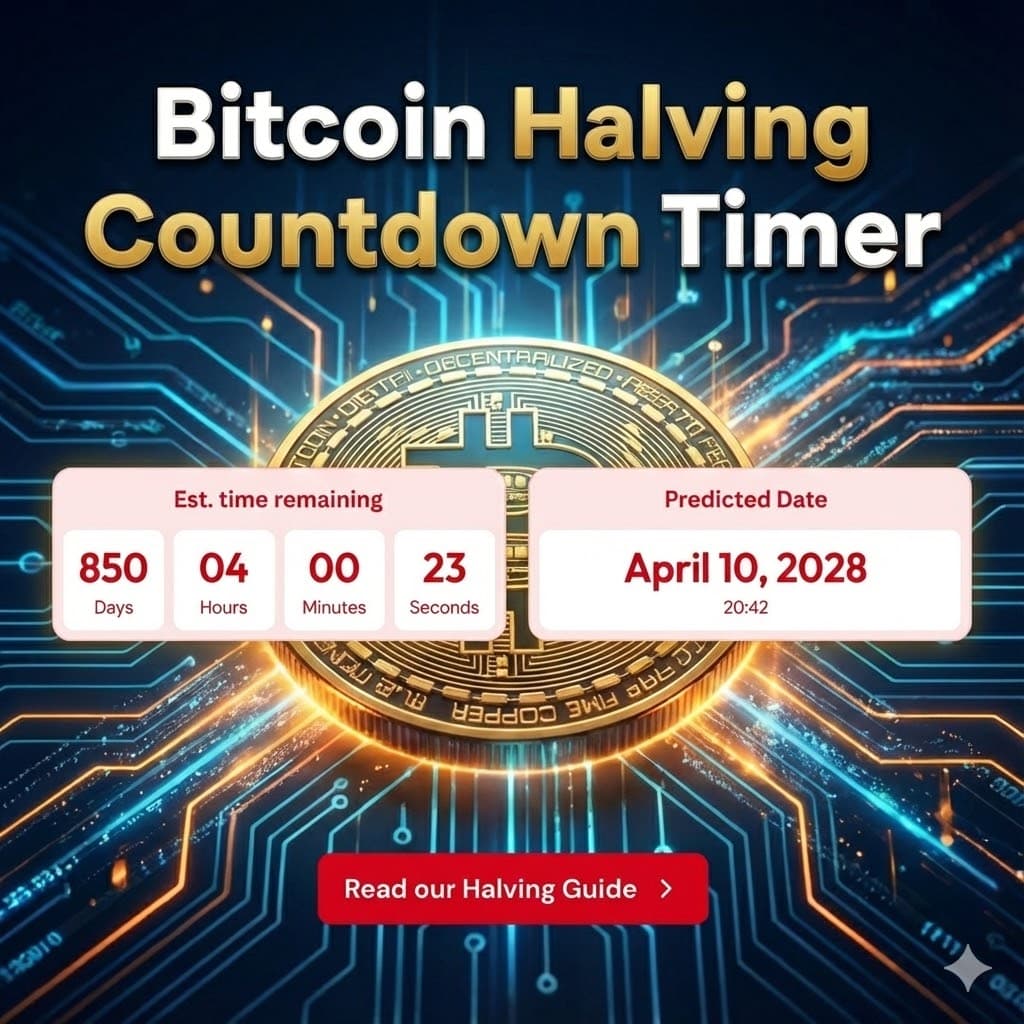
Track the seconds ticking away to crypto’s most anticipated event with our live Bitcoin Halving Countdown Timer. As the next Bitcoin halving date approaches, monitoring the shift in the Bitcoin block reward schedule is important to mark on your calendar for miners and investors alike.
This page provides real-time estimates based on current network data, helping you visualize the path to the next supply shock. Below the timer, explore our comprehensive guide on Bitcoin halving history and learn exactly what the Bitcoin halving is to ensure you understand the mechanics driving digital scarcity and contributing to market cycles.
When is the Next Bitcoin Halving?
The next Bitcoin halving is currently projected to occur in March or April 2028. However, because the exact timing depends on network activity, this date is subject to change.
While we can predict the specific block height at which the halving will occur (Block #1,050,000), we cannot predict the exact second it will be mined but our estimation will be close, and will adjust to become more accurate closer to the exact time.
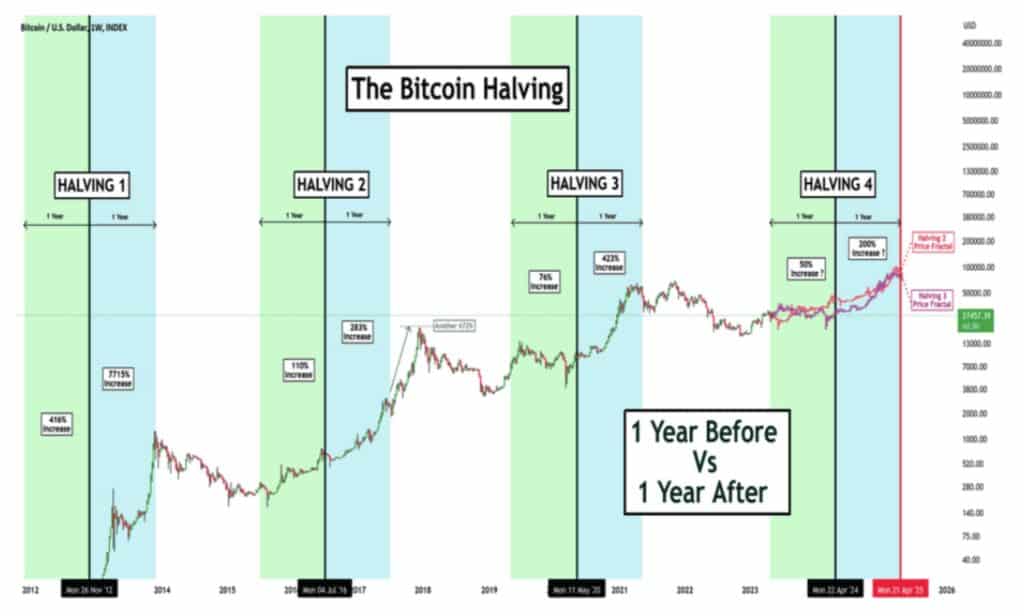
Here is a look at how Bitcoin’s price has reacted after previous halvings
Why Isn’t the Date Fixed?
Unlike a scheduled stock market holiday or a central bank meeting, the Bitcoin halving isn’t marked on a calendar. It is triggered solely by the blockchain’s length.
The Bitcoin network is designed to produce one block approximately every 10 minutes. If the network ran perfectly on that schedule, we could calculate the date with second-perfect precision. However, in the real world, mining speed fluctuates based on the global “Hash Rate” (the total computing power connected to the network).
- High Network Activity: When more miners join, blocks are found faster than 10 minutes, pulling the date closer.
- Low Network Activity: If miners go offline, blocks take longer to find, pushing the date further away.
Think of this countdown as an estimated time of arrival (ETA) on a GPS; it adjusts in real-time based on the “traffic” (computing power) on the road.
Note: Curious why we even have halvings or how they impact the Bitcoin economy? Read our beginner’s guide: What is the Bitcoin Halving?
How We Calculate the Halving Date
You might be wondering how we can predict a specific date for an event that is years away. Unlike the Olympics or a presidential election, the Bitcoin Halving isn’t scheduled for a specific calendar day. Instead, it is scheduled for a specific block height.
Because the Bitcoin network is programmed to operate like a clock, we can project the date using a relatively simple formula:
Here is the logic behind the math:
- The Target: The Bitcoin code targets a block production time of exactly 10 minutes.
- The Distance: We take the specific block number where the next halving is hard-coded to happen (e.g., block 1,050,000) and subtract the current block height.
- The Projection: We multiply that “distance” by 10 minutes to get the total time remaining.
However, if you refresh this page tomorrow, you might notice the estimated date has shifted slightly. That isn’t a glitch, it’s a feature of how the network operates.
Why Does the Timer Speed Up or Slow Down?
If Bitcoin is a clock, it’s one that runs slightly fast or slightly slow, depending on how much computing power is plugged into the network.
The 10-minute block time mentioned above is an average, not a hard rule. In the real world, blocks are sometimes solved in 8 minutes, and other times they take 12 or more. This variance is driven by two key factors: Hash Rate and Mining Difficulty.
1. The Hash Rate Fluctuation
Think of the Hash Rate as the total combined horsepower of every miner around the world.
- When Miners Join (Speed Up): If the price of Bitcoin rises or new, efficient hardware is released, more miners rush to turn on their machines. This increase in power means that difficult mathematical puzzles are solved faster than 10 minutes. Consequently, our countdown timer will move the expected date sooner.
- When Miners Leave (Slow Down): If mining becomes unprofitable or energy prices spike, miners may unplug their rigs. With less power on the network, puzzles take longer to solve, pushing the halving date further away.
2. The Self-Correction (Difficulty Adjustment)
You might ask: “If miners keep joining, won’t the halving eventually arrive months too early?” No, because the network self-corrects. Every 2,016 blocks (roughly every two weeks), the Bitcoin protocol analyzes how fast blocks were mined in the previous period.
If blocks are mined too fast (under 10 minutes), the network increases the Difficulty, making the puzzles harder to solve. If blocks are mined too slowly (over 10 minutes), it lowers the difficulty.
This mechanism acts like a thermostat, constantly nudging the average block time back toward that 10-minute target. Our timer is constantly recalculating based on these real-time network conditions, giving you the most accurate “live” estimate possible.
Future Bitcoin Block Reward Schedule
Bitcoin’s monetary policy isn’t decided by a central banker in a closed-door meeting; it is written in open-source code that has remained unchanged since 2009. This predictability is what allows us to map out the future supply with high precision.
The schedule below outlines the “Eras” of Bitcoin. We are currently in Era 5, where the block reward is set at 3.125 BTC. This era began in April 2024 and will conclude with the next halving in 2028.
As you move down the table, notice the dramatic drop in the “Yearly Inflation” column. This is the mathematical heartbeat of Bitcoin’s deflationary model.
| Era # | Estimated Year | Block Height | Block Reward (BTC) |
Approx. Yearly Inflation
|
| 1 | 2009 (Past) | 0 | 50 | N/A |
| 2 | 2012 (Past) | 210,000 | 25 | 3.70% |
| 3 | 2016 (Past) | 420,000 | 12.5 | 1.80% |
| 4 | 2020 (Past) | 630,000 | 6.25 | 1.70% |
| 5 | 2024 (Current) | 840,000 | 3.125 | 0.80% |
| 6 | 2028 (Next) | 1,050,000 | 1.5625 | 0.40% |
| 7 | 2032 | 1,260,000 | 0.78125 | 0.20% |
| 8 | 2036 | 1,470,000 | 0.390625 | 0.10% |
| 9 | 2040 | 1,680,000 | 0.1953125 | < 0.1% |
| … | … | … | … | … |
| 34 | 2140 | 6,930,000 | 0.00 (Fees Only) | 0% |
The Road to 2140
While the halving reduces the flow of new Bitcoin, there is a hard cap on the supply. The Bitcoin code dictates that only 21 million coins will ever exist.
Current estimates suggest that the very last fraction of a Bitcoin, known as a “Satoshi”, will be mined in the year 2140. However, the vast majority of the supply has already been issued. Because the issuance creates a geometric decay curve (halving every four years), we are front-loading the supply.
By the early 2030s, over 99% of all Bitcoin will have been mined. The remaining <1% will be trickled out slowly over the next century.
What happens when the mining ends?
Once the block reward hits zero in 2140, miners will no longer receive a subsidy for securing the network. Instead, their operations will be funded entirely by transaction fees paid by users. This marks the final transition of Bitcoin from a growing inflationary currency to a purely deflationary, fee-sustained ecosystem.
Accuracy of Past Halving Estimates
If you had looked at a halving countdown timer in 2022, predicting the 2024 event, the date you saw then likely differed by days from the actual arrival date.
This isn’t because the math is flawed; it’s because the input variable of the network’s Hash Rate is unpredictable. Analyzing past halvings reveals a clear trend: the theoretical “four-year cycle” is rarely a perfect four years.
The Bitcoin network is designed to adjust its difficulty every 2,016 blocks to keep block times around 10 minutes. However, this adjustment is reactive, looking backward at the previous two weeks.
Historically, Bitcoin has experienced long-term, exponential growth in mining power. Because miners are often bringing new, more powerful hardware online faster than the network can adjust the difficulty upward, blocks are frequently found faster than the 10-minute target.
The result? Halvings have historically arrived “early.”
Below is an analysis of the deviation for previous eras:
Eras 1 & 2 (2012 & 2016 Halvings): These early eras saw explosive, often unpredictable growth in mining technology (moving from CPUs to GPUs to ASICs). Because hash rate grew so aggressively, these halvings arrived significantly faster than a simple 10-minute projection would have predicted years prior.
Era 3 (2020 Halving): As the mining industry matured, the deviation narrowed. However, significant price volatility in early 2020 caused massive swings in hash rate as miners plugged in and unplugged machines, causing the estimated date to drift back and forth by weeks leading up to the event.
Era 4 (2024 Halving): Leading into the most recent halving, we saw another surge in institutional mining power. Early projections placed the halving in May or even June 2024. The relentless addition of hash rate accelerated the timeline, ultimately pushing the event forward to April 20th.
Conclusion
The Bitcoin Halving is the economic heartbeat of the entire cryptocurrency ecosystem. This countdown timer serves as a real-time visualization of Bitcoin’s deflationary monetary policy, proof that, unlike fiat currencies, Bitcoin’s supply is strictly limited by code, not human decision.
As the timer ticks down to the next era of 1.5625 BTC block rewards, the market prepares for another supply shock. Whether you are a miner calculating future profitability or an investor monitoring the cycle, staying informed on the exact timing is important.
Bitcoin Halving Timer FAQs
Why did the countdown just change?

The timer updates automatically because Bitcoin blocks are mined at varying speeds depending on the global network’s computing power (hash rate).
Can the halving happen on a weekend?
Yes, the Bitcoin blockchain operates 24/7 without holidays, so the halving will occur the moment the target block is mined, even on a weekend.
How often does Bitcoin halving happen?
The Bitcoin halving is programmed to occur exactly every 210,000 blocks, which historically takes approximately four years to complete
Will Bitcoin price go up after halving?
While previous halvings were followed by significant price increases due to supply shock, historical trends do not guarantee future performance.
What is the current block reward?
As of the most recent halving in April 2024, the block reward paid to miners is currently 3.125 BTC per block
Does halving affect my Bitcoin holdings?
No, the halving only changes the rate at which new coins are created; your existing Bitcoin remains unchanged and no action is required on your part.
Bitcoin Magazine Pro Team. “How to Read and Interpret the Bitcoin Halving Price Chart.” Bitcoin Magazine Pro, www.bitcoinmagazinepro.com/blog/how-to-read-and-interpret-the-bitcoin-halving-price-chart/
“Developer Guide.” Bitcoin.org, Bitcoin Project, bitcoin.org/en/developer-guide#block-chain.
Conway, Luke. “Understanding Bitcoin Halving: Impact on Price and Investment Strategies.” Investopedia, www.investopedia.com/bitcoin-halving-4843769
“Total Hash Rate (TH/s).” Blockchain.com, blockchain.com/explorer/charts/hash-rate

Why you can trust 99Bitcoins
Established in 2013, 99Bitcoin’s team members have been crypto experts since Bitcoin’s Early days.
Weekly Research
100k+Monthly readers
Expert contributors
2000+Crypto Projects Reviewed