




In This Article
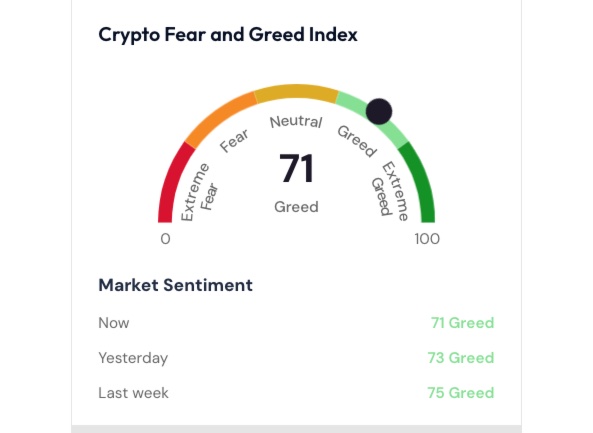
Crypto Fear and Greed Index
Crypto Fear and Greed Index
Crypto Fear and Greed Chart
Crypto Fear and Greed Chart
What is the Crypto Fear and Greed Index?
The Crypto Fear and Greed Index is a real-time sentiment gauge that attempts to quantify the collective emotions of crypto investors and traders. It aggregates various market signals such as Bitcoin volatility, trading volume, momentum, social media sentiment, dominance, and trends and condenses them into a score between 0 and 100. A lower reading indicates prevailing extreme fear, while a higher reading reflects extreme greed.
This index is currently maintained by multiple services (for example, Alternative.me) and is often integrated into crypto dashboards and analysis platforms.
Why is the Fear and Greed Index an Important Metric?
Emotions drive markets, and nowhere is that more visible than in crypto. The “buy low, sell high” maxim is really phrased in behavioral terms: buy when others are fearful, sell when they are euphoric. The Crypto Fear and Greed Index aims to map those extremes.
- When the index is very low (fear dominates), opportunities often appear, because though sentiment is negative, value may be undervalued.
- When the index is very high (greed dominates), markets often overextend, and corrections may follow.
In that light, the Index is a contrarian signal tool not a timing device. It helps you see when crowd psychology might be reaching extremes.
How to Best Use the Fear and Greed Indicator
The index should not be used in isolation. A better approach is to consider it alongside technical, on-chain, and macro metrics. Here’s how one might incorporate it:
- Contextual filter: If the index is in extreme greed, recognizing overbought conditions helps you avoid overexposure.
- Entry guardrail: During periods of deep fear, paired with signs of bottoming (e.g. stablecoin flows, accumulation), it can signal times to accumulate selectively.
- Divergences: Compare the index with price action. If price is rising but greed isn’t matching, the move may lack conviction.
- Time horizon alignment: Short-term traders may act more on Index swings; longer-term holders likely treat it as a check on emotional excess rather than a signal to pivot.
Always combine it with risk management, position sizing, and confirmation from other metrics. The Index is a sentiment thermometer, not a trade generator.
Crypto Fear and Greed Index Methodology
The Crypto Fear and Greed Index doesn’t guess investor sentiment — it quantifies it. The index pulls data from multiple live market feeds and social platforms, analyzing behavioral and technical factors to produce a score between 0 (extreme fear) and 100 (extreme greed).
As of 2025, the main inputs include:
- Volatility and market momentum – Compares current Bitcoin volatility to the 30- and 90-day averages to assess fear or exuberance.
- Trading volume and market trend – Measures whether high volume coincides with positive or negative price moves.
- Social media sentiment – Scrapes Twitter/X, Reddit, and other social platforms for bullish or bearish phrases.
- Bitcoin dominance – Tracks shifts between Bitcoin and altcoins, as declining BTC dominance often signals greedier risk appetite.
- Google Trends – Reflects mainstream retail interest through keyword frequency spikes.
The index updates roughly every eight hours and remains primarily Bitcoin-weighted, though new versions (like CFGI.io) have started incorporating broader crypto-market sentiment.
Historical Trends and Key Inflection Points
Looking back at the crypto market’s emotional cycles offers valuable lessons. The Fear and Greed Index has historically flashed “Extreme Fear” near major bottoms and “Extreme Greed” around market tops.
In late 2022, the index hovered around 10–15, coinciding with Bitcoin’s $16,000 lows. By March 2024, as Bitcoin climbed toward $70,000, it surged to 80–85, showing widespread euphoria. After a mild correction in mid-2025, readings fell back into the 30–40 zone, reflecting investor caution despite strong fundamentals.
Understanding these swings helps investors contextualize the mood rather than overreact to it. History shows that when the crowd panics, disciplined traders accumulate and when the crowd cheers, veterans start trimming positions.
Bitcoin vs. Altcoin Sentiment
Most versions of the Fear and Greed Index are heavily Bitcoin-centric, but altcoin markets often tell a different story. During “alt-seasons,” Bitcoin’s dominance declines even as total crypto market cap grows, creating a paradox: the index might display “Fear” because Bitcoin stagnates, while altcoins are booming.
To bridge this gap, newer analytics platforms like CFGI.io and CoinStats offer multi-asset sentiment tracking across Ethereum, Solana, and Layer-2 ecosystems. For traders focused on altcoins, combining these datasets provides a more complete picture of overall market psychology rather than relying solely on Bitcoin sentiment.
Advanced Trading Strategies Using the Fear and Greed Index
While the index isn’t a crystal ball, it’s an excellent contrarian signal when paired with technical and on-chain indicators.
When the index dives below 25 (Extreme Fear), it historically aligns with accumulation zones. Long-term investors often dollar-cost average (DCA) during these periods, taking advantage of discounted prices. Conversely, when the index soars above 75 (Extreme Greed), disciplined traders consider taking partial profits or rotating into stable assets.
The most effective use of the index is through confluence, not isolation. Combining sentiment data with RSI, open interest, funding rates, and on-chain flows creates a holistic view of market positioning. In other words, fear is opportunity, greed is caution, but context is everything.
Related Tools and Data Sources
To fully grasp market mood, traders should use multiple sentiment trackers alongside the Fear and Greed Index. Some recommended tools include:
- Alternative.me: The official and most widely referenced Crypto Fear and Greed Index.
- CFGI.io: Real-time multi-asset sentiment readings across multiple timeframes (15m, 1h, 4h).
- Santiment and Glassnode: For advanced on-chain sentiment and whale behavior analytics.
- Google Trends: A free gauge of retail interest in crypto-related keywords.
- TradingView: Allows overlaying sentiment indices on Bitcoin price charts for visual correlation.
Cross-referencing these helps filter false signals and spot authentic sentiment reversals before the crowd catches on.
Psychology of Fear and Greed in Markets
The reason this index works is simple: humans don’t change. Fear and greed have ruled markets since the Dutch tulip bubble and continue to do so in the digital age.
Fear makes investors dump good assets at bad prices. Greed convinces them the party will never end. In crypto, these emotions are amplified by volatility and social media hype, where narratives spread faster than reason. Behavioral economics calls this “herd behavior” and “loss aversion”; traders feel losses twice as painfully as they feel gains. Recognizing that your emotions mirror the market’s average mood is the first step to staying contrarian and profitable in the crypto space.
FAQs
What is a good Crypto Fear and Greed score to buy Bitcoin?

Historically, readings below 25 (Extreme Fear) have coincided with strong accumulation zones, though it’s best to confirm with other indicators.
How often is the Fear and Greed Index updated?
Every eight hours on most platforms, providing multiple daily snapshots of market sentiment.
Who calculates the Crypto Fear and Greed Index?
The most cited version is published by Alternative.me, though other providers like CFGI.io maintain independent indices.
Does the index cover altcoins or only Bitcoin?
It’s primarily Bitcoin-weighted, but complementary trackers now measure altcoin and DeFi sentiment separately.
What are the risks of trading solely based on this index?
Sentiment changes fast, and relying exclusively on this metric can lead to false signals. Always combine it with technical and fundamental analysis.
- Panos, Georgios, et al. “The Psychology of Cryptocurrency Trading and Investment.” Frontiers in Psychology, vol. 13, 2022, https://pmc.ncbi.nlm.nih.gov/articles/PMC8996802/.
- Delfabbro, Paul, Daniel L. King, and Alex Blaszczynski. “The Psychology of Cryptocurrency Trading: Risk and Protective Factors.” Current Opinion in Psychology, vol. 39, 2021, pp. 68–72. Flinders University Research Repository, https://researchnow-admin.flinders.edu.au/ws/portalfiles/portal/47324207/Delfabbro_Psychology_P2021.pdf.
- Krause, Nicholas, et al. “The Moral Foundations of Cryptocurrency: Evidence from Twitter and Survey Research.” Frontiers in Psychology, vol. 14, 2023, https://www.frontiersin.org/journals/psychology/articles/10.3389/fpsyg.2023.1128575/full.
- Yıldırım, Ömer, et al. “Understanding the Psychological and Behavioral Impact of Cryptocurrency Volatility on Investors.” Frontiers in Psychology, vol. 15, 2025, https://pmc.ncbi.nlm.nih.gov/articles/PMC11221751/.

Why you can trust 99Bitcoins
Established in 2013, 99Bitcoin’s team members have been crypto experts since Bitcoin’s Early days.
Weekly Research
100k+Monthly readers
Expert contributors
2000+Crypto Projects Reviewed