




In This Article
- Next Cryptos to Hit $1 in 2026: Best Picks Under $1 Right Now
- Top Cryptos That Could Hit $1 Next
Established Coins Already Closest to $1
- Filecoin (FIL)- Decentralized storage network; among the smallest gaps to $1 of any mid-cap token today.
- VeChain (VET)- Enterprise supply-chain blockchain with a large but well-established circulating supply
- Algorand (ALGO)- pure proof-of-stake L1 with institutional partnerships; supply dynamics are more $1-friendly than DOGE or SHIB.
- Stellar (XLM)- payments-focused L1 that has traded above $0.50 in prior cycles
- Top $1 Potential Crypto Coins Compared
- Cryptos That Have Hit $1 Before, And Could Again
- Why the $1 Price Level Matters in Crypto
- Key Signals That a Crypto Is Approaching the $1 Mark
- Which Meme Coins Will NOT Reach $1 (and Why)
- How to Buy Crypto Under $1
- Conclusion: Next Crypto to Hit $1
Seven tokens are realistically positioned to be the next crypto to hit $1 in this market cycle: Bitcoin Hyper (HYPER), LiquidChain (LIQUID), Maxi Doge (MAXI), Tapzi (TAPZI), SUBBD, Dogecoin (DOGE), and Kaspa (KAS). Fetch.ai (FET), Akash Network (AKT), and Render (RNDR) are reclaim candidates; all three already traded above $1 in 2024 and each needs less than a 3× move to get back there. Established mid-caps like Filecoin (FIL) and VeChain (VET) sit closest of all, within striking distance of $1 without needing a new market cycle.
Our analysts apply a supply-and-market-cap filter first: a token only makes this list if $1 is mathematically achievable without exceeding the value of the entire global economy. That filter rules out SHIB, BONK, and PEPE outright, we explain why further down, and separates genuine setups from hope-based price targets. Below, we break down the math, the catalysts, and a realistic timeline for each candidate.
Next Cryptos to Hit $1 in 2026: Best Picks Under $1 Right Now

- New Bitcoin L2 presale offering massive staking rewards
- By using a SVM Bitcoin Hyper is revolutionizing Bitcoin's potential
- Early buyers can use $HYPER tokens for transactions, staking, and ecosystem governance
 Bank Card
 BNB
BNB ETH
ETH- +1 more



- Unified liquidity across Bitcoin, Ethereum, and Solana
- Faster trading, deeper liquidity, and secure cross-chain capital flow
- Potential to increase interconnectivity for developers
- ETH
- USDT
- USDC
- +3 more


- The "Final Form" of Doge- The Ultimate Evolution of Dog-Themed Memecoins
- 25% of Supply Goes to Future Partnerships & Events
- Proof of Workout/Proof of Winning- Maximum Meme Embodiment
- ETH
- BNB
- USDC
- +2 more

- Native token of a leading crypto interest platform
- Earn 19%-25% APR by depositing into compound interest accounts
- Governance token that gives holders voting rights
- Bank Card
- ETH
- USDT

- First AI-Focused Content Creation & Premium Platform
- 250M+ Combined Following
- Staking + Creator Benefits
- Bank Card
- USDT
- ETH
- +2 more

- AI-driven platform that aims to deliver next-gen forex trading strategies
- The project acts as the broker itself, sustaining its model through rebates and buybacks from trades
- VFX token is used for staking, rebates, card access, and governance rights
- USDC
Key Takeaways
- Reaching the $1 price level depends more on supply, market cap headroom, and demand growth than on low price alone.
- Early-stage and under-$1 projects often see the strongest moves during favorable market cycles and capital rotation phases.
- Presales, staking incentives, and upcoming catalysts can accelerate short-term momentum toward the $1 mark.
- Completed audits and transparent tokenomics reduce downside risk when evaluating $1 potential.
- In 2026, the most credible $1 candidates have circulating supplies below 500 million tokens, meaning $1 only requires a sub-$500M market cap.
- AI infrastructure tokens (FET, AKT) are the strongest reclaim candidates, having already traded above $1 in the 2024 cycle.
- DOGE and SHIB face near-impossible $1 math: a $1 DOGE price would require a ~$147B market cap, making it the world’s second-largest crypto..
Top Cryptos That Could Hit $1 Next
The $1 price level is one of the most-watched milestones in crypto markets. Assets approaching this level often see sharp shifts in trader behavior, liquidity, and volatility, making them closely monitored during active market phases. Our analysts have selected projects with strong potential to generate significant value if they successfully execute their roadmaps. We feel that the next crypto to hit $1 will be projects like Bitcoin Hyper, and Dogecoin.
~200M (presale alloc) Presale Stage
Coins
What It Is
Circulating Supply
Mkt Cap at $1
Why It Could Hit $1
Realistic Path to $1
Bitcoin Hyper
Bitcoin Layer 2 focused on faster transactions and staking rewards
Presale stage — tokenomics TBA
LiquidChain
Layer 3 network unifying Bitcoin, Ethereum, and Solana liquidity
Presale stage — tokenomics TBA
Presale Stage
Maxi Doge
New Doge-based meme token with reward-focused mechanics
Presale stage — tokenomics TBA
SUBBD
AI-backed content token offering high APY
Tapzi
Competitive gaming crypto targeting sustained user growth
Presale stage — tokenomics TBA
Dogecoin (DOGE)
Largest meme coin with strong brand recognition
~147B
~$147B
Deep liquidity and repeated rallies keep $1 in focus
Possible-Supply math will make it difficult, but in another memecoin supercycle, Dogecoin will capture the most liquidity
Kaspa (KAS)
Fast, open-source Layer 1 with strong recent performance
~26.6B
~$26.6B
Momentum and growing visibility support further upside
Unlikely- Will require token burns
Presale token supplies and market caps are confirmed after the Token Generation Event. We update this table after each TGE
Best Crypto Under $1 in 2026
Finding quality crypto assets under $1 requires separating real opportunity from speculation. In this section, we break down individual projects that remain below the $1 mark in 2026, examining their positioning, utility, and potential catalysts.
1. Bitcoin Hyper – The First Bitcoin Layer 2 Scaling Solution for Under $1 and Presale Staking Rewards
Bitcoin Hyper (HYPER) is the first-ever Bitcoin Layer 2 rollup, speeding up transactions and increasing Bitcoin’s scalability. Based on well-known L2 frameworks like Lightning Network and Optimism, the project delivers near-instant finality for users sending and receiving BTC.
An important aspect of the Bitcoin Hyper ecosystem is the use of SVM (Solana Virtual Machine) smart contracts, which improve efficiency and allow Bitcoin to function on decentralized platforms. This broadens Bitcoin’s involvement in DeFi activities like staking and decentralized exchanges (DEXs). According to Solana Developer Docs, Solana can process a theoretical 50,000 transactions per second. Compare that to Bitcoin’s 5-7 TPS, and it is clear to see why Bitcoin could greatly benefit from tapping into the Solana Virtual Machine.
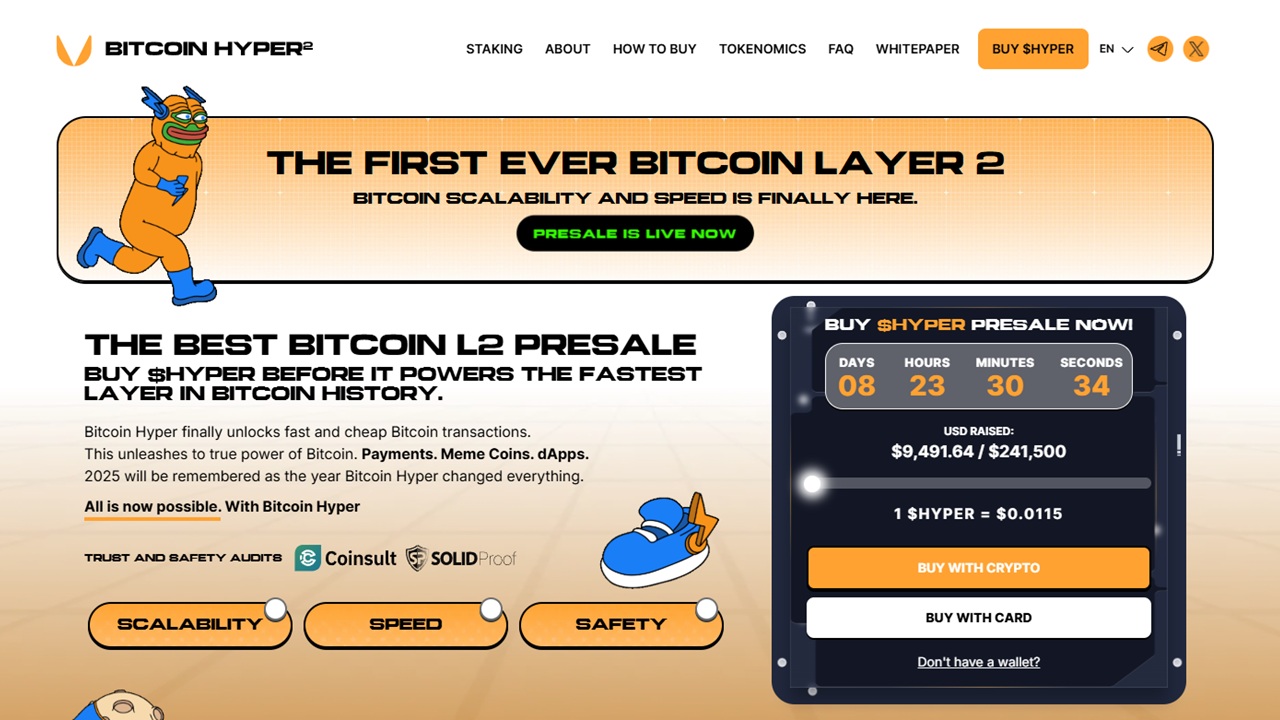
The Bitcoin Hyper L2 is powered by its native token, HYPER, which offers governance utility and staking benefits. In fact, those who buy HYPER in the ongoing Bitcoin Hyper presale can stake their holdings and earn up to 41% APY dynamic.
Bitcoin Hyper has completed three independent smart contract audits by SolidProof, Coinsult, and SpyWolf, with no major vulnerabilities identified. SolidProof awarded the project a trust score of 76.86, supporting its ranking as #1 on our list.
Across all audits, key checks confirmed that no new tokens can be minted, ownership is renounced, no honeypot or blacklist functions exist, fees cannot be excessively increased, and no high-or medium-risk issues were found.
Get the latest updates and official announcements by connecting with the Bitcoin Hyper Telegram community. Alternatively, check out this great video where one of our resident experts breaks down the ins and outs of this crypto. You can also take a look at our $HYPER Analysis: Is Bitcoin Hyper Legit or a Scam? And don’t forget to read the Bitcoin Hyper whitepaper. For more information, consider checking out our article on Bitcoin Hyper ($HYPER) Price Prediction 2026-2030
Pros
-
Built as a Bitcoin-focused Layer 2 network
-
Solana Virtual Machine enables fast smart contracts
-
Public-only presale with no private allocations
-
Staking rewards available for early participants
-
Audit planned before token generation event
Cons
-
Audit not yet completed or published
-
Single sequencer introduces centralization risk
-
Mainnet and ecosystem still under development
Realistic Timeline: Crypto altcoin seasons typically last 1-3 months during a crypto bull market. The timeline for Bitcoin Hyper to realistically hit $1 will be 1-3 months after Bitcoin surpasses its ATH of 125k and price stalls, before we see the capital rotation into altcoins.
2. LiquidChain – First Layer-3 Crypto Network Unifying BTC, ETH & SOL Liquidity
- Presale project: LiquidChain (LIQUID)
- Presale Price: $0.01215
- Raised so far: $44,000+
- Number of Participants: Not yet published
- Blockchain: Ethereum, Solana, Bitcoin
- Token type: L3 token (ETH, BTC, SOL)
- Accepted payment methods: ETH, USDT, USDC, BNB, SOL, Card
- Round Ends: Every 36 hours or sooner
LiquidChain (LIQUID) could be one of the most promising low-cap cryptos in 2026, as it plans to introduce the first unified Layer-3 network to connect Bitcoin, Ethereum, and Solana into a single execution layer.
Instead of operating as a standalone chain, LiquidChain serves as a DeFi settlement layer where assets from BTC, ETH, and SOL are verifiably represented and can flow freely between ecosystems.
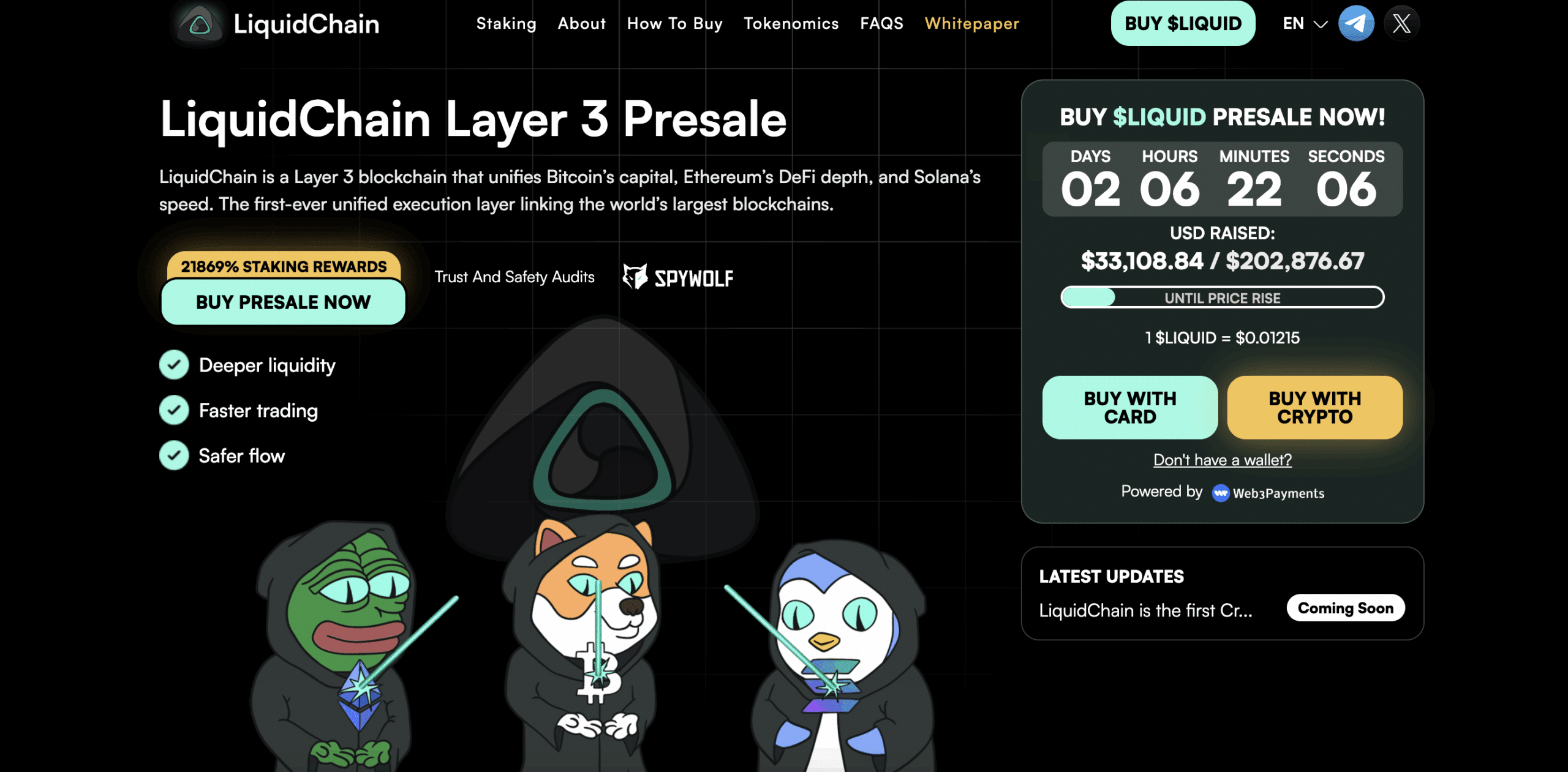
The network’s Unified Liquidity Layer is designed to remove fragmentation across major blockchains, while its VM is intended to enable real-time cross-chain operations inspired by Solana-level throughput.
The project has passed independent audits by CertiK and SpyWolf with no code vulnerabilities found. CertiK assigned a Double B rating, confirming all 26 security checks passed, with only non-critical recommendations such as improving DNS health and adding a bug bounty. SpyWolf’s analysis further confirmed no minting, honeypot, blacklist, or excessive fee risks, no hidden ownership or proxy contracts, and no self-destruct or router manipulation functions.
Early presale participants can stake their tokens immediately for a very high APY. But remember this high yield comes with its own set of risks. To learn more about the project, go through the LiquidChain whitepaper and join the Telegram channel.
Pros
-
Unifies Bitcoin, Ethereum, and Solana liquidity
-
Cross-chain execution without traditional bridges
-
High-performance VM designed for DeFi throughput
-
Shared liquidity pools improve capital efficiency
-
Low fees and energy-efficient PoS-based design
Cons
-
Complex cross-chain architecture increases execution risk
-
Project is pre-mainnet with unproven adoption
-
Institutional liquidity plans are still theoretical
Realistic Timeline: Crypto altcoin seasons typically last 1-3 months during a crypto bull market. The timeline for LiquidChain to realistically hit $1 will be 1-3 months after altseason begins.
3. Maxi Doge – Dogecoin-Centered ERC-20 Token Offering Top-Notch Rewards
- Presale project: Maxi Doge (MAXI)
- Presale Price: $0.00028355
- Raised so far: $4.85M
- Number of Participants: 25,769
- Blockchain: Ethereum
- Token type: ERC-20
- Accepted payment methods: ETH, BNB, USDT, USDC, Card
- Round Ends: 1 hours, 37 minutes
Maxi Doge (MAXI) is a dog-themed meme coin designed around a high-energy, gains-focused trading narrative rather than real utility. It positions itself as an “ultra-strong” Dogecoin-style token that relies on community momentum, branding, and market trends to drive interest.
The project offers presale staking with high APY rewards to incentivize early participation and has allocated a portion of its supply for future partnerships and promotional events, potentially tied to leverage or futures trading platforms.
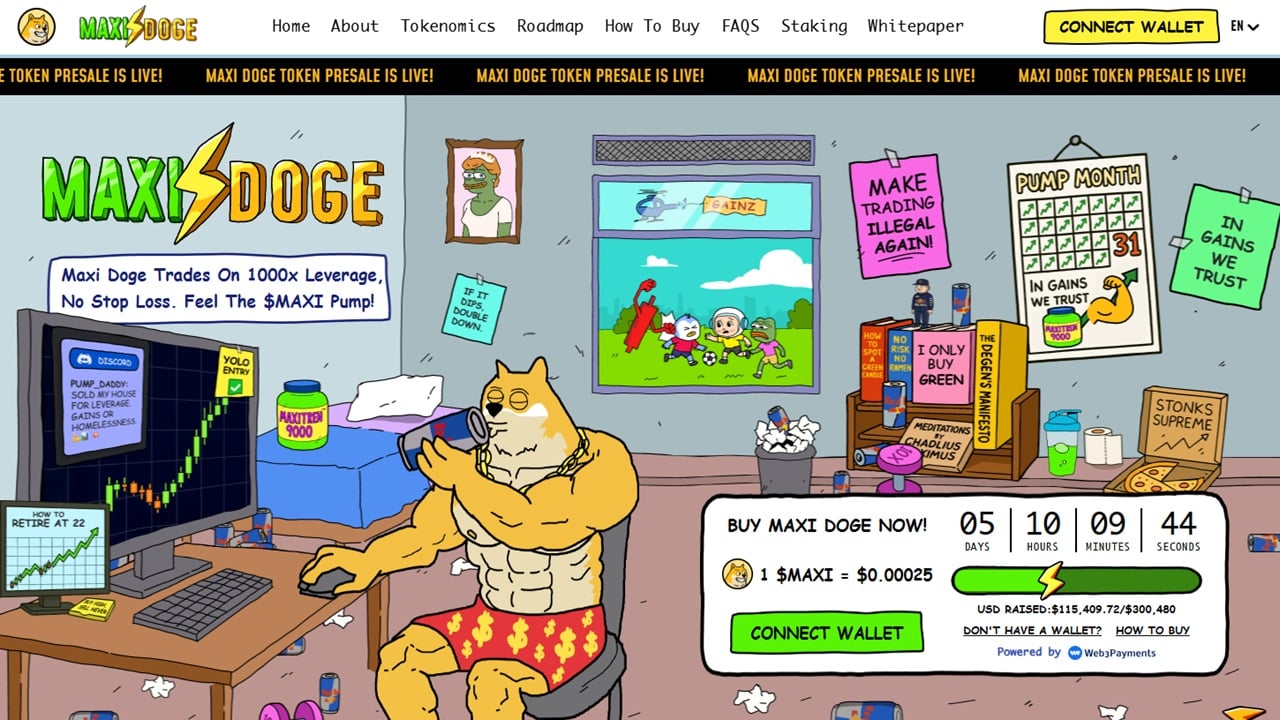
It offers staking reward of 73% at present. Maxi Doge has been audited by Coinsult and SolidProof, passing all key security checks with no critical issues found. Both audits confirm that no new tokens can be minted, there are no honeypot or blacklist functions, fees cannot be excessively increased, trading is enabled, and ownership has been renounced, with SolidProof assigning a trust score of 76.86.
The Maxi Doge whitepaper will allow you to gain a deeper understanding of the project. Otherwise, take a look at MAXI’s X or Telegram accounts, or check out our video. You can also take a look at our article: Is Maxi Doge (MAXI) Legit or a Scam? Read our Maxi Doge ($MAXI) Price Prediction 2026-2030 as well.
Pros
-
Passed audits by Coinsult and SolidProof
-
No minting, blacklist, or honeypot risks
-
Presale staking with high APY rewards
-
Strong meme branding and community appeal
Cons
-
Limited real-world utility
-
Highly speculative meme coin
-
No guaranteed exchange listings
Realistic timeline: If a meme coin supercycle occurs in the 2026–2027 window (a reasonable scenario given BTC’s halving cycle), MaxiDoge has a 3–6 month window to challenge the $1 price point. Sustained $1+ would require conditions beyond anything seen in the last four years.
4. SUBBD – AI-powered, Content-focused Crypto Token Rewarding Holders with Fixed APY
- Presale project: Subbd (SUBBD)
- Presale Price: $0.05766000
- Raised so far: $1.58M
- Number of Participants: 11,452
- Blockchain: Ethereum
- Token type: ERC-20
- Accepted payment methods: ETH, BNB, USDT, USDC, Card
- Round Ends: 1 days, 9 hours
SUBBD (SUBBD) is a cutting-edge AI-driven crypto project aiming to revolutionize the $85 billion creator subscription industry. Positioned as a decentralized platform, SUBBD empowers content creators with smart tools to develop their audience, while offering fans highly personalized, AI-enhanced experiences.
Now in its presale stage, the native SUBBD token is gaining momentum thanks to the backing of a strong team of ambassadors and access to a massive social network exceeding 250 million followers.

Holding SUBBD unlocks exclusive perks, including access to premium content from creators, staking opportunities, and engagement-based rewards. Early supporters can also stake their tokens during the presale and earn a fixed return of 20% APY. Out of the total 1 billion SUBBD token supply, 20% is allocated for the ongoing presale. An additional 18% is reserved for exchange liquidity, ensuring smoother access when the token lists publicly.
The project has passed independent audits by SolidProof and Coinsult, with no critical issues identified. SolidProof awarded a trust score of 76.86, confirming ownership is renounced, and the contract cannot mint tokens, blacklist users, or set high fees, while Coinsult found zero smart contract risks, no honeypot mechanisms, and verified that trading is fully enabled.
Dive deeper by exploring the official SUBBD whitepaper and stay connected through the vibrant Telegram community or the project’s X group for real-time updates. For SUBBD’s future outlook, see our SUBBD price prediction. You can also follow our “How to buy SUBBD token” guide to get started.
Pros
-
AI-powered content and creator-focused ecosystem
-
Clear token utility across subscriptions, staking, and rewards
-
Fixed APY staking incentives for holders
-
Large addressable creator economy market
Cons
-
Early-stage platform with limited live adoption
-
Token value depends on creator and user growth
-
Highly competitive content monetization space
Realistic Timeline: Crypto altcoin seasons typically last 1-3 months during a crypto bull market. The timeline for SUBBD to realistically hit $1 will be 1-3 months after altseason begins.
5. Tapzi – Competitive Gaming Crypto With High Potential Long-Term Upsides
Tapzi (TAPZI) is a Web3 skill-based blockchain gaming platform where players stake TAPZI tokens to compete in games and earn rewards through skill rather than chance. The platform aims to combine real competitive gameplay with blockchain mechanics to create a self-sustaining gaming economy supported by staking, tournaments, and token rewards.
Tapzi hosts classic, skill-focused games like Chess, Checkers, Rock Paper Scissors, Tic Tac Toe, and Sudoku. These are all accessible directly via the web with no downloads required, making it easy for anyone to jump in. In the 2026 market, gaming tokens are moving away from “Play-to-Earn” (P2E) models that rely on inflation and toward skill-based competitive gaming. Tapzi is therefore significant at the current time because it offers a competitive gaming ecosystem designed for sustained user growth.

The TAPZI token is central to everything. It’s used to access games, enter tournaments, unlock premium features, and earn rewards through staking. When asking which cryptocurrency will reach $1? Tapzi’s case for $1 rests entirely on user growth: skill-based Web3 games have a real shot at retention that P2E models never had, but the token still needs measurable daily active users post-launch before $1 becomes a realistic target rather than a presale narrative.
Tapzi’s smart contracts have been independently audited by reputable firms such as SolidProof and Coinsult, with reports confirming no major code vulnerabilities and protections like no minting ability and no wallet restrictions. The team has also completed SolidProof Gold Tier KYC verification, and a CertiK audit is underway to further strengthen security transparency.
To learn more, take a look at Tapzi’s whitepaper.
Pros
-
Skill-based gaming model with real competition
-
Audited smart contracts and KYC-verified team
-
Structured tokenomics with fixed supply and vesting
-
Multiple utilities: staking, tournaments, rewards
Cons
-
Early-stage presale with inherent risk
-
Dependent on player adoption and gaming engagement
-
Complex Web3 gaming execution may face delays
Realistic Timeline: Web3 gaming adoption typically takes 6–12 months post-launch to show in daily active users. Tapzi’s $1 case depends on hitting meaningful DAU numbers within that window — expect any serious move toward $1 no earlier than two to three quarters after mainnet, not immediately post-TGE.
6. Dogecoin – The Largest Meme Coin by Market Cap With High Chances of Hitting $1
Dogecoin is a community-driven cryptocurrency that started as a meme but evolved into one of the most widely recognized digital assets. With fast transactions, low fees, and strong retail adoption, Dogecoin is often discussed as the best crypto to buy under $1, especially by investors asking which coin can reach $1 or looking for the next crypto to hit $1 during favorable market cycles.
Doge Fast Facts & Tokenomics:
- Current Price:
- Market Cap:
- All-Time-High:
- 24-hour trading volume: $868.1M
- 7 Day performace:
Created by software engineers Billy Markus and Jackson Palmer to satirize the crypto boom, Dogecoin quickly built a large, active community and became the first major meme coin, combining internet culture with blockchain payments.
To learn more, read our in-depth Dogecoin review. If you’re looking to buy, our How to Buy Dogecoin guide walks you through the process, and you can also explore our DOGE price prediction for future outlook.
Pros
-
Strong brand and vast global community
-
Fast transactions with very low fees
-
High liquidity and exchange availability
-
Widely recognized as a meme coin pioneer
Cons
-
No cap on supply, ongoing inflationary issuance
-
Limited technical utility compared to smart-contract chains
-
Price largely driven by sentiment and hype
Why DOGE Is Still Sub-$1 in 2026
Dogecoin has a massive circulating supply of ~147 to 170 billion tokens, meaning a $1 price target would require a ~$150+ billion market cap.
That valuation would place DOGE directly in Ethereum territory, creating a steep mathematical ceiling that keeps it sub-$1 despite high global awareness. Furthermore, Dogecoin adds roughly 5 billion new coins to its supply annually, creating permanent inflationary sell pressure that requires constant, heavy buy-side capital just to sustain current price levels.
What actually moves Dogecoin: high-beta retail sentiment rotations, high-profile social media endorsements (primarily from Elon Musk), and broader meme coin hype cycles. While its 2021 all-time high of $0.73 was fueled entirely by retail mania, its performance in 2026 relies on a shifting narrative, supported by the launch of early-stage institutional products like regulated exchange-traded funds (ETFs) and speculation around mainstream payment integrations.
Short-term signal to watch: Whale accumulation trends and development updates surrounding X (Twitter) Payments integration are the leading indicators to monitor for the next macro move.
Why DOGE Is Worth Holding Under $1, But $1 Is a Long Shot
Dogecoin’s $1 milestone is one of crypto’s most persistent narratives and one of its most mathematically challenging. With ~147 billion DOGE in circulation, hitting $1 would require a market cap of approximately $147 billion. That would make DOGE the second-largest cryptocurrency in the world, larger than Ethereum is today.
That doesn’t mean DOGE is a bad investment at current prices. It means the $1 narrative needs to be taken in context. DOGE has hit $0.73 before (May 2021) during extraordinary retail FOMO. Could it happen again? Yes, in a strong enough cycle. But it requires the kind of conditions that have only existed once in DOGE’s history, and even then, it didn’t hold above $0.50 for more than a few weeks.
What actually makes DOGE interesting in 2026: Elon Musk’s continued association with the brand, potential payment integrations at X/Tesla, and its role as the “gateway drug” coin for new retail entrants. These are real catalysts that could push DOGE toward $0.40–$0.60 in a bull cycle, but $1 requires exceptional conditions, not just a bull market.
Realistic timeline: If a meme coin supercycle occurs in the 2026–2027 window (a reasonable scenario given BTC’s halving cycle), DOGE has a 3–6 month window to challenge the $0.60–$0.80 range. Sustained $1+ would require conditions beyond anything seen in the last four years.
Don’t invest unless you’re prepared to lose all the money you invest. This is a high-risk investment and you should not expect to be protected if something goes wrong.
Cryptocurrency is offered by eToro USA LLC (“the MSB”) (NMLS: 1769299) and is not FDIC or SIPC insured. Investing involves risk.
7. Kaspa – Open-source Layer-1 Blockchain That Uses a BlockDAG Architecture
Kaspa is a fast, open-source Layer-1 proof-of-work cryptocurrency that uses a blockDAG (Directed Acyclic Graph) consensus protocol called GHOSTDAG to enable parallel block creation, resulting in very high throughput, fast transaction confirmations, and low fees while maintaining decentralization and security.
Kaspa Fast Facts & Tokenomics:
- Current Price:
- Market Cap:
- All-Time-High:
- 24-hour trading volume: $2.03K
- 7 Day performace:
It was fair-launched in November 2021 with no premine or pre-sale, emphasizing community-first development and decentralized governance. Its architecture aims to overcome the scalability limitations of traditional blockchains by allowing multiple blocks to coexist and be ordered efficiently.

This coin has recently evolved into a high-momentum powerhouse, largely due to its revolutionary tech grounding. Unlike traditional blockchains that process blocks in a linear chain, Kaspa’s GHOSTDAG protocol allows multiple blocks to coexist and be ordered in parallel. This is the cornerstone of the “Solana-killer” narrative. Kaspa aims to solve the Blockchain Trilemma by offering Solana-level speed and scalability without sacrificing the robust security and decentralization of a Proof-of-Work (PoW) system.
You can learn more about it in our dedicated Kaspa review. Do take a look at our “How to buy Kaspa” guide as well.
Pros
-
Very fast transaction confirmations and scalability
-
Strong decentralization with Proof-of-Work security
-
Fair launch with no premine or pre-sale
-
Low fees suitable for payments and microtransactions
Cons
-
No native smart contract platform yet (limited programmability)
-
Competes with large, established blockchains
-
Performance claims reliant on continued technical development
Why KAS Is Still Sub-$1 in 2026
Kaspa launched in 2021 with no premine, no VC allocation, and no presale. Its circulating supply of ~26.6 billion tokens means a $1 price would require a ~$26.6 billion market cap, placing it in Bitcoin-and-Ethereum territory. That’s the mathematical ceiling keeping KAS sub-$1 despite strong tech fundamentals.
What actually moves Kaspa: mining hashrate growth (a proxy for miner confidence), development progress on smart-contract functionality (the Rusty Kaspa roadmap), and broader PoW narrative cycles. Kaspa’s ATH came during the 2024 PoW narrative rotation; the next leg up is likely tied to similar conditions or a mainnet smart contract launch.
Short-term signal to watch: On-chain transaction volume and exchange listing expansions on Tier-1 CEXs are the leading indicators to monitor.
Realistic timeline: If a structural Layer 1 or advanced Proof-of-Work narrative takes hold in the 2026–2027 window (a reasonable scenario as the network’s native smart contract programmability matures), KAS has a 3–6 month window to challenge the $1 price point.
Established Coins Already Closest to $1
Not every $1 candidate needs a fresh bull cycle or a presale story. A handful of established, exchange-listed coins sit close enough to $1 today that a normal market move, not a supercycle, could get them there.
Filecoin (FIL)- Decentralized storage network; among the smallest gaps to $1 of any mid-cap token today.
Why FIL Is Struggling Below Key Levels
Filecoin launched its mainnet in late 2020 backed by heavy venture capital and a historic $257M ICO. With a circulating supply that has expanded to ~820 million FIL (against a 1.96B max supply), reclaiming previous highs or even maintaining a double-digit price requires substantial sustained liquidity. A return to its $236+ all-time high would demand a ~$195 billion market cap, putting it above nearly every asset outside the top three. For years, aggressive inflation from miner block rewards, collateral requirements, and early investor vesting has created persistent structural sell pressure that outpaced organic data monetization.
What actually moves Filecoin
Transitioning network activity from subsidized capacity to paid enterprise storage deals, sustained growth in on-chain smart contract activity via the Filecoin Virtual Machine (FVM), and broader AI/DePIN narrative rotations. Filecoin’s ATH in 2021 was fueled by speculative frenzy and storage provider collateral hoarding; any structural rebound is tied to proving that AI training pipelines, decentralized compute networks, and institutional clients generate verifiable cash flows and token burns.
Short-term signals to watch
The proportion of paid on-chain storage deals (vs. subsidized Filecoin Plus capacity), net storage collateral lock/burn rates, and FVM Total Value Locked (TVL) across native DeFi and data DAOs.
Realistic timeline
As the final waves of early vesting schedules wrap up and if the enterprise AI data storage demand materializes, FIL could see a 6–12 month window to reprice into the $3–$6 range, provided token burn mechanics begin outpacing remaining baseline emissions.
VeChain (VET)– Enterprise supply-chain blockchain with a large but well-established circulating supply
Why VET Is Still Far Below $1
VeChain transitioned to its native VeChainThor mainnet in 2018 following a 1:100 token split from its early ERC-20 token. Its circulating supply of ~85.99 billion VET (against a total cap of ~86.71 billion) creates a steep unit-bias ceiling: reaching a $1 valuation would require an ~$86 billion market capitalization, exceeding its April 2021 all-time high valuation ($0.28 ATH on a smaller float) by more than three times.
What actually moves VeChain
Real-world enterprise transaction throughput, VTHO burn volume outstripping base emissions, and broader enterprise supply chain / Real World Asset (RWA) narrative rotations. Because VeChain utilizes a two-token model, where holding VET generates VTHO to pay for gas, on-chain transactions must grow significantly to burn VTHO fast enough to create direct economic demand for VET. Upgrades like the VeBetterDAO ecosystem and supply-chain track-and-trace deployments with enterprise partners serve as the primary fundamental drivers.
Short-term signals to watch
Daily VTHO burn rates relative to daily issuance (~0.000432 VTHO per VET per day), growth in active enterprise smart contract clauses, and user engagement metrics across the VeBetter sustainability dApps.
Realistic timeline
If an enterprise RWA or sustainability-compliance narrative catches institutional momentum in the 2026–2027 market cycle, VET has a window to test double-digit cent levels ($0.05–$0.12). However, reaching the nominal $1 milestone remains mathematically improbable without massive macro market expansion.
Algorand (ALGO)- pure proof-of-stake L1 with institutional partnerships; supply dynamics are more $1-friendly than DOGE or SHIB.
Why ALGO Is Still Far Below $1
Algorand launched in 2019 via an initial Dutch auction with a fixed hard cap of 10 billion tokens. Over the years, structured vesting schedules, relay node compensation, and community governance distributions expanded the circulating float to ~9.0 billion ALGO. That circulating supply establishes a rigid mathematical ceiling: reclaiming $1 requires a ~$9.0 billion market capitalization, more than triple its current valuation and higher than its sustained average during the 2021 bull market peak (where its ATH above $3.20 occurred on a much smaller circulating float).
What actually moves Algorand
Enterprise institutional settlements, real-world asset (RWA) tokenization volume, and developer migration to Python-native tooling (AlgoKit). Despite Pure Proof-of-Stake (PPoS) offering sub-3-second finality and near-zero transaction costs, minimal fee friction means raw user activity generates very little native fee-burn pressure on the supply. Algorand’s historic runs were driven by speculative L1 rotations; any structural revival is tied to proving that state-sponsored digital identity projects, tokenized securities, and cross-border payment rails create genuine, recurring token sink demand.
Short-term signals to watch
Growth in Real-World Asset (RWA) Total Value Locked, consensus participation node incentive metrics, and the rate of new protocol deployments written natively via Algorand’s Python integration.
Realistic timeline
With the final tranches of the 10-billion supply distribution winding down toward the 2026–2030 cap, structural supply dilution has largely played out. If institutional RWA adoption surges over a 6–12 month window, ALGO has room to retest the $0.35–$0.60 range, though reaching the nominal $1 mark requires a broad-based macro Layer 1 liquidity wave.
Stellar (XLM)- payments-focused L1 that has traded above $0.50 in prior cycles
Why XLM is Still Sub- $1
Stellar launched in 2014 and later burned roughly half its supply in 2019, capping its hard ceiling at ~50 billion tokens. With a circulating supply that has expanded to ~34.6 billion XLM, a $1 price point would require a ~$34.6 billion market capitalization. That valuation would demand nearly triple the capital seen during its peak bull cycle valuations, representing the sheer supply scale that keeps XLM firmly under a dollar despite major institutional integration.
What actually moves Stellar
Real-world remittance volume (such as off-ramp corridors with partners like MoneyGram), smart contract adoption on the Soroban WebAssembly (WASM) platform, and large-scale tokenization of institutional assets. Stellar’s peak price ($0.938 ATH in 2018) was powered by early cross-border payment speculation and low initial float. For XLM to appreciate sustainably today, utility must evolve beyond high-speed, sub-penny settlement into active DeFi liquidity and fee-burn mechanics that directly counter the release of remaining foundation reserves.
Short-term signals to watch
Total Value Locked (TVL) and contract deployments across Soroban dApps, the pace of Stellar Development Foundation (SDF) reserve disbursements, and transaction volume across regulated stablecoins and tokenized treasuries.
Realistic timeline
If real-world asset (RWA) tokenization and enterprise payment rails gain strong institutional traction across the 2026–2027 market cycle, XLM has a window to test the $0.35–$0.55 range. Breaking through to a sustained $1 valuation, however, will require unprecedented macro capital inflows to overcome its multi-billion token float.
How We Picked Coins That Can Go To $1 (Methodology)
Our methodology for selecting crypto coins under $1 focuses on identifying projects with realistic valuation paths rather than hype-driven price targets. To assess tokens that could become the next crypto to hit $1, we analyzed supply dynamics, market capitalization headroom, liquidity, and fundamental growth signals, among other factors.
Is $1 Realistic? The Market Cap Test Explained
For beginners entering the crypto space, a token priced at a fraction of a cent feels like a bargain, sparking the inevitable question: “What if it hits $1?”
To understand why this rarely happens, you have to look past the unit price and understand Market Capitalization (Market Cap).
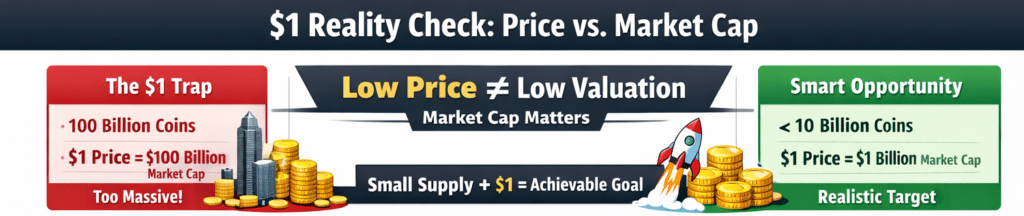
Market cap is the total dollar value of a cryptocurrency, calculated with a simple formula: Market Cap = Price x Circulating Supply.
The ultimate bottleneck for any asset isn’t interest or hype; it is the raw volume of tokens in existence. If a coin has a massive supply, hitting a $1 price target would require an impossibly massive valuation that exceeds the wealth of the entire global economy.
Look at Shiba Inu (SHIB) and Bonk (BONK) as prime examples of this mathematical reality. SHIB has a staggering circulating supply of roughly 589 trillion tokens. For SHIB to trade at $1, its market cap would need to reach $589 trillion; a sum that is nearly five times the GDP of the entire planet and multiples larger than the global stock market.
Similarly, BONK has a circulating supply of roughly 88 trillion tokens, meaning a $1 price tag would require an $88 trillion market cap. To put that in perspective, that is over 60 times the size of Bitcoin’s valuation. Without an unprecedented, near-total destruction of their token supplies via burning, these assets hitting $1 is a mathematical impossibility, proving that supply always dictates the ceiling of a token’s price.
How We Check if a Coin Can Reach $1
To understand if a coin can realistically hit $1, we look at how much money would need to flow into it. This helps us avoid hype and focus on what’s actually possible.
-
Step 1: Market Cap Check
We multiply the circulating supply by $1 to estimate the required market cap.Required Market Cap = Circulating Supply × $1
Then we compare this number with similar projects. If the required market cap is reasonable for that sector, it is more realistic. If it requires an extremely high valuation, it is more speculative. For example, if a meme coin needs a $150 billion market cap to reach $1, it is unlikely.
-
Step 2: Available Supply
Not all tokens are actively traded. Some are locked or staked.Effective Supply = Circulating Supply − Locked or Staked Tokens
If a large portion of tokens is locked, fewer coins are available in the market. This can make price movements easier.
-
Step 3: Demand Check
We also look at trading activity. If trading volume is increasing along with market cap, it suggests real demand. This indicates healthier growth rather than short-term hype.
This method helps identify coins with a realistic path to $1 instead of relying on speculation alone.
Top $1 Potential Crypto Coins Compared
This section compares leading cryptocurrencies with realistic $1 price potential, highlighting differences in use cases, risk profiles, and growth drivers.
Project
Category / Focus
Key Value Proposition
Audit Status
Risk Tier
Why
Bitcoin Hyper (HYPER)
Bitcoin Layer 2
Scales Bitcoin with fast L2 execution and SVM smart contracts
Maxi Doge (MAXI)
Meme Coin
Doge-themed meme token with high presale staking rewards
LiquidChain (LIQUID)
Layer 3/ Cross-chain
Unified liquidity layer for BTC, ETH, and SOL ecosystems
Pre-mainnet cross-chain liquidity layer; $1 requires proof that the Unified Liquidity Layer achieves real BTC/ETH/SOL adoption
SUBBD (SUBBD)
AI + Creator Economy
AI-powered content platform with fixed APY staking
Tapzi (TAPZI)
Web3 Gaming
Skill-based competitive games with staking and tournaments
Dogecoin (DOGE)
Meme Coin
Community-driven crypto with fast, low-cost transfers
Kaspa (KAS)
Layer 1 PoW
BlockDAG architecture for fast confirmations and scalability
FET
AI infrastructure
The alliance of AI blockchain projects.
Akash (AKT)
Cloud Computing
open marketplace where people can buy and sell computing power and GPUs.
Cryptos That Have Hit $1 Before, And Could Again
Some of the strongest $1 candidates aren’t first-timers, they’re tokens that already traded above $1 during the last bull run and have since pulled back below that level. For these, $1 isn’t a new milestone; it’s a reclaim. That distinction matters: the market has already demonstrated willingness to price them there, and the supply structure hasn’t changed enough to make it impossible.
Two tokens worth tracking in this category:
- Fetch.ai / Artificial Superintelligence Alliance (FET): FET traded above $3 in early 2024 during the AI narrative peak. It has since corrected to . With ~2.6 billion tokens in circulation, a $1 price implies a ~$2.6 billion market cap, a return to 2024 levels, not new territory. The AI agent narrative that drove the first run remains active in 2026. Risk: heavily correlated with broader AI sentiment in traditional tech markets.
- Akash Network (AKT): AKT hit above $6 in 2024. At current levels , it needs less than a 40% gain to reclaim $1. The circulating supply of ~288 million tokens implies a market cap of only ~$288 million at $1, one of the smallest targets among established tokens. Akash operates a decentralized GPU marketplace, and AI compute demand remains a structural tailwind.
- Render Network (RNDR): RNDR has traded as high as $13.60 (March 2024). At current levels well below $1, a $1 price implies only a ~$380 million market cap, one of the lowest bars among established AI/GPU tokens. Render operates a decentralized GPU rendering network with confirmed integrations across film, 3D, and AI workloads. Risk: supply unlocks and broader AI token correlation remain headwinds.
- XRP (Ripple): XRP is the clearest large-cap proof that the $1 milestone is achievable at scale, not just a low-supply phenomenon. XRP first crossed $1 in January 2018 and, after years trading below that level, reclaimed it again in the current cycle amid regulatory clarity following its SEC litigation and growing bank/payment partnerships. Unlike DOGE, XRP’s history shows a large-supply token can sustain $1+ once real utility demand, not just retail sentiment, shows up.
These are attractive picks for crypto traders because they are liquid, exchange-listed tokens with verifiable history. Add them to your watchlist alongside the presale projects above if you want a balanced sub-$1 portfolio.
Why the $1 Price Level Matters in Crypto
In the world of cryptocurrency, the $1 price point is far more than just a number; it is a psychological magnet driven by a cognitive shortcut known as Unit Bias. Most retail investors prefer to own ‘whole’ units of an asset rather than a fraction. Psychologically, owning 1,000 units of a coin priced at $0.10 feels like a more significant investment than owning 0.0011 of a Bitcoin, even if the dollar value is identical.
This bias creates a self-fulfilling prophecy. As a coin approaches $0.90, the anticipation of hitting the dollar milestone often triggers a surge in FOMO. Investors perceive sub-$1 coins as cheap or undervalued, regardless of their actual market capitalization. For projects like Dogecoin or Kaspa, this collective psychological push often provides the final burst of liquidity needed to break through the $1 resistance level and transition from a penny stock to a legitimate digital asset.
Key Signals That a Crypto Is Approaching the $1 Mark
Benefits and Risks of Chasing $1 Crypto Investments
Chasing cryptocurrencies with $1 potential can offer attractive upside, especially during strong market cycles. However, these opportunities also come with higher volatility and risk, making careful evaluation essential before investing.
Benefits
- High upside potential from relatively small price moves
- Strong market attention when a coin approaches the $1 level
- Early entry opportunities before wider retail adoption
Risks
- High volatility and sharp price swings
- Many sub-$1 coins fail to reach long-term adoption
Which Meme Coins Will NOT Reach $1 (and Why)
Shiba Inu (SHIB): With a circulating supply floating around 585 trillion tokens, a $1 price tag requires a $585 trillion market cap. That is nearly five times the GDP of the entire world.
Pepe (PEPE): This frog-themed ERC-20 token has a fixed circulating supply of 420.69 trillion tokens. Hitting $1 would value PEPE at $420.69 trillion, hundreds of times larger than the entire digital asset class combined.
Bonk (BONK): Operating on the Solana ecosystem, BONK has a supply of roughly 88 trillion tokens. A $1 target demands an $88 trillion market cap, which is more than 60 times the valuation of Bitcoin.
Floki (FLOKI): Despite aggressive burns that have permanently removed more than half of its original supply, FLOKI still has over 9.2 trillion tokens in circulation. It would require a $9.2 trillion market cap to reach $1, a figure roughly triple the size of Microsoft or Apple.
How to Buy Crypto Under $1
Buying established sub-$1 tokens like DOGE or KAS is straightforward — they’re available on most major exchanges, including Coinbase, Binance, Kraken, and eToro. The process is: create an account → verify identity (KYC) → deposit funds (card, bank transfer, or crypto) → search the token → buy.
For presale tokens (Bitcoin Hyper, LiquidChain, SUBBD, Tapzi, Maxi Doge), the process differs:
- Visit the official presale website via the links above
- Connect a compatible wallet (MetaMask, Trust Wallet)
- Purchase using ETH, BNB, USDT, or card
- Tokens are held in the contract until the TGE (Token Generation Event). Check each project’s timeline
Always verify you’re on the official contract address. Presale scams that mimic legitimate projects are common. Use only the links from this article or the official project website.
Conclusion: Next Crypto to Hit $1
The search for the next crypto to hit $1 is often fueled by the idea of big gains from a low starting price. Coins trading well below $1 attract attention because even small moves can lead to strong returns. Still, hitting $1 usually takes more than hype; it often requires real use cases, active communities, clear tokenomics, and steady demand.
While meme coins and early-stage projects can rise quickly during bull markets, lasting growth depends on ongoing development, healthy liquidity, and supportive market conditions. Focusing on fundamentals, staying patient, and managing risk can help investors make smarter decisions. The next crypto to reach $1 may come from today’s low-priced tokens, but informed choices matter more than speculation alone.
See Also:
- Crypto Market Cycles: Are We Still Following 4-Year Pattern?
- What is a Perp DEX? Perpetuals Explained
Cryptos to hit $1 FAQs
Which cryptos could hit $1 in 2026?


Some of the top cryptos that could hit $1 this year include Bitcoin Hyper, Maxi Doge, LiquidChain, and SUBBD. More established picks include Dogecoin and Kaspa.
Will XRP hit $1?
XRP already hit $1 mark soon after winning in court against SEC and went to reach new highs above $2 after Donald Trump won the 2024 elections. Current price of XRP is .
Will Dogecoin hit $1 in 2026?
Dogecoin hitting $1 in 2026 is possible but not guaranteed. It would likely require strong market momentum, renewed retail interest, and sustained demand, as DOGE’s large circulating supply makes major price moves harder without broad market support.
Can Pepe reach $1?
Pepe reaching $1 is extremely unlikely under current conditions, as it would require an unrealistically massive market capitalization due to its very large token supply. While PEPE can see strong percentage gains during meme coin rallies, $1 is not considered a realistic target without a major supply reduction or structural change.
What is the best cheap crypto to buy now?
There’s no single best cheap crypto to buy right now, but crypto presales can be worth considering. The right choice depends on your risk tolerance, established low-priced coins like Dogecoin tend to carry lower risk, while early-stage or presale tokens may offer higher upside but also come with much higher risk.
Can a meme coin reach $1?
Yes, a meme coin can reach $1, but it’s uncommon and depends on factors like token supply, market demand, strong community support, and overall market conditions. Most meme coins face supply and adoption limits that make $1 difficult to achieve.
Which Crypto Will Hit $1 Next?
Top candidates for hitting $1 in 2026 include Bitcoin Hyper (HYPER) due to its Bitcoin L2 utility, Kaspa (KAS) for its BlockDAG efficiency, and Dogecoin (DOGE) driven by institutional payment adoption and meme-cycle liquidity.
What market cap would Dogecoin need to hit $1?
Approximately $147 billion, roughly the size of Ethereum’s market cap today. It would make DOGE the second-largest cryptocurrency in the world. It’s not impossible, but it has only approached $0.73 once, during peak 2021 retail mania.
Which crypto has come closest to $1 from under $0.10?
Kaspa (KAS) went from roughly $0.0001 in 2022 to a peak of ~$0.20 in 2024, a 2,000x move, but its supply of ~26.6 billion tokens means $1 still requires a massive market cap. FET went from ~$0.05 to over $3 in the same period and actually crossed $1, making it one of the clearest real-world examples.
Are presale tokens a reliable way to reach $1 gains?
Presale tokens offer the lowest entry price but the highest failure rate. Studies suggest that roughly 70–80% of crypto presales fail to sustain their launch price beyond 90 days. The projects on this list have passed security audits, but audit status is not a predictor of price performance, only execution, adoption, and market conditions determine that.
References
- U.S. Commodity Futures Trading Commission. “Response to CFTC Request for Comment on Digital Asset Markets.” Commodity Futures Trading Commission, https://comments.cftc.gov/Handlers/PdfHandler.ashx?id=35619
- Cornell SC Johnson College of Business. “Perpetual Futures Contracts and Cryptocurrency.” Cornell SC Johnson College of Business, Feb. 2025, https://business.cornell.edu/article/2025/02/perpetual-futures-contracts-and-cryptocurrency/
- U.S. Commodity Futures Trading Commission. “Futures Market Basics.” CFTC.gov, https://www.cftc.gov/LearnAndProtect/AdvisoriesAndArticles/FuturesMarketBasics/index.htm.
- Cain, Cody M. “Bitcoin Halving: What to Know about the Cryptocurrency’s Scheduled Supply Cut.” Northeastern Global News, 18 Apr. 2024, https://news.northeastern.edu/2024/04/18/bitcoin-halving/

Why you can trust 99Bitcoins
Established in 2013, 99Bitcoin’s team members have been crypto experts since Bitcoin’s Early days.
Weekly Research
100k+Monthly readers
Expert contributors
2000+Crypto Projects Reviewed