






Bitcoin is the most liquid and widely held cryptocurrency in the world, but it is a transparent network. Every transaction is publicly visible on-chain, and wallet addresses can be traced back to real identities with the right tools. Zcash offers a meaningful alternative: built on zero-knowledge cryptography, it allows transactions to be fully shielded — hiding the sender, recipient, and amount entirely. For many users, converting BTC to ZEC is less a portfolio move than a deliberate step toward financial privacy.
The platform you use to make that conversion matters. Centralized exchanges with KYC requirements and account histories defeat the purpose of moving to a privacy-focused asset — if you upload your passport before swapping, your transaction is already on record. The right approach is a non-custodial, no-KYC swap service that executes the trade wallet-to-wallet without collecting personal data. This guide covers the best options for 2026, walks through the process step by step, and gives you everything you need to swap confidently.
How to Exchange Bitcoin to Zcash in 6 Easy Steps
The step-by-step process below uses GhostSwap as the example. GhostSwap requires no account, no email, and no identity verification at any stage — you can complete the entire process in under five minutes before Bitcoin’s network confirmation adds its own delay.
Step 1: Set up a Zcash wallet
Before you initiate any swap, you need a privacy coins wallet that can receive ZEC. For shielded transactions — the privacy-preserving type — the Zcash ecosystem recommends Zashi (mobile, shielded by default) or Ywallet (mobile and desktop). If you are using a transparent address, any ZEC-compatible wallet works, including Ledger hardware wallets. Download your chosen wallet from the official source, generate a new wallet, and copy your receiving address. If your wallet gives you both a transparent address (starting with “t”) and a shielded address (starting with “zs”), use the shielded one.
Step 2: Open GhostSwap and select your trading pair
Navigate to ghostswap.io in any browser — no installation, account, or signup required. In the swap interface, set the “You Send” field to BTC and the “You Get” field to ZEC. Enter the amount of Bitcoin you want to convert. GhostSwap immediately calculates and displays how much Zcash you will receive, with the service fee and network costs already factored into the quoted rate. There are no hidden charges added after confirmation.
Step 3: Review the exchange rate
Check the quoted rate carefully before proceeding. GhostSwap embeds its margin of approximately 0.30% directly into the displayed rate, so what you see is what you get — provided you send your deposit within the quote window. The interface also shows the estimated completion time, which for BTC-to-ZEC swaps typically runs between 10 and 30 minutes due to Bitcoin’s block confirmation times.
Step 4: Enter your Zcash receiving address
Paste your ZEC wallet address into the recipient field. This is the only piece of personal information the platform requests — and it is not personal information in any meaningful sense; it is simply where your Zcash will be sent. GhostSwap validates the address format before letting you proceed, which helps catch typos. Double-check the address manually regardless, because cryptocurrency transactions are irreversible.
Step 5: Send your Bitcoin to the deposit address
GhostSwap generates a unique, one-time Bitcoin deposit address for your swap. Open your personal Bitcoin wallet, paste this deposit address, and send the exact amount of BTC displayed. Do not send a different amount — sending less than quoted may result in the swap failing or a lower ZEC output; sending more may require manual support. Once you broadcast the transaction from your wallet, GhostSwap monitors the Bitcoin blockchain for your deposit.
Step 6: Wait for confirmation and receive your ZEC
After your Bitcoin transaction receives at least one network confirmation (typically 10 minutes), GhostSwap processes the swap and routes the ZEC to your receiving address. You can monitor progress in real time on the status page GhostSwap provides after you send. Most BTC-to-ZEC swaps complete within 15 to 30 minutes from the point of deposit. When the transaction completes, your Zcash arrives directly in your wallet — no login, no notification email, and no further action required.
Best BTC to ZEC Exchanges
1. GhostSwap
GhostSwap is the standout option for anyone looking to exchange Bitcoin to Zcash on a no KYC crypto exchange without creating an account or providing personal information. Operating as a non-custodial swap aggregator, the platform routes trades through multiple liquidity providers to deliver competitive rates across more than 1,600 cryptocurrencies. Funds never sit in a GhostSwap wallet — assets move directly from the user’s sending address to the destination wallet through automated smart contracts and atomic swap execution.
The platform’s privacy architecture is genuinely thorough. GhostSwap collects no personal data because it requests none: no email address, no phone number, no ID documents. Each transaction operates independently, with no connection to previous swaps, so the platform cannot build usage profiles or track patterns. For users who want an additional layer of operational security, GhostSwap is fully accessible via VPN and Tor without any connection flagging or blocking.
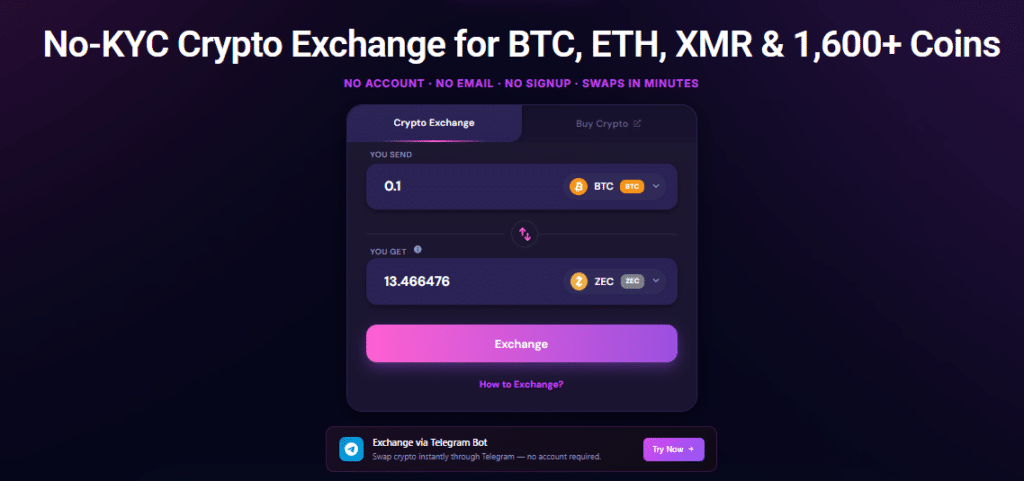
For BTC-to-ZEC specifically, GhostSwap is one of the few non-custodial platforms that has maintained reliable ZEC support as regulated exchanges continue to delist privacy coins under compliance pressure. The swap page at ghostswap.io/exchange/btc-zec provides a live rate calculator, a BTC-to-ZEC conversion table, and wallet recommendations for receiving shielded Zcash. The platform recommends Ywallet, Zashi, or Nighthawk for shielded ZEC delivery — sensible guidance for users who want the full privacy benefit of the swap.
The main limitations worth noting: GhostSwap is crypto-in, crypto-out only. There are no fiat on-ramps, so you need to already hold Bitcoin in a self-custody wallet before using the service. Additionally, as with any swap service, sending to an incorrect address results in permanent loss — the platform cannot reverse a completed transaction.
Read our GhostSwap review for a more in-depth look at this platform.
| Service Fee | ~0.30% (included in quoted rate) |
| Network Fees | Bitcoin fees vary ($1–$5 typical); ZEC fees under $0.01 |
| KYC Required | No |
| Supported ZEC Pairs | BTC/ZEC, ETH/ZEC, SOL/ZEC, USDT/ZEC, XMR/ZEC, and 1,600+ total pairs |
| Swap Time | 15–30 minutes (BTC confirmation dependent) |
| Fiat Support | No |
Pros
-
Zero KYC, no account, no registration of any kind
-
Non-custodial: funds never held on platform
-
Fully compatible with VPN and Tor
-
No withdrawal limits or swap volume caps
-
Service fee embedded in rate — no hidden charges
Cons
-
No fiat on-ramp; requires existing crypto holdings
-
Transactions are irreversible — address errors cannot be corrected
2. HiddenSwap
HiddenSwap is a no-KYC crypto-to-crypto swap service for users who want to exchange Bitcoin for Zcash without opening an account beforehand. A swap will need the user to choose the two coins and networks to swap between, enter the amount to swap, and the address that should receive the ZEC. No email, phone number, or identity document is requested.
Each order gets its own order ID and a one-time deposit address. After the Bitcoin deposit confirms, the swap is executed, and ZEC is sent to the wallet address entered at the start. HiddenSwap is not a wallet and does not hold user balances.
Zcash and Bitcoin are two of 1,100+ coins and networks supported by HiddenSwap, alongside other popular options like Ethereum, Tether (on Tron and Ethereum), Solana, Litecoin, Monero, and more. BTC-to-ZEC is a supported route, and swaps can also move in the opposite direction.
Users can choose between a floating rate (set when the deposit is confirmed) and a fixed rate (when available for the pair). A fixed rate holds only if the exact amount is received within a single transaction before the timer on the order page expires. If the market moves 3% or more before that point, the sender may be asked to accept a new rate or a refund.
The figure shown before the deposit already includes the HiddenSwap fee, the exchange spread, and the payout fee, which covers the cost of sending the ZEC (or BTC). There is no separate service charge after the swap starts. The sender’s wallet still pays the Bitcoin network fee to move the deposit, and that cost is not included in the quote.
On the privacy side, swap records on HiddenSwap store no names or IP addresses and are deleted after 90 days. The site works in Tor Browser and functions even with JavaScript turned off. The form asks for the sending address on most coins, but that field can stay empty for Zcash sent from a shielded balance. A Bitcoin payment remains visible on the Bitcoin chain.
The HiddenSwap service is crypto-in, crypto-out only, so users need to have their BTC in a self-custody wallet before starting. A deposit sent on the wrong coin or network, or without a required memo, is not processed automatically. Where recovery is possible, a fee of $50 plus network fees may apply. A completed payout to an incorrect address cannot be reversed.
| Service Fee | Included in the quoted rate |
| Network Fees | BTC deposit fee paid by the sending wallet; ZEC payout fee included in the quote |
| KYC Required | No |
| Supported ZEC Pairs | BTC/ZEC, USDT/ZEC, and other ZEC routes (within a list of 1,100+ coins and networks in total) |
| Swap Time | Network-dependent |
| Fiat Support | No |
Pros
-
No account, email, or KYC
-
No balances (which helps to ensure privacy and anonymity), payout goes to the address the user supplies
-
Floating and fixed rates, with the all-in quote shown before the deposit
-
Swap records will not contain your name or IP address. Records are also deleted after 90 days
-
Usable in Tor Browser and with JavaScript switched off
Cons
-
Wrong-network or missing-memo deposits are not automatic and may cost $50 plus network fees to recover
-
Fixed rates are not offered on every pair and can be reset if the market moves 3% or more before the deposit arrives
-
Crypto-to-crypto only; no fiat on-ramp
3. SwapRocket
Deleted: SwapRocket launched in mid-2025 and quickly built a following among privacy-conscious traders, reaching over 150,000 users in its first year of operation. Where GhostSwap routes through its own liquidity network, SwapRocket operates as a rate-aggregation engine — querying more than 20 liquidity providers in real time, including named sources such as Binance, Kraken, KuCoin, OKX, and Bitfinex, and executing each swap through whichever route delivers the best available rate at that moment
This aggregation approach gives SwapRocket a meaningful advantage on pricing, particularly for less liquid pairs where single-source platforms can struggle with slippage. The platform supports over 2,000 cryptocurrencies across all major blockchains, including full and unrestricted support for privacy coins — Monero (XMR), Zcash (ZEC), and Dash (DASH) — at a time when major regulated exchanges have removed these assets entirely. BTC-to-ZEC and ZEC-to-BTC are among the platform’s most-used routes as a result.
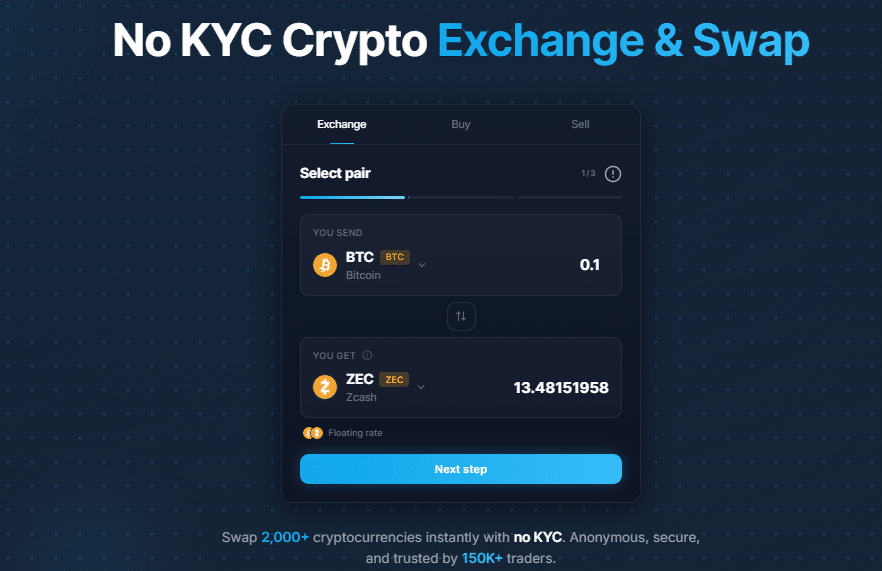
Deleted: SwapRocket’s fee structure follows the same all-in pricing model as GhostSwap: the rate displayed at the point of confirmation already includes the platform’s service margin and network costs, typically falling in the 0.5%–2% range depending on the pair and current liquidity conditions. No additional charges appear after the swap completes. The platform offers both fixed-rate and floating-rate options, which is a useful feature for BTC-to-ZEC swaps — choosing a fixed rate protects against price movement during Bitcoin’s confirmation window.
SwapRocket is newer than GhostSwap, meaning it carries a shorter track record. It also currently lacks a dedicated mobile application, though the web interface functions competently on mobile browsers.
| Service Fee | 0.5%–2% (included in quoted rate, varies by pair) |
| Network Fees | Included in quoted rate |
| KYC Required | No |
| Supported ZEC Pairs | BTC/ZEC, ETH/ZEC, SOL/ZEC, USDT/ZEC, XMR/ZEC, and 2,000+ total pairs |
| Swap Time | 5–30 minutes |
| Fiat Support | No |
Pros
-
Aggregates 20+ liquidity providers for competitive rates
-
Fixed-rate and floating-rate options available
-
2,000+ supported assets, including full privacy coin support
-
No KYC, no registration, no data retention
-
24/7 live customer support
Cons
-
Shorter operational history than established competitors
-
No dedicated iOS or Android app
4. StealthEX
StealthEX has operated since 2018, making it one of the longer-running non-custodial swap platforms in this space. It supports over 1,500 cryptocurrencies, including BTC, ZEC, XMR, ETH, SOL, LTC, USDT, and a substantial selection of smaller altcoins and DeFi tokens. For BTC-to-ZEC specifically, StealthEX offers both fixed-rate and floating-rate swap options, with the fixed-rate mode particularly useful for Zcash pairs given ZEC’s lower liquidity relative to Bitcoin.
The platform’s fee model embeds all costs — network fees, liquidity provider margins, and the platform’s own margin — into the quoted rate. Third-party analysis puts the effective fee at approximately 0.40% for popular pairs like BTC/ETH, though ZEC pairs may carry slightly higher spreads depending on liquidity routing at the time of the swap. The non-custodial architecture means StealthEX never holds user funds; the service operates as a bridge, routing the exchange and delivering ZEC directly to the address provided.
The key limitation to note with StealthEX: the no-KYC policy applies conditionally. Crypto-to-crypto swaps are KYC-free for most standard amounts, but transactions can be flagged by automated systems for larger values or certain pairs, at which point verification may be requested. This is a meaningful distinction from GhostSwap and HiddenSwap, where the structural no-KYC architecture means there is no account layer into which verification could ever be inserted. For users swapping modest amounts of BTC for ZEC, StealthEX works smoothly and anonymously. For larger swaps, GhostSwap offers more certainty.
| Service Fee | ~0.40% effective (included in quoted rate) |
| Network Fees | Included in quoted rate |
| KYC Required | No (conditional — may trigger for larger amounts) |
| Supported ZEC Pairs | BTC/ZEC, ETH/ZEC, ZEC/XMR, ZEC/USDT, and 1,500+ total pairs |
| Swap Time | 5–20 minutes |
| Fiat Support | Yes (fiat purchases via payment partners require KYC through processor) |
Pros
-
Established since 2018 — longer track record than most competitors
-
Fixed and floating rate options available
-
1,500+ supported cryptocurrencies
-
Fiat on-ramp available for users who need it
-
Android app available; iOS in development
Cons
-
KYC may be triggered for larger transactions — not unconditionally no-KYC
-
Average swap times can be slower than GhostSwap for some pairs
How We Picked the Top Bitcoin to Zcash Exchanges
Finding a reliable platform to exchange BTC to ZEC requires looking beyond headline claims. Most no-KYC swap services market themselves similarly — the differences only become apparent when you examine the specifics. Here is what we looked for when ranking the best platforms to buy Zcash.
Security and Regulation
We prioritised non-custodial platforms where user funds are never held in a central pool. Custodial wallets are the most common attack vector in crypto platform failures — they represent pooled assets that hackers target. All three platforms reviewed here operate on a wallet-to-wallet model, executing swaps through smart contracts and routing engines rather than exchange wallets. We also looked at compatibility with VPNs and Tor, which signals a genuine commitment to user security rather than a marketing claim.
No KYC
For a BTC-to-ZEC swap to deliver privacy value, the exchange itself must not create an identity record. We evaluated whether each platform’s no-KYC policy is structural (no account layer exists at any transaction size) or conditional (KYC can be triggered above certain thresholds or by automated risk systems). GhostSwap and HiddenSwap fall into the first category. StealthEX is largely no-KYC for standard amounts but can trigger verification for larger swaps, which we note transparently in the review.
Fees
For ZEC swaps specifically, fees matter more than for mainstream pairs because Zcash liquidity is thinner than Bitcoin or Ethereum. A platform that embeds hidden markups into the rate on low-liquidity pairs can cost meaningfully more than one with transparent all-in pricing. We looked for platforms that show the exact receive amount before confirmation, with no post-execution adjustments. GhostSwap’s ~0.30% spread is competitive here.
Swap Options
The breadth of ZEC trading pairs a platform supports determines how flexible you can be with your entry point. Rather than only reviewing BTC-to-ZEC, we considered how many other assets can be swapped to and from Zcash — useful for users who hold ETH, SOL, stablecoins, or Monero and want to convert to ZEC without routing through Bitcoin first. GhostSwap covers 1,600+ pairs; HiddenSwap covers 1,100+; StealthEX covers 1,500+. All three support the key pairs: BTC/ZEC, ETH/ZEC, USDT/ZEC, and XMR/ZEC.
Liquidity
Zcash is a smaller-cap asset compared to Bitcoin, so liquidity routing matters. A platform that pulls rates from multiple providers — or maintains relationships with high-volume liquidity sources — can offer better ZEC rates and less slippage than one relying on a single source. GhostSwap routes through multiple liquidity channels. Thin liquidity on any platform can mean wider spreads during periods of ZEC price volatility, which is why fixed-rate options are worth considering.
User Experience
All three platforms reviewed here essentially follow the same four-step model: select pair, enter amount, provide destination address, send deposit. GhostSwap’s interface is the most stripped-down (a single swap box with a clear rate display and no clutter), and HiddenSwap presents one quote that includes the HiddenSwap fee, the exchange spread, and the payout fee. None of the platforms we’ve covered in this article require account creation, which cuts out the biggest friction point of centralized exchanges entirely.
Top Tips for Swapping BTC to ZEC
Use a shielded Zcash address as your destination. Zcash supports both transparent addresses (publicly visible on-chain, similar to Bitcoin) and shielded addresses (encrypted using zk-SNARKs). If privacy is your reason for making the swap, using a transparent ZEC address defeats the purpose. Specify a shielded “zs” address from a wallet like Zashi or Ywallet to receive ZEC with full transaction confidentiality.
Run a small test swap before moving large amounts. Zcash network fees are typically under $0.01, making a small test transaction essentially free. Before swapping a significant amount of BTC, send a minimal test to confirm the platform is routing correctly to your address and that your wallet is receiving ZEC as expected. The cost of a test is negligible; the cost of a failed large swap is not.
Choose a fixed-rate swap during volatile periods. Bitcoin’s 10-minute average block time means there is always a window between when you initiate a swap and when your deposit confirms. If ZEC or BTC prices move sharply during that window, a floating-rate swap can deliver less ZEC than quoted. Fixed-rate options (available on HiddenSwap and StealthEX) lock the rate for a defined confirmation window, giving you a predictable outcome.
Withdraw BTC from a personal wallet, not directly from an exchange. If your Bitcoin is sitting on a centralized exchange, withdrawing it directly to a swap service creates a traceable link between your exchange account and your swap. For better privacy, withdraw from the centralized exchange to a self-custody wallet first, then initiate the BTC-to-ZEC swap from there. This adds one step but meaningfully separates the on-chain trail.
Understand the tax implications in your jurisdiction. Swapping Bitcoin for Zcash is treated as a taxable disposal of Bitcoin in most jurisdictions — you are selling BTC at the current market value and acquiring ZEC. Keep a record of the swap amount, the rate at time of execution, and any fees paid. The swap platforms reviewed here do not generate tax reports, so the record-keeping is your responsibility. Consult a tax professional familiar with cryptocurrency if you are unsure about your local rules.
Conclusion
For anyone who wants to move value out of Bitcoin’s transparent blockchain and into Zcash’s shielded ecosystem, the good news in 2026 is that the process is straightforward, fast, and available without identity verification. The three platforms reviewed in this guide each take a no-KYC, non-custodial approach that keeps personal data out of the equation from start to finish.
GhostSwap is our top recommendation for the majority of users looking to exchange BTC to ZEC. The platform has processed over $750 million in swap volume, supports 1,600+ trading pairs with ZEC among its most popular, and maintains a structural no-KYC policy with no volume thresholds. The fee spread of approximately 0.30% is competitive, the interface takes minutes to navigate, and the Tor and VPN compatibility adds a practical layer of operational security. Whether you are swapping a small amount of BTC for ZEC or executing a more substantial conversion, GhostSwap handles the trade wallet-to-wallet with no account required.
Visit GhostSwapFAQs
Can I exchange Bitcoin to Zcash without KYC?

Yes. GhostSwap, HiddenSwap, and StealthEX all allow BTC-to-ZEC swaps without identity verification. GhostSwap applies no-KYC policies at all transaction sizes, while StealthEX is KYC-free for standard swap amounts.
How long does a BTC-to-ZEC swap take?
The total time is mainly determined by Bitcoin’s network confirmation speed. Most swaps complete within 15 to 30 minutes from the point of sending your BTC deposit, with the Bitcoin confirmation itself accounting for the majority of that wait.
What wallet should I use to receive Zcash?
For shielded Zcash transactions, Zashi and Ywallet are the two most widely recommended options. Both default to shielded addresses, which give you the full privacy benefit of Zcash’s zk-SNARK cryptography. Avoid receiving ZEC to an exchange wallet, as most exchanges only support transparent addresses.
What is the difference between a transparent and a shielded Zcash address?
A transparent Zcash address (starting with “t”) works like a Bitcoin address — transactions are publicly visible on the blockchain. A shielded address (starting with “zs”) uses zero-knowledge proofs to hide the sender, recipient, and transaction amount. If privacy is your goal, always use a shielded address as your ZEC destination.
Are there any limits on how much BTC I can swap to ZEC?
GhostSwap does not impose any deposit or withdrawal limits on most pairs. StealthEX similarly has no stated maximum for crypto-to-crypto swaps. Minimum amounts apply on all platforms and depend on current network fees — the swap interface will display the minimum before you confirm.
Is it safe to use a no-KYC swap service?
The platforms reviewed here are non-custodial, meaning they never hold your funds during the swap process. The main risks are user error (sending to the wrong address is irreversible) and market volatility during the confirmation window (mitigated by choosing a fixed-rate swap). Running a small test transaction before large swaps is a sensible precaution on any platform.

Why you can trust 99Bitcoins
Established in 2013, 99Bitcoin’s team members have been crypto experts since Bitcoin’s Early days.
Weekly Research
100k+Monthly readers
Expert contributors
2000+Crypto Projects Reviewed