




In This Article
Ethereum is the second-largest smart contract blockchain and a leading platform for decentralized applications (dApps) and decentralized finance (DeFi). Since its inception, Ethereum has become a cornerstone of blockchain innovation, renowned for its rock-solid ecosystem, security, and widespread adoption across various sectors like NFTs and DeFi. If you’re investing for the long term, keeping an eye on the latest Ethereum price prediction reports can help you make informed decisions.
With ETH recently trading around the low $3,000 mark after briefly hitting a new all-time high of about $4,950 in August 2025, both investors and analysts are asking: how much further can ETH rise from here? Examining Ethereum’s on-chain data and important factors makes it hard to forecast its future price trend. As the second-largest cryptocurrency by market cap, it continues to play a vital role in decentralized finance, smart contracts, and decentralized applications.
Rising Crypto- Editor’s Choice

- New Bitcoin L2 presale offering massive staking rewards
- By using a SVM Bitcoin Hyper is revolutionizing Bitcoin's potential
- Early buyers can use $HYPER tokens for transactions, staking, and ecosystem governance
 Bank Card
 BNB
BNB ETH
ETH- +1 more

Key Takeaways
- Ethereum’s price potential depends on a mix of fundamental, technical, and on-chain factors.
- Ethereum’s on-chain analysis shows rising network activity, staking participation, and institutional interest.
- Short-medium and long-term ETH price predictions vary based on adoption, macroeconomic factors, and market sentiment.
- Institutional buying and growth in decentralized finance could drive Ethereum toward new all-time highs.
- Regulatory developments, competition from other blockchains, and selling pressure could limit Ethereum’s upside.
- Investors should combine technical analysis with their own research before making investment decisions.
Ethereum Price Prediction: ETH Overview
| Coin Name | Ethereum (ETH) |
|---|---|
| Ethereum Price | $2,696.41 |
| Ethereum Price Change 24h | ▲ 0.08385% |
| Ethereum Price Change 7d | ▲ 0.5% |
| Ethereum Market Cap | $329,260,123,020 |
| Circulating Supply | 120,232,214 |
How High Ethereum Will Go: Summary
Ethereum’s future price potential depends on adoption speed, market conditions, and network growth. While no forecast is absolute, we can outline three broad scenarios:
- Short-Term (Next 6–12 Months): If market sentiment remains positive and ETH holds key support levels, Ethereum’s price could reach a range of $4,800-$6,000. However, a shift in macroeconomic factors or regulatory uncertainty could keep ETH between $3,200-$4,200.
- Medium-Term (1–3 Years): With sustained institutional adoption, increased decentralized finance usage, and scaling solutions boosting capacity, ETH could trade between $7,500-$10,000. Slower adoption or selling pressure could cap it at $5,500-$6,800.
- Long-Term (3–7 Years): If Ethereum strengthens its position as the backbone for smart contracts, NFTs, and decentralized applications, and institutional demand accelerates, ETH could reach $15,000-$20,000. A prolonged bear cycle or strong competition from other blockchains could keep it closer to $8,000-$12,500.
| Year | Potential Low | Average Price | Potential High |
| 2026 | $2,000 | $3,000 | $5,500 |
| 2030 | $8,000 | $10,000 | $20,000 |
Ethereum’s Price Prediction
In 2024,
 Ethereum
0.08%
Ethereum
ETH
Price
$2,696.41
0.08% /24h
Volume in 24h
$8.43B
Price 7d
Buy Now!
was flat, peaking at nearly $4,100, and moving inside a tight range. Over the past 12 months, Ethereum has returned
.
Ethereum
0.08%
Ethereum
ETH
Price
$2,696.41
0.08% /24h
Volume in 24h
$8.43B
Price 7d
Buy Now!
was flat, peaking at nearly $4,100, and moving inside a tight range. Over the past 12 months, Ethereum has returned
.
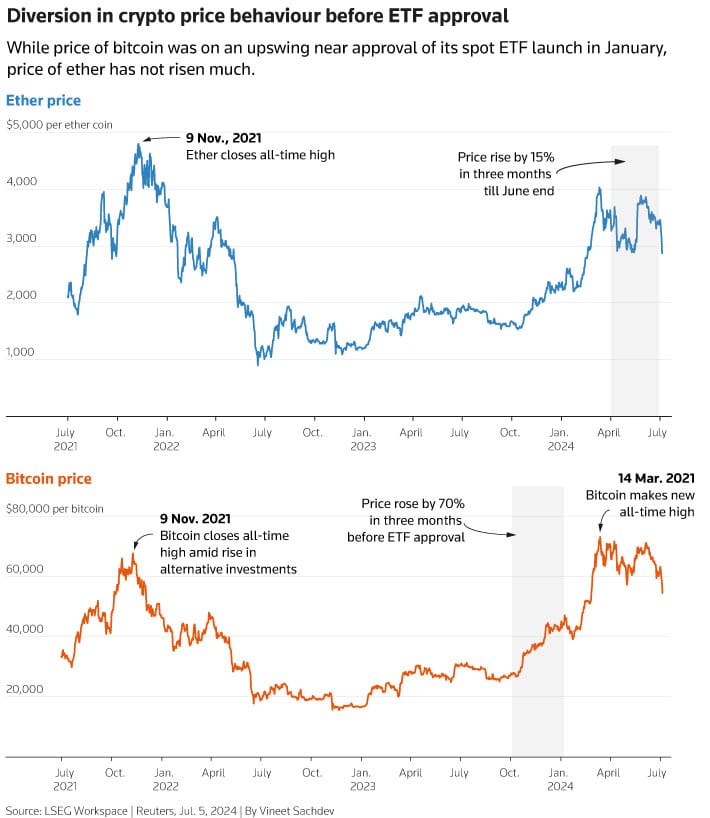
Throughout 2024, ETH primarily oscillated between $2,000 and $4,000 as markets absorbed two major developments: the March 2024 Dencun upgrade and the July launch of U.S. spot Ethereum ETFs. While ETF inflows were smaller than those seen in Bitcoin products, they still provided structural support and helped lift ETH back above $3,500 heading into early 2025.
Ethereum 2025 Price Performance Review
Ethereum’s 2025 price action ultimately reflected a consolidation year rather than a sustained breakout. ETH entered the year with strong momentum following spot ETF approvals and improving market conditions, briefly trading above the $4,000 level in the first half of the year.
As 2025 progressed, that momentum faded. Profit-taking, softer activity across parts of DeFi, and broader risk-off conditions across crypto pushed ETH lower, with prices settling into a wide consolidation range well below the yearly highs. Rather than establishing a new uptrend, Ethereum spent much of the year stabilizing after the early rally.
Despite the pullback, Ethereum retained its position as the leading smart contract platform by developer activity, Layer-2 usage, and on-chain settlement. In hindsight, 2025 served as a reset year for ETH, with price performance increasingly tied to macro conditions and real on-chain demand heading into 2026.
Ethereum Price Forecast Long-Term Outlook – 2026-2030 Predictions
Looking beyond 2025, Ethereum’s long-term price outlook depends less on short-term narratives and more on structural factors. These include ETH supply dynamics post-staking and burns, continued Layer-2 adoption, and Ethereum’s role as the settlement layer for DeFi, tokenization, and on-chain finance.
From a technical standpoint, a sustained break above the multi-year resistance zone near $4,500 would be required to unlock a higher-price regime. If broader market conditions remain supportive and Ethereum maintains its dominance in smart contracts and on-chain activity, ETH could trend higher between 2026 and 2030.
Under constructive conditions, Ethereum could reasonably trade in a broad range between $8,000 and $20,000 by 2030, with an average long-term valuation closer to $10,000. That scenario assumes continued ecosystem relevance and steady adoption rather than speculative excess.
While no long-term forecast is guaranteed, Ethereum’s trajectory remains anchored in measurable progress: network usage, staking participation, and its growing integration with both decentralized and traditional financial systems.
Our Ethereum Price Prediction Methodology
Factors That Could Influence Ethereum’s Price in 2026
Ethereum’s price movement in 2026 will be shaped by a mix of macroeconomic factors, blockchain-specific developments, and shifts in investor behavior. While ETH remains the second-largest cryptocurrency by market cap, it operates in a highly volatile market where both opportunity and risk move fast. Understanding the drivers behind Ethereum’s price is essential for making informed investment decisions.
From fundamental analysis of the Ethereum network’s growth to technical analysis of long-term trends, and from Ethereum’s on-chain analysis to global regulatory developments, several elements will play a significant role in determining how high Ethereum can go in this cycle or if its rally faces headwinds.
ETH’s Fundamental Factors
Ethereum’s price potential is closely linked to a blend of macroeconomic conditions, institutional behavior, and its role within the cryptocurrency market. Global economic shifts, including interest rate changes, inflation cycles, and broader liquidity trends, influence risk appetite for digital assets. In a looser monetary environment, institutional adoption often rises as funds and corporations increase their allocation toward ETH. In Q3 2025, the United States approved the GENIUS Act, making it law. It could spur onchain activity as more firms will likely deploy USD stablecoins in Ethereum.
Treasury demand is also emerging, with some firms, including SharpLink, buying and holding ETH as a long-term store of value and exposure to blockchain technology. Ethereum’s blockchain serves as the backbone for smart contracts, decentralized applications, and decentralized finance, enabling everything from lending protocols to NFT marketplaces.
Its economic model, combining proof of stake with EIP-1559’s fee-burning mechanism, creates a dynamic where high network activity reduces supply. Ethereum’s competitive edge over other L1 chains lies in its developer community, network security, and robust scaling solutions, which keep it positioned as the second-largest cryptocurrency by market cap despite increasing competition.
Technical Analysis of Ethereum
On the weekly ETH/USD chart, Ethereum is now trading in the low-$3,000s after a sharp reversal from its August 2025 all-time high just under $4,950. At the recent lows near $2,900, ETH had retraced roughly 40–45% from that peak before stabilizing.
The prior resistance band around $3,700–$3,800 has flipped into a major overhead zone, with several failed attempts to reclaim it in November and early December. Below spot, the $2,700–$2,900 region now acts as key support, aligning with the post-ETF consolidation area from late 2024 and early 2025. If that zone fails on a weekly close, the next structural support sits closer to $2,000–$2,200, where the last cycle’s higher-low base was carved out.
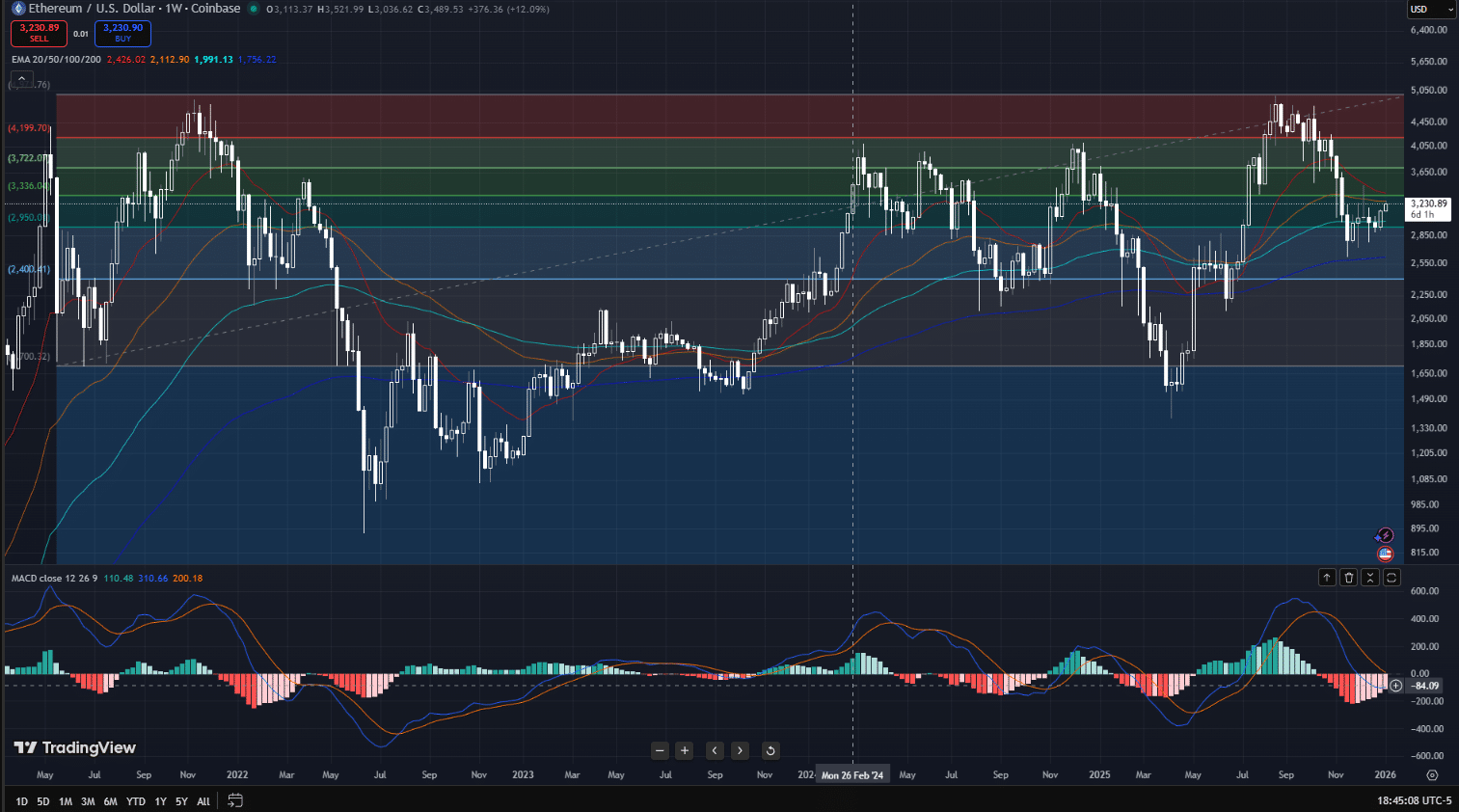
Momentum indicators remain neutral but fragile. The weekly RSI has cooled from overbought conditions without entering oversold territory, while the MACD has rolled over but has not yet signaled capitulation. From a technical perspective, Ethereum remains in a broad consolidation phase, with the next directional move likely determined by whether price reclaims the $3,800–$4,000 resistance or loses the $2,700 support on a weekly close.
Ethereum’s On-Chain Factors
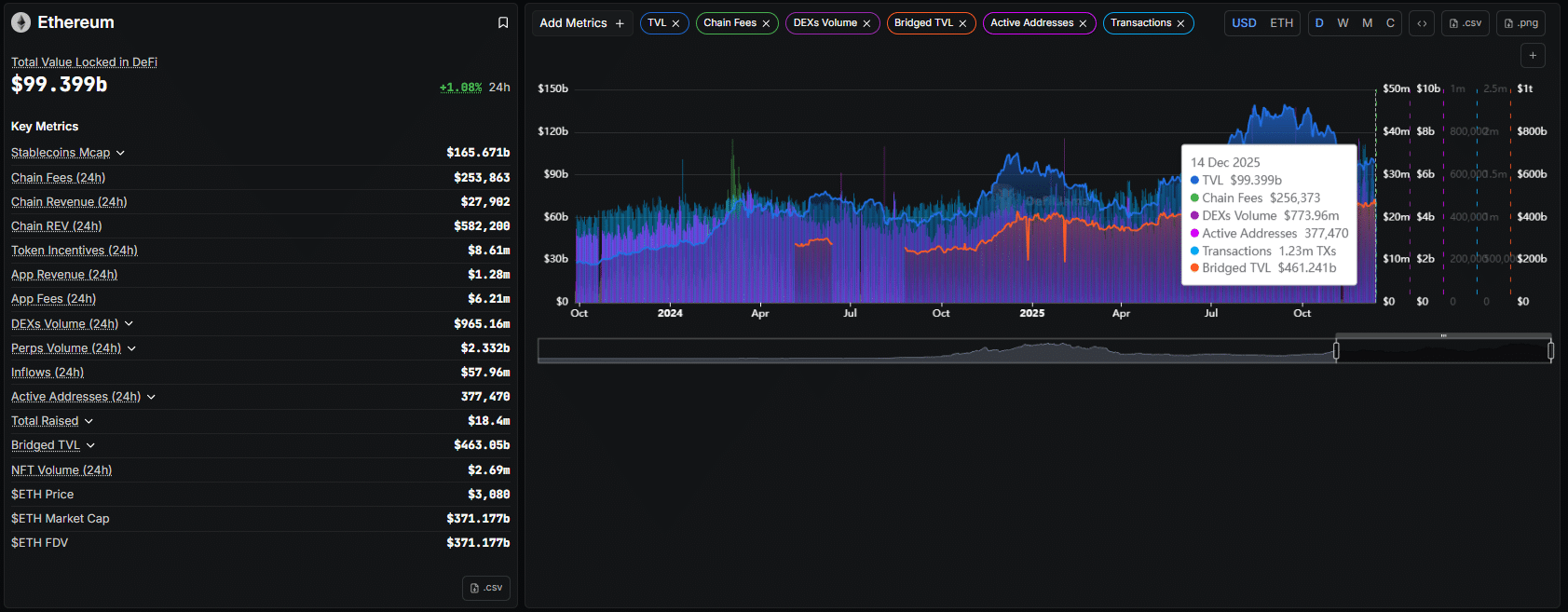
To assess Ethereum’s on-chain health heading into 2026, we analyzed core network metrics including Total Value Locked (TVL), chain fees, DEX volume, active addresses, transaction count, and bridged TVL. Together, these indicators provide a clear picture of Ethereum’s real economic activity beyond price action.
Total Value Locked (TVL)
At the time of writing, Ethereum’s TVL stands at approximately $99.4 billion, reinforcing its position as the largest DeFi ecosystem in crypto. While TVL fluctuated throughout 2024 and 2025, it remained consistently elevated compared to previous cycles.
This resilience suggests that capital continues to treat Ethereum as the base settlement layer for decentralized finance, even as activity increasingly shifts to Layer-2 networks.
Key takeaway: Ethereum’s TVL stability reflects long-term confidence, not short-term speculation.
Chain Fees & Revenue
Ethereum generated roughly $256,000 in daily chain fees and $27,900 in daily chain revenue at the time of the snapshot. While these figures are lower than peak bull-market levels, they show that Ethereum continues to capture meaningful economic value from on-chain usage.
Lower base-layer fees are not necessarily bearish; instead, they indicate successful scaling via rollups, which offload transaction volume while preserving Ethereum’s role as the final settlement layer.
Key takeaway: Ethereum is monetizing security and settlement rather than raw transaction throughput.
DEX Volume & Transactions
Daily DEX volume reached roughly $774 million, highlighting continued demand for decentralized trading on Ethereum. At the same time, the network processed approximately 1.23 million transactions per day, showing consistent baseline usage.
While Ethereum no longer dominates transaction count metrics, it still anchors high-value activity, particularly for large trades, institutional DeFi, and complex smart contract interactions.
Key takeaway: Ethereum prioritizes value density over raw transaction volume.
Active Addresses
Ethereum recorded about 377,000 active addresses per day, a figure that remained relatively stable across late 2025. This consistency suggests a mature user base with sustained engagement, rather than hype-driven spikes.
Active address stability is particularly notable given the rise of alternative Layer-1s and the growing use of Layer-2 solutions.
Key takeaway: Ethereum’s core user base remains sticky despite ecosystem fragmentation.
Bridged TVL (Layer-2 & Cross-Chain Capital)
One of the most important data points is Ethereum’s bridged TVL, which exceeds $460 billion. This metric captures capital secured by Ethereum but deployed across rollups and connected chains.
The scale of bridged TVL underscores Ethereum’s evolving role: less about executing every transaction, and more about acting as the economic backbone for a multi-layer blockchain ecosystem.
Key takeaway: Ethereum’s influence extends far beyond its base layer.
Overall On-Chain Assessment
Based on the provided data:
- Ethereum remains the dominant settlement layer in crypto
- Economic activity is steady, not euphoric
- Layer-2 adoption is working as intended
- Capital continues to trust Ethereum for security and finality
Bottom line: Ethereum enters 2026 with strong structural fundamentals. Growth is no longer measured by explosive on-chain metrics, but by sustained capital lock-in, ecosystem gravity, and its central role in the broader modular blockchain stack.
Ethereum Price History
Vitalik Buterin first introduced Ethereum in a 2013 whitepaper. The project secured $18.3 million in funding through a public crowd sale in 2014, with the initial coin offering (ICO) price of Ether (ETH) set at $0.311. The Ethereum blockchain officially launched on July 30, 2015, under the prototype name “Frontier.”
Since then, Ethereum has seen multiple upgrades and has grown to become a leading platform for decentralized applications. Its ICO price has since seen an extraordinary return on investment, with an annualized ROI of over 270%. Ethereum’s price journey has seen significant volatility. Starting in 2020, it rose from $615 in December to $1,314 in January 2021, and by the end of that year, it surged to nearly $5,000.
After peaking in 2021, Ethereum entered a downward trend, reaching $1,067 in June 2022. Recovery followed, with prices climbing back to $2,603 by September 2024. Major swings were driven by factors such as market sentiment, adoption, and macroeconomic influences. Despite price fluctuations, Ethereum’s market cap and trading volume remained substantial, indicating its enduring prominence in the crypto space.
As of October 6, 2026, 2026, Ethereum (ETH) is trading at .
Ethereum is down from its all-time high of , set in November 2021, but it has increased over the past 12 months. Currently, Ethereum has a market cap of .
Ethereum’s Recent Developments
Ethereum has become even more central to the crypto ecosystem over the past 18 months, thanks to a combination of ETF launches, major upgrades, and regulatory milestones. In July 2024, the U.S. SEC approved spot Ethereum ETFs, which began trading with issuers such as BlackRock and Fidelity.
While flows have been smaller and more cyclical than Bitcoin’s, these products have given institutions a regulated, exchange-listed way to hold ETH, supporting its long-term investment case.
On the technical side, Ethereum followed its March 2024 Dencun (Cancun–Deneb) upgrade (which dramatically cut Layer 2 transaction costs) with a second major upgrade in December 2025 known as Fusaka. Fusaka extended Ethereum’s data-availability and scaling roadmap using PeerDAS, raised the block gas limit to around 60 million, and laid the groundwork for further fee reductions on Layer 2s by adjusting blob parameters in future forks. Estimates from core-dev discussions suggest that, once fully tuned, the Dencun–Fusaka combo could reduce L2 fees by 40–60% versus pre-2024 levels.
The Fusaka rollout was not without drama. Shortly after activation, a bug in the Prysm consensus client caused a sharp drop (roughly 25%) in validator participation, briefly pushing Ethereum close to the threshold where it could have lost finality. The issue, tied to how Prysm handled old attestations, led to a temporary slump in voting and sync participation before developers pushed a workaround and validators restarted with patched settings. Network participation recovered to around 97–99% within hours, but the episode renewed concerns about client diversity and the risks of any single client dominating Ethereum’s validator set.
Regulation has also moved forward. The GENIUS Act, a comprehensive U.S. stablecoin law signed in July 2025, sets strict reserve, audit, and licensing standards for dollar-backed payment stablecoins, many of which primarily circulate on Ethereum. Together with Europe’s MiCA framework and ongoing tokenization experiments by large banks, this has strengthened the narrative that Ethereum is a core settlement layer for regulated digital dollars and tokenized real-world assets.
Taken together, these developments, spot ETFs, large-scale scaling upgrades like Dencun and Fusaka, and clearer rules for stablecoins, form the backdrop for Ethereum’s price outlook going into 2026 and beyond.
What is Ethereum?
Ethereum is a global network of computers operating on a decentralized protocol that allows individuals to build and interact with digital communities, applications, and assets without relying on a central authority. It empowers users by providing open access to its network, enabling anyone to create an Ethereum account and use or develop applications.
To learn more about this altcoin, check out our dedicated Ethereum review. If you are interested in purchasing it, take a look at our “How to buy Ethereum” guide.
Once you’ve purchased ETH, you’ll find plenty of wallet options to store it securely. We’ve analyzed and compared the best wallets for this coin in our “Beginner’s Guide to Ethereum Wallets”
Is Ethereum A Buy?
While Ethereum (ETH) has experienced significant growth and adoption, the market’s unpredictability means that any price forecast should be taken as speculation.
Reasons to Consider Ethereum:
If you are looking to pick some Ethereum up, we recommend the following exchanges as we’ve reviewed, tested, and personally used the mentions below:




Best Wallet is our top pick for users looking for the easiest way to buy ETH directly within a wallet. Best Wallet allows users to buy, sell, and swap crypto from directly within the wallet using the built-in DEX-aggregator.

The reason we recommend Best Wallet for new users and those looking for the most friction-free way to buy Ethereum is that by purchasing crypto from directly within a wallet, users lower their risk of exposing themselves to exchange hacks, third-party risks, and the possibility of sending to incorrect addresses when withdrawing from a traditional crypto exchange.
The Best Wallet DEX aggregator sources the best rates for users’ swaps, supporting 50+ chains, connecting to over 200 decentralized exchanges, and using up to 20 cross-chain bridges. Users can make both same-chain and cross-chain swaps. To know more about this non-custodial wallet, check out our Best Wallet review.
Ethereum’s Expert Predictions & Price Targets
Ethereum’s future price targets are a hotly debated topic among analysts, institutional investors, and long-term holders. While short-term fluctuations are influenced by market sentiment and macroeconomic factors, the big question remains: can Ethereum achieve the kind of exponential growth that pushes it into five-digit territory?
We can’t overlook the importance of influential people and experts when it comes to crypto prediction and comments. They are one of the main drivers of crypto value. Let’s take a look at what some of them said about Ethereum recently.
Anthony Scaramucci, CEO of SkyBridge Capital predicts that Ethereum’s price could reach $10,000 to $12,000. He sees institutional adoption as a key driver for Ethereum’s growth alongside Bitcoin.
Ryan Sean Adams, Co-Founder of Bankless, says that ETH could reach $10,000. During an interview with Altcoin Daily, he explained that ETH’s bearish scenario is the $10k mark. He thinks if Ethereum “doesn’t hit 10k in this cycle, then it’s stupid,” and that if that’s the case, then people should buy more ETH and keep. However, he continues that if more sections in the market realize Ethereum’s true value, then “10k-15k is realizable.”
Can Ethereum Break the $10K Barrier? 99Bitcoins’ Investigation
A $10K Ethereum would put its market cap in the $1.2-$1.25 trillion range, depending on circulating supply, roughly double Bitcoin’s market cap at the peak of the 2017 bull run. Achieving this milestone would require a combination of increasing institutional adoption, scaling solutions that drastically lower transaction costs, and a steady rise in decentralized finance and NFT activity on the Ethereum blockchain.

ETH’s path to $10K could mirror Bitcoin’s run to $60K+, which was fueled by a mix of institutional buying, favorable macro conditions, and major adoption events like ETF approvals. For Ethereum, catalysts could include the potential approval of additional ETH ETFs, deeper integration into traditional finance, and continued dominance in smart contracts and decentralized applications.
However, ETH would need to navigate several challenges: global regulatory developments, competition from faster Layer 1 blockchains, and potential selling pressure during overheated market conditions. If Ethereum clears the $4,800-$5,000 resistance and consolidates above it, technical analysis suggests a path toward $7,500-$10,000 in the next major bull cycle, with macro tailwinds being the deciding factor for whether it can close in on that upper target.
Risks That Could Limit Ethereum’s Price
Even with strong fundamentals and bullish long-term Ethereum price predictions, several risks could cap Ethereum’s upside or trigger sharp corrections.
These risks highlight why traders and investors should combine technical analysis, fundamental analysis, and their own research before making investment decisions in such a highly volatile market.
Pro Tip: If you need more crypto ideas and alternatives to Ethereum, check out our guide to the best cryptocurrencies to buy now.
Conclusion: How High Can Ethereum Go?
Ethereum remains a foundational player in the blockchain ecosystem, standing at the forefront of decentralized applications and finance. Its ongoing technological advancements, such as Ethereum 2.0, have strengthened its scalability, security, and environmental sustainability. Despite increasing competition from newer blockchains like Solana and Avalanche, Ethereum’s ecosystem, continuous upgrades, and strong institutional support make it a dominant force in the crypto space. With projections showing steady growth, Ethereum’s long-term outlook appears promising, making it a key asset to watch for both developers and investors alike.
See Also:
- Ethereum Futures: ETH Trading Guide for 2026
- Ethereum Staking: How to Stake ETH in 2026
- Ethereum Futures: ETH Trading Guide for 2026
- 14 Best Crypto ICOs to Invest in 2026
FAQs
Ethereum price prediction 2030, what to expect?

The Ethereum price prediction for 2030 depends on a mix of factors like adoption, ETH’s deflationary model, and broader market sentiment. Some analysts see ETH hitting $20,000 or even more if everything lines up, but it’s still a long-term guess.
What is the highest price Ethereum has ever reached?
Ethereum’s price hit its all-time high of around $4,878 in November 2021 during the peak of the last major bull run. This record came amid soaring market sentiment, a surge in decentralized finance activity, and booming non-fungible token sales on the Ethereum blockchain.
Is Ethereum a better investment than Bitcoin?
Whether Ethereum is a better investment than Bitcoin depends on your strategy and risk tolerance. Bitcoin is often viewed as a store of value, while Ethereum offers utility through smart contracts and decentralized applications. ETH’s potential for future growth is tied to adoption of the Ethereum network, scaling solutions, and institutional demand, but it also carries higher technological and competitive risks.
Why is Ethereum going up?
Ethereum’s price can rise for several reasons: increasing institutional buying, positive market sentiment, strong on-chain metrics, or favorable macroeconomic factors. Network upgrades, scaling solutions, and growth in decentralized finance and NFT markets often contribute to higher ETH prices by boosting demand and reducing supply through fee burns.
How high can Ethereum go in five years?
If Ethereum maintains its dominance in decentralized finance, scales effectively, and continues attracting institutional adoption, ETH could reach the $15,000-$20,000 range within five years. However, this depends on market trends, macroeconomic factors, and regulatory developments, as well as avoiding major network or security setbacks.
How does institutional adoption influence Ethereum’s price outlook?
Institutional adoption can have a significant role in driving Ethereum’s price. Large-scale investments, ETF approvals, and integration into traditional finance increase liquidity and market stability. This influx of capital can fuel long-term ETH price predictions, especially when combined with Ethereum’s deflationary tokenomics and expanding use cases in decentralized applications.
References:
- Ethereum.org. “What Is Ethereum?” Ethereum Foundation, https://ethereum.org/en/what-is-ethereum/
- Blockchain Council. “5 Best Use Cases of Ethereum Smart Contracts.” Blockchain Council, https://www.blockchain-council.org/blockchain/5-best-use-cases-of-ethereum-smart-contracts/
- United States Patent and Trademark Office. “Petition Documents, Artifact ID x-bVbo-ZlypYjYMzvWvj4pt_j-YVAYom–l1kqi45G4vy_qpxRRqyBo.” PTAB TAFS, https://ptacts.uspto.gov/ptacts/public-informations/petitions/1556023/download-documents?artifactId=x-bVbo-ZlypYjYMzvWvj4pt_j-YVAYom–l1kqi45G4vy_qpxRRqyBo
- Canada College Library Guides. “Ethereum Overview.” Canada College,
https://guides.canadacollege.edu/c.php?g=1269913&p=9314306 - Hu, Christine. “Ethereum: A Decentralized and Open-Source Super Platform.” Harvard Business School Digital Initiative, Harvard University,
https://d3.harvard.edu/platform-digit/submission/ethereum-a-decentralized-and-open-source-super-platform/

Why you can trust 99Bitcoins
Established in 2013, 99Bitcoin’s team members have been crypto experts since Bitcoin’s Early days.
Weekly Research
100k+Monthly readers
Expert contributors
2000+Crypto Projects Reviewed