






In This Article
One of the biggest threats looming in the Web3 space is the rise in quantum computing capabilities. It could pose a “Q-Day” threat, in which these computers could crack the secure cryptographic layer protecting over $3 trillion in crypto assets.
At a critical moment, qONE (qONE) is a new project that’s building the industry’s first quantum-native defense layer. It is backed by the publicly traded firm 01 Quantum Inc. and led by crypto veteran Antanas Guoga (Tony G). qONE is the project’s native token that will power access, fees, and governance across the qLABS platform’s tech stack.
With the qONE token offering soaring returns following its launch on Hyperliquid, many crypto enthusiasts are wondering about qONE’s potential over the next few years. Read on to explore the qONE price prediction from 2026 through 2030.
Key Takeaways
- qONE is a new crypto project developing a technology layer to protect existing blockchains against quantum attacks before they become practical.
- The project’s native qONE token will power Quantum-Sig wallets and fuel qLABS’ entire ecosystem of security products.
- qONE recently completed its presale event, which took place on February 5th, 2026 (24-hour event). Over $950K was raised through the presale.
- After launching at just $0.01 during the presale round, qONE is now trading at $0.013462 per token, a 31% price jump. Looking ahead, we think the token has the potential to reach $0.022 by the end of 2026 as investors potentially rush in to back its vision for a quantum-safe Web3 era.
- Over the long-term, the token’s performance will entirely depend on its ability to execute its roadmap goals. Assuming the project delivers on these goals, qONE could reach $0.11.
qONE Price Prediction Overview
We have relied mainly on fundamental factors in our qONE token price prediction, while also taking into account the recent trading history since qONE went live on Hyperliquid. A few of the core ones that matter most are launch liquidity, token unlocks, and whether qLABS can realistically convince partners to integrate and pay for its security tools.
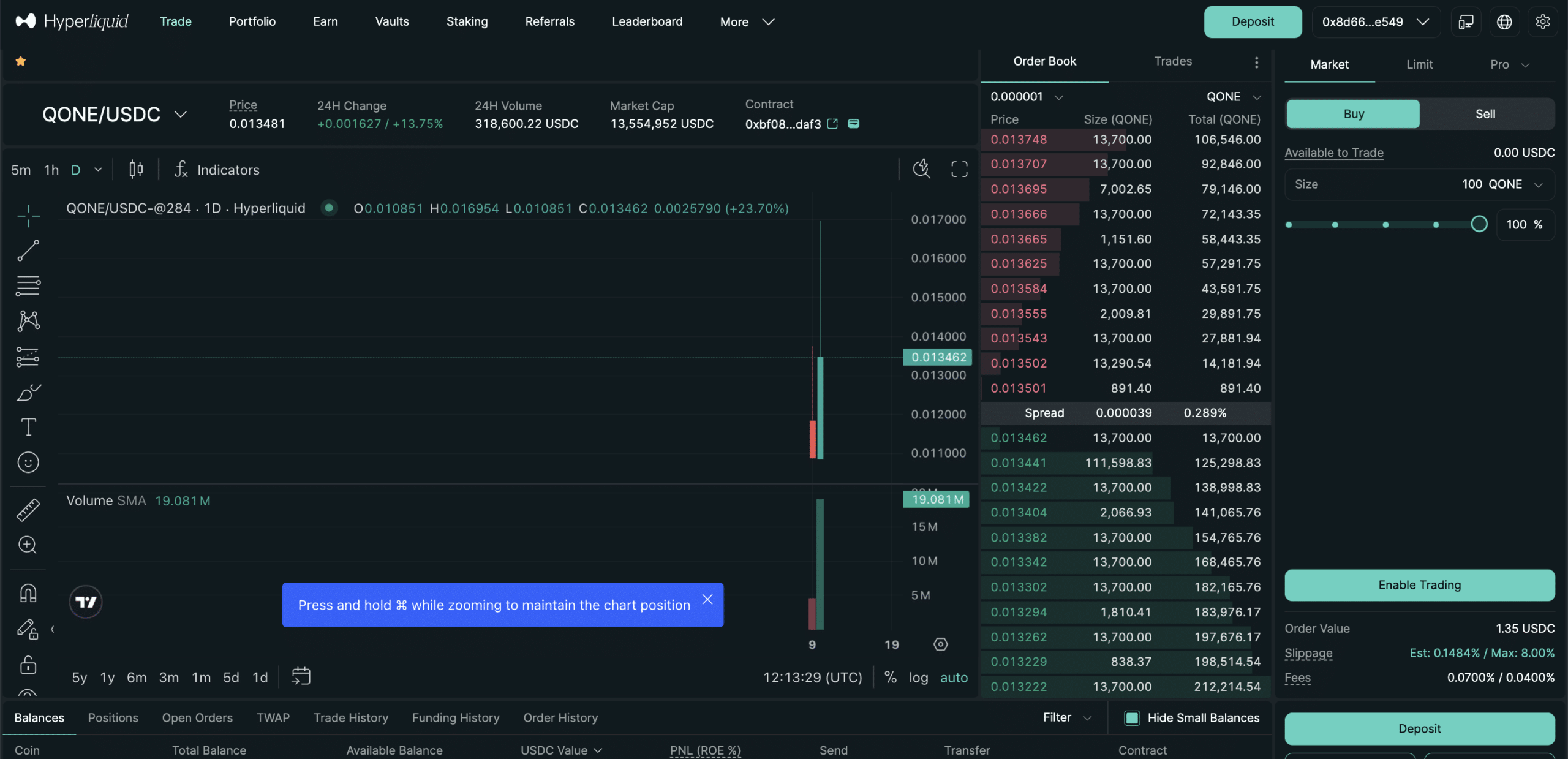
It is worth noting that the 24-hour presale was a success, raising $950K. Moreover, since launching at a price of $0.01 per token, qONE is now trading at $0.013462 per token.
Here’s a brief overview of the qONE token price forecast through 2030:
- 2026: As qONE aims to solve one of today’s most pressing issues, we think tech-savvy investors and retail buyers could contribute to the token’s buying pressure despite the uncertain market conditions. Assuming this scenario plays out, qONE could potentially reach about $0.022.
- 2030: By the close of the decade, qONE could become a vital piece of security infrastructure for the crypto world. Should it secure even a 1% share of the Bitcoin and stablecoin market deemed “at risk” through its Quantum-Sig Wallet, our 2030 projections indicate a price of nearly $0.11.
| Year | Potential Low | Average Price | Potential High |
| 2026 | $0.01 | $0.016 | $0.022 |
| 2027 | $0.019 | $0.028 | $0.035 |
| 2028 | $0.029 | $0.04 | $0.051 |
| 2029 | $0.042 | $0.057 | $0.073 |
| 2030 | $0.064 | 0.087 | $0.11 |
qONE Price History
On 5th February, qONE was launched through the presale round at $0.01 per token. Notably, early investors who signed up to a limited-time-only whitelist secured tokens at a discounted price of just $0.008 per token. After the presale managed to raise $950K, the qONE TGE (Token Generation Event) took place on 6th February. Currently, qONE is available to purchase on Hyperliquid. In just a few days since the token launched, qONE is up by more than 31%.
qONE Price Prediction 2026
2026 will be an important year for the qONE token because it will enter price discovery for the first time. The qONE public token presale ended in early February 2026, and qONE is now trading live on the Hyperliquid exchange.
As the team negotiates placements, we think it could push meaningful CEX expansion in late 2026 or 2027. Even so, announcements related to new partnerships or technical milestones could also have a huge impact on the token’s value. For instance, if qLABS secures a pilot program with a major exchange or wallet provider involving Quantum-Sig integration, the token’s price could experience a quick surge.
Given these factors, we expect qONE’s price in 2026 to be volatile. We believe qONE could reach $0.022 (roughly 2x the presale price) in such a bullish post-listing rally. But low liquidity could also transmute into sudden drops, especially if early buyers take quick profits. In this case, it qONE can drift back toward its initial presale price of $0.01.
qONE Coin Price Prediction 2027-2030
Perhaps the most important factor determining qONE’s price through 2030 is qLABS’ ability to genuinely build a critical security infrastructure for the Web3 world. Here is a detailed look at how the token could perform in the years to come:
qONE Price Forecast 2027
By 2027, qLABS will likely move past the initial excitement of its launch and will have to actually demonstrate tangible adoption to sustain growth. The real test will be the transition from a concept with potential to a protocol that companies reliably depend on.
To begin with, the purpose of qONE will likely become more apparent. qLABS has indicated that qONE will serve as an access key to its ecosystem. If the qONE Security Protocol is implemented, enterprises and exchanges may be required to stake qONE or pay transaction fees in qONE. And if staking rewards or fee-sharing mechanisms are implemented, a larger portion of tokens may be locked, thereby reducing the circulating supply.
We also believe that regulations like MiCA and the US Stablecoin Acts may introduce stronger cyber-resilience requirements by 2027. As a second-order effect on this requirement, more strategic enterprise partnerships could become the primary driver of growth. Even a modest pilot program with a popular custody provider or a platform can increase qLABS’ credibility and potentially stimulate demand.
As a result, we anticipate qONE to gradually continue its growth trajectory in 2027 and potentially reach a high of $0.035 that year. But if major chains announce their own native quantum upgrades (via hard forks), the need for external solutions could subside, as qONE could reach a low of $0.019 in 2027.
qONE Price Prediction 2028
qLABS could transition from a niche solution to a more widely adopted solution across DeFi and DAO treasuries by 2028. In such a scenario, the qONE Security Protocol could see rising adoption for critical functions like large vault transfers and treasury withdrawals. It is a significant shift because it could generate network effects, where multiple independent projects could need qONE to secure their operations.
In the meantime, we could see huge improvements in quantum-resistant stablecoin infrastructure, either through qLABS’s own offering or through collaborations with leading issuers. A “Q-stable” gaining popularity would likely draw more people into the ecosystem, increasing the utility of qONE.
The project could even benefit from its governance features. Should qLABS embrace a DAO structure by 2028, qONE holders can vote on improvements and important treasury matters. If the project’s adoption accelerates, we expect the qONE token to reach as high as $0.051 in 2028.
qONE Long-Term Outlook: 2029-2030 Price Potential
Security experts are highlighting that the fact that quantum research is advancing at an unprecedented pace. The number of qubits predicted to crack 256-bit encryption has been steadily decreasing, and some forecasts suggest this might even be possible by the early to mid-2030s.
By 2029, we could see prototype quantum attacks on less secure cryptos or perhaps more government alerts about vulnerable cryptographic methods. At that point, institutional investors and governments are likely to be taking quantum risk even more seriously. In such a scenario, the value of qONE might be driven, at least in part, by FOMO.
In fact, major custodians and government-sponsored projects could begin experimenting with quantum-resistant security modules. And if qLABS gains a reputation as a reliable company, it would likely help the token command a large user base.
That said, it’s equally crucial to understand the risks qONE could grapple with. One of the main factors that could affect the token price in 2030 is the future state of the crypto market cycle. A potential bearish market can negatively affect investor sentiment and, in turn, altcoins as a whole.
Another important point to keep in mind is the impact of growing competition. If some of the project’s competitors execute their roadmaps more effectively, qLABS could struggle to increase or even maintain its market share. The net outlook is that a potential high of $0.11 is within reach by 2030. A more conservative estimate might place it around $0.064, while slower adoption could keep it in the $0.08 range.
Our qONE Price Prediction Methodology
It is inherently challenging to accurately predict the price of a token that has just gone live. But you can still make an informed forecast of its price potential by understanding the project’s industry and its position within the crypto market cycle. Here are some factors that have shaped our methodology:
- Analysis of Need for Post-Quantum Infrastructure: Our prediction model accounts for the impact of qLABS’ post-quantum adoption. We’ve based our predictions on projected usage: how many wallets, apps, and institutions could adopt quantum-safe crypto each year, and what that means for qONE demand. In 2025, Coinbase and the Ethereum Foundation had already begun to address quantum risk. This means testnets, pilots, and early deployments will likely occur in 2026 and 2027. Also, as NIST and the EU implement PQC standards, new requirements for quantum-resistant encryption could potentially increase demand for projects like qLABS.
- Token Utility: Another important factor we’ve considered is the qONE token’s future utility and demand. We have linked the token’s upside to usage-based fees and staking requirements that drive repeat use.
- Crypto Market Cycle: We have assumed that qONE will trade like a small-cap token with a high beta. It can perform significantly better in risk-on markets, but it can also decline more sharply than blue-chip alts when the market declines. That is why the ranges are relatively wide, especially during the first year after listing.
What Is qONE?
qONE is a token that powers qLABS (Quantum Labs), a crypto security project that’s built around the idea that Web3 should be ready for quantum-era attacks before they occur. It is thus designing its products with the understanding that quantum computers will eventually threaten today’s cryptography.
Antanas Guoga, a former Lithuanian MP and successful entrepreneur, is spearheading the project as the president of qLABS, while Andrew Cheung, who is also the CEO of 01 Quantum Inc. (formerly 01 Communique Laboratory), acts as the project’s CTO.
For context, 01 Quantum is a Canadian cybersecurity firm with decades of history and multiple US patents in post-quantum cryptography (PQC). qLABS is built on that foundation, empowering the project to access PQC technology.
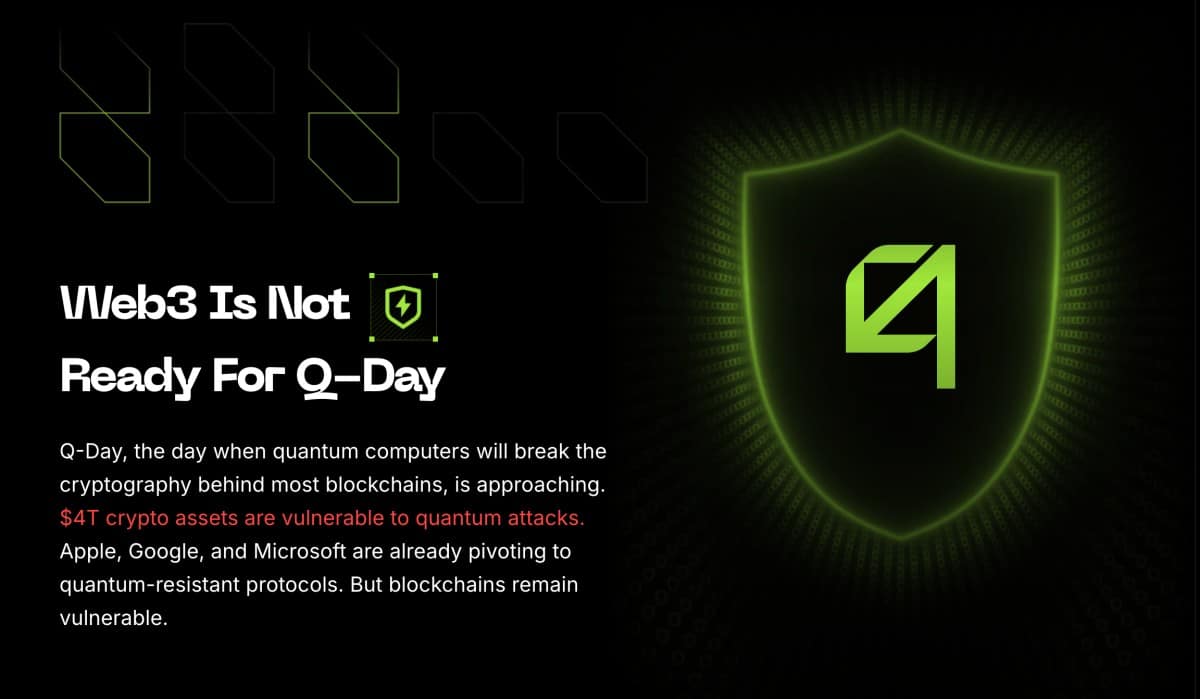
What‘s worth noting is that qLABS’ mission statement outlines plans to secure $100 billion in digital assets by 2028. To put things in perspective, it doesn’t want to start a new blockchain. Instead, it aims to protect existing chains without requiring users to move.
The Quantum Crypto Wrapper (QCW) from 01 Quantum will combine PQC with zero-knowledge proofs to unlock quantum-safe verification. Its partnership with 01 Quantum and Tony G’s industry connections could help it make a mark in the crypto and enterprise security circles.
qONE Crypto Use Cases
Below are some of the core use cases of the qLABS crypto:
- qONE Security Protocol: qONE aims to add a security “overlay” to existing chains. Transactions can require two signatures, a normal one (like Ethereum’s usual signature) plus a post-quantum signature. If the quantum-safe signature is missing, the transaction won’t execute, even if the regular key is compromised.
- Quantum-Sig wallet: A smart contract wallet that requires both traditional and quantum-safe approvals for any outgoing transfer. It works like a 2-of-2 multisig, but built for quantum protection. If someone steals your MetaMask key, they still can’t move funds without the second (PQC) key.
- Stablecoin and Payments Security: LABS is also developing stablecoin infrastructure, including protecting mint/burn keys and supporting high-value transfers. That could mean a quantum-safe wrapper for existing stablecoins. It is important because stablecoins move huge amounts of value every day and are prime targets for attacks.
- Developer Tools: For qLABS to grow, it needs SDKs and APIs so that dApps and exchanges can switch to quantum-safe mode without having to rebuild everything. The more people use it, the more demand can come back to the qONE token through fees, access, or staking.
What Drives the Price of qONE?
Here’s what will likely move qONE’s price over time:
- Post-Quantum Narrative and Regulation: As quantum risk becomes a bigger issue, projects that are actively working on quantum-safe solutions can get a lot of attention. If regulators require custodians or exchanges to use PQC standards, adoption of qLABS could accelerate. But if big chains come up with their own solutions, some of that narrative could be shared with competitors.
- Actual Protocol Usage: A few long-term drivers are the ability to support more wallets, enable safer transactions, and attract more enterprise clients. If you need qONE to pay for usage fees or bulk verification credits, its demand could rapidly increase with activity. And if any portion of the fees is burned or locked, it can further tighten the supply. You should monitor metrics like the number of active Q-Sig wallets, transaction volume, and the amount of assets that are safe.
- Staking and Unlock Schedules: The token’s price also depends on the relative liquidity of qONE versus locked. The token’s market supply will decrease if partners must stake to gain access, or if users must stake to receive rewards or vote. That said, community unlocks will also increase the supply, so the market needs sufficient new demand to absorb them.
Benefits and Risks of qONE
One of the project’s core benefits is the industry it’s targeting. It is working to develop solutions that make crypto safer, as quantum computers can break cryptographic signatures. If that threat is taken seriously, the need for quantum-safe tools could become permanent rather than a fad.
As we briefly discussed, qLABS also has strong technical roots thanks to its partnership with 01 Quantum. It has a bigger product vision that includes more than spans a protocol, wallet, developer tools, as well as stablecoin security. Perhaps an underrated benefit is its ability to protect existing blockchain networks, which makes things easier for daily users and expedites adoption.
On the other side of the coin, there are a few risks you should keep in mind. First is the possibility of a team execution error. PQC is a relatively complex field, where small mistakes can potentially have large consequences. Another factor to watch out for is the project’s actual adoption. It is common for traditional exchanges and institutions to pivot and adopt a forward-thinking approach, unless forced to do so.
Finally, tokenomics will play a crucial role. Investors should keep in mind that qONE could be volatile, and unlock schedules or weak market conditions could push the price down even if progress is real.
Is qONE a Good Investment?
We could classify it as a classic high-risk, high-reward crypto. Crypto enthusiasts and security experts have already recognized the need for projects that practically offer PQC solutions. The fundamental need for these solutions could continue to grow in the coming years, directly impacting demand and the price of the qONE token.
That being said, the risks are real. qLABS is still a new project, and a lot of its value will depend on how well its team executes the roadmap. This will include delivering secure code, getting enterprise integrations, and staying relevant as bigger companies push their own upgrades. Thus, it is extremely important for crypto investors to only invest an amount they can afford to lose.
Note: To find out the best ways to purchase qONE, visit our guide on how to buy qONE.
qONE Price Prediction: Conclusion
qONE is one of the few projects on the market actively building a quantum-safe technology stack for Web3. Given the positive start following qONE’s launch on Hyperliquid, we believe it could reach $0.022 by the end of 2026.
From a long–term perspective, the qONE token could experience high adoption if regulators enforce security standards for the post-quantum era. Thus, our 2030 qONE price forecast is near $0.11, assuming the team successfully launches features per the roadmap. Even so, you should do your own research into the project to understand its potential before actually committing your funds.
FAQs
Is qLABS a good investment?

Yes, it can be a good investment if the project can command a strong user base and practically address real issues related to quantum threats.
Will the qLABS price reach $1?
We believe the qONE token could reach approximately $0.11 by 2030. While $1 is not out of reach, it would imply a $1 billion valuation, which is an ambitious price target.
When will qONE launch?
The qONE token launched on the Hyperliquid exchange in early February 2026, following its 24-hour presale event.
References

Why you can trust 99Bitcoins
Established in 2013, 99Bitcoin’s team members have been crypto experts since Bitcoin’s Early days.
Weekly Research
100k+Monthly readers
Expert contributors
2000+Crypto Projects Reviewed