




In This Article
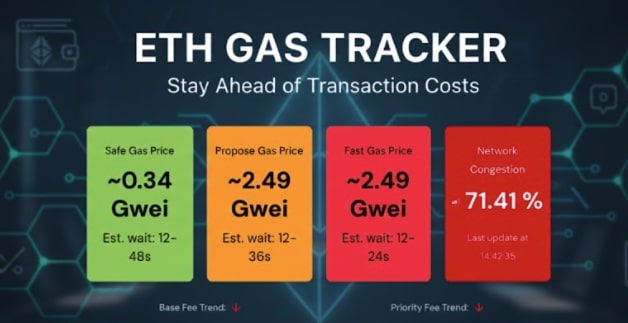
Don’t let the volatility of ETH gas fees catch you off guard. Our Ethereum Gas Fee Tracker delivers real-time Gwei data and the current Ethereum gas price so you never overpay. Use the live metrics and Gas Price Predictions below to minimize your transaction fees instantly.
Ethereum Gas Fee Tracker:
Ethereum Price:
Using our Gas Price Tracker and analytics can help traders gain a decisive advantage, ensuring consistent savings on gas fees across all their on-chain operations.
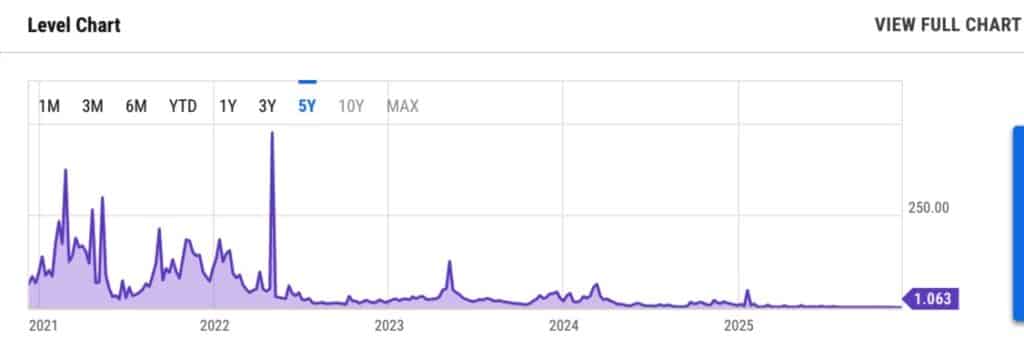
After all, nobody wants to spend $300 in gas fees to send a transaction worth $5… (Yes, that really was a common occurrence back in the 2021 euphoric stage of the bull market!).
What Are Ethereum Gas Fees?
Think of Gas for
 Ethereum
1.96%
Ethereum
ETH
Price
$2,423.43
1.96% /24h
Volume in 24h
$10.12B
Price 7d
Buy Now!
as similar to fuel in a car. Same as how a car needs gasoline to move from point A to point B, the Ethereum blockchain requires “gas” to execute every action, from transactions and minting NFTs to DApp and Smart Contract interactions.
Ethereum
1.96%
Ethereum
ETH
Price
$2,423.43
1.96% /24h
Volume in 24h
$10.12B
Price 7d
Buy Now!
as similar to fuel in a car. Same as how a car needs gasoline to move from point A to point B, the Ethereum blockchain requires “gas” to execute every action, from transactions and minting NFTs to DApp and Smart Contract interactions.
These Ethereum network fees serve an important purpose. They compensate the network’s decentralized workforce, being the network validators who use their own hardware and electricity to process the data on the Ethereum network, while also securing the network and processing transactions.
Without these transaction costs (gas fees) there would be no incentive for the people who run the validators to expend the computational energy and electricity needed to keep the Ethereum network running securely and efficiently.
How to Calculate ETH Gas Fees (EIP-1559 Explained)
Eth gas fees are calculated differently since the London Hard Fork that was introduced in 2021. This hardfork introduced Ethereum Improvement Proposal 1559 (EIP-1559), which shifted the network from a simple “first-price auction” system, which led to high volatility and often high gas fees during high traffic times, to a more predictable model where the fee is split into two primary components: the Base Fee and the Priority Fee.
The total cost of an Ethereum transaction is calculated as:
Total Gas Fee = Gas Used x (Base Fee + Priority Fee)
When setting up a transaction, users will specify a maximum amount they are willing to pay, which is the Max Fee. The final cost will be the least of the Max Fee and the sum of the Base Fee plus Priority Fee, making gas less like a competitive bid and more like a structured market.
The Base Fee: The Core Cost
The Base Fee is the mandatory minimum price per unit of gas that must be paid for any transaction to be included in a block.
- Mandatory Minimum: It is set algorithmically by the Ethereum protocol based on the network’s congestion level (targeting 50% block utilization).
- Burned by the Network: This fee is burned (permanently removed from circulation) and is never paid to validators. This is a key deflationary mechanic of Ethereum.
The Priority Fee (Tip): Speed and Incentives
The Priority Fee, often called the “tip”, is an optional, extra amount you include with your transaction to incentivize a validator to prioritize your transaction over others.
- Validator Payment: This is the only portion of the gas fee that is paid directly to the validator (formerly called the ETH miner tip).
- Speed Factor: If the network is busy, increasing your tip makes it more likely for your transaction to be confirmed quickly. The higher the competition for block space, the higher this fee must be to gain preferential inclusion.
The Max Fee: Your Absolute Limit
The Max Fee per Gas is the absolute maximum price you are willing to pay per unit of gas to get your transaction processed.
- Cap on Spending: By setting this limit, you ensure your transaction costs will never exceed a certain amount, providing protection against sudden gas price spikes.
- Refunds: If the final fee (Base Fee + Priority Fee) is lower than your Max Fee, the difference is automatically refunded to your wallet.
What is Gwei? (Gwei to ETH Converter)
If “Gas” is the fuel on Ethereum, then Gwei is the unit you use to measure it.
You know how, when you buy gasoline, the price is given in dollars per gallon or euros per liter? Gwei works the same way for Ethereum network fees. It is simply the universally accepted denomination used to quote the price of Gas. Since one full Ether (ETH) is worth a lot, conducting transactions in whole ETH would mean dealing with tiny, inconvenient decimal points like 0.000000001.
To make things easy for everyone, the community adopted Gwei. The term itself is a contraction of “Giga-Wei” and is also referred to technically as Nanoether.
Simply put, one Gwei is equal to one-billionth of an ETH
| Unit | Decimal Value (in ETH) | Scientific Notation (in ETH) |
| 1 Wei | 0.000000000000000001 | 10^{-18} |
| 1 Gwei | 0.000000001 | 10^{-9} |
| 1 ETH | 1 | 10^{0} |
When your wallet or our tracker shows the current Ethereum gas price is 20 Gwei, it means you are willing to pay $0.000000020 ETH per unit of Gas used. This conversion makes it much easier to track the fluctuating Gwei price in real-time and quickly calculate your 1 Gwei in USD equivalent for better budgeting.
Why Are Ethereum Gas Fees So High?
If you’ve ever checked your wallet before a transaction only to see the ETH gas fees spike, you’ve experienced the simple, ruthless mechanics of supply and demand on the Ethereum blockchain.
Ethereum is a victim of its own success: it’s the most secure and established platform for decentralized finance and NFTs, but it has limited capacity, leading to dramatic price swings.
Here’s the breakdown of what drives those famously high costs:
1. Fierce Competition for Limited Space
The core issue is block space demand. Imagine Ethereum’s block space as a highway with only four lanes. Every user’s transaction is a car trying to merge. When demand is low, the traffic moves fine. But when everyone rushes to transact simultaneously, those four lanes quickly become congested. Users then have to competitively “bid” with their Priority Fees (tips) to convince a validator to skip the line and include their transaction first. This intense network traffic automatically drives the Base Fee (the minimum required cost) much higher.
2. Major Drivers of Congestion (The “Gas Wars”)
While regular activity affects the price, certain high-profile events can cause fees to skyrocket, sometimes referred to as a “gas war,” as millions compete for the same resource in a short period.
- Massive NFT Mints: When a highly anticipated NFT collection drops, thousands of users try to mint (create) their token simultaneously. This massive, sudden flood of transactions creates a bidding frenzy, sending fees from single-digit Gwei to hundreds of Gwei in minutes.
- Meme Coin Pumps: Periods of hype or sudden volatility around popular meme coins cause frantic buying and selling on decentralized exchanges (DEXs). These complex “swap” transactions use a lot of gas, compounding the competition and pushing costs up for everyone.
- DeFi Yield Farming Spikes: Complex interactions with decentralized finance (DeFi) protocols, such as adding liquidity, staking, or leveraging positions, require many computational steps (high gas usage). When a new, lucrative farming opportunity appears, a rush of activity drives up the cost of even simple transfers.
Ultimately, high gas fees always come down to the same thing: too many users trying to do too much, too fast, forcing prices up until demand cools off.
How to Reduce Ethereum Gas Costs
Paying high Ethereum gas fees doesn’t have to be a fact of life. This is the highest-value section for the average user, as timing and strategy can save you hundreds, or even thousands, of dollars per year. Here is how you can consistently save on gas fees and beat the crowd.
1. Time Your Transactions (Using Our Gas Fee Tracker)
Because ETH gas fees are driven entirely by network demand, the simplest way to reduce costs is to transact when fewer people are online. Think of it like taking a toll road during rush hour versus late at night—the price changes dramatically.
- The Best Time: The general rule of thumb for finding the cheapest time to trade crypto is to use our Gas Heatmap (located near the top of this page). Look for the green zones, which typically fall on weekends (Saturday and Sunday) and late-night hours (2:00 AM – 6:00 AM UTC) on weekdays.
- The Worst Time: Avoid peak US and European working hours (usually 10:00 AM – 4:00 PM UTC, Monday to Friday). Timing your move by just a few hours can turn a $20 transaction into a $1 transaction.
2. Use Layer-2 Scaling Solutions
The single most effective way to eliminate high transaction costs is to stop using the Ethereum mainnet for every operation. Instead, use a Layer-2 network. L2s are built on top of Ethereum, inheriting its security while handling transactions off-chain, making them magnitudes faster and cheaper.
- Top L2s to Use: Move your assets and activities to leading Layer 2 networks like Arbitrum, Optimism, and Base. For example, comparing Optimism vs Ethereum mainnet fees often shows a 90% to 99% reduction in cost. While Polygon (a sidechain) is also popular, Arbitrum and Optimism use Rollup technology, which is fully integrated into Ethereum’s security roadmap.
- The Cost Difference: While a token swap on Ethereum mainnet might cost $5–$50, the same swap on an L2 typically costs just a few cents.
3. Simulate Your Transaction Before Sending
Nothing is more frustrating than paying $100 in gas only to have your transaction fail because of a bug or an error in a smart contract. Remember, you still have to pay the validator for their work, even if the transaction doesn’t complete!
- Avoid Failed Fees: Use advanced wallet features like those found in MetaMask or Rabby, which often incorporate transaction simulation tools (sometimes using platforms like Tenderly). These tools predict the outcome of your transaction before you send it to the blockchain, allowing you to avoid wasted ETH gas fees.
- Set a Max Fee: Always double-check that your wallet is using EIP-1559 and that your Max Fee is set accurately. This prevents your wallet from spending an absurd amount if gas spikes in the one second between hitting ‘send’ and confirmation.
Ethereum Gas Fees After “The Merge” & Ethereum 2.0
When Ethereum transitioned to Proof-of-Stake (PoS) during “The Merge” in 2022, there was a widespread misconception that Ethereum 2.0 gas fees would instantly drop. That wasn’t the case, and here’s why.
The Merge was a monumental change, but it focused entirely on consensus, not capacity. It replaced the energy-intensive Proof-of-Work (PoW) system with the vastly more efficient PoS method, dramatically lowering Ethereum’s carbon footprint. However, the update did not increase the size of the block or the speed at which transactions could be processed. Therefore, the PoS impact on fees was minimal; the supply of block space remained the same, meaning high demand still resulted in high fees.
The real scaling solution is arriving in stages via targeted upgrades that make the network more efficient for Layer-2s (L2s).
The True Fee Reducers: Sharding and Dencun
The genuine fee reduction for users is rooted in a series of planned and executed capacity upgrades designed to make it cheaper for L2 networks (like Arbitrum and Optimism) to post their massive bundles of transaction data back to the Ethereum mainnet.
- Dencun Upgrade (EIP-4844): The most recent and impactful example is the Dencun upgrade, which introduced “blobs.” These EIP-4844 blobs provide a new, dedicated, and significantly cheaper space for L2s to store their data. This update dramatically lowered the operational cost for L2s, and those savings are passed directly to you in the form of cents-per-transaction fees.
- Sharding (The Future): The long-term plan for Ethereum 2.0 includes Sharding, which will involve splitting the main chain into multiple separate chains (shards). This will massively increase the network’s overall data capacity, making it exponentially easier and cheaper for L2s to function, thus bringing long-term stability and affordability to the entire ecosystem.
Conclusion
Nobody actually likes dealing with gas fees. It’s frustrating when you see a simple token swap cost more than the value of the assets you’re moving. But here’s the good news: by understanding these mechanics, you’ve put yourself ahead of 90% of other users.
You now know that these costs aren’t random; they’re driven by the simple reality of limited block space. You understand the difference between the mandatory Base Fee that gets burned and the competitive Priority Fee that acts as your tip.
The key takeaway is this: use the Ethereum Gas Fee Tracker to your advantage. Stop blindly hitting ‘send’ and start transacting on those cheaper nights and weekends, or better yet, make the jump to those tiny-fee Layer-2 networks. You don’t have to be a whale to save big on your ETH gas fees.
Ethereum Gas Fee FAQs
Why did my transaction fail but I still paid gas?

You still paid because the validator had to expend computational work to process the transaction up until the point of failure. You are only refunded for the unused gas from your limit, not the gas already consumed.
When is the cheapest time to buy NFTs?
Weekends and late-night/early-morning hours (around 2:00 AM – 6:00 AM UTC). This is when network congestion is lowest, allowing you to use a minimal Priority Fee (tip).
What is the difference between Slow, Standard, and Fast gas?
These are three different levels of the Priority Fee (tip) you offer. Fast pays the highest tip for the quickest confirmation, Slow pays the least for the slower confirmation, and Standard offers a balance.
Will ETH gas fees ever go to zero?
No, not on the main chain. A small fee is mandatory for security (spam prevention) and to compensate validators. However, Layer-2 networks like Arbitrum and Optimism offer fees that are effectively near-zero (cents per transaction).
“Ethereum Staking Mechanics: A Step-by-Step Explanation.” Crypto for Innovation, n.d., https://cryptoforinnovation.org/ethereum-staking-mechanics-a-step-by-step-explanation/.
Locke, T. “What to Know about the Ethereum ‘London Hard Fork’ EIP 1559 Upgrade.” CNBC, 4 Aug. 2021, https://www.cnbc.com/2021/08/04/what-to-know-about-the-ethereum-london-hard-fork-eip-1559-upgrade.html.
Buterin, Vitalik, et al. “EIP-1559: Fee Market Change for ETH 1.0 Chain.” Ethereum Improvement Proposals, 13 Apr. 2019, https://eips.ethereum.org/EIPS/eip-1559
“Ethereum Dencun Upgrade: Everything You Need to Know.” ConsenSys, n.d., https://consensys.io/ethereum-dencun-upgrade.

Why you can trust 99Bitcoins
Established in 2013, 99Bitcoin’s team members have been crypto experts since Bitcoin’s Early days.
Weekly Research
100k+Monthly readers
Expert contributors
2000+Crypto Projects Reviewed