




In This Article
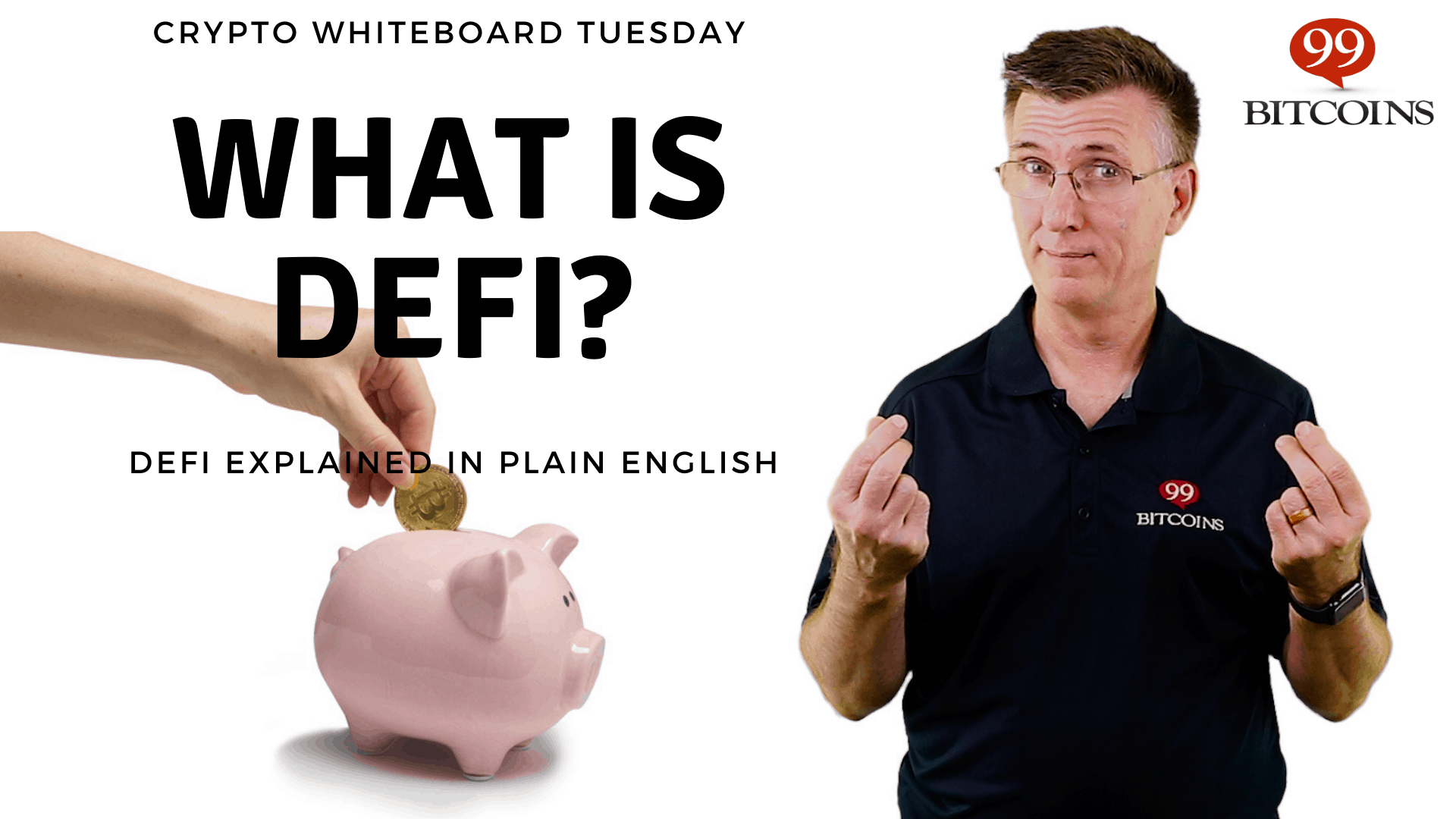
DeFi (Decentralized Finance) is becoming more and more popular as one of the main use cases for cryptocurrencies. DeFi has so many benefits that it isn’t hard to see why it continues to grow in popularity. This DeFi beginner guide 2026 explains in detail what DeFi is and what you should know about before getting involved.
What is DeFi: Summary
Let’s kick off with the decentralized finance definition. DeFi is a general term given to decentralized financial services such as decentralized exchanges, decentralized money markets, decentralized insurance companies, etc. It aims to replace centralized financial services with autonomous organizations that allow everyone to participate.
Don’t Like to Read? Watch Our Video Guide Instead
Bitcoin and Our Financial System
What is Bitcoin DeFi? If you’ve read our previous posts you already know that Bitcoin is a form of money that isn’t controlled by any central bank or government. It can be transferred to anyone from anyone around the world, without the need for a bank or a financial institution.
Bitcoin is decentralized money, and if you’re just starting out you may want to catch our “What is Bitcoin” video before moving forward.
However, transferring money is only the first of many building blocks in a financial system. Aside from sending money to one another, there are a variety of services we use today. For example, loans, saving plans, insurance, and stock markets are all services that are built around money and together create our financial system.
Today, our financial system and all its services are completely centralized. Banks, stock markets, insurance companies, and other financial institutions all have someone in charge, whether it be a company or a person, that controls and offers these services.
This centralized financial system, or CeFi for short, has its risks – mismanagement, fraud, and corruption to name a few. But what if we could decentralize the financial system as a whole in the same way Bitcoin decentralized money? That’s exactly what the DeFi meaning is all about.
Decentralized Finance Explained
DeFi is a term given to financial services that have no central authority or someone in charge. Using decentralized money, like certain cryptocurrencies, that can also be programmed for automated activities, we can build exchanges, lending services, insurance companies and other organizations that don’t have any owner and aren’t controlled by anyone.
Confused? Don’t worry, here’s DeFi explained:
Defi Component #1 – Infrastructure
In order to create a decentralized financial system, the first thing we need is an infrastructure for programming and running decentralized services. Luckily for us, Ethereum does just that. Ethereum is a Do It Yourself platform for writing decentralized programs also known as decentralized apps or Dapps for short.
Our “What is Ethereum” video explains Ethereum in great detail, but for now we’ll just say that through the use of Ethereum we can write automated code, also known as smart contracts, that manage any financial service we’d like to create in a decentralized manner.
This means that we determine the rules as to how a certain service will work, and once we deploy those rules on the Ethereum network we no longer have control over them – they are immutable.
Once we have a system in place like Ethereum for creating decentralized apps we can start building our decentralized financial system. Now let’s take a look at some of the building blocks that comprise it.
Defi Component #2 – Stable Money
The first thing any financial system needs is of course money. You may be thinking: “why not use Bitcoin or Ether, which is Ethereum’s currency?” Well, as for Bitcoin, while it is indeed decentralized, it has only very basic programmable functionality and is not compatible with the Ethereum platform.
Ether, on the other hand, is compatible and programmable, however, it is also highly volatile. If we’re looking to build reliable financial services that people will want to use we’ll need a more stable currency to operate within this system. This is where stablecoins come in.
Stablecoins are cryptocurrencies that are pegged to the value of a real-world asset, usually some major currency like the US dollar. Our video “What are stablecoins” explains in more detail how stablecoins are created and what the different types of stablecoin pegs are. Make sure to check it out if you want some additional information.
For the purpose of DeFi we’ll want to use a stablecoin that doesn’t use fiat money reserves for maintaining a peg, since this will require some sort of central authority. This is where DAI comes into play.
DAI is a decentralized cryptocurrency pegged against the value of the US dollar, meaning one DAI equals one US dollar.
Unlike other popular stablecoins whose value is backed directly by US Dollar reserves, DAI is backed by crypto collaterals that can be viewed publicly on the Ethereum blockchain.
DAI is over collateralized, meaning if you lock up in a deposit $1 worth of Ether, you can borrow 66 cents worth of DAI. As soon as you want your Ether back, just pay back the DAI you borrowed and the Ether will be released. If you don’t have any Ether to lock up as collateral you can just buy DAI on an exchange.
Because DAI is over collateralized, even if Ether’s price becomes extremely volatile, the value of the locked Ether backing the DAI in circulation will most likely still remain at 100% or more.
In essence, the DAI stablecoin is actually also a smart contract that resides on the Ethereum platform. This makes DAI a truly trustless and decentralized stablecoin which cannot be shut down nor censored, hence it’s a perfect form of money for other DeFi services.
DeFi Component #3 – Financial Services
Now that our decentralized financial system has stable decentralized money, it’s time to create some additional services. The first use case that we’ll discuss is the decentralized exchange, or DEX for short.
DEXes operate according to a set of rules, or smart contracts, that allow users to buy, sell, or trade cryptocurrencies. Just like DAI they also reside on the Ethereum platform which means they operate without a central authority. When you trade on a DEX, there is no exchange operator, no sign-ups, no identity verification, and no withdrawal fees.
Instead, the smart contracts enforce the rules, execute trades, and securely handle funds when necessary. Also, unlike a centralized exchange, there’s often no need to deposit funds into an exchange account before conducting a trade. This eliminates the major risk of exchange hacking which exists for all centralized exchanges.
But the range of decentralized financial services doesn’t stop there. Let’s move on to decentralized money markets – services that connect borrowers with lenders.
Compound is an Ethereum based borrowing and lending dapp, meaning you can lend your crypto out and earn interest on it. Alternatively, maybe you need some money to pay the rent or buy groceries, but the only funds you have are cryptocurrencies. If that’s the case you can deposit your crypto as collateral, and borrow against it.
The Compound platform automatically connects the lenders with borrowers, enforces the terms of the loans, and distributes the interest. The process of earning interest on cryptocurrencies has become extremely popular lately, giving rise to “yield farming” – A term given to the effort of putting crypto assets to work while seeking to generate the most returns possible.
Another example for a DeFi service can be decentralized insurance.
All of these new financial products definitely entail some risks which we will cover shortly, so why not create a service that insures my funds in case something goes wrong?
Well, how about a decentralized platform that connects people who are willing to pay for insurance with people who are willing to insure them for a premium, while everything happens autonomously without any insurance company or agent in the middle.
Money Legos: How Does DeFi Work?
DeFi services work in conjunction with one another, making it possible to mix and match different services to create new and exciting opportunities. This kind of resembles how you can use different LEGO blocks and get creative with whatever it is you want to build. Hence the term ‘money legos’ has been coined to refer to DeFi services.
For example, you can build the following service from different money legos:
You start out by using a decentralized exchange aggregator to find the exchange with the best rate for swapping Ether for DAI. You then select the DEX you want and conduct the trade. Then you lend the DAI you received to borrowers to earn interest. Finally, you can add insurance to this process to make sure you’re covered in case anything goes wrong.
That’s just one example out of the many opportunities DeFi offers.
DeFi Advantages and Risks
Like any fast-moving innovation, decentralized finance brings both opportunities and challenges. Here’s a balanced look at what stands out today:

Pros
-
Transparency – All transactions are verifiable on-chain, reducing hidden risks.
-
Global access – Anyone with an internet connection can use DeFi, bypassing gatekeepers in traditional finance.
-
Interoperability – Many protocols work together, allowing users to move assets across lending platforms, DEXs, and yield farms with ease.
-
Non-custodial control – Users hold their own keys and funds instead of trusting centralized intermediaries.
-
Innovation & flexibility – New products (like liquid staking and RWAs) are reshaping how people interact with money.
Cons
-
Smart contract risks – Bugs, exploits, and hacks remain a significant threat, even with audits.
-
Regulatory uncertainty – Governments are still defining how DeFi fits within financial frameworks, creating potential compliance risks.
-
Liquidity fragility – In times of stress, capital can vanish quickly from protocols, leading to cascading failures.
-
Partial decentralization – Many platforms still rely on centralized or semi-centralized infrastructure (e.g., governance capture, oracle reliance).
-
Complexity for new users – Wallet management, gas fees, and multi-step interactions can be overwhelming.
As always, the golden rule applies: never put more into a protocol than you can afford to lose.
Conclusion: DeFi Beginner Guide 2026
DeFi is no longer just a fringe experiment, it’s now a multi-hundred-billion-dollar sector that sits at the intersection of finance and technology. Protocols like Uniswap, Aave, and Lido have become household names within crypto, while newer innovations such as real-world assets (RWAs), decentralized stablecoins, and restaking are expanding what’s possible on-chain. Institutions are also dipping their toes into DeFi, exploring yield opportunities and tokenized treasury markets.
Still, challenges remain. Scalability, user experience, and regulatory clarity are works in progress, and high-profile hacks remind us that the ecosystem is far from risk-free. Yet the trend is undeniable: DeFi is steadily moving from experimental to essential, reshaping how money moves, how value is stored, and who gets access to financial opportunity.
If 2020–2023 was about bootstrapping, and 2024 saw the first wave of institutional adoption, 2026 is shaping up to be the year DeFi matures, with mainstream use cases, stronger infrastructure, and broader recognition as the backbone of the digital economy.
See also:

Why you can trust 99Bitcoins
Established in 2013, 99Bitcoin’s team members have been crypto experts since Bitcoin’s Early days.
Weekly Research
100k+Monthly readers
Expert contributors
2000+Crypto Projects Reviewed