





Ethereum (ETH) futures are popular instruments that crypto traders use to bet on the price movement of ETH without actually owning the cryptocurrency. If you are new to crypto investing and want to take your game to the next level, you may want to learn how to trade Ethereum futures.
In this guide, we will cover the basics of Ethereum futures contracts, including what they are, how they work, and how to use them for short-term trading and safeguarding your spot investments. We will also look at the top platforms for trading ETH futures, helping you choose the crypto exchange that fits your requirements best.
Key Takeaways
- Ethereum futures allow traders to speculate on ETH price movements without owning the asset.
- Perpetual futures contracts are special contracts that do not have an expiration date. However, traders may need to pay funding rates to keep positions open.
- Potential for amplified gains, ability to open long and short positions, and hedging are among the benefits of Ethereum futures trading.
- Crypto exchanges offer demo trading accounts for users to practice futures trading strategies.
- Understanding margin types, order types, and risk management is essential for anyone looking to trade ETH futures.
How to Trade Ethereum Futures: Summary
Our comprehensive Ethereum futures trading guide on how and where to trade Ethereum (ETH) futures in 2026 is designed to help beginners and intermediate traders confidently enter the world of crypto derivatives.
In this article, you will find a list of the top five ETH futures contract trading platforms. Each platform has a dedicated section with details about its features, pros and cons. We have created a table to make it easy for you to compare the sites next to each other based on their trading fees, KYC requirements, and unique features.
In the second half of the article, we explain what Ethereum futures trading is and debunk key concepts such as leverage, margin call, and perpetual contracts. We also compare Ethereum futures against Bitcoin (BTC) futures.
Top 4 Platforms to Trade Ethereum (ETH) Futures
Choosing the right Ethereum futures platform is important as it will directly affect your experience and will have some influence on your results. You do not want to be using a crypto exchange that does not have the essential tools required for you to maximize returns. With dozens of Ethereum futures exchanges available, it is important to compare features such as fees, leverage options, customer support, and user experiences.



In this section, we will highlight the top five platforms for ETH futures trading in 2026:
1. Binance – Top Exchange to Trade ETH Futures
When it comes to liquidity for ETH perpetual futures contracts, Binance is king due to its status as the largest crypto exchange in the world, thanks to the high trading volume. The platform offers two main types of ETH futures contracts: USD-Margined Futures and Coin-Margined Futures. The former is settled in stablecoins such as USDT and USDC, while the latter is settled in ETH itself.

Binance is an excellent choice for those searching for a beginner’s guide to ETH futures contracts, as the platform publishes easy-to-understand tutorials and offers a simulated ETH futures trading platform for learning without exposing users to financial risk. The platform is great for experienced users, too.
It allows up to 125x leverage on ETH futures, provides advanced trading tools and charts, and lets users choose between perpetual futures (no expiration date) and quarterly futures (comes with a set expiration date).
Read our Binance Review to learn why the platform is the most popular crypto exchange in the world.
Binance Pros & Cons
Pros
-
Being the world’s largest centralized exchange, Binance offers deep liquidity.
-
The platform provides various options to trades such as stablecoin settlement, ETH settlement, and perpetual futures
-
Traders can use leverage up to 125x on ETH futures leverage trading.
-
Binance’s BNB token has perks such as reduced trading fees.
-
Beginners can practice on Binance’s Ethereum futures demo account.
Cons
-
Requires users to complete the KYC process for full access.
-
The platform is not available in some jurisdictions due to regulatory restrictions.
-
Platforms such as Binance, being centralized, have the authority to block users.
2. Bybit – Popular Ethereum Futures Trading Platform in 2026
ByBit currently ranks as the second most popular crypto derivatives exchange by trading volume in the world after Binance. Bybit’s platform is known for its easy-to-understand design, high liquidity, and availability of advanced trading features, which make it a top choice for Ethereum futures for both beginners and professionals.

Just like Binance, Bybit offers flexibility to ETH long and short trading by offering expiration-less ETH perpetual contracts and ETH quarterly futures contracts that expire at the end of every quarter. The major difference is the payment of funding fees in the case of ETH perpetual contracts. For users new to crypto futures trading, Bybit offers an Ethereum futures demo trading account to learn and practice trading strategies.
Check out our ByBit Review to learn more.
Bybit Pros & Cons
Pros
-
Offers high liquidity for ETH derivatives trading.
-
The platform allows up to 100× ETH futures leverage trading.
-
Beginners will find it easy to use Bybit due to its clean and intuitive user interface.
-
Users can use a demo trading account to practice ETH futures trading.
-
Competitive fees and a structure that does not require users to hold tokens for discounts.
Cons
-
Like Binance, Bybit requires users to complete full KYC to unlock all features
-
It is not available in major crypto markets such as the U.S., U.K., and Canada.
-
Byit was hacked in February 2025, which may concern many crypto investors.
3. OKX – Ethereum Leverage Trading Platform
OKX is the third most popular crypto futures trading platform in the world in terms of trade volume. It is a fast-growing centralized exchange that is quickly eating into the global market share of dominant platforms such as Binance and ByBit by offering competitive fees, a user-friendly interface, and rich features.

The platform is a top contender for those looking for the best ETH futures platform in 2026. It offers up to 100x leverage for ETH perpetual and quarterly futures contracts and settles trades using stablecoins such as USDT and USDC, which allows easy profit and loss calculations and less volatile margins.
Traders on OKX can choose between cross margin mode and isolated margin mode. The former allows all your crypto futures positions to share the same pool of margin, while the latter gives each futures trade its own set of margin.
Read our OKX Review to learn more about this crypto trading platform.
OKX Pros & Cons
Pros
-
OKX offers up to 100× leverage on ETH futures leverage trading.
-
ETH futures traders can choose between cross margin and isolated margin mode.
-
OKX allows users to practice Ethereum futures trading on demo accounts.
-
The platform offers tiered futures trading fees where users can upgrade or downgrade based on their needs.
-
The availability of the OKX Web3 wallet makes it easy to add funds to the trading account.
Cons
-
Not available for U.S. and Canadian users due to regulatory restrictions.
-
Requires users to complete the KYC process for full features and higher withdrawal limits.
-
Fee structure may feel a bit complex as it is based on trading volume and OKB token holdings.
4. Bitget – Best Platform to Trade Ethereum Futures
Closing our list of the best ETH futures exchanges in 2026 is Bitget, a crypto exchange that boasts over 120 million users worldwide. It is a leading Ethereum futures platform that offers up to 125x leverage. A standout feature of the platform is the futures grid trading, which allows users to automate trading by placing buy and sell orders at pre-determined intervals within a selected price range.

Bitget’s AI-powered trading tools allow users to buy low, sell high in Ethereum futures contracts without constant manual oversight. Thus, making it an excellent choice to try and test Ethereum futures trading strategies under real market conditions. For beginners, Bitget offers ETH futures platforms for learning via demo and academy tools and copy trading features for easy trading.
Check out our comprehensive Bitget Review to learn more about this crypto derivatives trading platform.
Bitget Pros & Cons
Pros
-
Lets users settle Ethereum futures trades in stablecoins and ETH.
-
Supports ETH perpetual futures and expiration-based futures contracts with up to 125× leverage.
-
Futures copy trading, bots, and demo accounts enable easy futures trading for beginners.
-
Futures grid trading features let users automate ETH futures trading.
Cons
-
Users must complete mandatory KYC to enable Ethereum futures trading.
-
Not available in the U.S., U.K., Canada, and other restricted countries.
-
Some features, such as Futures grid bot, may be too complex for casual users.
Top-Rated Ethereum Futures Trading Exchanges Compared
Are you still wondering where to trade Ethereum futures? Choosing the right one depends on your trading needs and preferred features. Below is a side-by-side comparison of all the major platforms.
Platform
Leverage
KYC requirement
Demo account
Copy trading
ETH Futures type
Fees
Trading without KYC
Unique features
Binance
125x
Required for full access
Yes
Limited
Perpetual, quarterly, Stablecoin settlement, and ETH settlement
0.02% maker fee and 0.045% taker fee
No
Bybit
100x leverage crypto trading
Limited access without KYC
Yes
Yes
Perpetual, quarterly, Stablecoin settlement, and ETH settlement
0.02% maker fee and 0.055% taker fee
Partial
OKX
125x
Required for full access
Yes
Yes
Perpetual, quarterly, Stablecoin settlement, and ETH settlement
0.02% maker fee and 0.05% taker fee
No
Bitget
125x
KYC mandatory for ETH futures trading
Yes
Yes
Perpetual, quarterly, Stablecoin settlement, and ETH settlement
0.02% maker fee and 0.06% taker fee
No
How We Ranked Top Ethereum Futures Trading Platforms (Methodology)
To help you identify the top crypto leverage trading platform for ETH futures trading, we have devised an easy-to-understand evaluation method focused on core features relevant to both beginners and professional traders. The top five best ETH futures trading platforms were based on:
What Are Ethereum (ETH) Futures?
Ethereum futures are financial instruments that allow traders to speculate on the future price of ETH without owning the asset. Futures contracts are agreements to buy or sell the underlying asset at a pre-determined price before or on a specific date.
The original use of futures contracts in commerce was to mitigate the risk of price fluctuation or unfavorable currency exchange rate changes by fixing the prices in advance for future transactions. Today, future contracts are used in crypto, equity, commodities, and foreign exchange markets for speculation and hedging.

Trading of futures contracts is incredibly popular in the world of crypto. There are special futures contracts called perpetuals or “perps” that do not have an expiration date, created especially for the crypto market. Traders use them to go long (a bet that the underlying asset’s price will rise) or short (a bet that the underlying asset’s price will fall). So if you know how to short crypto, you can use the platforms mentioned above to speculate on falling cryptocurrency prices.
One of the biggest advantages of using crypto contract trading platform is the ability to use leverage. It is more than understanding what is leverage trading crypto. The use of leverage allows traders to open larger positions than their available capital, allowing them to amplify their gains. However, leverage is incredibly risky as it amplifies losses as well.
To open a position (i.e., go long or short), you will first need to deposit collateral, which is referred to as margin. Your position will remain open as long as the value of your margin remains above a minimum threshold.
Your crypto exchange may give you a margin call if the value of your margin drops too low. During such an event, you will either have to add more funds to your margin to maintain the position or reduce your position size by selling it. If you ignore the margin call, your position may be automatically liquidated to prevent further losses.
On a side note, if you want to trade some other coins like Litecoin instead of Ethereum, take a look at our Litecoin Futures Trading guide for 2026.
Ethereum Futures Contract Types
There are various types of Ethereum futures contracts. Their availability may vary from one platform to another:
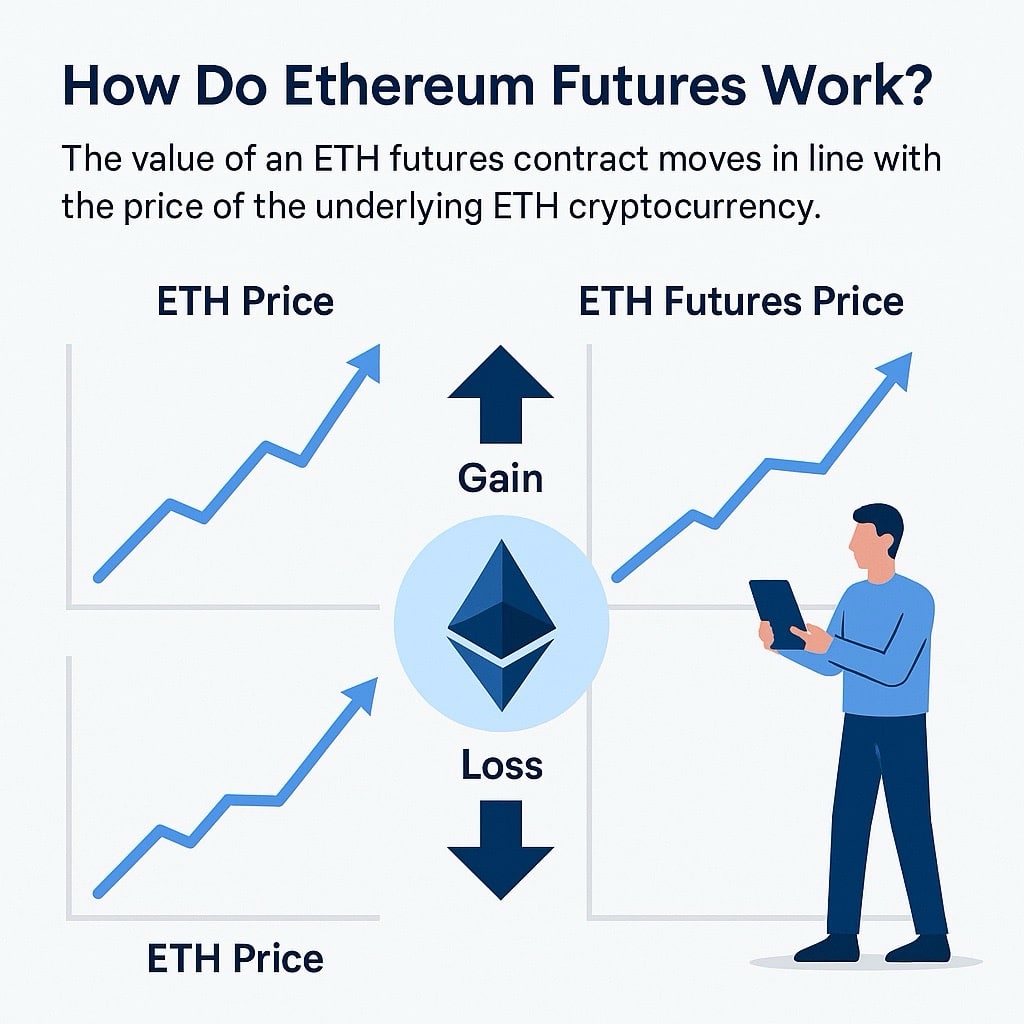
The value of an ETH futures contract moves in line with the price of the underlying ETH cryptocurrency. If you’ve entered a long position and the ETH price goes up, the value of your futures position increases. The difference between your entry price and the current ETH futures price determines your gain or loss. Similarly, if the price moves against you, your position loses value, and you may choose to close the trade to limit losses and avoid liquidation. Ethereum futures are agreements that require you to buy or sell ETH at a predetermined price on or before a specified date. When you buy an Ethereum options contract, you have the right to purchase or sell ETH at the predetermined price; however, you are not obligated to buy the underlying asset, as in the case of futures. Pro Tip: Want to skip the obligations tied to ETH futures? Binary options are an option to explore. Check out our guide on the best binary options trading platforms. Binance is ideal for both newcomers to the crypto derivatives market who are just starting to learn the ropes, along with experts, thanks to the advanced trading options and features. There is also demo trading available, which makes it a great learning tool for beginners to practice strategies, understand key concepts, and get a feel for how real futures trading works. Below you will find an easy step-by-step guide on how to trade ETH Futures on this platform. First thing you will need to do is create an account on the Binance official website. You will then need to set up a password and pass ID verification. Signup typically takes a few hours for KYC processing to be complete After you create your account and your information has been verified, you can access the Binance trading platform. Log in using your email address and password. You will need to fund your account with crypto such as USDT, BTC, or ETH by sending them to your account’s on-chain address, or buy buying crypto with fiat, or by depositing fiat via bank transfer or debit card. You can also use your credit card, Apple Pay, or Google Pay to make deposits. Now, head over to the “Crypto Futures” section of the trading screen. Find the ETH/USDT pair to begin ETH futures crypto margin trading. Select either “Buy” or “Sell” based on your prediction. Enter the amount you wish to speculate on. Adjust the leverage you wish to use. The higher the leverage, the bigger the potential profit and loss. Review your trade and hit the “buy/sell” button to place it. You can exit the trade early to lock in profits, wait for the price to hit your target, or risk getting “busted” if the market moves against your position. Here are some of the most effective Ethereum futures trading strategies that beginners as well as experienced traders can use to maximize their gains and limit losses. Bitcoin and Ethereum often behave differently in the market due to their unique use cases and communities. Hence, understanding one against the other is essential. Let’s quickly go through the difference between Ethereum and Bitcoin futures: As a budding crypto investor, learning about Ethereum Futures trading is valuable because it introduces key concepts like leverage and hedging. These skills can significantly enhance your trading strategies and improve your ability to manage risks effectively. At the same time, traders must acknowledge the risk involved in Ethereum futures trading as the use of leverage can lead to significant losses. Ethereum futures traders can start their journey small. Learn to manage risk by using stop-loss and limit orders. They also must take advantage of educational tools and simulated demo trading features available on the top Ethereum futures trading platforms, such as Binance, ByBit, OKX, and Bitget, before trading with real funds. DISCOVER: It is important to learn about Ethereum futures trading as you will get to know concepts such as leverage and hedging, which will help you to take your crypto trading and risk management skills to the next level. Potential for amplified gains, ability to open long and short positions and hedging are among the benefits of Ethereum futures trading. ETH perpetual futures are futures contracts that bet on the price movement of ETH without any expiration date. Yes, you can trade ETH futures without KYC on CoinFutures. Binance, ByBit, OKX and Bitget offer leverage on ETH futures up to 125x. The legality of Ethereum futures trading can vary from one region to another. Always check crypto laws in your region of residence before trading ETH futures contracts. Yes, ETH futures allows you to speculate on the price of ETH without owning the token. The minimum investing amount to trade ETH futures varies from one platform to another. Spot trading involves buying of cryptocurrency for ownership, while futures trading is used to speculate on the price of the cryptocurrency without it. Leverage is the used of borrowed funds to increase the size of your trading position. Margin trading in crypto refers to the practice of using borrowed funds to trade cryptocurrencies to take a larger position than your available funds. You have to deposit a collateral known as margin to be eligible to borrow. Established in 2013, 99Bitcoin’s team members have been crypto experts since Bitcoin’s Early days. Weekly Research Monthly readers Expert contributors Crypto Projects Reviewed
How Do Ethereum Futures Work?
Difference Between Ethereum Options & Futures?
How to Trade Ethereum Futures: Step-by-Step Guide
Register an Account on Binance
Access the Binance Trading Platform
Fund Your Account
Place Your Trade
Pros & Cons of ETH Futures Trading
Pros
Cons
Top Strategies For Trading ETH Futures
Ethereum Futures vs. Bitcoin Futures
Feature
Ethereum Futures
Bitcoin Futures
Underlying asset
ETH
BTC
Volatility
Higher than BTC
Lower than ETH
Liquidity
High, but less than BTC
Highest liquidity in the crypto futures market
Market maturity
Mature, listed on the Chicago Mercantile Exchange (CME)
Mature, listed on the Chicago Mercantile Exchange (CME)
Use case
Speculation and hedging
Speculation and hedging
Conclusion: Ethereum Futures Trading
FAQs:
Why should I trade ETH futures?

What are the benefits of Ethereum futures trading?
What are ETH perpetual futures?
Can I trade ETH futures without KYC?
Which platform offers the highest ETH futures leverage?
Is Ethereum futures trading legal?
Can I trade ETH futures without owning Ethereum?
What is the minimum amount required to trade ETH futures?
What is the difference in spot vs futures crypto trading?
What is leverage in crypto?
What is margin trading crypto?
References

Why you can trust 99Bitcoins