




In This Article
Perpetual decentralized exchanges (Perp DEXs) allow traders to speculate on cryptocurrency markets while retaining complete ownership over their crypto assets. They offer advantages such as leverage and no-expiry futures contracts, which leads many traders to learn more about what a perp DEX is.
This guide focuses on how perp DEXs work. You’ll learn how traders use them, how funding rates and liquidations function, and what key risks come with leveraged perpetual trading.
Key Takeaways
- Perpetual DEXs let traders speculate on crypto prices using leverage while keeping full control of their funds and avoiding expiry dates.
- No-expiry contracts remain open as long as margin is maintained, with funding rates keeping contract prices close to the spot market.
- Core components like smart contracts, liquidity pools, oracles, and on-chain settlement power all perp DEX activity.
- Leverage increases both potential gains and liquidation risk, making margin management critical for traders.
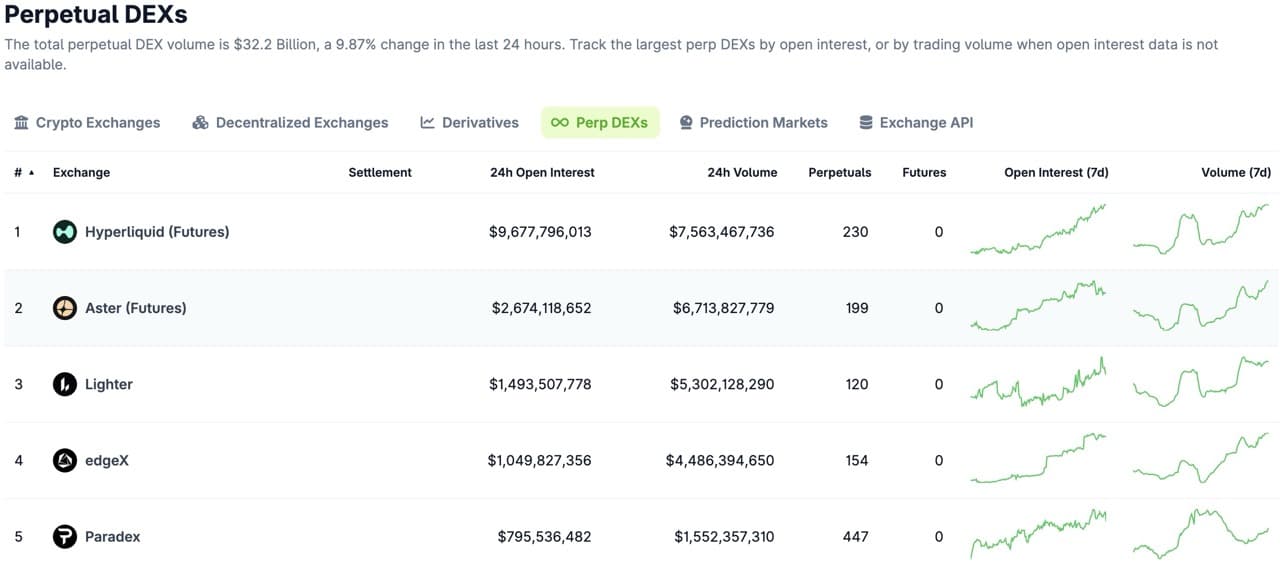
- Hyperliquid, Aster, Lighter, edgeX, and Paradex are among the most popular perp DEXs by trade volume.
Perpetual DEX Explained: Summary
This article goes beyond defining a perp DEX and explains how perpetual futures crypto trading actually works on decentralized platforms. It covers key mechanics like funding rates, leverage, margin, and liquidations, and shows how prices stay aligned with the spot market.
You’ll also learn how liquidity pools, oracles, and on-chain settlement power perp DEXs, along with the benefits and risks compared to centralized exchanges. The goal is to help readers understand not just what perp DEXs are, but how to use them responsibly.
What Is a Perp DEX?
A perp DEX is a platform that lets you trade no-expiry crypto futures contracts known as perpetual contracts. You can use perpetual contracts to go long or short on crypto prices without owning the underlying asset.
The use of leverage in perpetual futures trading enables traders to take positions that are larger than their available capital. Everything runs through smart contracts on perp DEXs and you keep control of your funds through your own crypto wallet.
In simple terms, a perp DEX is a crypto platform where you bet on price movements instead of buying coins. You can profit if prices go up or down, and you do not need to close the trade on a fixed date.
What Makes Perp DEXs Different from Traditional Futures Platforms?
The main benefits of a perp DEX over traditional futures exchange are self-custody, global access, transparency, no-KYC and no-expiry futures contracts.
What makes a perp DEX different is how it is built. There is no company holding your funds or approving trades. Trades are handled by code on the blockchain, and you connect using a non-custodial wallet like Best Wallet, which means you stay in control of your crypto.
Another key feature is perpetual contracts. These contracts never expire, so you can hold a position as long as you have enough margin. Prices are kept close to the real market using funding rates and oracle price feeds.
If you want to start using perp DEXs and trade crypto futures, Best Wallet offers a simple and easy-to-understand setup. Learn more about the platform in our dedicated Best Wallet review.
What Are Perpetual Contracts in Crypto?
A perpetual contract is a crypto derivative with no expiry date that lets traders speculate on price movements without owning the asset. Trades can remain open indefinitely as long as enough margin is maintained.
Traders use perpetual contracts because they allow both long and short positions and offer leverage. This gives traders larger exposure to price movements while using a relatively small amount of capital.
Instead of expiring, perpetual contracts use funding payments exchanged directly between long and short traders. A higher funding rate means long traders are paying more and sentiment is bullish, while a lower or negative rate points to bearish positioning.
Leverage makes perpetual contracts risky. Larger exposure means losses can build quickly even when prices move slightly.
Key Features & Components of a Perp DEX
A perp DEX is built from several core components that work together to enable perpetual trading without intermediaries. They are:
Funding Rates Explained (In Simple Terms)
Funding rates are regular payments that traders make to keep perpetual positions open. When the perpetual contract prices are higher than spot prices, long traders pay short traders. When the perpetual contract prices trade below the spot price, short traders pay long traders.
The payments are periodic and can vary from one exchange to another. For example, on Hyperliquid (HYPER) – the world’s most popular perp DEX by trading volume – funding rates are paid every hour. As per the Hyperliquid document,
Funding rates are designed to prevent large price disparities between the perpetual contract and the underlying asset. When the funding rate is high, it can incentivize traders to take the opposite position and help to bring the contract’s price closer to the spot price of the underlying asset.
Liquidation Mechanics on Perp DEXs
Liquidation refers to the automatic closing of a trade when losses become too large and the trader no longer has enough margin. Liquidations prevent further losses for the trader and protect the platform’s liquidity.
On a perp DEX, liquidations are handled by smart contracts without human intervention. When margin drops below a required level, the position is closed automatically.
These platforms rely on real-time price feeds from decentralized oracles. This reduces the risk of price manipulation but does not eliminate it entirely during extreme volatility.
Collateral and Margin Management
Collateral is the crypto you deposit to open and maintain a perpetual trade. It acts as a security deposit for the DEX and a safety buffer for traders as it absorbs losses when the market moves against the trader’s position.
Margin refers to the market value of collateral that is actively supporting your trade. As losses increase, available margin shrinks, bringing the position closer to liquidation.
Perpetual decentralized exchanges allow two types of margins:
- Cross Margin: Cross margin refers to using all available collateral in your account to support all open positions. This improves capital efficiency but means losses in one position can affect other positions using the same collateral.
- Isolated Margin: Isolated margin refers to limiting specific collateral to a single position or asset.
How Perpetual Decentralized Exchanges Work?
Perpetual decentralized exchanges allow traders to speculate on the cryptocurrency market using perpetual futures contracts in a decentralized manner.
These platforms operate as a 24/7 market, allowing traders to enter and exit positions at any time. This constant availability requires deep liquidity to ensure trades execute smoothly without large price swings.
Liquidity on a perp DEX comes from liquidity providers who supply capital to shared pools. These pools make decentralized trading possible by allowing traders to open and close positions without relying on a traditional order book.
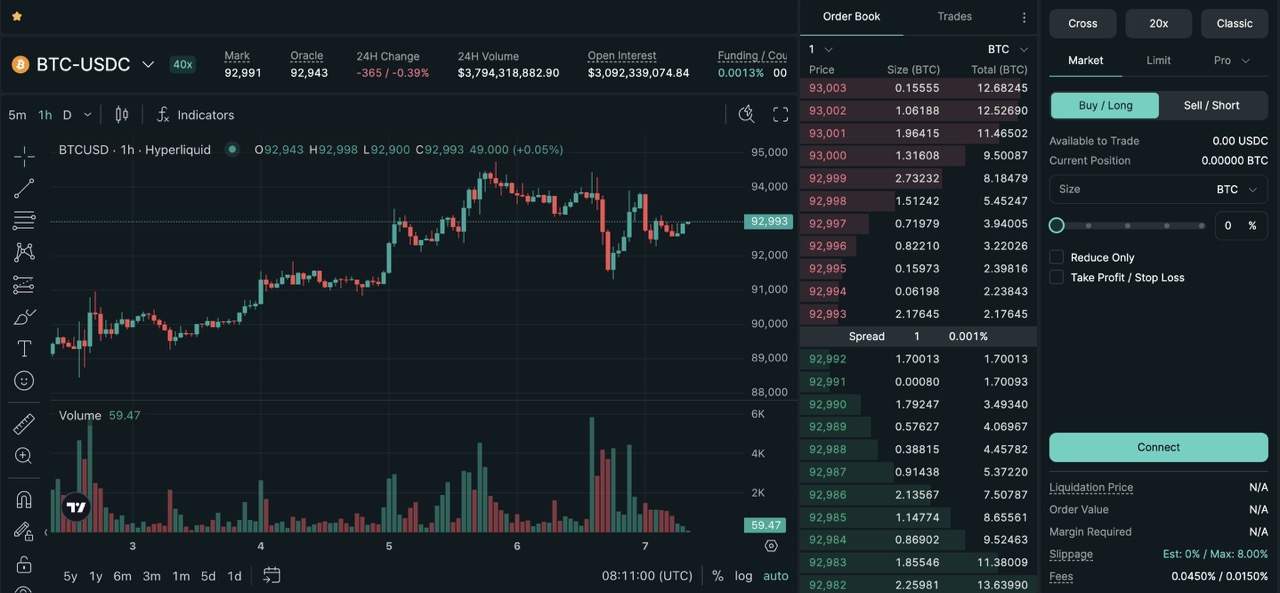
When a perpetual futures position is opened, the smart contract manages leverage, margin usage, unrealized profit and loss, and funding payments in real time. Trading fees are applied to each transaction and are typically paid to liquidity providers or the protocol.
Prices are sourced from Oracle feeds that aggregate data from external markets. This data is used to calculate mark prices, funding rates, and liquidation thresholds.
All activity uses on-chain settlement, meaning every trade and liquidation is recorded on the blockchain. This structure reduces counterparty risk but makes liquidity depth and smart contract design critical to system stability.
If you want to understand crypto futures before trading perpetuals, our Bitcoin Futures Trading Guide is a great place to start. You can then explore our roundup of the Best Crypto Futures Trading Platforms in 2026.
Pros & Cons of Trading Perpetuals on a DEX
Trading perpetuals on a DEX offers traders greater control, transparency, and access to leverage without relying on centralized platforms. At the same time, it comes with unique risks, including smart contract vulnerabilities, high volatility, and liquidation exposure. Understanding both the benefits and risks is essential before trading perpetuals on decentralized exchanges.
Pros
-
Perpetual DEXs enable decentralized trading of crypto futures derivatives.
-
Unlike traditional futures, perpetual futures have no expiry dates, allowing traders to keep open positions without rollovers.
-
Liquidity providers supply capital to liquidity pools, improving capital efficiency and supporting trade execution.
-
All trades use on-chain settlement, reducing counterparty risk common on centralized exchanges.
-
Trading fees are distributed to liquidity providers or the perpetual protocol, supporting decentralized derivatives markets.
-
Perpetual trading allows long or short positions on the underlying asset without owning the crypto.
Cons
-
Higher leverage increases risk, as leveraged positions can reach liquidation thresholds quickly in volatile markets.
-
Lower liquidity depth on some perpetual DEXs can lead to slippage during periods of high trading volume.
-
Smart contract vulnerabilities or oracle failures can impact derivatives trading and cause losses.
-
Funding rates and periodic payments can reduce returns when holding positions for long periods.
-
Risk management and collateral management are fully the trader’s responsibility in non-custodial trading environments.
-
Perpetual DEXs may face technical risks, including smart contract exploits, oracle manipulation, and systemic failures during high volatility.
Perp DEX vs. CEX Perpetuals (Conceptual Comparison)
A perp DEX and a centralized exchange both support perpetual futures trading, but they differ in custody, execution, and risk ownership. Perp DEXs operate within decentralized finance, while centralized exchanges run closed systems controlled by a company.
| Feature | Perp DEX | Centralized Exchange (CEX) |
| Trading model | Decentralized derivatives trading | Centralized derivatives trading |
| Custody | Self custody via crypto wallets (Eg. Best Wallet) | The exchange custodies funds for customers |
| Trade execution | Executed on-chain | Executed off-chain |
| Settlement | On-chain settlement | Internal settlement |
| Counterparty risk | Lower custodial risk, but exposed to smart contract bugs and exploits
|
Higher custodial risk if the exchange fails or freezes funds
|
| Liquidity | Provided by liquidity pools and virtual automated market makers | Order books with market makers |
| Liquidity depth | Depends on protocol and liquidity providers | Usually offers deep liquidity |
| Trading fees | Paid to liquidity providers or protocol | Paid to the exchange |
| Funding rates | Calculated on chain | Calculated by the exchange |
| Leverage | Protocol-defined leveraged trading | Exchange-defined leverage |
| Access | Permissionless | Account-based, often with KYC |
| Example | Hyperliquid, Aster, Lighter, edgeX, Paradex | Binance, Bybit, Gate.io, MEXC |
If you want to learn crypto futures trading without the complexity of perp DEXs or centralized exchanges, CoinFutures offers a gamified way to practice. The platform helps beginners understand risk and liquidations before trading real markets. Learn more about it in our full CoinFutures review.
Conclusion
Perpetual DEXs are growing rapidly as more traders seek flexible ways to manage risk and speculate on cryptocurrency markets. Concerns around custodial exposure and centralized platform failures have also pushed more activity toward decentralized platforms.
As crypto adoption grows, perpetual DEXs are expected to coexist alongside centralized exchanges as an alternative for traders who value transparency, control, and on-chain verification. Their use of real-time settlement, funding rates, and automated risk controls positions them as a core part of decentralized finance.
See Also:
- Risks Behind MicroStrategy’s Bitcoin Bet Explained
- Top Perpetual Decentralized Exchanges in 2026
- 99Bitcoins’ Q4 2025 State of Crypto Market Report
- Top Prediction Markets in October 2026
FAQs:
What is a perpetual contract?

A perpetual contract is a crypto derivative with no expiry date that lets traders speculate on crypto price movements without owning the asset.
What is perpetual trading?
Perpetual trading is the act of buying or selling perpetual contracts, allowing traders to go long or short using leverage as long as margin is maintained.
What collateral do Perp DEXes accept?
Most perpetual decentralized exchanges accept stablecoins like USDT or USDC, and some also allow popular crypto assets such as ETH or BTC. Using a non-custodial wallet like Best Wallet makes it easier to manage supported collateral across chains.
Are Perp DEXes safer than centralized exchanges?
Perp DEXes reduce custodial risk because users keep control of funds. However, they carry smart contract and oracle risks, which do not exist on centralized exchanges.
Can I trade perps with small amounts?
Yes, many platforms allow small position sizes due to leverage.
How do oracles affect Perp DEX pricing?
Oracles supply real-time price data from external markets. This data is used to calculate funding rates, mark prices, and liquidation levels.
How do liquidations work on a Perp DEX?
Liquidations happen automatically when margin falls below the required level, closing the position to prevent further losses.
What is the difference between mark price and index price on a perp DEX?
The index price tracks the spot market price from multiple sources. The mark price smooths short-term volatility and is used for funding and liquidation decisions.
References
- U.S. Commodity Futures Trading Commission. “Response to CFTC Request for Comment on Digital Asset Markets.” Commodity Futures Trading Commission, https://comments.cftc.gov/Handlers/PdfHandler.ashx?id=35619
- Cornell SC Johnson College of Business. “Perpetual Futures Contracts and Cryptocurrency.” Cornell SC Johnson College of Business, Feb. 2025, https://business.cornell.edu/article/2025/02/perpetual-futures-contracts-and-cryptocurrency/
- U.S. Commodity Futures Trading Commission. “Futures Market Basics.” CFTC.gov, https://www.cftc.gov/LearnAndProtect/AdvisoriesAndArticles/FuturesMarketBasics/index.htm.
- CoinGecko. “Decentralized Derivatives Exchanges.” CoinGecko, https://www.coingecko.com/en/exchanges/derivatives/decentralized
- Hyperliquid. “Funding Overview.” Hyperliquid Documentation, https://hyperliquid.gitbook.io/hyperliquid-docs/trading/funding#overview

Why you can trust 99Bitcoins
Established in 2013, 99Bitcoin’s team members have been crypto experts since Bitcoin’s Early days.
Weekly Research
100k+Monthly readers
Expert contributors
2000+Crypto Projects Reviewed