







Liquid Staking Derivatives (LSDs) and Liquid Restaking Tokens (LRTs) are two closely related tools built to make staking on Ethereum more flexible. Normally, when you stake your ETH, it gets locked up, meaning you can’t use it in DeFi or anywhere else.
LSDs and LRTs solve this limitation by giving you a liquid token that represents your staked or restaked ETH, so you can keep earning rewards while still putting your assets to work. In this guide, we’ll go over what LSDs and LRTs are, how they work, why they’ve become popular, and what risks there are to consider.
What Are Liquid Staking Derivatives?
Liquid Staking Derivatives, or LSDs, are tokens that stand in for cryptocurrency you’ve staked. When you stake ETH on Ethereum, typically, those coins get locked up. As a result, you can’t move them, trade them, or use them until you exit staking. LSDs address this by issuing a liquid token that represents your staked ETH, along with the rewards it earns. In other words, you get to stake and stay liquid at the same time.
LSDs really took off after Ethereum switched to Proof-of-Stake (PoS). Protocols like Lido, Rocket Pool, and Coinbase changed the game by issuing tokenized receipts for staked ETH; essentially, these are tokens that continue to earn rewards while also being usable throughout decentralized finance (DeFi). This made staking far more accessible, since users no longer had to choose between earning rewards or keeping control of their assets.
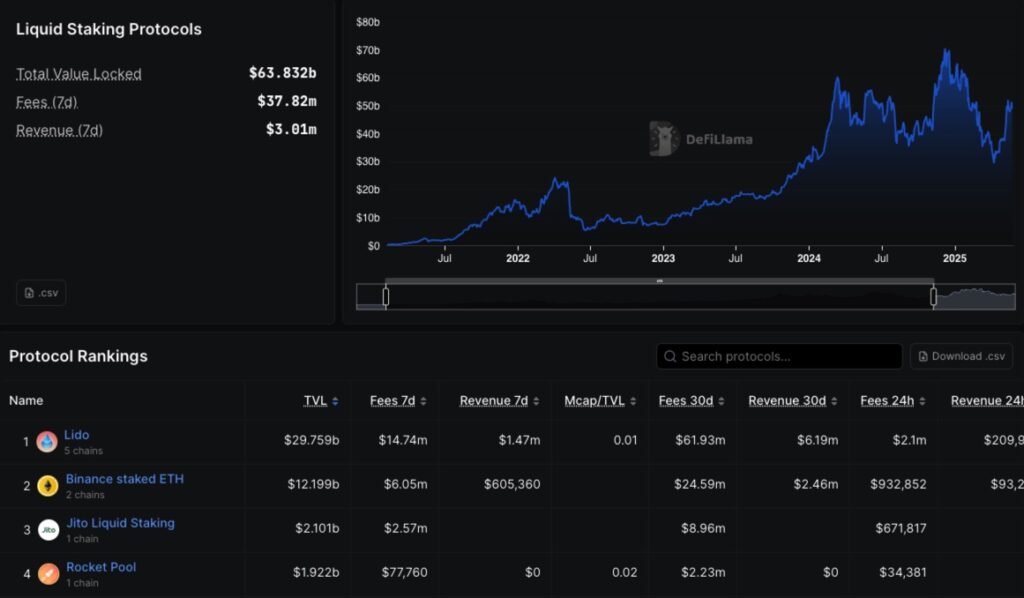
The basic process behind LSDs is straightforward. You deposit ETH into a liquid staking service, the service stakes it on Ethereum, and you receive a derivative token in return that you can utilize elsewhere. Depending on the protocol, this token either grows in value over time or adjusts its supply to reflect new rewards. When you’re ready, you can redeem it for the underlying ETH, though the exact redemption rules differ from one platform to another.
How LSDs Are Used
The biggest reason people love LSDs is simple: they turn locked staking positions into liquid assets you can actually use. Since LSD tokens can move around like any other crypto, they plug directly into the whole DeFi toolbox. You can lend them out, supply them as liquidity on DEXes, or use them as collateral in different yield strategies. This has created a massive ecosystem where staked ETH becomes productive collateral, i.e., it can move through multiple protocols at once.
Benefits of LSDs at a Glance:
| Solo Staking | Liquid Staking | |
| Liquidity | Tokens are locked |
Creates derivative asset that can be used in DeFi
|
| Rewards | Yiels are often higher |
Lower yields but can auto compound
|
LSDs also make staking way more accessible. Running your own validator normally requires technical know-how and as much as 32 ETH, which is out of reach for most people. Liquid staking platforms remove those barriers by letting anyone stake any amount of ETH, no hardware or setup required. Because of this, liquid staking now accounts for a large share of all ETH staked on the network.
What Is Restaking?
Restaking is a newer idea brought to life by EigenLayer. It basically lets your staked ETH work overtime. Instead of securing only the Ethereum network, restaking allows you to reuse your staked ETH, or even your LSDs, to help secure extra networks called Actively Validated Services (AVSs). AVSs can be anything from oracle networks and data-availability layers to rollup sequencers. In short, they’re specialized protocols that benefit from having serious economic backing behind them.
What makes restaking powerful is that you don’t need to lock up more assets. You’re using the same ETH collateral twice: once to secure Ethereum, and again to secure the AVSs you choose. In return for taking on extra responsibility, you can earn additional rewards on top of your regular staking yield.
Please note that restaking is fully optional. You pick the AVSs you want to support, and each one has its own reward model, requirements, and possible penalties. Since the entire restaking ecosystem is still in its infancy, new AVSs and strategies are constantly emerging, making it one of the fastest-moving segments in Ethereum at the moment.
What Are Liquid Restaking Tokens?
Liquid Restaking Tokens, or LRTs, are basically the liquid, tradeable version of assets that have been deposited into EigenLayer or similar restaking platforms. They work a lot like LSDs, but with an extra layer of rewards and complexity. When you deposit ETH or an LSD into an LRT platform, the service restakes those assets through EigenLayer. In return, you get an LRT that represents your combined position: your stake on Ethereum and your restaked position securing various AVSs.
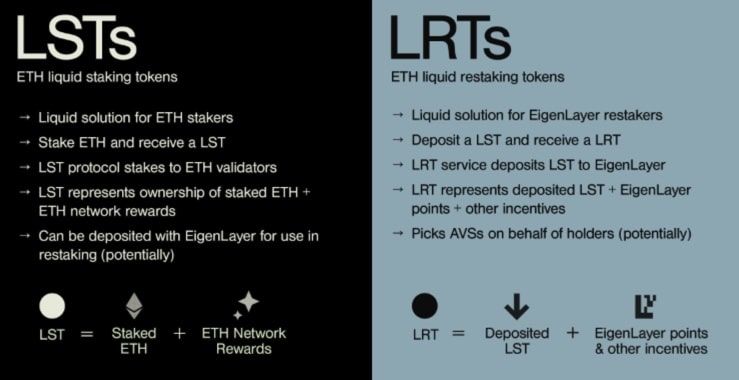
The appeal of LRTs is that they combine multiple yield streams in a single token. One LRT can earn you standard Ethereum staking rewards, restaking rewards from the AVSs you’re helping secure, and often additional incentives or potential airdrops offered by the LRT protocol itself. And because LRTs stay liquid and transferable, you can move them around, trade them, or use them in DeFi while still benefiting from everything happening under the hood in the restaking ecosystem.
How LRTs Work
LRTs are created by protocols that plug directly into EigenLayer. The process is simple:
You deposit ETH or an LSD like stETH,
The protocol restakes it into EigenLayer and assigns it to one or more AVSs,
The protocol then issues you an LRT that represents your entire restaked position.
From there, you can trade that LRT, use it in DeFi, or later redeem it for the underlying assets plus any rewards you’ve earned along the way.
Different LRT platforms take different approaches. Some spread your restaked assets across multiple AVSs to reduce risk, while others let you pick and choose exactly which services you want to support. Plus, many also introduce extra incentives, like governance tokens or points systems, to reward early adopters and boost participation.
Why LRTs Are Suddenly a Thing
EigenLayer’s shared-security model has taken off because it lets new protocols “borrow” Ethereum’s security instead of building their own validator network from scratch. In practice, this makes it much easier to launch new infrastructure services. Also, it opens up fresh earning opportunities for users who restake their ETH as collateral.
As more AVSs come online, the demand for restaked collateral keeps growing. That’s exactly where LRTs step in: they give everyday users a simple way to get exposure to the EigenLayer ecosystem without dealing with the technical side of running validators. On top of that, many LRT projects are rolling out points programs, user incentives, and potential airdrops, which naturally boost adoption even further.
Risks & Considerations
Both LSDs and LRTs run on smart contracts, which means they share the usual risks of decentralized protocols. LSDs have been around for years, so they are generally viewed as stable, but even they can depeg or face liquidity crunches when markets get shaky.
LRTs come with all of those risks plus the extra layer of exposure to AVSs. Each AVS can set its own slashing rules, uptime requirements, and performance standards. And because the whole ecosystem is still brand new, there aren’t any widely adopted best practices yet, and we don’t know how these systems will behave under real stress. Still, the promise of higher yields and wider participation keeps users piling in, even with the added uncertainty.
LSDs vs. LRTs: What’s the Difference?
If you need more clarity, here’s a TL;DR breakdown of the differences between LSDs and LRTs:
| What They Make Liquid | What They Represent | What You Earn | Overall Risk | |
| LSDs | Ethereum staking | A claim on staked ETH + regular staking rewards |
Standard ETH staking yield | Lower risk, single yield stream |
| LRTs | Restaking | A claim on restaked ETH/LSDs + staking rewards + restaking rewards from AVSs |
Standard ETH staking yield; restaking rewards from multiple AVSs; protocol incentives, points, or airdrops | Higher risk, multi-layered yield (staking + restaking + incentives) |
Conclusion
Liquid staking derivatives and liquid restaking tokens represent major advancements in how users interact with staking on Ethereum. LSDs helped unlock staked ETH and integrate it into DeFi, while LRTs expand that idea into the emerging restaking economy. When combined, they provide fresh opportunities to improve network security, earn rewards, and contribute to the development of decentralized infrastructure.
As the ecosystem evolves, both technologies are likely to play a central role in shaping how users engage with staking and security in the years ahead.
See also:
- What is Liquid Staking & How Does it Work?
- Top 13 DeFi Staking Platforms in 2026
- Ethereum Staking: How to Stake ETH in 2026
- What is Polymarket & How Does it Work?
FAQs
What is the difference between Liquid Staking Derivatives and Liquid Restaking Tokens?

Liquid Staking Derivatives represent ETH that has been staked on the Ethereum network, while Liquid Restaking Tokens represent ETH or LSDs that have been deposited into restaking protocols, e.g., EigenLayer. LSDs earn normal Ethereum staking rewards, and LRTs earn both staking and restaking rewards from AVSs. LRTs generally carry a higher risk and potentially higher returns.
Do LRTs replace LSDs?
No. LSDs are still the base layer for liquid staking. LRTs are built on top of LSDs and extend their functionality by allowing the underlying assets to be used for securing additional networks.
Are LRTs riskier than LSDs?
Yes. LSDs primarily carry smart-contract and liquidity risks. LRTs add a set of risks tied to the AVSs they secure. These include new slashing conditions, operational expectations, and the possibility of correlated failures across multiple services.
How do restaking rewards work?
Restaking rewards come from Actively Validated Services (AVSs) that use EigenLayer’s shared security. Each AVS defines its own incentive structure, which may include token rewards, points, airdrops, or service-specific fees. Rewards vary widely depending on the AVS and the platform chosen for delegating restaked assets.
Can the value of an LRT depeg?
Yes. Like LSDs, LRTs can trade below their theoretical value when liquidity is low or when market uncertainty increases. Depegs may occur during periods of high demand for redemptions or concerns about AVS-related risks.
Can I redeem an LRT for underlying ETH?
Yes. However, the process varies by protocol. Some LRTs support instant redemptions using liquidity pools, while others rely on a native redemption queue similar to Ethereum’s validator exit queue. Redemption times can range from instant to several days, depending on network conditions and protocol design.

Why you can trust 99Bitcoins
Established in 2013, 99Bitcoin’s team members have been crypto experts since Bitcoin’s Early days.
Weekly Research
100k+Monthly readers
Expert contributors
2000+Crypto Projects Reviewed