





In This Article
The x402 protocol is Coinbase’s attempt to fix a simple problem: the internet can send data everywhere, but money still moves like it’s stuck in the dial-up era. With x402 Protocol, a client requests a resource, the server responds with a 402 Payment Required status code, and the buyer settles the bill using automatic stablecoin payments directly through HTTP, no accounts, no API keys, no friction.
The Coinbase x402 protocol brings clean payment instructions, a signed payment payload, and instant settlement in digital dollars so apps, APIs, and AI agents can programmatically pay for access. It’s an open protocol designed for developers who want real internet native payments with minimal setup and verifiable value flow.
Quick Facts: x402 Protocol
Key Takeaways
- x402 is an open payment protocol that uses the 402 Payment Required status code to enable internet-native payments.
- Clients receive payment requirements, create a signed payment payload, and repay the request using the X-PAYMENT header.
- The protocol enables instant stablecoin settlement in digital dollars, ideal for APIs, apps, and AI agents.
- A payment facilitator verifies signatures, handles on-chain settlement, and returns the requested resource once paid.
- x402 eliminates accounts, API keys, and manual payment flows, offering minimal setup for developers.
- Buyers, wallets, and resource servers interact directly through open standards, allowing seamless programmatic payments.
What is the x402 Protocol?
The x402 protocol is an open standard that transforms HTTP into a payment rail. A client hits a protected endpoint, the server returns a 402 Payment Required response with clear payment requirements, and the buyer replies with a signed payment payload attached through the X-PAYMENT header.
If the signature and terms check out, the server responds with the requested resource. There’s no account system, no API keys hidden in an .env file, and no custom billing platform glued to your stack. Just internet native payments delivered through standard request/response flows.
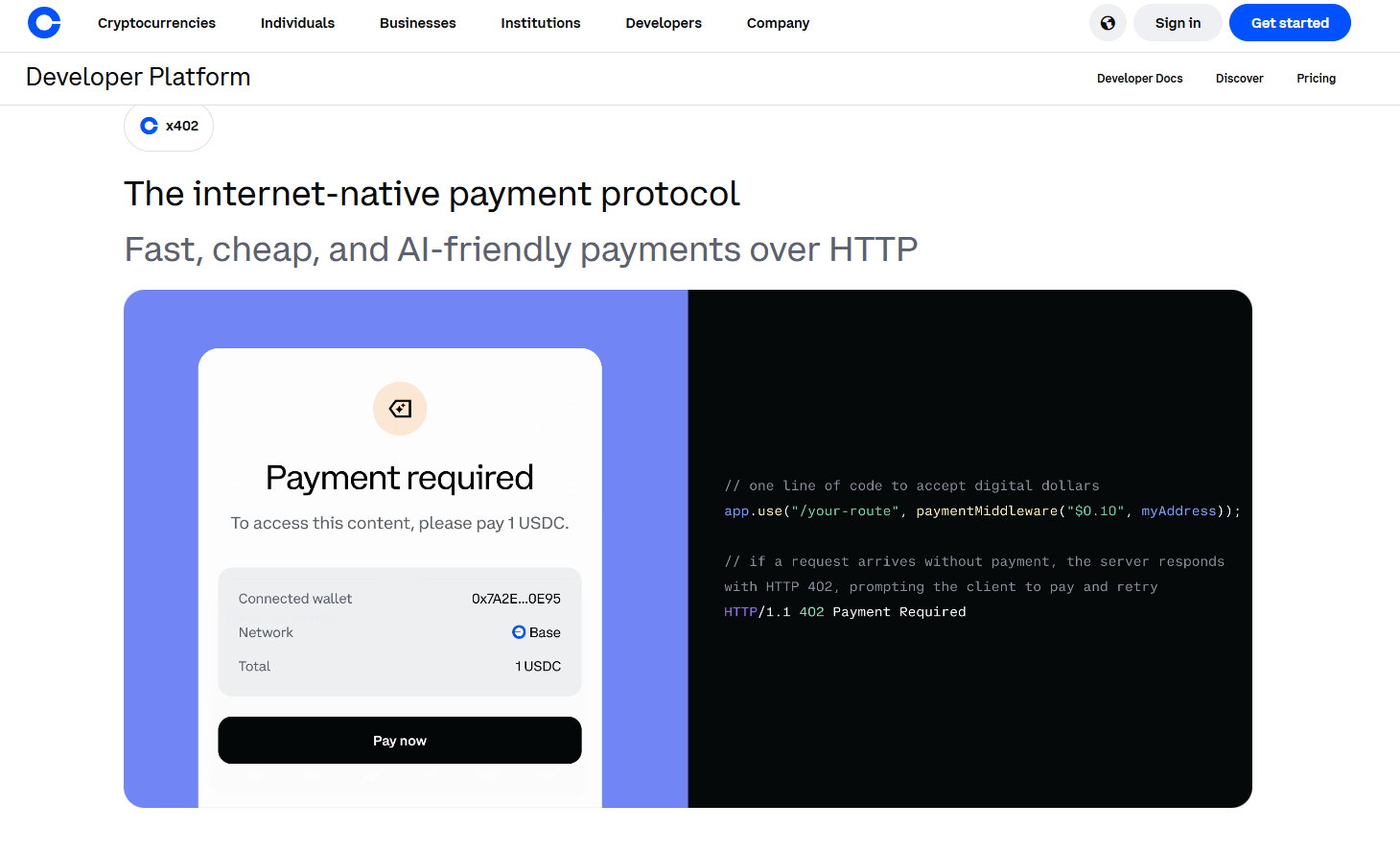
It’s a system built for developers and AI agents seeking to autonomously pay for paid services, consuming data and APIs without friction.
Instead of reinventing monetization, x402 makes the web behave like it should have from the beginning: a network where software can programmatically pay for value in digital dollars.
X402 Foundation
The X402 Foundation exists to keep the protocol open, stable, and vendor-neutral. Its stewardship focuses on maintaining the spec, ensuring the payment flows stay interoperable across wallets, servers, and facilitator implementations. Part of that work includes supporting reference implementations like templates that developers can rely on when wiring x402 into apps, resource servers, and facilitator servers.
Interoperability is a core priority. The foundation backs ecosystem programs that help teams ship integrations, improve server tooling, and build new facilitator models so developers can accept digital dollars with minimal setup. Any improvements to the protocol move through an open proposal process, where contributors submit changes, debate refinements, and track progress through transparent changelogs. The work stays public, so developers always know how the spec is evolving.
Whitepaper & Docs
The x402 whitepaper lays out the fundamental problem: the web has a status code for payments, but no protocol that actually uses it. From there, it defines how payment instructions should be communicated, how signatures are verified, how settlement occurs, and how the protocol defends against spoofing, replay attacks, and malformed payment messages. The document maps every step of the payment flow, from the moment a client requests access to settlement to the server unlocking the resource. According to the official x402 whitepaper,
x402 is a new open payment protocol developed by Coinbase that enables instant, automatic stablecoin payments directly over HTTP. By reviving the HTTP 402 Payment Required status code, x402 lets services monetize APIs and digital content onchain, allowing clients, both human and machine, to programmatically pay for access without accounts, sessions, or complex authentication.
The developer docs complement the whitepaper with practical guidance. They break down the core components (resource servers, wallets, facilitators), explain how payment details should be represented in the response body, and offer quickstart guides for both buyers and sellers. There’s guidance on using environment variables, working with Base Sepolia for testing, configuring server wallets, and verifying payments. For developers tracking updates, the docs maintain clean revision logs and changelogs so new releases don’t catch anyone off guard.
Background – The Need for a Web-Native Payment Layer
The modern web can authenticate users, encrypt traffic, and route data across the planet, but it still can’t natively move money. Everything involving value requires scaffolding: accounts, API keys, subscription systems, or proprietary gateways. These models work for humans but fall apart for automated workloads, particularly as AI agents begin consuming vast amounts of data, APIs, and compute. Machines need a way to pay for what they use, not a signup flow.
Problem with Traditional Web Payments
Traditional payments assume identity before value. They require custody, account management, and settlement rails that were never built for machine-to-machine transactions. They also fail to offer a clean way for software to programmatically pay for granular access; each request forces the developer to engineer their own billing layer.
x402 fixes this by embedding the signal directly in the protocol. When a 402 Payment Required status appears, the client knows exactly what to pay, how much, in what asset, and where. It signs the payment, resends the request, and the server returns the resource. Payments become just another message in the HTTP cycle, precise, verifiable, and completely transparent.
How the x402 Protocol Works?
The x402 flow is simple: the client requests a protected resource, the server responds with a 402 Payment Required status containing the payment requirements, and the buyer returns a signed payment payload via the X-PAYMENT header.
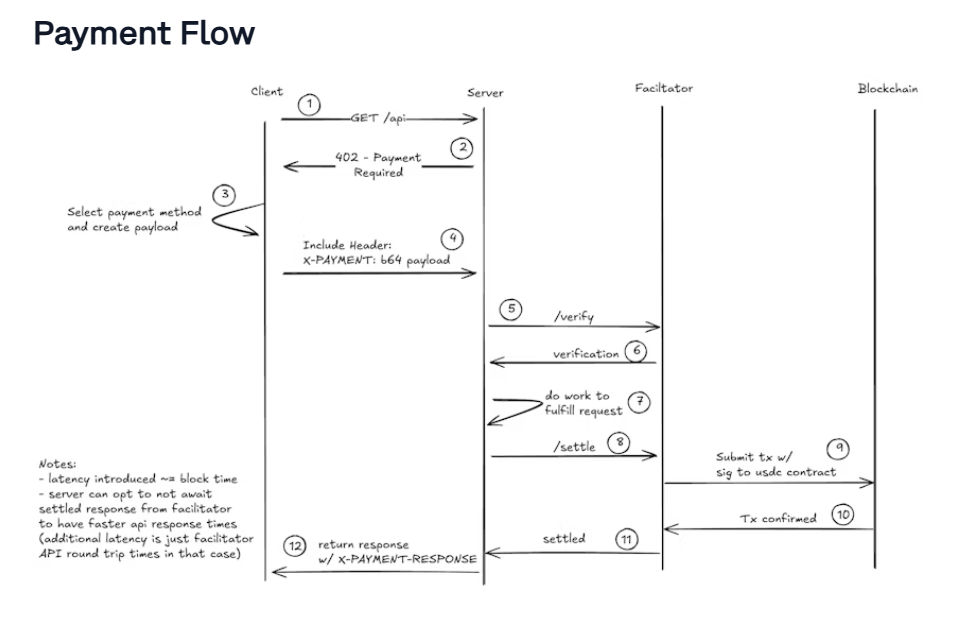
If everything checks out like signature, amount, asset, and destination, then the server returns the requested resource. It’s money moving through pure HTTP, allowing apps, wallets, and AI agents to programmatically pay for API calls, compute cycles, data streams, or any granular digital service.
Coinbase x402
Coinbase provides the first full production implementation of the spec, giving developers a turnkey way to get started without handling raw settlement or building verification logic from scratch. Their tooling includes a facilitator server, reference libraries, and streamlined quickstarts that allow sellers to accept digital dollars with minimal configuration.
The Coinbase flow abstracts the operational burden so developers can stay focused on the product instead of stitching together crypto wallets, settlement infrastructure, and signature verification.
Coinbase’s dashboards help track incoming x402 payments, resource-level revenue, API usage, and facilitator activity. For projects that require compliance checks, Coinbase also offers KYT and automated screening services, giving developers a clean on-ramp for regulated environments. Everything is designed to make the payment lifecycle (from request to settlement) predictable and observable.
Core Components of x402 Protocol
A few moving parts give the protocol its simplicity and flexibility. The resource server is responsible for returning the 402 Payment Required response, generating the terms of the payment, and unlocking the resource once a valid signature arrives.
It doesn’t need to manage accounts or authenticate users, just enforce the rules for each endpoint and verify that the payment matches the advertised price.
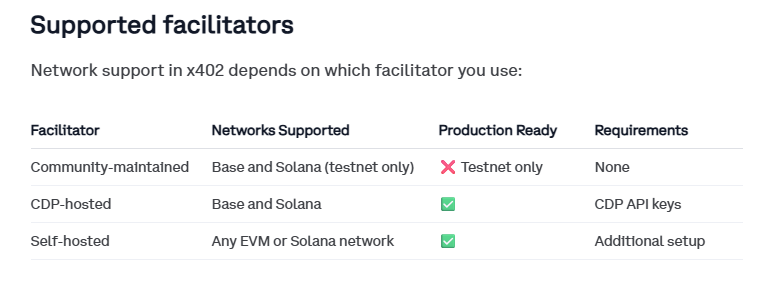
A payment facilitator plays the role of verifier and settlement agent. It checks the buyer’s signature, submits transactions on-chain, monitors confirmation, and reports the final settlement status back to the server. Facilitators ensure that payments are handled transparently, even when developers don’t want to run their own nodes or infrastructure.
Wallets create and sign the payment payload, using a private key to authorize the transfer. Client libraries handle the heavy lifting like pulling the payment details from the response body, formatting the payload, signing it, and attaching it to the retry request. This lets buyers, apps, and agents interact directly with x402-protected endpoints.
The protocol also defines standard headers and schemas. The X-PAYMENT header carries the signed payload. The JSON schemas define how the server describes its payment details, including amount, asset, expiry, and settlement parameters. These shared formats ensure every implementation (wallet, server, facilitator) speaks the same language.
Payments & Assets
x402 focuses on stable, predictable settlement which is why the default flow today uses USDC for payments. Stablecoins offer instant finality on fast L2s, making them ideal for microtransactions and machine-to-machine transactions where compute and data APIs might be billed every few seconds.
Finality and chargeback resistance are major advantages. Once the payment lands on-chain and is verified by the facilitator, the server can release the resource without worrying about reversals or clawbacks. Reconciliation becomes deterministic: every request maps to a signed transaction and a specific resource access.
Fees fall into two buckets: network fees (paid on the settlement chain) and any optional facilitator or infrastructure fees. The protocol itself doesn’t impose a fee layer; it leaves pricing models up to the ecosystem and the specific facilitator implementation.
How Developers Can Implement x402 Protocol?
Developers can drop x402 into their existing stack with minimal restructuring. Servers define the price of an endpoint, return a 402 Payment Required response when needed, and verify the signed payload on the retry request. Buyers, whether humans, scripts, or AI agents seeking to make autonomous calls, rely on wallet libraries to generate and sign the payment.
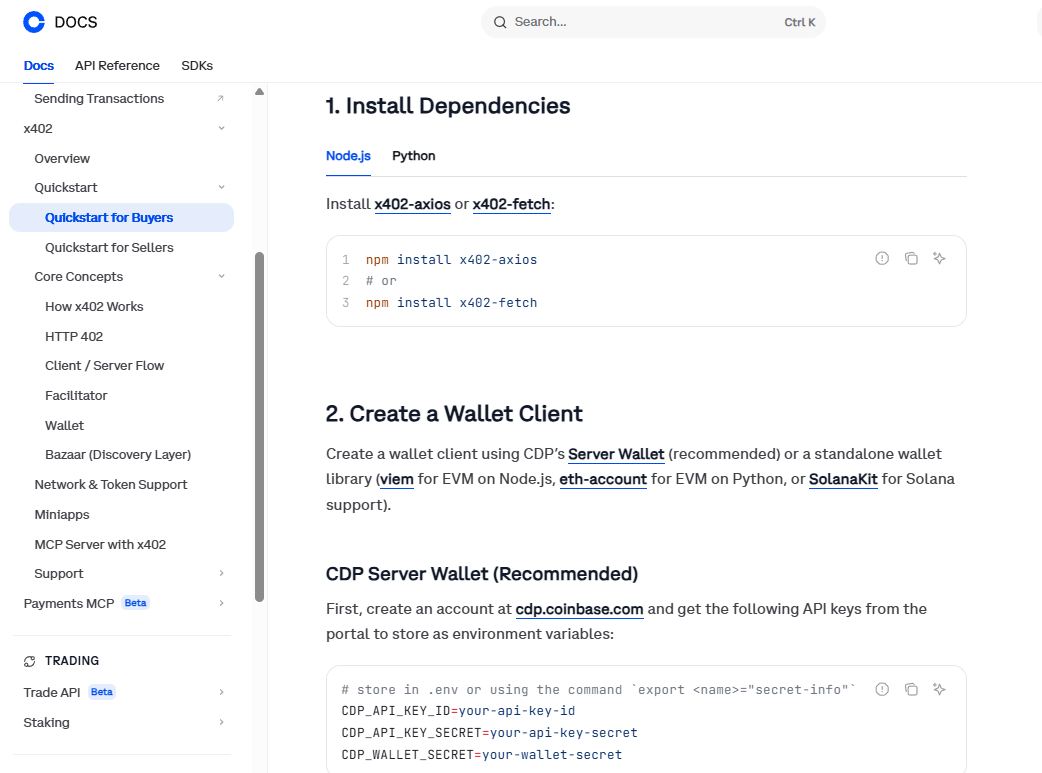
The only configuration most developers need is a facilitator API key, a receiving wallet, and some environment variables. From there, the flow runs automatically: request, price, payment, retry, and access.
Wallets & Agent Integrations
Wallets sit at the center of the x402 world. They hold funds, sign the payment payload, and give agents a way to authorize spending on the fly. For AI-driven apps or autonomous workloads, wallets act as both identity and treasury, allowing agents to pay for data, compute, and intelligence without a human in the loop. Integrations are handled through client SDKs that manage signing, message formatting, and submission. Agents simply read the server’s payment details, sign, and repay the request.
Security, Compliance & Observability
x402 defines a clean threat model. Servers must defend against spoofed signatures, replayed payments, and under/over-payment attempts. Facilitators enforce additional verification, ensuring the payment matches the original terms and settles cleanly.
For compliance-sensitive environments, third-party KYT and OFAC screening services can be applied at the facilitator layer before settlement. This allows businesses to enforce regulatory requirements without modifying the core protocol.
Observability is built into the flow. Developers can monitor revenue per endpoint, track incoming payments, review settlement states, and watch balances in real time. Because every payment is tied to a specific request/response cycle, analytics become precise and deterministic, ideal for usage-based billing and high-volume API traffic.
Real-World Use Cases of the x402 Protocol
x402 opens the door for payments that behave like any other HTTP request, which means it fits anywhere software needs to unlock value without human steps. APIs become metered services: a client hits an endpoint, pays in digital dollars, and gets back exactly what it asked for. Data providers can sell access by request instead of forcing subscriptions or API keys that leak and get abused.
AI systems are an obvious fit. Agents that generate code, query models, or scrape structured data can simply pay when the server returns 402 Payment Required, attach a signed payload, and continue running. The agent economy needs a protocol-level way to spend money (not a login page), and x402 delivers that.
It also works for content platforms, analytics dashboards, SaaS features, compute resources, and microtransaction-heavy workflows. Any service that wants to meter usage or charge per-call can adopt the protocol without redesigning its entire billing stack.
Comparisons & Alternatives
x402 isn’t the only attempt to bring payments online, but it’s the first that uses native web semantics.
Compared to the Lightning Network, x402 prioritizes developer simplicity and predictable stablecoin settlement. There’s no channel management, no routing failures, and no liquidity constraints. Instead of maintaining payment channels, developers work with a clean request-response loop.
Against Solana Pay, x402 is protocol-level rather than app-level. Solana Pay is built for point-of-sale and QR flows; x402 is built for API requests, agents, and server-to-server payments where every millisecond matters.
| Alternative |
How It Differs from x402
|
| Lightning Network |
Needs payment channels and routing
|
| Solana Pay |
Built for QR/checkout, not API payments
|
| Interledger / Web Monetization |
Uses streaming payments, not request-based
|
| Traditional Paywalls |
Requires accounts, API keys, and credentials
|
Relative to Interledger/Web Monetization, x402 focuses on explicit payments triggered by a specific request, not streaming micropayments tied to content consumption.
And when stacked against traditional paywalls and API keys, x402 cuts away the account system entirely. No password resets, no rate-limit bypassing, no credential leakage. Buyers programmatically pay and retry the request, nothing more.
Each alternative has strengths, but x402 excels when the priority is simplicity, transparency, and clean integration into existing HTTP flows.
Challenges, Risks & Adoption Barriers
No emerging payment protocol escapes friction. x402 depends on stablecoin rails and facilitator infrastructure, which means adoption hinges on developer trust, wallet support, and reliable settlement. Some teams may hesitate to redesign existing billing systems that already “work,” even if they’re held together with API keys and spreadsheets.
There’s also the question of standardization. While the spec is open, broad adoption requires multiple facilitator implementations, diverse wallets, and a growing ecosystem of reference libraries. If those pieces lag, early adopters may feel pinned to Coinbase’s tooling longer than intended.
Regulated businesses must also navigate compliance. Although facilitators can integrate KYT and OFAC screening, not every company is ready to accept digital dollars or adapt to crypto-native settlement.
Still, these barriers tend to shrink as the ecosystem matures. When payments are reduced to a single 402 Payment Required cycle, the long-term advantages become too compelling to ignore.
Conclusion
x402 gives the web something it’s never had: a native way to send money as easily as sending a request. A client hits a resource, gets the price, signs the payment payload, and retries the call using the X-PAYMENT header. The resource server verifies the payment, unlocks the content, and the workflow continues without accounts, API keys, or manual approval gates.
For developers and AI agents, this means the internet becomes a marketplace of services where value transfers cleanly, transparently, and without the overhead of legacy rails. For businesses, it offers a way to meter access, charge per request, and settle instantly in digital dollars with minimal infrastructure.
If the machine-driven future needs a payment layer (one built for automation, precision, and clarity) x402 is the first credible blueprint. The web has always been a network of data. x402 pushes it one step further: a network where software can finally pay for what it consumes.
DISCOVER:
- Crypto Exchange Promos & Discounts
- Crypto Wallet Promos & Discounts
- What Is Monad Crypto? Features & Why It Matters
- What is DeFAI? A Beginner’s Guide
- Crypto Market Cycles: Are We Still Following 4-Year Pattern?
FAQs
How do x402 payments work in practice?

A client requests a protected resource, the server returns a 402 Payment Required response with the payment terms, and the buyer generates a signed payment payload. The client retries the request with the X-PAYMENT header, the server or facilitator verifies the signature and settlement, and, if valid, returns the requested resource. The entire flow runs through standard HTTP, allowing software to programmatically pay without accounts or API keys.
What is Coinbase x402, and how does it differ from the x402 Protocol itself?
The x402 Protocol is the open standard, anyone can implement it, extend it, or build their own facilitator. Coinbase x402 is a production-ready implementation that provides the first facilitator server, developer tooling, observability dashboards, and quickstarts. In short: the protocol is the blueprint; Coinbase x402 is the most mature toolkit built on top of it.
What is the x402 Foundation?
The X402 Foundation is the independent steward of the protocol. It maintains the spec, coordinates ecosystem standards, supports reference implementations, and manages revisions or proposed upgrades. Its role is to ensure x402 evolves as an open, chain-agnostic, interoperable payment layer for the web.
Does x402 require a specific chain or asset?
No. The protocol is asset-agnostic and chain-agnostic. It defines how payments flow through HTTP, not where settlement occurs. Coinbase’s implementation currently uses USDC on Base for predictable, low-fee payments, but the standard itself can support any chain, asset, or settlement model as long as it follows the x402 verification rules.
Is x402 suitable for AI agents and per-request API billing?
Yes. x402 is built for machine-to-machine payments, making it ideal for AI agents, automated workloads, and API access priced per request. Agents can read the payment requirements, sign the payload, and repay the request autonomously. This removes the need for accounts, subscriptions, or manual payment flows.
What are credible alternatives to the x402 Protocol for achieving similar use cases?
Alternatives include the Lightning Network for fast Bitcoin payments, Solana Pay for merchant and point-of-sale flows, and Interledger/Web Monetization for streaming micropayments across networks. Traditional paywalls and API keys can replicate some of the business logic, but none deliver x402’s combination of HTTP-native semantics, stablecoin settlement, and frictionless programmatic payments.
References
- Coinbase. “Welcome to x402 – Coinbase Developer Documentation.” Coinbase, docs.cdp.coinbase.com/x402/welcome
- “The Basics about Cryptocurrency.” SUNY Oswego – CTS, www.oswego.edu/cts/basics-about-cryptocurrency
- U.S. Congress. Cryptocurrency: Selected Policy Issues. CRS Report R47425, 15 Feb. 2023. congress.gov/crs-product/R47425
- Joseph, Junie. Digital Currencies and Cross-Border Payments: An Overview. U.S. International Trade Commission Executive Briefings on Trade, Apr. 2023. usitc.gov/publications/332/executive_briefings/ebot_digital_currency.pdf
- Brookings Institution. “Crypto, Digital Assets, and the Future of Payments System.” Brookings, 22 Sept. 2022. www.brookings.edu/events/crypto-digital-assets-and-the-future-of-payments-system/

Why you can trust 99Bitcoins
Established in 2013, 99Bitcoin’s team members have been crypto experts since Bitcoin’s Early days.
Weekly Research
100k+Monthly readers
Expert contributors
2000+Crypto Projects Reviewed