




In This Article
Decentralized finance is entering its next evolution. DeFAI, short for AI-powered DeFi, blends artificial intelligence with blockchain-based financial protocols to create smarter, faster, and more adaptive financial systems. As traditional DeFi grows more complex, users are demanding better tools for risk management, yield optimization, and decision-making.
That’s where DeFAI comes in. Using machine learning, automation, and on-chain data transforms how users interact with decentralized finance. In this article, we’ll break down what DeFAI is, how it works, and why AI in DeFi could redefine the future of crypto finance.
Key Takeaways
- DeFAI combines decentralized finance with AI to automate decision-making, optimize capital allocation, and improve on-chain efficiency.
- Unlike traditional DeFi, DeFAI protocols can adapt in real time using AI models that respond to market conditions, liquidity shifts, and risk signals.
- DeFAI systems rely on decentralized data inputs and on-chain execution, reducing dependence on centralized intermediaries and black-box algorithms.
- Use cases for DeFAI include AI-powered trading strategies, automated lending and borrowing optimization, smart liquidity management, and on-chain analytics services.
- While DeFAI unlocks powerful new capabilities, it also introduces risks such as model transparency issues, data quality concerns, and smart contract vulnerabilities.
What Is DeFAI? (Definition & Core Concept)
DeFAI refers to the integration of artificial intelligence technologies, such as machine learning, predictive analytics, and autonomous agents, into decentralized finance (DeFi) protocols. The core idea behind DeFAI is to make DeFi more efficient, intelligent, and user-friendly by allowing AI systems to analyze massive amounts of on-chain and off-chain data in real time.
Unlike traditional DeFi, which relies heavily on manual strategy execution and static smart contracts, DeFAI introduces adaptive systems that can optimize yields, manage risk, detect anomalies, and even execute trades autonomously. This creates a new layer of intelligence on top of DeFi, enabling smarter lending, trading, portfolio management, and governance decisions.
At its heart, DeFAI aims to reduce complexity for users while improving capital efficiency and performance across decentralized financial markets. DeFAI helps simplify DeFi for users and reduces the effort required to manage a DeFi strategy effectively.
How DeFAI Works?
DeFAI works by combining AI models with blockchain-based smart contracts to create automated, data-driven financial systems. Here’s how the process typically functions:
Together, this fusion of AI automation and decentralized finance infrastructure enables more responsive, efficient, and scalable financial applications, pushing DeFi beyond static protocols into dynamic, intelligent systems.
On-Chain AI Models
At the core of DeFAI are on-chain AI models that live directly on the blockchain or interact with it in a trust-minimized way. Unlike traditional AI systems that run on centralized servers, these models are designed to operate transparently, with verifiable logic and deterministic outputs.
Smart contracts can reference AI-generated signals, such as risk scores, price forecasts, or portfolio recommendations, without relying on a single centralized provider.

While fully on-chain AI is still constrained by compute costs, many DeFAI protocols use hybrid architectures. In these setups, heavy model training happens off-chain, while inference results, proofs, or model updates are anchored on-chain.
This approach balances scalability with decentralization, ensuring users can audit how decisions are made while still benefiting from advanced machine learning.
AI-Driven Automation
One of DeFAI’s biggest breakthroughs is AI-driven automation in decentralized finance. Instead of users manually managing positions, AI agents can automatically rebalance portfolios, optimize yield strategies, manage collateral, or execute trades based on predefined goals and risk parameters. This is the real special sauce to DeFAI.
These autonomous systems operate 24/7, reacting to market conditions faster than human traders ever could. For example, an AI agent might detect rising volatility and reduce leverage, rotate capital into safer pools, or exit positions before liquidation thresholds are reached.
Because these actions are executed through smart contracts, they remain transparent, permissionless, and non-custodial. Users retain full control over their funds while delegating strategy execution to AI logic.
Decentralized Data Inputs
Reliable data is essential for AI-powered DeFi, which is why decentralized data inputs play a critical role in DeFAI systems. These inputs come from on-chain activity, decentralized oracles, governance signals, social sentiment feeds, and even cross-chain data sources. By aggregating data from multiple trust-minimized providers, DeFAI protocols reduce the risk of manipulation or single points of failure.
Advanced DeFAI platforms combine price oracles with behavioral and network-level data, giving AI models a more holistic view of the market. This enables smarter decision-making that extends beyond simple price action, factoring in liquidity flows, whale movements, protocol health, and user activity. The result is a more adaptive and resilient DeFi ecosystem powered by decentralized intelligence.
DeFAI really takes the decentralized interconnected world of Web3 DeFi to the next level by interoperating with many different decentralized systems.
Tokenomics in DeFAI Systems
Tokenomics plays a critical role in DeFAI protocols, acting as the coordination layer between users, AI agents, data providers, and governance participants. DeFAI tokenomics are some of the most interesting tokenomic models in all of crypto.
Unlike traditional DeFi tokens that mainly focus on governance or fee capture, DeFAI tokens are often multi-functional, designed to align economic incentives across both financial and computational activity.
At a high level, DeFAI tokens are typically used to pay for AI-driven services such as automated trading strategies, portfolio rebalancing, risk modeling, or predictive analytics. Users may spend tokens to activate AI agents, subscribe to advanced models, or unlock premium automation features. This creates direct demand tied to real protocol usage rather than pure speculation.

Many DeFAI systems also use tokens to incentivize data contribution and model performance. Data providers can earn tokens for supplying high-quality on-chain or off-chain data, while AI model operators may be rewarded based on accuracy, uptime, or profitability.
Poor-performing models can be penalized through slashing or reduced rewards, introducing a merit-based economy similar to validator incentives in proof-of-stake networks.
Governance is another key demand sink. Token holders often vote on model upgrades, risk parameters, treasury allocations, and which AI agents are approved for deployment. In more advanced designs, governance decisions themselves may be assisted by AI simulations that model outcomes before proposals are executed.
Finally, some DeFAI protocols incorporate staking or bonding mechanisms, where tokens are locked to secure the network, reduce spam, or signal long-term alignment. As DeFAI matures, tokenomics is increasingly shifting away from inflation-heavy rewards toward sustainable fee-based models driven by real AI utility on-chain.
Key Features of DeFAI
DeFAI, or decentralized finance powered by artificial intelligence, blends smart contracts with machine‑learning models to make on‑chain investing more automated and adaptive. Instead of manually hopping between protocols, users can delegate many decisions to AI agents that continuously react to market data and on‑chain signals. At its core, DeFAI enables –
Best DeFAI Coins to Buy
When looking for promising DeFAI projects, start by focusing on fundamentals rather than hype. Look for teams that clearly explain how they use AI, with whitepapers and docs that go beyond buzzwords and show concrete models, data sources, and on‑chain mechanisms.
Investors must note, most DeFAI projects are still early-stage and experimental. Strong narratives, but higher risk; best to approach with research and caution. Below is a list of some top DeFAI coins.
Tips to Find the Top DeFAI Coins
Finding the best DeFAI coins requires looking beyond hype to identify projects that truly combine artificial intelligence with real on-chain utility. The strongest opportunities lie in platforms that deliver measurable automation, smart risk management, and long-term value within decentralized finance.
How to Invest in DeFAI?
Getting exposure to DeFAI usually starts with a crypto wallet that can hold multiple EVM-compatible assets, connect to dApps, and make it easy to track new AI-related tokens as they launch.
A wallet like Best Wallet can act as your DeFAI hub: you can store OLAS, FET, and other AI-focused tokens, connect to DeFi dashboards, and explore new protocols without constantly switching apps or seed phrases. By keeping your DeFAI coins in one secure, user-friendly interface, you’re better positioned to react to new launches, provide liquidity, or stake tokens as opportunities appear.
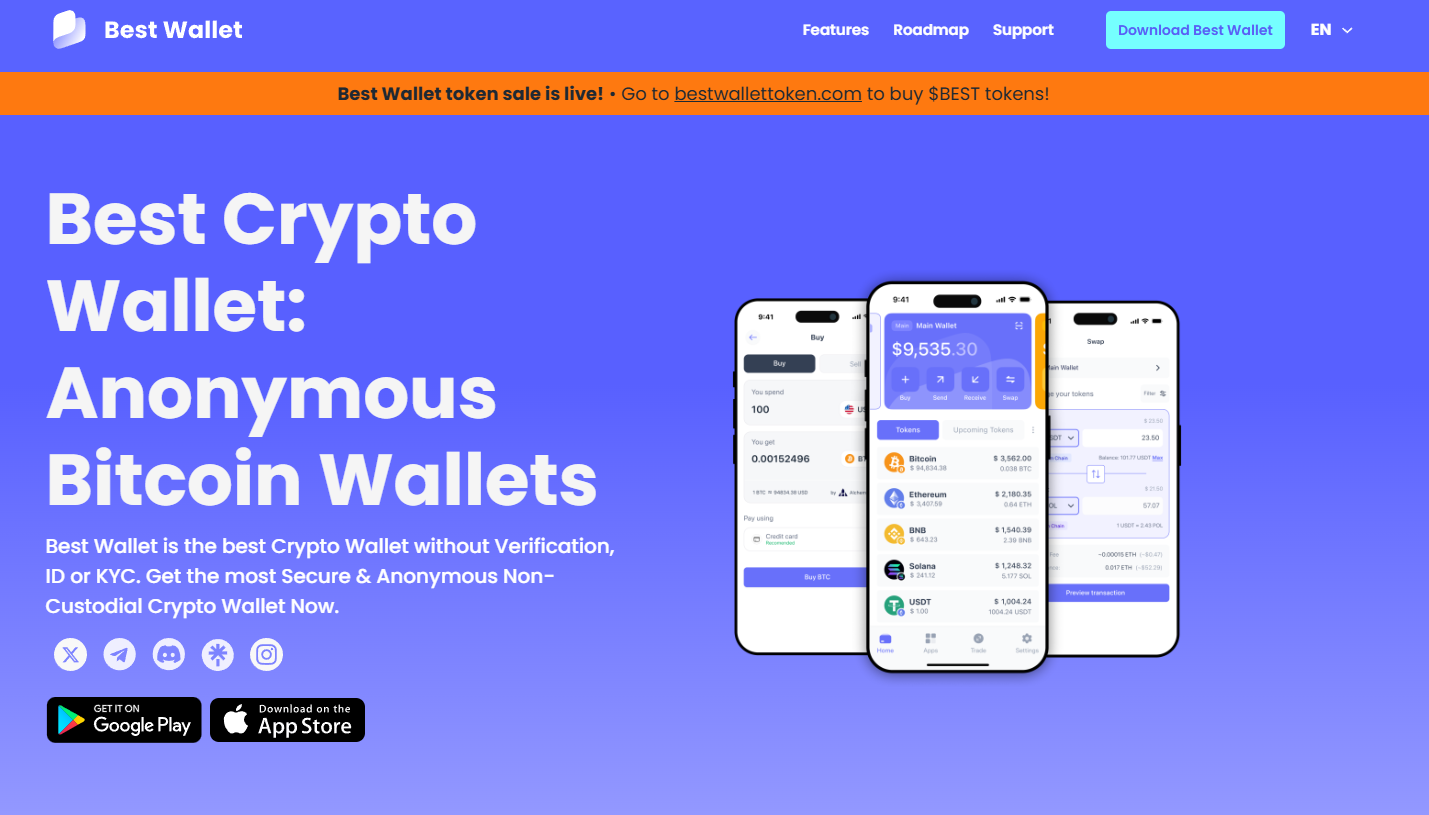
The wallet supports multiple blockchain networks, including Ethereum, Solana, and BNB Chain. But what really sets it apart is its built-in DEX, which allows users to swap tokens instantly without relying on a third-party interface.
Step-by-Step Guide to Investing in DeFAI
Follow these steps to set up Best Wallet, fund it, and start collecting your favorite DeFAI tokens like OLAS and FET.
-
Download and Set Up Best Wallet
Install Best Wallet on your preferred device and create a new wallet with a strong passphrase. Securely back up your recovery phrase offline so you can always restore access if needed.
-
Fund Your Wallet With Base Assets
Deposit crypto such as ETH or stablecoins into Best Wallet from an exchange or another wallet. These base assets will be what you swap into DeFAI coins like OLAS and FET.
-
Swap Into DeFAI Tokens
Use Best Wallet’s integrated swap or dApp browser to access a reputable DEX (for example, Uniswap or a similar EVM DEX). Search for OLAS, FET, or other DeFAI tokens, double-check contract addresses, and swap a portion of your ETH or stablecoins into these assets.
-
Organize and Track Your DeFAI Portfolio
Create a dedicated “DeFAI” watchlist or folder inside Best Wallet so your AI-related holdings are grouped together. Monitor prices, balances, and network fees directly in the app so you can decide when to rebalance or take profits.
-
Connect to DeFAI Protocols From Your Wallet
Use Best Wallet’s dApp connection feature to access DeFAI platforms (AI-driven yield aggregators, agent networks, etc.) without leaving the wallet environment. From there, you can stake, provide liquidity, or participate in governance using the same DeFAI coins you’re already holding, making the wallet your central command for AI-powered DeFi.
Differences Between DeFi and DeFAI
DeFi focuses on rule-based financial protocols that rely on smart contracts, while DeFAI enhances these systems with artificial intelligence to enable smarter, adaptive decision-making. Take a look at the differences between the two concepts.
| Feature | DeFi (Decentralized Finance) | DeFAI (AI-Powered DeFi) |
|---|---|---|
| Decision Making | Human-driven strategies and manual parameter tuning | AI models dynamically optimize strategies, risk, and execution |
| Automation Level | Rule-based smart contracts (static logic) | Adaptive automation powered by machine learning and on-chain agents |
| User Experience | Requires active user management and DeFi knowledge | Abstracted complexity with AI-driven recommendations and auto-execution |
| Risk Management | User-defined limits and static safeguards | Real-time risk assessment using predictive AI models |
| Capital Efficiency | Fixed strategies and preset allocations | AI reallocates capital dynamically based on market conditions |
| Data Inputs | Primarily on-chain data (prices, liquidity, oracles) | Combines on-chain data with AI-processed signals and off-chain datasets |
| Strategy Adaptability | Slow to adjust without governance updates | Continuously evolving strategies through model retraining |
| Governance | Token-holder voting and DAO proposals | AI-assisted governance with simulation and outcome forecasting |
| Examples | Uniswap, Aave, Compound | Fetch.ai-based DeFi agents, Numerai-style AI coordination layers |
| Core Value Proposition | Trustless finance without intermediaries | Intelligent, self-optimizing finance without human bottlenecks |
Real-World Use Cases of DeFAI
We are now seeing Artificial Intelligence popping up in many aspects of our daily lives. Whether that be through LLM queries, AI image generators, or AI content on social media, it is hard to escape AI at the moment.
Similarly, DeFAI is moving beyond theory and into real-world applications that improve efficiency, decision-making, and capital allocation across DeFi. By embedding AI models directly into decentralized systems, DeFAI enables smarter, more adaptive financial infrastructure without relying on centralized intermediaries.
AI-Powered Investment Platforms
One of the most compelling DeFAI use cases is AI-driven investing. These platforms use on-chain data, market signals, and machine learning models to optimize portfolio allocation, rebalance assets, and manage risk in real time. Unlike traditional robo-advisors, DeFAI investment tools operate transparently on-chain and can adapt instantly to market volatility, liquidity shifts, or changing macro conditions.
An example of an AI‑powered investing platform is alphaAI Capital, a next‑generation robo‑advisor that uses machine learning to manage portfolios, including crypto exposure, leveraged ETFs, and dynamic risk management.
AI-Optimized Lending & Borrowing Protocols
DeFAI is also transforming decentralized lending markets. Lending markets are already one of decentralized finances greatest hits and innovations, but adding AI only makes them better.

AI models can dynamically adjust interest rates, collateral requirements, and liquidation thresholds based on borrower behavior, market volatility, and liquidity conditions. This results in more efficient capital utilization, reduced bad debt, and improved risk management compared to static DeFi lending models.
AI-Driven DEX Tools
Decentralized exchanges are increasingly integrating AI to enhance trading efficiency. DeFAI-powered DEX tools can optimize routing, detect MEV activity, predict slippage, and identify abnormal trading behavior. Some systems also use AI to assist with liquidity provisioning, helping LPs adjust strategies based on real-time market conditions and fee optimization.
On-Chain AI Services
Beyond trading and lending, DeFAI enables fully on-chain AI services. These include decentralized oracles enhanced by AI filtering, autonomous smart contract agents, fraud detection systems, and protocol governance tools. By operating on-chain, these AI services remain transparent, verifiable, and censorship-resistant, key advantages over centralized AI infrastructure.
Benefits & Risks of DeFAI
Benefits Risks
DeFAI vs. CeFI AI Platforms
While both DeFAI (Decentralized Finance + AI) and centralized AI systems aim to automate decision-making and optimize outcomes, they differ fundamentally in architecture, incentives, and control.
CeFi AI systems are typically owned and operated by a single company or institution. Models are trained on proprietary datasets, executed on private servers, and governed by opaque rules. Users benefit from speed, polish, and convenience, but must trust that the system is acting fairly, handling data responsibly, and not changing rules mid-game.
In finance, this often means black-box trading algorithms, custodial risk, limited transparency, and restricted access. The significant difference is that DeFI AI platforms are closed systems that run unknown algorithms on unknown datasets, whereas DeFAI systems operate on transparent, public blockchains.
DeFAI systems, by contrast, are built on public blockchains and smart contracts. The AI logic, decision rules, and execution paths are often verifiable on-chain or through open-source code.
Instead of a single owner, incentives are aligned through tokens, governance, and decentralized participation. Data inputs can come from oracles, on-chain activity, and decentralized data markets, reducing reliance on any one data provider. Most importantly, execution happens trustlessly through smart contracts, not intermediaries.
| Feature | DeFAI Systems |
Centralized AI Systems
|
| Ownership | Community-driven, token-governed |
Single company or entity
|
| Transparency | On-chain logic, auditable smart contracts |
Black-box models
|
| Execution | Trustless, automated via smart contracts |
Custodial, off-chain
|
| Data Sources | On-chain data, oracles, decentralized feeds |
Proprietary, closed datasets
|
| Censorship Risk | Low | High |
| User Control | Non-custodial |
Custodial or permissioned
|
In short, CeFi AI optimizes for efficiency and control, while DeFAI optimizes for trust minimization, composability, transparency, and open access. As DeFAI matures, it aims to bring AI-driven automation to finance without sacrificing the core crypto ethos of transparency and user sovereignty.
Conclusion
DeFi has arguably been crypto and Web3‘s biggest breakout success of all time. For a while, DeFi was the hottest sector in the entire crypto space, where most of the money and attention flowed. AI then became the biggest tech sector of the 2020s as it also saw product market fit almost immediately with the release of ChatGPT. Then came the combo of AI and crypto, a new sector that gained a lot of attention in 2023.
DeFAI combines both of these incredibly popular technologies and has made some amazing improvements. Through automation, DeFAI helps eliminate human error from DeFi strategies, enhancing an already highly profitable approach. By layering AI-driven execution, risk management, and yield optimization on top of battle-tested DeFi primitives, it has the potential to make on-chain finance feel both smarter and more accessible to everyday users.
See Also:
- Risks Behind MicroStrategy’s Bitcoin Bet Explained
- Cameron & Tyler Winklevoss: Net Worth & Crypto Connection
- Crypto Market Cycles: Are We Still Following 4-Year Pattern?
- What is a Perp DEX? Perpetuals Explained
- What is Polymarket & How Does it Work?
FAQs
Are DeFAI cryptocurrencies safe?

DeFAI is still early and experimental, so no DeFAI cryptocurrency can be considered fully “safe,” but some are better designed and better managed than others. Safety depends on factors like audited smart contracts, transparent AI models and data sources, strong security practices, liquidity depth, and how battle-tested the protocol is in real market conditions. AI agents also introduce risks such as adversarial inputs, data poisoning, and opaque decision-making, so position sizing and diversification are critical.
Are new or low-cap DeFAI coins more likely to explode?
New or low-cap DeFAI coins can sometimes “explode” in price because thin liquidity and hype make them more sensitive to inflows. However, that same illiquidity makes them far more vulnerable to sharp crashes, manipulation, and whale-driven pumps and dumps, so they should be treated as high-risk trades rather than guaranteed moonshots.
What’s next for DeFAI?
DeFAI is likely moving toward intent-based UX, where users specify goals (“earn stable yield,” “hedge downside”) and AI agents handle routing, risk controls, and execution across protocols. As tooling, regulation, and security improve, the probable long-term winners will be projects that pair clear AI value-add with robust DeFi integrations and transparent, explainable systems instead of pure narrative-driven speculation.
References
- Everything You Need to Know About Decentralized Finance AI. Nansen, www.nansen.ai/post/defai-explained-everything-you-need-to-know-about-decentralized-finance-ai. Accessed 23 Dec. 2025.
- “DeFAI Explained: How AI Agents Are Transforming Decentralized Finance.” Ledger Academy, 9 June 2025, www.ledger.com/academy/topics/defi/defai-explained-how-ai-agents-are-transforming-decentralized-finance. Accessed 23 Dec. 2025.
- “What Is DeFAI? Top 9 DeFAI Projects in 2025.” Binance Square, www.binance.com/en/square/post/19991137531969. Accessed 23 Dec. 2025.

Why you can trust 99Bitcoins
Established in 2013, 99Bitcoin’s team members have been crypto experts since Bitcoin’s Early days.
Weekly Research
100k+Monthly readers
Expert contributors
2000+Crypto Projects Reviewed