




In This Article
The Monad blockchain has been popping up in more conversations lately, mostly because people want crypto apps that feel quick and easy without changing how they already build or interact.
This guide walks you through what makes Monad (MON) appealing, how it actually works under the hood in a simple way, and why so many builders are keeping an eye on its upcoming mainnet launch.
Quick Facts About Monad Layer-1 Chain
Key Takeaways
- Monad feels like Ethereum but runs way faster and costs less to use
- Apps don’t need major changes to work here, it supports the same stuff Ethereum does
- You can try it out safely using the testnet and earn airdrop rewards by actually using it
- The mainnet went live on November 24, 2025
- Monad works well for trading apps, games, social platforms, and any project that needs speed
What is Monad Crypto?
Monad is a next-generation Layer 1 blockchain that takes everything people already like about Ethereum and gives it a noticeable upgrade. It keeps full EVM compatibility with the Ethereum Virtual Machine, so developers can bring over existing Ethereum smart contracts and any other EVM compatible projects without touching the code.
Since it also supports full EVM bytecode compatibility, the experience feels instantly familiar for anyone who has built on the Ethereum blockchain or worked with other EVM compatible chains.
Everything becomes easier because the network is designed to handle multiple transactions without slowing down. Apps that are usually tough to scale, like trading platforms, social apps or payment systems, feel smoother on Monad because the chain aims to be a scalable and efficient platform that fits modern expectations in the crypto industry.
It does this with a refined execution engine and a high-performance storage system known as Monad’s custom database, which helps the network stay responsive even when activity ramps up.
Architecture and Performance Model
Monad’s architecture focuses on giving developers familiar tools while opening the door for much stronger performance. This balance is what makes the chain appealing to Ethereum developers, since they keep their normal workflow while gaining the benefits of faster execution and lower overhead.
Execution Model and EVM Compatibility
Monad keeps EVM compatibility, so code written for Ethereum behaves exactly as it should. The chain supports full bytecode compatibility, which means contracts run the same way while gaining a major boost in speed.
A lot of this comes from how Monad executes work. Instead of relying purely on sequential execution, the chain uses a mix of parallel execution, parallel processing, asynchronous execution, optimistic parallel execution, interleaved execution and deferred execution.
These methods let the network process transactions across multiple cores at the same time, which helps apps stay responsive when the workload gets heavy. The design also reduces communication overhead, avoiding the slowdowns linked to older data structures like the Merkle Patricia Trie.
All of this creates a smooth, reliable and high-performance EVM experience that still feels familiar to developers.
Consensus Overview and Finality Expectations
Monad uses a custom Byzantine Fault Tolerance system called the MonadBFT consensus mechanism, which focuses on strong security and quick confirmations. With globally distributed validating nodes, the network aims for sub-second finality, giving apps the kind of responsiveness that makes a difference during busy periods or time-sensitive interactions.
This setup makes the network feel consistently fast, even as more users and applications join.
Throughput Goals and What They Mean
Monad has shared a target of around 10,000 transactions per second. This is a significant goal for an EVM-compatible blockchain, especially one that keeps full EVM compatibility and supports existing smart contracts without modification.
Actual performance will depend on real-world usage, network activity and validator setups, but these goals show that Monad is built with ambitious capacity in mind as the Monad public mainnet grows within the blockchain ecosystem.
Monad Labs and Monad Foundation
The ecosystem is guided by two core groups that work together while focusing on different responsibilities. Monad Labs handles the engineering, research and technical improvements, while the Monad Foundation oversees governance, programs and broader community involvement.
Roles, Stewardship and Governance Vision
Since Monad Labs leads development, the Monad Foundation focuses on transparency, participation and long-term direction. This structure opens the door for developers, validators and community members to have a meaningful voice, which helps keep the network grounded in the wider blockchain ecosystem rather than relying on a single decision maker.
How Updates Move Through the System
Upgrades follow a structured proposal process, similar to the formats used by other major networks. Validators and contributors take part in reviewing changes, while engineering work continues in Category Labs. This mix keeps updates steady, thoughtful, and community-aligned.
Community Programs, Grants and Ecosystem Growth
Monad invests heavily in ecosystem development, offering grants, hackathons and builder programs that support new ideas across decentralized finance, gaming, social platforms and more. These efforts create an environment where teams feel supported as they experiment, build and grow, making Monad an inviting place for developers who want both performance and a strong community.
Testnet Guide
The Monad testnet gives you a safe place to explore how the network works before anything goes live on mainnet. You can connect a crypto wallet, try out apps, deploy simple contracts and see how the chain behaves under real activity.
The whole point is to learn the network early, understand what it feels like to build on it and help the team gather feedback that improves performance and stability.
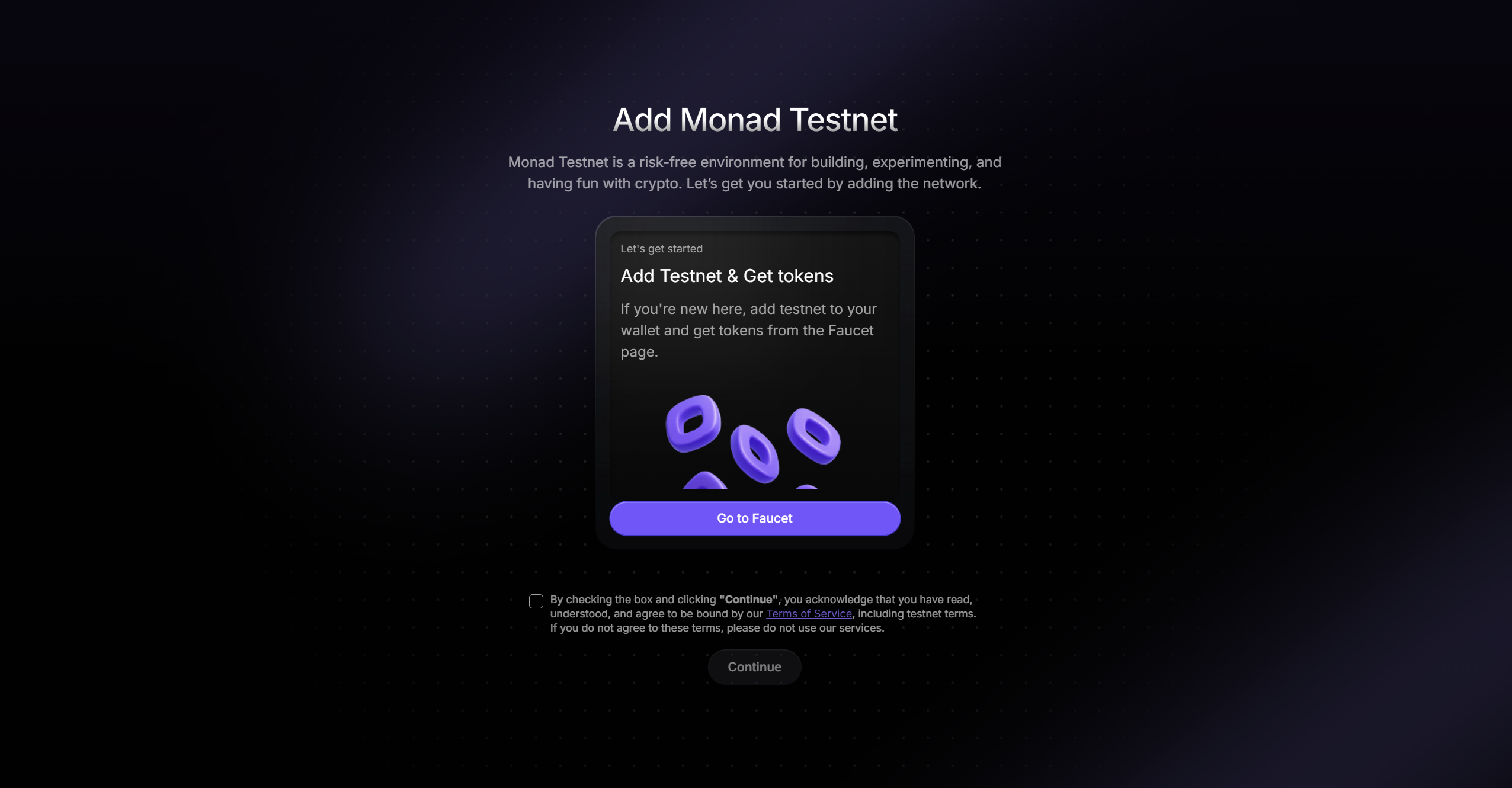
The testnet for the MON network is basically your playground before everything goes live on mainnet. It gives you a chance to mess around with the chain, try different apps, see how fast everything feels and get comfortable with the setup without risking anything.
As you go through it, you start building a clear on-chain footprint, and that can end up being really useful later since many projects look at genuine testnet usage.
How to Join the Monad testnet?
To get started, you just need an EVM-compatible wallet. MetaMask, Phantom Wallet, Backpack, OKX Wallet and Uniswap Wallet all work fine. When you open the testnet page with some of these wallets, the network might get added automatically, and if it doesn’t, you can add it yourself in a few seconds.
You simply fill in the network details:
Once that’s done, your wallet knows exactly where to send your transactions. Now you head over to the faucet, paste your wallet address or connect your wallet, and request some testnet MON.
These test tokens don’t have any real value, but they let you pay gas fees and interact with the whole ecosystem. As soon as the tokens show up, you can start playing around with everything the testnet offers.
Faucets, RPC Endpoints & Using the Explorer
After you’ve added the RPC endpoint and claimed some test tokens, you can move straight into the fun part. With a funded wallet, you can mint NFTs, deploy contracts, send transactions or try out swaps, and all of this activity gets recorded on the testnet explorer.
The explorer makes it really easy to keep track of what you’re doing because you can:
Since everything is recorded automatically, you end up with a full history of how you used the testnet. This matters a lot because projects often look for wallets that interacted with many different apps, not just wallets that claimed tokens and disappeared.
Deploying Demo Contracts & Collecting Feedback Logs
If you want to dive deeper, you can start deploying simple contracts just to see how the chain behaves. It doesn’t need to be anything big. Most people start with basics like:
- A small ERC20 token
- A test NFT collection
- A tiny contract that calls another app
- A simple staking or yield script
- A basic game interaction
Once the contract is deployed, you test it by sending transactions, calling different functions and checking how it behaves. You might send a bunch of transfers back-to-back, mint a few NFTs, try out a liquidity pool or push different error cases just to see what happens. Everything gets recorded in the explorer, and you can review the logs to understand exactly what the chain did with your request.
It helps to keep your own notes too, so you can look back at how active you were. Many people track things like:
By the time you finish the testnet, you’ll have plenty of experience with the network, and your wallet will show a natural usage pattern instead of one or two shallow interactions.
How to Follow Official Mainnet Launch Date Updates
The Monad mainnet and the MON token went live on 24 November 2025 at around 9 a.m. Eastern Time. Staying updated is straightforward once you follow the official channels.
To stay on top of everything, you can keep an eye on updates about:
The monad.xyz site handles the major announcements, and the blog gives more detailed breakdowns. Their X and Discord pages also share quick reminders and progress notes as launch day gets closer.
Pre Mainnet Readiness Checklist for Teams
If you’re preparing to launch a project on Monad mainnet, it helps to organise a smooth plan long before the actual release. You can start by reviewing every contract you deployed on testnet and making sure it behaves correctly under different conditions. Once you feel confident, you prepare a final version to deploy on mainnet.
You then adjust your user interface and backend so they point to the mainnet chain ID, the mainnet RPC endpoint and the correct mainnet block explorer. This step avoids confusing users and ensures your app reads and writes to the proper network from day one.
If your app has a token, you also prepare its distribution schedule and decide how liquidity will be added. Some teams also set up staking or reward systems, so having these ready before launch keeps everything organised.
Clear user onboarding is also important because people need to know how to connect to the Monad mainnet and how to claim or move tokens properly. Once you’ve handled the user side, you take care of security by deploying with a clean wallet, reviewing admin permissions and turning on monitoring tools. Doing all of this ahead of time helps your project transition into the mainnet environment without unnecessary stress.
Migration Notes for Projects Moving From Testnet to Mainnet
If your project already lives on the testnet, you should treat mainnet as a fresh start. Testnet tokens do not convert into real assets, so your contracts and token addresses will be completely different once you move. This means you redeploy your contracts on mainnet and then update your app so users interact with the proper addresses.
Your interface must switch from testnet RPC details to mainnet ones, and you need to replace every testnet explorer link with the mainnet explorer. It’s also important to communicate clearly with your users, since they need to know exactly what changes and how they can continue using your app safely. If your project measured testnet activity for future rewards, you should map those records to mainnet addresses carefully so everything lines up correctly.
After launch, you monitor your project closely because mainnet traffic can behave very differently from testnet usage. Gas fees shift, transaction loads grow, and user behaviour becomes more unpredictable. Keeping an eye on everything ensures you can respond quickly to anything that needs adjusting.
Airdrop Overview
The MON airdrop is set up to reward people who actually spent time using the network during its early stages, and it gives credit to the users who explored the testnet instead of just checking in once. Since the airdrop is tied to the mainnet launch, everything is laid out clearly so the distribution feels fair and easy to understand.
Typical Eligibility Patterns Projects Use
The MON token has a total supply of 100 billion, and 10.8 billion MON will unlock at launch, which comes out to 10.8% of the full supply.
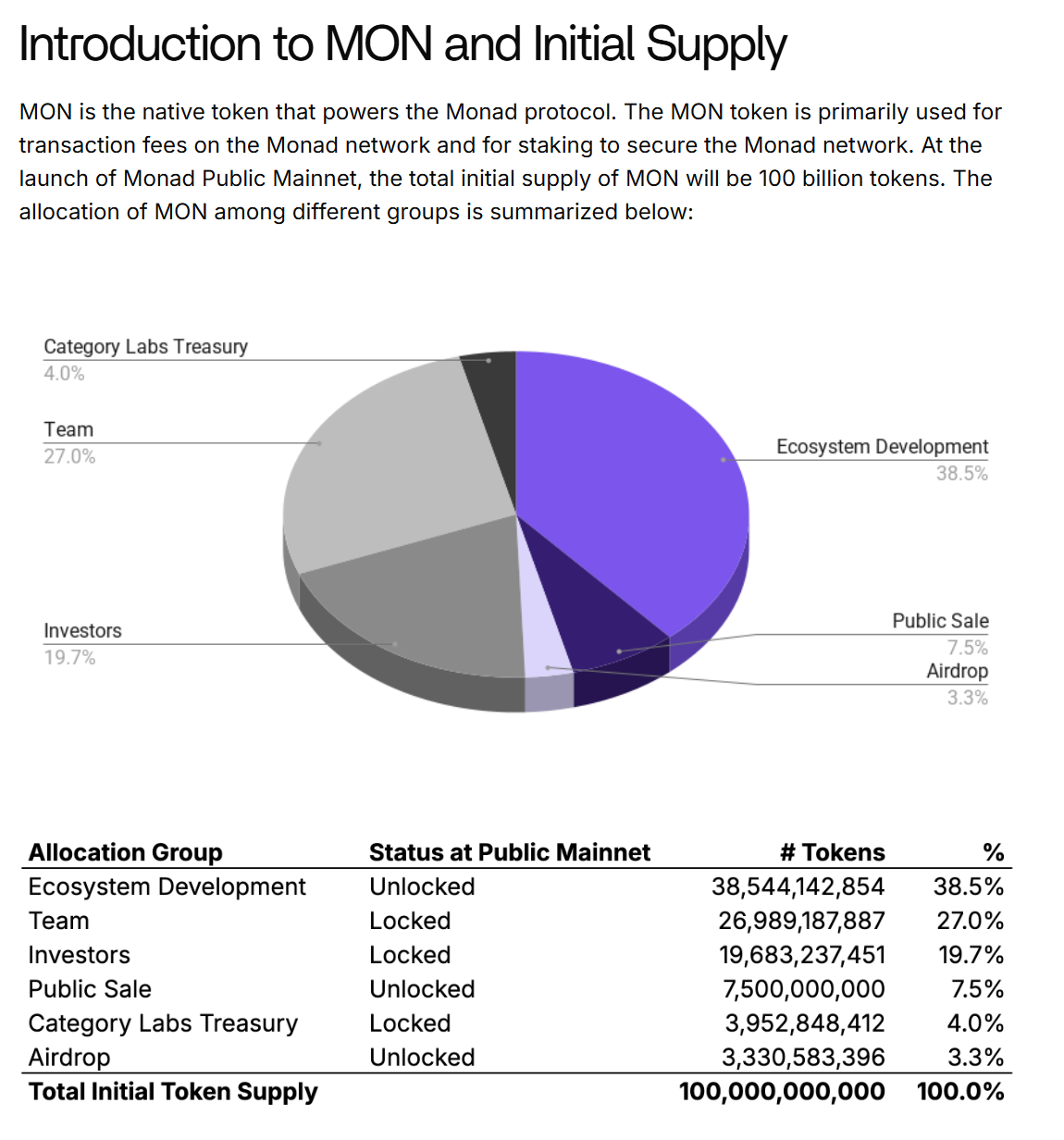
From that supply, 3.3% goes to the airdrop, 7.5% goes to the public sale, 38.5% is reserved for the ecosystem, 27% is assigned to the team, 19.7% goes to investors and 4% is held by the treasury.
Since the airdrop focuses on real participation, it looks at things like using testnet apps, minting NFTs, making swaps, providing liquidity and being active in the community. It also uses several categories at once, so a wallet can qualify in more than one way. The team expects around 230,000 wallets to be eligible, which makes the distribution broad without being random.
The activity that matters is simple and practical, typically involving trying different apps, interacting with multiple contracts, minting something, swapping tokens, or participating in testnet features across multiple sessions. Since the goal is to recognise real users, the system pays attention to whether someone actually explored the network for a while instead of doing a single action and disappearing.
People also participate by deploying small contracts, testing NFT mints across various projects, or trying out liquidity functions, all of which help demonstrate their genuine involvement. None of these actions needs to be complicated, but together they build a picture of steady testnet use.
Verifying Official Announcements & Avoiding Phishing
Large airdrops often attract fake claim pages, so it helps to slow down and check information carefully. The correct claim domain for MON is claim.monad.xyz, so anything that looks similar should be checked before you interact with it.
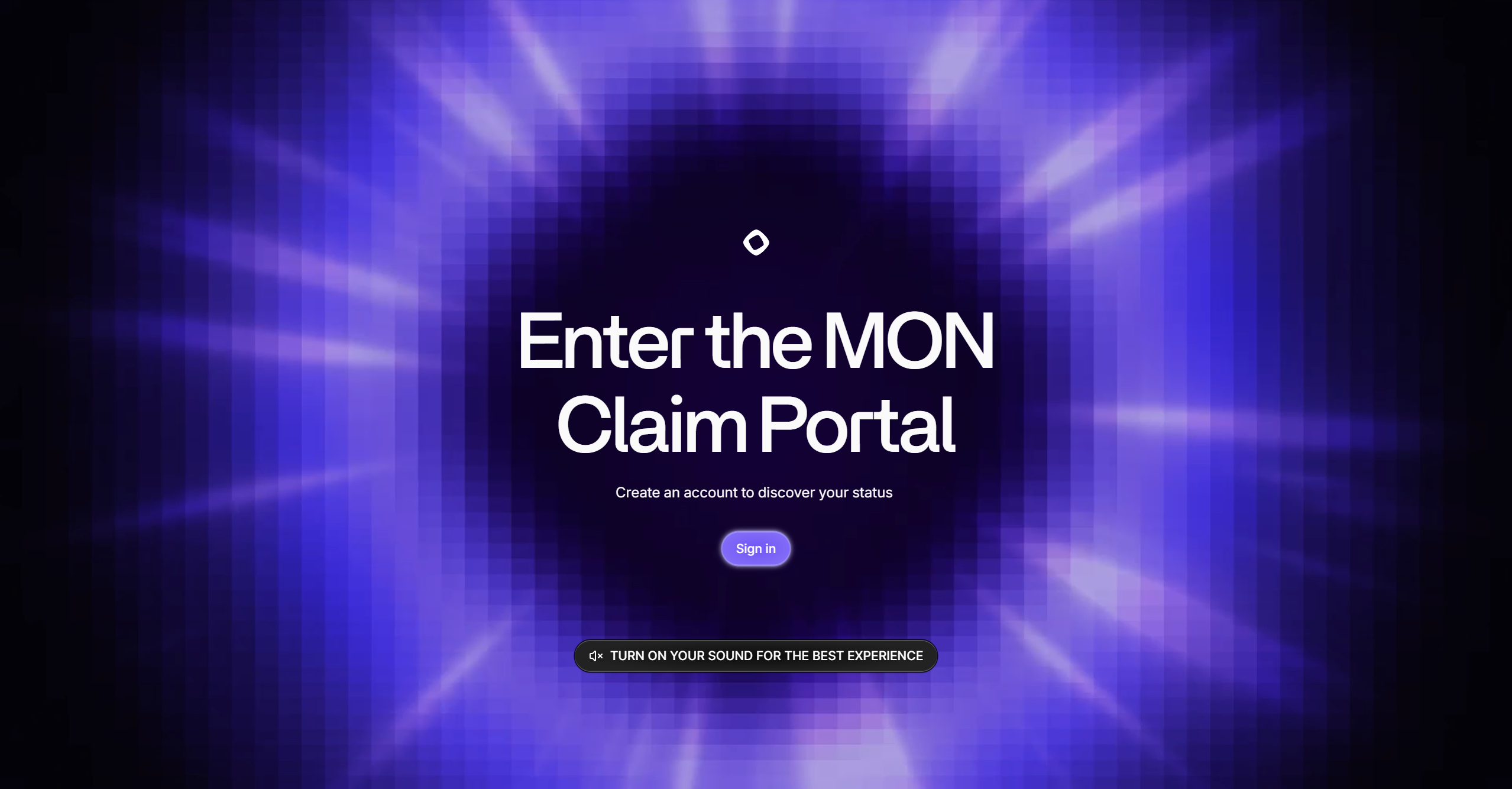
When you open the page, you should confirm the address is spelt correctly, the connection is secure and the information lines up with what appears on the main monad.xyz website and the project’s official social channels.
A real claim process will never ask for your seed phrase or private key, and it will never ask you to send funds to receive tokens. If a site or message asks for either one, it should be avoided entirely.
Explorer and On-Chain Data
Monad explorers such as MonVision and Monad Scan give you a clear view of accounts, contracts, transactions, and logs. They show balances, contract code, method calls, gas use, internal transactions, and decoded events.
You can follow blocks in real time and check network stats like TPS and gas prices without digging through your node.
Finding contract addresses is straightforward. If you deployed something, search for the deployment transaction and read the “contract created” field. If you only know the project name, use the token or project lists inside the explorer and confirm details such as deployer and ABI. Logs are available inside each transaction along with event signatures and decoded parameters when the ABI is verified.
Token pages help you confirm supplies, holders, and activity. This keeps you from mixing up real assets with copies. When debugging, a failed transaction shows a clear “failed” status, high gas use, and a revert message if available. Successful transactions show state changes, logs, and internal calls. Checking the explorer alongside your wallet or script helps you confirm that every interaction produced the expected events and results.
Wallets, RPC, and Tooling
Adding Monad to a wallet follows the normal custom network process. In MetaMask, you enter the testnet RPC URL, chain ID, currency symbol, and the explorer link. Once saved, the wallet switches to MON balances. Most EVM wallets follow the same flow, so configuration stays simple across desktop and mobile.
For development, tools such as Hardhat, Foundry, ethers.js, and viem work after you set their RPC URL to a Monad endpoint. Official docs provide the RPC method differences, WebSocket notes, and any testnet quirks. Monad also has a staking CLI for validator and delegation actions, and hosted providers like QuickNode, Alchemy, dRPC, and Ankr offer ready-made endpoints and dashboards.
RPC rate limits depend on the provider. When building apps, batch reads where possible, avoid tight polling loops, and retry with small delays when you hit limits. If you outgrow the default tier, you can upgrade your plan or use multiple endpoints for non-sensitive reads.
Once your wallet and tools are configured, testing feels like any other EVM chain. You deploy, watch the explorer for confirmation, read logs, and adjust your scripts as needed. Keeping your RPC settings verified and stable ensures you always see an accurate state while working on Monad.
How Monad Blockchain Works?
Monad tries to feel familiar if you already build on the EVM, but the way it runs transactions under the hood is very different.
The chain breaks the usual one-by-one execution model into a pipeline where ordering, execution, state writing, and consensus all move in parallel. This lets the network aim for around 10,000 transactions per second with sub-second finality while still keeping the normal EVM experience.

You write contracts the same way, deploy them the same way, and use the same tools, while the node does a lot more work behind the scenes.
Parallel Execution Model
The idea behind Monad’s execution layer is simple: if modern hardware has multiple cores, then your blockchain should use them. Instead of running every transaction in a strict line, the node takes the transactions from a block and runs many of them at the same time. While they are running, the next part of the pipeline can already start processing future blocks.
To keep everything correct, the client tracks which parts of the state each transaction reads and writes. If two transactions touch the same data and one reads something that was later changed, the node just replays that transaction with the fresh state.
Final state updates still land in normal block order, so the chain behaves exactly like a serial EVM, just reached with far more efficiency.
This setup helps a lot when the chain faces heavy bursts of activity. Things like liquidations, mints, or large trading spikes no longer clog the entire system. The pipeline keeps work spread out across cores and stages, giving you predictable behaviour even in busy periods.
MonadBFT Consensus
MonadBFT is the consensus system that decides block order and finalizes them. It builds on the HotStuff approach, which means validators only need to exchange a small number of messages, even when the validator set grows large.
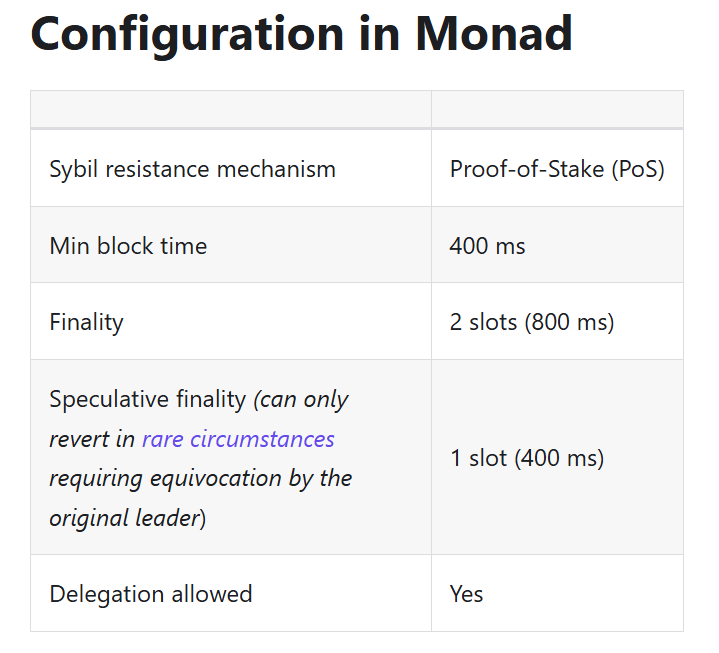
On a stable network, MonadBFT aims for block times around 400 milliseconds and finality around 800 milliseconds while still tolerating up to one third of validators acting in bad faith or going offline.
The protocol also considers real-world issues like MEV and malicious leaders. It includes speculative finality, which lets validators treat a block as nearly final after one round, with a second round locking it in fully. Extra rules prevent leaders from quietly abandoning a previous block to reorder transactions. Timeout certificates and strict reproposal rules make it hard to pull off tail-fork tricks or MEV games. Altogether, this keeps the chain fast, fair, and consistent even during validator disruptions.
EVM Compatibility
Monad keeps things smooth for developers by staying fully compatible with the EVM at the bytecode level. Solidity contracts compiled for Ethereum or any other fully compatible EVM chain can deploy here without needing changes. Addresses, opcodes, the account model, and the overall execution expectations stay the same.
Because of that, almost any tool you normally reach for works straight away. MetaMask, Hardhat, Foundry, Remix, ethers.js, viem, and standard JSON RPC methods plug in as long as you point them to a Monad endpoint.
Most developers spend their time on their usual workflow while picking up a few extra notes about how Monad handles execution and consensus. The goal is to let teams bring existing projects, audits, and codebases across and then benefit from the higher throughput and quick finality once they are live on Monad.
Bridges and Interoperability
Bridges enable the movement of tokens and data between Monad and other blockchains. Monad has an official bridge called Monad Bridge that lets you move tokens from other chains straight into Monad, and it runs on Wormhole to handle the transfer in the background.
You just connect your wallet, pick the chain you’re sending from, choose Monad as the destination and approve the amount you want to move. Once both chains finish their steps, the token appears on your Monad side, and you can use it for apps, swaps, or whatever you have planned.
The network also currently works with several well-known providers, including Axelar, Chainlink CCIP, Garden, Gas.zip, Hyperlane, LayerZero, LI.FI, Polymer, Relay, and Wormhole.
Each of these supports different kinds of bridging, whether it’s general cross-chain messaging or token transfers from specific chains. Some also bring wrapped assets into Monad’s testnet, like cbBTC and USDC, and the documentation lists the actual contracts being used for each route. These are the details you want to verify before trusting a bridge UI or transfer path.
There are always risks with bridging, and it helps to understand where those risks come from. When you send a token from another chain to Monad, the original is usually locked on the source chain while a wrapped version is minted on Monad. This process depends on the bridge’s contracts or validator network to work properly.
Monad finalizes blocks in under a second, but many other chains take longer, so most bridges wait for extra confirmations on the source side to make sure the transaction is safe.
To prevent replay attacks, the bridges use specific chain IDs and unique message nonces. For example, Wormhole uses chain ID 48 for Monad, and LayerZero uses endpoint ID 40204. These small technical details help protect your assets across chains.
The safest way to use a bridge is to go slowly and test first. Start by sending a tiny amount and watch what happens using both the Monad explorer and the explorer for the chain you started from.
Check that the address, contract, and token match what you expected. If you’re using an aggregator, keep Monad’s official bridge list open while you work, and confirm everything matches before sending more. Once you get used to checking things this way, cross-chain transfers into Monad feel much more secure and a lot less stressful.
Most bridge providers also have their own monitoring tools, such as WormholeScan, LayerZeroScan, Hyperlane Explorer, Gas.zip’s explorer or the Chainlink CCIP explorer. Once you confirm the route behaves the way you expect, you can scale up your transfers with a lot more confidence.
Validators, Staking, and Security
Staking on Monad is how the network stays secure and lets users earn rewards. Validators run full nodes, lock up MON and help decide on new blocks.
If you don’t want to run hardware, you can delegate your MON to a validator and share in their rewards. When a block is produced, the validator and their delegators split the reward based on how much everyone staked.
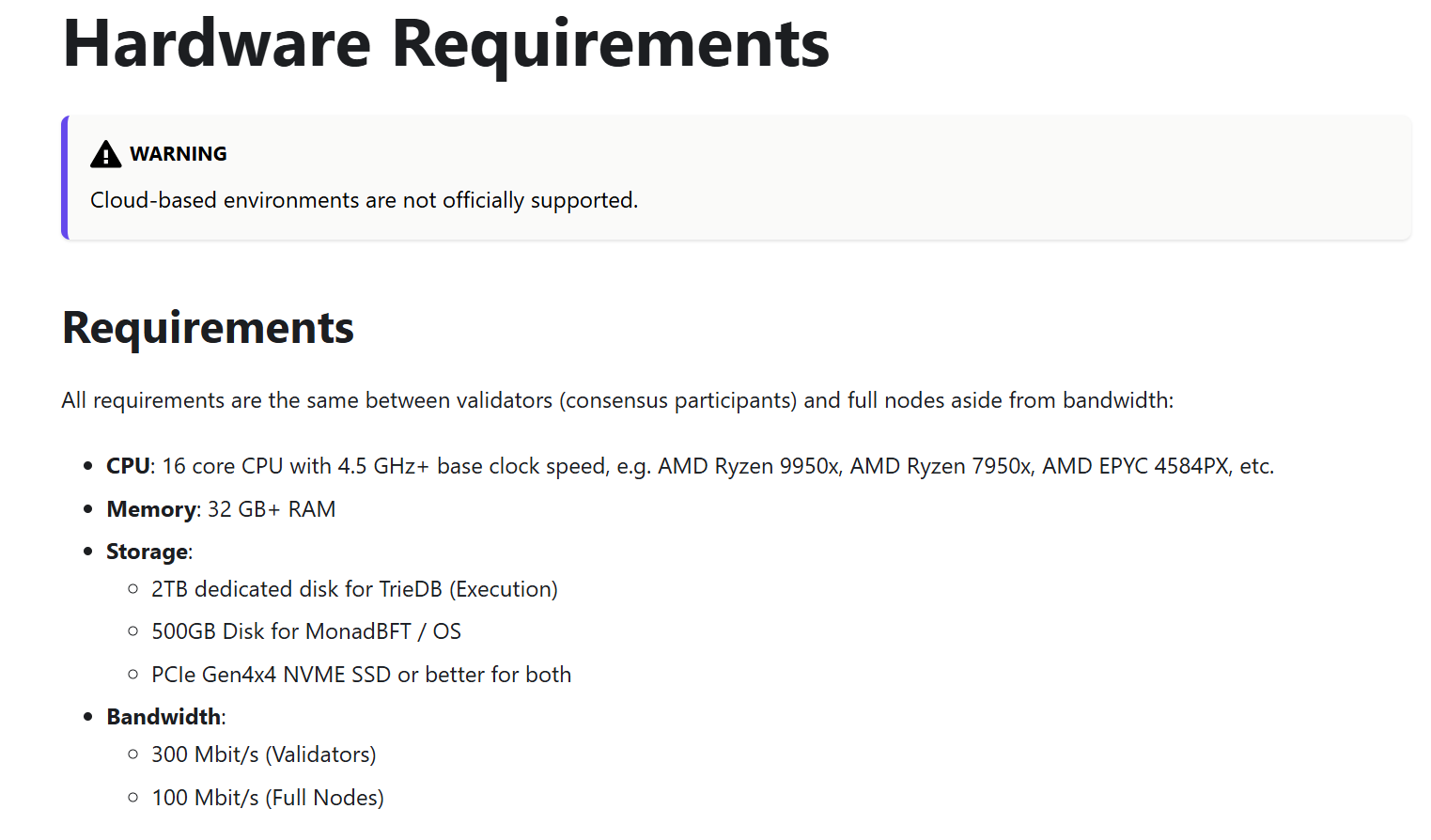
Becoming a validator means meeting some clear hardware and setup standards. Monad recommends a 16-core CPU running at about 4.5 GHz, 32 GB of RAM, one 2 TB NVMe SSD for the execution layer, another 500 GB SSD for consensus and OS storage, and a stable internet connection of around 300 Mbps.
The minimum stake to register a validator is 1,000,000 MON. Monad aims for around 200 active validators at a time.
Rewards are approximately 25 million MON per block, and the yearly inflation is roughly 2 billion MON, equivalent to about 2% of the original 100 billion supply.
Validators can lose part of their stake (and delegators can too) if they go offline too often or act badly. The protocol includes audits and bug-bounty programs, allowing people to review the code and identify potential issues before they occur.
Ecosystem Map
The Monad ecosystem already includes projects in DeFi, infrastructure, NFTs, gaming and payments. The official directory lists apps and services like DEXs, liquid staking, oracles, analytics tools, launchpads, gaming platforms and payment systems. For example, Allium covers analytics and indexing, Chainlink handles oracle services, AethonSwap works as a DEX, and launchpads help new tokens and NFTs get started.
When you evaluate a new app on Monad, it helps to ask a few things: Is it listed in the official directory or recognised in ecosystem maps? Are its contracts verified on the explorer, and does it have audits or bug-bounty history? What are the usage metrics like – how much liquidity or how many users does it have?
And finally, does it make good use of Monad’s strengths, like fast transactions and low fees? If you answer yes to all of those, you’re in a stronger position.
Core Features of Monad Crypto
Monad is a new blockchain designed to work like Ethereum, but with a lot more speed behind it. It aims for about 10,000 transactions per second, helped by block times that sit around 0.4 seconds and final confirmation that usually lands between 0.8 and 1 second.
Because of that, everything feels smoother to use, and developers don’t need to change the way they build their apps to get those benefits.

The network also keeps costs low by letting its nodes use many CPU cores at the same time, which helps them handle far more activity in a single moment. When you compare that with Ethereum’s usual 15 to 30 transactions per second, the gap becomes clear, especially for apps that rely on frequent updates or lots of small actions. As the load increases, that extra breathing room helps the entire experience stay consistent.
Monad also makes it easy for existing Ethereum apps to move over because it reads the same contract format. That means developers can keep their code as it is, and tools like MetaMask or common development frameworks can connect the moment the network is added. This keeps the learning curve low and helps teams adopt Monad without slowing down their workflow.
The project also has strong backing, with around 225 million dollars raised from well-known investors, which gives the team the resources to keep improving the network and supporting its ecosystem as it grows. With all of this combined, Monad aims to give developers and users a faster and more affordable experience while keeping the familiar tools and setup that people already trust.
Pros & Cons of Monad Crypto
Pros
-
High throughput targeting about 10,000 transactions per second
-
Fast block times around 0.4 seconds with confirmation in about 1 second
-
Low transaction fees suitable for frequent activity
-
Supports Ethereum contracts without code changes
-
Operates as a base layer with its own security model
Cons
-
Still pre-mainnet with limited real-world testing
-
Smaller app ecosystem compared to Ethereum and major Layer 2 networks
-
Requires bridges for moving assets in and out
-
Must still demonstrate long-term stability under heavy usage
Monad Use Cases
Monad is designed for apps that want the flexibility of Ethereum contracts but need much faster and cheaper activity. Its testnet has already passed 2.4 billion transactions, showing that the system aims for large-scale usage.
One strong use case is trading and DeFi. Fast confirmation helps with spot trading, lending, stablecoin swaps and liquid staking. Projects that use order books, options or perpetual contracts can take advantage of quick settlement and lower costs while still keeping their existing Ethereum-based code.

Games, social apps and NFT platforms also benefit because they depend on smooth interaction. A one-second confirmation makes on-chain actions feel closer to normal app interactions. Low fees also make small transactions practical, such as game items, tips or micro-payments.
There is interest from institutional platforms, too. Services that already support Ethereum can utilize Monad for faster internal transfers without requiring a complete overhaul of their existing setup. Platforms like Fireblocks are already preparing support with this in mind.
Together, these use cases show Monad’s goal: support busy apps that need speed, low fees and an easy path from Ethereum.
Monad vs. Ethereum L2s
Monad is sometimes compared with Ethereum Layer 2 networks because both aim to improve speed and reduce fees. The difference is that Monad is its own base chain, while L2s run on top of Ethereum and rely on Ethereum for security.
Here is a quick breakdown:
Feature
Monad (base layer)
Ethereum L2s (general picture)
Type
Independent chain with its own validators
Built on top of Ethereum
Transactions per second
About 10,000
Often thousands to tens of thousands, varies by network
Block time
About 0.4 seconds
Around 0.25 to 2 seconds
Final confirmation
Roughly 0.8 to 1 second
Seconds on the L2, full settlement tied to Ethereum block times
Fees
Very low
Low, but usually higher than Monad
App support
Runs Ethereum contracts with almost no changes
Mostly compatible, sometimes minor adjustments needed
Security source
Uses its own stake-based system
Secured by Ethereum
Moving assets
Uses bridges to reach Ethereum and other chains
Often has direct and well-established bridges to Ethereum
Ecosystem size
Newer and smaller
Larger and more mature
Monad offers speed and low cost on a standalone chain, while Ethereum L2s offer deep security and a much larger ecosystem. The better choice depends on how closely you want your project tied to Ethereum’s base layer.
Conclusion
Monad gives you a way to use or build crypto apps at a pace that feels closer to regular mobile or web apps. Everything stays familiar, from the wallets you use to the tools you build with, so the experience stays simple while the performance gets better. Apps react quickly, fees stay low, and the network holds up during busy periods.
The testnet makes it easy to jump in and try things out without any pressure. Plenty of people are exploring, deploying small projects, or just getting a feel for how smooth the network is, and all that activity counts toward the upcoming airdrop. The mainnet date is already set, and the ecosystem is growing in a way that feels steady and organized.
Anyone curious about faster crypto networks, building new apps, or getting ahead of a new ecosystem can treat Monad as a low-stress place to start experimenting. The setup is simple, the performance stands out, and the learning curve stays short.
DISCOVER:
- Crypto Exchange Promos & Discounts
- Crypto Wallet Promos & Discounts
- FUD (Fear, Uncertainty & Doubt) Meaning in Crypto
- What is DeFAI? A Beginner’s Guide
FAQs
How do I access the Monad testnet?

You just add the Monad testnet to any EVM style wallet, then grab some test tokens from the faucet so you can start sending transactions, minting things, or trying out apps.
Where can I find the Monad explorer?
You can check your activity on https://monadvision.com, and the testnet version is at https://testnet.monadvision.com, both linked directly from the official Monad docs.
How do I add the Monad RPC to my wallet?
You open your wallet’s custom network section, paste in the RPC URL, chain ID, name, and explorer link from the official documentation, then save it so your wallet knows where to send your transactions.
Where can I see the Monad token price?
The MON price will show up on the usual crypto tracking sites as soon as the token starts trading on launch day.
What is the role of Monad Labs and the Monad Foundation?
Monad Labs, now called Category Labs, builds the core tech, while the Monad Foundation handles the ecosystem side of things like community support, governance, and programs for builders.
Where can I buy Monad crypto?
You can buy Monad (MON) on major exchanges like ByBit and Bitget via trading pairs such as MON/USDT.
References
- Ethereum.org. “Ethereum Virtual Machine.” Ethereum.org, https://ethereum.org/developers/docs/evm/.
- Boston College. “Q&A on Cryptocurrency.” Boston College, https://www.bc.edu/bc-web/bcnews/nation-world-society/business-and-management/q-a-on-cryptocurrency-.html.
- University of Michigan. “Introduction to Ethereum.” University of Michigan, https://online.umich.edu/collections/fintech/short/introduction-to-ethereum/.
- Rasmussen University. “What Is Blockchain Technology?” Rasmussen University, https://www.rasmussen.edu/degrees/technology/blog/what-is-blockchain-technology/.

Why you can trust 99Bitcoins
Established in 2013, 99Bitcoin’s team members have been crypto experts since Bitcoin’s Early days.
Weekly Research
100k+Monthly readers
Expert contributors
2000+Crypto Projects Reviewed