





In This Article
As the native token of the Jupiter network, $JUP provides a wide range of benefits for its holders. However, the main perk of this governance token is staking. By staking Jupiter, you help secure the network, validate transactions, and participate in governance. In return, you earn additional $JUP tokens as rewards, creating a passive income stream. Staking Jupiter also grants governance rights, allowing you to influence the network’s future and ensure it evolves according to community needs.
With both financial rewards and governance privileges, Jupiter staking is an attractive option for investors looking to participate in a growing decentralized ecosystem. In this article, we will explain everything, from how to stake Jupiter to where to stake JUP tokens. Sit back, relax, and keep reading.
Key Takeaways
- Staking $JUP awards governing participation that incentivizes long-term involvement.
- Created some of the biggest airdrops in crypto history, awarding 700 million tokens.
- Excellent reward potential, determined by your voting power and participation.
- Staking rewards are distributed quarterly based on the abovementioned criteria.
- Unstaking requires a 30-day period.
Jupiter Staking: Summary
Our guide below will provide all the information about the JUP staking process so you know how to start and make the most of it. On top of learning what staking Jupiter is and how it works, you will also read more about the overall staking process, the best crypto staking platforms for staking Jupiter, pros and cons, what mistakes to avoid, and more. Equipped with that knowledge, you will be able to start staking Jup tokens and generate passive income effortlessly.
What is Jupiter Staking?
Jupiter is a DEX aggregator on Solana, and JUP is its governance token used for voting and staking rewards. As the name indicates, Jupiter staking is all about using the $JUP tokens you own and putting them to work. Like other staking opportunities, when you are staking Jupiter, you contribute towards supporting the network and helping keep it secure while generating passive income by being rewarded with additional $JUP tokens. However, one aspect that makes the Jupiter staking model unique is that staking your tokens gives you automatic access to the governing process, allowing you to vote on key decisions and increase your rewards.
Chasing High Rewards?
If you’re the kind of investor who enjoys being actively involved in shaping protocols and isn’t afraid of a little volatility for the chance at high returns, Jupiter isn’t the only project worth watching. Check out our latest roundup of the ‘13 Best Crypto Staking Coins‘ for more bold opportunities in the crypto space.
How Does Jupiter Staking Work?
Jupiter staking works similarly to other staking models. You can choose to stake your Jupiter tokens by locking them up and allowing them to contribute to securing the network, making it easier to validate transactions and generate rewards.
Before staking, users must hold $JUP tokens in a compatible wallet. They can then go to the staking portal, connect their wallet, and select the amount of Jupiter they wish to stake. On confirmation, staked tokens get locked in the network.
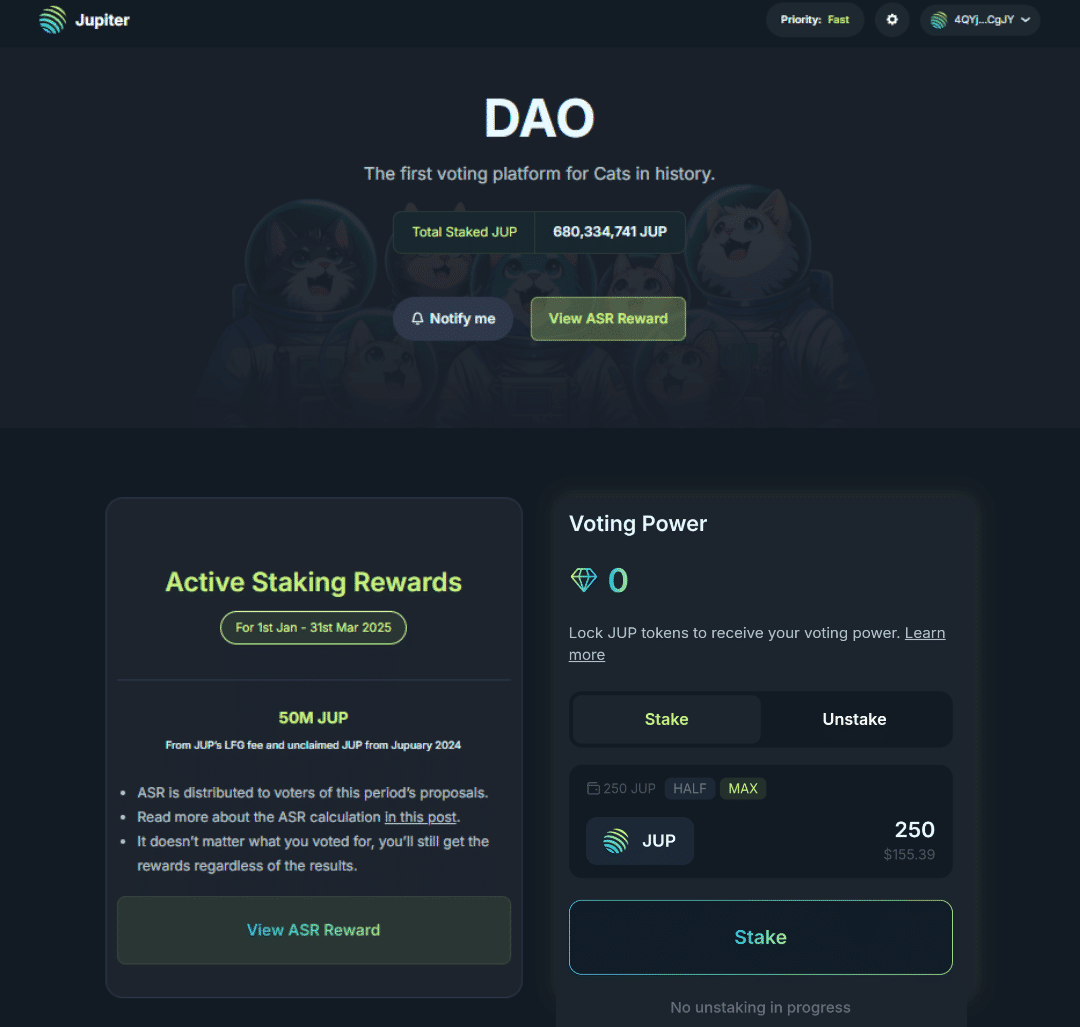
Staking Jupiter tokens also gives you instant access to the DAO and grants a governing role across the ecosystem. By becoming a Jupiter staker, you can actively participate, vote on proposals, and contribute to the project’s future.
Jupiter staking utilizes an ASR (Active Staking Rewards), a unique reward system to incentivize participation. According to Jupiter,
Active Staking Rewards is an innovative way to reward active participants with JUP, allowing them to accrue more voting power over-time, in the simplest way possible.
The rewards are dynamically calculated and determined based on activity and involvement, ultimately leading to more voting and participation. The ASR rewards pool is formed by the 75% FLG Launchpad fees and 100 million $JUP tokens distributed in two quarters. By integrating governance, security, and rewards into a single mechanism, Jupiter staking provides a comprehensive experience, aligning financial incentives with decentralized decision-making.
Best Platforms For Staking Jupiter in 2026
In the following section, we will look into the top crypto-staking platforms that support JUP staking.
Best Wallet
If you’re holding Jupiter (JUP) and exploring ways to grow your portfolio, Best Wallet offers one of the simplest and most secure tools to manage and interact with Solana-based assets. While native JUP staking is not yet supported inside Best Wallet, this feature-rich app still gives you access to multiple staking opportunities and DeFi tools in a mobile-first, non-custodial wallet environment. Read our full Best Wallet Review 2026 here.

Best Wallet is ideal for users who want full control over their crypto. You can store your JUP safely, swap Solana tokens with zero KYC, and participate in top crypto presales directly from the app. The wallet also features buying the $BEST token, which unlocks further rewards and access for users.
The platform is expanding rapidly and is a smart choice for long-term Jupiter token holders who want flexibility, fast access, and full ownership of their assets.
Best Wallet Key Features
- Offers some of the highest APYs in the market
- Exclusive partner integration allows fast and secure staking
- Wide range of built-in token swaps without long verifications
- Clean mobile interface with rapid rollout of features
Best Wallet Pros & Cons
Pros
-
Non-custodial design lets you hold the private keys
-
Swap other tokens and manage JUP easily inside the app
-
No KYC required for many DeFi, presales, and staking features
-
Earn rewards with the $BEST token
Cons
-
Mobile-only interface with no option for desktop yet
Binance
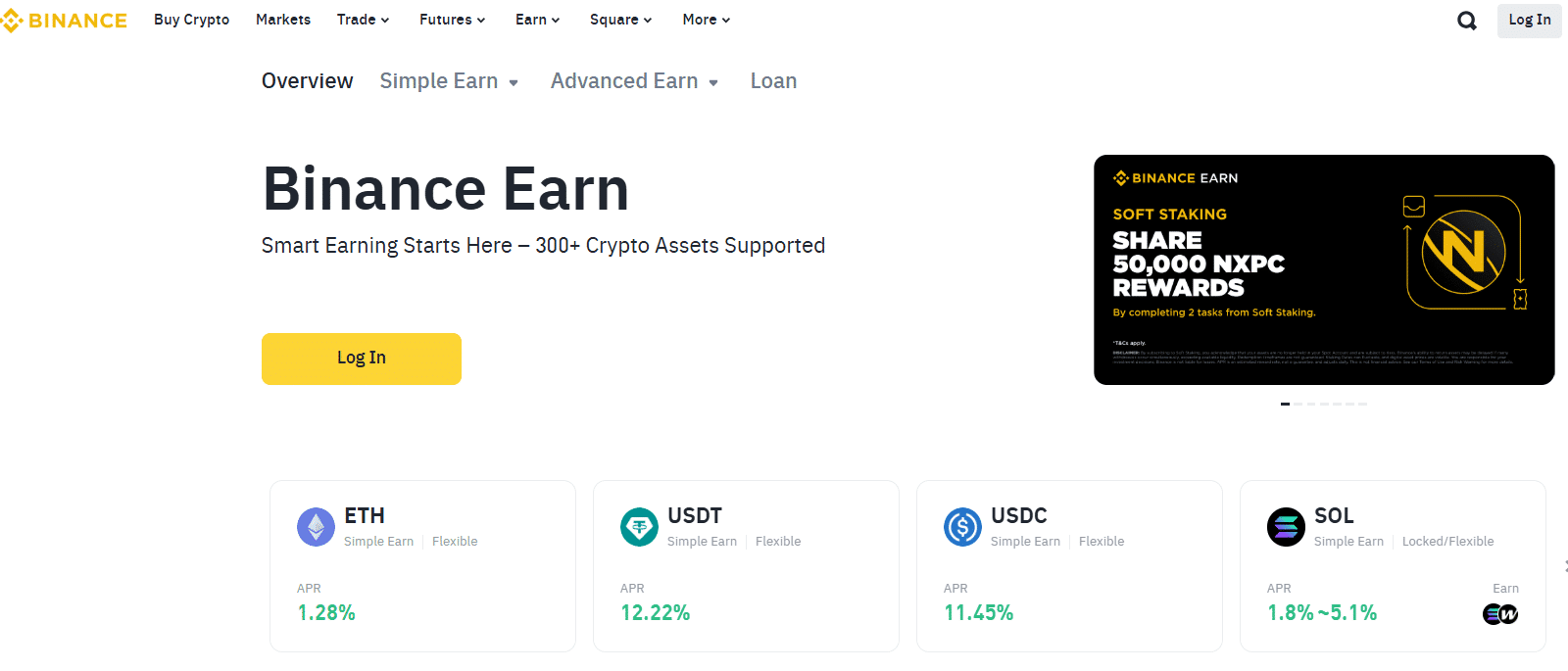
Binance is a leading crypto exchange platform that offers unmatched staking opportunities for a wide range of coins, including $JUP. Its Binance Earn feature provides a secure environment for purchasing and trading tokens, but also for staking. On top of that, Binance also offers a wide variety of tools, making it a good choice for everyone.
Currently, it offers an APY of 2.3% for staking $JUP tokens. Check more details about Binance staking in our separate guide. Do not forget to read our Binance exchange review for more.
Binance Key Features
- It offers a 2.3% APY for staking $JUP tokens
- Around-the-clock customer support
- Supports a wide range of top cryptos to buy
- Offers optimal fees for trading and withdrawals
Binance Pros & Cons
Pros
-
Wide range of products and services
-
Strong security protocols and measures
-
Suitable for all types of users regardless of experience
-
A diverse Earn feature with multiple ways to generate passive income
Cons
-
Not available in all U.S. states and Canada
-
The platform has had security concerns in the past
ByBit
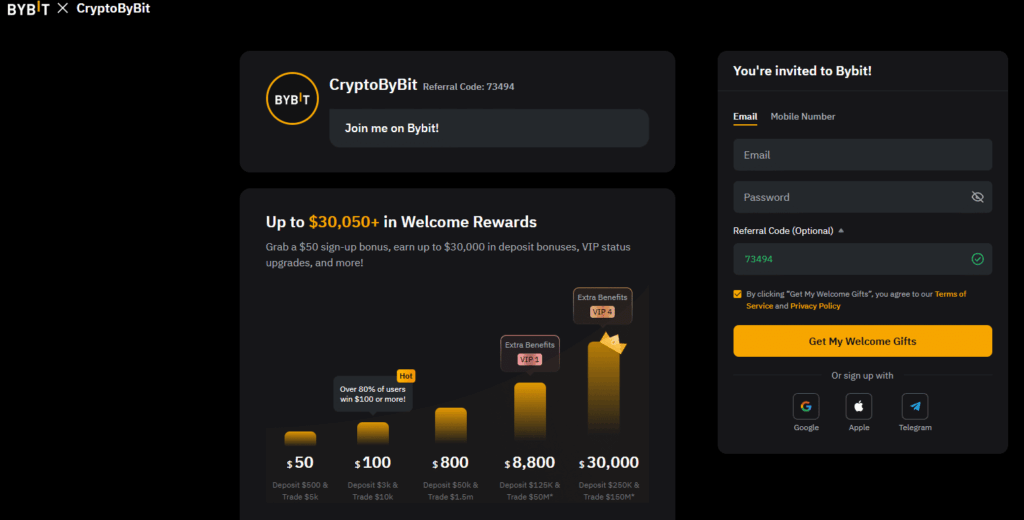
As one of the most popular crypto exchange platforms, ByBit offers a unique blend of security, a user-friendly approach, and a wide range of trading options. However, one of the most exciting features of ByBit is its Earn program, which allows you to stake your crypto tokens to generate passive income. ByBit offers flexible and fixed options for staking and competitive interest rates that can be a great way to maximize your yield. You can currently stake your $JUP tokens on ByBit for an APY of 1%. Visit our ByBit review for more info.
ByBit Key Features
- Supports a wide range of digital assets that can be seamlessly traded
- Offers an NFT marketplace
- Allows withdrawals to be in fiat currencies
- Offers a ByBit crypto debit card
ByBit Pros & Cons
Pros
-
A wide range of advanced trading tools perfect for experienced traders
-
Offers a referral program and sign-up bonuses
-
Staking your $JUP tokens on ByBit gives an APY of 1%
-
Known for its machine engine and ultra-fast transactions
Cons
-
It was targeted for one of the biggest hacks in 2025, losing $1.5 million
-
Might be too complicated for beginners
YouHodler
YouHodler is somewhat different from other exchanges since it doesn’t focus on the same aspects of the crypto world. Instead of spot trading, this platform focuses primarily on crypto loans, immediate purchases and sales, and earning interest through staking.
YouHodler is a custodial exchange known for its strong security measures and intuitive, user-friendly interface, making it an excellent choice for all users. However, one notable drawback is its relatively high fees, which can be less competitive than those of other platforms. Why don’t you see our YouHodler review for a better understanding?

YouHodler Key Features
- Offers a MultiHODL account for advanced leverage trading.
- Enhanced market exposure thanks to the Turbocharge.
- Offers excellent crypto-backed loans.
- APY for staking JUP tokens is at 15%.
- Supports over 50 of the best staking coins
YouHodler Pros & Cons
Pros
-
Excellent for beginners
-
You can deposit using your Google or Apple Pay accounts
-
Offers crypto loans
-
Provides opportunities for perpetual futures with up to 70x leverage
Cons
-
It was hacked back in 2019
-
Doesn’t provide P2P trading opportunities
How to Stake Jupiter? A Step-By-Step Guide
-
Fund Your Wallet
Start by topping up your crypto wallet with the necessary JUP tokens. You can purchase JUP tokens on the official Jupiter website or other reputable crypto exchanges.
-
Connect Your Wallet
Navigate to the Governance section on the nav menu at the top and connect your wallet.
-
Choose Your Stake Amount
Choose the amount of $JUP you want to stake. You can enter a specific amount or just stake all of them.
-
Confirm the Transaction
A window will pop up from your wallet, requiring you to confirm and verify the transaction.
-
Start Earning Rewards
The verification may take a few moments, but once confirmed, your tokens will be staked and you’ll begin earning $JUP rewards.
-
Participate in Governance
Scroll down to find the governance proposals and cast your vote. The ratio of one staked token equals one vote. This means the more you stake, the greater your voting power.
How Much Can You Earn by Staking Jupiter?
Although the APY can differ depending on the staking platform you choose to stake your $JUP tokens on, the project’s ASR system is still the essential element. Rewards are distributed in quarters, and according to the official website, the ASR pool for the last quarter consisted of 50 million JUP tokens and 75% of the launchpad fees. Jupiter also creates airdrops with massive rewards for users who stake their tokens.
Best Practices for Maximizing Jupiter Staking Rewards
Let’s review some strategies that may optimize your overall Web3 experience and increase rewards when staking Jupiter.
- You should aim to stake your tokens for long periods of time, as this will increase your eligibility for rewards across different quarters.
- Rewards are determined by your voting power and how much you participate in the voting process, so it might be smart to vote multiple times.
- The voting power is determined by the amount of $JUP tokens you stake. Adding tokens to your staking pool can be a good way to increase voting power and potential rewards.
- Participate in the voting process. You will still receive rewards regardless of whether your vote correlates with the outcome.
- You can also invest in $JLP tokens. These are not directly related to $JUP staking, but the rewards are generated by the traffic on the exchange, which can be a good way to improve the outcome.
Benefits and Risks of Staking Jupiter
Benefits
- Access to the governing aspect of the project, allowing you to participate in the decision-making process.
- Staking and active participation lead to more rewards
- Eligibility for airdrops and other rewarding events
- Rewards are not related to the way you vote.
- Even if your vote was not aligned with the outcome, you will still be rewarded.
Risks
- Unstaking period lasts 30 days, which can lead to missed market opportunities
- Although straightforward, the staking process may be a bit too complex for new users
Jupiter Staking vs. Harmony ONE Staking
Several key differences and similarities emerge when comparing Jupiter staking with Harmony ONE staking. Both are decentralized staking models, but they serve distinct purposes. Jupiter is a governance-based decentralized, no KYC exchange, allowing users to lock up $JUP tokens to participate in decision-making and earn rewards based on voting activity and community engagement. In contrast, Harmony ONE staking uses an Effective Proof-of-Stake (EPoS) model, where rewards depend on a validator running a node or a delegator supporting a validator. Jupiter operates within the Solana ecosystem, while Harmony ONE is a layer-1 blockchain with its consensus mechanism.
Jupiter staking relies on Solana’s blockchain security, using multi-signature authentication. Harmony ONE’s security is tied to its EPoS consensus, exposing validators to performance-based penalties. The risk profiles also differ, Jupiter staking carries a lower risk, as rewards are tied to governance activity rather than validator performance, with rewards depending on token price fluctuations and governance participation. Harmony ONE staking comes with a higher risk for users. Validators can face slashing penalties, and delegators need to verify validators.
Past security breaches, like the 2022 Horizon Bridge hack, have also raised concerns about Harmony’s overall security.
| Feature | Jupiter Staking | Hamorny (ONE) Staking |
| Native Staking | Native and through staking platforms | Native and through staking platforms |
| Decentralization | Yes | Yes |
| Security | Multisignature system | Strong security thanks to EPoS |
| Reward Source | Voting and governance | Node validation and delegation |
| Risk Level | Low | Medium |
Mistakes to Avoid When Staking Jupiter
Jupiter staking is straightforward and offers rewards based on your participation and voting. There are, however, some common mistakes people make when they stake Jupiter.
First, you should avoid splitting your staking pool. Many people think that splitting your tokens and using multiple wallets to stake $JUP tokens will increase the yield, but that is not the case with this staking model. Jupiter’s concept is based on voting power and participation, which is determined by the total number of staked tokens. Using numerous decentralized wallets doesn’t make any difference regarding potential rewards or maximizing yield.
Another common mistake could be locking up all of your $JUP tokens. Even though this is often the smart choice so that you can accumulate the most optimal voting power, it can also mean missing out on monetizing opportunities. Mainly because Jupiter imposes a 30-day unstaking period, which is a long time if you need to sell due to a positive market opportunity quickly.
Lastly, not staying updated is another common mistake, especially when it comes to Jupiter. It is one of the most engaging DAOs, and there are constantly new proposals to vote on. On top of that, it also hosts regular events and airdrops, such as the annual Jupuary, which was one of the biggest and best crypto airdrops in history.
How to Unstake Jupiter?
Unstaking your $JUP tokens is a simple yet lengthy process that is easy to understand. We will go over the unstaking process in more detail in the following section.
Future of Jupiter Staking: Long-Term Trends to Watch
Jupiter staking is gaining traction as more users engage with the DAO and governance model, and it continues to expand. This is evident by the fact that the Jupiter staking community and, by extension, the DAO continues to grow and evolve. The project is eager to support this progress and to create the best possible environment, so they are bringing in the experts. Based on a recent post on social media, Jupiter DAO has announced the addition of Givner Ariel, a DAO governance expert known for her work with MonkeyDAO, to help refine its governance structure and community engagement.

In addition, this year’s Jupuary airdrop was one of the biggest and most rewarding ones. However, another massive Jupuary airdrop is already confirmed for 2026, and it is expected to be even bigger.
Conclusion: Is Jupiter Staking Worth It?
Staking Jupiter can be a worthwhile investment. It is a simple process that can lead to massive rewards. Unlike other staking models, Jupiter staking is not a passive income opportunity, as it requires active participation, voting, and involvement in the governance of the project. It incentivizes this by increasing the voting power based on the number of tokens you have staked. The project offers one of the best DAOs in the crypto world, and even though there are some drawbacks, such as the 30-day unstaking period, Jup staking is worth doing. Now that you have the necessary information, you are ready to jump straight into it.
DISCOVER:
- Crypto Exchange Promos & Discounts
- Crypto Wallet Promos & Discounts
- How To Stake MANTA in 2026
- Cronos Staking: How to stake CRO in 2026
- Injective Staking: Beginner’s Guide to INJ Staking
FAQs
Does Jupiter have staking?


Yes, Jupiter offers staking opportunities that give voting and governance power and a direct involvement in the decision-making process.
What is the best place to stake Jupiter?
There are many places where you can stake Jupiter, the best one being the official Jupiter website. You can also check out platforms like Best Wallet or Binance.
How long does it take to unstake Jupiter?
Unstaking your Jupiter tokens requires a 30-day waiting period.
How to get Jupiter rewards?
You receive Jupiter staking rewards by voting on proposals and participating in the governance process. There are also various airdrop events.
References
- Taylor, Benjamin A. “Staking Your Crypto: What Are the Stakes?” Journal of Business & Technology Law, vol. 17, no. 1, 2021, Article 5, https://digitalcommons.law.umaryland.edu/cgi/viewcontent.cgi?article=1372&context=jbtl
- Cong, Lin William, Xi Li, and Neng Wang. Staking, Token Pricing, and Crypto Carry. Kenan Institute of Private Enterprise, Mar. 2022, https://kenaninstitute.unc.edu/rethinc/wp-content/uploads/2022/03/Cong-Staking-and-Crypto-Carry.pdf
- Jupiter. Jupiter DEX Aggregator. https://jup.ag/
- Jupiter. “ASR (Active Staking Rewards) Notes.” Jupiter Governance Forum, https://discuss.jup.ag/t/asr-active-staking-rewards-notes/12032
- Mazieres, David. “The Stellar Consensus Protocol: A Federated Model for Internet-level Consensus.” Association for Computing Machinery (ACM), https://dl.acm.org/doi/10.1145/3211933.3211953.

Why you can trust 99Bitcoins
Established in 2013, 99Bitcoin’s team members have been crypto experts since Bitcoin’s Early days.
Weekly Research
100k+Monthly readers
Expert contributors
2000+Crypto Projects Reviewed