




In This Article
- Tezos Staking: Summary
- What is Tezos (XTZ) Staking?
- How Does Tezos Staking Work?
- How to Stake Tezos: A Step-by-Step Guide
- Benefits and Risks of Tezos Staking
- XTZ Staking vs. ICP Staking: A Comparative Analysis
- How to Unstake Tezos: A Detailed Guide
- Future of XTZ Staking: Long-Term Trends to Watch
- Conclusion: Is Tezos Staking Worth It?
Tezos uses a PoS-based consensus mechanism known as LPoS. Users can delegate their XTZ tokens, a feature available from the start, or participate in Tezos staking, which has been recently introduced. Staking Tezos doesn’t require users to directly stake their XTZ on the Tezos blockchain, as many other platforms offer that service. That said, researching the terms, APYs, and other factors is crucial before deciding on the platform.
Those who want to maximize their XTZ rewards should implement several strategies, such as compounding, monitoring baker performance, and reviewing their strategy. While staking this coin provides many benefits, it also comes with certain risks. Let’s find out more.
Key Takeaways
- Tezos’ consensus algorithm is based on a mechanism called liquid proof-of-stake.
- Besides delegating, users can now stake their tokens, too.
- The best platforms for staking XTZ include Best Wallet, Tezos, Binance, Ledger, Kraken, and Coinbase Prime.
- APYs for staking this coin range from 2.19% to 18%, with Kraken offering the highest.
- You can maximize your Tezos rewards by following several strategies, including compounding, staying updated, monitoring baker performance, and reviewing your plan.
Tezos Staking: Summary
This comprehensive article about Tezos staking starts with its core functionality and differentiates between delegating and staking. We’ll review the best crypto exchanges and platforms for staking your XTZ tokens and outline their pros and cons.
We’ll also explore common mistakes so you know and avoid them, and share strategies for maximizing your XTZ rewards. You will learn about the benefits and risks of Tezos staking to make a more informed decision about whether this coin aligns with your investment goals.
What is Tezos (XTZ) Staking?
Tezos’ consensus algorithm is a variation of the proof-of-stake (PoS) mechanism called liquid proof-of-stake (LPoS). That means there’s no fixed number of block producers, with block production rights allocated depending on the amount of XYT staked by bakers and their delegators.
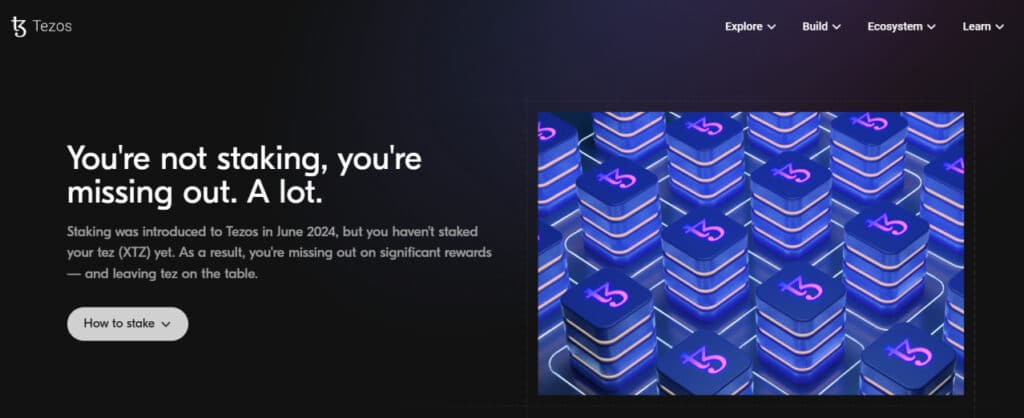
PoS-based blockchains use staking as a way to verify transactions on the network, with Tezos considered one of the top altcoins for staking. Tezos baking enables network security and governance by allowing XTZ holders to run a baker node or delegate their stake to a baker. This system will enable bakers and delegators to earn rewards and participate in on-chain governance.
The delegation structure differs from traditional Proof-of-Stake (PoS) consensus and delegated proof-of-stake (DPoS) blockchains because it allows token holders to delegate without locking their XTZ, providing more flexibility. While delegation is the easiest way for XTZ holders to earn rewards, only bakers participate in network consensus.
Delegation is not required to secure the network, but it allows non-bakers to benefit from staking rewards. Due to this distinction, the Tezos community distinguishes the platform’s consensus from DPoS by referring to it as liquid staking.
How Does Tezos Staking Work?
Tezos’ liquid-proof-of-stake system provides no fixed number of block producers, and block production rights are allocated based on the amount of stake each delegator or baker has. It enables bakers to run nodes with moderate hardware requirements, making it more accessible than some other PoS Web3 blockchains.
It also allows delegators to change bakers whenever they want, although delegation changes take effect after one full cycle. This lets users quickly align themselves with a baker with similar voting preferences. There is no requirement for tokens to be locked. However, bakers must lock up a portion of their own XTZ as collateral (bonding) to participate in block production.
Baking is how staking is known on Tezos. Delegation has been available right from the start, whereas staking is a new option, introduced with the implementation of adaptive issuance following the Paris Protocol upgrade.
To better understand Tezos staking vs. delegation, take a look at this table:
| Feature | Baking | Delegating |
| Reward start/stop | Immediately | After two cycles (around six days) |
| Reward factor | 3x | 1x |
| Reward recipient | Staker (directly to user) | Baker (transfers to user) |
| Funds availability | Locked | Liquid |
| Lock-up period | Four cycles (around 10 days) | No lock-up period |
| Slashing risk | Yes | No |
Note: We’ve mentioned the Paris upgrade, but let’s discuss it in more detail so that you gain a clearer picture of the changes made. Before June 2024 (the Paris upgrade), delegation was the only way for Tezos holders to earn rewards. The delegated Tezos remained liquid, and delegation rewards were distributed by bakers.
With the introduction of the Paris upgrade, staking launched on Tezos, allowing holders to lock their Tezos as part of a baker’s stake, which validators have to do if they want to participate in PoS networks. By teaming up with bakers and staking your Tez, you can earn triple the rewards from delegation, which will be credited to you automatically.
It’s also worth noting that bakers must stake 6,000 XTZ to “bake” blocks and earn rewards for doing so.
Top Platforms For Staking Tezos (XTZ) in 2026
We will now review the top crypto staking platforms for your XTZ, highlighting their key features, pros, and cons.
Best Wallet – Overall Best Staking Platform For Tezos
Best Wallet is a next-generation, mobile-first, self-custodial crypto wallet that combines staking, swapping, presale access, and multi-chain support in one intuitive app. Available for iOS and Android, it supports thousands of tokens across 60+ blockchains, allowing users to manage their portfolio and earn staking rewards without relying on third-party custody.
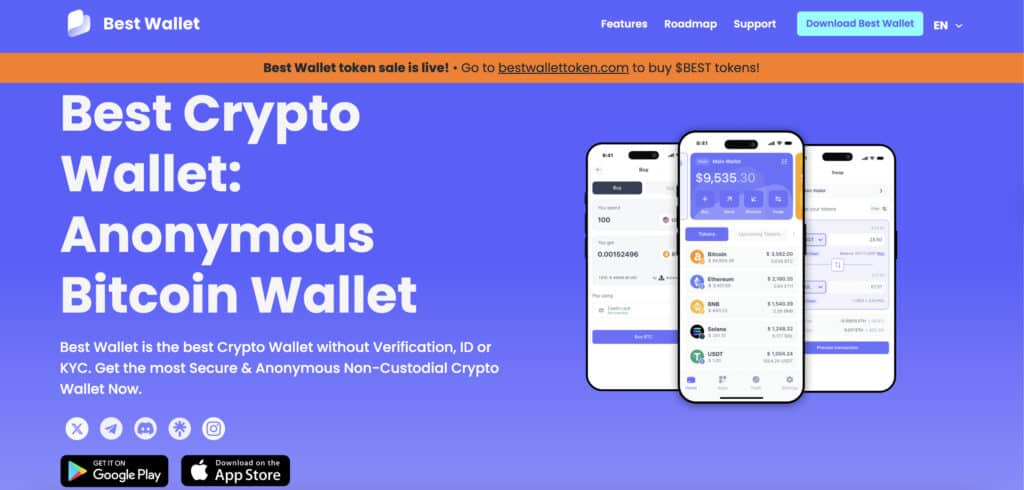
For Tezos holders, Best Wallet can be used to securely store XTZ alongside other digital assets, and when paired with its built-in staking aggregator to compare APYs across multiple protocols, it finds the most competitive yield. The wallet’s infrastructure already supports numerous proof-of-stake assets, making it a strong all-in-one hub for multi-asset stakers. It also allows investors to participate in crypto presales. Check out our dedicated Best Wallet review for more details.
Best Wallet’s Key Features
- Mobile-first design with iOS and Android support.
- Self-custodial architecture where users hold their own private keys.
- Staking aggregator that compares APYs across multiple protocols in real time.
- Supports 60+ blockchains and thousands of tokens.
- Built-in DEX aggregator for same-chain and cross-chain swaps.
- Anonymous fiat onramps for buying crypto without KYC (subject to limits).
- Buying the $BEST token boosts staking rewards and grants early access to vetted presales.
- Integrated access to upcoming token sales via the Upcoming Tokens portal.
Best Wallet’s Pros and Cons
Pros
-
Self-custodial with full control over private keys
-
Aggregates staking options to find best available APYs
-
Supports a wide range of assets and chains in one app
-
Extra perks for $BEST holders, including higher yields and presale access
Cons
-
Mobile-only
-
Loss of recovery phrase means permanent loss of funds
Tezos – Top Platform to Stake XTZ
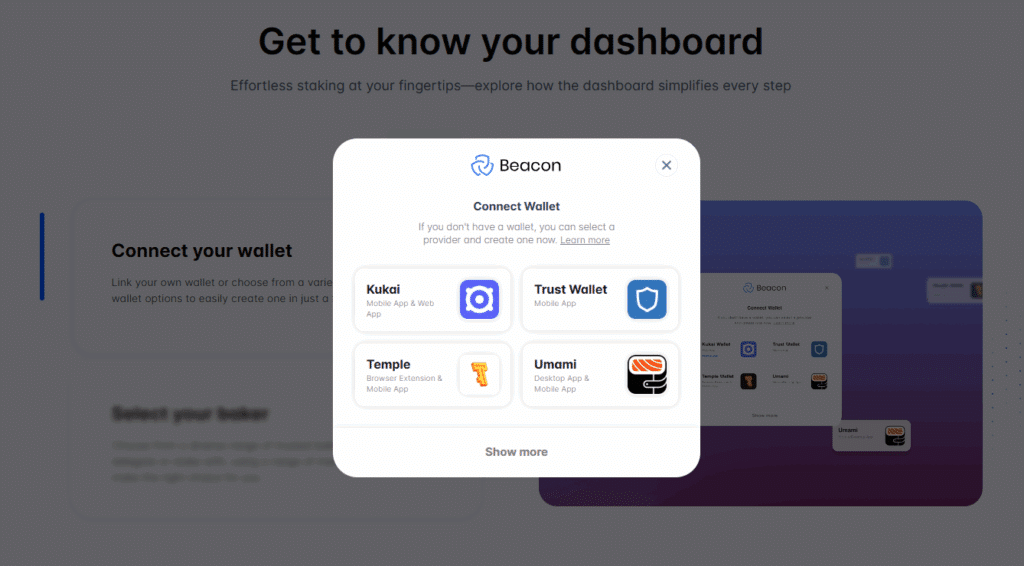
To stake your tokens on Tezos, connect your wallet to the staking app, delegate your XTZ to a chosen baker, and stake your delegated tokens. So, the simplest way to stake is to use the Tezos staking web application, which walks you through the process.
The estimated Tezos APY is 4.9% for delegators and 14.7% for bakers. Tezos distributes staking rewards automatically, and you can see them by looking up your account on a block explorer such as TzKT.
Tezos’ Key Features
- The Tezos staking web application is the simplest way to stake this token.
- The estimated APY is 4.9% for delegators.
- The estimated APY is 14.7% for bakers.
- Tezos distributes staking rewards automatically.
- You can see your rewards by searching your account on a block explorer.
Tezos’ Pros and Cons
Pros
-
Both delegators and bakers earn rewards
-
Rewards distributed automatically, with no manual action needed
-
Switching bakers at any time without restrictions
Cons
-
Baking has a lock-up period of four cycles
Kraken – Popular Crypto Exchange to Stake XTZ
Kraken lets you stake Tezos, earn rewards on your XTZ holdings, and help secure the Tezos network. The process involves creating a free Kraken account, depositing or buying XTZ, and staking your tokens to earn an APY between 12% and 18%.
Staking on Kraken has no minimum requirements, meaning you can stake any amount on XTZ in minutes. Our Kraken review shows that the platform uses SSL encryption, FIDO2 2FA, PGP-signed emails, and account timeout settings, so your funds remain safe.
Kraken’s Key Features
- The process involves creating a free Kraken account, depositing or buying XTZ, and staking your tokens.
- Staking Tezos offers an APY between 12% and 18%.
- You use one login to stake, buy, sell, and trade XTZ.
- There are no minimum requirements.
- The platform uses strong security measures.
Kraken’s Pros and Cons
Pros
-
No minimum staking requirements
-
Earn rewards with up to 18% APY
-
Robust security measures
Cons
-
Withdrawals may take time
Binance – Top-Rated Tezos Staking Platform
The Binance Earn feature supports over 300 assets, including XTZ. You can stake XTZ with flexible or locked options. The former provides rewards with an APY of 2.55%, while the latter allows you to choose between locking your assets for 30, 60, 90, or 120 days, with an APY of 2.19%, 3.49%, 3.90%, and 4.90%, respectively.
For instance, by staking 1,000 XTZ for a year, you will earn + 48.32876712 XTZ. As mentioned in our Binance review, staking is only available to users registered on Binance.
For your better understanding, we have covered everything about Binance staking in our separate guide.
Binance’s Key Features
- The Binance Earn feature supports over 300 assets, with XTZ as one of them.
- You can stake XTZ with flexible or locked options.
- The flexible option provides an APY of 2.55%.
- With the locked option, you can choose between locking your assets for 30, 60, 90, or 120 days.
- The locked staking option offers an APY ranging from 2.19% to 4.90%.
Binance’s Pros and Cons
Pros
-
Both flexible and locked options cater to different preferences
-
Earn up to 4.90%
-
Binance allows users to stake, trade, and withdraw XTZ within the same platform
Cons
-
You need to have an account on Binance to stake XTZ
-
Some users may find the platform a bit overwhelming
Ledger – Top Hardware Wallet To Stake Tezos
Ledger hardware wallet offers some of the best staking coins, including XTZ. The Ledger Live app enables you to securely and easily delegate your XTZ and start earning passive rewards. Ledger allows you to choose which validators to delegate your Tezos to. Staking Tezos provides an average 3% return, with the rate varying based on different criteria.
Remember that when you first start delegating, you must wait around five weeks for your validator to provide you with your first staking rewards. After this, you can expect rewards about every three days. Also, Ledger gives you the flexibility to switch validators if you wish. See our Ledger staking review for a well-rounded understanding.
Ledger’s Key Features
- The Ledger Live app enables you to securely and easily delegate your XTZ.
- Ledger allows you to choose which validators to delegate your Tezos to.
- Staking Tezos provides an average 3% return.
- When you first start delegating, you must wait around five weeks for your validator to provide you with your first staking rewards.
- You can switch validators if you wish.
Ledger’s Pros and Cons
Pros
-
Choose and switch validators
-
Receive staking rewards every three days after the initial 5-week waiting period
-
Ease of use
Cons
-
Initial 5-week waiting period
-
Some users may find the staking process a bit time-taking
Coinbase Prime – Top Tezos Staking Site For Beginners
Coinbase Prime offers Tezos staking with an estimated reward rate of 5.60%. Rewards are automatically compounded, and payouts are made every 30 seconds, but they may take 31-37 days to appear in your account due to network conditions.
Users can partially unstake their assets, though any new funds must be manually restaked, and changing staking amounts or validators requires unbonding.
Staking fees depend on the validator type, with Coinbase Custody public validator charging a 20% fee. No warm-up or unbonding periods exist, but general consensus approval is required for all staking activities. Stakers can’t delegate to multiple validators or modify amounts without manual intervention. Recently, new listings on Coinbase have introduced additional staking opportunities, potentially expanding your options to diversify.
Head to our Coinbase staking review for more information.
Coinbase’s Key Features
- Coinbase Prime offers Tezos staking with an estimated reward rate of 5.60%.
- Payouts are made every 30 seconds, but they may take 31-37 days to appear in your account due to network conditions.
- The Coinbase Custody public validator charges a 20% fee.
- There are no warm-up or unbonding periods.
- Stakers can’t delegate to multiple validators.
Coinbase’s Pros and Cons
Pros
-
An estimated reward rate of 5.60%
-
Payouts made every 30 seconds
-
No warm-up or unbonding periods
Cons
-
Stakers can’t delegate to multiple validators
How to Stake Tezos: A Step-by-Step Guide
Let’s go over the whole process of staking Tezos step by step:
-
Prepare a Tezos Wallet
Ensure you have a supported Tezos wallet installed and funded with XTZ tokens.
-
Open the Staking Site
Visit Tezos staking site in your web browser.
-
Connect Your Wallet
Click “Connect your wallet,” choose your wallet, and confirm the connection in your wallet app. The site will display your staked amount and account balance.
-
Select a Baker
Click “Select Baker” and choose the baker (validator) you want to delegate to.
-
Delegate to the Baker
Click “Delegate” and approve the operation in your wallet. Wait a few seconds for the delegation to finalize.
-
Open the Staking Flow
Click “Stake” and review/confirm the terms of use.
-
Enter the Amount
Enter the amount of XTZ you want to stake.
-
Confirm and Stake
Click “Stake” again to approve the staking operation. Confirmation may take several seconds.
How Much Can You Earn by Staking XTZ?
The estimated annual reward rate for staking this coin on-chain is 4.9% for delegators and 14.7% for bakers. Yet, the amount of XTZ you receive depends on several factors, including how lucky your baker is and how much you stake. Due to the adaptive issuance mechanism, the returns from staking are influenced by the proportion of staked XTZ compared to the total XTZ available, promoting a balance between staked and liquid XTZ.
Other platforms offer higher APYs for Tezos. For instance, staking on Kraken provides rewards of up to 18%.
To maximize your XTZ staking rewards, follow our strategies:Tips and Strategies for Maximizing Tezos Staking Rewards
Mistakes to Avoid When Staking Tezos
Read carefully the following mistakes, commonly made by Tezos stakers, so that you can avoid doing them:
- Not choosing reliable bakers: Seek bakers with a proven track record of high uptime, consistent performance, and positive community feedback.
- Ignoring the fees: Understand the baker’s service terms and fees before you delegate. They can vary substantially and directly affect your staking profits.
- Not paying attention to the rewards: It’s smart to use online staking calculators to assess potential returns based on baker performance and current network conditions.
- Neglecting security: Make sure you do regular software updates, enable two-factor authentication, and use unique and strong passwords.
Best Practices to Stake XTZ
The best practices to stake your XTZ successfully are:
- Staying informed: Stay updated on the latest staking developments and trends. You cannot make well-informed decisions if you aren’t current with rewards, protocol changes, and new crypto staking opportunities.
- Choosing reputable platforms: Use reputable staking platforms with a proven reliability and security track record.
- Risk management: Understand the risks of staking XTZ and set clear risk management guidelines. Consider factors like slashing risks, lock-up periods, and overall market volatility.
- Reinvesting rewards: Instead of cashing out your staking rewards immediately, consider reinvesting them to compound your earnings.
Benefits and Risks of Tezos Staking
Benefits Risks
XTZ Staking vs. ICP Staking: A Comparative Analysis
When comparing XTZ to ICP staking, we can first note that the former uses an LPoS, while the latter uses a four-layered consensus mechanism based on PoS.
Both offer governance power to their users. However, XTZ outperforms ICP regarding staking rewards, providing APYs of up to 18% based on the chosen platform, stake size, and baker performance. Lastly, they both offer flexible and locked staking options.
| Feature | XTZ staking | ICP staking |
| Consensus mechanism | Liquid proof-of-stake (LPoS) | A four-layered consensus mechanism based around PoS |
| Governance | Yes | Yes |
| Minimum stake | No minimum requirement | 1 ICP |
| Duration | Flexible and locked options | Flexible and locked options |
| Reward calculation | Based on platform, stake size, and baker performance | Depending on voting, governance participation, and stake duration |
| Staking rewards | Up to 18% | Up to 8% APY |
Did You Know?
Tezos is a great staking option, but what if you’re ready to explore more staking opportunities, see our curated list of the 14 Best Crypto Staking Coins and combine crypto strategies to make money.
How to Unstake Tezos: A Detailed Guide
These are the steps for unstaking your XTZ:
-
Open Tezos Staking Site
Visit the Tezos Staking Site through a web browser. -
Start Unstake
Click Unstake, read the delay notice, and click ‘I Understand.’ -
Choose Amount
Pick the amount of XTZ you want to unstake. -
Confirm Unstake
Click Unstake and confirm the transaction in your wallet or browser extension. -
Wait to Finalize
Wait until the request is ready to be finalized, the application will show a Finalize button when it’s ready. -
Finalize
Click ‘Finalize’ and confirm the transaction. You’ll receive a confirmation message once the process is complete. -
Note on Timing
You can unstake any amount of staked XTZ whenever you want; there is a 10-day waiting period before the unstake can be finalized.
Future of XTZ Staking: Long-Term Trends to Watch
Tezos aims to drive economic, social, and political innovation on a global scale. Tezos staking is set for significant growth and innovation in the coming years, driven by several key upgrades. The “Quebec” upgrade in January 2025 introduces refined staking mechanisms and adaptive slashing, enhancing the network’s economics and improving staking rewards.
These advancements aim to attract more stakers by offering better rewards and a more robust staking structure, making it a more appealing platform for long-term participation.
Additionally, Tezos is focusing on improving its efficiency with faster block times and lower latency. The “Paris” upgrade from June 2024 reduces block times to 10 seconds, enabling faster transaction finality on Layer 1. This will enhance the overall user experience for stakers and increase the network’s attractiveness to new participants, ensuring that Tezos remains competitive in the evolving smart contracts landscape.
Conclusion: Is Tezos Staking Worth It?
Tezos’ consensus algorithm is based on the proof-of-stake (PoS) mechanism called liquid proof-of-stake (LPoS). Delegation has been available right from the start, whereas staking is a new option on Tezos. Staking allows holders to lock their XTZ as part of a baker’s stake, which validators must do if they want to participate in PoS networks.
By teaming up with bakers and staking your XTZ, you can earn triple the rewards from delegation, which will be credited to you automatically. The best platform for overall staking needs, including Tezos, is Best Wallet.
The other top five platforms for Tezos staking include Tezos, Binance, Ledger, Kraken, and Coinbase Prime, offering staking rewards with up to 18% APYs. You can maximize your Tezos rewards by following the strategies we’ve provided, including compounding, staying updated, monitoring baker performance, and reviewing your strategy.
DISCOVER:
- Crypto Exchange Promos & Discounts
- Crypto Wallet Promos & Discounts
- Helium Staking: How to Stake Helium and Maximize Rewards in 2026
- How to Stake Stablecoins – A 2026 Guide to Stablecoin Staking
- Axie Infinity Staking: How to Stake AXS in 2026
- AAVE Staking: Benefits, Risks & Tips for 2026
FAQs
Is Tezos worth staking?


Yes, it is. The highest Tezos staking APY is 18%, offered by Kraken.
What is the minimum stake for Tezos?
There are no minimum requirements for staking Tezos.
Is my Tezos locked while it's staked?
Yes, your Tezos remains locked while it’s staked. You can request to unstake at any time, but you must wait 10 days before finalizing the withdrawal.
Which Tezos baker should I be delegating my funds to?
Choose a Tezos baker with a solid reputation, high uptime, low fees, and no history of over-delegation. You can compare bakers to find the best fit.
Is staking Tezos safe?
Yes, it is mostly safe. Delegating offers no risk to the user, allowing them to keep full control of their XTZ and spend it whenever they want. Moreover, users aren’t punished if the baker misbehaves.
What is the lockup period when I stake XTZ?
Baking on the Tezos platform has a lock-up period of four cycles (10 days). However, different platforms offer different lock-up periods for staking XTZ.
References
- Tezos. Tezos,tezos.com.
- HEC Paris. Staking, Token Pricing, and Crypto Carry. HEC, 2022. https://www.hec.edu/sites/default/files/documents/Staking%20Paper%20June%202022.pdf
- Taylor, Benjamin A. “Staking Your Crypto: What Are the Stakes?” Journal of Business & Technology Law, vol. 17, no. 1, 2021, Article 5, https://digitalcommons.law.umaryland.edu/cgi/viewcontent.cgi?article=1372&context=jbtl
- Tezos Foundation. Tezos Foundation, tezos.foundation.

Why you can trust 99Bitcoins
Established in 2013, 99Bitcoin’s team members have been crypto experts since Bitcoin’s Early days.
Weekly Research
100k+Monthly readers
Expert contributors
2000+Crypto Projects Reviewed