






In This Article
Best Platforms to Buy Bitcoin Anonymously
- 1. BitBase: The Best Way to Buy Bitcoin Anonymously
- 2. Margex: Popular Exchange to Buy Bitcoin Anonymously
- 3. KCEX: Trade Bitcoin Without ID Verification
- 4. BloFin: Crypto Platform to Buy Bitcoin Without KYC
- 5. LBank: Powerful CEX with Advanced Crypto Trading Tools
- 6. Best Wallet: Mobile No-KYC DEX with Easy Crypto On-ramp
- 7. WEEX: Buy BTC Without Revealing Identity
- 8. Changelly: Instant Decentralized Crypto Exchange with Zero ID Verification
- 9. ChangeNOW: Non-Custodial Decentralized Exchange with No-KYC for Small Swaps
- 10. Switchere: Simple Crypto On-Ramp with Minimal KYC Required
Easy Methods to Buy Bitcoin (BTC) Anonymously
- How to Buy Crypto With LocalCoinSwap
- Using Bitcoin ATMs: The Fastest Way to Trade Cash for BTC Privately
- How to Buy Crypto With Prepaid Card
- How to Buy Crypto without ID
- How to Buy Bitcoin without KYC
- How to Buy Bitcoin Without SSN
- How to Buy Bitcoin with a Credit Card Anonymously
- Top 6 Methods to Buy Bitcoin Anonymously Without Verification
- How We Test Platforms for Buying Bitcoin Anonymously in 2026
- Buying Bitcoin Anonymously: Pros and Cons
What Really Affects Your Privacy When Buying Bitcoin Anonymously
- Region-Specific Caveats You Should Know About
- KYC Can Still Be Triggered, Even On “No-KYC” Services
- Buying With Credit or Debit Cards: What Privacy You Give Up
- P2P Methods: Better Privacy, More Responsibility
- Mixing and CoinJoin: Legal Risk, Freeze Risk, and Unreliable “Complete Anonymity” Claims
- Post-Purchase Privacy: How People Accidentally Link Everything Together
- Final Things to Consider Before Buying BTC Anonymously
- Conclusion: Buy BTC With Anonymity
If you’ve tried to buy Bitcoin lately, you’ve probably hit a wall of “Verify Your Identity” pop-ups. In 2026, true anonymity is a moving target. Mainstream exchanges have turned into data collection hubs, and the new Curaçao LOK regulations mean even “offshore” sites are tightening their grip.
But here is the truth: You don’t need to hand over your passport just to own a few Satoshis.
Buying Bitcoin anonymously in 2026 isn’t about a single magic button; it’s about reducing your digital footprint. Whether you’re using a non-custodial wallet, a P2P cash trade, or a privacy-first swap service, this guide cuts through the no-KYC marketing fluff to show you what actually works and where the identity traps are hidden.
Top-Rated No-KYC Exchanges & Private Apps to Buy Bitcoin Anonymously in 2026

- Complete tasks to earn rewards
- Crypto & TradFi on one platform
- Up to 7.84% interest on deposited crypto

- Start Trading With as Little as $10
- Beginner-Friendly
- Supports 15 Blockchains and 50+ Fiat Deposit Methods

- Deep Liquidity and Vast Trading Pair Options
- No KYC in Most Jurisdictions
- Low Fees- 0% Spot and Future Makers, 0.01% Future Takers

- 400+ Spot & 350+ Perpetual Markets
- Copy Trading with Advanced Features
- Independent LPs and Market Makers- No Risk of Exchange Manipulation
Key Takeaways
- Bitcoin isn’t fully anonymous, as every transaction is public on the blockchain.
- You can still buy Bitcoin without ID using P2P sites, Bitcoin ATMs, or privacy wallets.
- BitBase lets you buy and store BTC with no KYC, straight from your phone.
- Buying with cash or prepaid cards offers the most privacy, but has higher risks and limits.
- Privacy tools like VPNs, Tor, and mixers can make your Bitcoin use harder to trace.
- Some platforms offer anonymous trading, but laws are changing, so always check local rules.
How to Buy Bitcoin Anonymously: Summary
BitBase is the best way to buy Bitcoin anonymously in 2026. It accepts a wide range of payment methods, including credit and debit cards, and offers a selection of more than 50 cryptocurrencies for purchase. Withdrawal limits for non-verified users are exceptionally high at $500,000 per day, meaning you won’t have to go through KYC to move your tokens off BitBase when you’re ready.
Bitcoin is not as anonymous as most people believe. All BTC transactions can be traced to the public blockchain, with a good deal of cryptocurrency exchanges requesting Know Your Customer (KYC) verification. In essence, every Bitcoin purchase can be linked to your actual identity, particularly on centralized platforms.
So, buying Bitcoin anonymously using cash or no-KYC crypto platforms like BitBase is still possible. Alternative methods include peer-to-peer exchanges like LocalCoinSwap, no-ID crypto platforms like Bisq, and anonymous Bitcoin ATMs.
For those seeking maximum privacy, you can use tools like Tor Browser, Tails OS, VPN services, coin mixers, and privacy coins. These methods can help you buy Bitcoin with complete anonymity, but they often come with trade-offs in speed and convenience. Whether you want to avoid surveillance, protect your financial privacy, or learn how to buy crypto anonymously, this guide walks you through your options.
| Platform | Best For | Main Features | Rating |
| BitBase | Seamless spot and futures trading with no KYC | 50+ spot and 400+ futures pairs, $500,000 withdrawal limit with no KYC | 4.9/5 |
| Margex | BTC trading with limited KYC needs | Basic trading without full KYC, derivatives + copy trading | 4.7/5 |
| KCEX | Basic BTC trading without full ID checks | Email/phone signup, 0% spot fees (as stated), futures access | 4.5/5 |
| BloFin | No-KYC exchange for spot & futures | 300+ USDT pairs, TradingView + bots, withdrawal caps for non-KYC | 4.4/5 |
| LBank | Trading crypto with a wide range of markets and tools | 800+ crypto trading pairs, copy trading, grid trading bots | 4.3/5 |
| Best Wallet | Buying & swapping BTC with no KYC (wallet-first) | Non-custodial, in-app DEX aggregator, multi-chain support | 4.1/5 |
| WEEX | No-KYC-friendly CEX trading | No verification needed for core actions, futures + spot access | 4.0/5 |
| Changelly | Instant swaps with lower ID exposure | Non-custodial swaps, wide token/fiat support, KYC may trigger | 3.8/5 |
| ChangeNOW | Small swaps without sign-up | Non-custodial swaps, fast execution, no-KYC for smaller swaps | 3.8/5 |
| Switchere | Buying Bitcoin instantly with minimal KYC | Limited KYC to buy crypto, instant buy/sell, accepts e-wallets | 3.6/5 |
Best Platforms to Buy Bitcoin Anonymously
Finding the best platforms to buy Bitcoin anonymously in 2026 is important for anyone who values privacy and control. Here are trusted options that let you purchase BTC without ID:
1. BitBase: The Best Way to Buy Bitcoin Anonymously
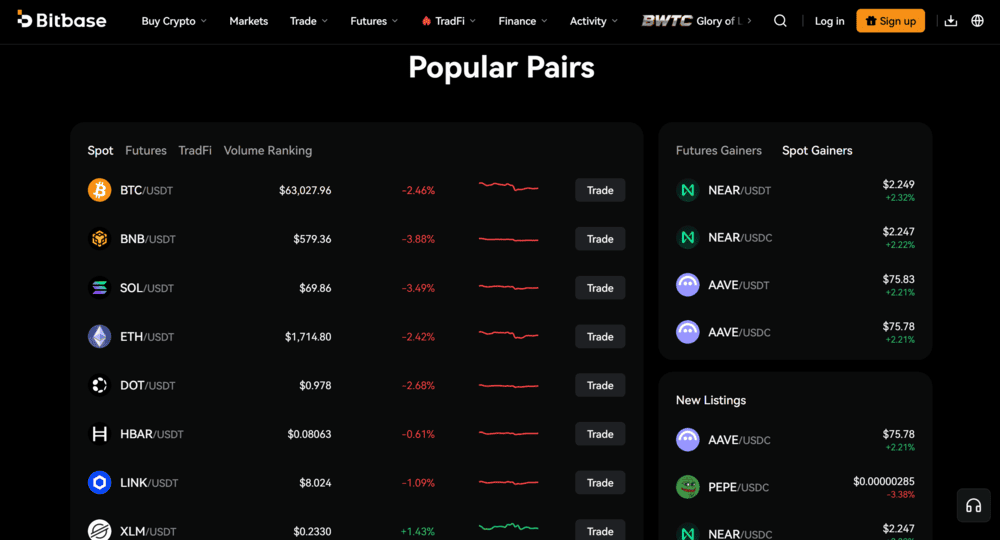
BitBase is our overall top-rated platform for buying Bitcoin and other cryptocurrencies anonymously. This full-service centralized exchange (CEX) offers trading on more than 50 popular cryptocurrencies, including BTC, ETH, XRP, and more. You can sign up with just an email address and make purchases using a credit or debit card, bank transfer, or online payment.
In addition, for users in Europe, BitBase has a series of physical stores and Bitcoin ATMs that offer full anonymity. Fees for in-person Bitcoin purchases are higher than buying through the exchange, but you have the option to make purchases with cash rather than electronic payment methods.
Once you have Bitcoin, BitBase makes it easy to start trading crypto. You can instantly swap for other major tokens using the CEX’s professional-grade trading interface. BitBase also offers more than 400 crypto futures contracts denominated in USDT, which allow you to take positions on the future price of crypto tokens without owning them directly.
We also like BitBase because of its competitive fees. Purchasing crypto online with fiat costs €5 plus 4.5%, while in-person purchases cost 8-15%. Trading fees are very low, starting at 0.1% for spot trading and 0.02% (maker) to 0.06% (taker) for futures.
When you’re ready to cash out, BitBase allows you to withdraw up to $500,000 per day in crypto with no KYC. However, bear in mind that you’ll need to complete a KYC check if you want to withdraw fiat.
Pros
-
Online CEX with user-friendly crypto on-ramp
-
Physical stores and Bitcoin ATMs available in Europe
-
Trade 50+ spot tokens and 400+ crypto futures pairs
-
Competitive on-ramp and trading fees
-
Withdrawal limit up to $500,000 daily with no KYC
Cons
-
KYC required to cash out to fiat
-
Doesn’t offer copy trading or grid trading bots
BitBase Review


2. Margex: Popular Exchange to Buy Bitcoin Anonymously
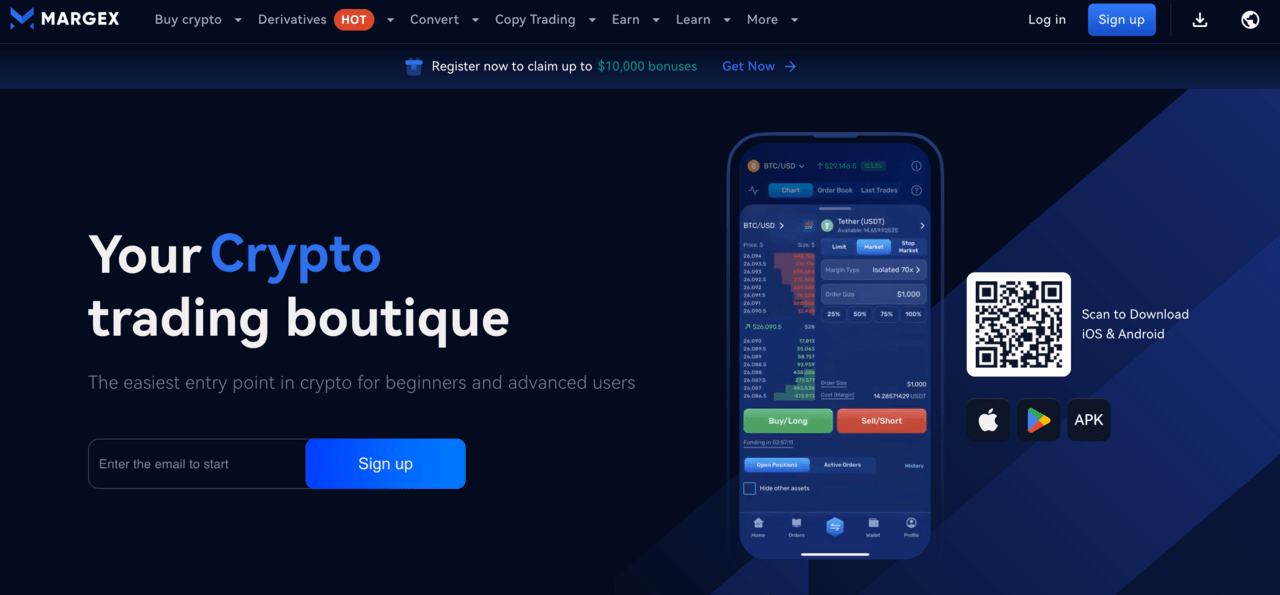
Margex is another popular way for you to buy Bitcoin anonymously. This exchange doesn’t require users to go through a long KYC process for basic trading. Instead, users can deposit crypto and begin buying Bitcoin right away. Please note that KYC is needed for some features, but you can still do basic spot trading without providing your identity.
It’s worth noting that users can safely trade 40+ cryptos, including Bitcoin. They can also use advanced trading tools like futures with up to 100x leverage. The app also gives traders access to real-time market data and charting tools that help them make well-informed choices.
Margex’s low trading fees (0.06% taker/0.019% maker) make it easy for people to trade Bitcoin. The platform also lets users stake their crypto holdings to make passive income.
Strong security measures, such as two-factor authentication (2FA) and cold storage, make Margex a relatively safe place to trade. The exchange also offers copy trading features that let users automatically mirror the trades of successful traders.
Use promo code MARGEXBONUS when making a deposit to get a 20% deposit bonus for deposits above $100 in any currency. The bonuses can be used to offset trading commissions.
Pros
-
Basic spot trading without full KYC
-
Futures up to 100x with risk tools
-
Low fees with maker/taker discounts
-
Copy trading available
Cons
-
KYC required for some features/limits
-
Smaller coin selection than top-tier CEXs
Margex Review
3. KCEX: Trade Bitcoin Without ID Verification
Another promising exchange from which to buy Bitcoin anonymously is KCEX. It allows users to trade without extensive KYC requirements. This platform enables basic trading with just an email or phone number signup, which makes it an attractive option for those prioritizing privacy. While some features may require additional verification, users can engage in spot trading and other basic functions without providing detailed personal information.
The exchange offers trading in over 100+ cryptos, including major coins like Bitcoin and Ethereum, and various altcoins. The platform offers advanced trading options, particularly in futures trading, with leverage of up to 100x. Traders can also access real-time market data and charting tools to make better trading decisions.
One of KCEX’s standout features is its competitive fee structure, with 0% fees for spot trading and low fees for futures trading (0% maker/0.02% taker). This fee schedule makes KCEX an economical choice for frequent traders. The platform also offers various promotions, including sign-up bonuses and rewards for completing certain tasks or reaching trading volumes.
Pros
-
Email/phone signup for basic access
-
0% spot maker fees on many pairs
-
Futures up to 100x
-
Bonuses and task-based rewards
Cons
-
Extra verification needed for higher limits
-
Liquidity varies across altcoins
KCEX Review
4. BloFin: Crypto Platform to Buy Bitcoin Without KYC
BloFin is a popular crypto exchange that allows users to trade Bitcoin and other cryptos without going through KYC verification for basic trading. If you want to buy $BTC without ID, BloFin is certainly one way to go. This exchange offers spot and futures trading on over 300 USDT-margined pairs without requiring identity verification for core features.
It’s worth noting that users can access up to 150x leverage on futures trading. The platform also provides advanced tools like TradingView charting, copy trading, and trading bots to assist traders in making informed decisions. BloFin’s competitive fee structure (0.1% maker/taker for spot, 0.02% maker/0.06% taker for futures) makes it even more attractive for frequent traders. The exchange also offers a welcome bonus of up to $5,000 for new users completing trading and deposit tasks.
Strong security measures, including a partnership with Fireblocks for asset custody and a 1:1 reserve policy, make BloFin a relatively safe place to trade. However, non-KYC users face a daily withdrawal limit of 20,000 USDT.
Pros
-
Core trading features available without KYC
-
Spot and futures markets with deep pairs
-
Advanced tools: TradingView, bots, copy trading
-
Competitive fees and promos
Cons
-
Daily withdrawal caps for non-KYC users
-
Region-based restrictions may apply
BIoFin Review
5. LBank: Powerful CEX with Advanced Crypto Trading Tools
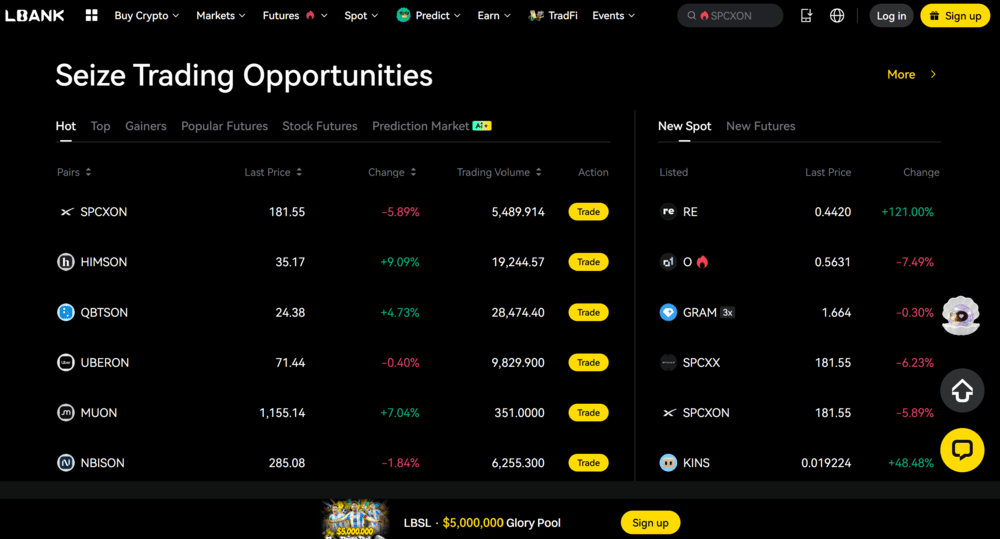
LBank is another top platform to buy Bitcoin anonymously. It offers a user-friendly crypto on-ramp that accepts multiple payment methods, including credit and debit cards, bank transfers, PayPal, prepaid cards, and digital wallets. Many methods can be used with no KYC checks.
In addition, LBank offers a peer-to-peer (P2P) exchange, which makes it easy to buy crypto directly from another individual. These transactions don’t require verification and more than 300 payment methods are supported.
What stands out most about LBank is the range of crypto markets and trading tools available. Users can access more than 800 crypto trading pairs, including 600+ crypto futures contracts denominated in USDT and USDC. On top of that, LBank offers on-chain TradFi trading for stocks and commodities along with its own on-chain prediction market.
Traders have access to powerful tools such as TradingView charts, a copy trading platform, and a grid trading bot. Competitions keep trading fun and offer big prizes for top traders, too.
LBank’s fees are slightly above the industry average, but not by much. Spot trading fees start at 0.2%, while futures trading fees start at 0.02% for makers and 0.06% for takers. Without KYC, you can withdraw up to 0.5 BTC in crypto per day (fiat withdrawals require KYC).
Pros
-
200+ payment methods supported to buy crypto
-
P2P exchange with no KYC required
-
Offers 800+ crypto trading pairs including futures
-
Advanced tools including TradingView charts, copy trading, and trading bots
Cons
-
No-KYC withdrawals limited to 0.5 BTC per day
-
Not available in the U.S.
LBank Review
6. Best Wallet: Mobile No-KYC DEX with Easy Crypto On-ramp
Best Wallet provides one of the best ways to buy Bitcoin online while staying anonymous, making it our top pick. It is a non-custodial wallet that does not require users to register their names, submit personal information, or complete KYC verification. Users can download the app and start buying/selling Bitcoin within minutes. The wallet also offers multi-blockchain support, allowing you to trade cryptocurrencies on popular networks such as Ethereum (ETH) and Binance Smart Chain (BNB).
The wallet offers in-app features such as cross-chain token swaps, a token launchpad, and a decentralized exchange (DEX) aggregator, making it one of the best crypto platforms to buy and sell cryptocurrencies.

Pro tip: The payment method you choose can greatly affect your privacy. If you’re using Best Wallet, the best option is to use the in-app DEX aggregator (or any DEX) and pay with cryptocurrencies via an on-chain transaction.
Best Wallet also lets you use cryptocurrencies using fiat currencies via credit or debit cards, Apple Pay, and Google Pay. These payment methods are super convenient, but keep in mind that any time you use bank transfers or anything linked to your bank, your transactions can be traced back to your crypto wallet account. If staying private is your goal, onchain payments on Best Wallet are the way to go.
If you want to know more about this mobile wallet, take a look at our dedicated Best Wallet review.
Next up, we have a summary of Best Wallet’s strengths and weaknesses and a step-by-step guide to buy Bitcoin anonymously on Best Wallet.
Pros
-
Best Wallet gives user full ownership of their Bitcoins by storing private keys locally.
-
Users are not required to complete KYC verification to use Best Wallet.
-
The platform supports multiple blockchains, including Bitcoin, Ethereum, Polygon, and BNB Chain.
-
Best Wallet comes with an in-built DEX aggregator for easy and cheap crypto trading.
-
Best Wallet’s interface is user-friendly, setup is simple, and it does not charge high fees, making it the perfect platform for beginners.
Cons
-
Best Wallet does not have a desktop app or browser extension.
-
Limited customer support.
-
You will be responsible for securing the cryptocurrencies, as Best Wallet is a self-custodial crypto digital wallet.
Best Wallet Review
7. WEEX: Buy BTC Without Revealing Identity
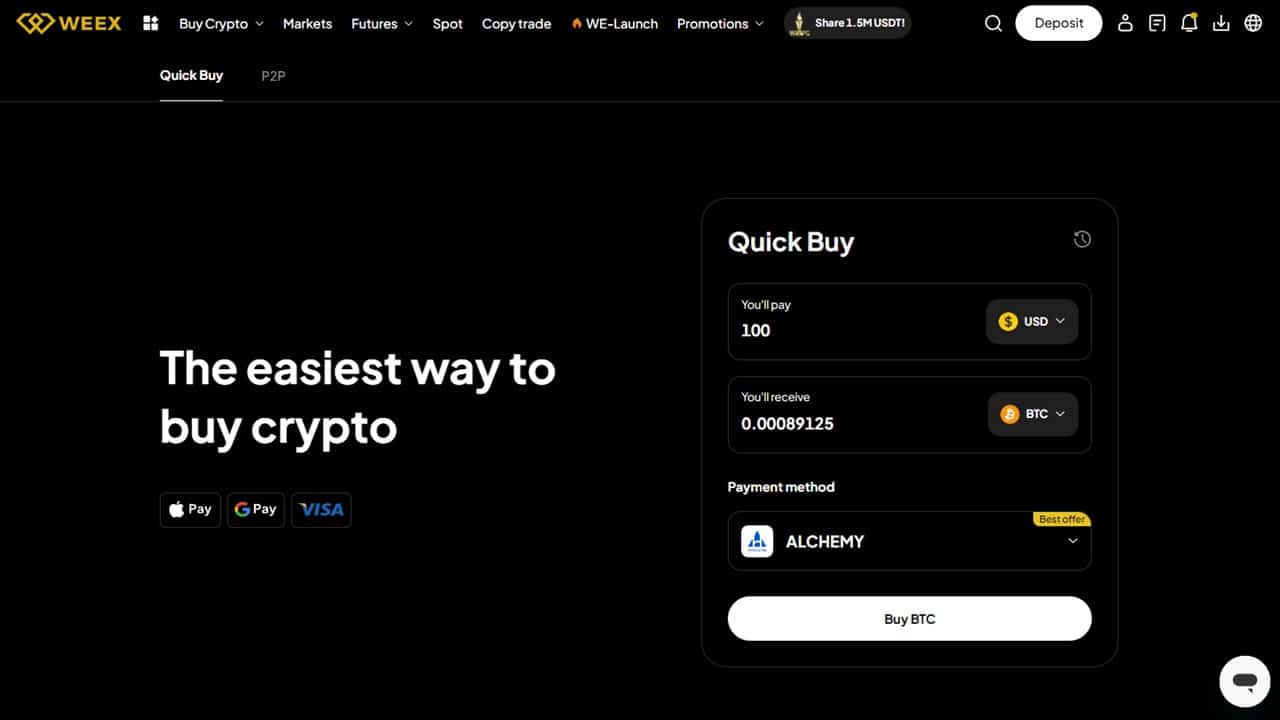
WEEX offers traders a variety of options, including spot trading, futures trading with up to 400x leverage, and copy trading. With access to over 600 cryptocurrencies, users have plenty of choices for building and managing their portfolios in addition to Bitcoin.
One standout feature is the absence of maker fees. Traders placing limit orders pay zero fees, helping them retain more from each transaction. This is particularly beneficial for high-frequency traders who execute multiple trades daily.
Additionally, WEEX offers up to $30,000 USDT in welcome bonuses for completing specific tasks like making a deposit or executing a trade. Other key features include a high-leverage futures market, allowing traders to amplify their positions up to 200x, and a transparent proof-of-reserves system. You can discover more in our full Weex review.
Pros
-
Zero maker fees on many markets
-
Futures up to 200x; copy trading
-
Large selection of trading pairs
-
Proof-of-reserves transparency
Cons
-
Bonuses and offers vary by region
-
Higher leverage increases risk
WEEX Review

8. Changelly: Instant Decentralized Crypto Exchange with Zero ID Verification
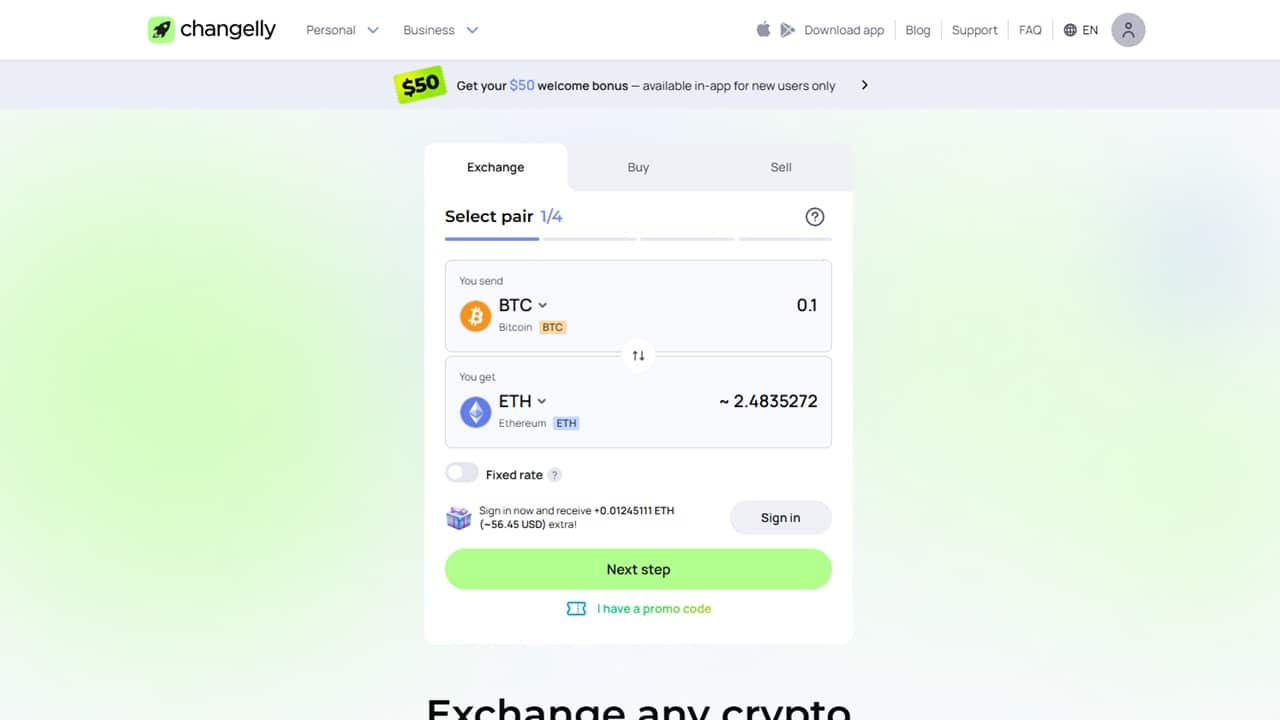
Changelly employs a non-custodial token swapping model, allowing users to purchase BTC without requiring KYC verification. It supports over 1,000 other tokens and more than 90 fiat currencies. With over 20 crypto trading platform partnerships, Changelly offers competitive rates for token swaps.
Transaction speed is a crucial factor when buying or swapping tokens, and Changelly transactions typically take 5 to 40 minutes to complete. The platform does not store any tokens throughout the process and instead securely sends the digital assets directly to users’ wallets.
Since 2015, Changelly has provided a secure and seamless token swapping option for privacy-conscious users. In case people encounter any issues with the platforms or have any concerns, the site’s 24/7 live chat team is available for real-time support.
Pros
-
Fast transactions, averaging 5 to 40 minutes
-
24/7 live chat for personal assistance
-
Supports BTC and 1,000+ other tokens
-
Mobile app available
Cons
-
May require KYC for large transfers
-
Crypto purchasing fees can be high
Changelly Review
9. ChangeNOW: Non-Custodial Decentralized Exchange with No-KYC for Small Swaps
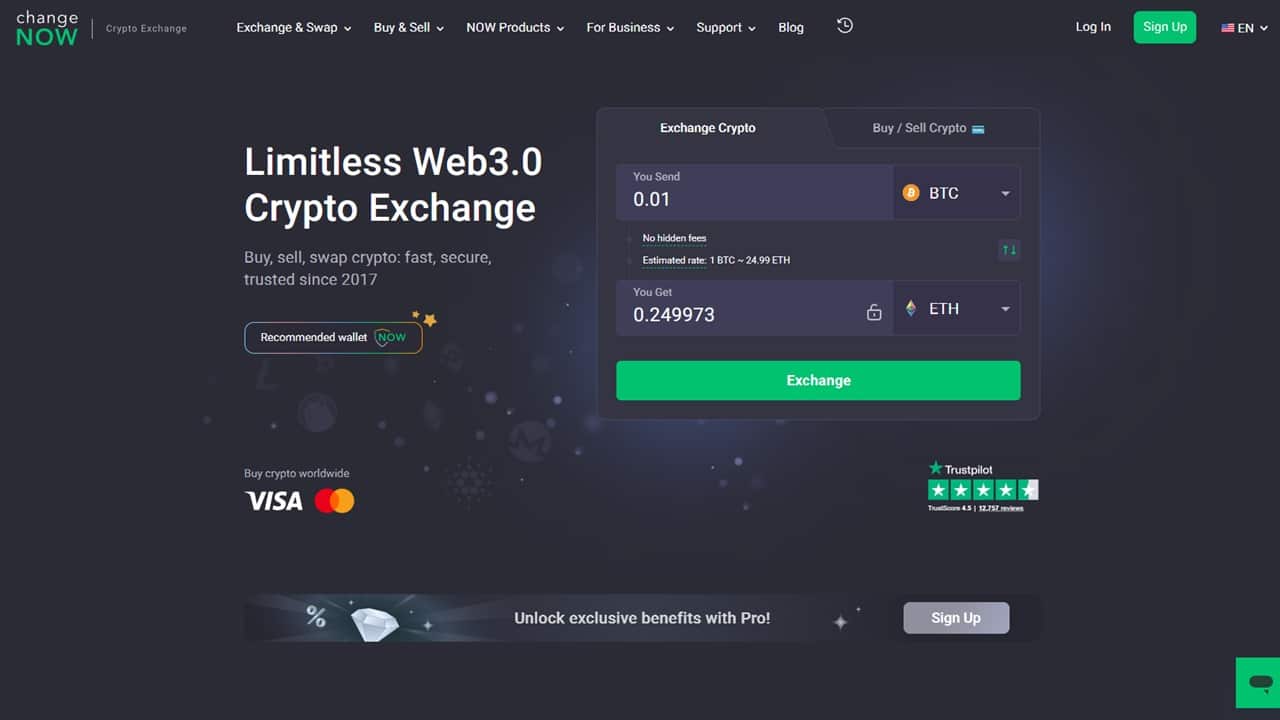
Launched in 2017, ChangeNOW is a self-custodial cryptocurrency exchange with over 5 million clients and support for more than 1,400 tokens, including BTC, ETH, and BNB. Users can swap tokens for BTC without any KYC or sign-up requirements.
Additionally, the platform offers fiat on and off-ramping, powered by various third-party gateways. Users can purchase various tokens using over 50 fiat currencies through payment options such as credit cards, bank transfers, e-wallets, and others.
ChangeNOW’s non-custodial swaps are fast, with transactions taking just 2 minutes to complete on average. Additionally, users retain full privacy and anonymity when using the platform thanks to the site’s non-custodial exchange model.
Pros
-
Supports 1,400+ cryptocurrencies across various blockchains
-
Non-custodial swap model that does not store users’ assets
-
2 minute average execution speed
-
24/7 live chat support available
Cons
-
No-KYC limited to token swaps at small amounts
-
Lacks advanced trading tools and interfaces
ChangeNow Review
10. Switchere: Simple Crypto On-Ramp with Minimal KYC Required
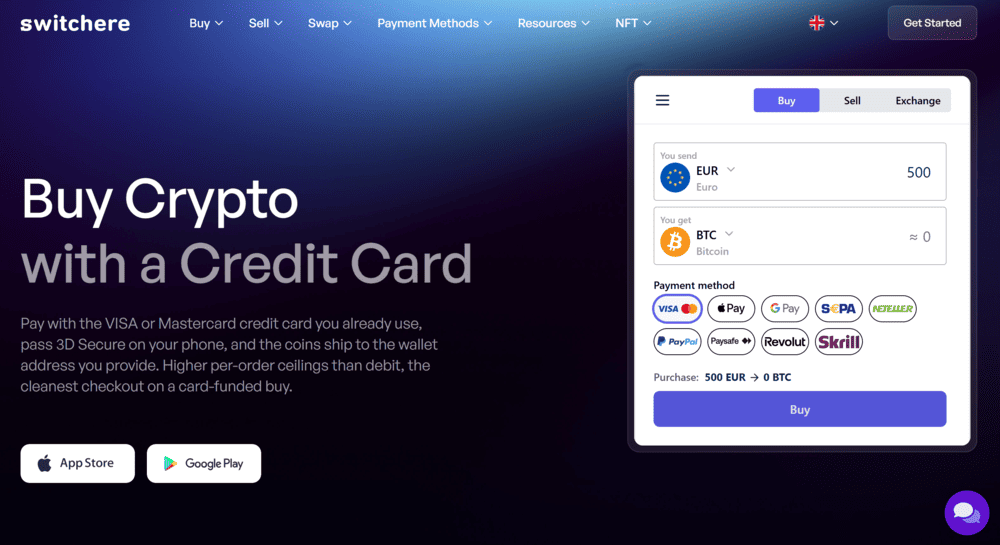
Switchere is a relatively new crypto exchange that makes it simple to buy BTC, ETH, and a handful of other major tokens. You can sign up with just your name, birthday, and country of residence, then purchase crypto instantly. Switchere accepts credit and debit cards, bank transfers, and e-wallets like PayPal, Neteller, Skrill, AstroPay, and more.
Crucially, Switchere’s fees to buy crypto with fiat anonymously are much lower than other platforms. You’ll pay just 3.60% for credit card transactions, compared to 4.5% or more at many competitors. In other words, you get more Bitcoin for your money when using Switchere.
Switchere also supports selling and swapping tokens on its exchange, and it offers low fees for these services as well. But bear in mind that this isn’t a full-service trading platform. The selection of cryptocurrencies is limited, you can’t trade crypto futures, and there are few order or risk management tools available.
It’s also important to be aware of Switchere’s limits for non-verified accounts. Until you complete a full KYC check, you’ll be limited to buying or selling $750 of crypto per day.
Pros
-
Buy and sell 50+ tokens instantly
-
Only limited personal information required to buy
-
Below-average fees to buy Bitcoin with a credit card
-
24/7 customer support
Cons
-
Unverified accounts limited to $750 in transactions per day
-
No crypto trading tools available
Switchere Review
Easy Methods to Buy Bitcoin (BTC) Anonymously
Buying crypto anonymously is getting tougher, especially with tighter KYC (Know Your Customer) regulations in many countries, and the implementation of the Financial Action Task Force’s (FATF) Travel Rule. Still, if you’re looking to buy Bitcoin without ID, one of the most reliable methods is to use peer-to-peer (P2P) platforms like LocalCoinSwap, where you can meet sellers in person and pay with cash. This method lets you buy crypto with no KYC, but it comes with higher risks, including scams or unreliable counterparties, so always use escrow and trusted sellers.
Another option is to use a Bitcoin ATM or a prepaid credit/debit card (more on these later). Bitcoin tumblers also allow you to “wash” your Bitcoin; however, we advise seeking advice regarding your local laws on this practice. There have been some enforcement actions and sanctions taken against users who use crypto tumblers and mixers, so we recommend avoiding this method or using caution.
How to Buy Crypto With LocalCoinSwap
If you’re looking to buy BTC without verification, then the easiest way would be to buy Bitcoin with cash and in person, if possible. Use LocalCoinSwap to find someone near your location who is willing to sell Bitcoin for cash.
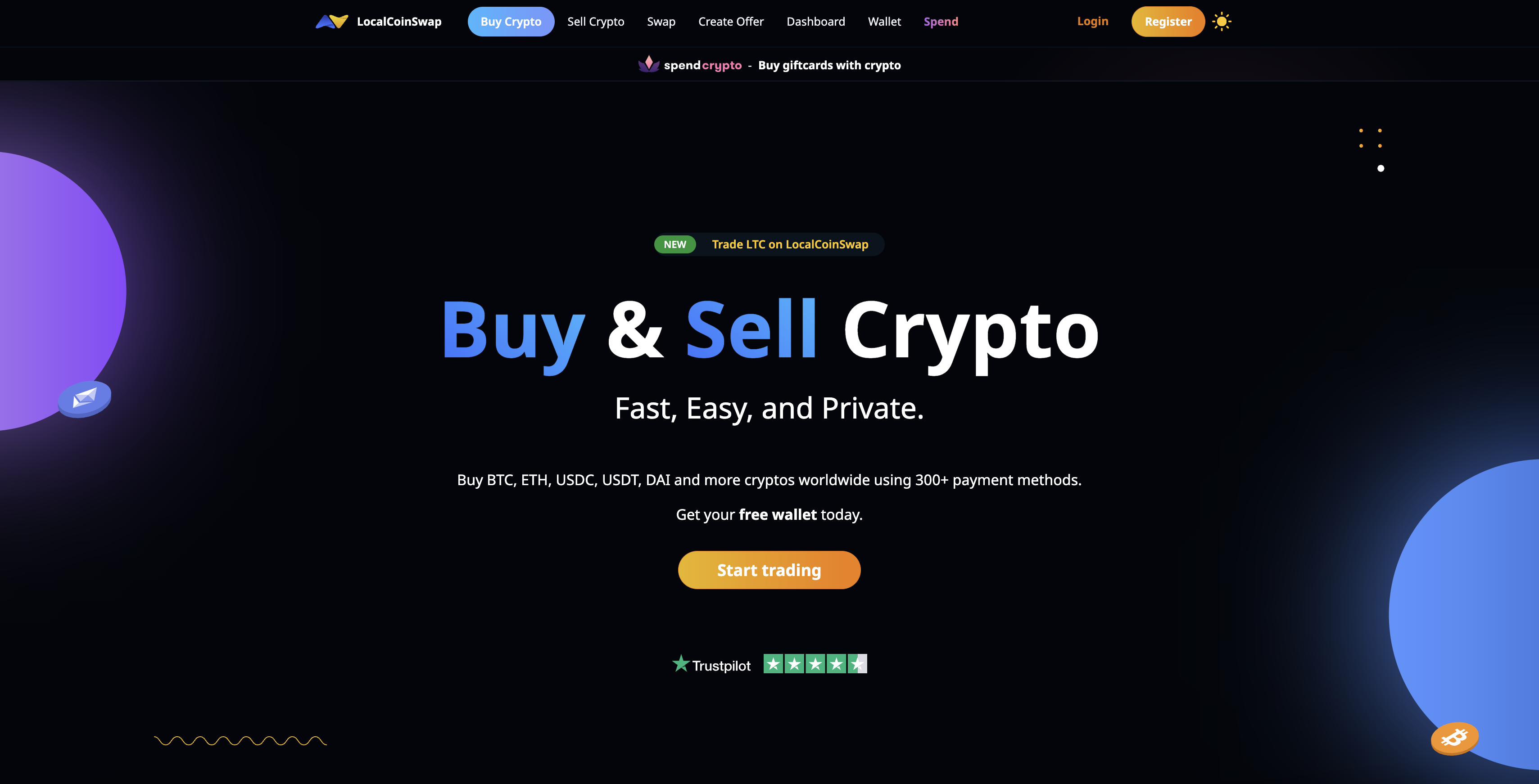
You can use an alias email address to sign up for LocalCoinSwap; their verification process is optional. When you use cash, it’s easy to become untraceable as there is no documentation for the transaction.
Remember that most sellers on LocalCoinSwap don’t like to deal with anonymous buyers; however, since you’re paying in cash, this should be less of an issue.
Using Bitcoin ATMs: The Fastest Way to Trade Cash for BTC Privately
Another way to buy BTC without verification is to go to your nearest Bitcoin ATM and buy it with cash. Buying Bitcoin via an ATM is probably a solid way to buy cryptocurrency anonymously; however, not everyone has an ATM nearby.
When asked to enter your Bitcoin address at the ATM, just specify that you don’t have one. This will generate a new paper wallet for you in most cases, and you’re good to go. Later, you can import the private key from that paper wallet and send those Bitcoins wherever you like.
Alternatively, you can buy a hardware wallet or download a software wallet first and only use that with a Bitcoin ATM to preserve anonymity. Remember, as soon as you use a crypto wallet to send funds to or from a platform that requires KYC, that crypto wallet is no longer anonymous.
How to Buy Crypto With Prepaid Card
One way to stay anonymous is to use a prepaid credit card you can get at any supermarket or convenience store. You can then use this card to buy Bitcoin without the need to supply any form of identification through sellers on LocalCoinSwap.
How to Buy Crypto without ID
With some decentralized systems like peer-to-peer (P2P) marketplaces, you can buy Bitcoin without providing your ID. These services secure users with multisig wallets and escrow schemes. Popular choices include:
- Perfect for experienced users, Bisq is completely decentralized and operates on Tor.
- P2P with escrow and no KYC, Hodl Hodl is multi-currency compatible.
- Previously known as LocalMonero, AgoraDesk works for BTC and XMR trades.
- RoboSats is Tor-based, lightweight, and privacy-focused.
If you are unsure about P2P marketplaces and find them inherently risky, consider Best Wallet.
How to Buy Bitcoin without KYC
If you are looking to buy Bitcoin with a credit card and no verification, crypto swap services like ChangeNOW and Changelly let you exchange crypto without KYC, as long as you stay within withdrawal limits. You can first acquire crypto through P2P trading or decentralized exchanges (DEXs) like Uniswap or PancakeSwap, then transfer it to a non-custodial wallet. Once you have crypto in your wallet, you can trade or swap Bitcoin without identity verification. But always ensure you use trusted platforms in the process.
ChangeNOW is one of the most popular no-KYC exchanges that also utilizes a non-custodial approach. For more details, see our in-depth ChaneNOW review.
Pro tip: Avoid fiat deposits on centralized exchanges, as they typically require KYC.
How to Buy Bitcoin Without SSN
Most big crypto exchanges in the US now ask for a Social Security Number (SSN) for tax reasons amid stringent KYC requirements. But some decentralized and P2P platforms act as anonymous crypto exchanges, letting you buy Bitcoin without it. DEXs like PancakeSwap and Bisq, which allow trading crypto without KYC, will also need limited personal details. The wallets like Best Wallet, Margex and Exodus that don’t require many identity checks will also allow Bitcoin purchases without an SSN.
How to Buy Bitcoin with a Credit Card Anonymously
This section will talk you through how to buy Bitcoin with a credit card anonymously.
This is difficult as credit cards leave a transaction history with your bank. Therefore using a prepaid credit card is a more viable option for buying Bitcoin anonymously.
In addition to this, many banks do not allow crypto purchases using credit cards, so you will need to research prepaid credit cards that can be used without KYC and will be an accepted form of payment from whoever your seller is.
Top 6 Methods to Buy Bitcoin Anonymously Without Verification
Here are the pros and cons of the best methods for buying Bitcoin anonymously without verification:
| Method | Pros | Cons |
| Best Wallet (Top Private Wallet) | No KYC, built-in swap makes tracking harder, easy to use |
Requires loading stablecoins first via a third-party provider
|
| Bitcoin ATMs | Quick, cash-based |
Outlawed in several countries
|
| P2P Marketplaces | Direct, flexible payment options |
Risk of scams, higher fees
|
| In-Person Cash Transactions | Full anonymity, no digital trail |
Requires a trusted seller, safety risk
|
| Prepaid Credit Cards | No link to your identity |
Higher fees, limited acceptance
|
| Bitcoin Mixing Services | Obscure transaction history |
Can be expensive, with potential delays
|
| Tor/VPN Usage | Masks IP address, enhances privacy |
Slower transactions, technical setup
|
How We Test Platforms for Buying Bitcoin Anonymously in 2026
To identify the safest ways to buy Bitcoin anonymously in 2026, we conduct testing using real funds across non-custodial wallets, peer-to-peer marketplaces, and no-KYC services.
Each method is evaluated based on whether identity verification is required at any stage, how transactions are processed, and how quickly Bitcoin is delivered to a private wallet.
We also test purchase limits, payment methods, and settlement times to determine which options genuinely support anonymous Bitcoin purchases rather than offering limited or conditional privacy.
We also assess privacy, fees, and security to ensure each method is practical and reliable. This includes analyzing KYC requirements, data exposure, and compliance with global standards such as the Travel Rule and Crypto-Asset Reporting Framework (CARF).
In addition, we calculate the true cost of each transaction by examining spreads, network fees, and P2P premiums, while prioritizing platforms that support self-custody and give users full control over their Bitcoin. Only methods that balance privacy, usability, and cost-efficiency are included in our recommendations.
Buying Bitcoin Anonymously: Pros and Cons
Below are the pros and cons of buying Bitcoin anonymously:
Pros
-
Protects identity and financial information.
-
No need to provide personal documents.
-
Greater control over assets without regulations.
-
Reduces the chance of transactions being traced.
-
Allows direct cash purchases without banks.
Cons
-
Anonymous transactions may attract scams.
-
Higher fees for anonymous purchases.
-
Fewer platforms and methods available.
-
Some jurisdictions have legal restrictions.
-
Less secure than regulated platforms.
Is Buying Bitcoin Anonymously Legal?
Yes, purchasing Bitcoin without identification is permitted in the majority of nations, though authorities are tightening their regulations. Many exchanges are now required to gather client data by the EU’s Travel Rule and FATF recommendations. You should constantly be aware of the regulations in your area because some privacy tools are controversial.
Legal Considerations
Buying Bitcoin anonymously can raise legal concerns depending on where you live. Many countries have introduced strict regulations to prevent money laundering and fraud, which require exchanges to verify users’ identities. For instance, in the United States, purchasing Bitcoin anonymously through traditional exchanges is difficult due to KYC regulations. Violating these laws can result in penalties or legal actions.
In regions like the European Union, KYC laws are also strict, and anonymous crypto transactions may be illegal if they surpass a certain threshold. On the other hand, some jurisdictions, like Switzerland or certain countries in Latin America, offer more leniency regarding privacy. However, it’s crucial to stay informed about local laws, as legal consequences can arise from using Bitcoin anonymously in prohibited ways. Always consult a legal expert before attempting to bypass identity verification processes in your country.
Why Stay Anonymous?
Before we discuss ‘how to stay anonymous,’ we need to understand why it is important to become anonymous in the first place.
The main reason is that you don’t want to get hacked or become a potential target. Raising your privacy level will lower your risk of falling victim to such actions. Some people value privacy as a matter of principle, while others lean into Bitcoin’s anonymity and privacy features for more specific activities, like accessing the darknet, possibly, but not necessarily, for illicit activities.
However, not all examples point to “bad intentions” or paranoia; the anonymous and private aspects of Bitcoin also lend themselves to, for example, the online gambling industry. Because anonymity and privacy are at the very backbone of Bitcoin, many online crypto casinos require very few personal documents (like IDs, passports, utility bills, etc.) to register and play.
Many people assume that only criminals seek anonymity when using Bitcoin, but there are valid reasons why someone may want to keep their transactions private. For example, journalists, activists, and individuals living in oppressive regimes may need to protect their financial privacy to avoid persecution. Additionally, businesses handling sensitive financial transactions may want to prevent competitors from tracking their spending patterns. Even everyday users may prefer privacy to avoid becoming a target for hackers, phishing scams, or financial profiling. Using Bitcoin anonymously helps reduce exposure to data leaks and ensures personal financial autonomy in an increasingly monitored world.
Furthermore, anonymous transactions allow people to make private donations—like to political parties or public causes—without exposing their real identities. This is especially useful if you want to support a political party or a cause without facing public scrutiny.
Bitcoin’s blockchain is built on rock-solid cryptography, preventing counterfeiting and other types of fraud, but the human element in Bitcoin transactions is always the “weakest link.”
Using an online pseudonym (e.g., Satoshi Nakamoto) will improve your privacy, but remember that a capable investigator can identify you over a standard internet connection.
Most Bitcoin wallets broadcast your real IP address, which can then be easily associated with your address(es).
As all Bitcoin transactions are a matter of public record, any address that becomes associated with your identity reveals four important pieces of information:
- How much Bitcoin do you have or have had in that address
- Exactly when you receive Bitcoin
- Who you received or received that Bitcoin from (unless they employ effective privacy methods)
- The address to which you send any Bitcoin (which, as with Number 3, may identify its owner).
Bitcoin wallets with coin control features allow you to make payments from select addresses (technically called UTXOs), giving you some control over what addresses you expose.
However, the way most Bitcoin wallets handle change often results in various addresses within the wallet becoming linked, making it not ideal for those looking to buy Bitcoin without ID verification.
As a result, one identity-associated address under your control can “leak” information about your other “unknown” addresses.
Understand what anonymous, no-KYC, and pseudonymous actually refer to.
Anonymous means there’s no direct identity trail tied to the purchase and your wallet, so someone looking at the transaction has very little to latch onto. This usually involves cash-based routes and good opsec (fresh wallet, new address, careful network privacy).
No-KYC means you avoid handing over ID to a platform. That helps, but your payment method and on-chain trail can still connect dots, especially if you used a card, bank-linked rails, or reuse the same wallet addresses.
Pseudonymous means you use a wallet address instead of a name. The blockchain stays public, and links can be made later through exchanges, payment providers, reused addresses, or IP/device traces.
Simple privacy scale (10 = most private)
| Method | Privacy Level | What It Feels Like In Practice | Common Examples In This Guide |
|---|---|---|---|
| Anonymous | 8–10/10 | Minimal identity trail when done carefully, fewer easy link points | In-person cash trades, some cash Bitcoin ATMs, privacy-first setup (fresh wallet + careful network privacy) |
| No-KYC | 5–7/10 | No ID upload, but payment rails and on-chain tracing can still connect you | No-KYC swap platforms, some no-KYC CEX tiers, funding via on-chain crypto transfers |
| Pseudonymous | 2–5/10 | Your name stays off-chain, but links get created easily through common touchpoints | Buying on most exchanges with bank/card rails, moving funds between known KYC services and the same wallet |
Quick rule of thumb: cash-based flows tend to score highest, on-chain swaps without ID sit in the middle, and bank or card-linked purchases usually land in pseudonymous territory, even if the wallet address looks “anonymous” at first glance.
How to Use Bitcoin Anonymously (Basic Guide)
As we already suggested, you can assume, as a starting point, that all addresses within your anonymous Bitcoin wallet can be linked to your real identity somehow.
If you’ve bought coins from an exchange with identity verification procedures or done business under your real name, this is quite possibly the case.
The good news is that your privacy can be partially or fully recovered from this state.
Improve Bitcoin Privacy
Avoid reusing addresses whenever possible. Generate a new address for each transaction you receive. Generating wallet addresses is free, so it’s an easy anonymizing step.
While there’s little point in updating a static address associated with your identity, such as a Bitcoin tip (donation) address linked to a social media profile, this is recommended practice in most other situations.
We recommend using HD wallets, which allow a virtually unlimited number of addresses to be linked to a single private key.
Improving Your Online Privacy
If you browse the internet from the same computer or device you use for Bitcoin, you should definitely upgrade your privacy and security features.
The information site Prism-Break provides a variety of recommendations for different operating systems and devices.
At a minimum, consider installing ad and JavaScript blockers, as well as denying or regularly clearing cookies. Using privacy-enhancing browsers such as Brave Browser, Tor Browser, DuckDuckGo, Opera, and others is also a good call.
Another option is to use an end-to-end encrypted email service such as Mailfence or Protonmail, which protects your data from third parties and governments.
Remember – mature and open-source solutions are usually preferable when selecting privacy/security/encryption software.
Avoid SPV and Hosted Wallets
SPV wallets do not store the blockchain locally. Instead, they query a single SPV server for transactions involving your wallet’s addresses.
While this functionality is far more efficient and fast than parsing the blockchain locally, the trade-off is that every Bitcoin address you own is submitted to the SPV server.
Almost all SPV wallets (also known as thin or light wallets) leak the addresses you own to whatever SPV server they connect to.
Some SPV wallets can use bloom filters to help conceal which addresses you own by requesting extra transactions that don’t involve your wallet.
Electrum, for example, doesn’t use bloom filters at all, so any server you connect to knows every address that you own. Another great privacy-focused wallet you can use is Incognito Wallet, an open-source wallet that enables privacy on any asset it holds. The wallet applies anonymity techniques like RingCT and StealthAddress (similar to Monero) to all assets it supports. This includes Bitcoin, Ether, USDT, and hundreds of other cryptocurrencies.
Hosted clients (wallets managed by a third party like Coinbase) are even worse regarding anonymity. All of your private and public keys reside on third-party servers, so it is trivial for the operator to know which Bitcoin addresses you own.
Additionally, any other information you’ve submitted to the service is associated with your Bitcoin addresses and can be easily accessed by the service’s operators.
These types of wallets make it easy for an SPV server operator or service administrator to know which Bitcoin addresses you own and associate them with your IP address.
If the operator is subpoenaed or NSL’d to provide logs to law enforcement or government agencies, he or she could potentially leak the information, lose it, or expose it.
One of the fundamentals of Bitcoin is not having to trust any single party. In terms of anonymity, use a full Bitcoin client like Bitcoin Core or Armory and store the entire blockchain locally.
Managing Passwords
Human-memorable passwords tend to be weak. This problem and its solution are best demonstrated by the following XKCD webcomic:
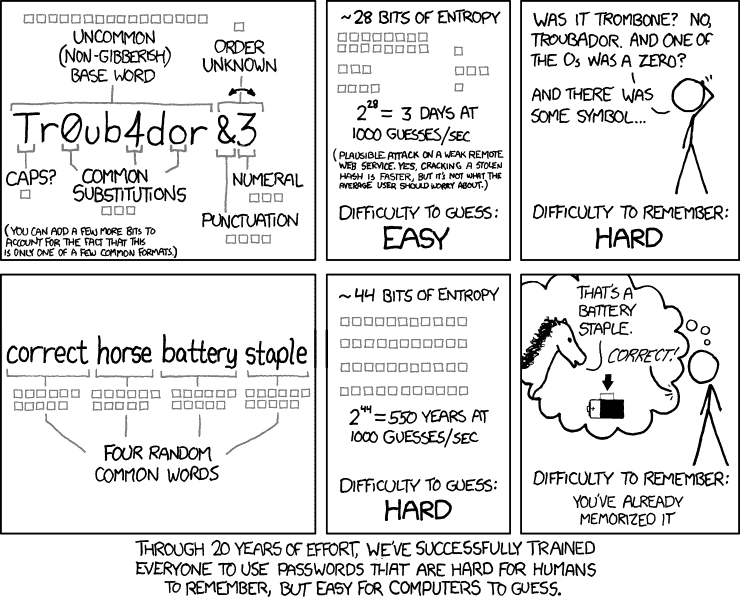
Using your variant on “correct horse battery staple” for multiple accounts is also a bad idea from a security and privacy perspective.
A single compromised account could leak all the passwords to your email, Bitcoin exchange, and other sensitive accounts. Trying to memorize a different password for tens or even hundreds of accounts is similarly a recipe for disaster.
The solution is to use a good, random-word password and a password manager. Password managers generate strong, lengthy, random passwords you don’t need to memorize.
The program stores your passwords in an encrypted format. They are accessible only when you enter your single master password into the manager (which should be memorized and never written down).
How to Become Anonymous (Advanced Guide)
Online security is often characterized as a trade-off between effectiveness and convenience. You can choose which end of this scale you wish to be on.
In this chapter, we’ll review methods that require more effort but make your steps much less traceable.
Disguising Your IP Address with Tor
The first step in becoming anonymous is using Tor, a powerful anonymity tool.
Visit TorProject.org to download and install Tor (short for The Onion Router). Once activated, Tor opens as a separate, Firefox-based internet browser that disguises your IP address.
Tor works by routing your connection through several other participating computers. The ultimate effect is that whichever website you access will see your request as coming from an entirely separate machine, usually in a different state or country.
Although it masks the IP address and certain potentially identifying browser characteristics, Tor is by no means a complete privacy solution.
Using your real name, accessing your regular email, or signing into social media via Tor will have exactly the same de-anonymizing effect as doing so through a regular browser.
For a more private email address, create a dedicated darknet email account for Tor usage, such as a Mail2Tor account.
Note that Tor also disables JavaScript by default; certain websites won’t load properly without JavaScript, but re-enabling it can potentially de-anonymize.
Once browsing through Tor, you may also access the darknet further to research internet anonymity without undue concern over prying eyes.
Running Bitcoin Through Tor
Once you feel familiar enough with Tor, it’s time to make your Bitcoin addresses anonymous. To do that, you need your wallet to connect through Tor.
One solution can be using Bitcoin Core, which automatically connects through Tor if it detects its presence. To force this behavior, follow these instructions on Bitcoin’s GitHub. Most other wallets can also connect through Tor; consult their documentation to discover how.
Consider installing a new wallet that only ever connects through Tor. To do that, disable your internet connection and configure the new wallet to run exclusively via Tor before launching it. You may then re-enable your internet connection and allow the wallet to sync.
If using a full wallet, copying an existing blocks folder (ensure that you don’t also copy your wallet.dat folder) to the “Tor wallet’s” data directory will greatly speed up the syncing process.
Directly transferring bitcoins from your old wallet to this new one will somewhat obscure the ownership of those coins. However, far more sophisticated transferal methods (covered later) will be more effective at disguising this flow of funds.
Consider Using a Virtual Private Network (VPN)
As mentioned, Tor does not guarantee 100% privacy. An adversary who owns both the first and last machines you connect through will see your IP address and the sites you access. So, how to buy Bitcoin without ID verification?
If you’re willing to pay for a little extra peace of mind, consider using a VPN service. Instead of accessing the internet—or Tor—directly, your connection will be routed through the VPN’s servers.
A VPN has somewhat similar benefits to Tor; it obscures your IP address. Most VPNs allow you to spoof the nationality of your IP address (which can help access location-specific data).
VPNs also provide security benefits. They act to screen your device for malware via firewalls and proxies.
Unlike certain sites that block access from known Tor routes, VPNs usually afford unlimited access and much higher bandwidth than the Tor network.
It’s entirely possible to access Tor through a VPN for another layer of obfuscation.
Disk Encryption
Leaving traces of your activity on your hard drive or removable media represents another way in which anonymity may be compromised. Disk encryption software allows you to encrypt a file, folder, or entire drive such that it can no longer be accessed without a password.
Encrypting your Bitcoin wallet file and any sensitive information stored on your computer is good practice. With decent disk encryption software, you can create multiple, secure backups of your most important files and data and disperse them on USB memory sticks and the like.
Wikipedia offers a good comparison of the available disk encryption software options. Do not rely on the Windows BitLocker program; unlike open-source alternatives, it is not provably secure.
Warning: If you lose or forget your encryption password, you’ll lose access to any encrypted files. No recovery!
The Amnesic Incognito Live System (TAILS)
Finally, if you’re serious about your privacy, you’ll want to bring all the above methods together in a secure operating environment. Unfortunately, standard operating systems do not prioritize privacy.
Windows, for example, is known for its efforts to monitor users. It, therefore, makes sense to boot into a secure, privacy-respecting operating system before attempting to send Bitcoin anonymously.
The reliable option here is Tails, a variant of the Debian-based Linux operating system, which by design leaves no trails.
Don’t worry if you’ve never used Linux before; Tails features an interface that will be familiar to any Windows or Mac user. Tails can even mimic the appearance of Windows so that casual onlookers won’t notice anything unusual about your computer usage.
Tails packs a host of privacy, security, and encryption features into a package small enough to fit on a portable USB drive. It even includes KeePassX (a password manager) and the Electrum light Bitcoin wallet as standard!
To boot to Tails on start-up, the USB drive must be formatted as bootable via a program like Universal USB Installer or Rufus.
Tails must then be downloaded and installed on the drive. Note that installing and keeping Tails updated will require 2 such USB devices.
If you want to get started with Tails, you can use this simple online tutorial.
Altering your BIOS setup to boot from Tails rather than the hard drive allows you to securely use untrusted computers and networks.
This means you may anonymously send Bitcoin from even a public, monitored computer, such as those in a library or internet café, without leaving any traces of your identity or activity.
While Tails easily defeats any software-based data logging, it can’t protect against hardware keyloggers or hardware screen captures. Fortunately, Tails contains a virtual keyboard and other mouse-driven text entry applications.
For password entry on untrusted devices, employing a combination of onscreen text-entry and spam-text logging countermeasures is recommended.
Tails stores no information regarding the software you use, sites you visit (via its built-in Tor browser), or anything else. However, Tails does allow you to create an encrypted, persistent volume within your USB stick.
Any data placed in the persistent volume will be maintained between sessions. It’s advised to store your password manager data file within this volume.
Anonymizing Your Bitcoin
Never mind buying crypto without KYC; if you have bitcoins that are already in some way provide a link to your details, you can break that link. This will serve to effectively anonymize the coins again.
If done correctly, future transactions from that point forward won’t be connected to you anymore.
Tumbling Coins Through Mixers
For anonymizing purposes, there are mixers (also known as tumblers). The basic concept is that you send the coins you want to have anonymized to the mixer, which in turn sends back the same amount minus a fee to a new address you provide.
The coins you receive back are from a large pool maintained by the mixing service and should ideally have no connection to your original coins.
The major flaw of this concept is its centralized nature. You have to trust the mixing service to return your coins, and additionally, you have to trust that they do not keep any records of the mixing transactions.
The latter point is especially tricky since you can never know for certain what they are doing with the data. If the mixer doesn’t keep any transaction records, they cannot prove it.
On the other hand, you have no way of knowing if they don’t or are even forced to hand over their data.
JoinMarket, an implementation of a privacy-improving technique first proposed by core developer Greg Maxwell, offers a trustless, decentralized method of mixing.
This infographic provides a gentle introduction to the workings of JoinMarket. Although a fairly simple concept, at the present state of development, JoinMarket represents a more complicated undertaking than sending coins through a mixing site:
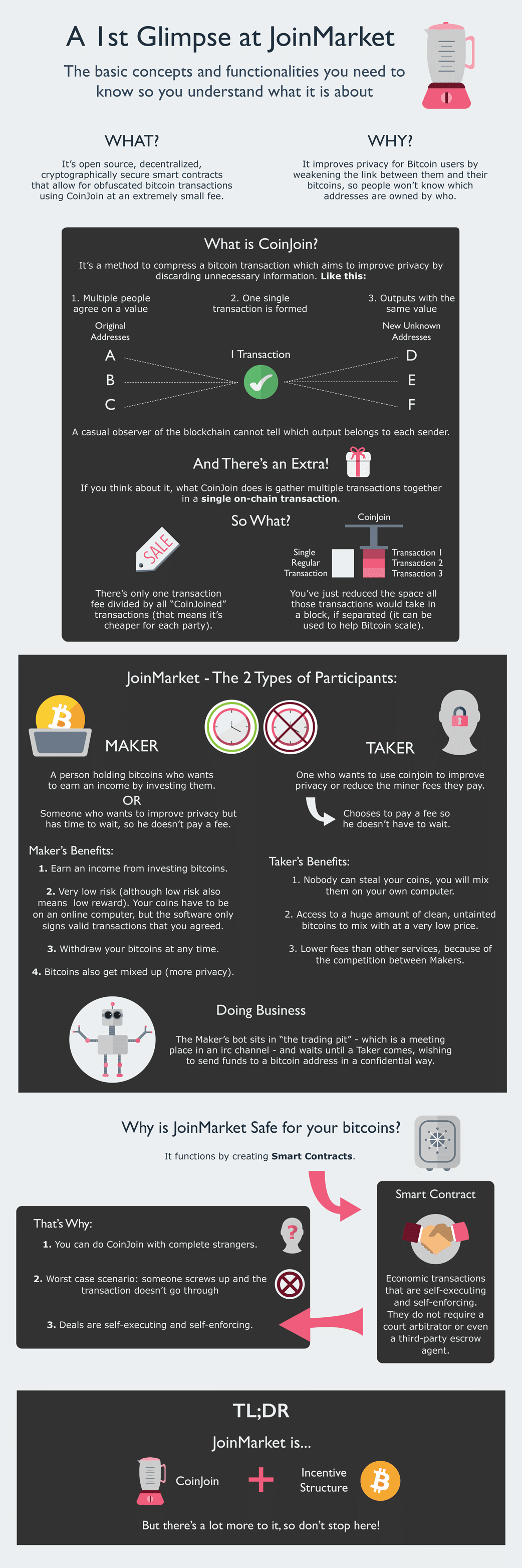
If you have a good understanding of Bitcoin and you’re prepared for a more hands-on method, we recommend JoinMarket.
JoinMarket gives you back control over the mixing process and lowers your risk and transaction fee. It even lets you earn a little money by helping others mix their transactions.
Another easy way to implement coin shuffling is to use the Wasabi wallet. This is an open-source wallet that implements trustless coin shuffling with mathematically provable anonymity. Read our full review of Wasabi Wallet here.
Obscuring the Trail Through Altcoin Shifting
Why stop at mixing between Bitcoin addresses? Mixing between Bitcoin and privacy-centric altcoins provides another layer of obscurity.
This method may require a little less trust than a centralized mixing service. The popular altcoin to use for this purpose is probably Monero (XMR).
This short guide covers buying Monero with Bitcoin (tl;dr, you can use Binance). To anonymize your bitcoins, simply convert them to XMR, forward them to a new Monero address under your control, and then convert them back to a new, anonymous BTC.
Circling Bitcoin Through an Exchange
This is perhaps the easiest method, but it doesn’t provide 100% total anonymity. If you have an account on a crypto exchange like Coinbase, Binance, or Kraken, you can send your Bitcoin to the exchange and then withdraw it to a different wallet address than the one you sent it from.
This works because many exchanges have a general “pool” receiving wallet that assigns incoming coins to your exchange account. You can then send them to a different address.
Whichever exchange you use will be able to see where you sent it, but from the outside, it will look like X sent 0.025 Bitcoin into “Binance Wallet 4.” That’s it. A future withdrawal will come from one of their general wallets. They will know, but again, the outside won’t.
Is Bitcoin Anonymous?
No, it isn’t. While Bitcoin provides more privacy than credit cards, it isn’t as anonymous as cash. So, if you plan to purchase your coins with an anonymous crypto wallet, you must proceed with caution.
Bitcoin operates by recording all transactions in a public ledger known as the blockchain. Even if you think you’re buying Bitcoin without registration, it’s not the case. There’s the implication that purchasing Bitcoin without identification is not feasible if you view a blockchain transaction as a form of ID.
Every transaction contains a Bitcoin amount, the sender’s crypto wallet address, and the recipient’s Bitcoin address. Blockchain tracking firms and companies like Chainalysis can easily monitor anonymous crypto transactions. Although no personal information is linked to a wallet address when it is set up, once a user buys or sells Bitcoin at a centralized exchange that requires KYC, it becomes simple to connect Bitcoin addresses to specific identities, reducing your Bitcoin privacy.
Georgi Koreli, Co-Founder and CEO of the privacy-focused wallet Hinkal, explains why true privacy on Bitcoin remains out of reach. Speaking to 99Bitcoins, Koreli didn’t hold back:
“Privacy on BTC is impossible as of now. All privacy solutions on Bitcoin are considered illicit and centralized, so this step makes privacy on BTC impossible.”
Think Bitcoin is the go-to currency for shadowy figures in trench coats? Not quite. While Bitcoin has a reputation for being anonymous, the reality is more see-through than you’d expect. According to blockchain sleuths at Chainalysis, less than 0.5% of crypto transactions are linked to illicit activity. So, there is not much dark web drama here.
In fact, many investigators say they’d rather criminals use Bitcoin than cash, since the blockchain leaves a breadcrumb trail of every transaction. Sure, your Bitcoin address doesn’t have your name on it, but when you interact with a centralized exchange that requires KYC, it’s like leaving your ID at the scene. Privacy? Yes, a bit. Full anonymity? Not unless you’ve mastered the art of blockchain hide-and-seek.
Can Bitcoin be Traced?
Yes. Because every transaction uses Bitcoins from a prior transaction, and the blockchain is public data, every Bitcoin payment has a traceable history that anyone can view right from that coin’s inception. If, for example, you’ve been trying to buy Bitcoin with a credit card anonymously, keep this in mind.
While cryptocurrency addresses are 100% traceable, they can’t be linked to a specific person or entity. That’s why Bitcoin is often called pseudonymous or pseudo-anonymous.
However, a person’s identity can be associated with a Bitcoin address through other means, as stated above, by using KYC exchanges or crypto platforms.
Once the association has been made, someone with enough determination, time, and resources could analyze the blockchain and determine how many Bitcoins an individual has, how they received them, and how they spend them. In other words, you can follow the paper trail (digital trail).
To use Bitcoin anonymously, precautions must be taken to prevent your true identity from being associated with your transactions and addresses for buying crypto with no ID.
Alternative Anonymity Tools
While VPNs offer a layer of anonymity, other essential tools can further enhance privacy when buying and using Bitcoin. One popular option is Tor (The Onion Router), which encrypts your internet traffic and routes it through multiple servers, making it difficult to trace your online activities. When using Tor alongside a privacy-focused wallet or decentralized exchange, you can significantly reduce the chances of your transactions being linked to your real-world identity.
Another option is to use decentralized exchanges (DEXs). These platforms don’t require KYC verification, allowing you to trade Bitcoin without providing personal information. Unlike centralized exchanges, DEXs operate directly between users, which adds an extra layer of privacy. However, keep in mind that this method requires some technical knowledge to operate securely. Pairing DEXs with Tor or a VPN can offer even more anonymity when buying Bitcoin.
Another method is to first buy privacy coins, like Monero (XMR) or Zcash (ZEC), then swap them for BTC on non-KYC platforms. Additionally, hardware wallets with privacy-focused features allow users to sign transactions offline, further reducing exposure. Using Bitcoin mixing services (if legal) also helps keep transactions private by avoiding direct ties to personal bank accounts.
Privacy Basics: What Commonly Affects Bitcoin Traceability
Buying Bitcoin without ID is only one part of the privacy equation. In practice, traceability is influenced by how wallets, networks, and exchanges interact over time.
- Network access can reveal location patterns
Internet connections may expose general location data when wallets or platforms are accessed. Repeated access from the same network can create observable patterns over time. - Transfers to regulated exchanges may link activity
When Bitcoin is later sent to an exchange that applies identity verification, prior transaction history associated with those funds may become attributable within that platform’s compliance framework. - Wallet usage patterns affect on-chain visibility
Combining Bitcoin from different sources into a single wallet can make transaction histories easier to analyze, as movements are publicly recorded on the blockchain. - Off-chain communication can reduce practical privacy
Email receipts, SMS confirmations, and payment processor records create secondary data trails. Even if Bitcoin was acquired without ID, linked communication channels may weaken anonymity in practice. - Cross-chain activity expands visibility
Bridging Bitcoin into wrapped assets or interacting across multiple networks exposes activity to additional analytics systems. Each new blockchain interaction increases the overall observable footprint.
What Really Affects Your Privacy When Buying Bitcoin Anonymously
Privacy with Bitcoin comes from a mix of factors, including where you live, how you pay, which services you use, and how you handle your coins afterward. Some options are easy but leave clear records. Others offer more privacy but add cost, risk, or extra steps.

This section explains how these pieces fit together so you know what to expect in real life situations.
Region-Specific Caveats You Should Know About
Privacy options change a lot depending on where you live, so location can decide what actually works in the real world.
Bitcoin ATMs are illegal if you live in the UK. Since UK enforcement against illegal crypto ATMs has been active, many “ATM finder” results lead to machines that no longer exist, require checks, or involve risky setups that can cause problems.
If you live in the EU, expect more data collection across services over time, as frameworks like MiCA and Travel Rule-style requirements push platforms toward more formal compliance, making low-friction “no-ID” fiat routes harder to find.
Keep in mind that a method that works in one country can disappear in another country, or suddenly require extra checks based on local rules, so it helps to stay flexible and have a backup plan.
KYC Can Still Be Triggered, Even On “No-KYC” Services
A lot of swap services and instant exchanges work smoothly until a transaction triggers automated risk checks, and when that happens the service can pause the swap and request verification before it continues.
This can happen for normal reasons, like large amounts, unusual timing, suspicious routing, wallet links to previously flagged activity, or certain chain and liquidity paths that raise red flags in automated monitoring.
For you, that means “no-KYC” often describes the default flow, not a guarantee, so it’s smart to plan for the possibility of a hold and avoid sending funds you cannot afford to have stuck in review.
Buying With Credit or Debit Cards: What Privacy You Give Up
Credit and debit cards may be the most convenient options for buying Bitcoin; however, banks and payment processors tie transactions to your real identity, and most crypto providers add extra fraud controls on top.
Even when the crypto app looks simple, the payment trail still exists, and it can link your purchase back to you through your bank records, card details, and the payment processing chain.
If you use a card to buy BTC, treat it as a straightforward tradeoff where speed and ease come first, and then focus on protecting your privacy through what you do after the purchase.
P2P Methods: Better Privacy, More Responsibility
Peer-to-peer buying can offer better privacy, especially if you use cash-based payments or methods with fewer personal data hooks, but it comes with tradeoffs that you should expect from the start.
You’ll often pay a premium compared to exchange pricing, because sellers charge extra for the privacy and the added risk, and you also take on more scam exposure because you are dealing with individuals rather than a large platform.
That’s why escrow and reputation matter so much with P2P, and it’s also why safer habits make a big difference, like keeping all communication inside the platform chat, sticking to high-reputation sellers, avoiding off-platform deals, starting small before scaling up, and meeting in public places if you ever do an in-person cash trade.
Mixing and CoinJoin: Legal Risk, Freeze Risk, and Unreliable “Complete Anonymity” Claims
Privacy tools like mixers and similar “anonymizing” services carry a risk profile that many people underestimate, especially now that enforcement and scrutiny have ramped up throughout the past few years.
In practice, this can show up later when funds touch compliance-heavy services, because transactions can get flagged and coins can get frozen or blocked, even when your goal is personal privacy rather than anything shady.
There’s also a bigger point worth being direct about: “complete anonymity” claims are unreliable, because the ecosystem around you, including exchanges, on-ramps, analytics tools, and legal pressure, can turn privacy into a moving target.
If you care about privacy, it makes sense to start with lower-risk steps first, like wallet separation, clean address habits, and avoiding obvious linking behaviors, before you go anywhere near higher-risk tools.
Post-Purchase Privacy: How People Accidentally Link Everything Together
A lot of privacy gets lost after purchasing Bitcoin, because people accidentally connect all their activity into one obvious trail.
The most common mistakes include reusing the same receiving address repeatedly, sending coins from an ID-heavy purchase into the same wallet used for private activity, or combining funds from different sources into a single transaction that links them forever.
A simple way to keep things cleaner is wallet separation, where you keep coins bought through high-identity routes in one wallet and coins bought through privacy-focused routes in another wallet, and you keep those pools from merging later.
What Is a Crypto Dusting Attack and How Can You Protect Your Wallet?
When buying Bitcoin anonymously, be aware of dusting attacks. These happen when someone sends a tiny amount of BTC to your wallet to try to track your activity if you later spend it together with your other coins. Because Bitcoin transactions are public, mixing that small amount with your balance can weaken your privacy. To stay anonymous, avoid spending unknown small deposits and use a wallet with manual coin control so you can keep those funds separate.
If you want to go deeper, running your own Bitcoin node can also reduce reliance on third-party servers for broadcasting and balance checks, and newer network-level improvements like BIP324 help by encrypting peer-to-peer connections between nodes, which can reduce passive network surveillance.
For receiving privacy, Silent Payments is a concept that aims to let you publish one static address while still receiving to fresh on-chain destinations, which can reduce address linkability for everyday payments, while keeping expectations realistic about how privacy works in the broader system.
Final Things to Consider Before Buying BTC Anonymously
Although it can be appealing to buy Bitcoin anonymously, be mindful of the possible risks:
- Fraudulent merchants and P2P scams
- Revoked codes and fake gift cards
- Inadequate exchange rates and excessive ATM fees
- Legal ambiguities in various contexts
- Use escrow, always double-check platforms, and put your personal security first.
Conclusion: Buy BTC With Anonymity
Many cryptocurrency enthusiasts are concerned about where to buy crypto without ID. Of course, just how much privacy you want online is totally up to you. The more anonymous you want to be, the more effort you’ll need to put in to stay off the radar.
If you’re just looking to buy crypto without showing your ID, using cash is still one of the easiest ways to stay private. But if you’re mainly trying to avoid KYC, Best Wallet is the best option. It’s our top choice for buying and storing Bitcoin without giving up your details. Just load stablecoins into the app and use the swap feature to get BTC privately.
If you want full-blown anonymity while using Bitcoin online, you’ll need to go a few steps further. That means combining privacy wallets with VPNs, Tor, and other privacy tools to cover your tracks.
See also:
FAQs:
How can I buy Bitcoin anonymously?

The best way to buy Bitcoin anonymously is to find someone IRL who has some Bitcoin they are willing to sell in exchange for a means of payment such as cash. You can attend crypto meetups to find people that have Bitcoin. Buying Bitcoin anonymously is becoming harder due to changes to KYC requirements on exchanges. Also, trying to buy crypto anonymously with a credit card is challenging, given that it leaves traces on the blockchain. A better option in this case is to use a peer-to-peer marketplace to find sellers.
How can I buy Bitcoin anonymously with cash?
To do this you would need to find a seller and meet up with them to arrange the sale. Alternatively, you could use a Bitcoin ATM to make the transaction, as some of these accept cash and do not require KYC. Start with finding a Bitcoin ATM near you.
Do Bitcoin ATMs require ID?
Yes, many Bitcoin ATMs demand some type of identification. This is especially the case for transactions that exceed a certain amount. While lower sums – usually below $500 – might only need phone number verification, transactions involving higher amounts often require official, or government-issued identification. You might even need Social Security Number verification.
Is Bitcoin 100% anonymous?
Bitcoin is not 100% anonymous. All Bitcoin transactions are recorded on the publicly accessible blockchain. While users’ identities aren’t directly tied to their Bitcoin addresses, advanced techniques like blockchain analysis can sometimes link addresses to real-world identities.
Which Bitcoin wallet does not need verification?
There are a number of crypto wallets that don’t require ID. The best anonymous Bitcoin wallet currently in the crypto space is Best Wallet, a trading and investing tool that also functions as a decentralized exchange. Another example is Trezor, which doesn’t demand KYC verification. However, finding a crypto wallet without verification isn’t easy. To make a Bitcoin purchase, you will typically need to provide ID details.
Can you buy Bitcoin without ID?
Yes, you can buy Bitcoin without ID, but it typically involves using less conventional methods such as: P2P marketplaces, Bitcoin ATMs (with limits), DEXs, direct cash transactions with individuals. However, most major exchanges like Coinbase require ID verification to comply with regulations.
How can I buy Bitcoin with PayPal but without ID?
Buying Bitcoin with PayPal without ID is challenging because most platforms that accept PayPal for Bitcoin transactions usually require some form of identity verification. However, you might find sellers on P2P platforms like Paxful who accept PayPal for Bitcoin without needing ID verification.
Can you buy Bitcoin on Coinbase without ID?
No, you cannot buy Bitcoin on Coinbase without ID. Coinbase is a regulated exchange that follows strict KYC rules, so you must provide ID for verification before purchasing any cryptocurrency. You may be able to use Coinbase and CEXs to rotate bitcoins you already own, but not to buy new ones without ID.
Can I buy Bitcoin without an SSN?
You can buy Bitcoin without an SSN using P2P platforms, Bitcoin ATMs, decentralized exchanges, or prepaid cards. Most U.S. exchanges require an SSN, but these alternatives offer privacy with some trade-offs like higher fees and lower limits..
Do Bitcoin ATMs Charge a Fee?
Yes. Most ATMs charge a fee (usually between 7% and 10%). If the fee isn’t stated explicitly, it’s “hidden” inside the exchange rate. Do your calculations beforehand to have a rough estimate of what you expect to receive.
How Much Was Bitcoin in 2009?
When Bitcoin was introduced in 2009, its price was effectively zero dollars as it was only exchanged among a small group of enthusiasts. The first recorded exchange for money occurred in late 2009, valuing a single bitcoin at about $0.001.
Is it legal to buy Bitcoin without KYC?
Yes, in most jurisdictions, it is legal to buy BTC via P2P or decentralized methods. However, businesses (exchanges) are often legally required to ask for ID, which is why users seek out non-custodial wallets.
Does "No-KYC" mean "Anonymous"?
No. It means the platform doesn’t have your ID. However, your blockchain footprint (the ledger) is still public. If you send that BTC to a KYC-exchange later, they can link your history.
References:
- Best Wallet. Best Wallet, Buy, Store, and Swap Crypto Securely. https://bestwallet.com/en/
- Chainalysis. “2024 Crypto Crime Report: Introduction.” Chainalysis, https://www.chainalysis.com/blog/2024-crypto-crime-report-introduction/
- U.S. Department of the Treasury. “Treasury Designates Mixer for Illicit Use by DPRK Cyber Actors.” U.S. Department of the Treasury, https://home.treasury.gov/news/press-releases/jy0916
- 99Bitcoins. How to Buy Bitcoin with Cash, 99Bitcoins Guide. https://99bitcoins.com/buy-bitcoin/buy-bitcoin-with-cash/
- 99Bitcoins. Best Wallet Review, 99Bitcoins. https://99bitcoins.com/bitcoin-wallet/best-wallet-review/

Why you can trust 99Bitcoins
Established in 2013, 99Bitcoin’s team members have been crypto experts since Bitcoin’s Early days.
Weekly Research
100k+Monthly readers
Expert contributors
2000+Crypto Projects Reviewed