




In This Article
Celestia is a modular blockchain that enables crypto developers to launch their own blockchain. Its native token, TIA, is the backbone of its ecosystem. TIA tokens have three primary use cases: paying for transaction fees, staking, and governance.
In this guide, you will learn how Celestia staking works, where to stake TIA coin, and how Celestia staking mechanism compares to other PoS cryptos. We’ll also discuss the benefits and risks of staking Celestia, and you will learn how to maximize your staking rewards.
Key Takeaways
- Celestia is a modular blockchain that runs on CometBFT and the Cosmos SDK.
- It uses a Proof-of-Stake system to secure the network.
- Validators run nodes, while delegators earn rewards by staking through them.
- Only the top 100 validators receive staking rewards.
- Validator commissions typically range between 5% and 20%.
- Staking rewards are paid in TIA tokens.
- Rewards depend on how much you stake and how well the validator performs.
- Poor validator performance can lead to slashing of both validator and delegator stakes.
- You can stake TIA using wallets like Keplr, Leap, and Gem.
- Staking is also available on exchanges like Kraken and OKX.
Celestia Staking: Summary
In this guide, you will learn how to stake TIA step-by-step and the main benefits and risks of staking this coin. We also reviewed the top 5 crypto staking platforms that support TIA staking to help you find the one that suits you best. In addition to that, we have listed several tips and strategies that will help you maximize your rewards while staking Celestia.
We go beyond what is Celestia. Celestia uses a Proof-of-Stake (PoS) mechanism based on CometBFT (formerly known as Tendermint) and the Cosmos SDK framework, which sets it apart from other PoS cryptos. That’s why we compared its staking model with the staking models of other Cosmos-based tokens, such as Mantra, Cronos, and Injective.
We’ll conclude this guide by analyzing Celestia’s 2024 annual report to predict its trajectory in 2026 and beyond.
What is Celestia (TIA) Staking?
Celestia staking process enables TIA holders to support the security of the Celestia network by locking up their tokens. Users can participate in staking by becoming validators or delegators. The former will be responsible for running the nodes, while the latter delegate their stakes to an existing validator.
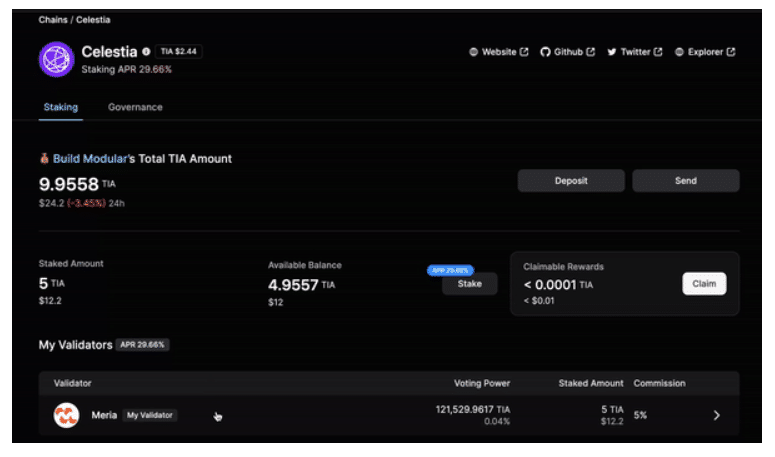
Both validators and delegators will earn staking rewards (in the form of TIA tokens) and gain voting rights, which means they’ll be able to participate in Celestia’s governance.
How Does Celestia Staking Work?
As mentioned, Celestia uses a Proof-of-Stake mechanism built on CometBFT and Cosmos SDK framework to enhance its network security, decentralization, and scalability. Its PoS mechanism enables TIA holders to engage in staking by becoming validators or delegators. The validator set comprises 100 validators whose role is to run nodes and participate in block production.
Celestia validators will earn rewards every time they produce a new block. They’ll also charge a commission fee that typically ranges between 5% and 20%. On the other hand, delegators can delegate their stake to existing validators in return for rewards based on their delegated amount and the validator’s performance. Delegators can use wallets like Keplr, Leap, or Gem to participate in the staking process. They can also stake their tokens via crypto exchanges like Kraken and OKX.
Looking Beyond Modular Chains?
Celestia’s modular architecture is exciting, but it’s just one part of a much bigger staking system. Explore our latest guide on the 13 Best Crypto Staking Coins to discover other high-yielding projects across the PoS ecosystem that combine strong fundamentals with staking potential.
Where to Stake Celestia: 5 Platforms for Celestia Staking in 2026
You can stake TIA via various crypto wallets, like Keplr, Leap, and Gem, as well as crypto exchanges, like Kraken and OKX. When buying TIA, each platform imposes its own rules. The same happens in terms of staking and APYs. Here, we reviewed their key features to help you choose the best staking platform for your needs.




Best Wallet – Most Secure Non-Custodial Wallet For Staking
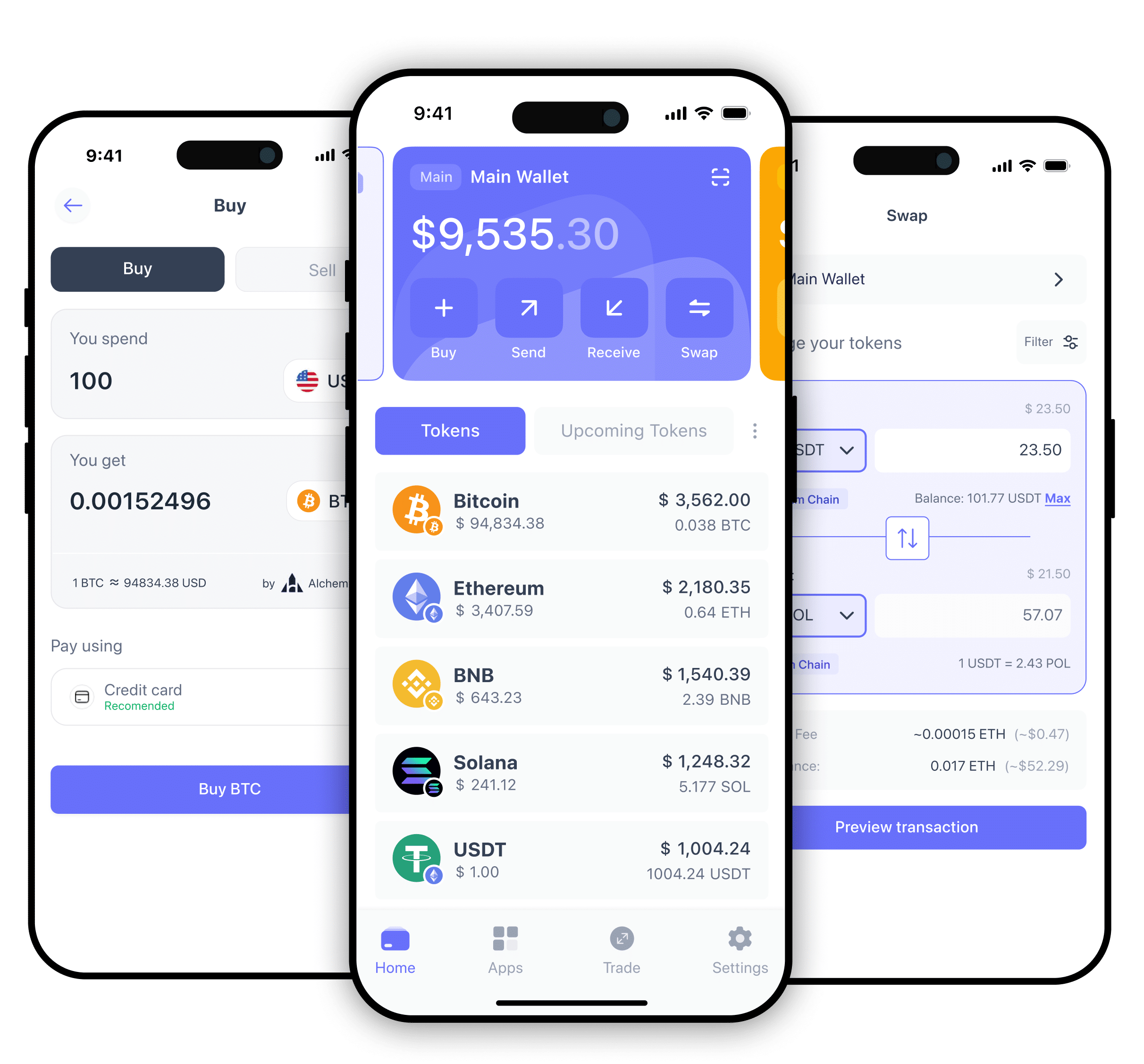
Although Celestia (TIA) is not currently supported on Best Wallet, it remains our #1 recommended platform for staking and portfolio management. As a secure, non-custodial mobile wallet, Best Wallet gives users access to industry-leading staking opportunities across 60+ major blockchains without needing KYC or giving up custody of their crypto.
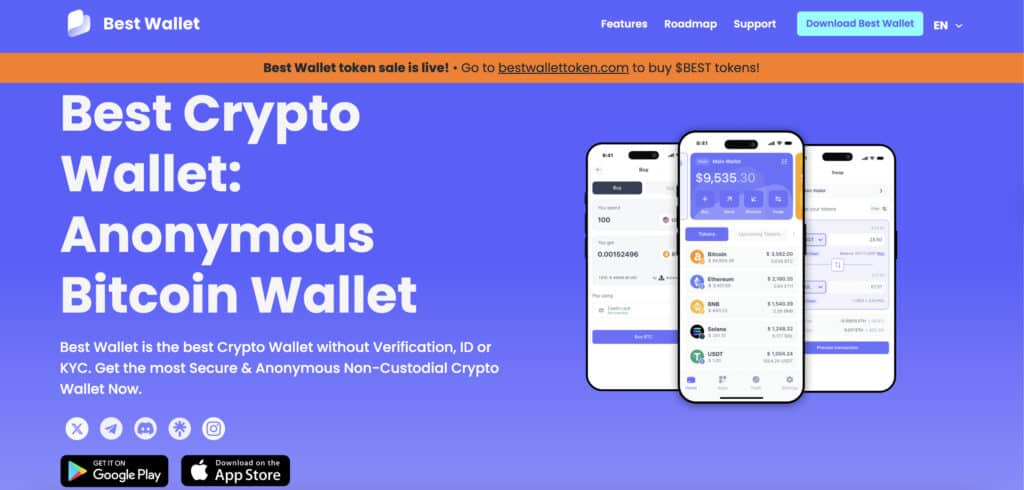
What makes Best Wallet stand out is not just its staking support, but its all-in-one design. You can easily track rewards, stake popular coins like Injective, Cronos, and Ethereum, and even participate in new crypto presales, all inside one intuitive app. Its native $BEST token unlocks exclusive perks and boosts utility across the ecosystem.
Best Wallet Features
- Non-custodial, mobile crypto wallet
- Staking support for 60+ blockchains
- Zero KYC to start earning rewards
- Built-in DEX and swap functionality
- Access to crypto presales and buying the $BEST token for perks
- Private key control with high-level security
So while Celestia staking itself is best done on wallets like Keplr or exchanges like Kraken, it’s still smart to manage your broader crypto portfolio, especially your other staked assets, inside Best Wallet. Its simple UX, wide chain support, and native yield tools make it the perfect home base for crypto investors. Check out the Best Wallet review for more.
How to Start Staking with Best Wallet?
If you prefer a mobile-first and non-custodial solution, here’s how to stake your crypto using the Best Wallet app.
-
Download the Best Wallet App
Visit the official Best Wallet site or app store and install the mobile app on your Android or iOS device.
-
Create or Import Your Wallet
Generate a new wallet or securely import an existing one using your seed phrase. Back it up safely.
-
Fund Your Wallet
Transfer supported assets (like ETH, INJ, CRO, or SOL) into your wallet using a swap or external wallet.
-
Go to the Staking Tab
Inside the app, tap on the ‘Earn’ or ‘Stake’ tab to see supported tokens and current APYs.
-
Choose a Token and Start Staking
Select the coin you wish to stake, review the validator options or fixed APY, and confirm the transaction.
Track your staking rewards inside the app and unstake when needed. Keep in mind that the available APYs and lock-in periods may vary by token. Best Wallet gives you full custody of your assets, so make sure your seed phrase is stored securely.
Even if you use other platforms for Celestia, Best Wallet is a powerful companion for diversifying your staking strategy across leading PoS assets. It’s ideal for mobile-first investors who want full control, no KYC barriers, and future-ready features.
Keplr Wallet
Keplr Wallet is a self-custodial wallet that supports 250+ chains, including Celestia. This wallet is a web extension and a mobile app compatible with Android and iOS devices. You can stake Celestia on Keplr for an APR of 10.91%. The staking process is straightforward – install the Keplr wallet web extension on your browser, navigate to the staking dashboard, select a validator, and delegate your tokens.
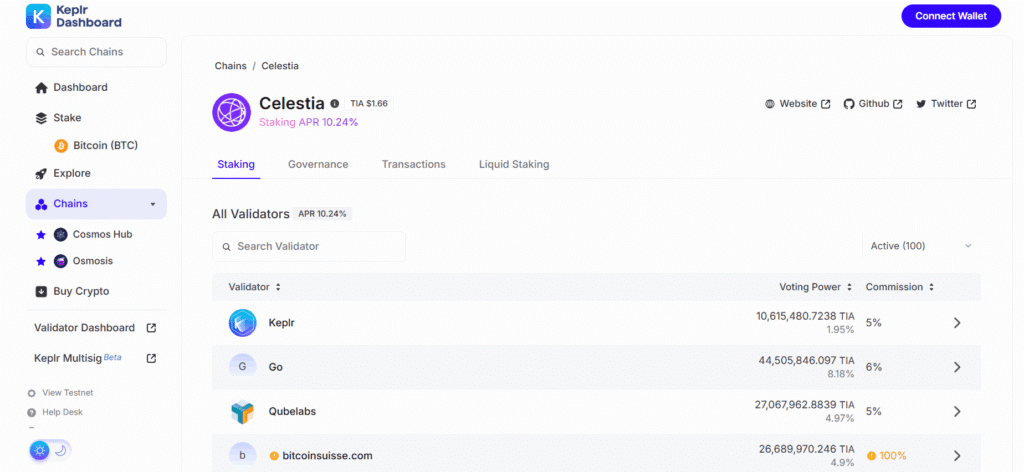
What makes Keplr Wallet stand out from the competition is its validator dashboard, which allows users to browse and compare Celestia validators, read validator reviews, and track their status and commission changes. You can also integrate Keplr with Ledger hardware wallets.
Keplr Wallet Key Features
- Users can delegate their tokens and monitor their rewards directly within the wallet.
- A powerful and versatile dashboard that enables users to browse and compare validators, read validator reviews, and track their commission changes.
- Keplr Wallet can be integrated with hardware wallets like Ledger.
- Validators can get comments from delegators and send announcements.
- Redelegating to another validator for the first time doesn’t require an unbonding or waiting time.
Keplr Wallet Pros & Cons
Pros
-
Built-in staking support
-
Available as a web extension and a mobile app
-
User-friendly staking dashboard
-
Supports all IBC assets
-
Users can create shared accounts
-
EVM and Starknet support
-
Multiple login options
Cons
-
Validators can charge high commissions that go up to 100%
-
When you delegate to a validator, your assets will be locked for a certain period
-
There may be issues with the Amino JSON signing of Authz messages on certain chains that use Cosmos SDK versions older than 0.46
-
You won’t be able to change your vote or edit your review if the voting period for the proposal is not opened
-
You have to authorize your account to participate in voting on proposals
Leap Wallet
Leap Wallet is a non-custodial wallet available as a mobile app for iOS and Android devices and as a browser extension. Leap enables its users to stake TIA and 70 other Cosmos ecosystem chains. The staking rewards come with an APR of 10.92%. Leap users will also be able to participate in Celestia’s airdrops. At the time of writing, Celestia stakers can earn ALT tokens (AltLayer’s native utility token).
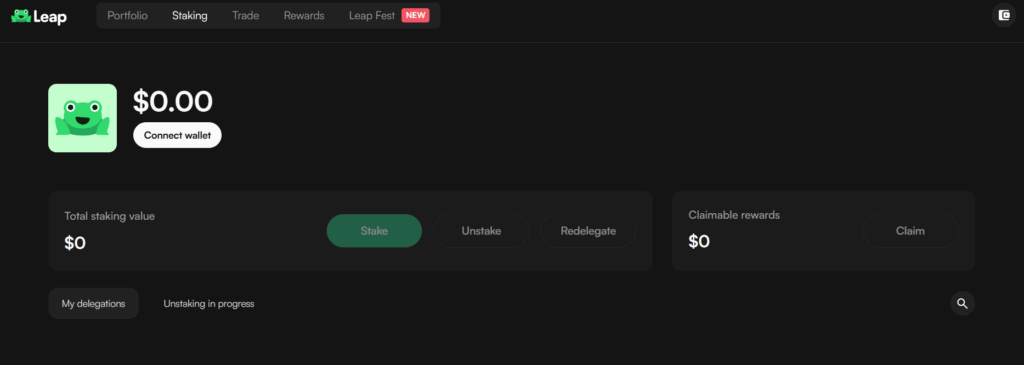
Besides delegating your tokens, you can run a Celestia light node directly from the wallet by opening the main menu and tapping the Run Light Node and Start Verifying button.
Leap Wallet Key Features
- Users will receive real-time push notifications for activities such as staking operations and governance proposals.
- Celestia stakers can participate in airdrops from projects within the Cosmos ecosystem.
- Users will be able to transfer their assets across 70 Cosmos ecosystem chains.
- Users can participate in governance by browsing proposals.
- Users can move across ecosystems using IBC and cross-chain swaps.
- The auto-lock feature will enable you to auto-lock your Leap extension for extra security.
Leap Wallet Pros & Cons
Pros
-
In-wallet staking
-
Intuitive dashboard
-
Users can run a Celestia node directly from the wallet
-
Celestia stakers can earn airdrops
-
Leap Wallet is available as a browser extension and Android and iOS apps
-
Leap is a non-custodial wallet, which means that you will have full control over your assets
-
Halborn audits the Leap wallet extension
Cons
-
Running a Celestia node on Leap requires technical expertise
-
Only one wallet can be connected to the Leap Dashboard
-
You won’t be able to re-delegate your assets during the re-delegation period
-
Leap Wallet is a browser extension for Chrome, Edge, and Brave. It doesn’t support Firefox and Safari
Gem Wallet
Gem Wallet is a self-custodial wallet that supports the Celestia blockchain, which means that its users can stake, store, and manage their TIA tokens directly from their wallet. The staking rewards come with an APR of 16.08%, while Celestia validators will set the minimum staking requirement.
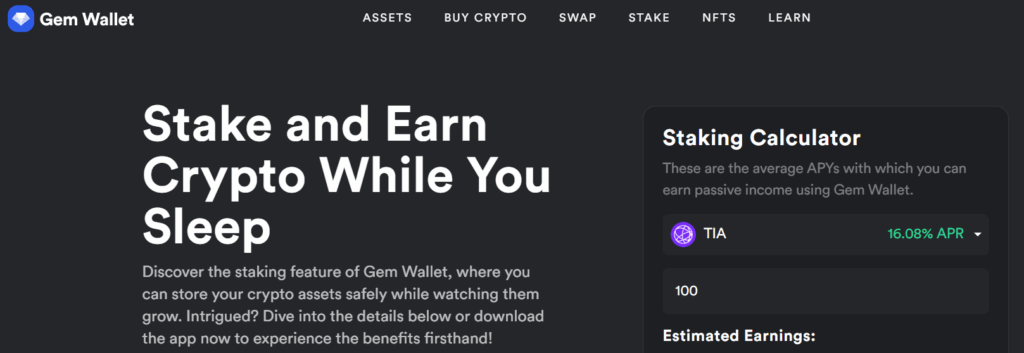
Download the Gem Wallet app to stake TIA, navigate to Celestia, and tap on the Stake button. Then, you will have to enter the amount you wish to stake and select a validator from the list. The staking rewards will be generated automatically. However, you will have to claim them manually. The unstaking period lasts for 21 days. See our Gem Wallet Review before proceeding for further details.
Gem Wallet Key Features
- Users will be able to manage multiple wallets within a single interface. They’ll also be able to monitor their balances without accessing their private keys.
- Users can stake their TIA tokens directly from their wallets.
- The Gem Wallet supports WalletConnect, meaning that users can connect to dApps across various blockchains.
- Uses advanced encryption and secure key management to protect its users’ funds.
- The Gem Wallet uses a non-custodial architecture so that users will have complete control over their assets.
Gem Wallet Pros & Cons
Pros
-
Competitive APY
-
Simple and intuitive user interface
-
Available as a mobile app
-
Advanced management features
Cons
-
You will have to claim your staking rewards manually
-
The unstaking period lasts for 21 days
-
Gem Wallet cannot be integrated with hardware wallets
-
No multi-signature support
Kraken
Kraken is a crypto exchange that offers on-chain staking and opt-in rewards programs. Users can stake Celestia through fixed and flexible staking methods. The fixed option comes with an APY ranging from 8% to 12% (you will have to lock up your tokens for 21 days), while the flexible option comes with an APY that goes from 3% to 6%.
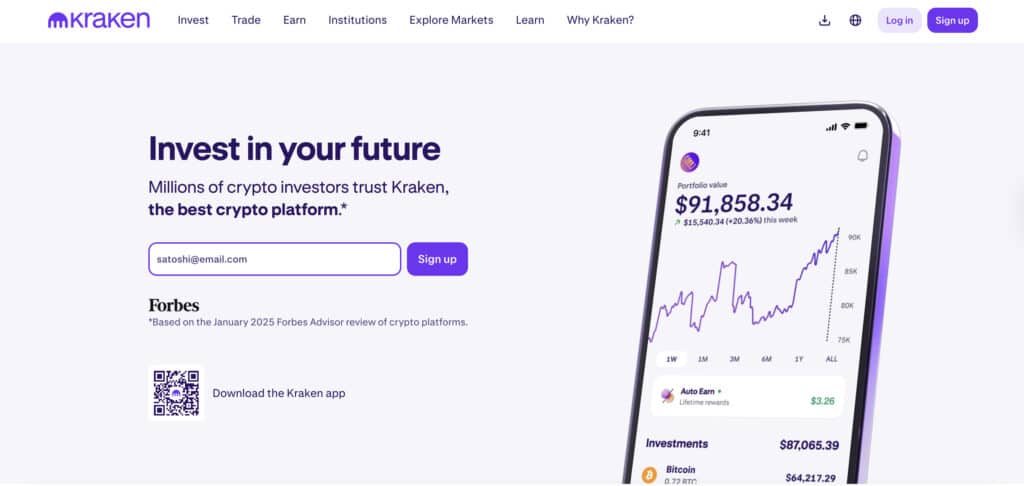
What’s more, there are no minimum staking requirements. However, the unbonding period will last for 21 days. You can also stake and unstake TIA using the Kraken Pro mobile app.
The Kraken Pro app is designed specifically for experienced traders. See our dedicated Kraken review for more details.
Kraken Key Features
- Your weekly earnings will be automatically added to your balance (and compounded over time).
- The staking rewards will be paid out on a weekly basis.
- Users can choose between fixed and flexible betting options. The fixed option offers higher APY and a 21-day unbonding period.
- Kraken employs robust security measures to protect its clients’ assets during the staking process. These include 2FAs with Passkey and advanced cold storage and hot wallet solutions.
Kraken Pros & Cons
Pros
-
Flexible and fixed staking options
-
No transaction fees for staking or unstaking
-
No minimum staking requirements
-
Users will be able to stake and unstake TIA using the Kraken Pro app
-
On-chain staking is available in 37 U.S. states and 2 territories
Cons
-
You won’t be able to earn rewards if you use a hardware wallet
-
On-chain staking services are not available in California, Maryland, New Jersey, South Carolina, Texas, and Wisconsin
-
U.S. clients won’t be able to access Opt-In rewards
-
The staking rewards are subject to a commission fee of 20% (for flexible staking)
OKX
OKX is one of the largest crypto exchanges in terms of trading volume. OKX enables users to earn staking rewards through its Simple Earn and on-Chain Earn services. Both services have two modules – fixed and flexible. The former enables users to earn interest for a fixed term at a fixed rate, while the latter provides flexible returns. At the time of writing, TIA staking comes with flexible terms and an APY of 10%.
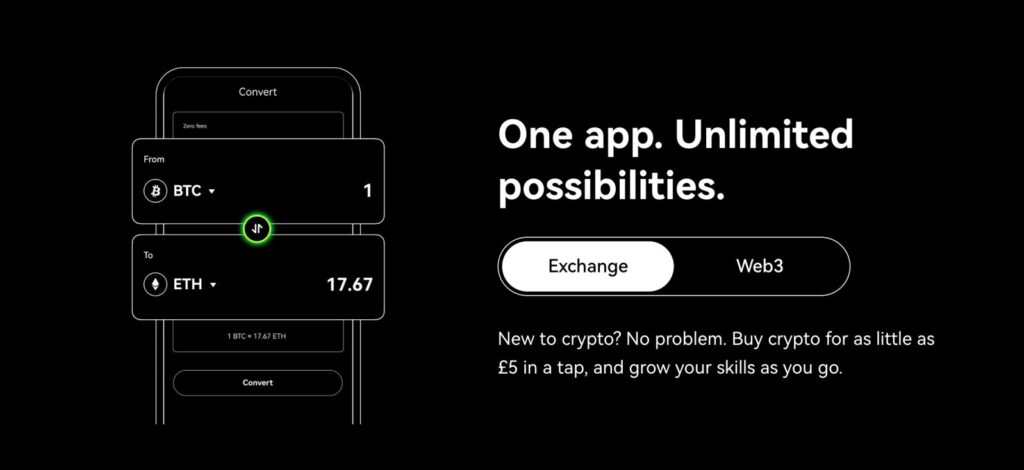
To stake TIA, you will have to open an account on OKX, go to the Earn section, select Celestia, enter the amount you wish to stake, and confirm your choice. Head to our OKX Review for more information.
OKX Key Features
- My Earnings section will enable users to manage their portfolios and track their staking rewards.
- The OKX Jumpstart platform will allow users to participate in Mining and On Sale events, providing them with an opportunity to gain access to new crypto projects.
- The OKX wallet supports centralized and decentralized finance features, from staking to yield farming. Read our OKX Wallet review here.
- The Auto-Earn service will automatically deposit your tokens into the OKX Simple
- Earn Flexible Program, enabling you to earn market-based interest hourly.
OKX Pros & Cons
Pros
-
Intuitive dashboard, suitable for both beginners and advanced traders
-
Mobile app available for iOS and Android devices
-
Simple Earn and On-Chain Earn services
-
Educational resources on staking
Cons
-
At the time of writing, TIA staking comes only with flexible terms
-
Celestia tokens are subject to withdrawal fees
-
OKX is not available in the U.S.
How to Stake Celestia (TIA): A Step-by-Step Guide
Below, you will find the step-by-step guide using Keplr, Leap and Gem wallets.
-
Stake Celestia with Keplr Wallet
Download the Keplr browser extension. Tap the ‘Staked’ button and select ‘Stake with Keplr Dashboard’; select the Celestia network, choose a validator from the list, and tap on the Stake button. Enter the amount you wish to stake. Click on the ‘Approve’ button to confirm your transaction.
-
Stake Celestia with Leap Wallet
Download the Leap browser extension; click on the Stake button located at the bottom of the screen. Tap on the Stake button and choose a validator from the list. Enter the amount you wish to stake and tap the Stake button. Click on the ‘Review’ button to see transaction details, and tap on the Stake button to complete the process.
-
Stake Celestia with Gem Wallet
Download the Gem Wallet app. Navigate to Celestia and tap on the Stake button. Enter the amount you wish to stake and choose a validator from the list, review the network terms and commission and click on the ‘Confirm’ button.
How Much Can You Earn by Staking TIA?
Both validators and delegators will earn rewards by participating in Celestia’s consensus. Validators will earn rewards by producing new blocks, while delegators will earn rewards by delegating their stakes. The rewards will be based on the delegated amount and the validator’s performance.
Validators will charge a commission fee ranging between 5% and 20%. The commission fee will be deducted from the rewards before they are distributed to delegators. At the time of writing, the estimated annual percentage yield for staking Celestia on Keplr and Leap Wallet stands at 10.96% and 10.92%, respectively. If you stake TIA on Gem Wallet, you will be able to earn an APY of 16.08%. On the other hand, staking TIA on crypto exchanges like Kraken and OKX will enable you to earn an APY between 3% and 10%.
Tips and Strategies for Maximizing Celestia Staking Rewards
Benefits and Risks of Staking TIA
Benefits of Celestia Staking
- Staking will enable you to earn regular passive income, which is especially useful for long-term holders.
- Everyone who stakes their tokens will earn voting power, which means they’ll be able to participate in Celestia’s governance.
- By staking Celestia, you will actively participate in securing the network and supporting its growth.
- You can stake your tokens on liquid staking platforms, like MilkyWay or Stride, to maximize your yield while maintaining liquidity.
- Some platforms will automatically compound your staking rewards, increasing your potential overall returns.
Risks of Celestia Staking
- Validator misbehavior can lead to slashing. If slashing occurs, you will lose a portion of your staked tokens.
- The rewards will be based on the staked amount and the performance of the selected validator. Validators who are often offline will generate lower rewards for their delegators.
Mistakes to Avoid When Staking TIA
Best Practices to Stake Celestia
Celestia Staking vs. Other Coins: A Comparative Analysis
In this segment, we’ll compare Celestia’s staking mechanism with the staking models of other Cosmos-based tokens, such as Mantra, Cronos, and Injective.
Each blockchain tailored its staking mechanism to align with its network requirements and architectural goals. All four blockchains use variations of the PoS consensus mechanism. Celestia uses a Proof-of-Stake mechanism based on CometBFT and the Cosmos SDK framework. Mantra uses a BFT mechanism integrated with the Cosmos SD, Cronos uses Delegated Proof of Stake, while Injective uses a Tendermint-based Proof-of-Stake consensus mechanism.
As for rewards, all four networks distribute their rewards per block. Celestia and Cronos don’t impose minimum staking requirements. For Mantra, the minimum staking requirement is 1 OM, while the minimum staking requirement for Injective will depend on the platform.
The unbonding period on Celestia and Injective lasts 21 days, while on Mantra and Cronos, the unstaking period lasts 8 and 28 days, respectively. All four blockchains use slashing mechanisms to penalize their validators if they misbehave.
| Features | Celestia | Mantra | Cronos | Injective |
| APY | ~10.96% | ~5.43% | ~7.51% | ~12.16% |
| Consensus mechanism | Proof-of-Stake mechanism based on CometBFT and the Cosmos SDK framework | BFT mechanism integrated with the Cosmos SD | Delegated Proof of Stake (DPoS) | Tendermint-based Proof-of-Stake |
| Reward distribution | Per block (every 6 seconds) | Per block (every 3.49 seconds) | Per block (5-6 seconds) | Per block (every 0.76 seconds) |
| Minimum staking requirements | No minimum staking requirement | 1 OM | No minimum staking requirement | Depending on the platform |
| Unbonding period | 21 days | 8 days | 28 days | 21 days |
| Slashing risks | Yes | Yes | Yes | Yes |
How to Unstake TIA?
Here’s how to unstake Celestia using the Keplr Wallet:
Step 1. Open the Keplr Dashboard and tap on the Stake button.
Step 2. Select the Celestia network.
Step 3. Scroll through the validator list to find your chosen validator.
Step 4. Tap on the Manage button located next to your chosen validator.
Step 5. Click on the Undelegate button to begin the unstaking process.
Step 6. Enter the amount you wish to unstake and tap on the Underdelegate button.
Step 7. Tap Approve to authorize your transaction.
Future of Celestia Staking: Long-Term Trends to Watch
Now that you know how to stake Celestia, you’re probably wondering if it’s worth it. We asked ourselves the same question and analyzed its 2024 annual report. According to the report,
Celestia recorded one of the highest staking ratios among all Cosmos chains in 2024. Its staking ratio increased by 49.5%. The number of Celestia delegators also increased by 65%, while its number of active addresses increased from 308,728 in January to 851,775 in December 2024.
Celestia’s introduction of liquid staking contributed the most to the growth of its user base. MilkyWay was the first liquid staking protocol that enabled TIA holders to stake their tokens in exchange for milkTIA tokens. In just one day, MilkyWay received staked funds worth more than $1.5 million. In 2024, Stride became the second protocol that enabled TIA holders to participate in liquid staking. Stride also airdropped 5 million STRD tokens (or 5% of the total supply) to stTIA token holders, further increasing user interest and engagement.
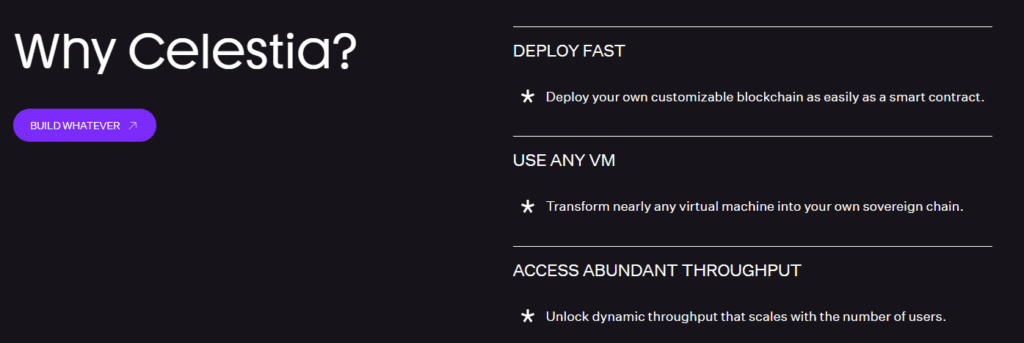
Celestia recently introduced two new governance proposals that could reshape its future. The first is related to reducing TIA inflation by 33%, which would increase its long-term value. The second proposal is related to locking staking rewards for locked tokens. This proposal aims to synchronize reward unlocks and vesting schedules to prevent sudden market fluctuations. To prevent validators from charging 100% commissions, the proposal also includes a limit on validators’ commission fees that would amount to 25%.
If these proposals pass, they will strengthen Celestia’s economic model.
Visit our Celestia Price Prediction guide for more information about TIA’s trajectory.
Conclusion: Is Staking Celestia Worth It?
Celestia staking will enable you to support the network’s security in return for rewards based on your staked amount and the performance of your chosen validator. To maximize your staking rewards, delegate your tokens to validators with high uptime. You should also diversify your stakes across multiple validators to avoid slashing. In addition, staking will grant you voting rights, which means you will be able to participate in Celestia’s governance.
During 2024, Celestia recorded one of the highest staking ratios among all Cosmos chains. This trend is likely to continue in 2025, especially if the proposal to lock staking rewards for locked tokens gets accepted.
DISCOVER:
- Crypto Exchange Promos & Discounts
- Crypto Wallet Promos & Discounts
- Injective Staking: A Beginner’s Guide to INJ Staking
- Helium Staking: How to Stake HNT in 2026
- How to Stake Stablecoins in August 2026
- Tezos Staking Guide: Where to Stake XTZ in 2026
FAQs
What is the staking rate in Celestia?


The current staking rate for Celestia amounts to ~10.96%. However, this rate can vary depending on the staking platform. Keep in mind that validators will also charge commission fees that will be deducted from your staking rewards.
Should I stake Celestia?
Staking TIA will enable you to earn regular passive income while supporting the Celestia ecosystem. You’ll also gain voting power, which means you will be able to participate in its future development.
How do you stake Celestia?
You can stake Celestia using Keplr, Leap, and Gem wallet. The staking process includes downloading the Keplr browser extension, choosing a validator, and entering the amount you wish to stake. You can also stake TIA by creating an account on crypto exchanges like Kraken and OKX.
What is the TIA token used for?
TIA token has multiple use cases. Developers can use TIA to pay for blobspace and data availability. TIA tokens can also be used for staking and governance.
References
- Mazieres, David. “The Stellar Consensus Protocol: A Federated Model for Internet-level Consensus.” Association for Computing Machinery (ACM), https://dl.acm.org/doi/10.1145/3211933.3211953
- INSEAD Alumni Crypto Club. Staking and Token Economics Newsletter. INSEAD, 2022. https://blogs.insead.edu/france-iaa/files/2022/10/Newsletter-56-INSEAD-Alumni-Crypto-club.pdf
- Dong, Xinshu, et al. Remote Staking with Optimal Economic Safety. arXiv, 2024. https://arxiv.org/abs/2408.01896
- Cong, William, Ye Li, and Neng Wang. Staking, Token Pricing, and Crypto Carry. Kenan Institute of Private Enterprise, University of North Carolina, 2022. https://kenaninstitute.unc.edu/rethinc/wp-content/uploads/2022/03/Cong-Staking-and-Crypto-Carry.pdf

Why you can trust 99Bitcoins
Established in 2013, 99Bitcoin’s team members have been crypto experts since Bitcoin’s Early days.
Weekly Research
100k+Monthly readers
Expert contributors
2000+Crypto Projects Reviewed