




In This Article
Injective (INJ) is a layer one (L1) blockchain purpose-built for decentralized finance (DeFi) applications. While there are plenty of L1 blockchains in the crypto industry that cater to financial applications, Injective takes it one step further by optimizing its blockchain to provide a highly interoperable and performant network suited to host exchanges, lending protocols, and real-world assets (RWA).
So, are you interested in learning what Injective is? This INJ overview for beginners will help you understand how Injective works, its unique features, and why it stands out in the DeFi ecosystem.
Key Takeaways
99Bitcoins’ Take on Injective (INJ) Crypto Project
It’s not easy to differentiate yourself from the competition when you are an L1 project; somehow, Injective has found a way to do it. This blockchain project stays true to crypto’s original mission of making finance open, permissionless, and decentralized, while helping it to enter the next phase in its evolution. The project’s value proposition could be its laser focus on catering to decentralized Applications (dApps). Injective has identified existing DeFi problems, such as frontrunning, and has solved them by practical methods such as on-chain settlement, fast block times, and time-stamped transaction sequencing. Overall, Injective’s highly interoperable, scalable, and customizable network is well-positioned to attract both DeFi developers and traditional finance institutions.
Injective Review: Summary
This Injective Protocol overview offers an easy breakdown of the DeFi-focused blockchain network, making it suitable for readers at any level of crypto experience. We will begin by explaining key technical concepts that you will need to understand about Injective crypto. Then, we will explore Injective in depth, covering its origin story, founding team, and the core problems it is trying to solve.
In the second half of the article, we will dive into the tokenomics of the INJ token and talk about the Injective Protocol blockchain’s architecture and structure. By the end, you will have a solid understanding of Injective’s unique approach to blockchain scalability and the difference between INJ and its rivals. To help you get started with self-custody, we have also included a curated list of the best crypto wallets to hold your INJ tokens.
Terms You Need to Know Before Understanding Injective
Here are the key technical terms you need to know before understanding Injective Protocol:
- L1 blockchain: A layer one blockchain is a base layer blockchain on top of which secondary networks and decentralized applications can be built.
- Consensus mechanism: A system used by distributed and independent participants of a blockchain network to agree on a single, shared state of the ledger.
- Proof-of-stake (PoS): A type of consensus mechanism where validators must deposit crypto collateral to participate in consensus. To learn more about it, read our ‘What is PoS‘ guide.
- Cosmos: An ecosystem of interoperable blockchains built using a common standard.
- Cosmos SDK: A software development kit that developers can use to easily create Cosmos blockchains.
- Tendermint: A type of PoS consensus mechanism commonly used in Cosmos chains.
- Staking: The process of depositing crypto collateral to participate in consensus.
- DeFi: Decentralized finance refers to a branch of financial services that does not depend on a centralized operator. Instead, financial services are facilitated by a distributed set of network participants and autonomous smart contracts.
What is Injective (INJ)?
Injective is a highly interoperable L1 blockchain built to host decentralized exchanges, lending markets, and real-world assets. The blockchain is built from the ground up to prevent frequently occurring DeFi problems, such as front-running and maximal extractable value (MEV) exploitation (more on that later). To understand MEV better, check out how one crypto user lost $12 million to MEV bots.

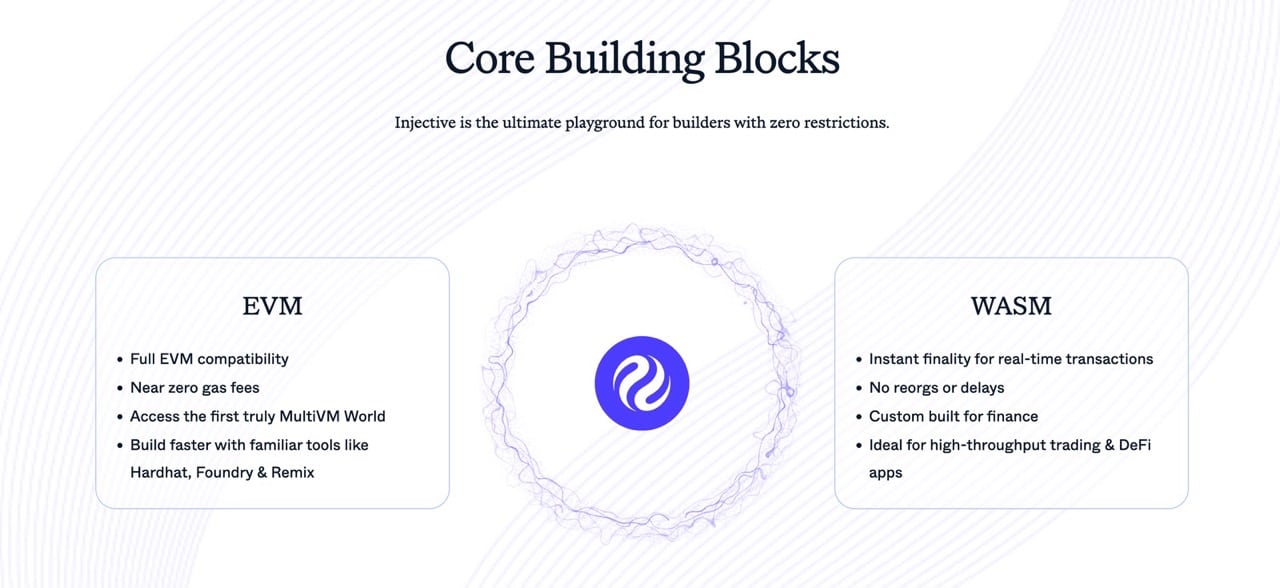
The blockchain features a modified version of the Ethereum Virtual Machine (EVM) called the Injective EVM. Instead of existing on a separate layer, the Injective EVM is embedded into the Injective blockchain’s core infrastructure, which allows frictionless transactions and high throughput.
So, why does Injective call itself the “blockchain built for finance?” The reason lies in its specialized architecture, which enables the entire trading lifecycle, order book management, order matching, trade execution, and settlement to take place fully on-chain. This design not only streamlines financial operations but also enhances trustlessness, censorship resistance, and developer accessibility. In one of its blogs, Injective says,
What truly differentiates Injective is that it brings every component of a decentralized exchange to the public. Everything, from the front-end exchange interface, back-end infrastructure, smart contracts, to orderbook liquidity, is provided openly and for free. This transforms the traditional business model of exchanges as the technical barrier to entry for individuals is eliminated, allowing them to freely run a highly performative exchange.
History of Injective Crypto
Injective started as a project under Binance Labs’ Incubation program in 2018. It was in late 2020 that Injective’s first public testnet, called Solstice, went live. The following year, Injective allowed validators to join the testnet network, allowing them to earn rewards for testing the capabilities of the protocol.
In early 2021, Injective published details of a three-phase mainnet launch. The first phase would see the creation of a bidirectional cross-chain bridge between Ethereum and Injective. The second phase marked the launch of a version of the Injective mainnet that operates within testing environments. The second phase allowed individuals to stake INJ tokens with existing validators and transfer tokens from Ethereum to the Injective Chain. The third and final phase saw the launch of the Injective Canonical Chain Mainnet in November 2021, which allowed unrestricted transfers and trading.
In August 2023, the INJ 2.0 upgrade was implemented, increasing the number of INJ tokens burned every week. In April 2024, the INJ 3.0 upgrade was implemented, introducing a deflationary mechanism to reduce the supply of the INJ token. In July 2025, Injective released a testnet version of the Injective EVM.
About the Injective Team
Injective was co-founded by Eric Chen and Albert Chon in 2018. The core development team behind the project is known as Injective Labs.
Before building Injective, Chen was a researcher at Innovating Capital, where he worked on trading strategies and protocol research. He graduated from New York University with a bachelor’s degree in finance.
Chon graduated from Stanford University with a degree in computer science. He worked as a software engineer and consultant at Amazon and Open Zeppelin before building Injective with Chen. Chon is currently the CTO of Injective Labs.

Injective Crypto Explained: What Problems Does Injective solve?
Injective was created to solve pressing DeFi issues related to frontrunning and MEV exploitation.
For context, frontrunning refers to the practice of strategically placing transactions before a target transaction to gain a market advantage. For example, if you buy a substantial amount of INJ tokens from an on-chain exchange, your transactions will be broadcast across the blockchain before being finalised. Some network participants (could be a trading bot) may see your pending transactions on the public blockchain and strategically place their transactions before yours.
Front-running is one of the many ways DeFi users are exploited using MEV techniques. MEV stands for maximal extractable value, which refers to the maximum value that a validator can obtain from a newly created block. Since block-creating validators are responsible for including, excluding, or reordering transactions in a block, they are in a position to profit from MEV strategies.

Injective prevents front-running by adding a timing mechanism, which is technically known as proof-of-elapsed-time using verifiable delay functions. Here, takers (traders who execute available buy and sell orders) are made to wait a specific amount of time before submitting the trade. They are also required to submit a cryptographic proof showing that they waited before submitting the trade.
Injective’s system makes sure no one can cut in line. The system locks in the timing of each trade, so only the trader who waited the required time gets to fill the order first.
Injective (INJ) Tokenomics
INJ is the native and utility token of the Injective Protocol. It launched in 2020 on the Binance Launchpad. The INJ token plays a key role in the protocol’s security, as network validators use it for staking. This section explores the token’s supply, distribution, use cases, and governance powers.
INJ Token Supply
Here are the important details of INJ’s supply that you need to know about:
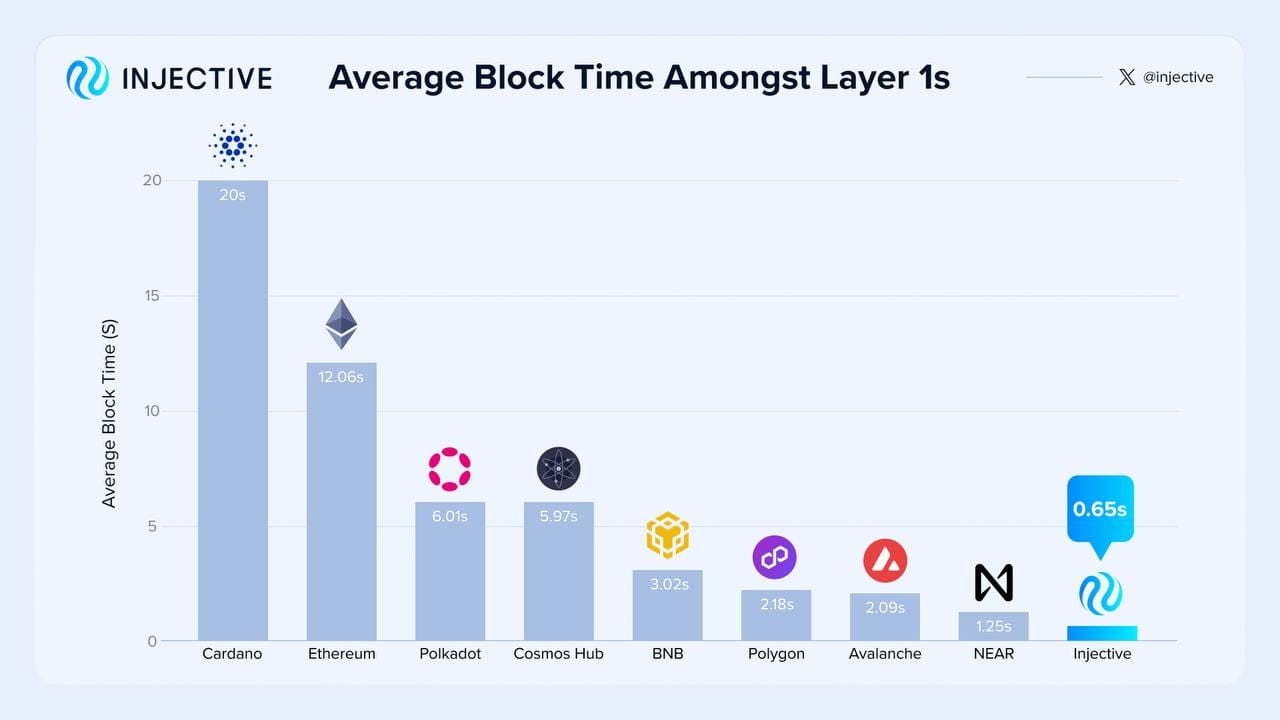
Here is how INJ’s initial supply of 100 million tokens was distributed in 2020. Below is a summary of the main use cases for the INJ token: Governance on Injective is centered around the INJ. Token holders can propose network changes and vote on active proposals. To prevent spam, the protocol requires users to deposit 500 INJ tokens for proposals to move to the voting stage. If the minimum deposit is not met by a given time, proposals are automatically rejected. If a proposal does not pass during the voting period, the deposit amount is forfeited. Only INJ holders who stake their tokens can participate in voting. The amount of INJ tokens staked determines the weight of a voter. More than 33.4% of the total staked tokens at the end of the voting period need to participate in the vote for consideration. At least 50% of votes cast need to vote in favour of the proposal for it to be accepted. Injective is made up of foundational components known as modules. Each module is built to provide a specific function. For example, one module may manage trading, while another module may define how decentralized governance takes place on Injective. Each module has its own set of rules and functions, but can combine to expand the blockchain’s capabilities. According to Injective, its module-based architecture makes Injective developer-friendly by reducing the technical complexity of implementing core features. You can think of modules as tools that developers use to create applications. Here are some examples of modules on Injective: Like other blockchains, Injective acts as a ledger that records and verifies transactions and account balances. Smart contracts are used to create tokens and build decentralized applications on Injective. Users can transfer tokens to Injective from over 20 blockchains using Cosmos’ interoperability feature, Inter-Blockchain Protocol, and via the Wormhole bridge. Injective is a blockchain built using the Cosmos SDK. It uses the Tendermint PoS consensus mechanism, which makes it highly scalable. Validators deposit collateral in a process called staking to become eligible to verify transactions and create new blocks. Each block creation round is divided into three phases, i.e., block proposal, pre-vote, and pre-commit. Validators cryptographically sign and broadcast votes to agree on the next block. The use of Tendermint consensus ensures that the Injective blockchain will function correctly even if one-third of its validator nodes are faulty or malicious. If you are interested in learning more about the Cosmos SDK and the Tendermint consensus mechanics, read our Cosmos (ATOM) review. Smart contracts on Injective are executed by a modified version of the Ethereum Virtual Machine (EVM) known as the Injective EVM. Unlike most virtual machines that operate on a separate layer from the core blockchain layer, the Injective EVM is embedded directly into Injective’s Layer 1 blockchain. According to Injective, its native EVM is highly scalable, supporting over 20,000 transactions per second. It is also similar to the original EVM used in Ethereum, which makes it easy for developers to import their decentralized applications and smart contracts to Injective. Additionally, the Injective native EVM is designed around an interoperability-focused architecture called MultiVM that allows smart contracts across different virtual machines to coexist, interact, and compose in a single runtime. Injective has a token standard called CW20, which closely resembles the popular ERC-20 token standard used in Ethereum to create fungible tokens. Modules such as TokenFactory make it easy for developers to mint tokens on Injective. Meanwhile, the Permissions module is specially made for financial institutions and RWA issuers who want to create restrictions on sending, receiving, minting, and burning of specific tokens on Injective. Injective is a highly scalable blockchain network. Performance upgrades implemented in recent years have slashed block times down to 0.65 seconds. In comparison, block times of Solana (SOL) and Ethereum (ETH) were 0.4 seconds and 12.12 seconds, according to data compiled by Chainspect. “Quicker block times reduce the risk of slippage and limit the value extracted by arbitrageurs, making Injective an ideal platform for applications such as high-frequency trading and other time-sensitive operations,” says Injective. In this section, we examine important Injective Protocol on-chain metrics to learn more about the performance and growth of the project: Here are interesting stats and key on-chain metrics that INJ investors will find insightful: In a report, research firm Messari noted that the launch of Injective’s native EVM that enables over 20,000 transactions per second and allows seamless interoperability between EVM and Cosmos-based WASM smart contracts could position Injective as a “leading infrastructure for on-chain finance.” The research firm also said that market expansion in the real-world asset tokenization sector is a “bull case” for the Injective Protocol. Elsewhere, in the first quarter of 2025, Grayscale included Injective Protocol among the potential altcoins that the asset manager is considering adding to its suite of investable products. Injective was included under the “Financials” sector category alongside popular names such as Hyperliquid (HYPE), Aerodrome (AERO), and Jupiter (JUP). Injective has established itself as a top 100 crypto by growing its market cap from less than $30 million at the end of 2021 to over $250 million. Now, the protocol is looking to attract DeFi developers as well as corporate institutions to its shores by offering a blockchain platform tailor-made for financial applications and real-world asset tokenization. If you’re thinking about investing in INJ, it’s important to do your own research (DYOR). Make sure your decision aligns with your risk tolerance, market outlook, available capital, and long-term financial goals. And purchase INJ from trusted platforms like the ones listed below. If you want to know more, check out our “How to buy Injective (INJ)” guide.
The core principles of cryptocurrencies promote self-custody of assets. To do so, you will need a crypto wallet that will give you full ownership and control over your crypto tokens. Below, you will find the top non-custodial crypto wallets to hold your INJ tokens: Pro Tip: You can also check out Best Wallet, a self-custodial wallet and all-in-one crypto platform. It lets you securely store your assets while also offering easy options to buy, sell, stake, and swap thousands of cryptocurrencies. Plus, it gives you access to exclusive crypto presales. Learn more about this wallet in our separate Best Wallet review. Injective Protocol has ambitious plans to be the home of the global on-chain economy. The project is redefining the DeFi landscape by introducing RWA assets such as on-chain trading in oil prices, U.S. equities, and foreign exchange. The blockchain is also enabling developers to create advanced DeFi applications supported by unique features such as an on-chain order book and verifiable delay functions. DISCOVER: The use of on-chain orderbook and verifiable delay functions makes Injective different from other L1 chains. You can use Injective for trading by logging in to a compatible crypto wallet on a decentralized exchange. The release of Injective’s native EVM allows decentralized trading apps to offer gasless transactions to users. Any crypto user can benefit from using Injective as the blockchain is built to prevent frontrunning. Yes, you can stake your INJ coins to earn passive yield and to become eligible to vote on network proposals. You can buy INJ tokens on centralized crypto exchanges such as Binance and OKX. Injective was co-founded by Eric Chen and Albert Chon in 2018. The core development team behind the project is known as Injective Labs. Yes, Injective supports cross-chain trading by using the Inter-Blockchain protocols and bridges between Ethereum and Injective. Established in 2013, 99Bitcoin’s team members have been crypto experts since Bitcoin’s Early days. Weekly Research Monthly readers Expert contributors Crypto Projects Reviewed
INJ Coin Distribution & Allocation
Category
Percentage of the initial total supply
Seed sale
6%
Private sale
16.67%
Binance Launchpad sale
9%
Team
20%
Advisors
2%
Ecosystem development
36.33%
Community growth
10%
INJ Utility & Use Cases
Governance & Protocol Control
How Does Injective Work?
Injective Blockchain Structure
Token Standards & Smart Contracts
Scalability & Performance
Pros & Cons of INJ Coin
Pros
Cons
Injective Network Analytics
On-Chain Metrics
What Do Experts Think About INJ Crypto Coins
Is Injective a Buy?
Best Injective Wallets
Conclusion: What is Injective (INJ)?
FAQs:
What makes Injective different from other DeFi projects?

How to use the Injective Protocol for decentralized trading?
How does Injective enable decentralized trading without gas fees?
Who can benefit from using Injective?
Can I stake INJ coins?
Where can I buy Injective (INJ)?
Who founded Injective?
Does Injective support cross-chain trading?
References

Why you can trust 99Bitcoins