







The Ethereum Virtual Machine (EVM) is the engine behind Ethereum’s execution layer, responsible for processing transactions and running smart contracts across thousands of nodes around the world.
In this guide, we’ll break down how the EVM works, what makes it unique, and why it plays such a crucial role in broader crypto adoption.
Key Takeaways
- The Ethereum Virtual Machine (EVM) powers Ethereum’s execution layer and runs smart contracts across thousands of decentralized nodes.
- The EVM ensures every node produces the same result, keeping the blockchain secure, consistent, and censorship-resistant.
- Smart contracts written in languages like Solidity are compiled into bytecode that the EVM executes.
- EVM compatibility allows developers to deploy the same apps across many blockchains, improving scalability and adoption.
- The EVM remains central to DeFi, NFTs, and Web3 applications, making it one of the most important technologies in crypto.
How Does the Ethereum Virtual Machine Work?
Each full node on the Ethereum blockchain runs an instance of the EVM. Individually, these nodes are responsible for running the smart contracts that are hosted on the network. These smart contracts are the key differentiator of EVM, so let’s take a look at them in more detail.
Smart contracts are executable pieces of code that run on the blockchain, specifically on full nodes. Simply put, they behave like conditional switches: if a specific condition is met, a particular action is taken. On Ethereum, smart contracts are written in a human-readable programming language, typically Solidity, which is then compiled into a series of hexadecimal opcodes called bytecode that the EVM operates in.
The bytecode for each contract is stored at a specific address on the blockchain. Multiple smart contracts can interact to form a protocol or a decentralized application (dApp). This is thanks to EVM being Turing-complete, the ability to complete any calculation, which allows for complex smart contracts, such as Uniswap V3, which occupies 17 contract accounts on the Ethereum blockchain.
As mentioned earlier, transaction execution is done independently by each node. For instance, when swapping ETH for USDC on Uniswap, the simultaneous smart contract execution on every node ensures decentralization.
These nodes don’t work for free. Nodes calculate the “gas” cost required to execute smart contracts, which represents how much computational power is needed to run the code. This amount varies by complexity and network traffic. Users pay these gas fees in Ethereum (ETH), making this crypto essential for operating the EVM.
Did you know?
Validator nodes don’t receive revenue directly from users. The Ethereum protocol burns the majority of these base fees. Instead, validators are compensated with newly minted ETH for securing the network, along with optional “priority fees” from users seeking faster transaction inclusion.
What is the Purpose of the EVM?
We’re familiar with applications that run on a remote server, such as shopping, banking, or social media apps. These are all examples of centralized applications. They’re usually under complete control of a corporation, which can freely access and change the data stored on the server (for example, a bank can reverse a transaction).
Ethereum is a permissionless and trustless network, enabling anyone to participate and execute transactions without the need for an intermediary. While pioneering networks like Bitcoin supported permissionless and trustless transactions, the EVM enables much more complex mechanisms. This opens the door to sophisticated lending markets, decentralized trading platforms, Web3 gaming, and numerous other decentralized applications that simpler, purpose-built networks like Bitcoin can’t accommodate.
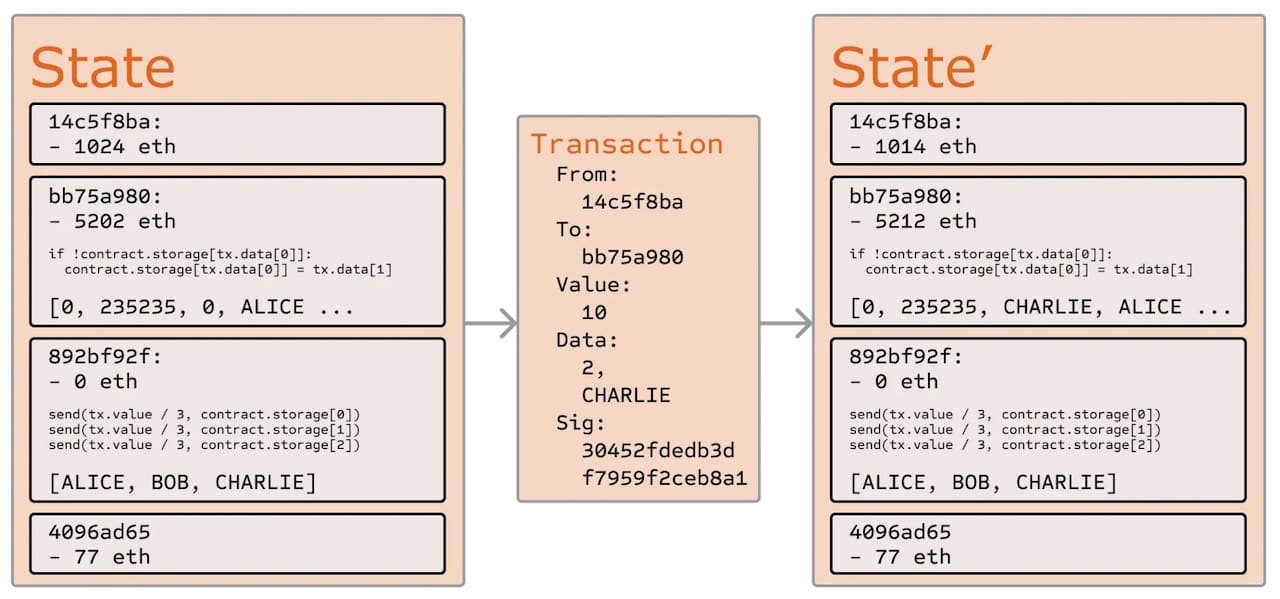
In this environment, the EVM manages the chain state, including Ethereum account balances, smart contract deployment and storage, and transaction nonces that prevent “replay” attacks (an exploit where a valid transaction is repeated or delayed). If the initial valid state of every instance of EVM is the same, they will all reach the same result after a specific transaction is executed.
This is a crucial component to maintain consensus on the Ethereum network, as all nodes must agree on the network’s final valid state after executing a transaction. If found to be valid, transactions are added to proposed blocks.
Why is the Ethereum Virtual Machine Important?
The EVM brings programmability to blockchain, elevating the technology to more than just a platform for monetary transactions. The ability to host powerful decentralized applications, combined with trustless execution, changed the blockchain landscape forever. A growing selection of dApps now spans a wide range of applications, including decentralized finance (DeFi), gaming, and social media.
The EVM is also an important unifying factor in crypto development. While other blockchains now support smart contracts, the prevalence of EVM-compatible chains focuses development resources and makes it easier to deploy dApps on multiple chains. This efficiency allows developers to build once but deploy to multiple markets.
While dApps capture the spotlight, the Ethereum Virtual Machine is largely responsible for the proliferation of tokens in the blockchain space. Before Ethereum, the coins that powered blockchain networks were the primary value. Today, thousands of tokens on the market utilize EVM instead of a proprietary chain, including many of the top currencies like Tether (USDT), which is deployed on several EVM chains.
Of course, Ethereum itself couldn’t function without this key infrastructure piece. As discussed above, the EVM plays a key role in making Ethereum run without intermediaries, making it a truly decentralized and distributed ledger. Its architecture is also designed to prevent malicious code from infecting host machines, the network, or other smart contracts.
Architecture of the EVM
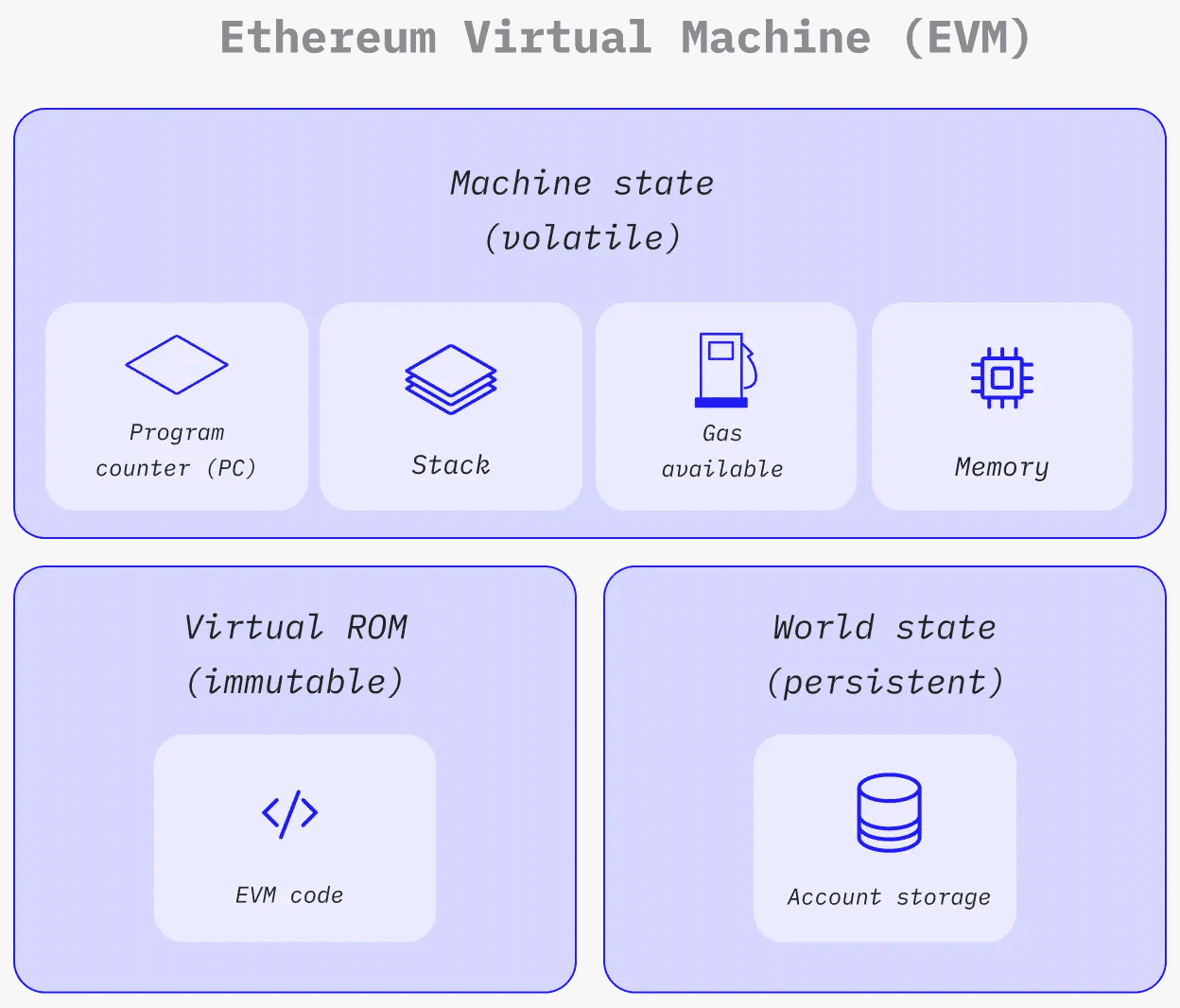
Let’s explore the EVM’s architecture in more detail by examining its key components and how they work together in a new transaction. This section gets a bit technical, so bear with us.
In this example transaction, we want to swap ETH for USDT using Uniswap on the Ethereum blockchain. To the end user, the workings under the hood won’t be apparent, but here’s what’s going on behind the scenes.
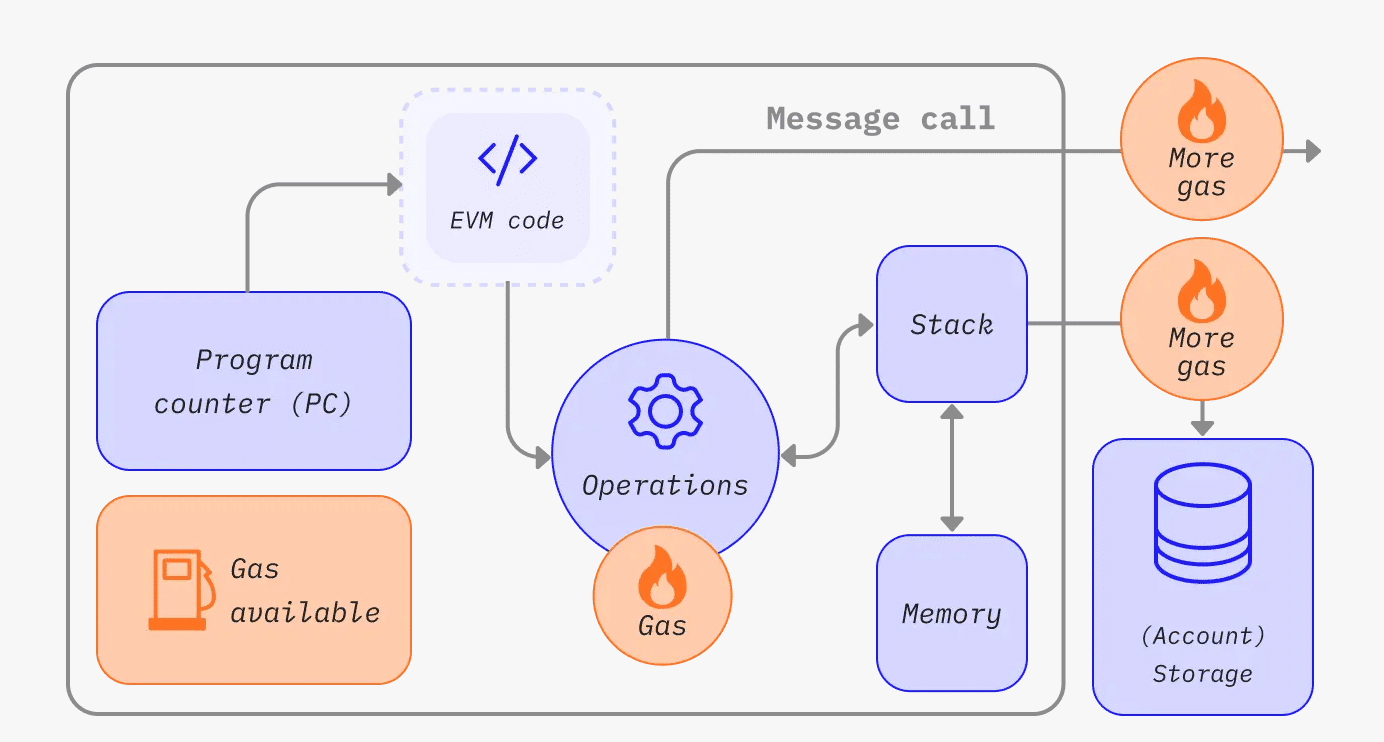
1) Calldata: First, we select a swap amount on Uniswap, which then sends a message to a crypto wallet app, such as MetaMask. The wallet app prepares all the data needed for the transaction. This is called the Calldata, and it includes a function selector (e.g., swapExactETHForTokens), function arguments (e.g., sending amount), as well as deadlines and the recipient address. This bunch of data is then sent to the EVM.
2) ROM: Read-Only Memory (ROM) stores permanent data for smart contracts deployed on the Ethereum chain (ROM code cannot be changed). When our swap transaction reaches a full node, the EVM loads the bytecode for that specific smart contract into ROM so that it can execute the transaction.
3) Program Counter: The EVM program counter sequentially works through each opcode of the function identified in the calldata. This ensures that the smart contract executes as intended.
4) Stack: The EVM uses a stack for temporary storage for calculations. In a swap context, these values might represent the amount of USDT based on the ETH amount and the amount of liquidity in the pool at the current price. The stack works like a notepad where intermediate calculations are held before (potentially) being moved to Memory or Storage, which we’ll discuss next.
5) Memory: Memory allows storage of temporary data needed to execute the transaction. For example, if the transaction requires multiple hops to complete, the Uniswap contract might write this data to memory temporarily.
6) Storage: The Ethereum blockchain holds a record of all transactions in storage, with the results of the transaction affecting the global state of the blockchain. This defines whether an address has sufficient funds for a transaction.
7) Gas: Ethereum tokens (ETH) act as fuel for the blockchain, with the computation resources required commonly expressed as “gas”. Gas fees are determined by computational effort and network demand. In the swap described above, the transaction likely incurs minimal cost compared to more complex transactions. But if the transaction required multiple hops or the network was busy, the transaction could consume much more gas.

Because each opcode requires gas, more complex transactions, such as complex smart contracts, which consist of longer arrays of opcodes, add to the transaction cost. Smart contract optimization is, therefore, key to keeping the cost down.
All these elements work together as EVM processes transactions on Ethereum. From the end user’s standpoint, these elements are largely abstracted, with the only gauge on transaction complexity or network congestion being the gas price.
Other Blockchains That Use EVM
Following Ethereum’s mainnet launch in 2015, several other chains started making use of the EVM, including multiple well-known Layer-1 chains that adopted (or adapted) EVM in the years that followed.
Layer-1 chains, such as BNB Smart Chain and Gnosis, use their own nodes to maintain consensus but employ EVM architecture to work with their own consensus mechanisms. Sidechains, such as Polygon and Rootstock, work similarly, serving as a bridge to a primary chain like Ethereum or Bitcoin.
In addition to sidechains and other Layer-1 chains, several Layer-2 chains also utilize the Ethereum Virtual Machine, including Arbitrum and Base. These Layer-2 chains execute transactions off-chain in an EVM environment and then pass these transactions to Ethereum in bulk to secure them with Ethereum’s proof-of-stake consensus mechanism.
Pros & Cons of the Ethereum Virtual Machine
The EVM opens a world of possibilities for blockchain applications. But for its numerous advantages, the EVM’s architecture also has some drawbacks. Notably, gas fees can spike if the network experiences congestion, such as when the CryptoKitties craze slowed Ethereum transactions to a crawl.

Ethereum developers are continuously introducing rigorously tested improvements to address the downsides of the EVM and scale the technology effectively for modern crypto usage without sacrificing decentralization or network security.
Let’s analyze the primary pros and cons of the Ethereum Virtual Machine.
Pros
-
The EVM is fully programmable, allowing developers to build advanced and feature-rich applications.
-
Ethereum’s decentralized architecture ensures trustlessness and strong censorship resistance.
-
The isolated execution environment improves security by preventing malicious code from spreading.
-
Deterministic execution ensures all nodes reach the same result, maintaining network consensus.
-
A large ecosystem of tools and developers makes building on the EVM accessible and efficient.
Cons
-
Network congestion can slow transactions and reduce scalability.
-
Gas fees can rise sharply during high activity periods.
-
Smart contracts are immutable once deployed, even if bugs are found.
-
Developers must learn Solidity and EVM-specific concepts, which may have a steep learning curve.
Future of the EVM
The Ethereum Virtual Machine (EVM) is evolving as Ethereum pushes toward cheaper transactions, higher throughput, and easier development. Many of the upcoming upgrades focus on improving performance, security, and developer experience without breaking existing applications.
Key upgrades shaping the EVM’s future include: Together, these changes point toward a faster, cheaper, and more developer-friendly Ethereum, while keeping the EVM at the center of the ecosystem. The Ethereum Virtual Machine is what turned Ethereum into more than a payments network. By enabling smart contracts, it opened the door to DeFi, NFTs, gaming, real-world assets, and thousands of dApps that power today’s Web3 ecosystem. Even as new blockchains compete with higher speeds and different programming languages, the EVM remains the industry standard. Its massive developer community, rich tooling, and wide compatibility keep it at the center of blockchain innovation. See Also: Best DeFi Crypto Wallets | Top 13 in 2026 Ethereum refers to the entire blockchain protocol, whereas the Ethereum Virtual Machine (EVM) refers to the runtime environment in which Ethereum nodes process transactions for the network. Many also refer to Ethereum’s native token, ether (ETH), as Ethereum. No, the Ethereum Virtual Machine (EVM) is an isolated, Turing-complete virtual machine built for executing smart contracts on the Ethereum network. By contrast, an Ethereum wallet holds the private keys that control crypto assets on the blockchain, with the keys proving ownership of the assets. The EVM still struggles with scalability challenges, which can drive up transaction costs and slow transaction times. Computational resources are limited, and enough gas isn’t always available. However, several strategies aim to improve EVM’s ability to process transactions with the same amount of gas faster and cheaper, including Layer 2 chains like Arbitrum or Base, which use the Ethereum chain to secure transactions. Solana and Ethereum serve different markets in many cases, with Solana appealing to those who want fast and inexpensive transactions, and Ethereum being known for its stability, dApp availability, and deeper liquidity. Vitalik Buterin, one of the founders of Ethereum, developed the concept of the Ethereum Virtual Machine in 2013. Ethereum’s mainnet launched in 2015. Established in 2013, 99Bitcoin’s team members have been crypto experts since Bitcoin’s Early days. Weekly Research Monthly readers Expert contributors Crypto Projects Reviewed
Conclusion
FAQs:
What is the difference between Ethereum and Ethereum Virtual Machine?

Is EVM the same as Ethereum Wallet?
What are the limitations of the Ethereum Virtual Machine?
Is the Solana virtual machine better than the Ethereum virtual machine?
Who built the Ethereum Virtual Machine?
References:

Why you can trust 99Bitcoins