




In This Article
The crypto world loves a good story. Bitcoin as digital gold, Ethereum as the decentralized computer, Solana as the speed demon. Now comes Bittensor, the self-proclaimed open marketplace for intelligence. If you’re here for a Bittensor review or just poking around this beginner’s guide to Bittensor crypto, strap in. So, what is Bittensor (TAO)? Imagine Bitcoin miners, but instead of burning electricity to brute-force hashes, they’re competing to produce useful machine learning models.
Validators score outputs, rank miners, and decide who gets paid in TAO. It’s blockchain meets artificial intelligence, dressed up as a decentralized network where brains replace brute force. Sounds awesome, right? Maybe. Or maybe it’s another over-engineered attempt to staple “AI” onto a blockchain. That’s what we’ll dig into: how it works, why it matters, who benefits, and where the risks are hiding. Consider this your no-bullshit field guide to the Bittensor ecosystem. Equal parts promise, peril, and potential profit.
Key Takeaways
- Bittensor (TAO) is a decentralized machine learning protocol where miners build AI models and validators score them.
- The network pays contributors in TAO token, which has a capped supply and halving schedule similar to Bitcoin.
- The 2025 rollout of Dynamic TAO introduced subnet-specific currencies and reshaped staking incentives.
- Open-source, incentive-driven, challenges the monopoly of large corporations in AI.
- Investing in TAO is a speculative bet on whether decentralized AI can compete with centralized giants.
99Bitcoins’ Take on Bittensor Crypto Project
Every bull cycle has its darling. In 2017, it was ICOs. In 2021, NFTs. Today, Bittensor (TAO) is angling to be the banner child for “decentralized AI.” Strip away the hype and here’s the truth: it’s an audacious experiment to build a decentralized machine learning protocol where miners contribute AI models, validators score their output, and the network pays in TAO for value delivered. That’s the dream. The reality? It’s messy.
The potential:
- Bittensor spreads the cost of Artificial Intelligence training across a much broader community instead of leaving it in the hands of a few large corporations.
- It creates a peer-to-peer marketplace for machine learning services provided. A kind of global, open-source intelligence bazaar.
- If it works, TAO token holders and stakers could sit at the center of the first real decentralized AI network.
The risks:
- Training and validating powerful AI models isn’t cheap. The network depends on steady computational resources and that puts constant pressure on participants.
- The incentive design is still young. Rewarding good work and punishing freeloaders is easier to write in a whitepaper than to enforce in practice.
- And let’s be real: no one’s proven yet that blockchain-based AI marketplaces can beat centralized platforms on cost, speed, or adoption.
So, what’s the 99Bitcoins take? If you’re chasing the next memecoin, Bittensor crypto investment probably isn’t your thing. But if you believe that AI development should be open, collaborative, and powered by incentives rather than corporate monopolies, Bittensor deserves a spot on your radar. Just don’t mortgage the house for it. The line between genius and folly here is paper-thin.
Bittensor Review: Summary
Here’s the skinny: Bittensor is trying to be the Bitcoin of AI, a decentralized machine learning protocol where instead of miners burning electricity, they crank out AI models. Validators aren’t just rubber-stamping blocks; they’re scoring outputs, deciding which models are useful, and making sure the TAO token flows toward actual value.
In this review, we’ll look at:
It’s a beginner’s guide to Bittensor crypto written for people who want the facts with a bit of edge. By the end, you’ll know if TAO deserves a spot on your watchlist or if you should move on and let someone else play guinea pig in this grand experiment.
Terms You Need to Know Before Understanding Bittensor
Before we dive headfirst into the Bittensor ecosystem, let’s clear the fog around some jargon. Crypto projects love to hide behind buzzwords, so here’s a decoder ring:
Memorize these terms and you’ll sound less like a tourist and more like someone who actually gets how the Bittensor network operates.
What is Bittensor (TAO)?
So, what is Bittensor (TAO) really? Strip away the crypto jargon and you’ve got a decentralized machine learning protocol that wants to be the Wall Street of AI models. Instead of a single entity or one central server deciding who trains the next powerful AI models, Bittensor spreads the work across a peer-to-peer marketplace.
Here’s the setup:
The pitch is simple: build a global neural network that isn’t owned by Big Tech. The Bittensor protocol rewards anyone, from PhD-level AI experts to scrappy coders, with TAO if they provide value. In theory, this creates continuous improvement in the Bittensor ecosystem, producing more powerful AI models than any centralized giant could manage.
In practice? It’s still early days. Whether this turns into a self-sustaining collaborative environment or collapses under its own complexity is the trillion-dollar experiment.
History of Bittensor Crypto
Bittensor came to life in 2021, designed from day one as an open-source protocol that could run without a central master pulling the strings. No pre-mine, no private allocation, no shadowy insiders dumping on retail later. Every single TAO token has been earned on-chain, the way Bitcoin miners had to sweat for their rewards.
The early vision was straightforward but ambitious: build a decentralized network where AI projects could plug in, trade computational resources, and bootstrap a global neural network. Over the years, that blueprint hardened into the current structure of miners, validators, subnets, and staking mechanisms.
By 2023, Bittensor had grown from a fringe experiment into a serious AI-related services protocol. The big milestone came in February 2025, when the community approved and rolled out Dynamic TAO, a radical shift that allowed each subnet to mint its own alpha currency. This changed emissions, delegation, and incentives across the entire Bittensor blockchain, proving that the protocol could adapt through on-chain governance rather than top-down decrees.
In short: Bittensor’s history is young, messy, and still unfolding. But its ethos (distributing rewards for machine intelligence in the same way Bitcoin did for currency) remains its beating heart.
About the Bittensor Team
Behind the curtain, Bittensor isn’t a faceless DAO conjured out of thin air. The project was launched by Jacob Steeves, a former Google AI engineer, and Ala Shaabana, a machine learning researcher. Their goal was simple but audacious: build a protocol that makes machine intelligence as open and unstoppable as Bitcoin’s blockchain.
The team operates through the Opentensor Foundation, which handles development, coordination, and (at least until recently) oversight of the network. But in line with Bittensor’s ethos, even this control is fading. Governance is shifting toward a bicameral system with the Triumvirate (proposal makers) and the Senate (top delegates), meaning the community, not a single entity, is beginning to steer upgrades and protocol control.
While Steeves and Shaabana still play a key role as architects and evangelists, the network’s survival depends less on personalities and more on whether the broader community of miners, validators, and stakers can keep pushing the protocol forward.
That’s the gamble: Bittensor isn’t selling you the cult of a founder like Vitalik Buterin or Satoshi Nakamoto. It’s betting that a collaborative environment of AI experts and crypto natives will out-innovate both large corporations and Web3 competitors. Whether that actually happens is the part investors and developers are still wagering on.
What Problems Does Bittensor Solve?
Let’s be blunt: today’s AI game is rigged. A handful of large corporations control the computational resources, the AI models, and the pipelines for AI-related services. If you’re not sitting on Google’s servers or Microsoft’s balance sheet, you’re a spectator. Bittensor looks at that monopoly and says, “nahhh, let’s blow it up.”
Here’s what it’s aiming at:
In theory, Bittensor ensures that the future of AI isn’t dictated by a single entity but by a much broader community. Whether that ideal can survive real-world economics is another story, but it’s a problem worth trying to solve.
Bittensor (TAO) Tokenomics
Tokenomics is where ideology meets cold math. Like Bitcoin, Bittensor plays the scarcity game, hard caps, halving cycles, and carefully metered emissions. But unlike Bitcoin, TAO is the bloodstream of a decentralized machine learning protocol, rewarding miners, paying validators, and keeping the Bittensor network alive.
TAO Token Supply
The total supply of TAO is capped at 21 million. No hiddeninflation switches, no surprise minting events. As of August 2025, about 9.75 million TAO are circulating, less than half the eventual total.
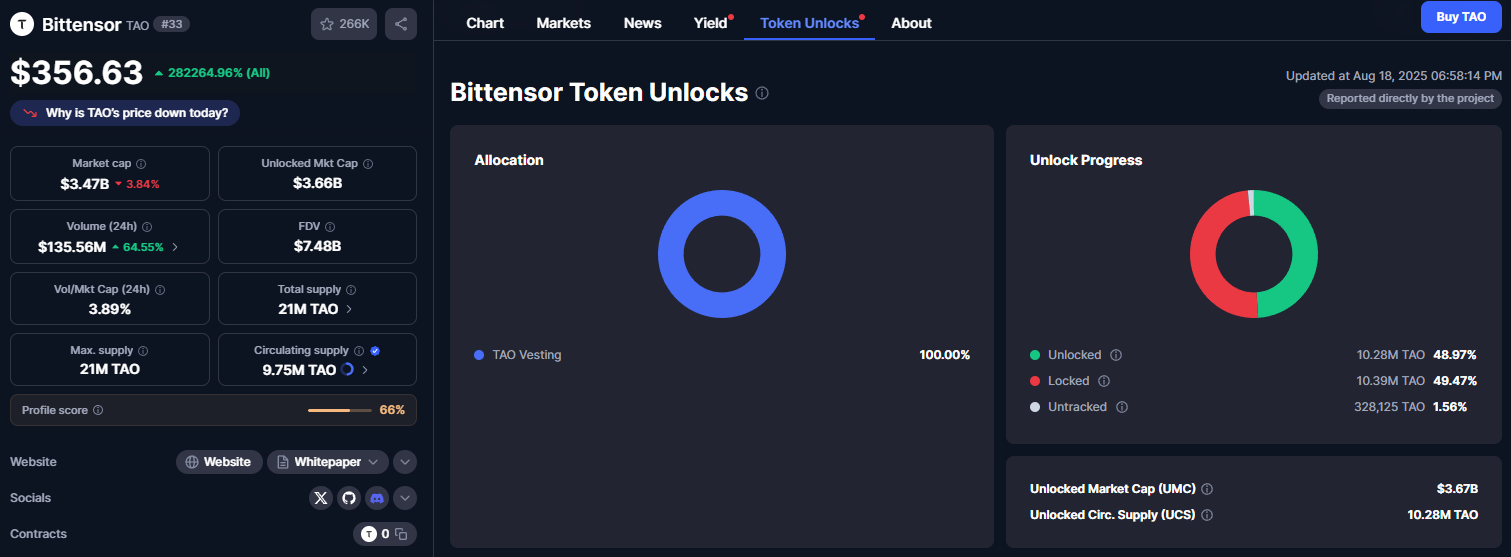
Roughly 48.97% is unlocked, while 49.47% remains locked, drip-fed through a vesting schedule that extends into the 2040s. This slow release keeps miners and stakers incentivized for decades, while also ensuring constant market pressure from unlock events.
TAO Coin Distribution & Allocation
Unlike most crypto launches, there was no pre-mine, no VC carve-out, no insider backroom deals. All TAO is earned through network participation. Every token comes from mining, validating, or staking, the same rules for everyone.
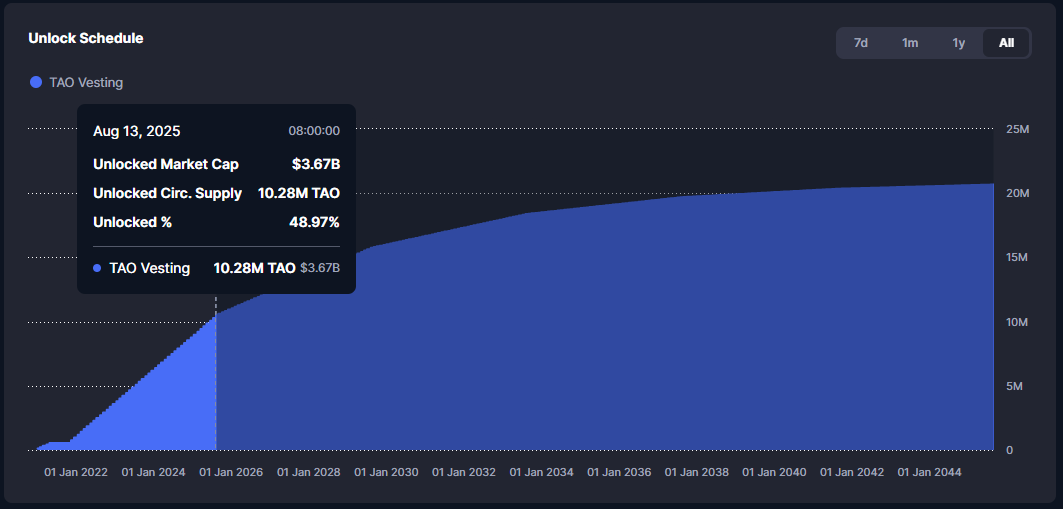
Still, the vesting unlocks matter. On August 20, 2025, roughly 216,000 TAO (about 1.03% of max supply, worth ~$77M at current prices) hit the market. For long-term believers, that’s new fuel for growth. For skeptics, it’s potential sell pressure waiting to smash the chart.
TAO has multiple purposes inside the Bittensor ecosystem: Think of it as the oil that keeps the global neural network from stalling.TAO Utility & Use Cases
Economic Model & Incentives
TAO’s design borrows Bitcoin’s ethos: scarcity and halving. Block rewards shrink over time, forcing the network to rely on transaction fees and service demand. But Bittensor adds its own twist with Dynamic TAO (dTAO), introduced in 2025.
Each subnet now issues its own alpha token (α), tied to TAO through bonding curves and emission markets. This lets each subnet compete for emissions and incentivizes continuous improvement. Miners and validators get paid for delivering value, not just plugging in hardware.
It’s a high-wire act: balancing incentives to reward good actors while slashing dead weight. If the design holds, it could keep the Bittensor protocol efficient for decades. If it fails, the whole thing risks devolving into rent-seeking and wasted computational power.
Governance & Protocol Control
Early on, the Opentensor Foundation held the keys. But in 2025, Bittensor shifted toward decentralized governance. The new bicameral model splits power between:
- Triumvirate – Proposal makers (mainly core contributors).
- Senate – Top delegates chosen by stake weight, who approve or reject changes.
This setup means no single entity controls upgrades. Instead, the broader community of TAO holders and validators guides protocol evolution, from emission tweaks to security fixes.
It’s governance with teeth. If the Senate stalls, upgrades die. If the Triumvirate misfires, bad ideas never reach execution. Messy? Sure. But that’s the point: distribute power, force compromise, and keep the network from turning into another centralized fiefdom.
How Does Bittensor (TAO) Work?
Bittensor is a decentralized machine learning protocol with a clear technical structure: subnets where miners provide models, validators evaluate them, and TAO incentives keep the system running. The design trades Bitcoin’s wasted hashpower for something more practical. Scoring and rewarding machine learning outputs. So, how does it all work?
Architecture Behind Bittensor
The Bittensor protocol is built around specialized subnets, each focused on a distinct AI-related service. Think generating human-like text, optimizing ML models, or handling specific tasks.
Each subnet runs on four key roles:
Together, these actors turn Bittensor into a peer-to-peer marketplace for intelligence. An open, distributed computing layer where contributions are priced, scored, and rewarded.
TAO’s Blockchain Structure
Under the hood, Bittensor runs on a Substrate-based blockchain (the same framework that powers Polkadot). This chain handles TAO issuance, validator permits, staking delegation, and subnet registration.
Key mechanics:
This structure ensures TAO is constantly tied to work, output, and subnet economics.
Token Standards & Smart Contracts
Unlike Ethereum, Bittensor isn’t built around generalized smart contracts. Its token standards are leaner, purpose-built for network incentives:
Scalability & Performance
The Bittensor team knows the nightmare of scaling. Traditional machine learning services choke when funneled through a single server. Bittensor spreads tasks across a decentralized network of miners, scaling horizontally as more participants join.
Still, scaling isn’t free. Computational power is costly, and the network has to constantly balance incentive flows to avoid collapse under its own weight.
Benefits and Drawbacks of TAO Coin
Like any ambitious crypto experiment, TAO is a double-edged sword.
Advantages
- Open Access – Anyone can plug in, mine, validate, or stake. No permission needed.
- Decentralized AI – Shifts control of AI development from Big Tech monopolies to a broader community.
- Strong Incentives – Clear staking rewards, emissions, and governance rights tied to TAO.
- Scarcity – 21M cap, Bitcoin-style halving cycles, and carefully managed vesting schedule.
Disadvantages
- Complexity – Between subnets, validators, α tokens, and emission curves, this isn’t beginner-friendly.
- Computational Costs – Running powerful AI models demands serious hardware, leaving small miners at a disadvantage.
- Unproven Adoption – No guarantee that developers and enterprises will prefer a blockchain-based AI marketplace over centralized platforms.
- Market Pressure – Ongoing unlocks mean dilution risk. Tokenomics look solid on paper, but supply hitting the market can crush price momentum.
In short: TAO’s design is brilliant but brutal. It rewards contribution, punishes mediocrity, and dares to build a global neural network in public. Whether it thrives or implodes depends on whether its economics can outcompete centralized AI giants.
TAO Coin’s Analytics
The market treats TAO like a mid-cap asset with heavyweight volatility. More than 365,000 accounts and nearly 4 million transfers suggest the Bittensor cryptocurrency has growing adoption, but still nowhere near the scale of Ethereum or Solana.
In short: TAO has carved a space for itself, but the market is still deciding if this is infrastructure or speculation.
On-Chain Metrics
Looking at the Bittensor blockchain itself, you can see how the network lives and breathes. Subnets are where the action is, each representing different machine learning services with its own emission share. Validators compete for weight and delegation, fighting to attract TAO holders through performance.
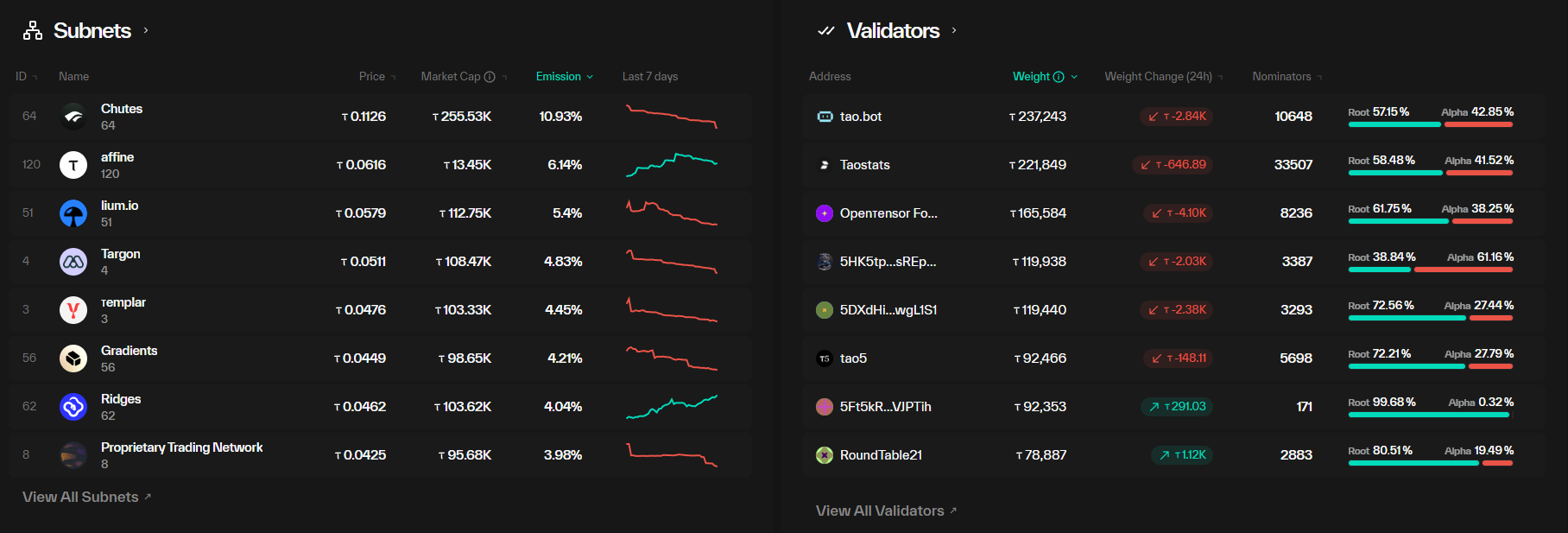
Top Subnets: “Chutes,” “affine,” and “lium.io” lead emissions, each specializing in different AI projects. Together, they attract the lion’s share of rewards.
Validators: Heavyweights like tao.bot and Taostats control a significant stake, while smaller validators jockey for delegation. Performance shifts daily, with weight changes showing how quickly capital moves in response to results.
Nominators: Stakers split their delegations between Root TAO and α (subnet-specific tokens). This balance reflects whether confidence leans toward the base network or specialized subnet economies.
The takeaway? Bittensor’s on-chain metrics show a live, competitive economy not just a ghost chain. But concentration among top validators hints at potential centralization risks, even inside a system designed to decentralize.
Is TAO a Buy?
Whether Bittensor (TAO) belongs in your portfolio depends on what kind of gambler you are. Let’s not sugarcoat it: TAO is a high-risk, high-reward play.
The Case For Buying:
- Scarcity: With a 21M cap, TAO follows Bitcoin’s scarcity playbook. Supply unlocks are predictable, and staking can offset some dilution.
- Incentive Design: Miners, validators, and stakers all have skin in the game. The incentive mechanisms aim to reward real value, not wasted hashpower.
- Narrative Tailwind: In a market obsessed with artificial intelligence, TAO positions itself as the flagship decentralized AI project. Narrative alone can drive capital in bull cycles.
The Case Against:
- Execution Risk: Running machine learning models on a blockchain is unproven. If the economics don’t align, the system could stall.
- Centralization Pressure: Top validators already control significant weight. A “decentralized” system dominated by a few whales defeats the point.
- Market Pressure: With half the supply still locked, every unlock risks creating fresh sell pressure making it tough for price to sustain.
Bottom Line: TAO isn’t a safe bet. It’s a speculative call option on the future of decentralized machine learning. If you believe AI should be owned by a broader community instead of large corporations, TAO has a compelling narrative. If you want steady gains and sleep at night, look elsewhere.
Bittensor’s Future: What To Expect?
The future of Bittensor (TAO) hangs on whether its grand experiment in decentralized AI can outcompete centralized giants. Right now, it’s running on conviction, clever tokenomics, and a passionate community. But the next few years will test whether the Bittensor ecosystem can deliver results that justify the hype.
What’s Coming:
- Dynamic TAO Expansion – The rollout of subnet-specific α tokens is still new. Expect volatility as capital moves between subnets, validators, and delegation pools. The winners will be the subnets that prove they can deliver consistent AI services at scale.
- Token Unlocks – With nearly half the supply still locked, every unlock (like the August 2025 event) will be a stress test. Price stability depends on whether demand can match that steady drip of supply.
- Broader Adoption – To move beyond speculation, Bittensor needs real developers building AI projects that businesses and researchers actually use. Without that, TAO risks being just another shiny governance token with no end-user demand.
- Governance Maturity – The Senate/Triumvirate system is young. How the community handles its first contentious protocol upgrades will reveal whether decentralization is real or cosmetic.
The Risks:
- If computational costs outweigh rewards, miners will drop out.
- If validator power concentrates, the system could end up with the same centralization problems it set out to solve.
- If no sticky demand emerges for machine learning services, TAO’s value will rest entirely on speculation.
The Potential:
If Bittensor pulls it off, it becomes the first open, peer-to-peer marketplace for intelligence. A network where collective intelligence grows because the incentives are aligned. If it fails, it’ll be remembered as another bold idea that collapsed under its own complexity.
In short: TAO’s future is binary. It either matures into a cornerstone of decentralized AI, or it fades into crypto history as a project that aimed too high.
Conclusion: What is Bittensor (TAO)?
Bittensor isn’t salvation, and it’s not snake oil either. It’s a network that swaps Bitcoin’s wasted hashpower for something arguably more useful: rewarding people for building and judging machine learning models. The system runs on incentives, not press releases. Miners compete to produce, validators compete to score, and stakers fuel the engine with TAO.
The upside is obvious. If it works, Bittensor cracks open the monopoly of large corporations and gives a broader community a way to own a piece of machine intelligence. The downside is equally blunt. Costs are high, adoption is unproven, and half the supply is still waiting to hit the market. Centralization risks don’t magically disappear just because you call it “decentralized.”
So where does that leave TAO? It’s not a blue-chip hold you brag about at Thanksgiving. It’s a speculative position on whether decentralized machine learning can move from theory to practice. For some, that’s an insane risk worth taking. For others, it’s a hard pass.
Either way, Bittensor forces you to ask a question bigger than crypto: who should own intelligence, the few, or the many?
DISCOVER:
- Crypto Exchange Promos & Discounts
- Crypto Wallet Promos & Discounts
- What is Berachain (BERA) and How Does it Work?
- Top Bittensor (TAO) Wallets for October 2026
FAQs
What makes Bittensor (TAO) unique?

Unlike most blockchains, Bittensor doesn’t reward wasted hashpower. It pays miners for producing and validating machine learning outputs, creating a marketplace for useful computation instead of raw electricity.
What is the TAO token used for?
TAO is the lifeblood of the network. It’s used for staking, delegation, governance, rewarding miners and validators, and accessing services inside subnets.
Can I mine TAO?
Yes, but not in the Bitcoin sense. “Mining” on Bittensor means running AI models or providing computational resources inside a subnet. Validators score your output, and your rewards depend on performance.
Where can I buy TAO crypto tokens?
TAO trades on select centralized and decentralized exchanges. Availability is still limited compared to majors like ETH or SOL, so liquidity can vary.
Who created Bittensor crypto?
Bittensor was founded by Jacob Steeves, a former Google AI engineer, and Ala Shaabana, a machine learning researcher. The project is developed under the Opentensor Foundation.
Can I stake TAO tokens?
Yes. TAO holders can stake by delegating to validators through Bittensor’s on-chain system. Rewards are earned based on validator performance and emissions.
Is Bittensor a layer-1 blockchain?
Yes. It’s a Substrate-based layer-1 chain with its own consensus, token, and governance system, built specifically to support decentralized machine learning.
Is Bittensor (TAO) fully decentralized?
Not yet. While governance has shifted to a bicameral system of proposals and delegates, critics point out validator concentration and foundation influence. It’s moving toward decentralization, but it’s still a work in progress.
References
- Fenwick, Mark, and Erik P. M. Vermeulen. Fintech and the Future of Corporate Governance. ECGI, Apr. 2018, www.ecgi.global/sites/default/files/working_papers/documents/finalfenwickvermeulen1.pdf.
- Cong. Research Serv. Cryptocurrency: Selected Policy Issues. R47997, 2023, www.congress.gov/crs-product/R47997.
- Biden, Joseph R., Jr. Advancing Artificial Intelligence Education for American Youth. The White House, 29 Apr. 2025, www.whitehouse.gov/presidential-actions/2025/04/advancing-artificial-intelligence-education-for-american-youth/.
- Library of Congress. Cryptocurrency and Blockchain: A Resource Guide. 2024, https://guides.loc.gov/fintech/21st-century/cryptocurrency-blockchain

Why you can trust 99Bitcoins
Established in 2013, 99Bitcoin’s team members have been crypto experts since Bitcoin’s Early days.
Weekly Research
100k+Monthly readers
Expert contributors
2000+Crypto Projects Reviewed