




In This Article
Lights, Camera, Tokenized Treasuries. It’s 2008. The banks just torched the global economy with enough leverage to make a degenerate DeFi ape blush. Regulators throw on their capes and vow: “Never again.” Fast forward to today, and here comes Ondo Finance, strutting onto the scene in a crisp suit like a Goldman vet who got tired of boardrooms and decided to launch a DAO from a laptop in Lisbon. So… What is Ondo Finance (ONDO)?
This one’s different. Real different. Ondo is the bridge, no, the freight train between traditional financial markets and decentralized finance. A protocol designed to stuff the bloated sausage of traditional finance into the clean, composable shell of blockchain tech. It’s giving U.S. Treasuries, money market funds, and institutional-grade securities a crypto passport and they’re entering DeFi customs like they own the place.
This Ondo Finance review isn’t for hedge fund boomers or Reddit maxis. This is your beginner’s guide to the ONDO token, written for the retail investor who’s tired of rugpull roulette and wants exposure to real-world assets without licking TradFi’s boots.
Is this the dawn of a new financial order? Or just another wolf in tokenized sheep’s clothing? Let’s find out.
Key Takeaways
- Ondo Finance is a DeFi protocol connecting traditional financial markets with blockchain technology via tokenized U.S. Treasuries and other real world assets.
- The ONDO token is a governance token used to vote on proposals and help steer the Ondo DAO’s evolution.
- Ondo offers institutional-grade exposure to stable assets like Treasuries and demand deposits, without sacrificing decentralization.
- Ondo’s ecosystem includes Flux Finance, USDY, and Ondo Bridge, allowing for on-chain access to regulated financial products.
- Through its products, Ondo Finance aims to provide both yield generation and robust risk management for retail and institutional users.
- The platform is fully compliant with the Securities Act and emphasizes asset security and bankruptcy remoteness through strong legal structures.
99Bitcoins’ Take on Ondo Finance
We’ve seen a thousand “revolutionary” DeFi protocols. Most of them die faster than a meme coin post-VC exit. But Ondo? This one smells like it showered, wore a suit, and went straight to Capitol Hill before writing a single line of Solidity. Ondo Finance isn’t trying to be another protocol chasing unsustainable yield in the back alleys of crypto. It’s the protocol that walked into the room, shook hands with both Wall Street and Web3, and said, “Let’s tokenize the damn thing.” It’s a regulated, institutional-grade framework that gives you exposure to tokenized U.S. Treasuries, bank demand deposits, and money market funds while operating on decentralized rails. The closest comparison? Think of Ondo as BlackRock’s younger, faster cousin who can actually write smart contracts. Our take? Ondo is doing what DeFi was always meant to do democratize access to financial products and make them borderless, transparent, and programmable. If it sticks the landing, ONDO might just become the gateway drug that gets traditional financial institutions hooked on cryptocurrency infrastructure.
Terms You Need to Know Before Understanding ONDO
Before we dive deeper into the Ondo rabbit hole, let’s get our financial vocab straight. You don’t need an MBA from Wharton to understand ONDO, but if you don’t know the difference between a tokenized note and a money market fund, you’re gonna have a bad time. So here’s your quick and dirty decoder ring.
Now that we’ve got the lingo down, let’s answer the big question, what the hell is Ondo Finance actually doing?
What is ONDO Finance (ONDO)?
Let’s cut through the jargon. Ondo Finance is the protocol that decided DeFi doesn’t need to be the Wild West forever. Instead of memecoins and mystery meat tokens, it’s bringing tokenized U.S. Treasuries, money market funds, and other real world securities on-chain without compromising on compliance or composability.
Ondo Finance is about one thing: bridging traditional finance with decentralized finance in a way that doesn’t make regulators foam at the mouth. It offers exposure to financial products and services that normally require seven-figure portfolios, accredited status, or an Ivy League handshake. Ondo Whitepaper states,
At Ondo, our mission is to make institutional-grade financial products and services available to everyone. We believe that blockchain technology has the potential to improve both the infrastructure of — and access to — financial products and services. We also believe that the best technical improvements need to be combined with the best practices from traditional finance.
It’s about laying the rails for a future where tokenized financial products aren’t some experimental DeFi toy, but the standard. If BlackRock and Uniswap had a baby, and that baby went to law school and deployed on Ethereum… that baby’s name would be Ondo Finance.
History of Ondo Finance
Every good origin story starts with a breakaway. In this case, from the gilded towers of Goldman Sachs. Nathan Allman, the founder of Ondo Finance, wasn’t some pseudonymous dev LARPing as a banker. He was actually on Wall Street working in the Special Situations Group at Goldman, deep in the belly of traditional finance. And then one day, he had the “what if?” moment.
What if we didn’t just build another DeFi casino… What if we built infrastructure to bring real-world assets, like U.S. Treasuries into crypto… And what if we did it in a way that passed the smell test for both regulators and institutional investors?
That question led to the founding of Ondo Finance in 2021. Not long after, they launched Ondo V1 Vaults, offering fixed-yield products backed by blue-chip crypto collateral. Then came Flux Finance, a lending protocol that accepts tokenized Treasuries as collateral, something unheard of at the time.
But Ondo wasn’t stopping at Ethereum. In 2024, they dropped Ondo Chain, a custom-built L2 using the Cosmos SDK and built with one goal: scale tokenized financial instruments with speed, cross-chain composability, and regulatory compliance baked in. This was the protocol’s significant milestone, planting a flag in the ground and saying: “We’re not playing by TradFi’s rules anymore, we’re building better ones.”
About the Ondo Finance Team
What Problems Does Ondo Finance Solve?
Let’s be honest: DeFi is mostly YOLO wrapped in a UI. One day you’re staking some obscure governance token, the next you’re wondering why your APR dropped from 6,000% to zero overnight. Meanwhile, in the boring-but-profitable world of traditional finance, there’s a $100 trillion ocean of real world assets, but they’re locked behind bureaucracy, red tape, and golf club memberships. Ondo Finance stares down this dysfunction and says, “Nah, we’re gonna fix that.”
Here’s what it’s gunning down with sniper precision:
Is Ondo In Trouble With Regulators?
Any time a project starts playing with real-world assets and big money, the regulators eventually show up. Ondo has already had its turn under the spotlight, with the SEC digging into how its products work and whether the ONDO token breaks any rules. The good news is that Ondo has addressed this head-on in its official blog. It revealed that the SEC has ended its long investigation into the company and no charges have been filed.
Under the Biden administration, the SEC was reportedly checking whether Ondo’s tokenized Treasury products, tokenized stocks, and its ONDO token were breaking securities rules. Ondo stated that it fully cooperated and explained that its products are designed to be safe, transparent, and compliant with traditional finance standards.
Ondo also noted that this outcome indicates a shift in U.S. attitudes toward tokenization. According to the blog, the SEC’s new leadership has been closing many old crypto cases and is now studying how tokenization and blockchain can improve market operations. Ondo added that its purchase of Oasis Pro gives it important licenses, such as broker-dealer and ATS approvals, which will help the company grow as tokenized assets become more common in the U.S.
Ondo Finance Tokenomics
Tokenomics should tell a story. A good one balances growth, decentralization, and incentives across all stakeholders. A bad one reads like an exit strategy for insiders. ONDO’s tokenomics falls somewhere in between.
It’s structured, transparent, and undeniably institutional. But while the protocol preaches decentralization, the numbers tell a different tale. With the vast majority of tokens allocated to the Foundation, Team, and early investors, ONDO functions more like a governance chip for a private boardroom than a community-owned asset.
Spoiler: it’s built for scale, but not necessarily for the little guy.
ONDO Token Supply
Let’s start with the numbers.
- Total Supply: 10 billion ONDO
- Circulating Supply (as of August 15, 2025): ~3.16 billion
- Fully Diluted Valuation (FDV): $10.18 billion
- Market Cap: $3.21 billion as of 15 August, 2025
- Unlocked Market Cap: $4.97 billion
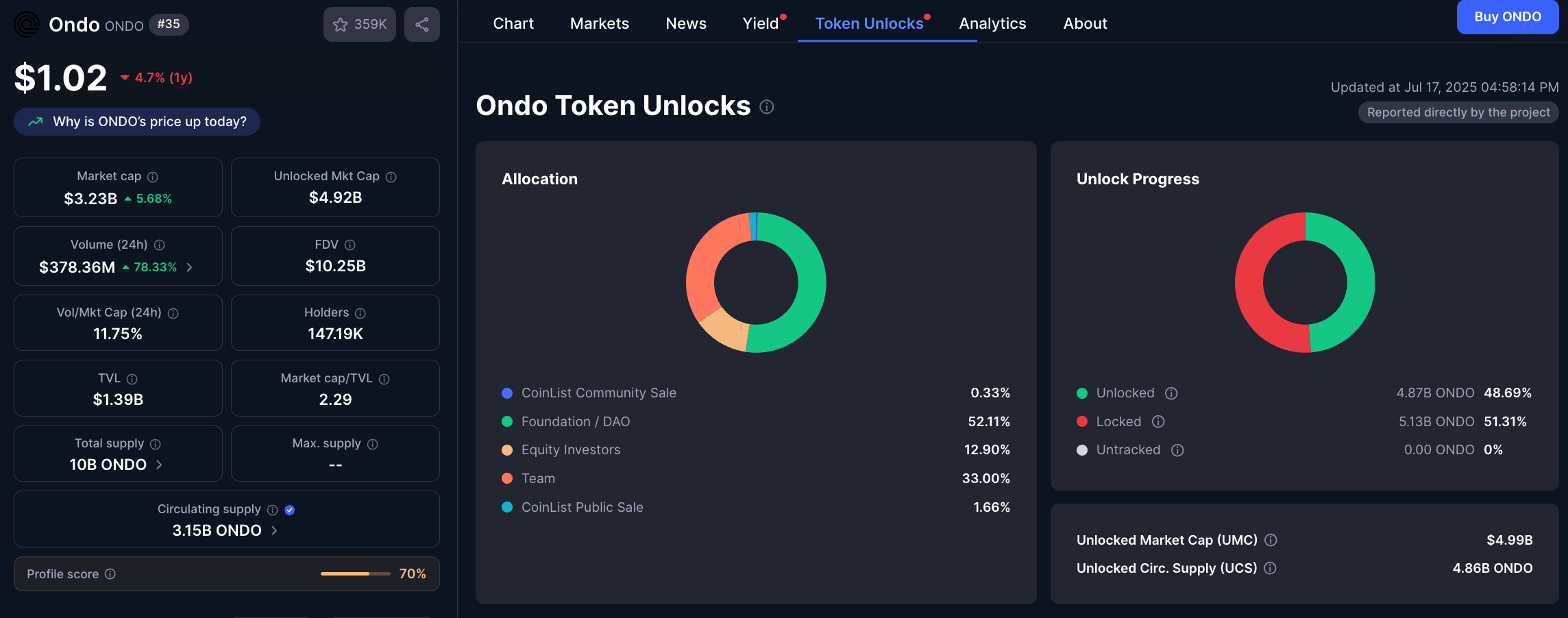
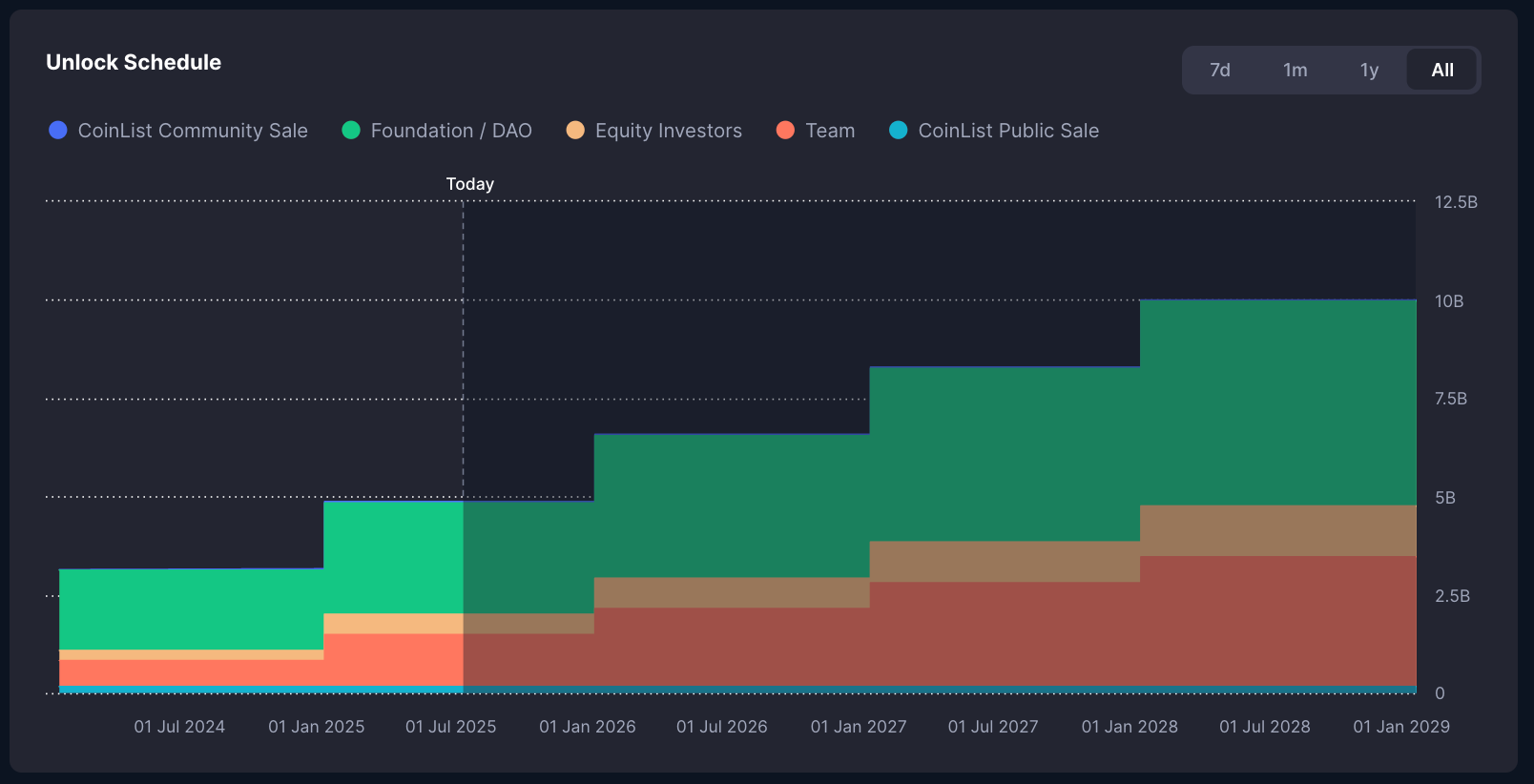
Roughly 48.69% of the token supply is unlocked, with 51.31% still under lock and key. And no, there’s no max cap defined yet. So while the supply is fixed at 10B for now, stay alert.
ONDO Coin Distribution & Allocation
Now, who actually holds this thing? Let’s follow the money:
That’s a staggering 98% of the total supply in the hands of insiders, institutional players, and the protocol’s core entity. Let’s be blunt: this is a top-heavy allocation designed to fund development, secure partnerships, and give founding stakeholders long-term upside. Whether or not you’re comfortable with that depends on your risk appetite and your tolerance for centralized token control.
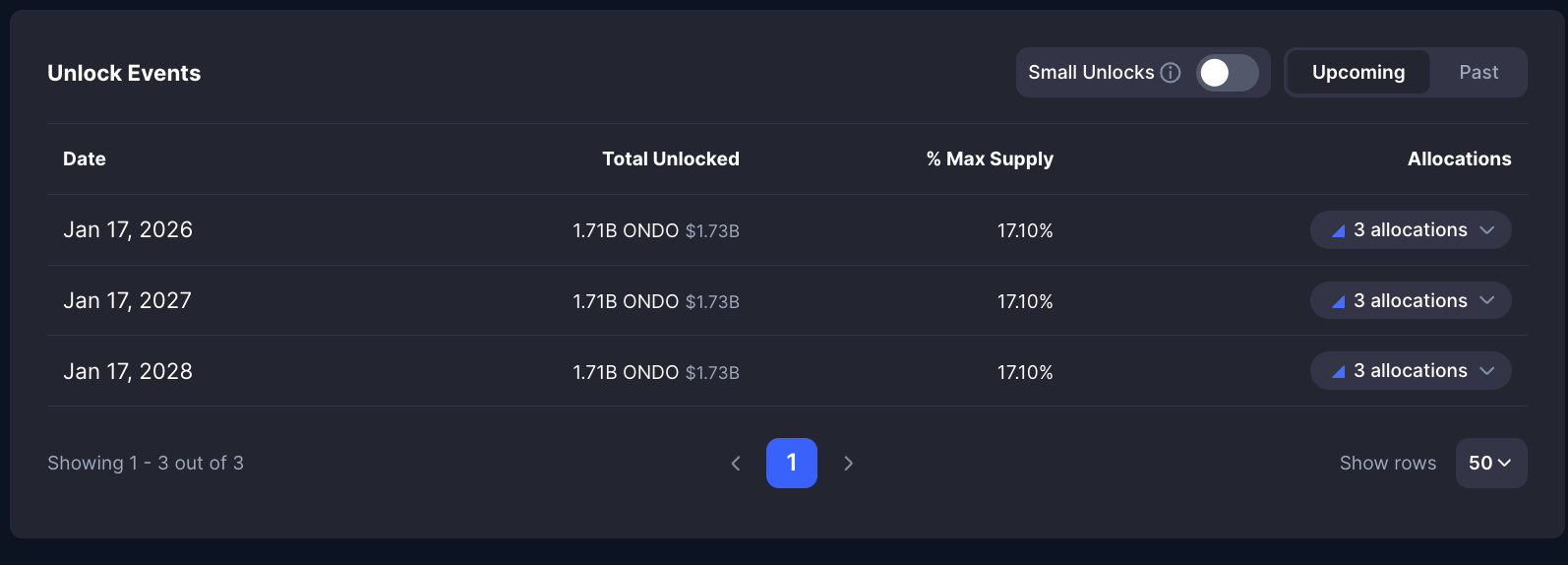
Now, to Ondo’s credit, unlocks are gradual. As of August 2025, 48.69% of the supply is unlocked, with 51.31% still vesting. Major unlock events; each releasing 1.71B ONDO (17.1%), are scheduled for January 2026, 2027, and 2028, creating predictable dilution windows.
But here’s the tradeoff: while the slow unlock schedule helps prevent sudden market shocks, it also means that token holder influence remains muted for years. The people driving protocol decisions today are the same people who funded and built it.
So don’t be fooled by the word “DAO” in the distribution chart. The structure might be legal and logical, but it’s not decentralized, not yet.
ONDO Utility & Use Cases
Let’s not kid ourselves though, ONDO isn’t reinventing utility in crypto. It’s not the gas token of a high-performance chain. It doesn’t unlock access to tokenized U.S. Treasuries. It doesn’t accrue protocol fees. And it certainly doesn’t generate yield. So what does it do? Well… it votes. That’s it. ONDO is a governance token. Full stop.
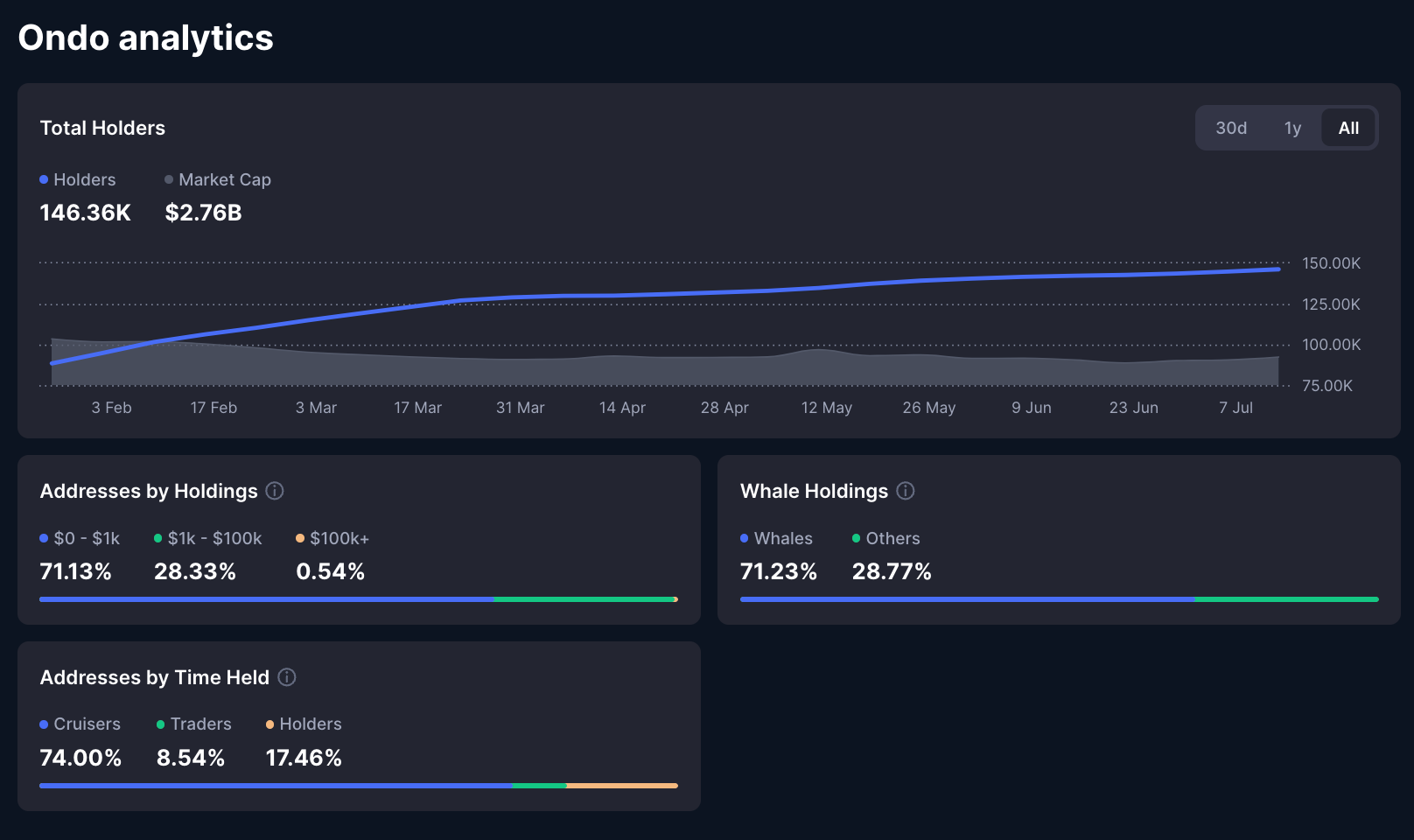
Its utility is tied entirely to participation in the Ondo DAO, where holders can vote on protocol upgrades, incentive programs, or decisions affecting Flux Finance, the Ondo Bridge, and future deployments across Ondo Chain. But as we already established, over 95% of the token supply is in the hands of insiders. So even the governance angle; while technically real, is practically neutered for most holders.
You’re not staking ONDO for rewards. You’re not using it to access USDY. And there’s no requirement to hold ONDO to interact with Ondo’s actual financial products. You could benefit from the Ondo ecosystem without ever touching the token. That’s the paradox here: Ondo the protocol is impressive. ONDO the token? Less so.
If you’re looking for a token that plays a central economic role in its own ecosystem, ONDO doesn’t make a compelling case yet. Right now, it’s a symbol of potential future control, not a tool of present-day utility.
So unless that governance power becomes more democratized and unless ONDO is given a clearer role in the protocol’s value flow, it’s just another governance token sitting in a growing pile of them.
Economic Model & Incentives
On paper, Ondo’s economic model looks like a careful balancing act. Half the token supply is under DAO control, with the rest spread between the team, investors, and two public sales. So far, so good. But let’s not confuse token allocation with economic decentralization.
The Foundation/DAO holds over 52% of the supply. The team controls another 33%. Equity investors control an additional 12.9%. Combined, that’s 98% of ONDO tokens concentrated in non-retail hands. And while long vesting cliffs exist, sure, that slows the unlock pressure, it also means that in the near term, governance is mostly theater. The real power sits with insiders.
Yes, some of these tokens are earmarked for things like liquidity incentives, partnerships, and growth. But how those funds get deployed is entirely up to the same insiders holding the majority of tokens. That’s not a DAO. That’s a boardroom with Discord.
There’s also no clear burn mechanism or long-term deflationary incentive model. No token sinks. No guaranteed demand driver beyond speculative governance. You’re trusting the future utility of ONDO will materialize over time, but that’s a bet, not a certainty.
So let’s be real: this is an institutionally structured token economy, designed to reward early stakeholders and give the protocol a war chest. It’s strategic, not scammy, but it’s also not neutral. If you’re looking for a DeFi token that puts the community first out of the gate, ONDO isn’t quite that.
Governance & Protocol Control
This is where the decentralization thesis starts to wobble. Yes, ONDO is a governance token. Yes, there is an Ondo DAO. And yes, proposals can be voted on by token holders. All the right ingredients. But when over 85% of the supply is locked up between the Foundation and Team, the average user’s vote is more ceremonial than consequential. You’re not steering the ship, you’re waving from the dock.
The Ondo Foundation acts as the protocol’s North Star, guiding development and overseeing multi-sig wallets, partnerships, and DAO operations. It plays a vital role but also acts as a central authority, which raises questions for anyone expecting “pure” DeFi.
To be fair, governance is evolving. Flux Finance, the USDY mechanism, and Ondo Chain are all expected to be increasingly community-driven over time. But for now? The knobs and levers of power remain largely in the hands of a private institutional network. So ask yourself: is this a problem? Not necessarily. But let’s not call it decentralized governance if the only ones governing are the insiders.
How Does Ondo Finance Work?
Let’s set aside the token noise for a moment and zoom in on the actual machinery. Because Ondo the protocol (not the token) is where the real innovation happens.
Ondo Finance operates like a pipeline, channeling stable, yield-generating traditional financial products like U.S. Treasuries, bank demand deposits, and money market funds into tokenized, programmable digital assets on public blockchains. The goal? Bring real-world yield into crypto without bringing the regulatory baggage with it.
So how do they pull it off?
Architecture Behind Ondo Finance
Ondo’s architecture splits into two domains:
This dual-entity structure allows Ondo to remain compliant in the U.S. while giving token holders a say in how parts of the system evolve. But let’s be clear: the financial products themselves like USDY, are not decentralized. They rely on centralized custody and legal frameworks for compliance and investor protections.
Token Standards & Smart Contracts
Ondo builds on Ethereum and uses ERC-20 token standards for all its digital assets, including USDY and ONDO. These smart contracts are upgradeable, governed by the DAO, and are fully audited and open-source. The Ondo docs emphasize the role of smart contracts in creating transparency, automation, and efficiency. For example:
Still, while smart contracts remove human middlemen, they don’t remove centralized dependencies. Users are ultimately trusting off-chain custodians to hold the real assets backing their tokens. Smart contracts can enforce logic, but they can’t enforce custody.
Scalability & Performance
Ethereum isn’t exactly known for low fees or lightning speed, and Ondo knows it. To solve for scale, Ondo built its own chain: a Cosmos SDK-based L2 simply called Ondo Chain. Its main goal? To optimize cross-chain settlement of tokenized financial products, enabling faster and cheaper transactions across DeFi ecosystems.
Key traits of Ondo Chain (per the docs):
In other words: Ondo Chain is a specialized router built to serve a specific class of assets and users, mainly institutions and compliant DeFi protocols.
Benefits and Drawbacks of ONDO
Ondo is attempting to do something few protocols have dared: bring real-world financial markets onto crypto rails without getting crushed by regulators. And in many ways, it’s succeeding. But that success comes at the cost of decentralization and trustlessness, two of crypto’s founding ethos.
Pros
-
Provides exposure to real-world yield through tokenized U.S. Treasuries and bank deposits
-
Regulatory compliance is built in via SEC-registered entities and legal asset protections
-
Smart contracts are open-source, audited, and govern key protocol mechanics
-
Ondo Chain improves scalability and cross-chain performance for tokenized financial products
-
Enables institutional-grade financial products to be composable within DeFi
Cons
-
Real-world assets are held off-chain by centralized custodians, creating trust dependencies
-
Over 95% of ONDO tokens are controlled by insiders and the Foundation
-
The ONDO token has no direct utility beyond governance voting
-
Access to USDY and other products is restricted to whitelisted or non-U.S. users
-
Relies heavily on traditional finance infrastructure to function
Ondo Finance Analytics
For all the whitepapers, pitch decks, and press releases, the truth lives in the data. And Ondo’s analytics paint a story of real growth, with a few interesting caveats. Between rising TVL, and consistent fee generation, Ondo is undeniably gaining traction. But zoom in, and it becomes clear: this is a protocol optimized for capital efficiency, not community engagement.
On-Chain Metrics
TVL Growth: As of mid-July 2025, Ondo Finance holds $1.39 billion in total value locked. That’s up from under $600 million just six months earlier, a more than 130% increase in TVL since January. The majority of this capital sits on Ethereum ($1.03B) and Solana ($249M), with the rest spread thin across XRPL, Mantle, Sui, and others. This tells us two things:
- Institutions are clearly parking serious money here (likely via USDY).
- But the long tail of retail DeFi chains? Barely touched. Polygon’s contribution: $0.00.
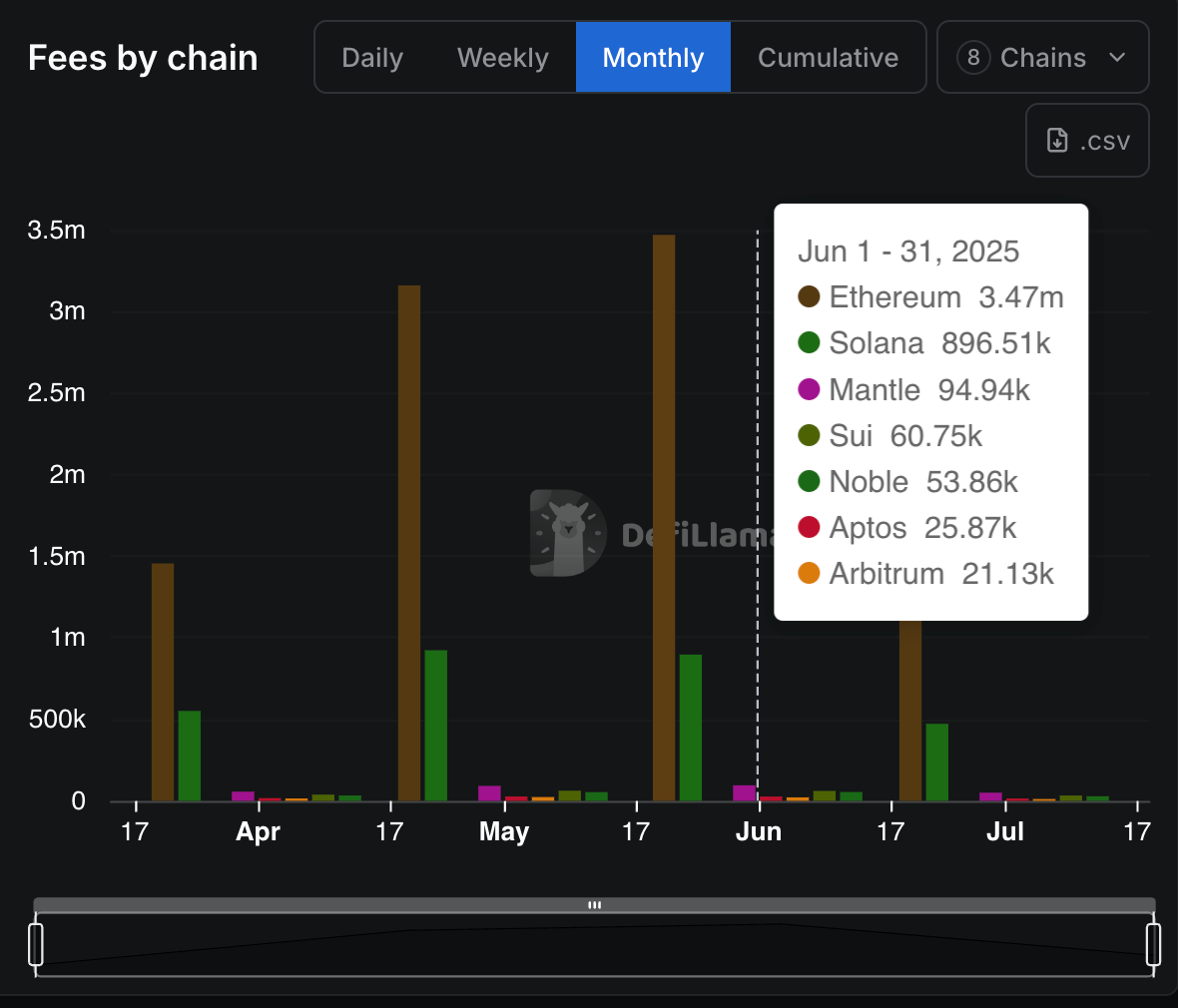
Fees and Revenue: Ondo’s revenue model is lean but functional.
- Annualized Fees & Revenue: $54.23 million
- July 2025 Revenue: $4.61 million
- July 2025 Fees Collected: $4.61 million
- Top Fee Chain: Ethereum by a long shot ($3.51M in July), followed by Solana ($852K)
The protocol isn’t inflating its numbers through incentives, it paid out $0 in token rewards. All earnings are real, and largely driven by users accessing products like USDY through Flux. That’s great for sustainability. But it also means there’s little incentive for DeFi mercenaries to stick around.
Developer Activity: This is where things cool off. For the week of June 10, 2025, Ondo logged:
- 1 active developer
- 5 commits
- 14 contributors
Even in its busiest recent weeks, it hovered around 0.6–1.0 devs actively pushing code. For a protocol managing over $1B in TVL and dozens of smart contracts, this is… light. You can argue it’s stable and doesn’t need much iteration, but low dev velocity can signal stagnation, especially in a fast-moving DeFi world.
What Do Experts Think About ONDO Tokens
Despite the skepticism around ONDO’s current utility, experts across the crypto and fintech space see the protocol, and its broader mission, as a meaningful step in bridging traditional financial systems with DeFi infrastructure. According to CoinGecko,
Ondo Finance brings institutional-grade products on-chain, pushing for a new era of financial inclusivity and access.
CoinGecko’s assessment echoes a growing sentiment: while many DeFi protocols chase yield or speculative TVL, Ondo is building infrastructure for real institutional capital. That alone has given the protocol legitimacy in a space that often lacks it.
Another industry voice added weight to the bigger picture: – Daan de Rover, via Traders Union, said,
Ondo’s entry into tokenized treasuries highlights a broader momentum in digital asset innovation…
Tokenizing U.S. Treasuries and launching them across multiple chains like Ethereum, Solana, and Sei, represents a major shift in how traditional assets can operate in a permissionless setting. Experts agree that Ondo Finance is helping define what real-world asset protocols can look like when done right.
That said, neither quote singles out ONDO the token. And that’s important. Most of the praise is directed at the protocol, the products, and the compliance model not the tokenomics or governance experience. There’s still no broad consensus that ONDO, as a governance token, captures value in a meaningful or scalable way.
Is ONDO a Buy?
Let’s not dance around it. ONDO is a governance token for a protocol with real traction and serious institutional lean. But the million-dollar question isn’t whether Ondo Finance is legit (it is). It’s whether owning ONDO gives you meaningful exposure to that legitimacy. So… is ONDO a buy?
If you believe in the rise of tokenized real world assets and think traditional financial products like U.S. Treasuries will increasingly migrate on-chain, then Ondo is at the front of that movement. The protocol has:
From a macro view, the idea of bridging traditional finance and DeFi isn’t going away. Ondo has positioned itself as a foundational player in that shift. But now the uncomfortable part: owning ONDO doesn’t mean you’re profiting from that success, at least not directly.
If you’re investing in ONDO, you’re making a speculative bet on future governance relevance not current protocol utility. That’s not inherently bad, but it’s important to understand. You’re not buying Apple stock; you’re buying a seat at the shareholder table of a company that hasn’t decided what shareholders are for yet.
ONDO isn’t a clear-cut buy or sell. It’s a conviction play. If you believe Ondo will evolve toward community-led governance and introduce deeper utility for the token, getting in now might be smart. But if you want real value accrual today, there are arguably stronger picks both in DeFi and in the RWA sector. DYOR, manage risk, and know the difference between protocol performance and token value. But if you want to buy ONDO, consider these safest crypto platforms.




Best ONDO Token Wallets
So you’ve picked up some ONDO. Now comes the responsible part: storage. Leaving tokens on an exchange is fine if you’re trading daily, but for everyone else, self-custody is non-negotiable, especially if you want to participate in governance or just sleep better at night. Here are the best crypto wallets to store ONDO tokens, based on verified support and functionality.
Best Wallet
Best Wallet is a sleek, non-custodial wallet that is available as a mobile app that doubles as an exchange. It supports ONDO out of the box as an ERC-20 token, letting you store, swap, and even buy directly inside the app. It’s simple, secure, and user-friendly, with support for over 60 networks. While there’s no browser extension just yet, it’s reportedly in the works. For mobile-first users or those new to DeFi, Best Wallet offers one of the cleanest onboarding experiences available. Learn more in our dedicated Best Wallet review.
Exodus
Exodus is the perfect balance of design and function. It’s available on both desktop and mobile, making it a great fit for users who want flexibility without sacrificing ease of use. It supports ONDO tokens natively and integrates seamlessly with hardware wallets like Trezor for added security. While it’s not fully open-source, Exodus remains one of the most popular wallets for managing multiple assets in a single, polished interface. If you’re someone who likes visual clarity with solid functionality, Exodus won’t disappoint. To know more about this wallet, check out our separate Exodus review.
Ledger (Flex /Stax)
Ledger is the gold standard for hardware wallets, and it supports ONDO as an ERC-20 token through its Ethereum app. You can pair it with MetaMask for DeFi access, while keeping your private keys offline. The Ledger Flex is a cost-effective option. If you’re holding a meaningful amount of ONDO or just value long-term asset security, Ledger’s cold storage model is as close to unhackable as it gets. To know which one out of these two are a better option, check out our Ledger Flex vs. Stax review.
Trezor
Trezor is a battle-tested hardware wallet that also supports ONDO via Ethereum. It’s open-source, well-documented, and integrates with Exodus or MetaMask for ease of use. While it has a slightly steeper learning curve and price tag than some competitors, its transparency and track record make it a favorite for security-focused users. If open-source philosophy and long-term cold storage matter to you, Trezor is worth the investment.
Choosing the right wallet is step one in taking control! And in a space where platforms disappear overnight, ownership of your keys is mandatory.
Ondo Finance vs. Maple Finance
Ondo and Maple aren’t trying to do the same thing, but they’re often mentioned in the same breath. Why? Because they both sit at the intersection of real-world assets, yield generation, and institutional DeFi. But under the hood, these two protocols couldn’t be more different.
Here’s a breakdown of what separates them and where they overlap.
| Feature | Ondo Finance | Maple Finance |
|---|---|---|
| Core Product | Tokenized U.S. Treasuries, bank deposits (e.g. USDY) | Uncollateralized loans to institutional borrowers |
| Asset Type | Fully collateralized, low-risk RWA | Credit-based, high-yield lending |
| Yield Model | Fixed yield via real-world backing | Variable yield via institutional borrower demand |
| Access | USDY often restricted to whitelisted or non-U.S. | Open to DeFi lenders and borrowers (institutional) |
| Governance Token | ONDO | MPL |
| Decentralization Level | Hybrid: centralized asset mgmt, decentralized DAO | Hybrid: centralized borrower onboarding, DAO voting |
| Regulatory Posture | SEC-registered investment adviser; strict compliance | Regulatory-lite, more flexible |
| Primary Focus | Bridging TradFi to DeFi via tokenized instruments | Expanding DeFi credit to real-world institutions |
Ondo is laser-focused on bringing traditional financial instruments onto the blockchain, think U.S. Treasuries, demand deposits, and money market funds. It does so in a way that’s wrapped in legal compliance, bankruptcy remoteness, and institutional custody. Maple, by contrast, is about on-chain credit markets giving institutions access to capital without collateral, based on off-chain reputation and underwriting.
So which is better? That depends on your risk appetite. If you want safe, yield-bearing tokens backed by the U.S. government, Ondo is the clear winner. If you want exposure to riskier, high-yield DeFi lending to institutions, Maple has the edge. They’re not competitors. They’re two sides of the RWA coin. Ondo is fixed-income; Maple is credit risk.
Conclusion: What is Ondo Finance (ONDO)?
Ondo Finance is a serious protocol in a space that doesn’t always reward seriousness. Instead of leaning into the usual DeFi gimmicks, it’s opted for regulatory clarity, real-world assets, and infrastructure designed for institutions.
That approach has worked. USDY is gaining adoption, TVL is rising, and Ondo’s name is consistently mentioned in the RWA conversation alongside giants like BlackRock and Circle. It’s one of the few projects that actually bridges traditional finance and DeFi in a way that regulators and institutions can engage with.
But there’s a clear separation between the strength of the protocol and the value of the ONDO token. ONDO doesn’t currently capture protocol revenue, doesn’t unlock access to products, and doesn’t offer staking or fee-sharing. Its role is limited to governance…governance that’s currently dominated by insiders. That may change, but it hasn’t yet.
So if you’re looking at Ondo from a product perspective, the fundamentals are strong. If you’re evaluating the ONDO token, it’s more of a speculative governance play than a direct claim on protocol growth.
The bottom line? Ondo is building real infrastructure for tokenized assets but whether ONDO becomes essential to that ecosystem is still an open question.
DISCOVER:
- Crypto Exchange Promos & Discounts
- Crypto Wallet Promos & Discounts
- Ondo Finance (ONDO) Price Prediction 2026–2030
- What is Bittensor (TAO): A Beginner’s Guide
FAQs
What does the ONDO token do?


The ONDO token is a governance token. It allows holders to participate in proposals and voting within the Ondo DAO, which governs certain aspects of the ecosystem like Flux Finance and potential protocol upgrades. However, it currently has no direct utility in the usage of products like USDY, and does not accrue revenue or yield.
Is Ondo Finance available to retail users?
Yes, but with restrictions. Some Ondo products like USDY are only available to non-U.S. retail users or qualified institutional investors, depending on the jurisdiction. While parts of the ecosystem are accessible, access to certain tokenized financial products is subject to regulatory and compliance limitations.
What are tokenized U.S. Treasuries in Ondo Finance?
These are short-term U.S. government debt instruments that have been converted into digital tokens, in Ondo’s case, through a product called USDY. USDY is backed 1:1 by a combination of U.S. Treasuries and bank demand deposits, and issued via a legally compliant structure. It allows eligible users to hold a yield-bearing, real-world asset directly on-chain.
Is Ondo Finance safe to use?
Ondo takes a compliance-first approach to safety. Real-world assets are held by regulated custodians and managed under bankruptcy-remote legal structures. Its smart contracts are audited and open-source, and USDY is issued by a registered investment adviser. That said, it still relies on off-chain infrastructure, meaning it’s not fully trustless like some DeFi protocols.
What makes Ondo Finance different from other DeFi platforms?
Ondo focuses on tokenizing real-world assets like Treasuries and deposits, rather than building speculative DeFi primitives. It’s one of the few projects that combines regulatory compliance, real yield, and institutional-grade products with on-chain infrastructure.
References
- “Ondo Chain Overview.” Ondo Finance Documentation, https://docs.ondo.finance/ondo-chain/overview
- “Ondo Finance.” DeFiLlama, https://defillama.com/protocol/ondo-finance
- “Ondo Finance Inc. – Tokenized Treasury Product Memo.” U.S. Securities and Exchange Commission, submitted by Davis Polk & Wardwell LLP, 25 Apr. 2025, https://www.sec.gov/files/ctf-memo-ondo-finance-inc-davis-polk-wardwell-llp-042425.pdf
- “Robinhood Markets, Inc. – Letter on Tokenization and Regulatory Framework.” U.S. Securities and Exchange Commission, 25 Apr. 2025, https://www.sec.gov/about/crypto-task-force/written-submission/ctf-written-robinhood-tokenization-letter-04252025
- “What Are Real World Assets (RWAs)? Exploring RWA Protocols.” CoinGecko Learn, https://www.coingecko.com/learn/what-are-real-world-assets-exploring-rwa-protocols

Why you can trust 99Bitcoins
Established in 2013, 99Bitcoin’s team members have been crypto experts since Bitcoin’s Early days.
Weekly Research
100k+Monthly readers
Expert contributors
2000+Crypto Projects Reviewed