





In This Article
Stablecoins are rapidly changing the way that businesses operate. They make it easier, faster, and cheaper to send money across borders, enabling businesses to expand their international footprint and pay employees and vendors around the world.
But before you can reap the benefits of stablecoin payments, you need a stablecoin payment platform. In this guide, we’ll take a look at the best stablecoin payment providers in 2026 and help you choose the right one for your business.
The Best Stablecoin Payment Platforms Ranked
Here’s an overview of the best stablecoin payment platforms for 2026.
- NOWPayments – Highly flexible crypto payments platform with strong stablecoin support
- BitPay – Crypto ‘super-app’ supporting stablecoin payments for businesses
- CoinGate – Seamless global stablecoin checkout for online businesses
- Ivy – Borderless business accounts supporting both stablecoins and local payment rails
- Mural – API-centric platform for building stablecoin wallets and payment systems
- BVNK – Enterprise-scale stablecoins payment provider with 25+ licenses
An Introduction to Stablecoin Payment Providers
If you’re an individual, you can send and receive stablecoin payments with just a crypto wallet. But if you’re running a business, you have a complex web of rules to navigate to ensure your payments are fully compliant with national laws and international anti-money laundering requirements. You also need a way to prevent fraud, secure large amounts of money, and get paid through invoices and checkout portals.
That’s where stablecoin payment providers come in. These providers offer digital infrastructure to facilitate the more than $27 trillion in annual stablecoin payments that businesses make. They offer ready-to-deploy tools to help you collect and send stablecoins around the world in a manner that’s compliant, fast, and low-cost.
Crucially, stablecoin payment platforms work with the systems your business already uses. So, you can integrate them into your online checkout, point-of-sale (POS), or invoicing systems instead of rebuilding your financial systems from scratch. They also make it easy to settle payments in fiat so your business can get paid without exposure to volatile crypto markets.
In addition, while stablecoin payment providers do charge money, fees are typically much cheaper than fees for fiat cross-border payments. For businesses operating internationally or that have global supply chains, these platforms can help you save a significant amount of money.
Top Stablecoin Payment Solutions 2026 Reviewed
Now let’s take a closer look at the top stablecoin payment platforms and what type of business each is best for.
1. NOWPayments – Flexible Crypto Payments Platform with Stablecoin Support
NOWPayments is a business-oriented stablecoin payment platform that prioritizes ease of use and flexibility. It’s designed as a scalable platform where you can choose from a variety of turnkey solutions and develop your own payment tools as needed.
Turnkey products offer invoicing, subscription payments, checkout pages, donations, and even in-person payments across a variety of cryptocurrencies. If you need more than what’s natively available within NOWPayments, the platform has an API with documentation in 13 programming languages. While you don’t have to use the API to accept stablecoin payments with NOWPayments, it does enable you to automate payments and automatically settle crypto transactions in fiat.
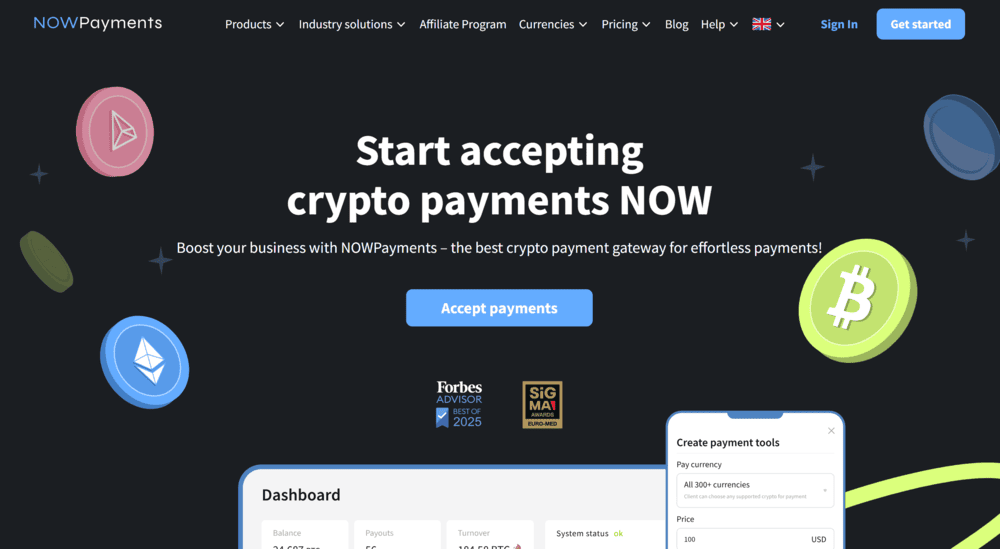
NOWPayments supports an impressive variety of cryptocurrencies, including stablecoins like USDT, USDC, TUSD, GUSD, BUSD, PYUSD, DAI, USDD, and USDP. It also supports EURT, although that’s the only non-USD stablecoin available. USDT is available over 5 blockchains including Solana, Tron, Ethereum, Binance Smart Chain, and Polygon.
NOWPayments also keeps fees simple. You’ll pay a flat rate of 0.5% for every incoming crypto payment, regardless of what coin you use. There’s another 0.5% to convert crypto to fiat. When you want to send payments in crypto using tokens already held in your account, NOWPayments doesn’t charge any fee.
Best for: Online businesses interested in adding USD stablecoin payments alongside existing payment methods.
| Stablecoins supported | Settlement options | Intended business type | Licensing | Fees |
| USDT, USDC, TUSD, GUSD, BUSD, PYUSD, DAI, USDD, USDP | Fiat, stablecoins, altcoins | SMBs | None | 0.5% processing fee, 0.5% fiat conversion fee |
Pros:
- Supports 9 USD-denominated stablecoins for payments
- Turnkey payment tools and developer-friendly API
- Transparent, flat fees for stablecoin payments and fiat settlement
- Custody account for holding crypto with NOWPayments
- 24/7 customer support
Cons:
- Doesn’t hold any major money services licenses
- Limited to 1,000 transactions at a time for mass payments
2. BitPay – Crypto ‘Super-app’ with Stablecoin Payments for Businesses
BitPay is a user-friendly crypto platform positioning itself as an all-in-one ‘super-app’ for both individuals and businesses. It doesn’t require development to start accepting stablecoin payments, and you can get paid out in fiat in your bank account instantly.
BitPay supports multiple stablecoin payment options, including an online checkout integration, a QR code-based in-store checkout for your POS, and digital invoicing. You can also make payouts to vendors and employees in crypto, including via mass payments.
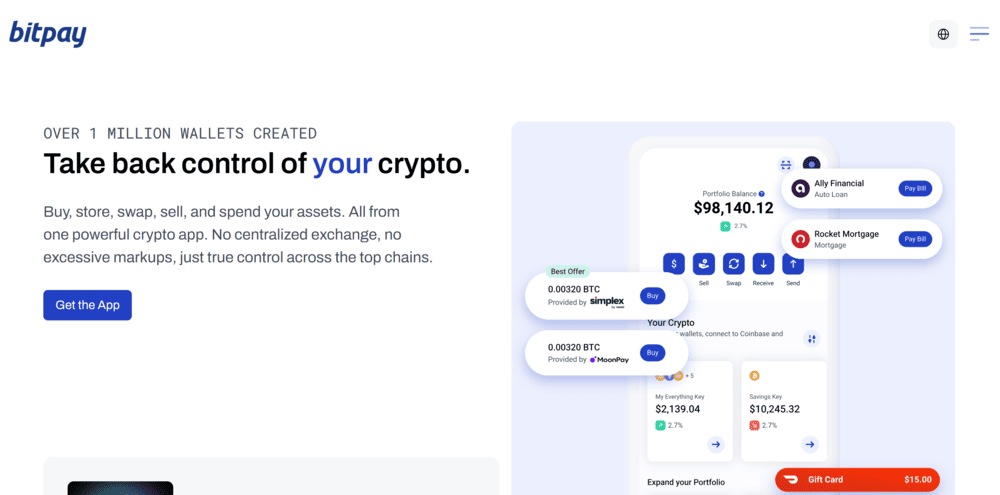
What’s great about BitPay is that you have the option to settle payments in crypto and keep a crypto wallet, but you don’t have to. If you prefer, you can accept and send stablecoin payments without ever directly owning crypto. For businesses still skeptical of digital assets or that worry about compliance, this is a huge advantage.
BitPay currently supports several major stablecoins including USDC, USDT, GUSD, PAX, and EUROC. Direct bank deposits are available in 37 countries and crypto settlements are available in 200+ countries.
Best for: Small businesses that want the ability to accept in-person stablecoin payments from customers.
| Stablecoins supported | Settlement options | Intended business type | Licensing | Fees |
| USDC, USDT, GUSD, PAX, EUROC | Fiat, altcoins, stablecoins | SMBs | Money Services Business license in 25+ U.S. states | 1%-2% + $0.25 per transaction |
Pros:
- Integrates with existing online checkouts and POS devices
- Supports multiple USD and EUR stablecoins
- Pay and settle in fiat without ever managing crypto
- Supports mass payments to vendors and employees
- Compliant in 200+ countries
Cons:
- Limited flexibility for growing businesses
- Few crypto custody or treasury options like earning yield
3. CoinGate – Seamless Stablecoin Checkout for Online Businesses
CoinGate is another capable stablecoin payments solution targeted at online small businesses that want a way to accept digital payments from customers globally. It offers a ready-made checkout integration for e-commerce sites and supports USDC stablecoin payments on 7 major blockchains.
CoinGate makes payments simple for customers by supporting both WalletConnect and Binance Pay. That means fewer abandoned carts at checkout and a better experience for customers on mobile. In addition, CoinGate automatically generates receipts for every transaction. If you need to process a refund, CoinGate will repay the customer in the original crypto they used for payment.
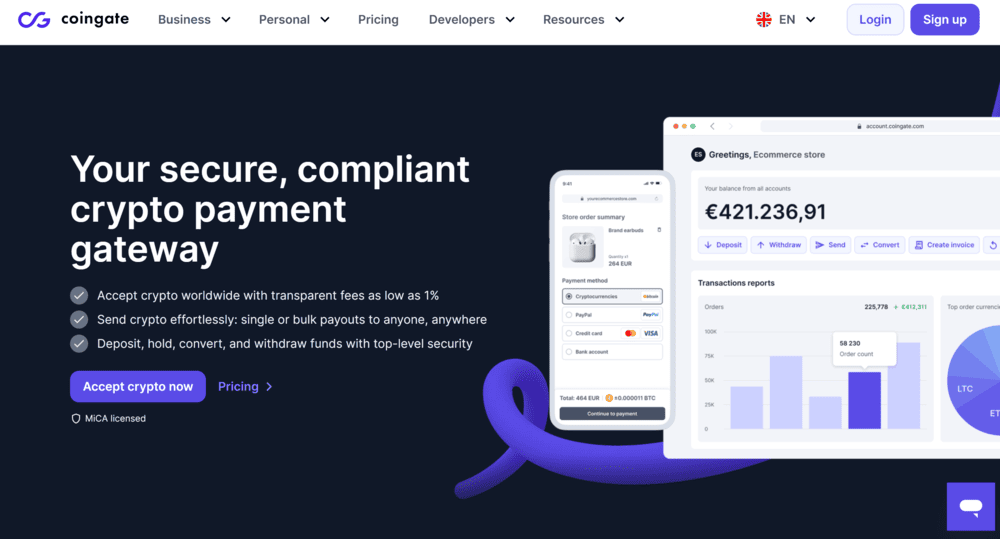
Transactions using CoinGate are settled in crypto or USD, EUR, or GBP (other fiat currencies aren’t supported at this time). You can keep crypto balances in your account or cash out to a bank account instantly. CoinGate also offers built-in reporting, so it’s easy to keep track of your payment flow and account for every token your business touches.
If you need more payment customization, CoinGate has an API you can use to set up automations and new integrations. That’s big since it means this solution can scale with your business as your payment needs change.
Best for: E-commerce businesses that want a plug-and-play payment solution with low fees.
| Stablecoins supported | Settlement options | Intended business type | Licensing | Fees |
| USDC | Fiat, altcoins, stablecoins | SMBs | EU MiCA and Payment Institution licenses | 1% |
Pros:
- Ready-made integrations for Wix, WooCommerce, Magento, and more
- Supports WalletConnect and Binance Pay
- Automatic receipts and refund handling
- Flat 1% transaction fee with no additional account fees
- API available for additional customization
Cons:
- USDC is only stablecoin accepted
- Above-average fees for fiat conversions
4. Ivy – Borderless Business Accounts Supporting Stablecoins and Fiat
Ivy is a fintech that blends fiat and crypto payments. It supports a wide range of altcoins, stablecoins, and fiat currencies, and makes it easy to convert between them with low fees so you can make cross-border payments and move seamlessly between Web3 and the physical world.
The platform has partnered with a network of 5,000+ global banks to offer impressive uptime and local bank details across dozens of countries. That’s an advantage because it means you can use stablecoins for cross-border payments and fiat on local payment rails for domestic payments, giving you options to maximize speed and minimize fees.
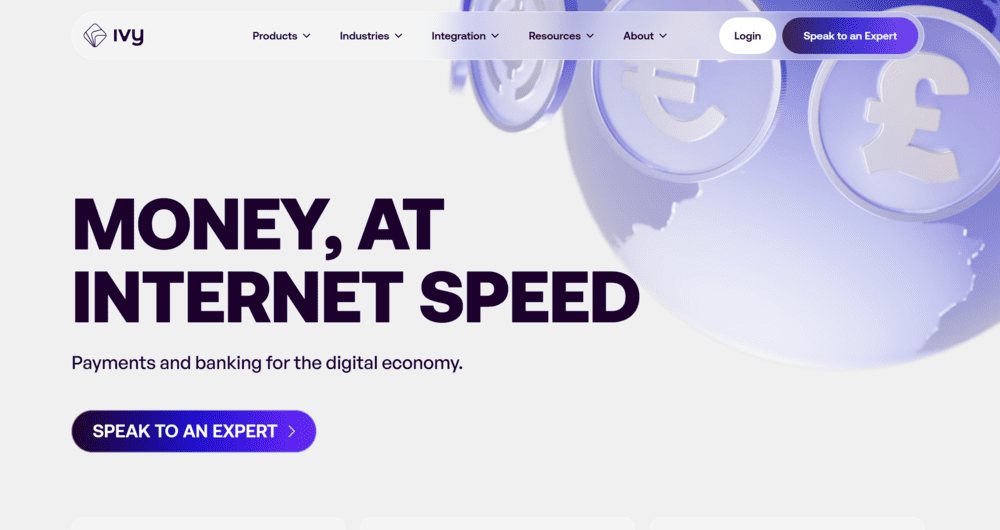
Ivy does require some development in order to implement, but the platform offers flexibility in that respect, too. You can implement Ivy via Mollie or Praxis, use Ivy’s open API, or check out documentation on how to integrate Ivy into a range of popular online checkout tools. Ivy has great documentation, although support isn’t available 24/7.
Ivy’s selection of stablecoins is somewhat limited, as you can only settle in USDC or EURC. In addition, the company only supports around 60 countries for payouts right now, with a strong focus on Europe. So it may not be the best choice for businesses that need to manage payments in Asia or Latin America.
Best for: European businesses that need support for both stablecoin and fiat cross-border payments
| Stablecoins supported | Settlement options | Intended business type | Licensing | Fees |
| USDC, EURC | Fiat, stablecoins | SMBs, enterprises | EU Virtual Asset Service Provider and Payment Institution licenses | By quote only |
Pros:
- Tight integration between fiat and stablecoins
- Partnerships with 5,000+ banks for uninterrupted payments
- Offers local IBANs in dozens of European countries
- Multiple implementation options for online payments
- Strong regulatory and compliance backing
Cons:
- Limited payment networks outside Europe
- Only supports Circle stablecoins
5. Mural – API for Building Stablecoin Wallets and Payment Systems
Mural is a stablecoin payments provider with a highly flexible API to support custom digital solutions. It requires a significant amount of development compared to other platforms, but Mural also offers more flexibility for custom payment needs. That makes it ideal for fintechs, online marketplaces, and enterprises with high payment volumes across dozens of countries.
Mural currently supports several major stablecoins including USDC, USDT, and PYUSD. It also offers virtual bank accounts in a variety of jurisdictions, making it easy to settle in either stablecoins or the fiat of your choice. You can hold balances in multiple fiat currencies and stablecoins in your account and convert between them instantly.
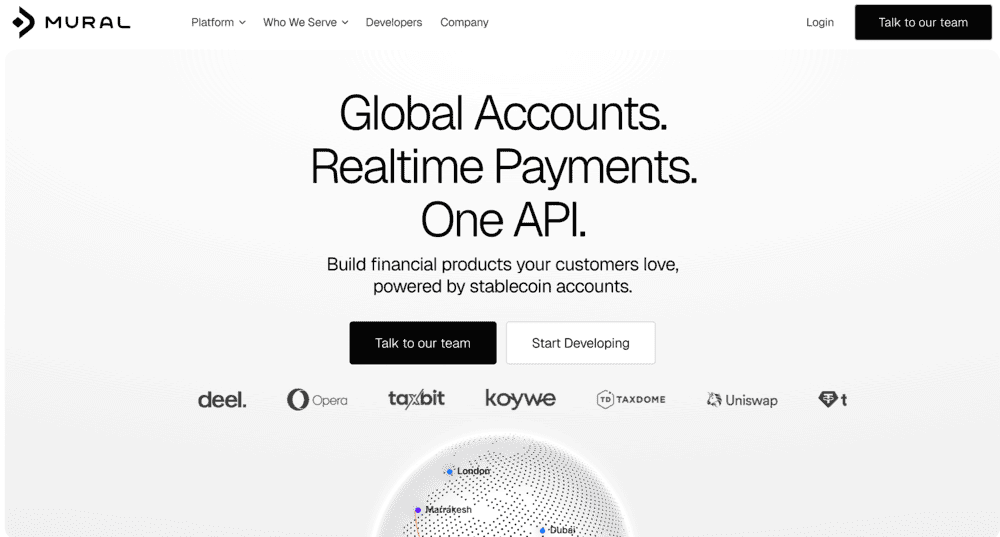
Another benefit to Mural is that its API supports custom automations and workflows, so you can put your payments on autopilot. The platform also offers several options for earning yield on stablecoin balances, although it’s not a full-blown DeFi staking platform.
Mural handles compliance automatically, which is very helpful if you’re using the platform to pay vendors or accept marketplace payments. You don’t need to bring your own license or establish a compliance program to start using stablecoins.
Best for: Mural is best for fintechs, banks, and large enterprises with a ready development team to build on the platform’s API.
| Stablecoins supported | Settlement options | Intended business type | Licensing | Fees |
| USDC, USDT, PYUSD | Fiat, altcoins, stablecoins | Fintechs, enterprises | Money Services Business license in 9 U.S. states | By quote only |
Pros:
- Licensed in the U.S.
- Supports multiple fiat and stablecoin balances
- Highly customizable API
- Allows you to earn yield on stablecoin balances
- Automations for high-volume payments
Cons:
- Only supports USD stablecoins
- API-first approach requires significant development effort
6. BVNK – Enterprise-scale Stablecoin Payments Provider
BVNK, also known as System Pay Services, is a fintech catering to enterprise-scale companies that want to incorporate stablecoin payments for vendors and employees around the world. It offers a combination of turnkey solutions and a proprietary Layer-1 blockchain to enable low-fee, fully compliant digital payments.
What’s interesting about BVNK is the flexibility it offers for enterprises. You can bring your own Money Services Business license (ideal for banks and other fintechs) or use one of BVNK’s 25+ licenses to stay compliant across dozens of countries. You can also choose between popular stablecoins like USDT, USDC, and PYUSD or creating and deploying your own custom stablecoin.
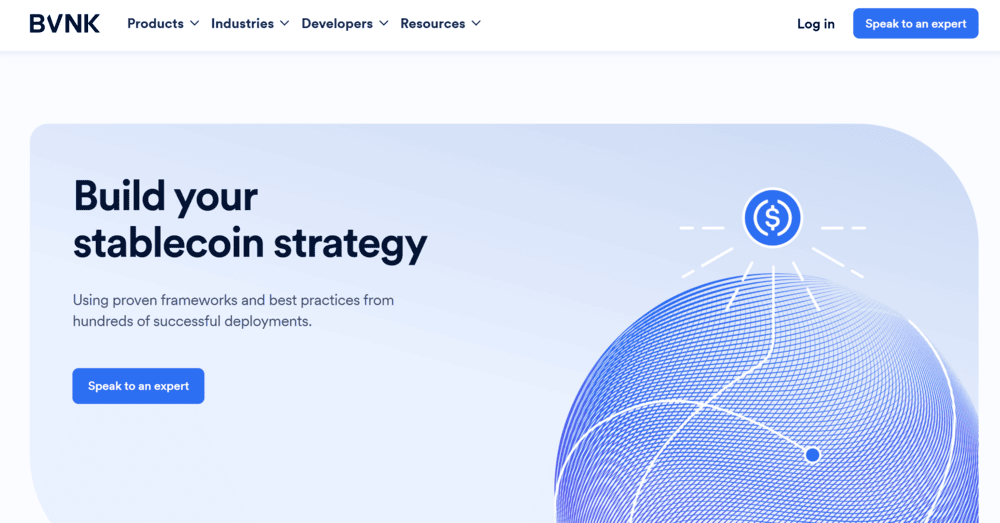
Transactions can be settled in either fiat or stablecoins, and it’s easy to convert between digital and fiat currencies within your account. You also get full access to local and international payment rails like ACH, SEPA, Fedwire, and Swift. BVNK was recently acquired by Mastercard, so it could soon add payments over Mastercard’s global rails.
BVNK’s licenses span the US, Europe, and Asian financial hubs like Singapore, so it has one of the widest reaches of any stablecoin payments provider. It also boasts 99.9% uptime, ISO27001 and SOC 2 Type II security certificates, and annual independent audits, ensuring BVNK is safe enough for the largest businesses.
Best for: BVNK is best for enterprise businesses that need multi-country payments licensing or want to bring their own license to a ready-made payments system.
| Stablecoins supported | Settlement options | Intended business type | Licensing | Fees |
| USDC, USDT, PYUSD | Fiat, stablecoins | Fintechs, enterprises | Money Services Business license in 25+ U.S. states, EU Virtual Asset Service Provider, UK Electronic Money Institution | By quote only |
Pros:
- Licensed in multiple countries including US, UK, EU, and Singapore
- Has its own Layer-1 blockchain for custom stablecoin payment rails
- Both turnkey and fully customizable payment solutions
- Access to local and international fiat payment rails
- 99.9% uptime and strong security measures
Cons:
- Complex user interface and development requirements
- Higher fees than other stablecoin payment providers
What Makes a Great Stablecoin Payment Platform?
There’s a lot that goes into choosing the best stablecoin payment provider for your business. Let’s take a closer look at some of the key features to consider and why they matter.
Supported Cryptocurrencies
The first thing we look at when comparing stablecoin payment solutions is what cryptocurrencies they support. Having access to more stablecoins means more flexibility for your business and your customers. Many platforms also support Bitcoin and popular altcoins for payments, which is important if your business needs to accept payments from customers who may hold these assets instead of stablecoins.
It’s especially important to check the variety of stablecoins and networks available. Major stablecoins like USDC and USDT run on multiple blockchains, and some networks like Solana and Ethereum Layer-2 networks offer faster processing with lower fees. If your business operates internationally, having access to non-USD stablecoins like EUROC can be especially helpful.
Multi-currency Settlement
Another key thing to consider is what currencies payments can be settled in. Many of the top stablecoin payment platforms offer you flexibility to settle in both fiat and crypto, giving you flexibility to decide what currencies your business wants to hold. This is especially important if you also make payments in stablecoins since keeping a crypto treasury to fund outgoing payments can reduce conversion fees.
Transparent Fees
Pricing can vary widely among stablecoin payment providers, from under 1% per transaction to over 3%. For businesses with tight margins, it’s crucial to know how much stablecoin payments will cost you and whether they’re actually cheaper than traditional payment rails.
Many stablecoin payment providers offer pricing by quote only, especially if they offer tailored solutions. But every company should be able to give you a price range if you provide some basic details about your expected payment volume and needs.
Compliance and Security
Compliance is one of the most challenging aspects of processing stablecoin payments, so it’s important that your payment provider handles this for you. You shouldn’t need to bring your own Money Services Business license. Look for providers that are licensed in multiple countries and U.S. states and that strictly follow anti-money laundering requirements.
Security is a related concern. Payment providers should have a track record in the industry showing that they’ve never lost customer funds mid-transaction. Cybersecurity certifications like ISO27001 and independent audits can provide a lot of confidence in a provider’s operations.
Ready-made Payment Tools
While some enterprise-focused payment providers offer an API and nothing else, the vast majority of stablecoin payment solutions have ready-made tools so you can accept payments as soon as you sign up. Those include ready-made invoicing tools, CSV-based mass payout tools, payment links, and more.
You should also get access to a multi-currency crypto wallet with integrated exchange features. That’s key for being able to instantly convert between altcoins and stablecoins as well as between fiat and crypto.
APIs and Integrations
Integrations for popular e-commerce marketplaces and POS devices can make it a lot easier to accept stablecoin payments at your business. In the best cases, you won’t need any development to plug into your existing payment tools. Stablecoins will just be another way you can pay and get paid.
For larger businesses, having access to an API is crucial. An API enables custom development, including the ability to create payment automations and tightly control payment flows through your business. If you expect to need API access, make sure your provider has detailed documentation, ideally in multiple programming languages.
Comparing the Top Solutions
Here’s a summary of how the best stablecoin payment platforms compare on key features.
| Provider | Stablecoins supported | Settlement options | Intended business type | Licensing | Fees |
| NOWPayments | USDT, USDC, TUSD, GUSD, BUSD, PYUSD, DAI, USDD, USDP | Fiat, stablecoins, altcoins | SMBs | None | 0.5% processing fee, 0.5% fiat conversion fee |
| BitPay | USDC, USDT, GUSD, PAX, EUROC | Fiat, altcoins, stablecoins | SMBs | Money Services Business license in 25+ U.S. states | 1%-2% + $0.25 per transaction |
| CoinGate | USDC | Fiat, altcoins, stablecoins | SMBs | EU MiCA and Payment Institution licenses | 1% |
| Ivy | USDC, EURC | Fiat, stablecoins | SMBs, enterprises | EU Virtual Asset Service Provider and Payment Institution licenses | By quote only |
| Mural | USDC, USDT, PYUSD | Fiat, altcoins, stablecoins | Fintechs, enterprises | Money Services Business license in 9 U.S. states | By quote only |
| BVNK | USDC, USDT, PYUSD | Fiat, stablecoins | Fintechs, enterprises | Money Services Business license in 25+ U.S. states, EU Virtual Asset Service Provider, UK Electronic Money Institution | By quote only |
Our Conclusion: Which is the Best Stablecoin Payment Platform in 2026?
Based on our analysis of stablecoin payment providers, NOWPayments is the best solution for most businesses in 2026. We appreciate how easy it is for businesses to scale up or down their needs, particularly around invoicing, subscription payments, checkout pages, and donations.
Methodology: How We Reviewed Stablecoin Payment Providers
Our stablecoin payment platform reviews are based on deep dives into each provider and its payment solutions. We considered the stablecoins and networks available for payments as well as the availability of fiat payment rails. We confirmed providers’ licenses and security certifications and reached out directly to get pricing details. Finally, we researched customer reviews to ensure each platform has kept customer funds safe.
FAQs
What is the best stablecoin payment platform for a small business?

Based on our research, the best stablecoin payment platform for small businesses is NOWPayments, for its range of stablecoins and payment services for companies of any size.
Which stablecoin payment platform has the lowest fees?
Among top stablecoin payment providers with fixed fees, NOWPayments is the cheapest. It charges just 0.5% for stablecoin transactions, although it costs an additional 0.5% to convert to fiat. Many stablecoin payment providers offer pricing by quote only, and enterprise businesses may qualify for lower fees from some providers.
Does PayPal support stablecoin payments?
Yes, PayPal supports stablecoin payments using its PYUSD stablecoin. PYUSD transactions are supported across 70 countries and funds are settled in fiat within minutes in most cases. However, transactions cannot be settled in crypto.
What use cases do stablecoin payment platforms support?
Stablecoin payment platforms enable businesses to use stablecoins like USDT and USDC for a variety of purposes. They can send cross-border B2B payments using stablecoins to pay vendors and avoid hefty international transaction fees, for example. They can also use stablecoin payments to pay employees or contractors. Accepting stablecoins gives businesses a way to get paid by customers faster and with fewer fees.
Do you need a license to make stablecoin payments?
Your business doesn’t need a license to make stablecoin payments, but the platform you use to send and receive stablecoins does. In the U.S., stablecoin payment providers must be licensed as a Money Services Business in each state in which they operate. In Europe, providers must hold a Virtual Assets Service Provider or MiCA license.
References
- The stable door opens: How tokenized cash enables next-gen payments (McKinsey)
- Markets in Crypto-Assets Regulation (MiCA) (European Securities and Markets Authority)
- Mastercard says it’s acquiring stablecoin startup BVNK in $1.8 billion bet on future of payments (CNBC)

Why you can trust 99Bitcoins
Established in 2013, 99Bitcoin’s team members have been crypto experts since Bitcoin’s Early days.
Weekly Research
100k+Monthly readers
Expert contributors
2000+Crypto Projects Reviewed