






In This Article
The Render Network (RENDER) is a decentralized marketplace where people rent out GPU power to others who need it. It first became popular for 3D rendering, and it is now growing into other heavy computing tasks too. In 2024, it started getting wider attention after Octane X, OTOY’s rendering software for Apple devices, was featured in a public presentation.
Are you interested in learning what Render is? In this Render Network review article, we will cover everything from the project’s history to tokenomics and more.
Key Takeaways
99Bitcoins’ Take on Render Crypto Project
Originally designed to offer permissionless, on-demand GPU power for graphics and image rendering, the Render Network now sits in a strong position to benefit from the explosive growth of artificial intelligence (AI). McKinsey estimates that data centers will require as much as $6.7 trillion in capital investment by 2030 to meet the AI sector’s rising compute needs. With Big Tech giants like Microsoft, Meta, Amazon, and Alphabet pouring trillions of dollars into GPU infrastructure, Render’s potential role in the AI boom is becoming increasingly relevant. Render’s biggest advantage is its decentralized, open network structure. Anyone with suitable GPU hardware can contribute capacity, allowing the network to scale far more flexibly than centralized providers. As AI demand continues to surge, Render could see meaningfully accelerated adoption and growth.
Render Network Review: Summary
This beginner’s guide to the Render Network explains how the project democratizes access to GPUs, allowing anyone to procure compute resources for tasks like 3D rendering, AI model training, and visual effects.
We’ll start by introducing key concepts that will help you understand how Render fits into the broader blockchain and digital content ecosystem. Next, we’ll explore the origins of the Render Network, its founders, development team, and long-term vision.
In the second half of this Render Network review, we’ll break down the utility and tokenomics of the RENDER token. By the end, you’ll have a clear understanding of how Render works and how it differs from centralized rendering solutions.
Terms You Need to Know Before Understanding RENDER
Here are the key technical terms you need to know before understanding the Render Network:
- GPU: GPUs are specialized processors that were initially designed to perform graphics rendering functions.
- Rendering: Rendering refers to the process of creating photorealistic or non-photorealistic images from input data such as 2D or 3D models.
- Render engine: A software or application that performs rendering.
- Ray tracing: Ray tracing is a rendering technique that realistically simulates the lighting of a scene.
- Blockchain: A distributed and immutable ledger that records transactions and account balances.
- Decentralization: It is the distribution of power and control across multiple participants rather than being held by a single central authority.
What is Render Network (RENDER)?
The Render Network is a peer-to-peer decentralized compute marketplace where you can sell your idle GPU resources. Artists and creators use the Render Network to procure the required resources to complete image generation tasks. The platform is permissionless, which means that anyone from anywhere in the world can buy and sell GPU compute resources on Render.
Render has key advantages over traditional cloud computing operators such as Amazon Web Services (AWS), as it is built to be accessed quickly through plugins. There are cost advantages, too, as Render’s platform does not require subscriptions. Users pay only for the time they use rendering resources. Furthermore, Render is integrated directly into popular 3D design applications such as Blender and Cinema 4D for seamless creative workflow.
A blockchain powers the platform that stores content information, tracks payments, and hosts smart contracts. The use of a blockchain not only allows Render to create a peer-to-peer economy around its services but also enables the protection of content ownership rights and the implementation of content usage policies. Payments for procuring GPU compute resources on the Render Network are denominated in a native cryptocurrency called RENDER.

History of Render Crypto
The idea of the Render Network crypto project was first introduced in August 2017 by its founder, Jules Ubach. In the introductory blog post, Ubach spoke on a platform that would make the rendering services “easy and accessible to everyone.”
The Render Network was initially built on top of the Ethereum (ETH) blockchain. In late 2017, the project conducted token sales at a purchase price of 1150 Render tokens per 1 ETH. The native token was originally called RNDR.
Before the launch of the Render Network mainnet in 2019, the project migrated RNDR tokens to a new contract to enable escrow smart-contract functionality and to reduce the token supply from 2.147 billion to 536 million. Render was made accessible to the public in April 2020.
In 2021, Render Network bridged the RNDR token from Ethereum to Polygon (POL) due to gas fees and network congestion issues on the former. In November 2021, Render Network announced that it would completely migrate to Solana (SOL), citing highly programmable infrastructure, high network throughput, and low latency.
Render moved its token to the Solana network in 2023. It also launched an official upgrade portal that lets holders swap the old RNDR token for the new RENDER token at a 1:1 rate. New Render Network tokens issued on Solana were renamed as RENDER.
In April 2025, Render’s community passed a proposal to create a new Render Compute Network specifically optimized for AI workloads.

About the Render Network Team
The Render Network was founded by Jules Ubach in 2017 and was initially financed by a company called OTOY Inc., a cloud graphics company founded by Ubach.
Today, the Render Network is maintained by its community. In 2023, a non-profit organization called the Render Network Foundation was established to oversee the growth of its ecosystem. Corporate members such as OTOY, Swatchbook, and MR Studios also contribute to its wider adoption.
Founder Ubach is the CEO Of OTOY. Trevor Harries-Jones, OTOY’s chief operating officer, was appointed as the director of the Render Network Foundation. Tristan Relly, former CEO of decentralized finance (DeFi) protocol Balancer, was appointed as the Head of Operations of the Render Network Foundation.

What Problems Does Render Solve?
Render Network was created to democratize access to GPU computing. The network allows GPU-based render jobs to be distributed and processed in a peer-to-peer network, making rendering simpler for end users and content creators.
By allowing anyone with idle GPU computer resources (e.g., personal computers) to join, Render Network created a marketplace where cheap GPU compute resources can be bought and sold in a permissionless manner. End users now have an alternative to centralized cloud computing services that may not be flexible enough to meet demand and may not offer competitive prices because they use enterprise-grade GPU hardware designed for intense workloads.
Furthermore, the integration of blockchain technology allows the creation of a native cryptocurrency to facilitate payments and transactions. The underlying blockchain can record job-related proofs and identifiers, helping track work and payments transparently without putting large media files directly on-chain.
Creators can also use smart contracts to program usage policies and royalty payments. Blockchain immutability helps preserve on-chain records linked to a job, which improves auditability around what was submitted and how payments were handled.
According to the Render Network team,
What’s blockchain’s promise to content creators? We could sum it up in three aspects: rights protection, monetization, and bringing power back to individuals.
Latest Developments On The Render Network
Render has gone through a series of changes over the past two years that have shaped how the network works today and how the RENDER token fits into it.
One of the biggest steps was making RENDER on Solana the main token for the project, which also meant the older RNDR token on Ethereum and Polygon became a legacy version that users can swap for RENDER at a 1:1 rate through the official upgrade portal.
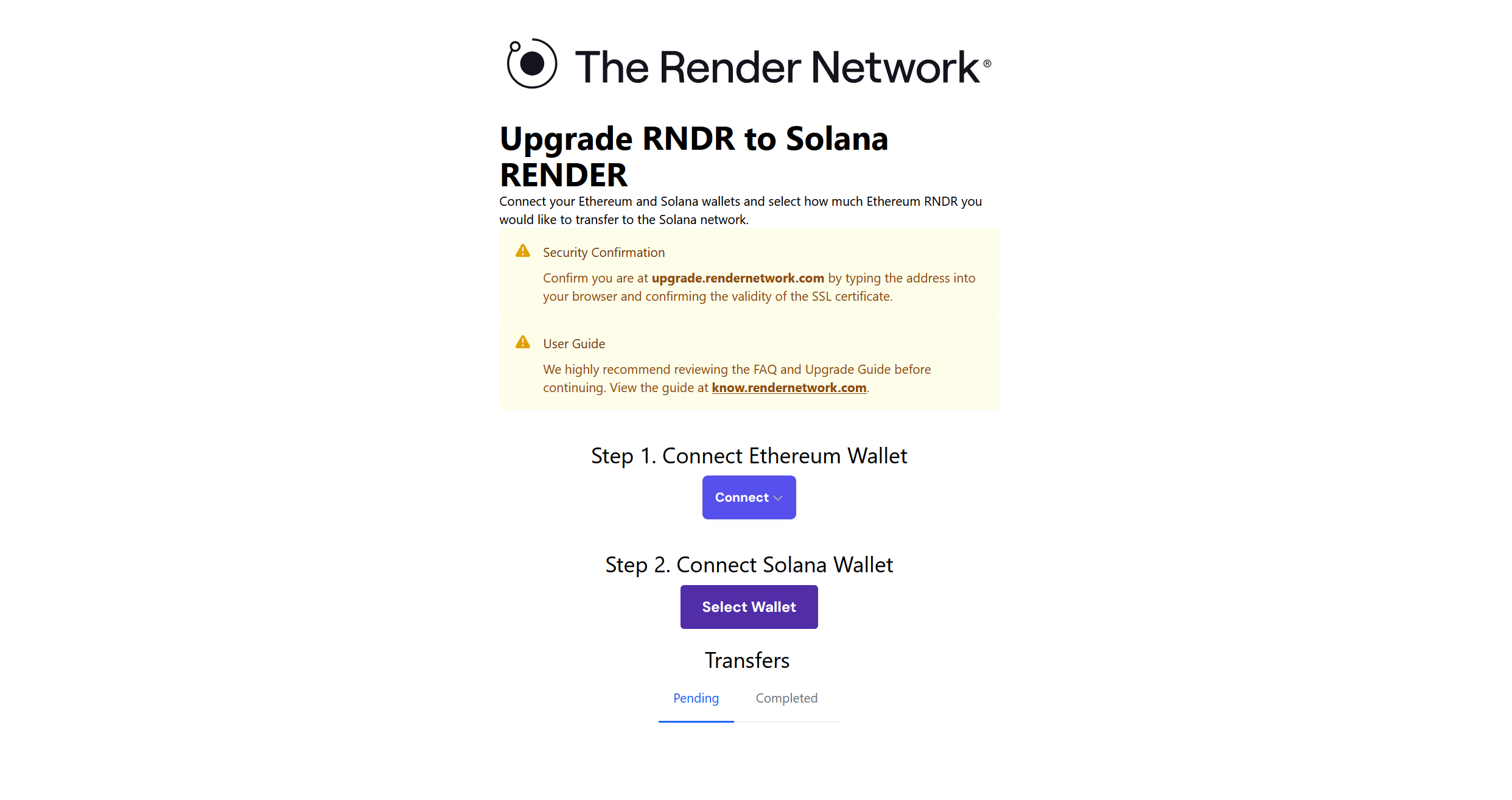
With that move in place, all new features, payments, rewards, and governance activity naturally shifted over to the Solana version of the token.
That transition also set the stage for another major update, the rollout of the Burn-and-Mint Equilibrium system, often shortened to BME. Under this setup, users burn RENDER tokens to create Render Credits when they submit jobs, and node operators who complete those jobs receive newly minted RENDER as a reward, which ties the token supply directly to real demand for GPU power on the network.
As the token system became more closely linked to real usage, governance started to take on a bigger role as well. The project now uses a formal process called Render Network Proposals, or RNPs, which allows the community and other stakeholders to suggest changes, discuss them openly, and vote on upgrades to the protocol, token design, and network features.
Render (RENDER) Tokenomics
RENDER is the native token powering the Render Network. It was initially issued on the Ethereum blockchain when it was originally called “RNDR”. In 2023, the Render Network migrated to the Solana blockchain, following which the native token was renamed to “RENDER.”
In this section, we will study the RENDER token, its supply, distribution, and use cases.
RENDER Token Supply
Here are the main supply stats for the Render Network token. It’s worth checking a live tracker for the latest numbers, since these change over time:
- Initial total supply: 2.147 billion tokens
- Current total supply: 533.34 million tokens (Total supply changes over time, so check a live tracker like Coingecko for the latest total supply figure before investing or transferring funds.)
- Current max supply: 644.16 million tokens
- Circulating supply: 518.58 million tokens
- Circulating supply as percentage of max supply: 80.5%
RENDER Coin Distribution & Allocation
Here is how the initial total supply of 2.147 billion tokens was distributed when the RNDR token was created in 2017:
Category
Percentage of the initial total supply
Token sale purchasers
25%
Team members and advisors
10%
Render User Development Fund
65%
RENDER Utility & Use Cases
Here is a summary of the RENDER token’s use cases:
- GPU computing: Users must burn RENDER tokens to receive Render Credits, which are required to complete rendering jobs.
- Ecosystem support: A large part of the original token supply was set aside to help grow the network over time. This can be used for things like funding development, partnerships, and new features.
- Governance: RENDER token holders can propose and vote on network improvement proposals.
Governance & Protocol Control
The Render Network introduced decentralized governance in January 2023, when OTOY Inc. transferred control of the core Render Network repository and the Render Network brand to the Render Network Foundation.
Render has a “Render Network Proposal” system that allows community members to propose changes to the Render Network. To be implemented, proposals must undergo a series of reviews and voting approvals. RENDER token holders can vote on proposals on the Nation voting interface by connecting their crypto wallets.
How Does Render Network Work?
To use the Render Network, creators must create an account on OTOY’s Creator Portal and have an active OctaneRender license or subscription, which is available for EUR19.99 per month when billed yearly and EUR23.95 per month when billed monthly.
Users must add RENDER tokens to their accounts to submit rendering jobs. They can buy RENDER tokens and RENDER credits directly from the Render Network Portal or send them to their account from their crypto wallet.
Architecture Behind Render
Render has two key participants on its network: creators and node operators. Creators are individuals and organizations that tap into the Render Network to procure GPU compute for image rendering. Node operators are network participants who rent out their idle GPUs on the Render Network. Node operators are paid to render using RENDER tokens.
Pricing for GPU compute work on Render is broken down into a multi-tier pricing structure based on speed, security, and costs. Creators must convert their RENDER tokens into a non-fungible and non-refundable token called RENDER Credit, which is used to pay for desired work.
Once a rendering job is complete, creators have 24 to 48 hours to approve the job. Node operators only receive RENDER tokens once the creator confirms that the renders were successfully processed. Payouts take place every 7 to 10 days in a consolidated manner to save transaction fees.

Render Blockchain Structure
Render Network uses the Solana blockchain to facilitate RENDER token transactions, store data on-chain, and host smart contracts.
According to Render, the project chose to migrate from Ethereum to Solana due to its high throughput, low fees, and better programmability. Render said that Solana allows developers to write smart contract code in Rust and C++, compared to Solidity on Ethereum. Check our Ethereum vs. Solana article to understand the key differences between the two leading blockchain networks.
Render added that network transaction fees known as gas fees played an important role in the decision to migrate to Solana, as the network publishes data from render jobs that are written on-chain. Render explained,
For example, a single render can include thousands of unique assets as individual nodes within its scene graph – including 3D models, textures, scripts, HDRIs, effects, custom render graph nodes, volumes, rays, sdf / meshes, and scene graph states. Many applications of the Render Network for real-time streaming experiences, gaming, generative art, and emergent forms of composable media require all of these unique node graph assets to be tracked on chain.
Token Standards & Smart Contracts
When Render migrated to Solana, the project upgraded its native token to a Solana-based token with a special feature called Burn Mint Equilibrium (BME). According to Render, the BME model allows the network to price its services using a supply and demand equilibrium, which helps creators forecast rendering job costs.
Smart contracts on Render describe the terms of agreement between the provider and purchaser of a service or a token. They also act as an automatically executable agreement when pre-determined conditions are met.
Render also uses a special type of smart contract known as escrow contracts that hold tokens paid by creators for a rendering job. The escrow contract only pays the node operator when the creator confirms the work.
Scalability & Performance
The scalability and performance of the Render Network are dependent on the underlying layer one blockchain on which it is built. In the case of Render, the L1 blockchain is Solana. Here are the key performance stats of the Solana blockchain, according to Chainspect:
- Max throughput: 2,909 transactions per second (TPS).
- Max theoretical throughput: 65,000 TPS
- Block time: 0.4 seconds
- Finality: 12.8 seconds
Here are some Render Network performance metrics as compiled by the Render Network Foundation:
- Total frames rendered: 54.634 million
- Total node operators since inception: 5,600
Benefits and Drawbacks of RENDER Coin
Pros
-
Render allows anyone to access and provide GPU compute resources.
-
The platform is capable of scaling to provide virtually unlimited GPU power via its decentralized model.
-
Users can rent their idle GPU and earn RENDER tokens.
-
Render provides a cost-effective alternative to centralized cloud computing providers.
-
Render is integrated with popular 3D design applications such as Blender and Cinema 4D.
-
Render introduced pricing in fiat currencies for easy payments.
Cons
-
Render is dependent on the underlying L1 blockchain for token transactions and smart contract agreements.
-
RENDER price swings can affect income and costs.
-
There was a lack of public information about node operators on Render.
-
Some users may find Render complicated to use.
Render Network Analytics
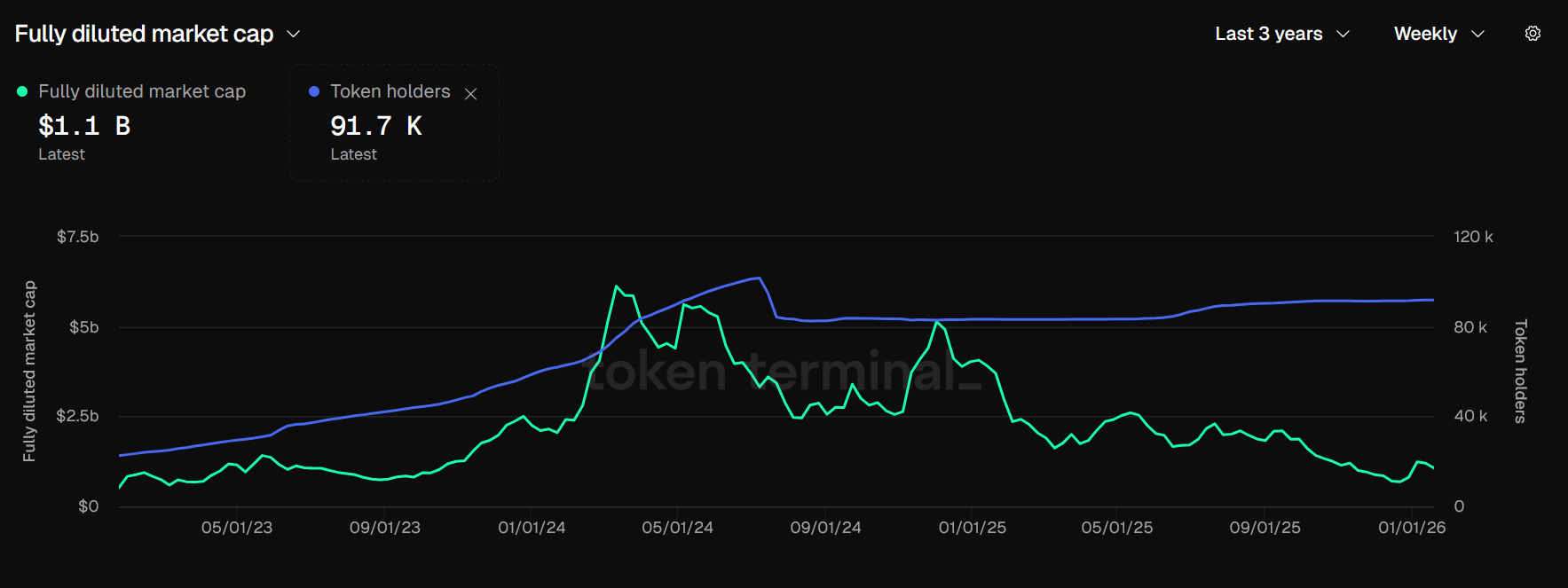
In this section, we look at important on-chain metrics of the Render Network to learn more about the decentralized GPU rendering crypto project.
On-Chain Metrics
What Do Experts Think About Render Crypto
In a research report, a16zcrypto wrote that DePIN projects such as Render can aid AI innovation by democratizing access to the compute infrastructure, as industry advancement is currently bottlenecked by energy and GPU resources.

a16zcrypto also added that “centralization of AI models among a handful of companies is another timely concern.” Researchers at the firm said that decentralized networks can help create cost-effective, censorship-resistant, and scalable AI.
Similarly, asset manager Grayscale said DePIN projects are relevant to industries with high capital requirements, a large barrier to entry, monopolistic dynamics, and underutilized resources.
Grayscale added that DePINs represent “a compelling investment opportunity.”
If DePINs capture even a small share of these markets (internet connectivity, data storage, and computational hardware), the potential impact could be substantial.
Is RENDER a Buy?
Render Network is one of the standout DePIN projects in the crypto market. The project gained attention for its unique model of leveraging idle GPU power, which experts say has the potential to disrupt the highly lucrative AI industry. However, the Render Network is still at an early stage, and there are uncertainties and risks that investors must consider.
If you’re considering buying the RENDER token, it’s important to do your own research (DYOR). Your decision should take into account your personal risk appetite, financial goals, and understanding of the broader market. Wondering where to buy RENDER tokens?
Top crypto exchanges like Binance and Bybit offer a secure and beginner-friendly experience for buying RENDER. If you decide to invest, consider using reputable and secure platforms like the ones listed below. To know the step-by-step method of buying Render, check out ‘How to buy Render‘ guide.




Best Render Network Wallets
If you have RENDER tokens on a centralized crypto exchange, you can consider transferring them to a non-custodial crypto wallet. These wallets allow you to retain full control and ownership of your digital assets and enable token use on DeFi platforms.
Note that you will need a RENDER-compatible wallet if you want to buy RENDER tokens on decentralized exchanges. You will also need it if you want to run a node on Render or if you want to use Render’s GPU marketplace. We have previously explored the best RENDER wallets.
Conclusion: Render Network
The Render crypto project is emerging as an important alternative to centralized cloud computing service providers by providing creators with affordable and on-demand access to GPU compute. With its Solana-based infrastructure, plugin integrations, and blockchain-backed content protection, Render could help shape a creator-first media industry. The Render Network crypto project and the DePIN industry as a whole are exciting developments to keep track of.
DISCOVER:
- What is Mantle (MNT): A Beginner’s Guide
- What is Near Protocol (NEAR): A Beginner’s Guide
- What is Ethereum Name Service (ENS) Domain?
- What is Injective (INJ)? A Beginner’s Guide
- What is Ondo Finance (ONDO): A Beginner’s Guide
- What is Berachain (BERA) and How Does it Work?
FAQs
Who can benefit from using Render (RENDER)?

Render benefits digital artists, 3D designers, game developers, AI researchers, and anyone needing GPU compute. Individuals with idle GPUs can also monetize their hardware on Render Network.
Can I earn rewards by staking Render?
Render does not use traditional staking. Instead, users can earn RENDER tokens by renting out idle GPU resources as node operators.
Who founded Render crypto project?
Render was founded in 2017 by Jules Urbach, also the CEO of cloud graphics company OTOY.
Does Render support NFTs and the Metaverse?
Yes. Render enables creators to build and render assets for the Metaverse and NFTs.
How can I become a node operator on the Render Network?
To become a node operator, you must rent your idle GPU resources to the network. However, your GPU hardware must meet the platform’s technical requirements. Once accepted, you’ll receive rendering jobs and earn RENDER tokens upon successful task completion.
What blockchain does Render use?
Render runs on the Solana blockchain. It migrated from Ethereum to Solana in 2023.
How does Render handle payments and fees?
Users must convert RENDER tokens into non-refundable Render Credits to pay for compute tasks. Payments are held in escrow and only released to node operators after creator approval.
Is Render a good investment?
If you’re considering buying the RENDER token, it’s important to do your own research (DYOR). Your decision should take into account your personal risk appetite, financial goals, and understanding of the broader market.
What industries use Render crypto?
Render is used in animation, architecture and design, gaming, virtual reality, augmented reality, metaverse, and AI inference and learning.
References
- Render Token. “Render Token and the Future of Media.” Medium, https://medium.com/render-token/render-token-and-the-future-of-media-791d75e25045.
- Render Token. “RNDR Token Sale Details.” Medium, https://medium.com/render-token/rndr-token-sale-details-3386e75a6fff.
- “Render Price (RNDR).” CoinMarketCap, https://coinmarketcap.com/currencies/render/.
- Render Network. “Adding Tokens to Your Account.” Render Network Knowledge Base, https://know.rendernetwork.com/getting-started/how-to-get-started/adding-tokens-to-your-account.
- Render Network. “How Do Token Contracts Work?” Render Network Knowledge Base, https://know.rendernetwork.com/basics/how-do-token-contracts-work.

Why you can trust 99Bitcoins
Established in 2013, 99Bitcoin’s team members have been crypto experts since Bitcoin’s Early days.
Weekly Research
100k+Monthly readers
Expert contributors
2000+Crypto Projects Reviewed