




In This Article
You’re trying to send ETH to your buddy. You copy-paste his wallet address, something like 0x4E833624… but the screen glitches, your cat walks across the keyboard, and you hit send. Congrats. You just funded a stranger’s vacation in Ibiza. Welcome to crypto UX in 2026, still held together by copy-pastes and blind trust in alphanumeric spaghetti. Now, enter stage left: Ethereum Name Service, or ENS, the unsung hero of crypto user experience. You’ve probably asked, “What is Ethereum Name Service (ENS)?” Think of it as DNS for the Ethereum blockchain, but on-chain, unstoppable, and finally human.
Instead of sending ETH to 0xFUBARsAreForever, you send it to vitalik.eth. Clean. Simple. Foolproof unless Vitalik changes his name to something even more memetic.
If you’re looking for a beginner’s guide to ENS token, or you’re just sick of sweating every time you double-check an address, you’re in the right place. We’re diving deep into what is an ENS domain, how it all works, and whether this is the next piece of infrastructure you’ll be bragging about having bought early.
This is about giving power back to users in a sea of faceless hashes and centralized DNS chokeholds. Buckle up. ENS might be the backbone of how we all interact with Ethereum in the next era.
99Bitcoins’ Take on ENS Domains
Let’s cut through the fluff. You want the Ethereum Name Service explained like a real person would, not by someone who just regurgitated the whitepaper and called it a day. Here’s our honest read: ENS is one of the most practical inventions in the Ethereum ecosystem, and it doesn’t get nearly enough credit. Everyone’s chasing yield, L2 speed, and memecoins with frogs on them. Meanwhile, ENS is over here quietly doing the Lord’s work, making Ethereum usable for actual humans. So what is the ENS domain meaning in plain English? It maps machine-garbage addresses into names we can actually remember. It’s a protocol that lets you own yourname.eth and link it to your Ethereum address, your Bitcoin wallet, your website, even your content hashes. It’s like buying digital real estate that happens to make your crypto life less of a UX horror story. As an ENS crypto project, it’s not just about vanity URLs. It’s infrastructure. It’s identity. And it’s one of the few parts of Web3 where the utility is immediate not buried under layers of speculation or vaporware promises. And the Ethereum Name Service utility goes deeper than you think: Is it perfect? No. It’s early. But if you’re the type who saw value in internet domain names in the 90s and hated watching others flip them for six-figures while you slept on it, pay attention this time. ENS is that rare crypto project that doesn’t need hype. It just needs people to understand what it is.
Ethereum Name Serivce Review: Summary
Imagine explaining to your boomer uncle how to send you crypto. You could hand him a 42-character string of chaos, or just say, “Send it to john.eth.” That’s it. That’s the pitch.
In this ENS crypto guide, we’re giving you the Ethereum Name Service overview in one sentence: ENS replaces complex crypto addresses with simple, readable names. Period.
It’s the missing link between blockchain and normal people. It’s the moment where crypto finally stops looking like you’re programming in assembly and starts feeling like you’re using the internet.
Here’s how ENS simplifies crypto wallet addresses:
- You register an ENS domain, like coffee.eth.
- You link it to your Ethereum wallet.
- People send assets to coffee.eth instead of your long, forgettable 0x address.
No typos. No anxiety. Just a human-readable name in a machine-readable world. If that doesn’t sound revolutionary to you, you’ve clearly never fat-fingered a wallet transfer.
Key Takeaways
- ENS is short for Ethereum Name Service, a decentralized protocol that turns long Ethereum wallet addresses into human-readable names like you.eth.
- ENS domain registration is simple and permissionless, anyone can claim a name using their wallet and a few bucks in gas.
- The benefits of Ethereum Name Service go beyond addresses: you can link your ENS to websites, avatars, metadata, or even use it as a Web3 login.
- The ENS token use cases include governance of the protocol, domain owners and token holders can vote on key upgrades and fee structures.
- This system eliminates errors in transactions and makes crypto more user-friendly, no more copy-pasting 42-character hex strings.
- Still asking what is Ethereum Name Service? Think of it as Web3’s version of DNS, but trustless, open, and built for the Ethereum generation.
Terms You Need to Know Before Understanding ENS Domain
Before we go full Matrix on how this protocol works, let’s decode some of the crypto lingo that ENS throws around like everyone’s fluent in Web3 Latin.
That’s your toolkit. Now let’s unpack how it all came to be.
What is Ethereum Name Service (ENS)?
Let’s stop pretending crypto addresses are user-friendly. They’re not. They’re a UX disaster duct-taped to a decentralized dream. So what is Ethereum Name Service (ENS)?
It’s a name service that lives on the Ethereum blockchain and maps long, machine-readable wallet addresses to short, human-readable names like turning 0xD3aDb33f… into moonbag.eth.
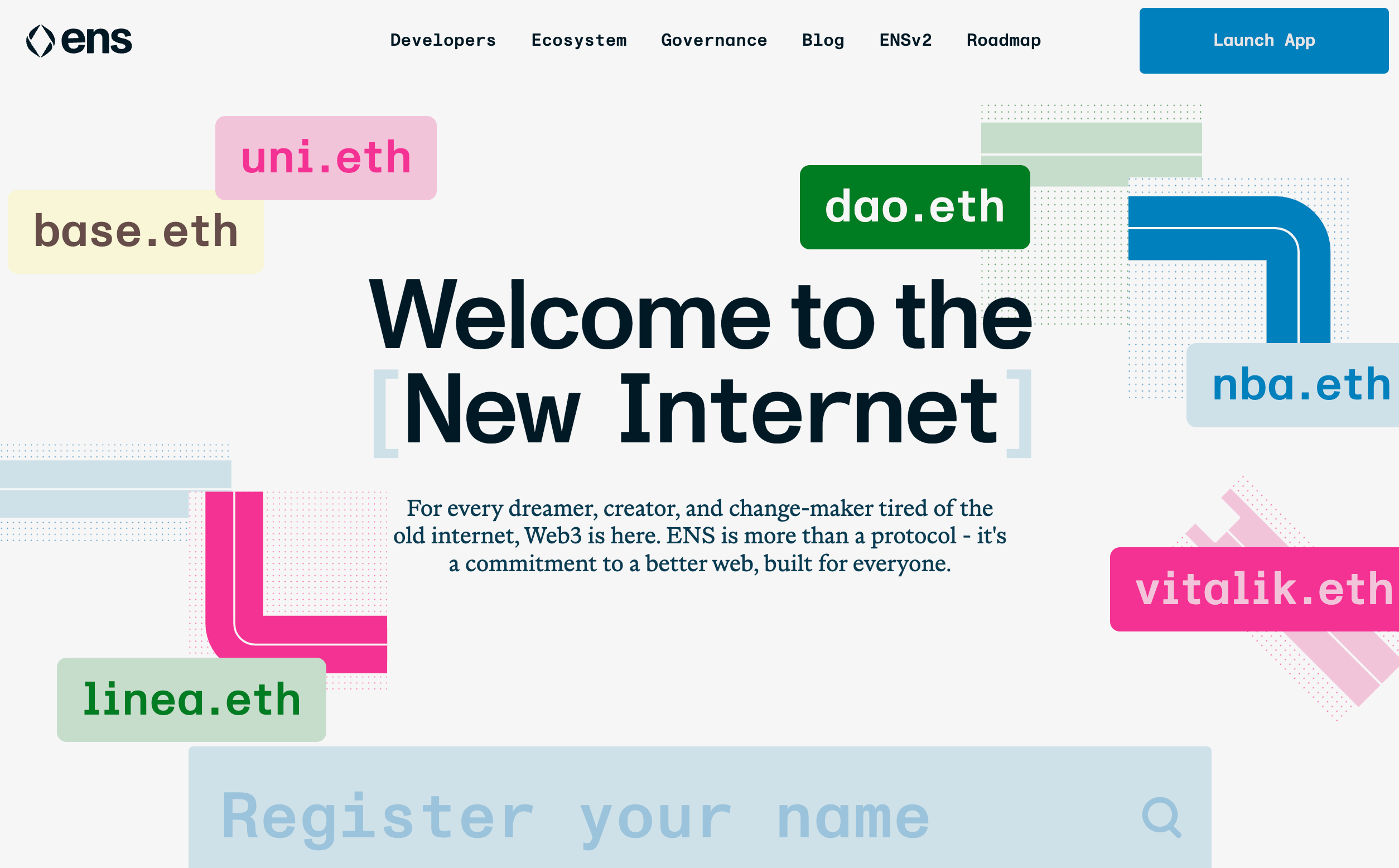
Now imagine this: the DNS system we all use to type “google.com” instead of an IP address, but instead of being run by ICANN and a handful of state-sanctioned gods, ENS is powered by Ethereum smart contracts, owned by no one, and governed by everyone who holds the $ENS token.
It’s the Ethereum Name Service overview you didn’t know you needed:
ENS is the layer that makes the Ethereum blockchain domain names usable for normies and crucial for developers trying to onboard the next billion users without needing them to memorize cryptographic gibberish. In short: ENS is the Web3 name layer that makes the internet of the future actually navigable.
History of Ethereum Name Service (ENS) Domain
Let’s rewind the tape. The Ethereum Name Service history starts in 2017, a time when ICOs were printing millionaires, CryptoKitties were clogging the chain, and everyone still believed Vitalik Buterin might be Satoshi’s cousin.
Amidst all the chaos, a few builders looked at Ethereum and thought: “Great, we’ve built a decentralized world computer. Too bad no one knows how to use it.” Copying and pasting wallet addresses was still a UX minefield, and DNS (the traditional internet naming system) was still clinging to its centralized throne.
So, a team from the Ethereum Foundation decided to fix that. They launched ENS as a smart contract–based protocol to create a naming layer for Ethereum. One that worked like DNS, but on-chain, trustless, and composable. That’s how .eth became the top-level domain for the Ethereum ecosystem.
Originally, the domains were auctioned off using a Vickrey-style auction (yes, that’s as confusing as it sounds). Eventually, they ditched that in favor of a more streamlined registration model that let users simply register names and renew them yearly.
The ENS system has evolved from a nerdy experiment into a critical layer for wallet identity, dApp UX, and content hosting in Web3. Millions of domains have been registered. Big brands are buying theirs. Celebs are flexing theirs. And if history repeats itself, just like .com domains in the 90s, owning a clean .eth could one day be worth more than your favorite altcoin bag.
About the ENS Team
Behind every clean .eth name is a group of devs who decided crypto shouldn’t feel like typing in Morse code blindfolded.
The Ethereum Name Service team was originally built under the Ethereum Foundation, with a core squad led by Nick Johnson, a software engineer who looked at DNS and thought, “Yeah, let’s rebuild that, but without the politics and gatekeepers.”
These were builders genuinely obsessed with making the Ethereum ecosystem less painful to use. They didn’t raise hundreds of millions in a flashy ICO. They built a working product. Then made it open source. Then handed it over to a decentralized autonomous organization (DAO) to let the community take control.
Today, ENS is governed by the ENS DAO, and that means changes to the protocol, like pricing, updates, and how revenue is used, are all voted on by token holders. If you’ve got $ENS in your wallet, you’ve got a seat at the table.
They’re not flashy. They’re not shilling. But they’re responsible for one of the few actually-working products in crypto and they did it with minimal drama and maximum transparency. If Web3 had a Hall of Fame, the ENS team would be the ones labeling the plaques.
What Problems Does Ethereum Name Service Solve?
Crypto has a usability problem. Always has. It’s not the tech. It’s the fact that sending money feels like defusing a bomb, one wrong character, and your funds vanish into the blockchain void.
So… what is Ethereum Name Service really solving? Everything that makes crypto feel like a punishment for not having a CompSci degree. According to ENS Whitepaper,
ENS maps human-readable names like ‘alice.eth’ to machine-readable identifiers such as Ethereum addresses, other cryptocurrency addresses, content hashes, metadata, and more. ENS also supports ‘reverse resolution’, making it possible to associate metadata such as primary names or interface descriptions with Ethereum addresses.
Here’s the pain ENS removes:
In short: ENS simplifies how we interact with cryptocurrency, and fixes the naming, routing, and identity layers of Web3 with one elegant protocol. It makes the blockchain human.
Difference Between ENS & Traditional Domain Names
Let’s play a quick game of spot the difference.
On one side: DNS, the Domain Name System we’ve all used since dial-up. Type google.com, and some backroom of servers points you to the right IP address. Sounds simple, right?
Now flip the coin and you’ve got ENS, the Ethereum name system for the blockchain world. Here’s where things get spicy:
In Web2, users follow rules. In Web3, users become owners. So yeah, both systems assign readable names to digital locations. But only one does it without permission, on-chain, and with the ethos of true internet ownership baked in. Spoiler alert: It ain’t DNS.
Ethereum Name Service Tokenomics
Let’s talk numbers, the stuff that makes your inner degen lean forward.
The Ethereum Name Service tokenomics are surprisingly clean for a protocol launched in an era where token models were usually just copy-pasted from whatever was pumping.
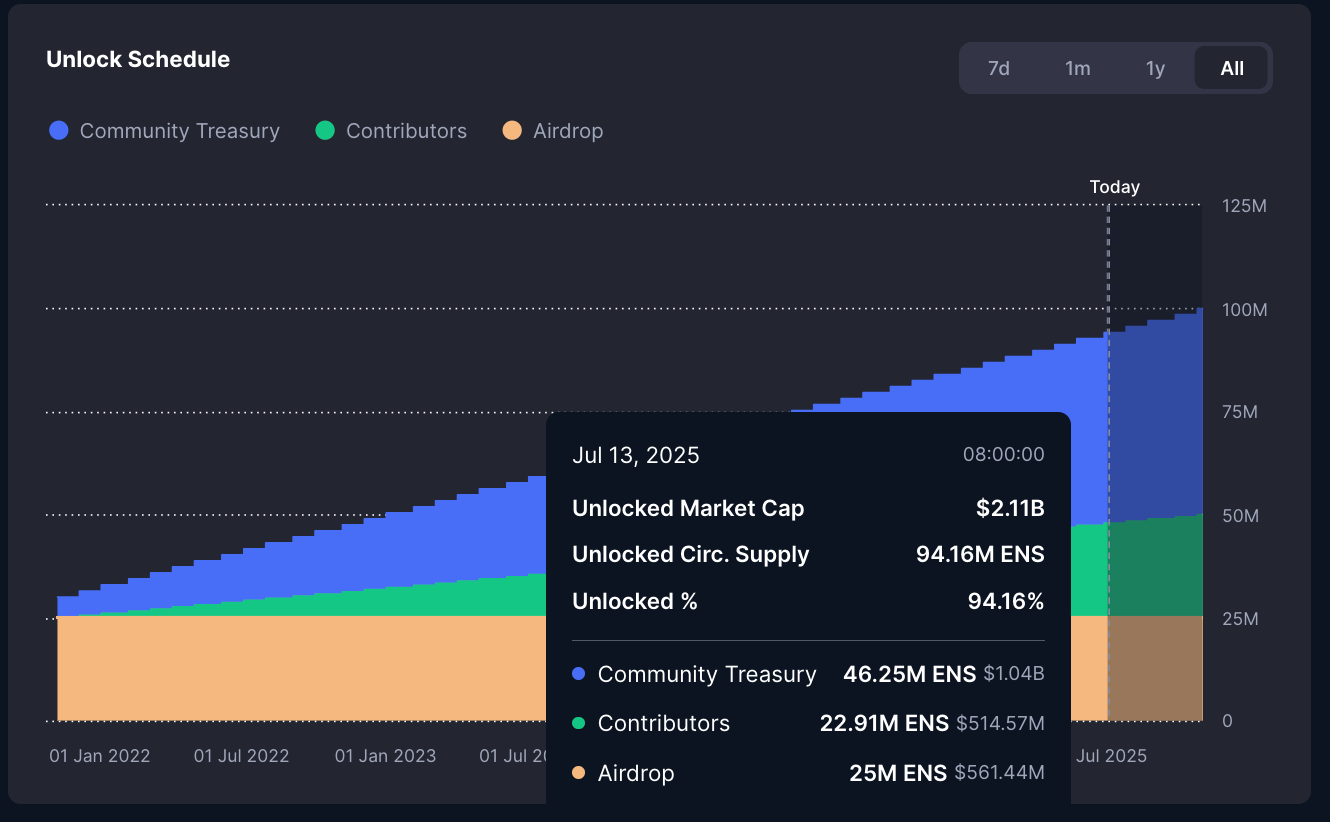
The total supply of $ENS is 100 million tokens, and as of July 2025, 94.16% is already unlocked. That’s over 94.16 million ENS tokens in circulation. Translation? There’s no tsunami of tokens waiting to nuke your bags later. The unlock cliff is basically done.
Here’s how the supply breaks down:
ENS Utility & Use Cases
$ENS is a governance token, meaning holders steer the protocol’s future. Want to propose a change to registration fees? You need $ENS. Want to vote on how community funds are deployed? $ENS. Want to sit at the table where decisions about your favorite ENS crypto project get made? Stack your tokens and speak your piece.
It’s a functional token, not a speculative ghost coin. It gives domain owners and users actual power over the protocol. That’s the kind of alignment most Web3 projects pretend to have.
Oh, and with an unlocked market cap of $2.11B, ENS is a blue-chip play in the naming layer of Ethereum’s infrastructure stack. Tokenomics that don’t suck. Who knew?
Economic Model & Incentives
Most crypto projects launch with tokenomics that look like they were scribbled on a napkin after four espresso martinis. ENS? It’s different. The economic model is built around utility, users, and keeping the protocol running like a Swiss watch. Let’s break it down:
This is an economic model that incentivizes participation, not speculation. It rewards early adopters. It gives users power. And it funds itself in a way that makes sense. Instead of mining for tokens, you mine for human-readable identity in a world of noise and hash. Now that’s a business model worth naming.
Governance & Protocol Control
Most crypto projects talk a big game about decentralization right up until the founders flip a kill switch or rug the treasury on the way out. Not ENS. This is one of the few projects where the community holds the reins.
The ENS token is a true governance token, not a decorative badge for speculators. It gives users direct influence over the protocol via the ENS DAO, a fully-fledged decentralized autonomous organization that actually works. How does it work?
The DAO has already handled everything from budgeting to deploying funding for ENS ecosystem tools. And since the DAO controls the Community Treasury (which holds nearly half the token supply), it’s also got serious capital behind it. If a dev team wants to build new features or integrations for this ENS crypto project, they go through the DAO.
It’s the kind of setup that gives users full control, not just over their domains, but over the future of the entire system. In a world where too many protocols are decentralized in name only, ENS actually walks the walk.
How Does Ethereum Name Service Work?
So, how does ENS work exactly? ENS takes those hideous machine-readable addresses, you know, 0xThisLooksLikeALicenseKey, and maps them to clean, human-readable names like yourname.eth. It’s not magic. It’s just smart contracts doing what they were born to do: store and resolve data in a trustless way.
Here’s what happens under the hood:
-
ENS Registry
The registry smart contract is the backbone of the name service ENS system. It records who owns what ENS domain, the resolver used, and the time the domain expires. Every .eth name points back here.
-
Resolver
This contract stores all the relevant records: your Ethereum addresses, content hashes, Twitter handle, avatar, and any other data you want associated with your domain. This is where the magic happens, turning bags.eth into a fully functional identity hub.
-
Controller
The controller contract handles the logic. ENS domain registration, renewal, and subdomain management. It checks availability, processes your registration, and keeps your domain under your control. Want gm.bags.eth to redirect to your wallet? This handles it.
Together, this stack (registry, resolver, controller) is what makes name service ENS so damn elegant. No middlemen. No approvals. Just you and the blockchain shaking hands. So the next time someone asks how ENS works, tell them it’s like DNS on steroids, rebuilt for a decentralized world, where users control their identity, not some registrar holding your domain hostage for $14.99 a year and your soul.
Token Standards & Smart Contracts
This is where things get technical, but also where ENS really flexes. The ENS domain is a full-blown ERC-721 token, aka a non-fungible token (NFT), just like your Bored Apes or Pudgy Penguins. But instead of holding a JPEG, it holds your identity. Let’s break it down.
This setup turns every ENS name into a programmable, composable identity unit that can interact with every layer of the Ethereum stack. Now that’s infrastructure.
Scalability & Performance
Let’s address the elephant in the node room: can ENS scale, or is it just another clever idea bottlenecked by Ethereum gas fees and congestion? Short answer: ENS isn’t the problem. Ethereum is.
But the way the ENS protocol is designed is it’s lean, efficient, and highly optimized for what it does. It’s a naming service, not a perpetual casino. Here’s why it scales surprisingly well:
Users aren’t waiting for ENS to catch up, it’s already there. Quietly doing its job while the rest of crypto screams about TPS and modular blockchains. Ethereum Name Service utility is proof that not every protocol needs to be flashy or loud. Some just need to work, and ENS does.
Pros and Cons of Using ENS Domains
Let’s not kid ourselves, nothing in crypto is perfect. Not even ENS.
But when you weigh the pros and cons of Ethereum Name Service, it becomes clear why .eth names are flying off the shelves faster than ETH disappears during an L2 airdrop announcement. Here’s what you need to know:
Pros
-
Transforms unreadable Ethereum addresses into human readable names like yourname.eth
-
ENS domains are NFTs, giving domain owners full control and true ownership
-
Highly composable, use it for wallets, websites, avatars, logins, and more
-
Reduces errors in wallet transfers and interactions by removing complex addresses
-
Grants governance power via $ENS token in a truly decentralized protocol
Cons
-
Registration and updates still require Ethereum gas, which can be pricey
-
Domains must be renewed annually or risk expiration
-
No recovery options, lose your wallet, lose your domain
-
Still not fully adopted across all major dApps and wallets
So while ENS isn’t a silver bullet, it is one of the most practical and functional tools in the Web3 arsenal, and it’s only getting stronger.
Is ENS Crypto a Buy?
Let’s talk money. Because no matter how useful a protocol is, you’re probably still asking the one question that haunts every degen’s dreams: Is ENS crypto a buy? Here’s the ENS crypto guide take. No hopium, just signal.
The Bull Case
ENS has something most crypto tokens don’t: Ethereum Name Service utility. Real utility. People use it. Every .eth domain registered, every wallet mapped, every reverse record set, it’s all activity that anchors ENS deeper into the Ethereum ecosystem. Add to that:
- Strong network effects – the more people use ENS, the more valuable it becomes.
- Sticky ownership – once you’ve got a name like yourbrand.eth, you’re not flipping it next week.
- DAO with teeth – token holders have real governance power, not just meaningless vote buttons.
And let’s not forget: in a future where domain owners become digital citizens of Web3, ENS is the ID system. It’s the phonebook. The naming layer. Every major protocol will plug into it, if they haven’t already.
The Bear Case
That said, ENS isn’t without risk:
- Revenue is tied to Ethereum gas prices. If gas spikes, fewer people register or renew.
- Speculation on rare names drives short-term volatility just like the .com boom did.
- Competition is emerging, other blockchains and even alt-Ethereum naming services are gunning for market share.
And the $ENS token itself? It’s not a cash flow asset. It’s a governance token. You’re betting on participation, growth, and demand, not yield.
Verdict: Is Ethereum Name Service Worth It? If you’re looking for a long-term bet on Ethereum infrastructure, identity, and the user layer of Web3, then yes. ENS is worth it. Just don’t expect overnight moonshots. This is a protocol play. Slow burn. Deep roots. And if it succeeds, it becomes as essential as email. Not sexy. Just inevitable.
How to Buy ENS Domains?
So you want to buy an ENS domain? Good. You’re finally tired of typing 0xDeadB33f… and praying you didn’t miss a digit. Here’s how to use Ethereum Name Service the right way, to claim your slice of the decentralized internet and slap your name on it.
-
Head to the Official ENS App
Go to app.ens.domains. This is the real deal, avoid fakes or clones. Connect your Ethereum wallet (MetaMask, Best Wallet, Coinbase Wallet, etc.) and make sure you’ve got some ETH for gas.
-
Search for Your ENS Name
Type the name you want like bossmoves.eth into the search bar. The app will check if it’s available. If it’s taken, prepare to get creative. Welcome to the new Web3 land rush.
-
Register Your Domain
Once you’ve found an available name, you’ll begin the ENS domain registration process. You’ll sign two transactions: one to start the request, and another to finalize it. This prevents bots from sniping domains mid-process.
-
Set Your Records
After you own the domain, assign it to your wallet address and add records like content hashes, social handles, or even subdomains. Want payme.john.eth? Go wild.
-
Renew Annually
Most names cost $5/year (more for shorter ones). Set a reminder to renew. If you forget, someone else might scoop your name while you’re on vacation.
ENS crypto domains are programmable, transferable digital assets that give users control over their Web3 identity. And registering one is easier than buying a .com used to be in the 90s. Get yours while they’re still cheap because trust us, nobody wants to be the guy bidding 40 ETH for john.eth.
Ethereum Name Service Future: What To Expect?
So what’s next for ENS? Will we be trading ENS names like .coms in 1999? Will zuck.eth finally point to something other than a burner wallet? If you’ve made it this far into the ENS crypto project, you already know it’s not a flash-in-the-pan altcoin. It’s a protocol with legs and a clear roadmap laid out by a very engaged, very DAO-driven community.
Here’s what the future could look like:
In short? Ethereum Name Service is just getting started. It’s gone from clever experiment to critical infrastructure, and the best part is, anyone can create with it, govern it, or build on top of it. The internet didn’t realize how important DNS would become until it was too late. This time, you’ve been warned.
Conclusion: What is Ethereum Name Service (ENS)?
So… what is Ethereum Name Service, really? It’s not just a way to send crypto without sweating over typos. It’s not just a cool .eth name to slap in your Twitter bio. It’s not even just a piece of infrastructure.
ENS is the foundation of identity in a decentralized world the name service layer that takes Ethereum out of the shadows of technobabble and into the realm of human interaction. It gives users something crypto has sorely lacked since Genesis Block #1: Control.
You own your name. You define your presence. You link your Ethereum addresses, content, websites, and profiles into one human readable domain that says: This is me. On-chain. And I’m not going anywhere. This is a protocol.
A set of smart contracts that just… work. Quietly. Reliably. On Ethereum. While the rest of crypto screams about the next meta, ENS just keeps growing domain by domain, user by user, DAO vote by DAO vote.
If you’re still asking what is an ENS domain, here’s the answer that matters: It’s the difference between being a random wallet address… and being known. It’s your username, your brand, your access key, your resume, your Web3 passport wrapped into one elegant string of characters and verified by the most secure network on Earth.
So yeah, you could ignore it. But when ENS is powering every wallet login, social graph, and digital handshake in Web3… don’t say nobody told you. Because now you know. And now, you’re in control.
DISCOVER:
- What is Berachain (BERA) and How Does it Work?
- What is Ethereum and How Does it Work?
- Ethereum Price Prediction for 2025-2030
- What is Injective (INJ)? A Beginner’s Guide
- What is Ondo Finance (ONDO): A Beginner’s Guide
- What is Bittensor (TAO): A Beginner’s Guide
- How to Buy Ethereum Name Service (ENS): Beginner’s Guide
FAQs
What can I do with an ENS domain?


You can use it as your wallet alias (you.eth instead of 0xWhatever), log in to dApps, host decentralized websites, link social profiles, store metadata, or just flex it in your X bio. It’s your Web3 ID card, do with it what you want.
How do I register an ENS domain?
Go to app.ens.domains, connect your wallet, search for the name you want, and register it by signing two on-chain transactions. That’s it no paperwork, no ICANN middlemen, no begging for permission.
Is there a yearly fee for owning an ENS domain?
Yes, most domains cost around $5/year (paid in ETH), and shorter names are more expensive. Forget to renew, and someone might snipe your name faster than a gas war on mint day.
Can I trade or sell my ENS domain?
Absolutely. ENS domains are NFTs, ERC-721 tokens. You can sell them on OpenSea, flip them like .coms in 1999, or just sit on vitalik.eth and wait for the offers to roll in.
Why should I use ENS instead of regular crypto addresses?
Because typing 0xBEEF… is how people lose money. ENS gives you human-readable names that are safer, easier, and less stress-inducing. No more copy-paste paranoia.
Are ENS domains censorship-resistant?
Yes. Your domain lives on Ethereum. No Web2 registrar can shut it down. No overlords can seize it. You own it until you stop paying or burn the key.
What is ENS token used for?
The $ENS token is a governance token. It lets you vote on proposals, control the treasury, set protocol parameters, and shape the future of ENS. If you hold it, you’ve got a seat at the table, not just a ticker in your wallet.
References
- Ethereum Name Service. ENS Domains, https://ens.domains/.
- “Ethereum Name Service Price (ENS).” CoinMarketCap, https://coinmarketcap.com/currencies/ethereum-name-service/
- McCorry, Patrick, et al. “Smart Contract-Based DNS and PKI.” arXiv, 2021, https://arxiv.org/pdf/2104.05185
- “What Is Ethereum Name Service (ENS)?” GeeksforGeeks, https://www.geeksforgeeks.org/solidity/what-is-ethereum-name-service-ens/
- ENS Documentation. Ethereum Name Service, https://docs.ens.domains/

Why you can trust 99Bitcoins
Established in 2013, 99Bitcoin’s team members have been crypto experts since Bitcoin’s Early days.
Weekly Research
100k+Monthly readers
Expert contributors
2000+Crypto Projects Reviewed