




In This Article
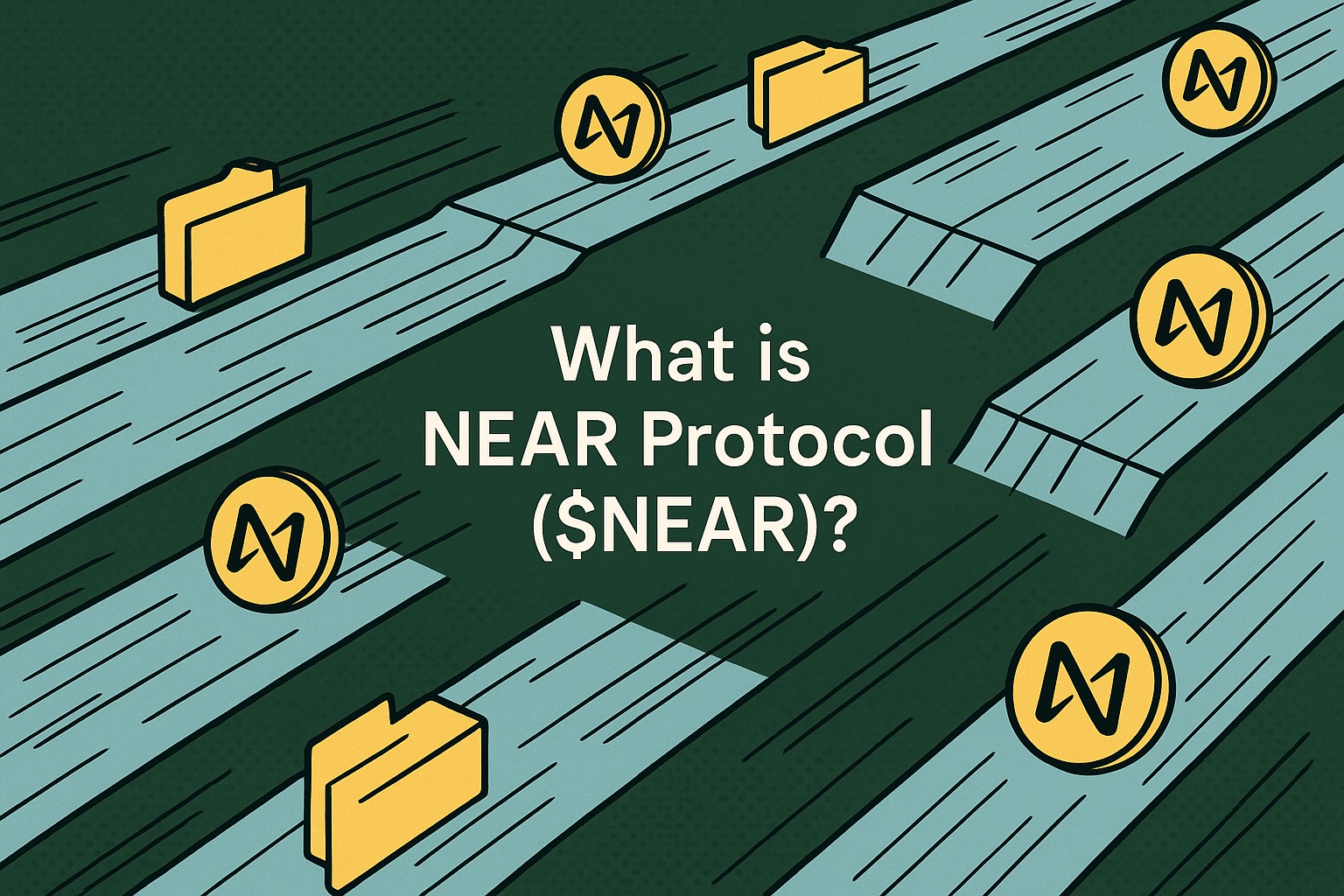
What is Near Protocol (NEAR)? Near Protocol is a blockchain that scales through a technique called sharding, a path Ethereum (ETH) originally explored but later abandoned in favor of layer-two solutions.
In this beginner’s guide to NEAR Protocol, we will learn what NEAR is and cover everything from the project’s origins to its tokenomics and use cases, offering a comprehensive NEAR review for anyone curious about the project.
Key Takeaways
- NEAR Protocol is a high-performance L1 blockchain that is designed to be fast and scalable.
- Sharding is a scaling technique used by NEAR that splits its blockchain into multiple parallel networks called shards.
- Ethereum originally planned to scale via sharding, before pivoting to pursue a rollup-centric scaling.
- NEAR Protocol is positioning itself as an L1 blockchain purpose-built for the deployment of user-owned AI agents.
- Co-founder Polosukhin helped develop the “Transformer” architecture that powers AI systems like ChatGPT.
99Bitcoins’ Take on NEAR Protocol
NEAR Protocol is evolving into a Layer 1 designed for AI and high-volume onchain activity. In December 2025, NEAR hit 1 million transactions per second (TPS) in a publicly verified benchmark using real code and affordable hardware. The team said the result proved that “sharding is the path to true scalability for the blockchain industry.” This milestone also showed that NEAR can scale horizontally as demand grows, giving developers huge headroom for building AI agents and other high-load applications. Looking ahead, one key update to watch is the proposed Halving upgrade, which aims to cut NEAR’s inflation rate from 5% to 2.5%. The community is actively debating the change, and its outcome could shape NEAR’s long-term token economics.
NEAR Protocol Review: Summary
The article breaks down NEAR Protocol in a clear and concise manner, making it easy to grasp for readers of all experience levels. We’ll start by introducing key technical terms, next we’ll dive into the NEAR Protocol, exploring its origin, founding team, development roadmap, and the major challenges it aims to address.
In the latter half of the article, we’ll examine the tokenomics of the NEAR token in detail. By the end, you’ll gain a strong grasp of Near’s innovative technologies, its unique approach to scalability and usability, and how it differs from other L1 blockchains. We’ve also included a curated list of top crypto wallets compatible with NEAR Protocol to help you get started safely.
Terms You Need to Know Before Understanding NEAR Protocol
Here are the key technical terms you need to know before understanding NEAR Protocol:
- L1 blockchain: A layer one is a base layer blockchain on top of which secondary networks and decentralized applications are built.
- Consensus mechanism: A system used by distributed and independent participants of a blockchain network to agree on a single, shared state of the ledger.
- Proof-of-stake (PoS): PoS is a consensus mechanism in which blockchain validators deposit collateral to become eligible to participate in consensus. To learn more about it, read our ‘What is PoS‘ guide.
- Validators: Network participants responsible for verifying and processing transactions, as well as adding new blocks to a blockchain.
- Smart contracts: Programs that can execute instructions autonomously when pre-determined conditions are met. Learn more about this in our ‘What is a smart contract’ guide.
- Sharding: A scaling technique that divides a blockchain into parallel networks called shards.
What is Near Protocol?
NEAR Protocol is a high-performance L1 blockchain that is designed to be fast and scalable. The blockchain uses a sharded design to offer block times as fast as 600 milliseconds and transaction finality in under 1.2 seconds.
The project’s sharding solution is called Nightshade, which splits the NEAR blockchain into multiple networks known as shards. Each shard handles and executes its own set of transactions, allowing an increased number of transactions to take part across the NEAR blockchain. Security of the shards is not compromised as every shard is validated by NEAR’s validators.
When it comes to applications, NEAR has narrowed its focus to serving Artificial Intelligence. Near says that its blockchain was built from “day one” to power AI and is not like rival chains that are “retrofitting for AI.” The project has created a platform called NEAR AI that provides open-source infrastructure, tools, and products that developers can use to build user-owned AI agents that are deployed on the NEAR blockchain.
NEAR’s agent interaction protocol, called AITP, allows AI agents to communicate with each other, while privacy-preserving transactions on NEAR protect AI agents by keeping transactions confidential. Furthermore, AI-powered smart contracts on NEAR enable the autonomous execution of financial transactions.

History of NEAR Crypto
NEAR was founded in 2017 by Illia Polosukhin and Alexander Skidano. The project was originally called “NEAR.ai.” By 2018, the duo had already begun working on a new proof-of-stake (PoS) blockchain with a fully sharded design after realizing that existing networks such as Ethereum (ETH) were incapable of handling a target throughput as high as 100,000 transactions per second.
After nearly two years, the NEAR blockchain opened its mainnet to the public in 2020. In 2021, the protocol took its first step towards a sharded design by implementing the Nightshade upgrade. The Phase Zero of Nightshade saw the network split its state into four shards.
Phase One of Nightshade was completed in 2022, which introduced shard validators that validate only one shard at a time. Phase Two of Nightshade was introduced in 2024, which lowered hardware requirements and running costs for the validator.
Among the key developments in NEAR blockchain technology was the launch of a data availability solution called NEAR DA in late 2023. NEAR DA offers modular rollups and layer two blockchains, a place to publish and verify transactions at low costs.

About the Near Protocol Team
Illia Polosukhin and Alexander Skidanov are co-founders of NEAR.
Polosukhin is a graduate of the Kharkiv Polytechnic Institute, Ukraine, where he studied applied mathematics and computer science. He worked as a software engineer at Salford Systems and Google collectively for over nine years.
Skidanov is a graduate of the Izhevsk State Technical University, Russia, where he completed a master’s degree in computer science. He worked as a software developer at Microsoft and MemSQL before co-founding NEAR.
In 2019, a non-profit organization called NEAR Foundation was established to support the growth of the NEAR ecosystem. Polosukhin is the CEO of the Near Foundation.
According to CryptoRank, NEAR Protocol has raised over $607 million via public token sales and funding rounds. In the first half of 2022, NEAR closed two of its biggest funding deals, collectively worth $500 million. Three Arrows Capital, Andreessen Horowitz (a16z), DragonFly Capital, Circle, and Tiger Global Management were among the investors.

What Problems Does NEAR Protocol (NEAR) Solve?
NEAR Protocol started as “Near.ai,” built on the belief that AI would make software creation easier and more accessible. The founders realized this vision required a blockchain that was fast, affordable, and simple for developers. A feat that NEAR Protocol is close to achieving, having recorded 1 million transactions per second in testing.
Today, NEAR’s primary mission is user-owned AI. The project aims to ensure AI systems and on-chain agents work for end users rather than large corporations. To support this, NEAR provides tools and infrastructure to create and manage AI agents, protect user data, align agent behavior with user interests, and enable open participation.
Near Protocol Tokenomics
NEAR is the native token of the NEAR Protocol. The token is crucial to the protocol’s security as the validator uses it for staking. In this section, we explore the token’s supply, distribution, use cases, and governance powers.
NEAR Token Supply
Here are the important token economic details you need to know about the NEAR crypto token:
The launch of the NEAR Protocol’s blockchain on April 22, 2020, created 1 billion NEAR tokens. The majority of the initial supply of NEAR tokens was subjected to lockups of up to 60 months. Here is how the initial supply of the NEAR token was distributed: Below is a summary of the main use cases for the NEAR token: This blockchain project uses a framework called “House of Stake” to implement decentralized governance. House of Stake uses a stake-weighted system, where, instead of a traditional “one person, one vote” policy, voting power is tied to staked NEAR tokens. House of Stake gives NEAR holders the power to vote on network decisions by locking up (staking) their tokens. Whenever holders stake their tokens, they receive a receipt token with voting power called veNEAR. The longer you lock your NEAR token, the more veNEAR tokens you receive. Anyone can submit network improvement proposals. A dedicated committee screens proposals, which are then voted on. NEAR’s governance system has a committee called Endorsed Delegates, who are based on merit and participation. veNEAR holders can delegate their voting power to these delegates. The House of Stake system has set aside 0.5% of NEAR’s annual inflation as rewards and incentives to veNEAR holders to promote decentralized governance. NEAR is a blockchain network that provides a platform to developers to build decentralized finance (DeFi) applications and autonomous AI agents. The blockchain acts as a ledger that records and verifies all the transactions conducted on NEAR. Projects depend on the blockchain to distribute their tokens and financial applications. Smart contracts can be deployed on the NEAR blockchain. These self-executing contracts are used to create tokens and decentralized applications. They can execute instructions autonomously when pre-determined conditions are met. The NEAR token is crucial to the security and functionality of the NEAR Protocol. It is used by validators for staking and by users to pay gas fees. NEAR is designed to inflate at a fixed rate of 5% per year. 90% of newly-issued NEAR tokens are used to pay validators for computing, storing, and securing transactions occurring on the network. The NEAR Protocol also implements a burn mechanism where all transaction fees collected from users are burned. For context, token burning refers to the process of permanently removing tokens from circulation by sending them to an irretrievable wallet address. According to NEAR Protocol, the burn mechanism lowers the NEAR token’s inflation rate. NEAR Protocol uses a sharding design called Nightshade, which breaks the network into multiple shards that process transactions at the same time. Nightshade 2.0 added stateless validation, so validators no longer need to store the full state for every shard, which makes the system more efficient and easier to scale. As of late 2025, NEAR runs nine live shards on mainnet, up from six in 2024 and eight in early 2025. This upgrade delivered roughly a 12.5% throughput boost and increased the number of chunk validators the protocol can support from 300 to 500. NEAR Protocol’s architecture uses sharding as a scaling solution, as opposed to the rollup-centric approach implemented by Ethereum (ETH), because NEAR wants to prioritize simplicity for developers and users. NEAR says that by using sharding to scale, it is “willing to make the protocol more complex under the hood for the sake of a better experience for its users.” Developers can choose between JavaScript and Rust programming languages to write smart contracts in NEAR. Smart contracts on NEAR’s blockchain are deployed into accounts identified by unique addresses, similar to crypto wallet addresses. Once a smart contract is deployed on the NEAR blockchain, anyone can interact with it in a permissionless manner. Smart contracts on NEAR can transfer tokens, call methods or other contracts, create new accounts, deploy contracts, and update their code. They are mainly used to create decentralized applications, AI agents, and crypto tokens. NEAR supports both fungible and non-fungible tokens (NFTs). In May 2024, NEAR introduced Name Tokens as an identity solution for wallet addresses and smart contract addresses. Name Tokens can be used to simplify wallet addresses and as an infrastructure identifier. Nightshade is a scalability-focused upgrade implemented on the NEAR Protocol. In August 2024, NEAR released Nightshade 2.0, which introduced features such as stateless validation on its protocol. According to NEAR, stateless validation removes the need for validators to maintain the state of each shard. This frees up resources, improves single-shard performance, and adds capacity for more shards on the network. In this section, we examine important NEAR Protocol on-chain metrics to learn more about the performance and growth of the project: Here are interesting stats and key on-chain metrics that NEAR investors will find insightful: Justin Bons, founder and CIO of European cryptocurrency fund Cyber Capital, said that NEAR has “close to an ideal economic design.” Bons’ comments came after NEAR proposed to decrease its native token’s annual inflation by 2.5% in June 2025. He further stated, Making NEAR not only one of the most scalable blockchains in the world, but also by adopting an economic design that reflects a thoughtful consideration of this difficult balancing act. NEAR is positioned to remain relevant for a very long time to come. Elsewhere, crypto asset manager Grayscale said that NEAR has the potential to benefit from the intersection of AI and crypto. Grayscale highlighted in a report that NEAR’s co-founder, Polosukhin, helped develop the “Transformer” architecture that powers AI systems like ChatGPT. With regards to NEAR’s scaling by the sharding roadmap, Grayscale said, Through its unique design choices, Near is fast, cost-effective, and easy to use for developers and users alike. Unlike many other large smart contract platforms, it has already proven it can onboard new users into crypto at scale, although its fee revenue remains relatively low compared to competitors. NEAR Protocol’s blockchain development tools are growing increasingly popular among developers. To date, NEAR’s infrastructure has powered various dApps within the DeFi, NFTs, AI, and blockchain gaming verticals. Projects and users are drawn to NEAR on the offer of fast transactions, low fees, and a developer-friendly interface. However, like all crypto assets, the NEAR token carries market risks. If you’re considering buying the NEAR token, it’s essential to do your own research (DYOR). Your investment decision should align with your risk appetite, market perspective, available funds, and long-term financial goals. Ensure you get your NEAR tokens from a reputable platform like the ones listed below. If you want to know the step-by-step guide for buying this crypto, check out our ‘How to buy Near Protocol‘ guide.
Crypto users must always secure their tokens by practicing responsible wallet management. The first step in storing your tokens securely is choosing the correct crypto wallet as your vault. Below, you will find the top non-custodial crypto wallets that will give you full ownership of your NEAR tokens. NEAR Protocol has taken the less-trodden path of sharding in its journey to find scale. Ethereum, too, originally planned to scale via sharding. However, it pivoted to pursue a rollup-centric scaling roadmap. It is too early to say whether these projects will be successful in reaching their ultimate goal of finding mass scale, as the two blockchain scaling methods of sharding and rollups have never been implemented before at such a global scale. The main difference between the two blockchains and the reasons for their varying scaling roadmap is the degree of importance they choose to give to decentralization, security, and scalability. DISCOVER: NEAR Protocol is a L1 blockchain that is purpose-built for AI applications. The NEAR token is used for staking, gas fee payments, ecosystem funding, and validator rewards. What makes Near Protocol different from Ethereum is that NEAR scales using a technique called sharding which divides NEAR’s blockchain into multiple parallel networks called shards. In contrast, Ethereum scales with the help of layer two chains. Nightshade is a scalability-focused network upgrade on the NEAR Protocol. It has been implemented in a phased manner. You can build all types of dApps on NEAR Protocol, ranging from DeFi applications to blockchain gaming, and NFTs to AI agents NEAR Protocol implemented an interoperability solution called Aurora in 2021 that allows the permissionless transfer of tokens and data between Ethereum and NEAR. Yes, NEAR Protocol is secure. It is protected by the PoS consensus mechanism and a network of decentralized validators who process and verify transactions. NEAR Protocol can be used to transfer cryptocurrencies in a borderless and peer-to-peer manner. It can also be used to create tokens that represent off-chain assets such as real estate, equities, and commodities. The protocol can also be used to create an autonomous AI agent that can be community-owned via tokens. According to Chainspect, Ethereum creates a new block every 12 seconds while NEAR creates one in about 0.75 seconds. Established in 2013, 99Bitcoin’s team members have been crypto experts since Bitcoin’s Early days. Weekly Research Monthly readers Expert contributors Crypto Projects Reviewed
NEAR Coin Distribution & Allocation
Allocated to
Percentage of the initial total supply
Community grants and programs
17.2%
Core contributors
14%
Operations grants
11.4%
Backers
17.6%
Foundation Endowment
10%
Early ecosystem
11.7%
Small backers
6.1%
Community sale
12%
NEAR Token Utility & Use Cases
Governance & Protocol Control

How Does NEAR Protocol Crypto Work?
Architecture Behind the NEAR Coin
NEAR Protocol Blockchain Structure
Token Standards & Smart Contracts

Scalability & Performance
Benefits and Drawbacks of NEAR Crypto
Pros
Cons
NEAR Protocol Coin’s Analytics
On-Chain Metrics
What Do Experts Think About NEAR Crypto
Is NEAR a Buy?
Best Near Protocol Wallets
Conclusion: What is NEAR Protocol?
FAQs:
Is NEAR Protocol a Layer 1 or Layer 2 blockchain?

What is the $NEAR token used for?
What makes NEAR Protocol different from Ethereum?
What is Nightshade in NEAR Protocol?
Can you build dApps on NEAR Protocol?
Does NEAR Protocol support Ethereum compatibility?
Is NEAR Protocol secure?
What are some real-world use cases of NEAR Protocol?
Which blockchain is faster between Ethereum and NEAR?
References

Why you can trust 99Bitcoins