




In This Article
Staking enables token holders to participate in a Proof-of-Stake (PoS) consensus mechanism and earn rewards in exchange for locking their coins on the network. TRON staking allows holders to earn rewards on their TRX holdings while helping to secure the TRON network.
TRX staking differs from other PoS networks in that it employs a Delegated Proof-of-Stake (DPoS) mechanism, enabling users to stake TRX to vote for Super Representatives (SRs) who are responsible for validating transactions and maintaining the network. SRs earn block and voting rewards, with voters receiving a share based on their staked TRX and the SR’s vote count. Staking this coin offers rewards between 3% and 7.14%, depending on the platform. Stakers have to be aware of market, regulatory, and liquidity risks. Let’s go over this in more detail.
Key Takeaways
- TRON uses a DPoS system where users vote for Super Representatives.
- You can earn 3% to 7% APY by staking TRX, depending on the platform.
- Staking rewards come from both block production and voting incentives.
- TRX staking can be done through wallets, exchanges, or DeFi platforms.
- Super Representative choice affects your rewards, so pick one with good performance and low commission.
- Best Wallet supports staking and is a secure non-custodial option with high-reward coins available.
TRON Staking Guide: Summary
This article explains how TRON staking works, where to stake TRX, and how to maximize your rewards. It covers Tron review, TRX staking methods, risks, Super Representatives, and future trends in the TRON blockchain. TRON crypto staking is a simple way to earn passive income by locking up your tokens to support the network. For beginners, platforms like Binance and non-custodial wallets like Best Wallet make it easy to get started.
Compared to other crypto staking options, TRON offers lower entry requirements and steady rewards. In 2026, TRX remains worth considering, with potential earnings between 3%-6% annually, depending on where and how you stake.
What is Tron Staking?
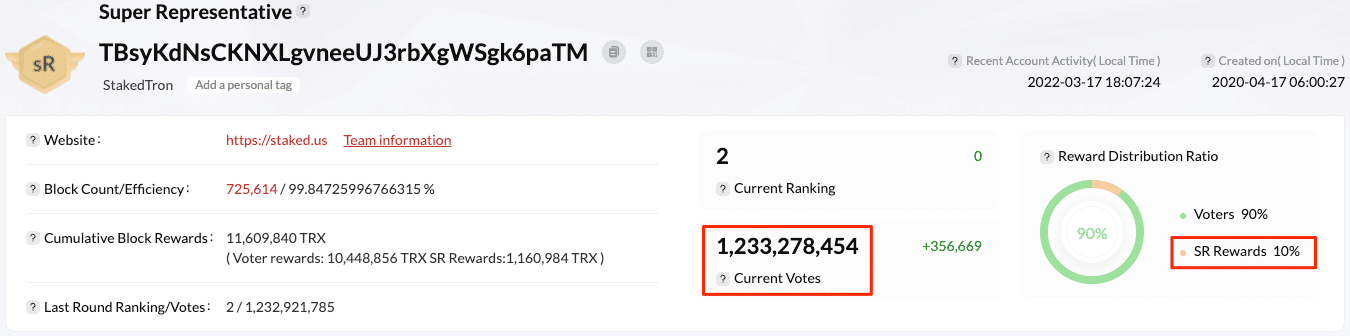
Staking TRON TRX allows you to earn rewards on your TRX tokens while helping to secure the TRON network. TRON uses a DPoS mechanism, where users stake TRX in order to vote for Super Representatives (SRs) who are responsible for validating transactions and maintaining the network. SRs produce blocks and pack transactions, for which they receive block rewards and voting rewards. At the same time, SR partners only receive voting rewards without performing the two tasks mentioned above.
How Does TRX Staking Work?
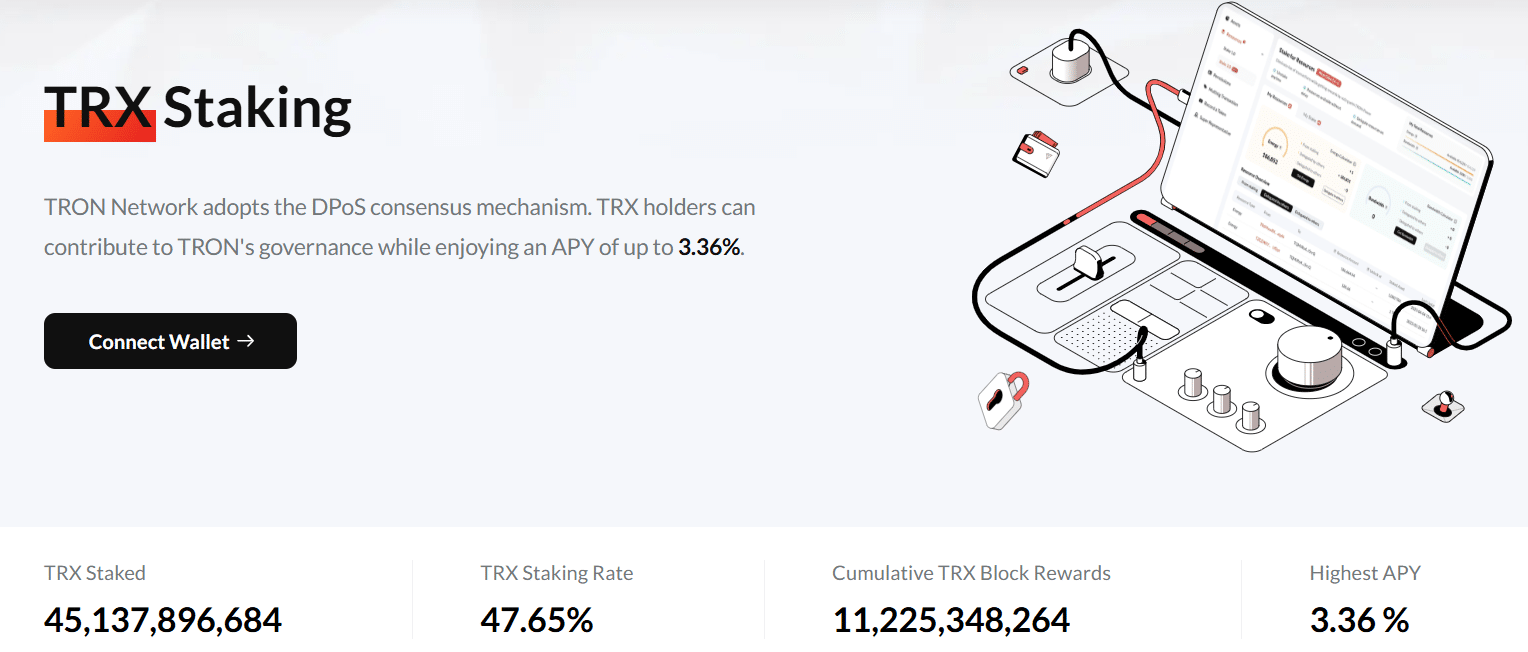
Every TRON account can vote for Super Representative (SR) candidates, but the network only counts your most recent vote, i.e., each new vote replaces the previous one. Votes are tallied every six hours. The top 27 candidates become Super Representatives, those ranked 28–127 are Super Partners, and all others remain SR candidates.
The TRON network produces a new block roughly every three seconds. Each block awards 16 TRX to the SR responsible for producing it. In addition, TRON distributes 160 TRX in voting rewards per block among the top 127 nodes, with the amount each node receives determined by the number of votes it has. Both SRs and Super Partners share a portion of these rewards with their voters, based on each voter’s share of total votes for that node and after the node’s commission rate is applied.
When an SR completes block production, the rewards are first deposited into a sub-account in the superledger. SRs can view these rewards but cannot use them immediately. Once every 24 hours, an SR may withdraw the accumulated rewards from the sub-account into their main account.
Super Representatives earn TRON staking rewards from both block rewards and voting rewards, and each SR sets its own brokerage ratio (commission rate). The default is often 20% for the SR, meaning 80% is shared with voters, although this can vary depending on the SR. Voter payouts are calculated based on the SR’s commission, the node’s total votes, and each voter’s individual voting weight, all publicly viewable on-chain.
Under the current incentive model, voting rewards total roughly 4,608,000 TRX per day, distributed across the top 127 nodes according to their vote share. Block rewards amount to a theoretical maximum of 460,800 TRX per day, divided among the 27 SRs responsible for producing blocks.
Two crucial resources ensure smooth transaction processing within the TRON network: bandwidth and energy. The former represents the ability to perform transactions on the TRON network. Users earn bandwidth points by staking TRON, enabling them to execute transactions without incurring high fees. The latter is allocated for running smart contracts, as when users interact with decentralized applications (dApps) or execute smart contracts, they need TRON staking energy. Users need it to execute smart contracts on this blockchain, and staking builds their energy reserves.
As we can see, staking this coin offers many benefits, like earning passive income, reducing transaction fees with energy and bandwidth, protecting the network, and participating in governance. And while you’re at it, discover the top Tron dApps in our easy guide.
Best Platforms for Staking TRON
Many crypto staking platforms offer staking services for TRX; all of them have their own pros and cons. We have reviewed each one below.
Best Wallet – Best Self-Custodial Wallet For Staking
Best Wallet is a powerful mobile-first crypto staking platform designed for users who value privacy, flexibility, and high yields. Available on iOS and Android, the app offers a sleek, beginner-friendly interface that makes it easy to stake thousands of tokens across 60+ blockchains.

Unlike centralized platforms, Best Wallet is self-custodial, meaning users retain full control of their private keys. This is a major advantage for those prioritizing security, especially as staking happens directly on-chain via a built-in aggregator, featuring the best APYs in real-time.
One of Best Wallet’s standout features is its dynamic staking dashboard. Whether you’re staking blue-chip tokens like ETH or exploring crypto presales launchpad tokens with high APYs, the app provides flexible lock-up options and transparent validator data to help you make informed decisions. Additionally, the $BEST native token boosts rewards and offers early access to new staking projects.
The platform also supports anonymous fiat onramps, letting users buy crypto with cards, e-wallets, or bank transfers without KYC, although certain transaction limits may apply. The privacy-first approach is great for user autonomy, but it can be a drawback if you lose access to your device without backing up your passphrase, as there’s no recovery help. Still, strong security features like PINs, biometrics, 2FA, and phishing alerts make Best Wallet one of the safest ways to stake and store crypto.
Find our in-depth Best Wallet Review 2026 here for more.
TRON’s Official Site – Top TRON Staking Site in 2026
TRON’s official staking platform offers direct, on-chain access to energy, bandwidth, and governance rights through its Stake 2.0 system. By staking TRX tokens, users access valuable network resources that help reduce transaction fees and enable participation in Super Representative (SR) voting. One of the strengths of staking on the TRON network is its integration into the protocol itself, as no third-party intermediaries are needed. Everything from staking to delegating resources can be done directly via wallet interfaces or APIs.

Another significant advantage is resource delegation: users can delegate unused Energy or Bandwidth to other wallet addresses once staked, allowing for more flexible network utility. However, it’s worth noting that voting rights (TP) cannot be delegated, which may limit shared participation in governance. Additionally, only external addresses can receive delegated resources, and these delegations can be optionally time-locked.
A notable feature is the TRON Power (TP) reclamation logic, which automatically adjusts a user’s voting rights when they unstake TRX. While this maintains balance in the voting system, it can unexpectedly reduce influence across multiple SRs if users aren’t aware of the mechanics. TRON’s Stake 2.0 also includes tools to cancel all ongoing unstaking operations, letting users re-stake instantly without waiting for the 14 days to end. This adds some welcome flexibility for active participants.
Kraken Staking – Best TRX Staking Site For Beginners
Kraken makes staking TRON (TRX) simple, flexible, and beginner-friendly, offering up to 5% APR depending on the staking option you choose. Users can stake TRX through the Kraken desktop site, mobile app, or Kraken Pro platform, with no minimum deposit required. The process is as easy as creating a free Kraken account, buying TRX, and clicking “Earn” to start staking.
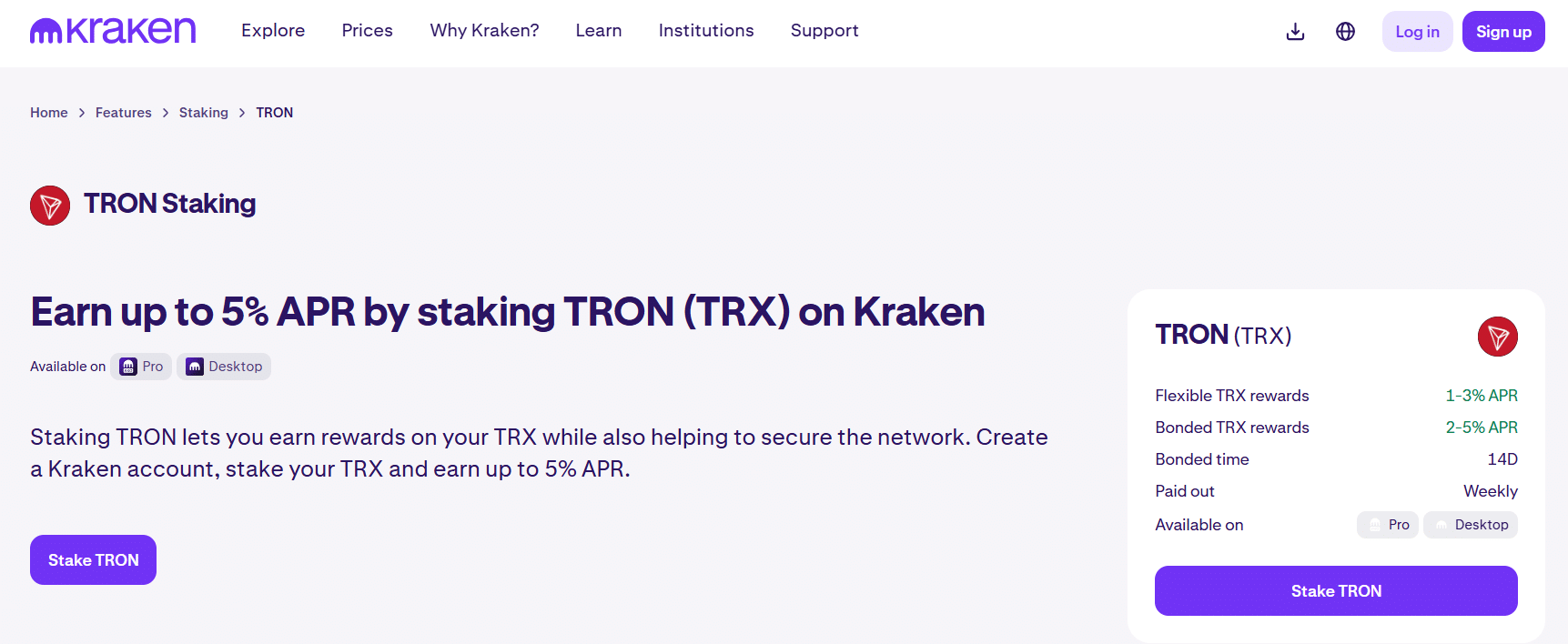
One of the key advantages of staking TRX on Kraken is that users can choose between flexible and bonded staking. Flexible staking allows users to unstake TRX at any time, ideal for traders who want access to their funds without being locked in. On the other hand, bonded staking locks your TRX for 14 days but offers higher potential rewards. This flexibility gives users more control over their earnings strategy, although the tradeoff is that bonded rewards take longer to access.
Kraken handles all the technical staking backend for you, making it especially attractive for those new to staking or not comfortable interacting with wallets and validators. However, since staking through Kraken is custodial, users must trust the platform to safeguard their assets. While Kraken is widely regarded for its strong security, it’s important to note that you won’t retain direct ownership of your private keys when staking through the exchange. Check out our Kraken exchange review 2026.
Rewards on Kraken are paid out weekly, and the platform provides a staking calculator to help you estimate your future earnings based on the TRX price and staking term. Additionally, Kraken Pro users can combine staking with trading tools, margin options, and access to perpetual futures, all from a unified interface. This ecosystem makes Kraken a solid option not only for staking but for managing a broader TRX portfolio with convenience and speed.
Binance – Most Popular Staking Platform For TRON
Binance offers a low-risk and convenient way to stake TRON (TRX) through its Simple Earn platform, allowing users to passively grow their crypto holdings while maintaining flexibility. With estimated APRs starting from 1.5%. Binance supports both flexible and locked staking products for TRX. This gives users the choice between instant liquidity or slightly higher earnings through a time-bound commitment. The staking process is fully automated with optional features like auto-compounding and auto-subscribe, making it ideal for users who want to maximize returns without actively managing their portfolio.
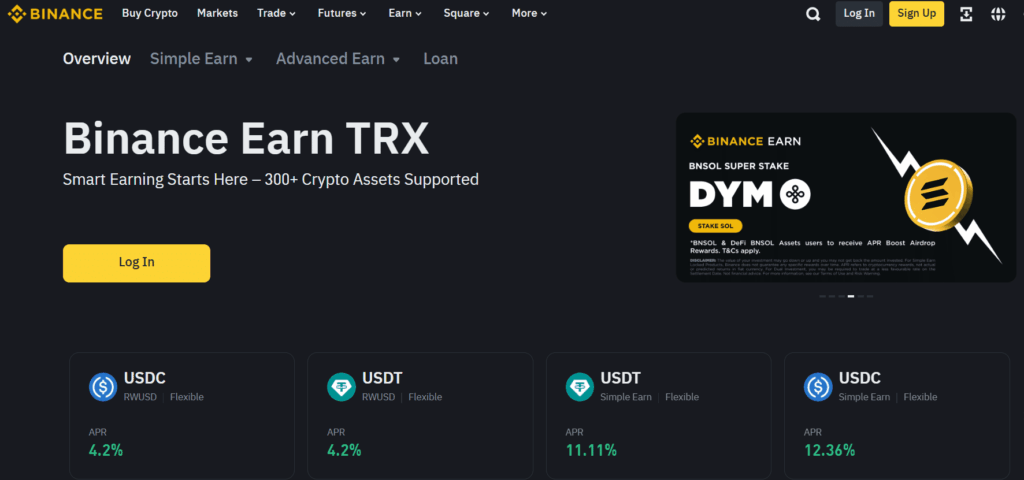
A major strength of staking TRX on Binance is the platform’s ease of use. You can start earning in just a few steps: deposit TRX, choose a staking product, and begin accumulating rewards. With no technical know-how required and no separate wallet setup, even beginners can stake TRON effortlessly. Additionally, Binance supports over 300 cryptocurrencies through its Earn suite, allowing users to diversify their passive income strategies from a single dashboard.
Refer to our Binance Review and Binance Staking guide for more details.
However, staking through Binance does come with trade-offs. While the platform is highly user-friendly, it’s still a centralized exchange, meaning you don’t have control over your private keys. This introduces counterparty risk, and in some regions, staking options may be limited or restricted altogether based on local regulations. Also, while the APR is predictable and principal-protected in Simple Earn, it is generally lower than what you might find through decentralized validators or advanced DeFi staking platforms.
Ledger – Top Hardware Wallet For TRON (TRX) Staking
Staking TRON (TRX) with Ledger is possible through TronScan, even though it’s not yet supported natively in the Ledger Live interface. Users can connect their Ledger device to TronScan via a browser and access the Stake 2.0 dashboard to freeze TRX, allocate resources (Bandwidth or Energy), and vote for Super Representatives. The process offers a secure and direct way to participate in TRON staking while keeping full control of your private keys, as all transactions must be signed on the Ledger device itself.
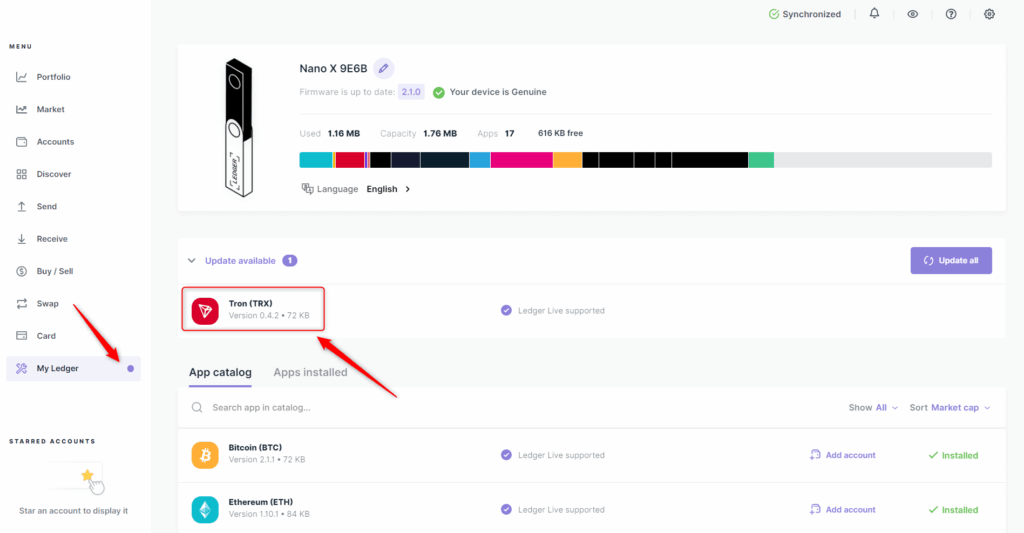
One key benefit is that staking through TronScan gives you full access to the TRON network’s on-chain governance, including earning TRX rewards through voting. The platform also supports dynamic resource management under Stake 2.0, meaning you can reallocate Bandwidth and Energy without needing to unfreeze your TRX. However, a few downsides exist: Ledger Live currently doesn’t support Stake 2.0 directly, and staked balances won’t appear in your app interface. Unstaking also requires a 14-day waiting period, and rewards are not guaranteed. Still, for users who value cold storage security and want direct access to TRON’s full staking features, using Ledger with TronScan remains a powerful combination.
Power Users, This One’s for You
TRON offers low fees and fast rewards, but what if you’re ready to explore even bolder staking opportunities? Don’t miss our curated list of the 13 Best Crypto Staking Coins. It is a must-read for any investor looking to go beyond the basics and stake with crypto strategies to make money.
How to Stake TRON (Step-by-Step for Different Methods)
Let’s explore the different methods for staking your TRON with these step-by-step guides:
You can take this route of TRON staking via TronLink Wallet because it’s best for decentralization and voting power. Staking TRON via TronLink Wallet
Set up TronLink Wallet & acquire TRX
TronLink is one of the best TRON wallets, so if you haven’t yet, sign up for a TronLink Wallet account and fund it with TRX.
Navigate to the staking section & select a Super Representative
Open the staking menu in the wallet and find SRs.
Freeze TRX & vote for your chosen representative
Freezing TRX for bandwidth lets you send TRX without transaction fees, while freezing TRX for energy allows you to transact with TRC20 tokens and TRON smart contracts fee-free. Then, vote for an SR.
Claim rewards & reinvest for compounding
Occasionally claim rewards, which you can reinvest to optimize earnings through compound staking.
In case you want a simple staking process, this is the step-by-step method you need to follow. Track your rewards and unstake if needed: Monitor your staking rewards on the exchange. Remember that flexible staking allows you to withdraw whenever you want, whereas locked staking requires you to wait until the staking period ends to withdraw your TRON. Also, centralized exchanges provide lower yields compared to liquid staking. Staking TRX Through Crypto Exchanges
Pick a crypto exchange
Find a reputable crypto exchange, like Kraken or Binance, offering TRX staking with flexible or locked staking options. They allow for easy setup, automating the process without requiring users to manage votes or freezing.
Fund your exchange wallet with TRX
Buy or transfer from your external crypto wallet.
Visit the staking section on the exchange
Find TRX staking options and choose between flexible or locked staking. However, remember a drawback here – unlike self-custodial staking, you don’t have full control over your assets.
Stake your TRON
Enter the amount you wish to stake and confirm the transaction. Some platforms allow you to choose different lock-up periods with varying APYs.
Staking TRON via any DeFi platform is quite flexible. Follow this guide. Tron Staking via DeFi Platforms
Pick a DeFi platform
Choose one that supports TRX staking or liquidity provision. With liquid staking, users can stake their TRX while still being able to use them for other purposes. Also, they receive bandwidth/energy in exchange, which can be rented to other users for a fee, generating extra income.
Connect your wallet and fund it
Pick a non-custodial wallet that supports TRON staking and connect it to the platform. Deposit TRX into the staking contract or liquidity pool.
Choose between staking or providing liquidity
Staking allows users to lock up their TRX to support the network and get rewards in exchange. At the same time, liquid staking enables users to stake their TRON tokens while still being able to use them for other purposes, like investing or trading.
Track rewards and risks
TRON staking rewards can be variable due to network conditions and fluctuating APY. Still, check for smart contract audits and be aware of potential risks, like rug pulls or protocol failures.
If needed, unstake or withdraw liquidity
You can always unstake your TRX or withdraw liquidity, considering possible withdrawal fees, cool-down periods, or impermanent loss impacts on your final balance.
We recommend reading our How to Buy Tron (TRX) guide before proceeding.
TRON Staking Rewards & APY: How Much Can You Earn?
Super Representatives (SRs) currently earn up to 16 TRX per block under TRON’s reward model. With a new block produced roughly every 3 seconds, this corresponds to a theoretical maximum of around 460,000 TRX in block rewards per day, distributed across the 27 SRs who take turns producing blocks. The actual amount earned varies depending on block timing and whether an SR misses any blocks.
As a voter supporting one of these SRs, your individual rewards depend on your share of the SR’s total received votes and on the SR’s own productivity and brokerage (commission) rate.
In addition to block rewards, TRON allocates a voting reward of 160 TRX per block, which totals roughly 4.6 million TRX per day under ideal network conditions. These rewards are distributed among the 27 SRs and the 100 SR Partners (SRPs) according to how many votes each receives.
Voters can earn a portion of these rewards as well, based on the proportion of votes they contributed to a given node and the payout policy chosen by that SR or SRP. Because reward structures and payout percentages vary across nodes, returns for voters can differ significantly.
A candidate can earn rewards only if the SR candidate they vote for is among the top 127 in terms of received votes.
Let’s compare the latest APY rates for staking TRX. For the estimations, we’ve considered the TRX price of $0.246062.
| Platform | APY | Earning simulations for 1,000 TRX staked | Earning simulations for 10,000 TRX staked | Earning simulations for 100,000 TRX staked |
| TRON’s official site | 4.47% | $11.04 | $109.99 | $1,099.90 |
| Kraken | 6% | $14.76 | $147.64 | $1,476.37 |
| Binance | 6.91% | $17 | $170.03 | $1,700.29 |
| Atomic Wallet | 5% | $12.30 | $123.03 | $1,230.31 |
| Ledger | 5% | $12.30 | $123.03 | $1,230.31 |
But TRON staking isn’t just about earning rewards; it’s also about maximizing those rewards through compounding. Compounding means earning interest on the principal investment amount and any accumulated rewards or interest over time. It’s a powerful wealth-boosting strategy since reinvesting your staking rewards/earnings leads to faster portfolio growth.
How to Choose a Super Representative for High TRX Rewards
The top 27 validators, in terms of the number of votes received, are referred to as Super Representatives. They validate network transactions and earn voting and block rewards. That’s why finding the right super representative is crucial. You will have to consider several factors when picking one:
According to Alex Svanevik, Nansen CEO, joining the TRON Super Representative program aligns with their goal of making blockchain data more understandable. He stated,
We look forward to supporting TRON’s governance and ecosystem growth with our analytics expertise.
To monitor the SRs’ performance, visit the TRONSCAN page. It offers data on the blocks produced and missed, productivity, and more. The page also allows you to unvote the old SR and assign votes to a new one.
TRON Staking vs. TRX Liquidity Mining: Profitable Strategy
| Features | Staking | Liquidity Mining |
| Meaning | Holding a crypto in a wallet to validate transactions and support network security, earning rewards in return | Providing liquidity to a DEX and earning rewards in exchange |
| Reward Potential | Lower rewards | Higher rewards |
| Risk Management | Safer option as it involves holding a digital asset in a wallet | Riskier alternative since it involves offering liquidity to a particular crypto to drive its liquidity up |
| Complexity | Relatively simple | More complex |
| Timeframe | Since cryptocurrencies are locked up for a specific period, this is a long-term investment | Since users can provide liquidity for a shorter period, this can be a short-term investment |
Staking is generally safer than liquidity mining, including holding digital assets in a wallet to protect the network. Liquidity mining is riskier since it provides liquidity or moving assets among liquidity pools, exposing assets to impermanent loss.
If you want to invest long-term and don’t mind being required to lock up your cryptocurrency for a certain period, staking is the better option. While liquid mining is better for liquidity or lending/borrowing for a shorter period.
You can optimize your TRX earnings by strategically staking TRX to earn passive income while benefiting from transaction fee reductions and securing the network. Alternatively, you can simultaneously engage in liquidity mining for higher but riskier returns.
How to Unstake TRON (TRX)?
Unstaking TRX requires a 14-day waiting period after submitting an unstaking request, during which your TRX remains locked. TRON itself does not charge any unstaking fees or penalties, but if you staked TRX through a centralized exchange (CEX) like Binance or Kraken, there may be withdrawal fees or reduced rewards for early unstaking. If you participated in DeFi liquidity pools, be aware of potential impermanent loss, withdrawal slippage, or transaction fees when exiting. Ledger is another great option.
The best time to unstake TRX depends on APY rates, market conditions, and Super Representative (SR) performance. If staking rewards decline, you might consider unstaking to seek higher-yield opportunities. Market conditions also matter; unstaking before a TRX price surge ensures you can sell at peak value, while in a bear market, holding may be a safer option. Additionally, switching to a more reliable SR could maximize your rewards if your SR increases fees, has excessive downtime, or loses ranking. Finally, unstaking during low network congestion can help avoid delays and high transaction fees.
Step-by-Step Guide to Unstaking TRX Coins
1. Visit TRONSCAN and choose ‘Connect Wallet.’
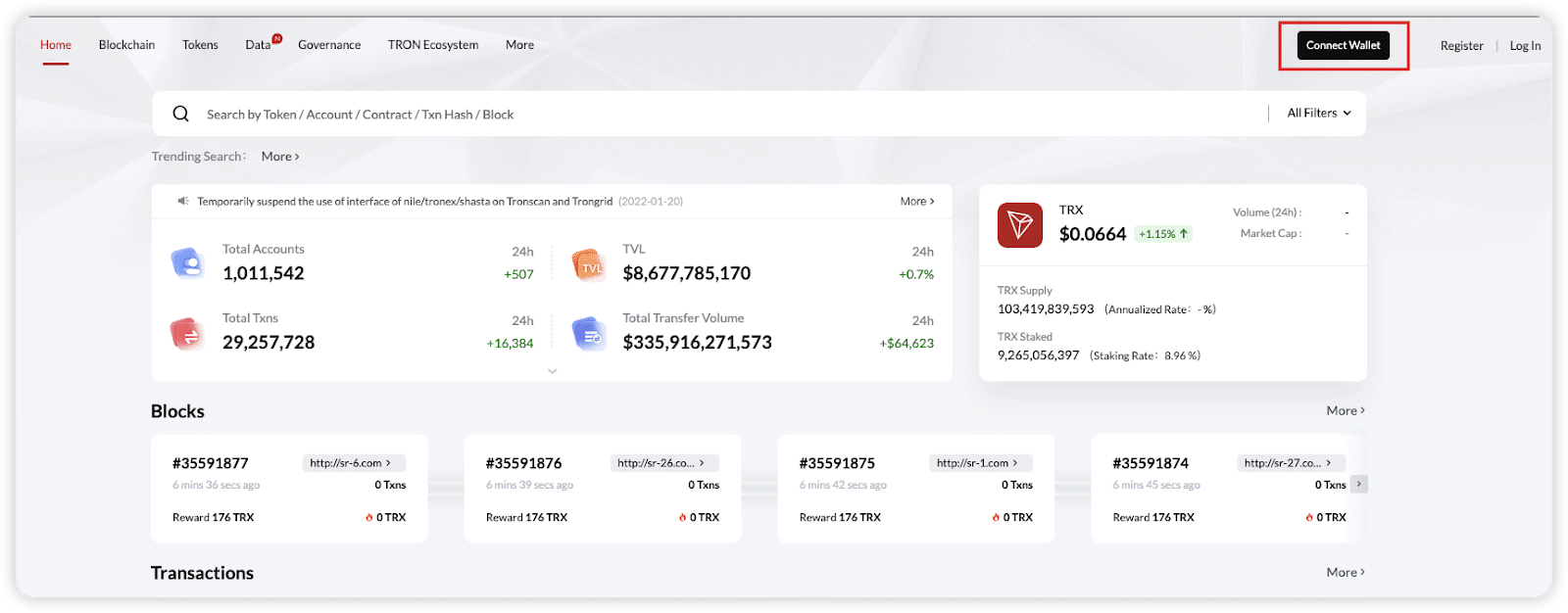
2. Go to your wallet address, and then click ‘>’ to the right of ‘Resources,’ which will take you to the ‘Stake 2.0’ page.
3. Click ‘Unstake TRX’ on the ‘My Stake’ tab.
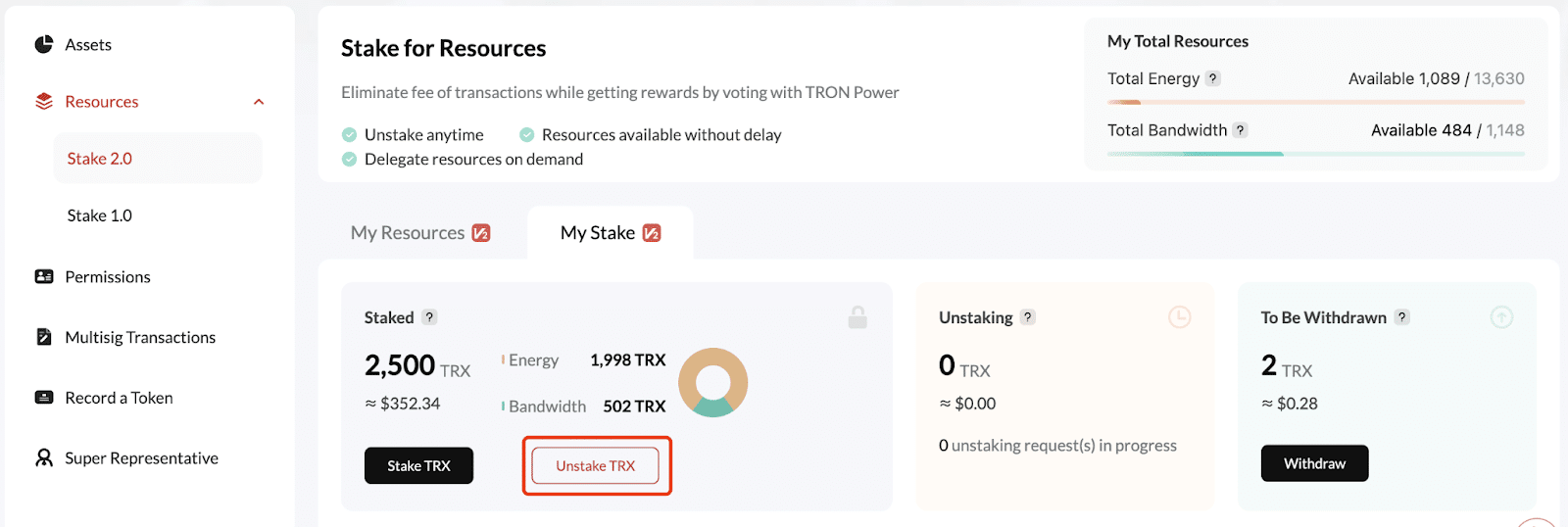
4. In the window that appears, enter the amount of TRX you want to unstake and choose ‘Unstake.’ Next, log in to your TronLink wallet to submit the transaction.
5. After the transaction submission and confirmation, you need to wait several days for unstaking before you can withdraw.
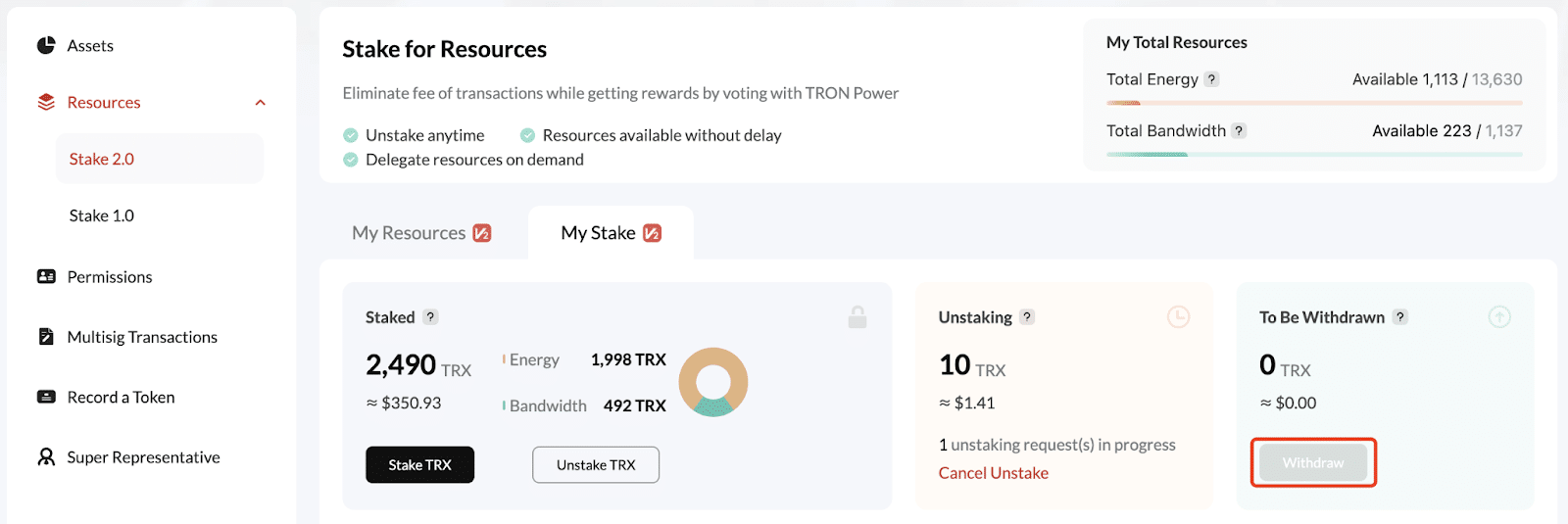
6. After the pending period, you can see the amount of TRX available for withdrawal in the ‘To Be Withdrawn’ section. Pick ‘Withdraw’ and confirm. Then, log in to your TronLink wallet to submit the transaction.
7. After the transaction submission and confirmation, the TRX will be automatically withdrawn to your account.
Risks of TRON Staking & How to Minimize Them
Future of TRON Staking: What’s Coming Next?
The future of TRON staking is promising, with many development plans. Nansen’s recent appointment as an SR will enhance Web3 and blockchain transparency and governance, potentially impacting staking participation and rewards.
There are also many optimistic projections for TRX staking APY in the coming year. For example, staking this coin currently offers yields of around 3-6% APY. However, as the network implements fee reductions and governance enhancements, these returns could potentially increase, making staking this token an even more appealing opportunity for investors.
Conclusion
TRON (TRX) remains one of the most accessible and flexible staking opportunities in crypto. Its Delegated Proof-of-Stake system lets you lock up even a small amount of TRX and earn passive rewards, while helping secure the network. In 2025, TRON staking typically offers ~3–7% APY, depending on the SR you choose, the total stake, and network conditions.
For many users, especially beginners or those holding TRX long term, this steady yield, combined with the ease of delegation and low entry barrier, makes TRON a solid choice for both passive income and long-term holding. That said, TRON isn’t a “set and forget” kind of investment. Your returns depend heavily on SR productivity, voting dynamics, and network factors. And if you’re looking for higher yields or prefer more diversification, it might be wise to compare TRON staking with other staking coins before committing.
Ultimately, TRON offers a compelling entry point into staking and crypto governance: simple to use, modest but consistent rewards, and a major blockchain ecosystem behind it. As long as you stay aware of the variables, staking TRX remains a sensible option in 2025 and beyond.
See Also:
- Tron Review 2025: What is TRX Crypto?
- Tron (TRX) Price Prediction 2025 – 2030
- Best Tron dApps in 2025: Top TRX Projects Reviewed
- Best TRC20 Wallets in 2026
FAQs
How much can I earn staking TRON?

You can typically earn between 3% and 6% annually by staking TRON (TRX), depending on the method and platform you use.
Is staking TRX safe?
Staking TRON is safe, especially if the user keeps control over their private keys.
What is the staking rate for TRX?
The average staking rate for TRON ranges from 3.3% to 5% annually when staking natively or via wallets. However, some centralized platforms may offer up to 7% APY, depending on terms and lock-up periods.
Can I stake TRON on Binance?
Yes. Compared to other platforms, Binance provides the best TRON staking rewards, with an APY of up to 6.91%.
Can I stake TRX on multiple Super Representatives?
Yes, you can vote for several SRs by using Batch Vote.
Is staking TRX better than providing liquidity?
Staking TRX is usually safer than liquidity mining. If you want to invest long-term and don’t mind being required to lock up your cryptocurrency for a certain period, staking is the better option. Yet, if you want to offer liquidity or lend/borrow for a shorter period, choose liquid mining.
References:
- Gogol, Krzysztof, et al. Empirical and Theoretical Analysis of Liquid Staking Protocols. arXiv, 2024. https://arxiv.org/abs/2401.16353
- Dong, Xinshu, et al. Remote Staking with Optimal Economic Safety. arXiv, 2024. https://arxiv.org/abs/2408.01896
- Cong, William, Ye Li, and Neng Wang. Staking, Token Pricing, and Crypto Carry. Kenan Institute of Private Enterprise, University of North Carolina, 2022. https://kenaninstitute.unc.edu/rethinc/wp-content/uploads/2022/03/Cong-Staking-and-Crypto-Carry.pdf
- Mazieres, David. “The Stellar Consensus Protocol: A Federated Model for Internet-level Consensus.” Association for Computing Machinery (ACM), https://dl.acm.org/doi/10.1145/3211933.3211953

Why you can trust 99Bitcoins
Established in 2013, 99Bitcoin’s team members have been crypto experts since Bitcoin’s Early days.
Weekly Research
100k+Monthly readers
Expert contributors
2000+Crypto Projects Reviewed