




In This Article
“What is yield farming?” sounds like some rural pastime for bored bankers. In reality, it’s one of the sharpest blades in crypto’s DeFi arsenal. Yield farming in crypto isn’t planting seeds and waiting for tomatoes; it’s about throwing your digital assets into smart contracts and squeezing every drop of yield the system will spit out. If Wall Street invented structured products to juice returns, DeFi invented yield farming to turn every coin you own into a potential cash-flow machine.
Of course, everyone wants to know which fields are fertile. The top yield farming platforms in 2026 control billions in total value locked, offering investors the illusion of predictable income with APYs that look like they were dreamed up during a fever dream. But beneath the surface, yield farming is both an opportunity and a landmine, depending on whether you understand the game or get rekt by it.
Key Takeaways
- Yield farming in crypto turns idle tokens into yield by locking them into DeFi protocols, often with high but volatile returns.
- Top yield farming platforms manage billions in TVL, but “high APY” usually comes with equally high risks, smart contract exploits, market crashes, and good old-fashioned greed.
- Strategies range from simple liquidity pools to exotic leverage plays, all designed to milk more yield than staking or hodling.
- The risks of yield farming are as important as the rewards: impermanent loss, rug pulls, and liquidity drying up overnight.
- Yield farming isn’t passive income; it’s active speculation wearing a “fixed income” disguise.
Yield Farming in DeFi: Summary
Yield farming in crypto has gone from fringe experiment to one of DeFi’s most lucrative (and dangerous) pastimes. This guide breaks down what is yield farming in DeFi, how it works, and the strategies investors use to squeeze returns from liquidity pools and smart contracts.
We’ll explore the different types of farming from liquidity pool farms, staking, insurance mining, arbitrage mining, even NFT yield farming, alongside the risks and rewards hiding behind those mouthwatering APYs. Expect a no-BS look at yield farming platforms, the protocols currently leading the rankings, and the key numbers like TVL and APY that drive this market.
For beginners, we’ll also outline exactly how to yield farm: from providing liquidity on a DEX to navigating yield farming projects with leverage. Finally, we’ll compare yield farming to other ways of earning in crypto (staking, lending, and just hodling) to decide if this DeFi hustle is worth your time or just another game of musical chairs.
What is Yield Farming?
Strip away the buzzwords and what is yield farming crypto really about? It’s the DeFi hustle where you put your tokens into a protocol’s liquidity pool or staking contract, and in return, you get rewarded with more tokens. Simple in theory, chaotic in practice.
Think of crypto yield farming as the decentralized cousin of depositing dollars in a high-yield account except instead of some banker in a suit managing risk, you’ve got code, smart contracts, and the collective greed of crypto traders pulling the strings. According to researcher Lorenzo Schönleber
Yield farming is a decentralized finance strategy in which liquidity is provided in exchange for rewards in the form of transaction fees paid by liquidity takers.
At its core, yield farming in DeFi means becoming a liquidity provider. You supply assets to a protocol, say USDC and ETH into a DEX, and the project incentivizes you with fees, governance tokens, or sometimes freshly minted magic internet money. Those incentives are why yield farming projects routinely promise APYs that make TradFi blush.
But don’t get it twisted. Yield farming isn’t passive. It’s a rotating game of cat and mouse: farmers chase the highest yields, protocols fight to attract liquidity, and everyone hopes the music doesn’t stop while their funds are still locked.
How Does Yield Farming Work?
So, how does yield farming work when you strip it down to the mechanics? “Plain and simple”, you’re locking tokens inside a yield farm smart contract. That contract funnels your assets into a pool, where they’re used for trading, lending, or other DeFi wizardry. In exchange, you earn a cut of the fees plus extra rewards the protocol throws in to keep you hooked.
Most of the action happens on decentralized exchanges. How yield farming works on DEXs is straightforward: traders swap tokens, pay fees, and those fees are distributed back to the liquidity providers. Toss in governance tokens or bonus rewards, and suddenly the APY looks like something out of a Ponzi dream. That’s yield farming APY explained: the more trading activity and incentive payouts, the higher the advertised return.
To start, you have to learn how to provide liquidity in DeFi. This usually means depositing two assets of equal value, say ETH and USDC, into a liquidity pool. The protocol then gives you LP tokens, which represent your share of the pool. Those LP tokens can be staked, farmed, or used as collateral in other protocols, creating an endless daisy chain of yield opportunities.
The system works because liquidity providers take the risk, and protocols dangle rewards. But as we’ll see, chasing yield is less like clipping bond coupons and more like playing musical chairs with leverage and code.
Types of Yield Farming
Yield farming is a toolbox of DeFi yield farming strategies built on different market mechanics. The common thread: a yield farm smart contract paying you for providing some mix of liquidity, time, and risk. Let’s dive into the different flavors.
Liquidity Pool or LP Farms
You add two assets to an AMM pool, say ETH/USDC, so traders can swap. You earn:
- Swap fees (e.g., 0.05%-0.3% on many DEXs).
- Token incentives (governance/emissions).
- Sometimes gas rebates or “points.”
How it actually works: AMMs like Uniswap V2 use the constant-product rule 𝑥⋅𝑦 = 𝑘. When price moves, the pool rebalances against you. That creates impermanent loss (IL): the drag versus just holding. If price doubles (r = 2), the IL formula gives ~ –5.72%. Fees can offset this, but only if volume is high and your range stays active.
Uniswap v3 made LP positions price-range NFTs. You earn higher fees by placing liquidity in a tight band, but if the price leaves your band, you stop earning and hold only one asset. Range management (rebalancing) adds gas cost and timing risk. That’s where vaults and “autocompounders” step in to rebalance for you, great until volatility nukes the range.
Stake Farms
You lock one token and earn rewards. Cleaner UX, simpler accounting, fewer moving parts.
Flavors:
- Protocol staking: Stake the protocol’s token to earn emissions or a fee share.
- ve-tokenomics: Lock for time, get veTKN voting power. Vote on gauges to direct emissions to certain pools. Voters get bribes from projects bidding for liquidity.
- Auto-compounders: Vaults harvest rewards, sell to base asset, restake. Great until rewards dry up or the vault strategy breaks.
Risks: dilution from emissions, long locks (bad if the token trends down), smart-contract risk, and incentive rugs when governance moves the goalposts.
Insurance Mining
You supply capital to cover smart-contract exploits, oracle failures, or exchange defaults. In return, you earn premiums and incentive tokens. Think of it as becoming the reinsurer of DeFi.
Mechanics to know:
- Risk tranches: Some protocols bucket risk by protocol, duration, or severity.
- Capacity and pricing: Higher perceived risk, higher premium APR, until the pool fills.
- Claims process: On a valid claim, your capital can be slashed to pay policyholders.
Why yields look juicy: catastrophe risk is real and correlated. One big exploit can erase years of premiums. Read the policy terms, claims governance, and assessor incentives before chasing the APR.
Arbitrage Mining
Protocols need keepers to keep markets honest: update oracles, liquidate unsafe loans, rebalance vaults, or close bad perps positions. Some pay bounties or emissions to whoever does the job first.
Where the edge lives:
- DEX – CEX spreads: Buy where it’s cheap, sell where it’s rich. Compete with low-latency bots. Gas, failed txs, and MEV eat your lunch.
- Peg maintenance: Pool incentives reward traders who push a depegged asset back toward parity (works… until it doesn’t).
- Liquidation racing: Money markets pay a liquidation bonus. Miss a block, and a rival bot takes it.
MEV reality: Searchers use private relays, bundles, and sophisticated routing. If you’re not engineering-grade, stick to safer strategies.
Trade Mining
Protocols pay traders with tokens or points to bootstrap activity. It can be maker-only, taker-heavy, or PnL-weighted to discourage wash trading.
Design levers:
- Maker rebates: Post tight quotes, earn tokens.
- Tiered multipliers: More volume or liquidity time – higher rewards.
- Points seasons – token: Common 2024-2025 playbook. Big carrot, then a cliff.
Where it breaks: If emissions dwarf real fees, volume is mercenary. When rewards end, activity collapses. If you farm this, have an exit plan the second the incentives taper.
Yield Farming Strategies
Below, you will find some strategies that will help you in your yield farming journey.
1. Stablecoin Farming – The “Set It and Check Later” Play Lock up stablecoins like USDC, USDT, or DAI on trusted platforms such as Aave, Curve, or Yearn. You’re earning yield from lending interest and bonus token incentives. 2. Blue-Chip Liquidity Pools – Riding Dual Assets You pair a big-name token like ETH or BTC with a stablecoin in a liquidity pool (1:1 value), usually on DEXs like Uniswap or Sushi. You earn both trading fees and governance rewards. 3. Auto-Compounding Vaults – The Lazy Farmer’s Dream Vaults from Yearn, Beefy, or Autofarm automate your yield: they claim rewards, sell them into the base asset, and add them back into the pool. 4. Cross-Chain Yield Chasing – Go Where the Yield Is Move assets across Ethereum, Solana, Avalanche, or Layer 2s with bridges like Wormhole or LayerZero, hunting juicy APYs in less saturated markets. 5. Governance Token Staking – Bribes & Power Plays Lock up governance tokens (e.g., veCRV or staked ETH) to vote on emission allocations or gauge bribes. You earn yield and control protocol direction.
Benefits & Risks of Yield Farming
Yield farming in crypto looks like free money until you realize the fine print is written in invisible ink. Every extra percent of APY comes with hidden strings, and most farmers only notice when they’re already caught. Here’s the balance sheet, yield farming pros and cons without the brochure fluff.
Benefits Risks
Top 5 Popular Yield Farming Platforms
You want platforms that actually pay, without a side of vapor. Here are the five that matter, written straight, no corporate brochure voice, and grounded in the only sources that count: their own apps and docs.
Aave
If DeFi had a single place where grown-ups park size and still sleep, it’s Aave. You supply blue-chips or stables, earn a clean supply APY, and if you insist on temptation, borrow against it to build a loop. Rates and risk controls aren’t theater; they’re visible, parameterized, and enforced in code. The live app shows the total market size, per-asset supply, and borrow APYs, and collateral settings for each market, so you’re never guessing.
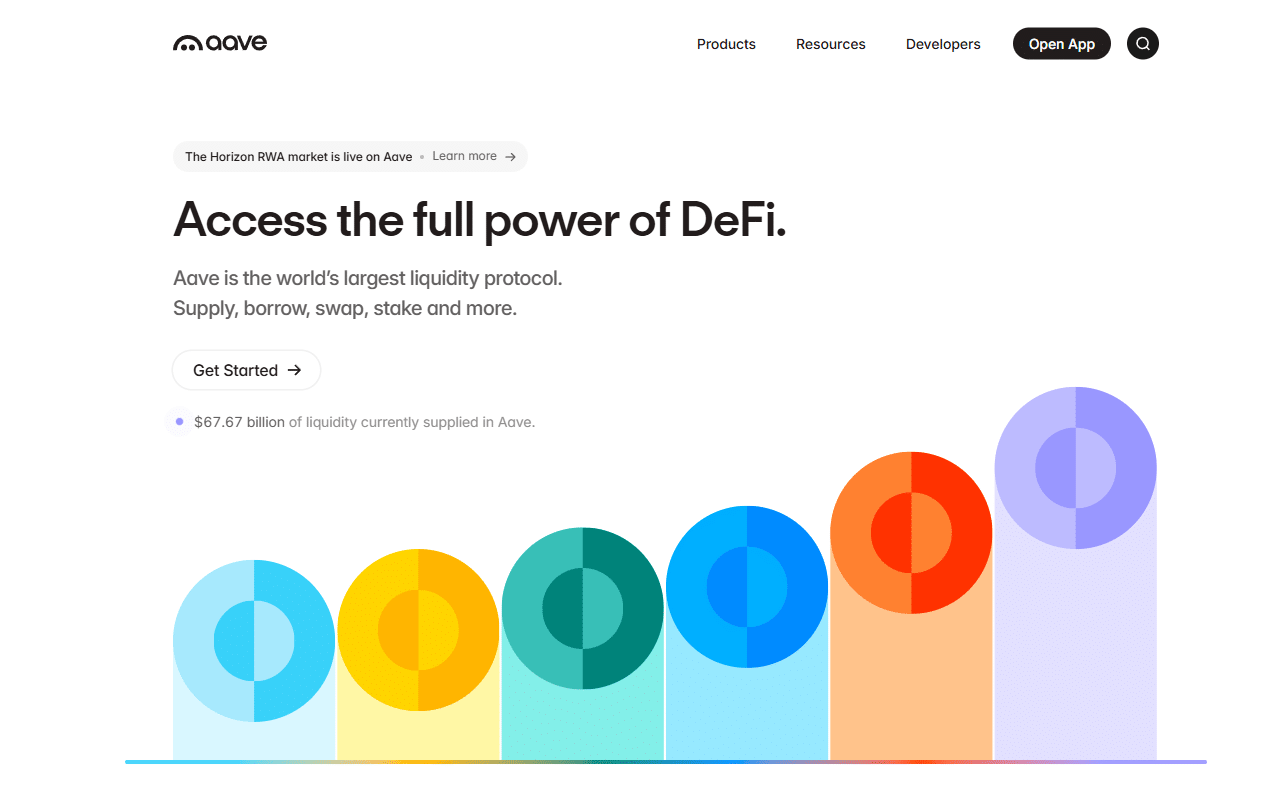
What keeps Aave in every farmer’s toolkit is reliability under stress. E-mode, LTVs, liquidation thresholds, and oracle choices are laid out in the interface and documentation. If you’re farming yield with collateral as your foundation, this is the base layer you sanity-check first. To know more about it, check out our dedicated Aave review.
PancakeSwap
PancakeSwap is the everyday AMM that still prints for BNB Chain natives, and now sprawls across L2s. The play is simple: pair a blue chip with a stable, collect swap fees, and lean into CAKE incentives when they light up a pool. The Info dashboard is the compass; it breaks out TVL and volume by chain so you can chase flow where it actually lives rather than where CT hopes it might.
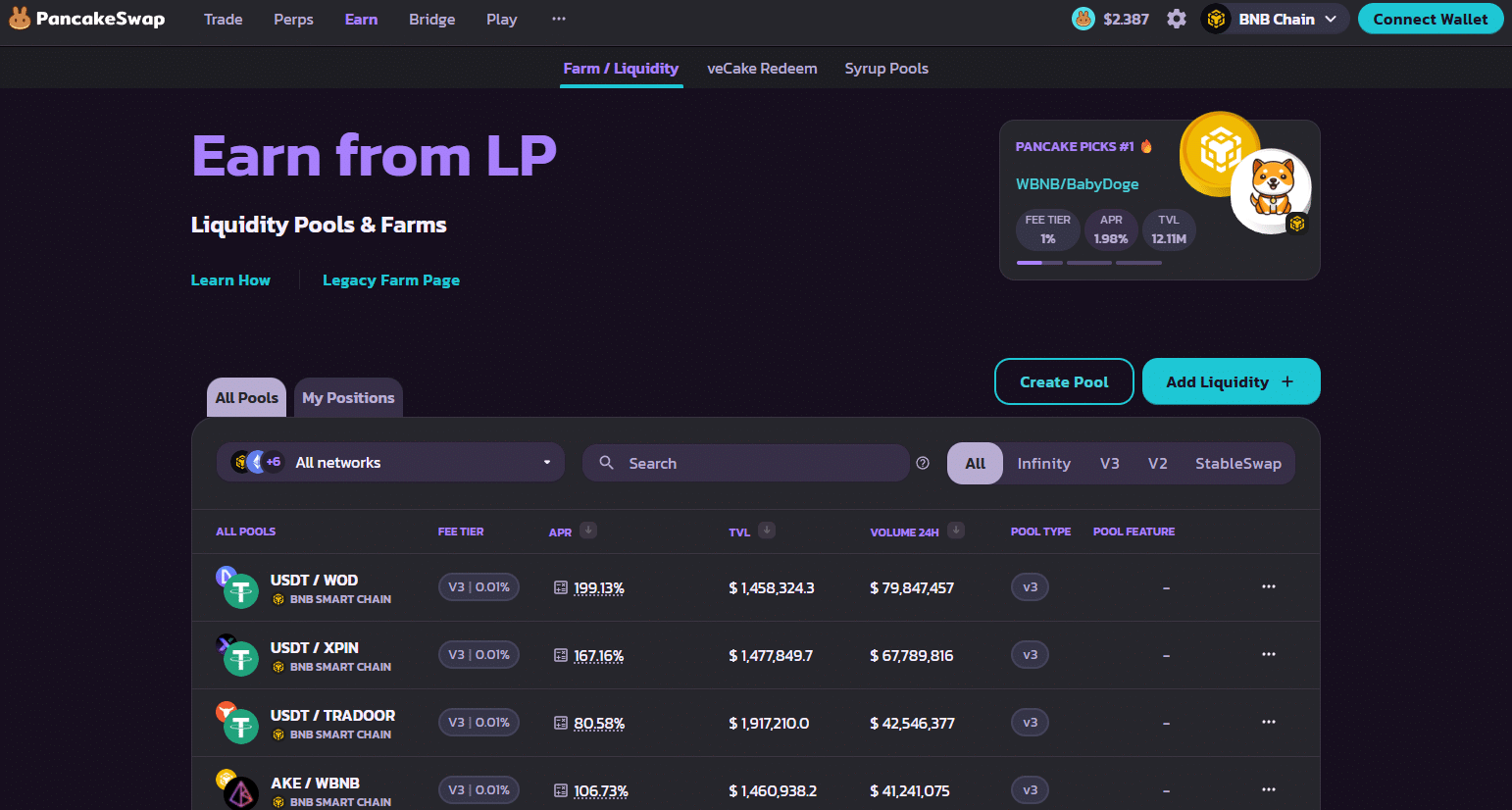
This is why farmers keep circling back: you can evaluate a pool’s depth, recent activity, and chain-specific tempo in one glance before committing capital. No third-hand charts, no stale screenshots, just the protocol’s own analytics. To learn more about this protocol, consider taking a look at our PancakeSwap review.
Curve Finance
When assets rhyme, stables, LSTs, wrappers, Curve is still the place to earn fees without donating your stack to impermanent loss. Pools list live TVL and a variable APY that swells with volume and softens when the market goes quiet. If you want “low-IL carry” rather than roulette, you start with pools whose pegs you actually trust, and Curve shows you the numbers pool by pool.
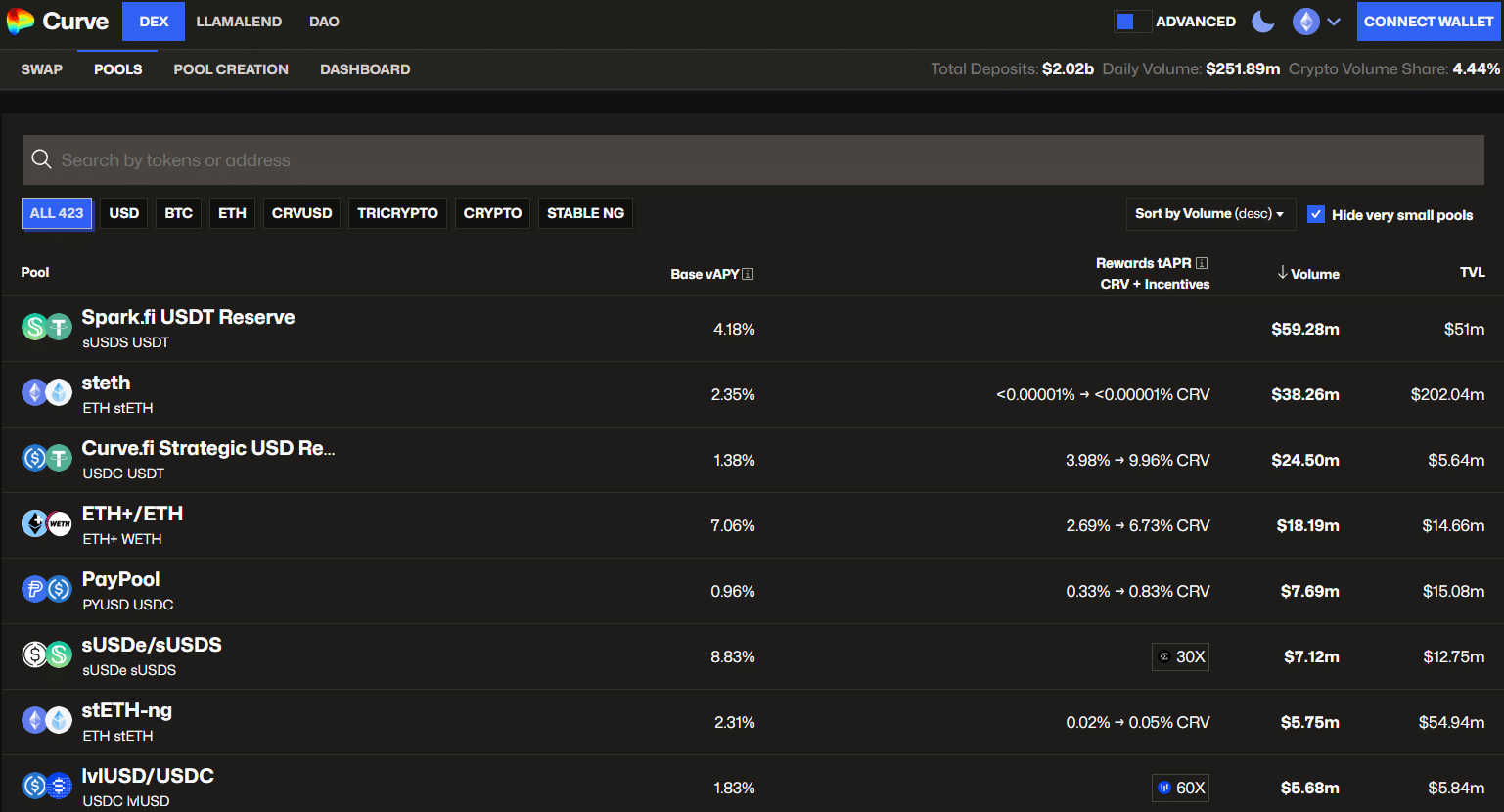
It’s utilitarian by design: efficient swaps for like-pegged assets, predictable fee mechanics, and transparent pool stats in the front end. That mix keeps Curve in rotation for anyone farming with stables or near-pegged pairs. Learn more in our Curve Finance review.
Uniswap
Uniswap turned LPing into a craft. You choose a fee tier and a price range; when the price lives inside your band, you harvest fees with far less capital than the old v2 style required. When it runs away, you earn nothing until you adjust. The fee tiers aren’t folklore, they’re codified: 0.01%, 0.05%, 0.30%, and 1%, with governance having added the 0.01% tier. That structure is public and documented, which is why serious LPs still map their ranges here.
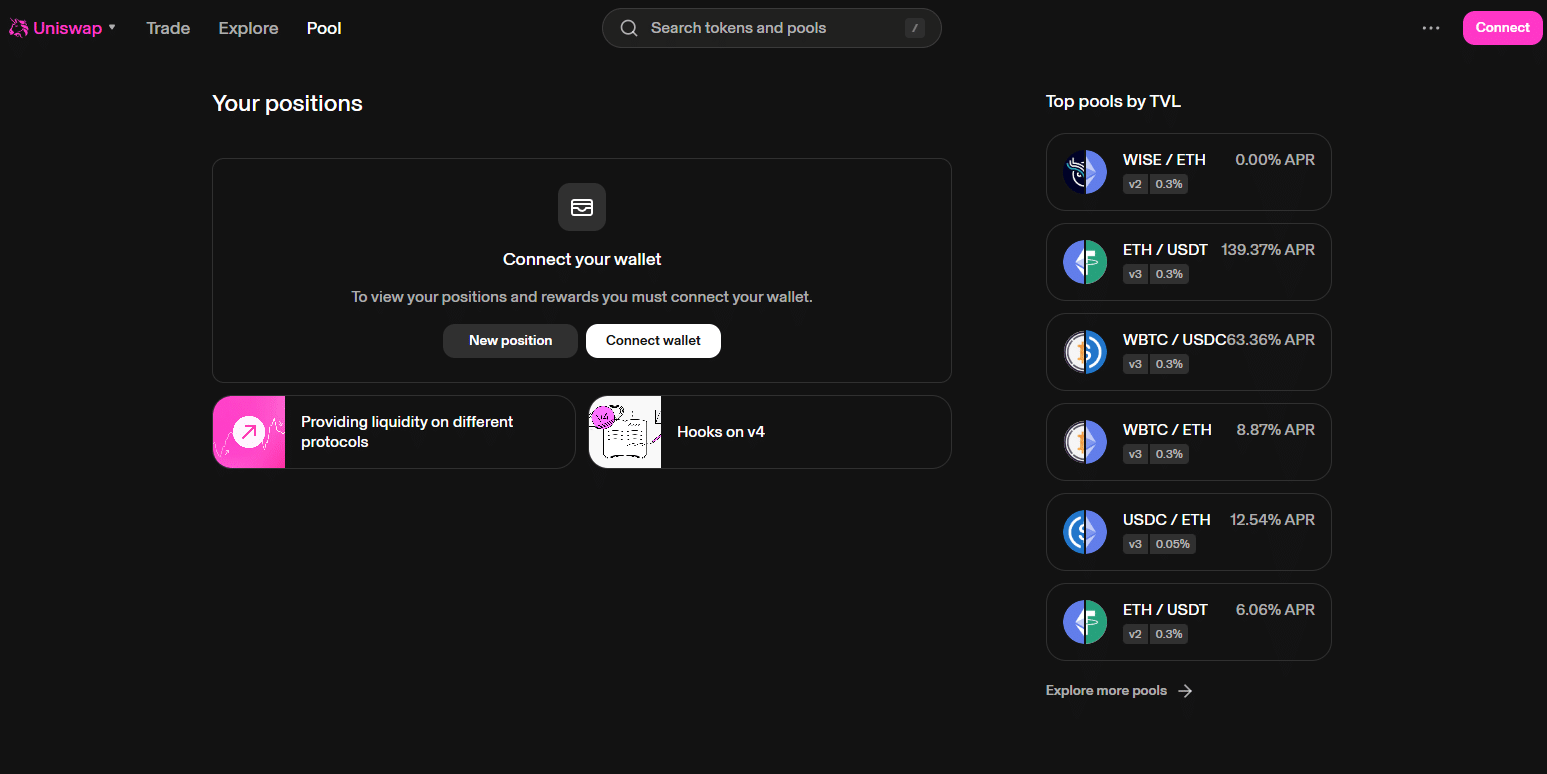
This is the venue for hands-on farmers who prefer fee income over emissions theater. The rules are clear, the liquidity is deep, and the docs explain exactly how tiers and ticks work so you can position with intent. Get to know this DEX better in our comprehensive Uniswap review.
Yearn
Sometimes the right move is to admit you don’t want to babysit farms. Yearn’s vaults automate the grind like harvesting, swapping, and compounding across underlying strategies, so you spend time on risk selection instead of clicking buttons. The app shows per-vault TVL and an estimated APY on the vault tile; the docs break down how those figures are computed, including how Curve-based vaults derive their APY.
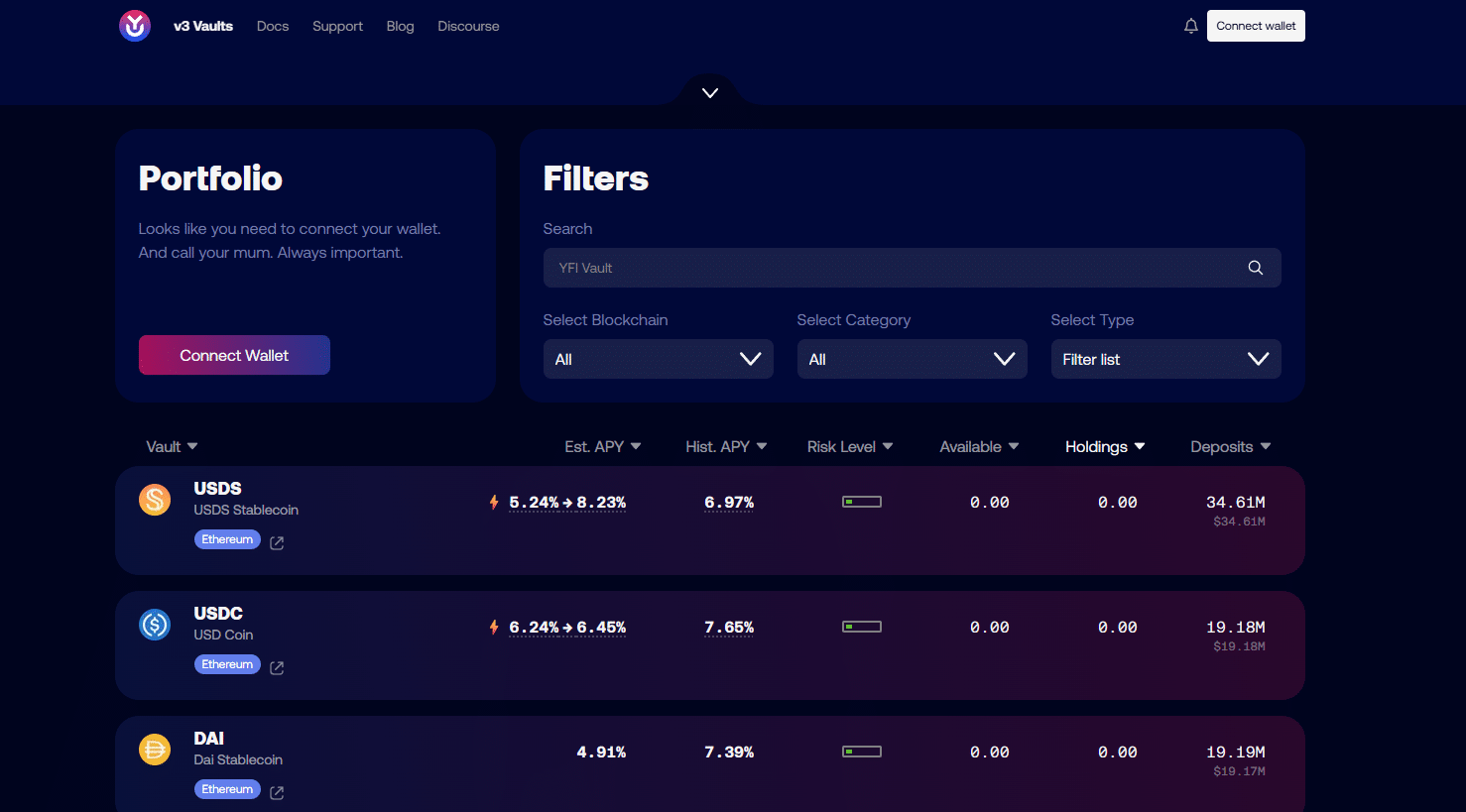
That transparency is the draw. You can verify a vault’s TVL and methodology before depositing, and let the strategy execute while you watch the meter rather than the mempool. It’s the original “set it and verify it” layer for yield farming in crypto.
How to Get Started with Yield Farming: Step-by-Step Guide
-
Choose Your Chain & Wallet
Pick where you’ll farm (Ethereum, Arbitrum, Base, BNB Chain). Use a trusted wallet: Best Wallet & MetaMask for EVM chains; Phantom for Solana. Stick to official download pages only.
-
Add or Verify the Network in Your Wallet
For non-default networks (Arbitrum, Base, BNB Chain), add the RPC and chain ID in Settings – Networks. Cross-check details on the official chain docs before saving.
-
Fund the Wallet
Transfer ETH/BNB and the tokens you plan to farm (e.g., ETH, USDC). Always keep a small gas buffer. Test with a small amount first, then scale.
-
Pick a Reputable Platform
Open the official app of Aave, Uniswap, Curve, PancakeSwap, or Yearn (no look-alike URLs). Check live TVL/APY in the interface, not screenshots. If anything feels off, stop.
-
Approve the Tokens
Click “Approve” so the protocol can use your asset. Use the minimal allowance when possible. Each approval costs gas; confirm the spender address is the protocol’s contract.
-
Provide Liquidity or Make a Deposit
LP route: select a pair (e.g., ETH/USDC) and deposit an equal value of each; receive LP tokens in return. Lending/vault route: supply a single asset (e.g., USDC to Aave or a Yearn vault).
-
Stake LP Tokens
Some farms pay only when LP tokens are staked in a rewards contract. Hit “Stake,” confirm, and verify the rewards meter starts moving.
-
Set Safety Rails, Alerts & Limits
Track PnL versus simple holding, not just headline APY. Set price alerts for your pair, watch health factors if you borrow, and bookmark the protocol’s status page and docs.
-
Claim & Compound on a Schedule
Decide how often to claim rewards. Small, frequent claims waste gas; long delays risk price swings. Many farmers compound weekly or when fees cover gas comfortably.
-
Exit Cleanly, Unstake → Remove Liquidity → Swap
Unstake LP tokens (if staked), remove liquidity, and swap back to your target assets. Leave a little native token for final gas. Revoke any lingering token approvals afterward. -
Optional: Bridge Between Chains
If the best farm lives on another network, use a reputable bridge. Move a small test first, then the rest. Remember: bridges are powerful and a common failure point. -
Optional: Pair with a Hardware Wallet
For larger positions, connect a Ledger or Trezor. Transactions must be confirmed on the device, keeping your private key off the browser entirely.
Yield Farming vs. Other Crypto Earning Methods
Yield farming isn’t the only way to make your coins sweat. You’ve got staking, lending, and the monk’s path: HODLing. Each pays you differently and punishes different mistakes. This section cuts through the marketing and stacks them side by side so you can choose the grind that actually fits your risk.
Yield Farming vs. Staking
Staking pays you for securing a network. Predictable, chain-level, and usually dull in the best way. Yield farming pays you for providing liquidity or capital to protocols. Dynamic, market-driven, and moody. Staking returns come from block rewards and fees. Farming returns come from swap fees, lending interest, and incentives. If you want set-and-forget, staking wins. If you want active management with higher upside and sharper drawdowns, yield farming takes the crown. This is the staking vs. yield farming fork in the road: stability versus speed. If you’re unsure where to start with staking, explore our list of top crypto staking platforms to see the best places to stake your coins.
Yield Farming vs. Lending
Lending is the straight line. Supply a single asset, earn interest, maybe mine the platform’s token. Your risk is borrower defaults handled by collateral, oracle risk, and rate compression. Farming is a curve. You may hold two assets, face impermanent loss, and depend on trading volume or emissions.
Lending yields compress when capital floods in. Farming yields spike when volume does. If you crave clarity and single-asset exposure, lending fits. If you can stomach market churn for higher potential return, farming fits better.
Yield Farming vs. HODLing
HODLing is a purity test. No smart contracts, no approvals, no impermanent loss (IL), just conviction. The trade-off is opportunity cost. You earn nothing while price drifts sideways. Farming tries to monetize that dead time. You get fees and incentives, but you add smart-contract, depeg, and IL risk. If your thesis is a one-way moonshot, HODL and touch grass. If you expect chop and volume, farm the chop and let the market pay rent.
Side Note: People use the terms loosely. Liquidity mining vs. yield farming boils down to this: liquidity mining is the act of providing liquidity to earn token incentives; yield farming is the broader craft of stacking fees, incentives, lending interest, bribes, or points across protocols. Mining is a tactic. Farming is the playbook.
Conclusion: Is Yield Farming Worth It?
So, is yield farming worth it? It can be, if you treat it like a business, not a slot machine. Ask simple questions with brutal honesty. Where does the yield come from today? What breaks it tomorrow? How fast can I exit without torching slippage? If the answers are clear, the spread is real, and the yield farming platforms are reputable, farming turns idle assets into cash flow. If the answers are vibes, screenshots, and mystery meat APY, walk away.
Yield farming in crypto rewards the prepared and punishes the sleepy. Start small. Track performance against HODLing, not the brochure APY. Prefer depth over gimmicks. And remember: the best farmers don’t chase the highest number on the page, they chase the yield that survives contact with reality.
DISCOVER:
- Crypto Exchange Promos & Discounts
- Crypto Wallet Promos & Discounts
- How to Do Crypto Research: Learn From Experts
- Top Privacy Coins for Private Transactions in 2026
FAQs
Is yield farming the same as staking?


No. Staking secures a network and pays protocol rewards. Yield farming supplies liquidity or capital to apps and earns fees and incentives.
How do yield farmers make money?
From swap fees, lending interest, and token incentives or bribes. Net profit equals fees + rewards minus gas, slippage, and impermanent loss.
What is impermanent loss in yield farming?
It’s the value gap versus simply holding the two assets. Price moves rebalance your pool share, and the loss becomes permanent when you withdraw.
Can I do yield farming with stablecoins?
Yes. Stablecoin pools aim for lower volatility and simpler returns, but depeg risk still exists and yields are usually lower.
Is yield farming profitable in 2025?
It can be, but it’s regime-dependent. Track results against HODLing, and size small when APYs rely on short-term incentives.
What is the difference between APY and APR in yield farming?
APR is simple interest without compounding. APY assumes a compounding schedule, so it reads higher for the same base rate.
Is yield farming legal?
It depends on your jurisdiction and how the platform operates. Expect tax reporting, and check local securities and derivatives rules before you deposit.
References
- Okpalaeze, Azubike. “What Is Yield Farming?” HT Blockchain Bi-Weekly Newsletter, Huston–Tillotson University, 20 Sept. 2021, https://htu.edu/wp-content/uploads/2021/09/HT-Blockchcian-NewsLetter-Article-7-What-is-Yield-Farming.pdf
- Li, T. N., et al. “Yield Farming for Liquidity Provision.” Université Paris Dauphine–PSL, FinTech & Digital Finance Chair, https://dauphine.psl.eu/fileadmin/mediatheque/chaires/fintech/articles/Yield_Farming_14_06_2023.pdf.pdf
- “What Is Yield Farming? How Does It Work?” CrowdSwap, 10 Oct. 2024, https://crowdswap.org/blog/what-is-yield-farming-how-does-yield-farming-work/
- “All About Yield Farming in DeFi.” Chainalysis, 2 Nov. 2023, https://www.chainalysis.com/blog/introduction-to-defi-yield-farming/

Why you can trust 99Bitcoins
Established in 2013, 99Bitcoin’s team members have been crypto experts since Bitcoin’s Early days.
Weekly Research
100k+Monthly readers
Expert contributors
2000+Crypto Projects Reviewed