







In This Article
AI-powered trading bots help crypto traders identify opportunities and analyze the market with speed and accuracy that humans can’t match. Many of these bots can even execute trades automatically, giving traders the ability to maximize potential profits and reduce the stress of manual trading.
Because not all AI bots perform the same, each varies in risk, success rates, and adaptability to different market conditions. It’s important to select one that fits your personal trading style. So, what is the best AI trading bot right now? In this guide, we’ve ranked and reviewed the top AI crypto trading bots of 2026 to help you make the best choice.
AI Trading Bots: Quick Overview
Crypto AI bots streamline trading by automating strategies and spotting profitable setups faster than manual analysis. Each platform offers unique strategies, risk profiles, and features, so choosing the right fit matters. In this review of the best AI trading bots for 2026, we highlight leading options: MEXC for copy trading, OKX for built-in strategies, and Binance for long-term portfolio management.
Whether you’re a beginner exploring automated tools or an experienced trader fine-tuning advanced strategies, AI trading bots can save you valuable time and give you an edge when used correctly.
The Best AI Trading Bots 2026
Overall, these 10 providers offer the best AI trading bots:
- MEXC – Automatically copy experienced crypto investors for a passive trading experience
- BloFin – Access AI-powered Signal and TWAP bots with community-driven development
- OKX – Choose from over 600 pre-built AI bot strategies via profit-sharing agreements
- Binance – One of the best options for long-term portfolios with an auto-rebalancing tool
- Bybit – Top-rated trading bots for high-risk investors via the Martingale system
- PrimeXBT – Copy successful crypto traders like-for-like with ROIs of over 500%
- BingX – Great option for grid trading strategies to capitalize on sideways markets
- Cryptohopper – Build a custom AI trading bot from the ground up without coding skills
- 3Commas – Automate a dollar-cost average strategy for risk-averse crypto investing
- WunderTrading – Best option for implementing TradingView alerts into an AI bot
Key Highlights: AI Trading Bots
- AI trading bots simplify crypto trading by automating decisions and executing trades.
- Different bots cater to specific needs, like Binance for portfolio management.
- Features like grid trading and DCA make advanced strategies easy to use.
- Testing bots with historical and live data ensures they work effectively.
- Success depends on choosing the right bot and keeping an eye on its performance.
Best AI Trading Bots Reviewed
If you’re looking for the best AI trade bot, this section provides detailed reviews of the top options available in 2026. Each AI trading bot review below highlights its features, pricing, and suitability for different trading strategies:
1. MEXC – Automatically Copy Experienced Crypto Investors for a Passive Trading Experience
- Pricing: Average profit-sharing fee of 10–15%
- Strategy: Copy trading strategies include high-frequency, stable, and long-term investing
- Target markets: Hundreds of perpetual futures markets
MEXC, one of the best crypto exchanges, doesn’t directly offer AI trading bots. It does, however, offer copy trading tools—which, just like AI bots, offer a fully automated experience. There are almost 9,000 experienced traders to choose from, each with a unique strategy, system, and risk profile.
Finding a suitable trader to copy is easy; filters include the historical win rate, 7-day return on investment (ROI), preferred trading pairs, and the number of followers. All traders specialize in perpetual futures, meaning long and short trading is supported. Not to mention high leverage limits.

Simply click on a trader to explore their target markets and key statistics. There are no upfront fees when copy trading—although profit-sharing commissions apply. This averages 10–15%. Standard commissions are also charged, although this is capped at 0.1% when trading perpetuals. While MEXC is available in most countries, this doesn’t include the US.
Pros and Cons
Pros
- Offers a passive investing experience via copy trading
- Almost 9,000 experienced traders to choose from
- Automatically buy and sell perpetual futures
- Lots of strategies and risk profiles are available
- Average profit-sharing commission of 10–15%
Cons
- Doesn’t directly offer AI trading bots
- Isn’t available in the US
2. BloFin – AI-Powered Trading Bots With Community-Driven Innovation
- Pricing: Trading fees starting from 0.02% (maker) and 0.06% (taker)
- Strategy: Multiple strategies, including Futures Grid, Futures DCA, Futures TWAP
- Target markets: Over 250 cryptocurrencies, including Bitcoin and various altcoins
BloFin is a crypto trading platform that offers more than just one crypto AI trading bot designed to automate and enhance trading strategies. Among its offerings are the Signal Bot and TWAP Bot, with additional bots in development.
The Signal Bot integrates with TradingView, executing futures trades automatically based on user-defined signals. This allows traders to capitalize on market opportunities without constant monitoring. The TWAP (Time-Weighted Average Price) Bot assists in reducing slippage by dividing large orders into smaller, strategically timed trades.
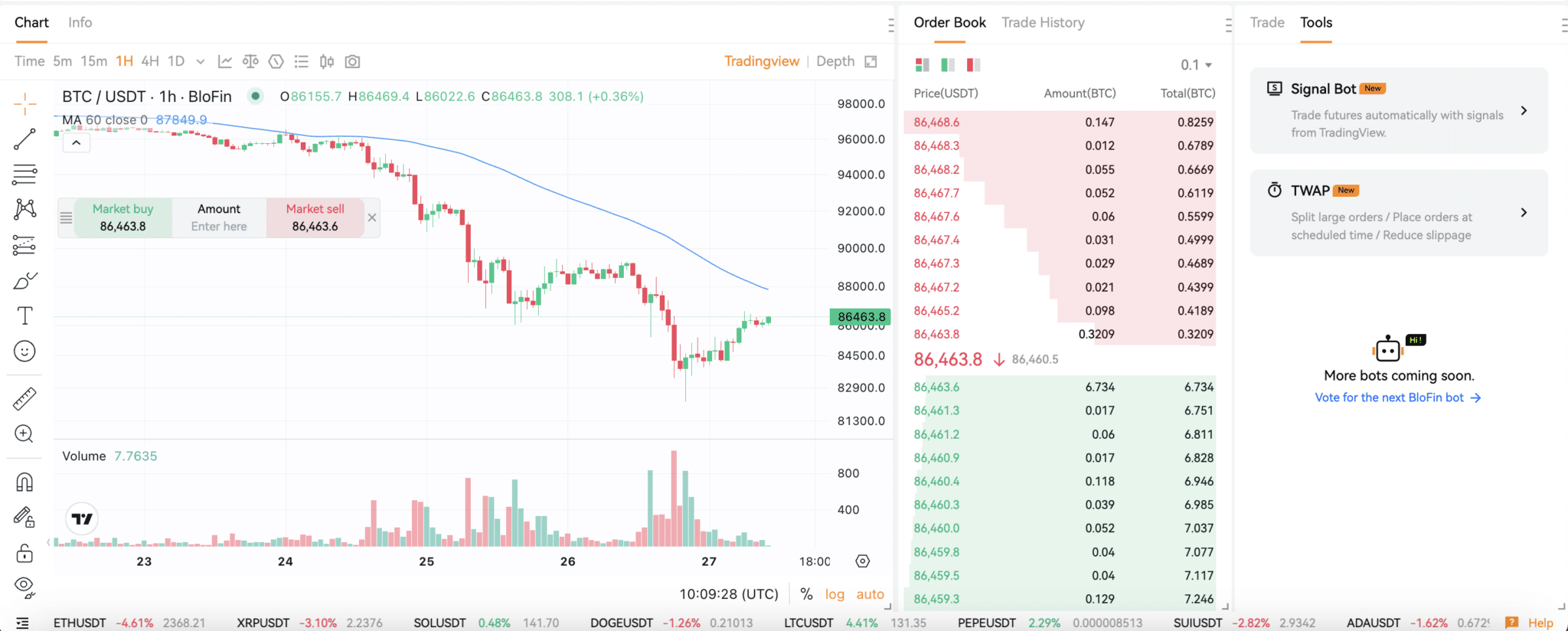
BloFin actively involves its user community in the development of new trading bots. Users can vote on upcoming bots, with current strategy options including Futures Grid, Futures DCA (Martingale), Scaled Order, Futures CTA, Futures VP, and an enhanced Futures TWAP.
In addition to its AI trading bots, BloFin offers features such as copy trading, demo trading, and a comprehensive rewards system. BloFin’s fee structure is competitive, with futures trading fees starting at 0.02% for makers and 0.06% for takers. Spot trading fees begin at 0.1% for both makers and takers.
Pros and Cons
Pros
- A diverse selection of AI-powered trading bots, including Signal and TWAP Bots
- User-driven development with voting on upcoming bot implementations
- Additional features like copy trading and demo trading
- Spot trading fees start at just 0.1%
- Gives access to more than 250 cryptos
Cons
- Some advanced bots may require a learning curve for beginners
- Requires KYC verification for full access
3. OKX – Choose From Over 600 Pre-Built AI Bot Strategies via Profit-Sharing Agreements
- Pricing: Average profit-sharing fee of 10-25%
- Strategy: Multiple strategies, including arbitrage, slicing, DCA, and grid trading
- Target markets: Bitcoin and hundreds of altcoins
The next option to consider as to our AI trade bot review is OKX—a popular crypto exchange with over 600 pre-built bots. Users can find their ideal trading bot based on their preferred strategies—such as dollar-costing averaging (DCA), arbitrage, slicing, signal, and grid trading. Additional filters include the maximum drawdown, profit and loss in percentage terms, and the runtime since activation.
OKX’s AI trading bots cover hundreds of cryptocurrencies, including the best altcoins. For example, there’s a futures grid bot that short-sells CEL/USDT with 6x leverage. Alternatively, there’s also an AI bot that goes long on SHIB/USDT via a DCA strategy. All OKX bots are free to use, but profit-sharing fees apply.
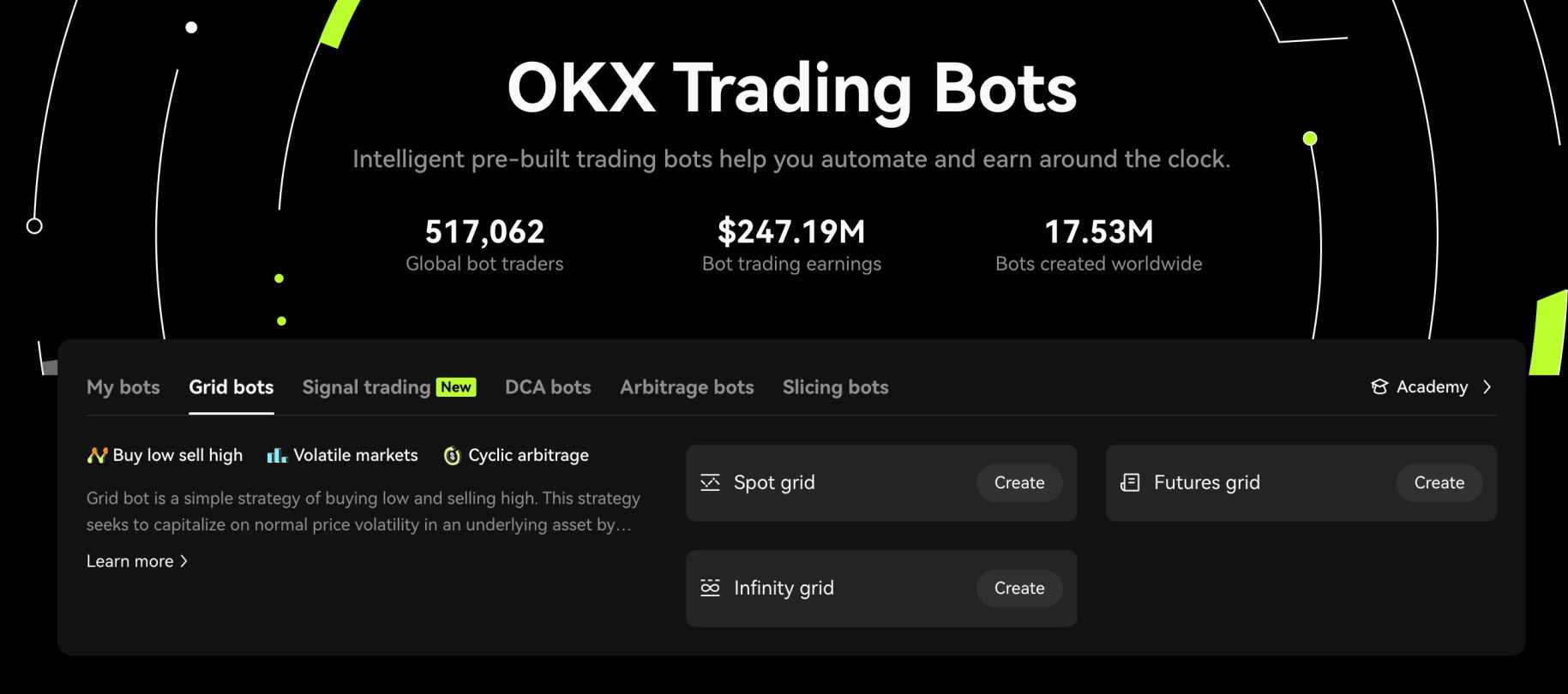
This averages 10–25%, depending on the strategy. You’ll also need to consider standard trading commissions, which start at 0.1% per slide on the spot trading markets. Additionally, OKX also enables users to create a custom bot strategy, although this is more geared toward seasoned traders.
Pros and Cons
Pros
- Choose from over 600 pre-built bot strategies
- Strategies including grid, DCA, and arbitrage trading
- No upfront fees to deploy the selected bot
- Only pay fees when the bot makes a profit
- Supports hundreds of altcoin markets
Cons
- Many bots apply high leverage to their positions
- Not available in some regions—including several EU nations
4. Binance – One of the Best Options for Long-Term Portfolios With an Auto-Rebalancing Tool
- Pricing: Average profit-sharing fee of 1–2%
- Strategy: Multiple strategies including rebalancing, arbitrage, and algo trading
- Target markets: Hundreds of spot and futures pairs
The next option to consider is Binance—which offers over 113,000 pre-built bots. First, users must choose between the spot and futures markets, alongside their preferred cryptocurrencies. Binance supports hundreds of markets, including Cardano, Solana, BNB, Ethereum, Bitcoin, and Dogecoin.
Users can narrow down their search by the bot’s runtime and ROI. Multiple strategies are covered, although one of the best is the rebalancing bot. This is ideal for long-term investors, as it automatically builds, weights, and rebalances portfolios based on real-time market conditions.

For instance, if one of the portfolio holdings declines in value, the Binance bot might sell a profitable coin to purchase more. This ensures coins are bought when prices are low and sold when they’re high. Other popular strategies include arbitrage, grid, and algo trading. Profit-sharing commissions apply but average just 1–2%.
Pros and Cons
Pros
- Supports over 113,00 pre-built bots
- Ideal for long-term investors seeking aut0-portfolio management
- Other strategies include algo and arbitrage trading
- Most bots come with a profit-sharing commission of under 2%
Cons
- Many bots have only been running for several days
- Prohibited in some countries—including the UK
5. Bybit – Top-Rated Trading Bots for High-Risk Investors via the Martingale System
- Pricing: No additional fees, standard commissions only
- Strategy: Multiple strategies including the Martingale system, grid trading, and DCA
- Target markets: Hundreds of spot and futures pairs
Bybit, considered one of the best no KYC crypto exchanges, offers more than 1,000 pre-built bots. It’s one of the best options for high-risk investors seeking significant gains. This is because some Bybit bots leverage the Martingale system. This means the bot ‘doubles up’ when it closes a losing position. This repeats until the bot makes a profitable trade.
For example, suppose the initial stake is $10 and the bot trades BTC/USD. If the trade is unsuccessful, the next BTC/USD position will be $20. Then $40, $80, and so on. Once successful, the next trade reverts to the original stake of $10. The Martingale system can be used on hundreds of cryptocurrencies, including Chainlink, Pepe, Ethereum, and Solana.

Some strategies come with leverage, with multiples ranging from 3x to 50x. Alternatively, some Bybit bots specialize in spot trading, which will appeal to users with a lower risk appetite. Bybit is also suitable for DCA strategies and capitalizing on sideways markets. Best of all, no fees or profit-sharing commissions apply.
Pros and Cons
Pros
- Offers high-risk trading bots via the Martingale strategy
- Automatically trade the futures markets with leverage
- Also offers DCA and sideways bots for the spot trading markets
- No additional fees or profit-sharing commissions
Cons
- Some strategies won’t be suitable for beginners
- Limited filters when choosing a bot
6. PrimeXBT – Copy Successful Crypto Traders Like-for-Like With ROIs of Over 500%
- Pricing: Profit-sharing commissions of 15-40% depending on the account tier
- Strategy: Copy trading strategies
- Target markets: 100+ markets including crypto, forex, indices, and commodities
PrimeXBT is a top-rated crypto exchange that offers automated investing tools. This comes via copy trading strategies, meaning positions are executed by human traders rather than AI bots. Nonetheless, the experience is 100% passive. Some of the best traders to copy have generated ROIs of over 500%.
This is based on an extended trading history for increased validity. For example, ‘wesfin1’ has produced an ROI of 553% since joining PrimeXBT 261 days ago. This trader has a 100% win rate in the prior month and has a maximum drawdown of 55%. Trading strategies vary depending on the trader.

Some are short-term day traders while others build positions on a long-term time horizon. All traders charge a profit-sharing fee. This varies depending on the user’s account tier. The drawback here is that standard users pay 40%. This is reduced to 15% for elite users. PrimeXBT is primarily used by crypto traders, although it also supports forex, indices, and commodities.
Pros and Cons
Pros
- Best AI bot for trading crypto during sideways markets
- Automatically places orders within the selected price range
- Choose from over 750 coins via spot trading and futures
- Only pay standard trading commissions
Cons
- Doesn’t offer DCA strategies
- Limited options when making P2P deposits
7. BingX – Great Option for Grid Trading Strategies to Capitalize on Sideways Markets
- Pricing: No additional fees, standard commissions only
- Strategy: Grid trading
- Target markets: 750+ supported coins, via spot and futures markets
I rate BingX as one of the best AI trade bots for grid trading strategies. This enables users to capitalize on sideways markets within a predefined price range. For example, suppose ETH/USD has traded between $3,300 and $3,700 in the past two weeks. The grid bot could buy ETH/USD whenever it hits $3,305, and sell ETH/USD at $3,695.
The idea is to profit from the identified price range until it breaks out. This crypto AI trading bot can also enter stop-loss orders above and below the price range. This ensures users trade in a risk-averse manner. More than 241,000 users have invested in the spot grid strategy, translating to more than $177 million in closed positions.

Alternatively, the grid trading strategy can also be deployed on perpetual futures. However, this is a higher-risk strategy that won’t be suitable for conservative investors. No extra fees are charged when using a BingX bot, so it’s only standard commissions that must be covered. Spot trading commissions cost 0.1%. Futures commissions range from 0.02% to 0.05%.
Pros and Cons
Pros
- Best AI bot for trading crypto during sideways markets
- Automatically places orders within the selected price range
- Choose from over 750 coins via spot trading and futures
- Only pay standard trading commissions
Cons
- Doesn’t offer DCA strategies
- Limited options when making P2P deposits
You can learn more about this popular cryptocurrency exchange and AI trading bot crypto platform in our BingX review.
Visit BingX8. Cryptohopper – Build a Custom AI Trading Bot From the Ground up Without Coding Skills
- Pricing: From free to $129 per month
- Strategy: Custom strategy builder, plus pre-built strategies like DCA and momentum trading
- Target Markets: Trades any crypto pair on 15 supported exchanges
Cryptohopper is one of the best AI trading bots for building a custom strategy from the ground up. There is no requirement to learn or understand coding; Cryptohopper uses a ‘build and test’ system. First, users must determine which technical indicators they want to implement into their strategy.
Over 130 indicators are supported, including the Bollinger Bands, moving averages, and the RSI. Next, users must choose their trigger points. For example, the bot can be programmed to short-sell Litecoin if the RSI exceeds 75, and the current price is below the 200-day moving average. Crucially, Cryptohopper comes with a backtesting facility.

This enables users to test their bot creation via historical market data. Demo trading tools are also provided, allowing testing in live market conditions. Cryptohopper also offers pre-built strategies, such as DCA and momentum trading. In terms of pricing, users need the $29 per month plan to access the strategy builder.
Pros and Cons
Pros
- The best option for building a custom AI trading bot
- No coding skills are needed
- Offers backtesting and demo trading tools
- Also has a marketplace with pre-built strategies
Cons
- Costs $29 per month to use the strategy builder
- Advanced knowledge of crypto trading strategies is needed
9. 3Commas – Automate a Dollar-Cost Average Strategy for Risk-Averse Crypto Investing
- Pricing: From free to €79 per month
- Strategy: DCA investing, plus grid and signal trading
- Target markets: Trades any crypto pair on 14 supported exchanges
3Commas is an established trading bot platform that’s ideal for DCA investing. Unlike traditional DCA strategies, the 3Commas bot automates the investing schedule based on your preferences. This is especially useful when building and maintaining a diversified crypto portfolio.
For example, suppose you want to buy the best meme coins, such as dogwifhat, Shiba Inu, and Bonk. You can instruct the bot to purchase $30 of each meme coin every week. This reduces the risk over time, as your purchases align with broader market conditions. What’s more, you can spread the DCA investments over multiple exchanges.

14 exchanges are supported, including Binance, Bybit, KuCoin, and OKX. 3Commas is also a good option for grid trading strategies during sideways markets. This strategy can trade up to 100 pairs simultaneously with pre-built risk-management tools. Pricing plans range from free to €79 per month, depending on the required features.
Pros and Cons
Pros
- Top-rated trading bot for DCA investing
- Automatically build and maintain diversified crypto portfolios
- Strategy tools come with risk-management orders
- Also supports grid and signal trading strategies
Cons
- The DCA bot costs at least €49 per month
- The free plan comes with limited functionality
Bonus Tool: CoinFutures – Simulate High-Leverage Crypto Trading Without Connecting an Exchange
- Pricing: Free to use without any KYC
- Strategy: Manual directional trading with simulated 1000x leverage
- Target Markets: Trades crypto futures like BTC, ETH, DOGE, SOL
CoinFutures isn’t an AI trading bot, but it’s a valuable simulation platform for anyone who wants to practice crypto futures trading in a fast, simplified format. The platform allows users to predict whether a coin will go up or down and simulate trades with leverage levels up to 1000x without needing to link an exchange, complete KYC, or risk real funds.
It’s especially useful for new traders learning how to short crypto, test their reaction to volatility, or get familiar with the fast pace of leverage-based trading. The best part is that users can cash out anytime. While it doesn’t offer automation or technical indicators like a traditional bot, CoinFutures develops short-term directional instincts, helping much like AI bots.
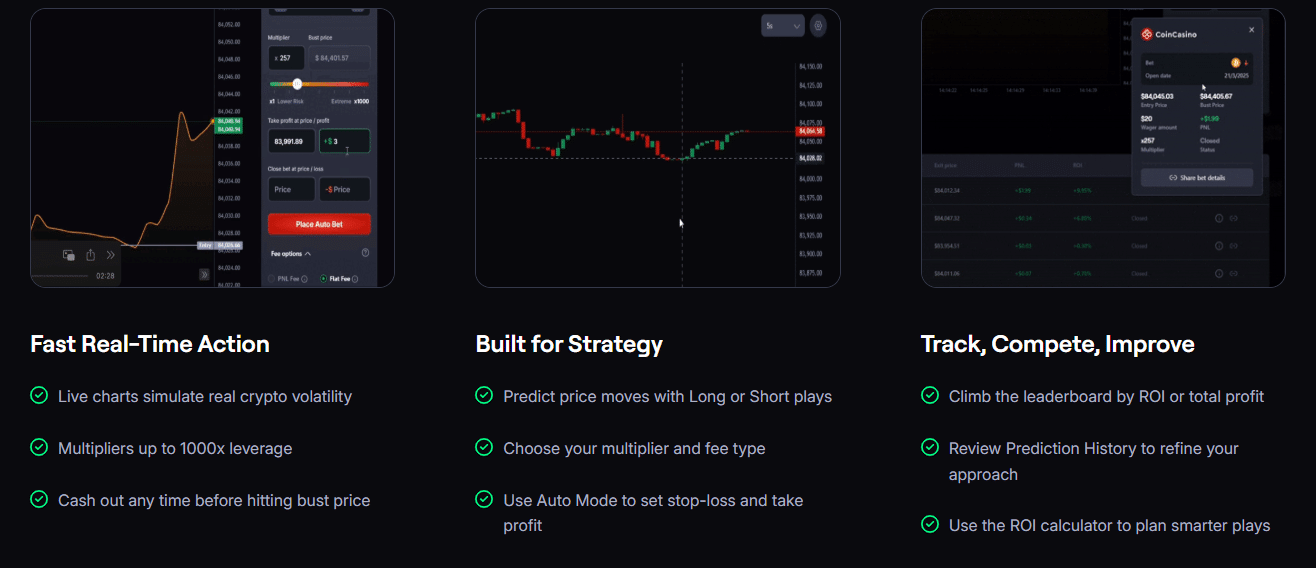
CoinFutures is powered by a volatility-mimicking algorithm that mirrors actual market behavior, letting users experience the thrill (and pressure) of high-leverage scenarios. You can play on desktop or mobile, with support for crypto and card-based deposits.
Pros and Cons
Pros
- Simulated 1000x crypto leverage without needing an exchange
- Instant access with no account setup, no KYC
- Great for learning how to short or go long on crypto
- Works on mobile and desktop
Cons
- High multipliers can make outcomes volatile
Please read our full CoinFutures Review for more.
How do AI Trading Bots Work?
AI trading bots use artificial intelligence to generate real-time signals. These signals determine whether to buy or sell a crypto pair based on predetermined metrics. This generally includes technical indicators and risk-management orders.
- For example, consider an AI bot that specializes in sideways markets.
- It uses Trendlines, the Fibonacci Retracement, and Pivot Points to identify support and resistance levels on the XRP/USD pair.
- The bot finds that the key trading range is $0.40 to $46.
- Whenever XRP/USD hits $0.405, it places a buy order. The order is closed when XRP/USD hits $0.455.
- Stop-loss orders are placed just below $0.40 for protection against the eventual breakout.
This is just one example of how an AI trading bot works. AI day trading is particularly effective for short-term strategies, as bots analyze real-time data to make rapid decisions. Importantly, AI bots offer an automated trading experience. Users typically choose their preferred strategy, risk settings, and order sizes. The bot will then scan the markets, perform technical analysis, and place buy and sell orders autonomously.
For the best results, traders are advised to backtest their AI trading bot. This means testing the bot’s performance based on historical data. This should cover multiple years and cycles, ensuring that the backtesting process is accurate and reliable.
Types of Automated Crypto Trading Software
This section discusses the different types of automated crypto trading solutions. You might have understood that AI for trading crypto is redefining investment strategies by enabling real-time market analysis and execution. Read on to discover the right AI trading bot for you.
Algorithmic Trading
Algorithmic trading bots place buy and sell orders based on predetermined conditions. They continuously scan live crypto prices, charts, and trends via technical indicators. orders are executed when an indicator is triggered.
For example, the algorithmic bot might buy Bitcoin when the 50-day moving average is above the 200-day moving average. Algorithmic bots are best suited for seasoned traders with a firm grasp of programming languages, such as Python or Java.
Grid Trading
Grid trading bots are ideal for trading during consolidation cycles. This means the identified crypto pair has been trading in a tight pricing range for extended periods. Grid trading bots must first establish the support and resistance levels.
The bot can then enter buy and sell orders accordingly. Stop-losses are placed below and above the support and resistance levels, respectively. This ensures the bot avoids large losses when the pricing range breaks out.
DCA Trading
The best AI trading bots for long-term investors use the DCA strategy. This initially requires some input from the user, in terms of the chosen cryptocurrencies and budget. For example, suppose you want long-term exposure to XRP, Litecoin, Bitcoin Cash, Ethereum, Dash, Monero, and Stellar.

The DCA bot will buy these coins at optimal pricing levels. For example, it might allocate funds to any of these coins whenever their price drops by 1.5%. Mimicking this strategy manually will be cumbersome, as you’d need to be glued to pricing charts. Especially when investing in many different coins.
Signal Trading
Some AI trading bots use the signal method. This means the bot automatically executes orders when a chart signal has been triggered. This prevents the need to trade manually.
For example, suppose the signal focuses on the RSI. Whenever the RSI hits 28, the bot will buy Litecoin. Conversely, the bot will short-sell Litecoin when the RSI hits 72. Signal trading is particularly powerful when used alongside TradingView alerts.
Arbitrage Trading
Arbitrage trading is considered a low-risk strategy. However, it’s only possible when using an AI trading bot that can scan pairs on multiple exchanges simultaneously. The concept is simple: arbitrage strategies take advantage of price discrepancies on two or more exchanges.
- For example, suppose Toncoin is trading at $7.22 on OKX and $7.40 on MEXC.
- This means the bot can make a $0.18 profit for every 1 Toncoin purchased on OKX and instantly sold on MEXC.
It’s crucial to choose an arbitrage bot that can execute identified opportunities in milliseconds. Otherwise, the trade can yield a loss if the price changes before both orders are placed.
Copy Trading
Although copy trading doesn’t use artificial intelligence or bots, it’s still an automated investing strategy. Instead of copying an algorithm, you’ll be mirroring an experienced crypto trader. So, any orders they place will be replicated in your account.

You can choose how much to invest, and the position sizes will be adjusted accordingly. The only drawback with copy trading is that it doesn’t offer a 24/7 experience. After all, human traders can only research and trade for several hours per day.
How to Choose the Best Crypto AI Bot
Now we’ve discussed the different types of strategies and systems, you’ll need some guidance on choosing the right AI trading bot. Read on to discover the most important metrics.
Automation Level
The first step is to think about how much automation you require. For example, some users prefer a 100% passive experience. This means choosing a bot that offers plug-and-play solutions. Put otherwise, you simply need to specify your position sizes and activate the bot on your preferred exchange.
Thereon, the bot will trade crypto on your behalf 24 hours per day, 7 days per week. Which means that AI automated trading software simplifies the trading process by running 24/7 with minimal human intervention. That said, some users prefer more control over an AI bot.
This might mean customizing the bot’s risk settings, active trading sessions, or trigger points. Alternatively, you might only want the bot to research and discover trading opportunities. Meaning – you want the option of whether or not the trade should be executed.
Trading Strategy
Another important metric is the trading strategy implemented by the AI bot. For example, low-risk traders might opt for an arbitrage or scalping strategy. These strategies target small profit margins but they’re super active. Scalping, for instance, often demands hundreds of positions per day.
Those looking for the biggest crypto gains might consider the Martingale strategy. This high-risk strategy doubles the position size if the previous trade yielded a loss. For example, if the first trade was worth $50 the next one will be $100, $200, and so on. The Martingale strategy reverts to the original stake ($50) when it yields a winning trade.
Risk Settings
Risk is just as important when researching AI trading bots for crypto. Some platforms automatically generate a risk rating for each bot it lists. This is based on multiple metrics, such as the maximum drawdown, average position size, leverage settings, and average trade duration.
The risk is also determined by the cryptocurrencies being traded. For example, Bitcoin and Ethereum are considered much more risk-averse than meme coins like Shiba Inu and Bonk. Ultimately, make sure the bot aligns with your risk tolerance.
Backtesting and Live Testing
Testing is the most important stage when deploying AI trading bots.
There are two different testing segments to undertake:
- Backtesting: The first segment is backtesting, which uses historical crypto data. This includes prices, volume, volatility, and order book depth across multiple years. Within minutes, the backtesting tool will provide performance results based on this data.
- Live testing: Historical data isn’t guaranteed to repeat itself. So, live testing is also important. The bot will execute its strategy using ‘paper funds’. This means orders are based on real-time markets but without risking your bankroll.
AI bots should only be activated once the backtesting and live-testing results are solid. Even then, constant monitoring is crucial; what works today might not work tomorrow.
Supported Exchanges and Instruments
Make sure the chosen AI bot is compatible with your preferred exchange(s). Especially when using a third-party provider that requires an API connection. This is particularly important when using cross-exchange strategies like arbitrage trading.

Additionally, consider which trading instruments the AI bot needs access to. For example, some AI strategies are best suited for perpetual futures. This is because they require short-selling tools and/or leverage. Other bots are designed for the spot trading markets, which are generally lower risk.
Pricing
Pricing should also be considered when exploring AI crypto bots. For a start, assess how prices are charged. Some trading bots are free to deploy but come with a profit-sharing commission. This means you’ll lose a percentage of any profits made but won’t need to pay anything when orders are closed at a loss.
Profit-sharing commissions can vary widely, so ensure you check this before proceeding. Alternatively, some AI bots charge a monthly subscription fee. This means you keep 100% of any profits the bot makes. However, you’ll need to ensure these profits exceed the monthly fee being paid.
AI bots for crypto trading use sophisticated algorithms to identify and capitalize on market opportunities. But, if you’re on a budget, consider the best free AI trading bot options. They typically offer basic features with optional premium upgrades.
Past Performance
An AI bot’s past performance shows its success rate since being deployed. This is usually shown as a profit or loss figure in percentage terms. Naturally, the best bots have a high-profit percentage. However, the runtime is equally important.
For example, an AI bot might have a historical profit rate of 270%. However, if the runtime is just one week, the results are far from reliable. Instead, we’d much prefer an AI bot with a smaller profit rate but over a much longer time frame.
Some bots also come with a win rate. This is based on the number of winning and losing trades in percentage terms. For example, suppose the bot has placed 1,000 trades. 800 were winners and 200 were losers. This means the win rate is 80%.
How Profitable are AI Trading Bots?
Not every AI trading bot is profitable, just like not all trading strategies are profitable. No software can guarantee consistent returns without proper testing and optimization. The performance of an AI bot depends heavily on both the underlying strategy and the market environment. A bot might perform extremely well during certain conditions, such as when a market is trending or consolidating. However, the same approach may quickly become ineffective once those conditions shift. This is why successful traders treat bots as tools that require ongoing monitoring, adjustments, and risk management rather than “set and forget” money machines.
For example, a grid trading bot could generate steady profits trading ETH/USD for several weeks while the market moves sideways. However, if Ethereum suddenly breaks out of its consolidation range, the bot’s parameters may no longer be valid. Without adjustments, this could turn a winning strategy into a losing one.
That said, AI-powered trading bots do offer distinct advantages over human traders. They can process millions of data points per second, analyze thousands of cryptocurrency pairs simultaneously, and react to changes instantly. Many advanced bots incorporate technical indicators, sentiment analysis, and predictive modeling, allowing them to place precise orders across multiple exchanges in real time. This speed, scale, and accuracy make AI trading bots a valuable tool for traders who understand their strengths and limitations.
How to Maximize Returns with AI Crypto Trading Bots
Maximizing returns is the overall objective when deploying AI crypto trading bots. AI for crypto trading enables users to make data-driven decisions and optimize their portfolios on the go. However, it involves using robust AI trading tools that incorporate various risk strategies and market analysis. Here are some tips that can help you achieve this goal:
- Risk settings: Most AI bots come with various risk settings. It’s important to select a level that aligns with your risk appetite. For example, a conservative risk setting might deploy stop-loss orders at 2%. This means the bot will never lose more than 2% on any single trade. An aggressive risk setting might increase the stop-loss level to 15%. This means higher risk but also increased profit potential, as trades remain open for longer.
- Extended testing: Consider using extended time frames when backtesting and live testing an AI bot. For example, testing its performance for at least a month means the results have validity. However, testing the bot for several days won’t yield the same reliability. Put otherwise, the longer the testing stage the better.
- Adequate technical framework: Having a solid strategy and risk-management setup is just half the battle. It’s also important to have a reliable and robust technical framework. This means using a Virtual Private Server (VPS) to maximize the bot’s uptime, a fast computer and internet connection, and an exchange that executes orders in milliseconds. Even a delay of a second can turn a profitable trade into a losing one—especially when scalping or arbitrage trading.
- Real-world developments: AI trading bots are purely technical, meaning they’re typically programmed to follow pre-defined code. This means real-world developments aren’t considered when placing buy and sell orders. For example, if a crypto project is hacked and a major sell-off occurs, the bot won’t know why prices are plummeting. Instead, it will revert to technical charts and indicators, meaning potential large losses. This is why constant monitoring and risk management are so important, especially stop-losses.
Are AI Trading Bots Legal?
AI trading bots are not only legal but they’re encouraged by many exchanges. For a start, AI bots don’t guarantee success. On the contrary, many bots lose money. Additionally, most bots are simply programmed to follow a predefined strategy. It’s just that bots can implement these strategies faster and more effectively.
As such, bots don’t violate existing trading laws or exchange policies. However, there are some exceptions. Crucially, if the AI bot engages in market manipulation, this is illegal in most jurisdictions. Using bots to execute inside trading information is also prohibited. Pump and dumps, wash trading, and other unethical practices should also be avoided.
Therefore, when choosing a legit AI trading bot, ensure it complies with exchange regulations and avoids unethical practices.
Security: Are AI Trading Bots Safe?
AI trading bots are generally safe. However, security measures depend on how the bot is deployed. For example, some trading bots are offered directly on exchange platforms, including Bybit, OKX, and Binance. This means the bot uses the exchange balance and doesn’t require third-party integrations.
Conversely, some bots are offered by intermediary platforms, such as Cryptohopper and 3Commas. This means the bot must be connected to an exchange via an API. While this is typically secure, it’s important to check what permissions the API has. This shouldn’t include anything other than placing orders within the bot’s parameters.

What’s more, remember that trading bots aren’t risk-free—even if stop-loss orders have been deployed. Especially when market prices are extremely volatile. For example, suppose you’ve got a stop-loss order at 5%. If a major dump occurs, the stop-loss order might not be matched by the markets, meaning you could lose significantly more than 5%.
Users across different platforms give mixed reviews of using AI trading bots.
“Turns out you can use AI to write code to trade the markets,” noted AI VC Deedy Das.
A Reddit user, meteoraln, noted that calling it a “trading bot” makes automated trading sound too simple when it’s a serious science.

All things considered, it’s crucial for users of AI trading bots to stay informed about the evolving regulations and ethical standards around automated crypto trading to ensure compliance and maintain market integrity.
Conclusion
We’ve explored the best AI crypto trading bots 2026, covering a wide range of strategies, systems, and risk factors. Crypto AI bots not only offer a passive trading experience but their capabilities far exceed humans. Bots can analyze significant data sets for multiple coins simultaneously, 24/7. Trading bots can be a great way to test out a trading strategy in an automated way.
Moreover, orders can be placed on different exchanges at rapid speeds. However, be aware that AI bots aren’t a surefire way to make money. Make sure you research the bot’s parameters, such as its maximum drawdown, historical win rate, and return on investment. Also, ensure adequate backtesting and live testing before deploying the bot. But what is the best AI trading bot for you? Surely, you already know by now that it depends on your goals, risk tolerance, and trading strategy.
If you are new to the world of intersecting AI and Crypto, you may be interested in our Beginner’s Guide to AI Crypto Coins.
See Also:
- 10 Best AI Crypto Coins to Invest in 2026
- How to Buy Bonk ($BONK) – Beginner’s Guide
- Bitcoin Price Prediction for 2025, 2030
- Toncoin ($TON) Price Prediction 2025–2030
FAQs
Are there AI trading bots for crypto?


Yes, there are fully automated AI bots for crypto, allowing users to trade passively 24/7. Some bots can be customized and built from the ground up, offering a more hands-on approach.
How much do AI trading bots cost?
Some AI trading bots charge monthly subscription fees—prices depend on the provider and required features. Some bots are free to use but come with a profit-sharing commission paid to their creator.
Do AI bots really work in crypto trading?
Yes, some AI bots produce consistent profits, but they’re not guaranteed. This is why backtesting and live testing procedures are so important.
How do I start with an AI trading bot?
Choose a reputable bot platform and pick a strategy, such as DCA, arbitrage, or grid trading. Adjust the risk settings, backtest the bot, and connect it to the preferred crypto exchange for live trading.
Which AI trading bot is best for crypto?
MEXC is one of the top trading platforms that automates your trading experience with its copy trading feature. Alternatively, consider bots on BloFin, OKX, or Binance to automate trades on established coins like Bitcoin and Ethereum.
References
- “AI Trading – What Is AI Trading & How It’s Used in Stock Trading.” NASDAQ, www.nasdaq.com/articles/ai-trading-what-is-ai-trading-how-its-used-in-stock-trading.
- “How a Trading Algorithm Actually Works.” Wall Street Journal, www.wsj.com/articles/how-a-trading-algorithm-actually-works.
- “What Is Backtesting?” Corporate Finance Institute, corporatefinanceinstitute.com/resources/valuation/what-is-backtesting.
- “What Is an API (Application Programming Interface)?” Amazon Web Services, aws.amazon.com/what-is/api.

Why you can trust 99Bitcoins
Established in 2013, 99Bitcoin’s team members have been crypto experts since Bitcoin’s Early days.
Weekly Research
100k+Monthly readers
Expert contributors
2000+Crypto Projects Reviewed