




In This Article
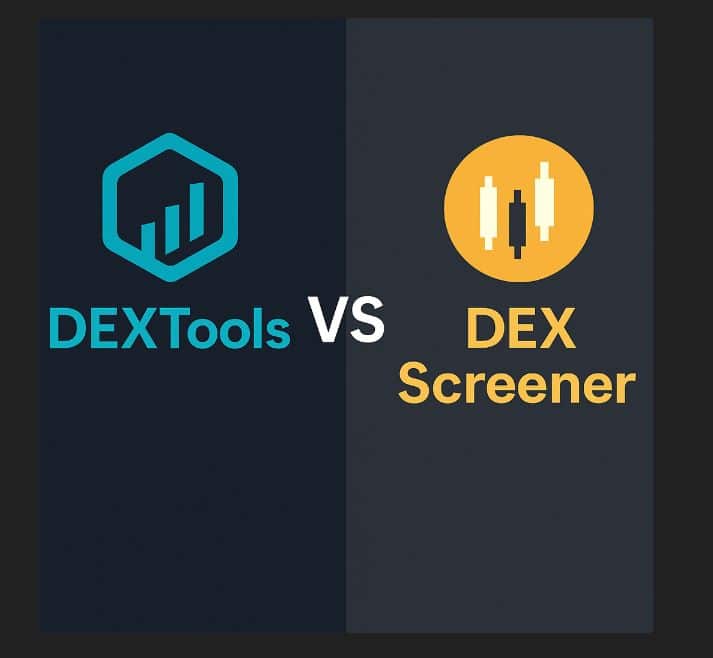
In the decentralized exchange markets, traders live and die by information. The faster you see liquidity move, the faster you survive. That’s where DEXTools and DEX Screener step in, two platforms fighting for the same spot on your second monitor. Both deliver real-time data, token performance tracking, and advanced tools to help you make better trading decisions across multiple blockchains. But which one actually gives you an edge?
Before diving into comparisons, it’s worth asking: What is DEXTools? What is DEX Screener? In this article, we’ll break down DEXTools vs. DEX Screener across their core features, user experience, and unique strengths. From advanced features like on-chain analysis and multi-chain support to how they surface trending tokens, you’ll see exactly which platform stands out in 2026 and why the best trading strategy might depend on using both.
Quick Facts About DEXTools & DEX Screener
1. Platform Overview 2. Launch Year 3. Supported Blockchains 4. Key Features DEXTools: DEX Screener:
Key Takeaways
- Both DEXTools and DEX Screener give traders real-time data to track token prices, liquidity, and market trends across multiple blockchains.
- DEXTools offers more advanced tools like Pair Explorer, MultiSwap, and a trading simulator, ideal for experienced traders.
- DEX Screener focuses on simplicity, providing a completely free, user-friendly interface with multi-chain support and portfolio tracking.
- DEXTools uses its native DEXT token to unlock premium features, while DEX Screener relies on Boosts and Ads for monetization.
- For traders who want both depth and accessibility, using both platforms together provides broader coverage and better-informed trading decisions.
What is DEXTools (DEXT)?
If the crypto markets are chaos, DEXTools is the radar. It’s the on-chain command center for traders trying to survive decentralized exchange warfare with something more than luck. In a world ruled by bots, rugs, and anonymous deployers, DEXTools gives you what the others don’t, real-time data, token performance tracking, and advanced tools to spot opportunities before they vanish.
DEXTools is built for experienced traders who thrive on in-depth analysis and token metrics that go beyond price candles. Its interface consolidates data from different decentralized exchanges across multiple blockchains like Ethereum, Binance Smart Chain, Polygon, Arbitrum, and Avalanche, among others. The goal: let you monitor market trends, verify project reliability, and make informed trading decisions faster than the next person in line.
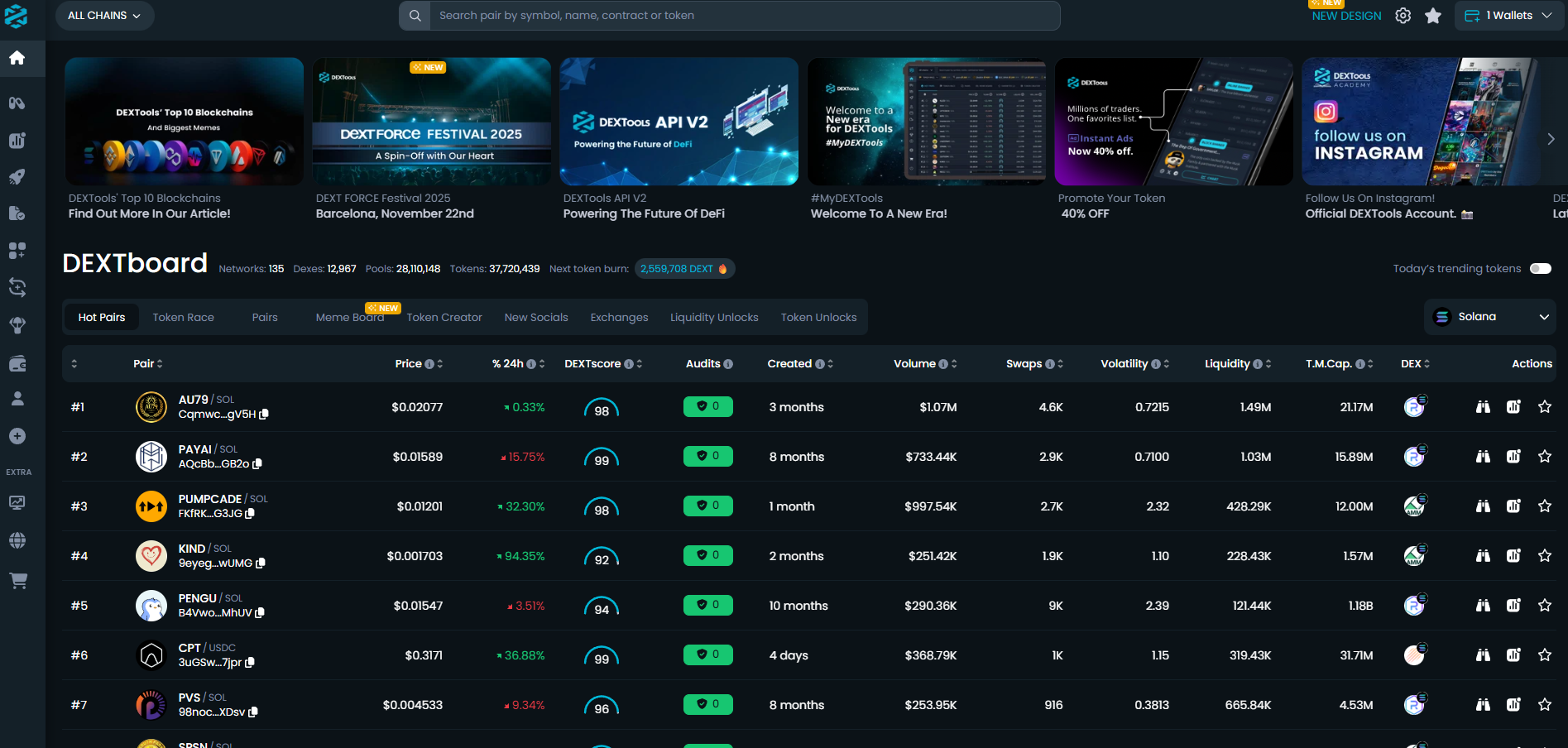
Its core modules are what make it indispensable. The Pair Explorer digs into token pairs with surgical precision, showing liquidity depth, transaction history, and pool ownership down to the wallet level. Pool Analytics tracks how liquidity moves between pools, letting traders see whether whales are buying in or bailing out. The Trending Tokens list filters what’s exploding in real time, based on trading volume, engagement, and velocity. And for those who live by alerts, the app lets you set price notifications tied to volume spikes, new pool launches, or whale swaps, turning noise into actionable signals.
The secret sauce, though, is the DEXTools Trending Bot. It’s how new coins hit the spotlight. The bot scans on-chain activity, looking at liquidity injections, swap velocity, and unique traders, to decide what trends. But it’s not a buy signal; it’s a spark. Smart traders use it as a radar ping, then confirm safety through liquidity locks, contract audits, and holder distribution. The bot helps you spot momentum, not blindly follow it.
Most traders use DEXTools as their on-chain workflow hub. They’ll check liquidity pools, run honeypot tests, and verify social links directly from token pages, cutting down time spent chasing scammy Telegram links. It’s this blend of speed and due diligence that makes DEXTools a favorite among those who don’t want to become someone else’s exit liquidity.
What Does It Do?
DEXTools acts as the trader’s radar in decentralized exchange markets. It aggregates real-time data from multiple blockchains and different decentralized exchanges into one clean interface.
From price performance to transaction volume, it’s designed to provide users with detailed information about digital assets they’re tracking. It lets traders analyze markets, spot token anomalies, and make informed decisions with confidence. Maybe you’re scanning for new tokens or following top traders, it’s a one-stop control room for on-chain intelligence.
So, what does DEXTools do? It gives you structure in the storm. A place where data meets instinct, where trading decisions are made on facts, not FOMO. It’s not a guarantee of success, but in a world where every swap could be your last, it’s one of the few tools that helps you see the floor before you fall through it.
How to Use DEXTools?
Building a Cross-Venue Watchlist
Start by connecting your wallet (unique or burner). From there, build a watchlist using tickers, contract addresses, liquidity pools (LPs), and routers across multiple blockchains. This gives you a single dashboard to monitor token performance and market trends without jumping between sites.
Reading a Pair Page
Every pair page is a goldmine of data you just need to know where to look. The top shows price, FDV vs. market cap, and volume. Dig deeper for LP ownership, tax rules, and transaction history. If liquidity is unlocked or ownership is anonymous, that’s your first red flag.
For deeper insight, traders can enable technical analysis tools like Bollinger Bands, moving averages, and volume overlays to forecast price movements.
Setting Alerts That Actually Help
Set alerts for volume spikes, new pool listings, or whale swaps. Avoid spam-level alerts; focus on signals that align with your trading strategy, for example, a 20% liquidity increase or a token’s first $1M 24-hour volume mark.
Security and Privacy
Keep your setup clean. Use trusted RPC endpoints, double-check URLs to avoid link spoofing, and never install fake DEXTools apps. The official DEXTools app is available on the App Store and Google Play, but scammers clone it frequently. Always verify before connecting wallets.
What is DEX Screener?
If DEXTools is the Bloomberg Terminal of DeFi, DEX Screener is the Formula 1 dashboard, sleek, fast, and built for traders who don’t waste a second. It’s one of the most widely used real-time analytics tools for decentralized exchange markets, offering a clean, user-friendly interface that makes sense of token chaos across multiple blockchains.
At its simplest, DEX Screener is a token screener and analytics hub. It aggregates live data from dozens of different decentralized exchanges, giving users instant access to token prices, market trends, and trading volume without touching a single API key. Doesn’t matter if you’re tracking a new meme coin on Base, or a fresh listing on Solana, it updates with real-time data so you can stay informed and react before the market does.
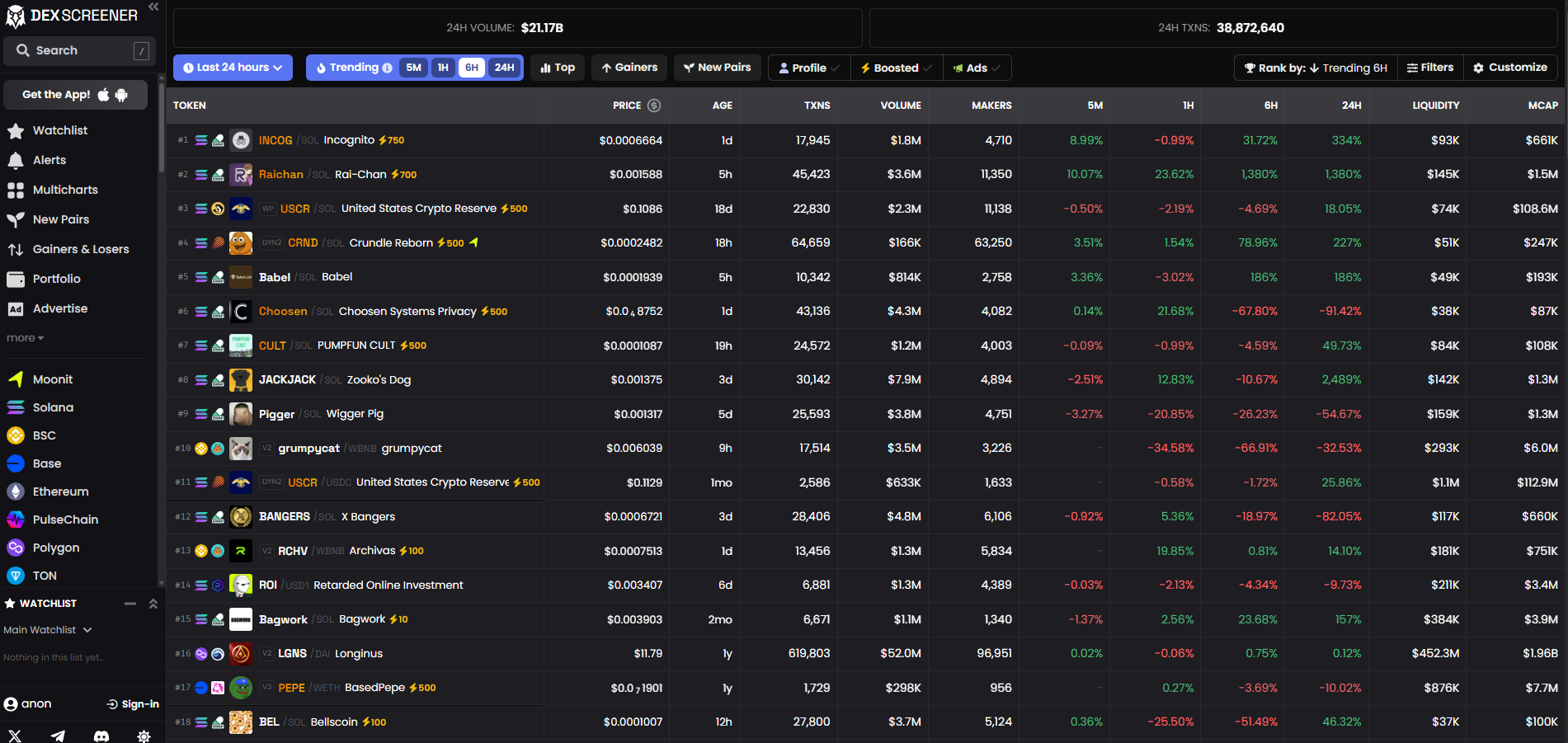
Its core modules are built for traders who want clarity without complexity. The Pair Screener tracks tokens across hundreds of DEXs, surfacing price movements, liquidity depth, and transaction volume. The Multi-Chain Discovery tool acts like a radar for new tokens, showing where capital is flowing across chains. Watchlists let users bookmark and monitor favorite tokens across various blockchains, while price alerts keep you notified of major market shifts.
But where DEX Screener really shines is in its trending tokens and listing dynamics. The site continuously recalculates what’s trending based on trading volume, engagement, and velocity, similar to DEXTools’ trending bot, but with more neutral weighting. It also includes the Dexscreener Boost feature, a paid visibility tool that lets projects advertise their tokens. Paired with Dexscreener Ads, these boosts can push tokens up the trending ranks temporarily, but it’s transparent. You’ll always see which tokens are “boosted,” helping traders avoid pay-to-trend traps.
The result is a completely free platform that feels as fast as a native app, with a layout that prioritizes data over distractions. It’s why both new users and experienced traders alike lean on it as their go-to tool for token tracking and on-chain analysis.
What DEX Screener Does?
DEX Screener simplifies on-chain analysis for traders who want real-time updates without navigating a maze of contracts. It lets users visualize price performance, inspect liquidity changes, and track transaction volume across multiple blockchains.
The platform’s unique strengths lie in its speed, clarity, and multi-chain support. Unlike most analytics dashboards that require logins or paid access, DEX Screener provides everything free. You can watch live data, follow market movements, and review project reliability before committing a single dollar.
The experience feels smooth and instantaneous: open a pair, check the chart, and you’re seconds away from executing a trade through an external DEX aggregator. That’s the design philosophy: cut friction, deliver insight, and keep traders focused on execution, not exploration.
How to Use DEX Screener?
-
Open DexScreener (Verified URL)
Go to DEX Screener. It runs in-browser, no download required. Bookmark it and avoid look-alike domains or fake apps.
-
Discover Pairs Across Multiple Blockchains
Use the chain/DEX filters to scan tokens on Ethereum, BSC, Base, Arbitrum, Solana, and more. Sort by volume, price change, or age to find new tokens and active markets.
-
Build and Organize a Watchlist
Click the “star” next to any pair to add it to your watchlist. Create groups by chain or strategy (e.g., new listings, high-liquidity, taxes > 5%).
-
Read a Pair Page Like a Pro
Check price, FDV vs. market cap, 24h volume, liquidity depth, and recent trades. Review LP ownership/locks, buy/sell taxes, and contract links before making a decision.
-
Set Smart Alerts (Price, Volume, Liquidity)
Create alerts for % moves, volume spikes, or liquidity changes. Focus on signals that match your plan, e.g., first $1M 24h volume or +20% liquidity in 10 minutes.
-
(Optional) Track With a Wallet or Address
For read-only tracking, paste a wallet address to follow balances and positions. If you connect a wallet (e.g., Phantom for Solana or MetaMask for EVM), use a burner and strict permissions.
-
Verify Contracts and Safety Signals
Open the token’s contract from the pair page. Confirm verified source, holder distribution, and LP lock status. Avoid pairs with unlocked liquidity and opaque ownership.
-
Use Technical Analysis When Needed
Enable indicators like Bollinger Bands, moving averages, and multiple timeframes to map momentum and volatility before entering.
-
Stay Private and Secure
Check the URL every session, avoid link-spoofing from socials, never sign unknown transactions, and keep RPC/wallet hygiene tight. DexScreener is free; no seed phrase or private key is ever required.
Dex Screener Vs. DexTools: A Complete Comparison
Both DEXTools and DEX Screener dominate the on-chain analytics space, but they cater to slightly different audiences. One is built for precision and depth; the other for speed and simplicity. Choosing between them depends on what kind of trader you are, the one who loves dissecting token metrics, or the one who reacts to real-time data before anyone else does.
Below is a side-by-side breakdown of the two platforms before we dive into the details.
| Category | DEXTools | DEX Screener |
|---|---|---|
| Launch Year | 2020 | 2021 |
| Core Focus | Deep analytics and multi-tool suite for experienced traders | Lightweight, real-time token tracking for all users |
| Supported Chains | Over 60 chains, including Ethereum, BSC, Polygon, Arbitrum, Optimism, Avalanche, Fantom, Base | Over 60 chains, including Solana, Base, Arbitrum, TON, and Ethereum |
| Pricing Model | DEXT token for premium access; limited free tier | Completely free; ads and boosts for revenue |
| Interface | Dense data dashboards with advanced charting | Sleek, mobile-optimized interface with instant load times |
| Alerts & Tracking | Price, liquidity, and volume alerts with DEXT Premium | Free alerts and watchlists for all users |
| Portfolio Tools | Limited, external wallet integration required | Built-in multi-wallet portfolio tracking |
| Security | Contract verification tools and liquidity safety checks | Read-only structure with clear boosted token labeling |
| Unique Edge | Pair Explorer, Big Swap Explorer, MultiSwap, trading simulator | Boost visibility, multi-chain discovery, and live alerts |
User Interface & Mobile Accessibility
DEXTools looks and feels like a trader’s workstation. Packed dashboards, dense metrics, and multiple tabs for everything from Pair Explorer to liquidity analytics. The mobile app mirrors this depth, available on iOS and Android, syncing watchlists across devices. It’s not minimalist, but it’s powerful once you know where to look.
DEX Screener, by contrast, focuses on speed and simplicity. Its web app loads instantly, even on mobile browsers, and doesn’t require a login or token subscription. The interface highlights the essentials like charts, volume, and liquidity in a layout clean enough for both beginners and experienced traders chasing trends on the go.
Charting & Data Analytics Tools
When it comes to technical analysis, DEXTools is the clear heavyweight. It supports multiple charts, overlays like Bollinger Bands, and customizable timeframes. The DEXTools trading simulator even lets you test strategies without risking capital, making it a playground for data-obsessed traders.
DEX Screener keeps it lean. You’ll find clean, real-time charts, accurate candle timing, and instant updates, perfect for quick reads. It lacks the deep analytical overlays but wins on usability and performance during volatile market movements.
Pricing
DEXTools runs a hybrid model: it’s free to use, but premium plans unlock advanced features through the DEXT token. Premium tiers include faster data refresh, deeper on-chain analysis, and early access to new tokens.

DEX Screener is completely free. There’s no token, no subscription, and no hidden paywall. It monetizes through Dexscreener Boosts and Ads, which promote specific tokens transparently on trending lists. It’s open access, but it comes with the tradeoff of occasional promoted listings.
Wallet Integration and dApp Compatibility
DEXTools connects directly with wallets like MetaMask, WalletConnect, and Trust Wallet for executing swaps via MultiSwap. It’s a proper trading platform with dApp-like utility, connect, analyze, trade.
DEX Screener, however, doesn’t focus on wallet-based trading. It’s mostly read-only, with optional integrations for portfolio visibility. That separation boosts security, no approvals, no accidental signatures, just observation.
Portfolio Tracking
DEX Screener wins this round. Its portfolio tracking module lets users follow multiple wallets, visualize token holdings, and review performance in one dashboard.
DEXTools, while powerful, lacks built-in tracking. Traders often rely on third-party portfolio apps like DeBank or Zapper to fill the gap.
Safety and Security
Security in DeFi means protecting both your wallet and your time. DEXTools offers built-in honeypot detectors, contract verifications, and liquidity lock insights to keep users from falling into scams. Its environment is non-custodial but wallet-connected, so hygiene matters.

DEX Screener takes a different approach, with no wallet connection by default. It displays boosted pairs clearly and relies on transparency instead of heavy filtering. This makes it safer for casual browsing and token tracking without the risk of malicious signatures.
Demo Trading
A standout difference: DEXTools offers a trading simulator, letting users test trading strategies using live market data. It’s perfect for those learning on-chain analysis without burning real ETH or BNB.
DEX Screener doesn’t have simulation yet. It’s a pure observation tool, you trade elsewhere, using its data as your guide.
Apps, APIs, and Websocket Access
For developers, DEX Screener offers open access to its DexScreener API and DexScreener WebSocket API, allowing data streaming and integrations with bots or dashboards. It’s ideal for analysts or quant traders building scripts.
DEXTools, while less open, provides limited API access for premium users and partners. Its focus is trader-first, not developer-first.
Trending Tokens, Bots, Ads & Signal Quality
Both platforms have their own flavor of trending tokens, but their methods differ.
DEXTools Trending Tokens: Computed via volume, liquidity, and engagement velocity. Its DEXTools Trending Bot identifies market momentum before it hits social feeds, but traders must remember the bot reads movement, not fundamentals. It can’t tell you if a token’s legit, only that it’s loud.
DEX Screener Trending Tokens: Ranked using similar metrics but adjusted for multi-chain data. Its Boosts and Ads can temporarily elevate a project’s visibility, but every boost is labeled to avoid misleading users.
The trick is knowing how to filter the noise. Before acting on any trend, always verify:
Signals are only as good as the trader reading them. DEXTools may give you a microscope; DEX Screener gives you a radar. The best traders use both, one for precision, the other for perspective.
Best Alternatives To DEXTools & DEX Screener
While DEXTools and DEX Screener dominate the conversation around on-chain analytics, they’re not the only names in town. DeFi is an ecosystem of specialists, each tool carving out its niche. Some focus on multi-chain discovery, others on social data, and a few on developer-grade insights. The right combination depends on your workflow; maybe you’re scanning for new tokens, building a trading bot, or analysing whale flow. Below are the top alternatives worth adding to your stack.
Cross-Chain Dashboards/Scanners
Chain-Specific Leaders
Solana:
- Birdeye: Real-time order flow analytics, price feeds, and liquidity tracking.
- Photon: Visualizes quotes and order book depth, useful for catching front-run protection and MEV trends.
- Step Finance: A portfolio dashboard that turns your on-chain data into visual insights. Great for seeing how your Solana positions perform in aggregate.
BSC: Poocoin and Bogged Finance both specialize in charting, limit orders, and tax flagging, vital when trading tokens on the Binance Smart Chain, where contract taxes and reflections can distort price charts.
Base/Arbitrum/Optimism: Use native DEX explorers like Uniswap Info, or plug into Defined.fi and GeckoTerminal for cross-rollup coverage. These networks thrive on fast liquidity and frequent launches, so real-time monitoring is essential.
Polygon/Avalanche/Fantom: DexGuru, GeckoTerminal, and DexView usually provide the deepest pair coverage on these chains, with accurate trading volume and liquidity data.
TON: The TON ecosystem now has its own suite, TON.app, DeDust, and STON.fi. These explorers provide pair analytics, liquidity tracking, and pool data unique to the TON blockchain’s architecture.
Trading Terminals/Aggregators
For those who want to act directly on data, trading terminals combine analytics with execution. 1inch, Paraswap, and Matcha all serve as DEX aggregators, finding the best routes across liquidity pools while giving gas estimates, slippage insights, and basic pool intelligence.
Platforms like OKX DEX and KyberSwap take it further, offering multi-chain routing, built-in charting, and pool stats. They’re perfect for traders who prefer to research and execute in the same window.
Developer-Oriented Data
If your idea of trading involves Python notebooks and SQL queries, these are your tools. Flipside and Dune let you build custom dashboards for holders, swaps, and liquidity pools. They’re the backbone of on-chain analytics research, feeding insights to trading firms and analysts alike.
Token Terminal brings a fundamental layer to crypto data, revenue, user growth, and fee trends across protocols. It’s less about pumps, more about sustainability.
Finally, BitQuery and Covalent provide API access to historical and live on-chain data, perfect for developers creating trading bots, research tools, or dashboards that plug directly into blockchain networks.
Building Your Ideal On-Chain Stack
No single tool gives you the full picture. In crypto, edge comes from stacking the right systems together: data for discovery, analytics for insight, and execution tools for precision. The best traders don’t just look at charts; they build an ecosystem of platforms that feed each other information in real time. Here’s how to build your own on-chain command center for 2026.
Discovery: Start where the noise begins, Reddit, X (Crypto Twitter), and GeckoTerminal. These are your early warning systems. Social chatter reveals momentum before it hits the charts, and GeckoTerminal confirms whether the hype matches on-chain activity. Think of this layer as your radar for new tokens, fresh liquidity, and meme-fueled madness. Deep Analysis: Once you’ve spotted something, go surgical. Use DEXTools, DEX Screener, and DexView for in-depth analysis. These tools let you measure liquidity, volume velocity, and token metrics across different blockchains. The goal here is validation and separating what’s real from what’s rug. DEXTools digs into pair explorer data and transaction history, while DexScreener provides real-time price performance and multi-chain discovery without a paywall. Smart Money Tracking: To see where the pros are playing, tap into GMGN.ai, Dune, and Flipside. These tools track smart money flows, holder growth, and whale positioning. GMGN.ai blends social intelligence with flow analytics, while Dune and Flipside let you write SQL queries that expose deeper blockchain patterns like who’s buying early, who’s dumping quietly, and how money migrates across ecosystems. Execution: When it’s time to act, precision matters. Use aggregators like 1inch or Matcha to route swaps through the best liquidity paths across decentralized exchanges. These tools optimize slippage, gas efficiency, and execution speed. They’re your bridge between data and action, the place where analysis turns into profit. Portfolio Tracking: Finally, close the loop with DeBank, Zapper, or Step Finance. These track your digital assets across chains, showing your exposure, PnL, and farming yields in real time. They tie everything together helping you measure risk, rebalance, and stay accountable. A proper on-chain stack doesn’t just make you informed, it makes you fast. Discovery tells you what’s happening, analytics tells you why, and execution tools let you act before everyone else. In a market where every block matters, the trader with the best stack isn’t just watching the chain. They’re ahead of it. Trading on-chain isn’t just about spotting the next 100x gem, it’s about surviving long enough to catch it. The decentralized world rewards speed, but it punishes carelessness. Every successful trader builds an instinct for risk management and a paranoia for security. Here’s how to keep your capital (and sanity) intact. 1. Verify Everything Before You Click Always double-check contract addresses, official links, and project socials. Scammers clone token names, copy logos, and even spoof DEXTools or DEX Screener URLs. Bookmark verified sites and never rely on random links shared in Telegram or X replies. 2. Use Burner Wallets for Exploration When testing new tokens or sketchy contracts, never connect your main wallet. Create a burner wallet with a small amount of crypto for testing swaps or liquidity pools. Even if a contract turns out to be malicious, your main holdings stay safe. 3. Watch Liquidity Locks and Ownership Before entering a trade, confirm liquidity lock duration and contract ownership. Platforms like DEXTools make this easy under the Pair Explorer tab. Locked liquidity signals short-term safety; unlocked pools mean the deployer can drain funds anytime. Ownership renouncement isn’t a silver bullet, but it’s a solid start. 4. Maintain Wallet Hygiene Keep private keys offline. Don’t reuse the same wallet across multiple dApps. Avoid signing random approvals and clean your wallet permissions periodically using tools like Revoke.cash. For long-term storage, use a Ledger Flex, Trezor Safe 5, or another hardware wallet. 5. Treat Free Tokens and Airdrops as Red Flags If a mystery token appears in your wallet, ignore it. Clicking or swapping unknown assets can trigger malicious approvals that drain your funds. The blockchain equivalent of “don’t open suspicious attachments.” 6. Monitor Transaction Volume and Taxes Both DEXTools and DEX Screener display transaction volume and buy/sell taxes. If taxes exceed 10% or volume suddenly spikes with zero holder growth, something’s off. Always check these signals before acting on any “trending token.” 7. Separate Tools by Purpose Use DEX Screener for observation, DEXTools for analysis, and aggregators for execution. Mixing all three in one wallet session increases exposure to malicious contracts or phishing scripts. 8. Stay Updated New scams evolve as fast as tokens do. Follow official communities, read documentation updates, and use sources like DeFiLlama or RugDoc to verify safety levels before you ape in. Protecting your capital ensures you’re around for the next opportunity. Trade smart, question everything, and never assume safety in a market that rewards risk. In the end, DEXTools vs. DEX Screener isn’t a question of which is better, it’s about which one fits your flow. Both tools dominate the on-chain analytics game, but they approach it differently. DEXTools is the data scientist: heavy, detailed, built for experienced traders who want to dissect token metrics and simulate trading strategies before acting. DEX Screener is the scout, fast, clean, and completely free, designed for traders who live by real-time data and need to move before the crowd. For deep dives into liquidity, pair analytics, and project reliability, DEXTools offers the edge. But if you want speed, multi-chain discovery, and a no-frills experience that works just as well on mobile, DEX Screener takes the win. Most successful traders use both, one to analyze, the other to react. The truth is, no single platform gives you every answer. The best approach is balance. Use DEXTools for depth, DEX Screener for speed, and your own judgment for everything in between. Because at the end of the day, the tools don’t make you money, your ability to analyze, adapt, and act does. DISCOVER: Go to the official site and click the wallet icon to connect Phantom. Only approve read-only permissions and never sign unknown transactions. Always verify the URL and avoid fake pop-ups or clone sites. Yes, DEX Screener provides a free public API and WebSocket stream for real-time token data and chart updates. Developers can access price, liquidity, and volume info without authentication. For Solana, use Birdeye or Step Finance for real-time order flow and portfolio analytics. On BSC, Poocoin and Bogged Finance deliver strong charting and tax flag tools. Both ecosystems have scanners optimized for fast-moving markets. Dune, Flipside, and GMGN.ai lead in tracking wallet behavior and smart money flows. They offer data-rich dashboards that reveal large buys, exits, and token concentration. Pair them with Token Terminal or DeFiLlama for broader liquidity insights. Always verify token contracts and ensure liquidity is locked. Avoid projects with uneven holder distribution or unverified contracts. Use burner wallets and only visit official domains like dexscreener.com and dextools.io. Established in 2013, 99Bitcoin’s team members have been crypto experts since Bitcoin’s Early days. Weekly Research Monthly readers Expert contributors Crypto Projects ReviewedRisk Management & Security Best Practices
Conclusion
FAQs
How to connect the Phantom wallet to DEX Screener safely?

Does DEX Screener have an API and WebSocket stream?
Best DEXTools alternative if I trade on Solana or BSC?
Which dashboards are best for holder/whale analysis?
How do I avoid scams when using token screeners?
References

Why you can trust 99Bitcoins