







In This Article
Best Crypto Arbitrage Bots 2026
- 1. Binance - The Overall Best Crypto Bot for Arbitrage Trading
- 2. OKX - Smart Coin Arbitrage Bot Aimed at Complete Beginners
- 3. Cryptohopper - The Best Option to Exploit Price Differences on Multiple Exchanges
- 4. Pionex - Low-Risk Arbitrage Strategy on USDT Deposits With APYs of Over 21%
- 5. WunderTrading - Top-Rated Bot Provider With Multiple Crypto Arbitrage Strategies
- 6. Crypto.com - Earn Stable Arbitrage Returns on BTC/USD via the Delta-Neutral System
- 7. Coinrule - Build Custom Arbitrage Strategies Without Coding Knowledge
- Can Crypto Arbitrage Bots Guarantee Profits?
- Key Features to Look for in a Crypto Arbitrage Bot
- Tips for Using Cryptocurrency Arbitrage Bots
- Conclusion
Arbitrage bots capitalize on crypto price discrepancies, either across two different exchanges or within the same platform. Arbitrage is often considered lower-risk than speculative trading, because bots aim to place buy and sell orders at nearly the same time. However, it is not risk-free: timing mismatches, exchange delays, fees, and slippage can erode or reverse profits in real trading.
This guide reviews the best crypto arbitrage bots 2026, ranking providers based on available strategies, supported markets, past performance, risk profile, and fees. Learn how arbitrage trading works in crypto and how to get started in under 10 minutes.
Crypto Arbitrage Bots: Key Takeaways
- Crypto arbitrage bots identify price differences between two or more markets, often by placing simultaneous orders in several places to lock in consistent small profits.
- Arbitrage is mostly used to score a high volume of small gains, making it most suitable for large-cap cryptocurrencies.
- Customization and automation options vary widely across services. While some bots offer plug-and-play simplicity, others require lots of optimization, but also a lot more options.
- To succeed, bot users need access to fast execution and low fees.
Best Crypto Arbitrage Bots 2026
Let’s get straight into it: the following sections rank and review the best crypto arbitrage opportunities 2026. Read on to choose the right provider.
1. Binance – The Overall Best Crypto Bot for Arbitrage Trading
Binance, the largest crypto exchange in terms of trading volume, offers a built-in bot that specializes in the arbitrage strategy. It leverages the delta-neutral system, which allows users to capitalize on funding rate discrepancies on perpetual futures. The bot monitors funding rates in real-time and automatically places buy or sell positions accordingly; this means it goes long on spot markets and short on the corresponding futures trading pair (or vice versa).
Binance’s arbitrage bot is user-friendly, as traders only input their investment size, and it gets to work. The arbitrage tool works across hundreds of pairs, including the best altcoins like Ethereum, Bitcoin Cash, and Litecoin. Binance also offers other automated bot strategies, including spot and futures grid, portfolio rebalancing, and dollar-cost averaging.
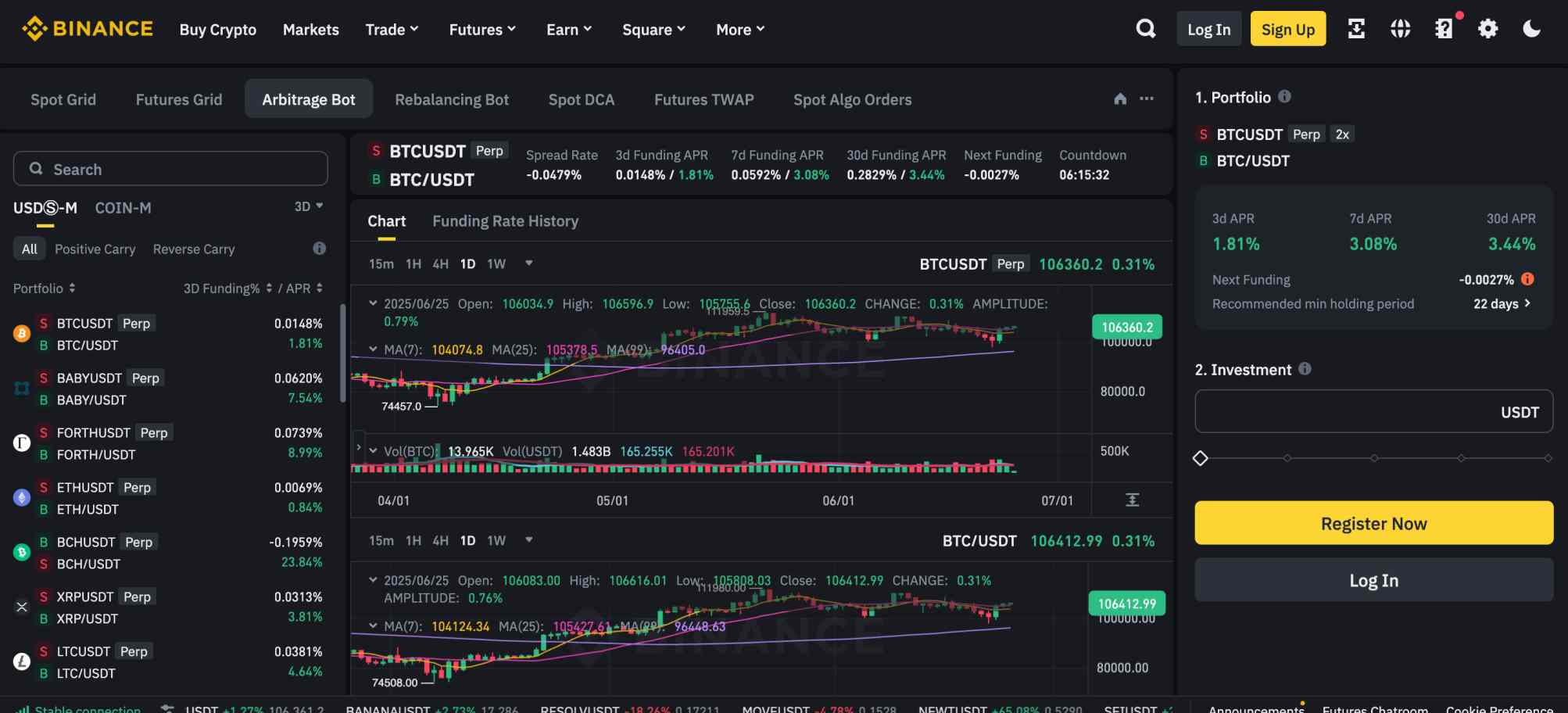
The exchange doesn’t charge additional fees when users deploy crypto trading bots, with just the standard commission applied. Commissions start at 0.1% on spot markets and 0.05% on futures, and discounts are available when traders meet higher volumes or hold BNB.
Pros
-
One of the best crypto arbitrage bots for funding rate discrepancies
-
Plug-and-play solutions; users just enter the investment size
-
The coin arbitrage bot supports hundreds of crypto pairs
-
Users only cover the exchange’s standard trading commissions
-
Also offers other bot strategies, including algo trading and portfolio rebalancing
Cons
-
Bots have limited customization tools
-
Potential funding rate profit margins are minute
2. OKX – Smart Coin Arbitrage Bot Aimed at Complete Beginners
OKX is a tier-one exchange that supports thousands of bot strategies, including crypto arbitrage trading. The exchange’s “smart arbitrage” system is ideal for beginners who want a simple way to trade digital assets passively. Traders initially select their preferred pair, like BTC/USDT or SOL/USD, and enter their investment size. The bot enters positions thereafter via the delta-neutral strategy.
OKX bots take long or short positions on spot markets and perpetual futures to profit from funding rate differences, similar to Binance. The strategy’s backtested APY ranges from 4.39% to 9.46% depending on the market. These returns are modest compared to other arbitrage bots, yet the projected risk is also low.
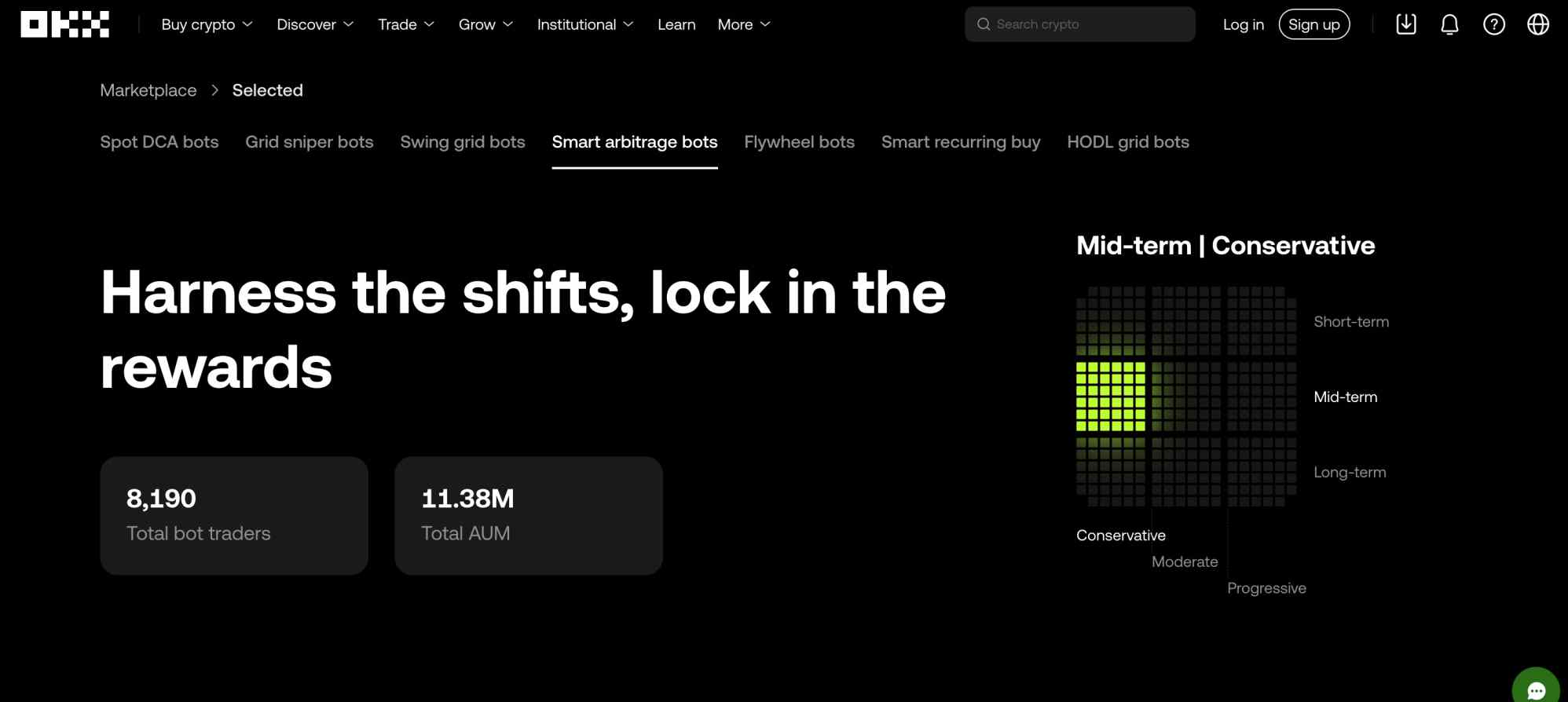
The platform offers a fee-free bot experience, although users must cover trading commissions, which start at 0.1% or 0.05% per slide for spot and perpetual positions, respectively.
In terms of accessibility, OKX is a global trading platform that accepts U.S. clients. All account holders must complete know-your-customer (KYC) requirements before they can deposit funds.
Pros
-
The smart arbitrage system is ideal for first-time bot users
-
No additional fees to deploy bots
-
Available globally, including the U.S.
-
The bot marketplace supports thousands of third-party strategies
-
Users can deposit funds instantly with fiat money
Cons
-
The arbitrage strategy only supports Bitcoin, Ethereum, and Solana
-
Backtested APYs are lower compared to other arbitrage bots
-
It’s mandatory to upload KYC documents
3. Cryptohopper – The Best Option to Exploit Price Differences on Multiple Exchanges
Launched in 2017, Cryptohopper is an established automated trading platform that offers a wide range of bots. It’s one of the best options for cross-exchange arbitrage trading: Cryptohopper works with the top Bitcoin exchanges, including OKX, Kraken, Coinbase, Binance, and KuCoin. Once deployed, the bot monitors real-time exchange rates 24/7, and when it detects a suitable price discrepancy, it places buy and sell orders to lock in the identified profit.
Note that users must already hold funds on the respective exchanges to capitalize on the cross-platform strategy, which may be a drawback for those on a budget. This is because to maximize the bot’s capabilities, users realistically must fund accounts with all supported platforms.
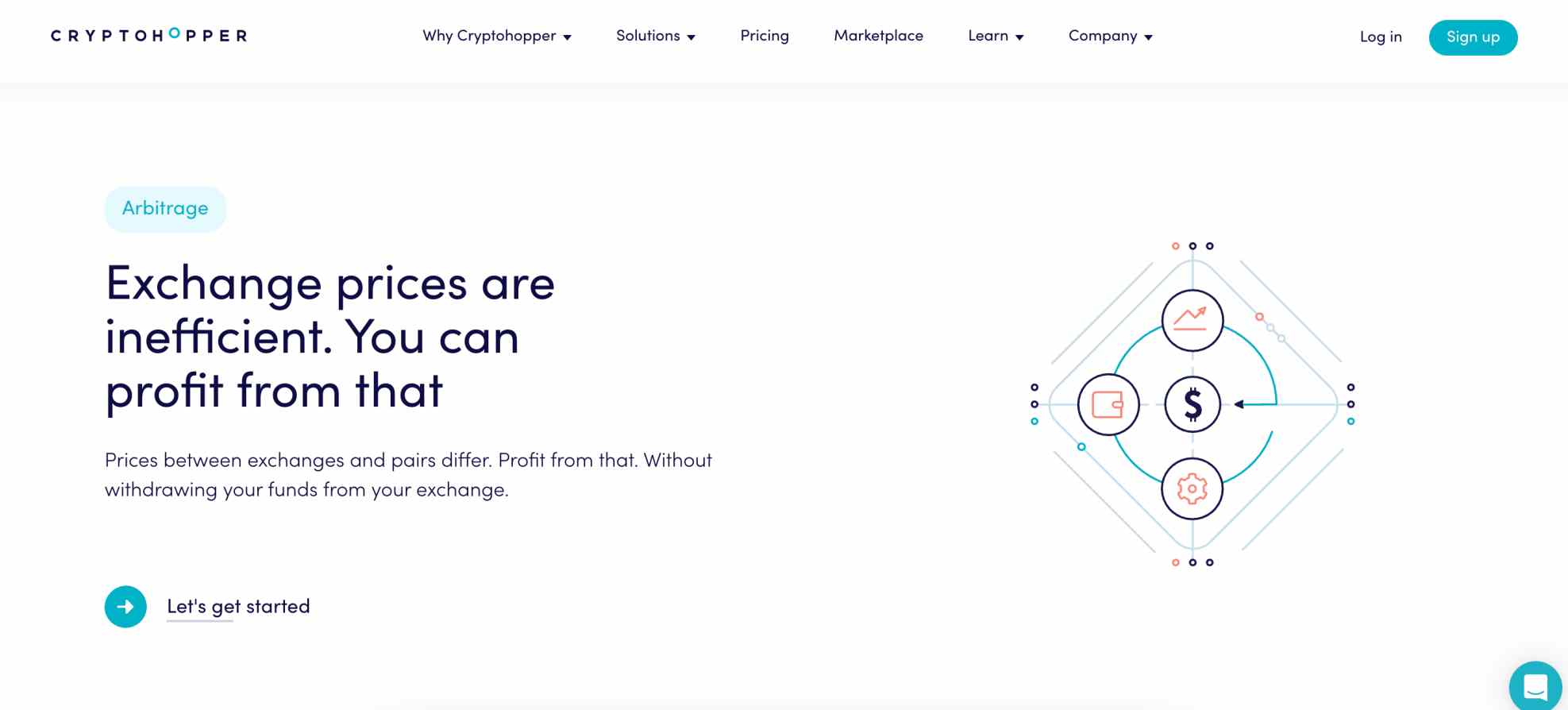
Moving on to fees, Cryptohopper offers four paid plans, ranging from $0 to $129 per month, and discounts are available when you pay annually. The best plan depends on how many open positions and exchange connections you need.
Pros
-
The best crypto arbitrage trading bot for cross-exchange strategies
-
Supports Coinbase, KuCoin, OKX, and 13 other top exchanges
-
No prior experience is needed; the platform is suitable for newbies
-
Lots of customization tools, including risk-management settings
Cons
-
Users need funded accounts with each exchange
-
Flat monthly plans may not be viable for casual traders
4. Pionex – Low-Risk Arbitrage Strategy on USDT Deposits With APYs of Over 21%
Pionex is an established bot trading exchange with over 5 million global users and $60 billion in monthly volumes.
Research shows that Pionex is one of the best crypto arbitrage bots to earn low-risk yields on USDT deposits. The bot buys cryptocurrencies like Bitcoin and Ethereum on the spot markets and short-sells those assets via perpetual futures. This strategy allows users to profit from the funding fees paid by leveraged long positions. While this market-neutral strategy is risk-averse, Pionex averages APYs of over 21%, which far outperforms traditional USDT savings accounts.
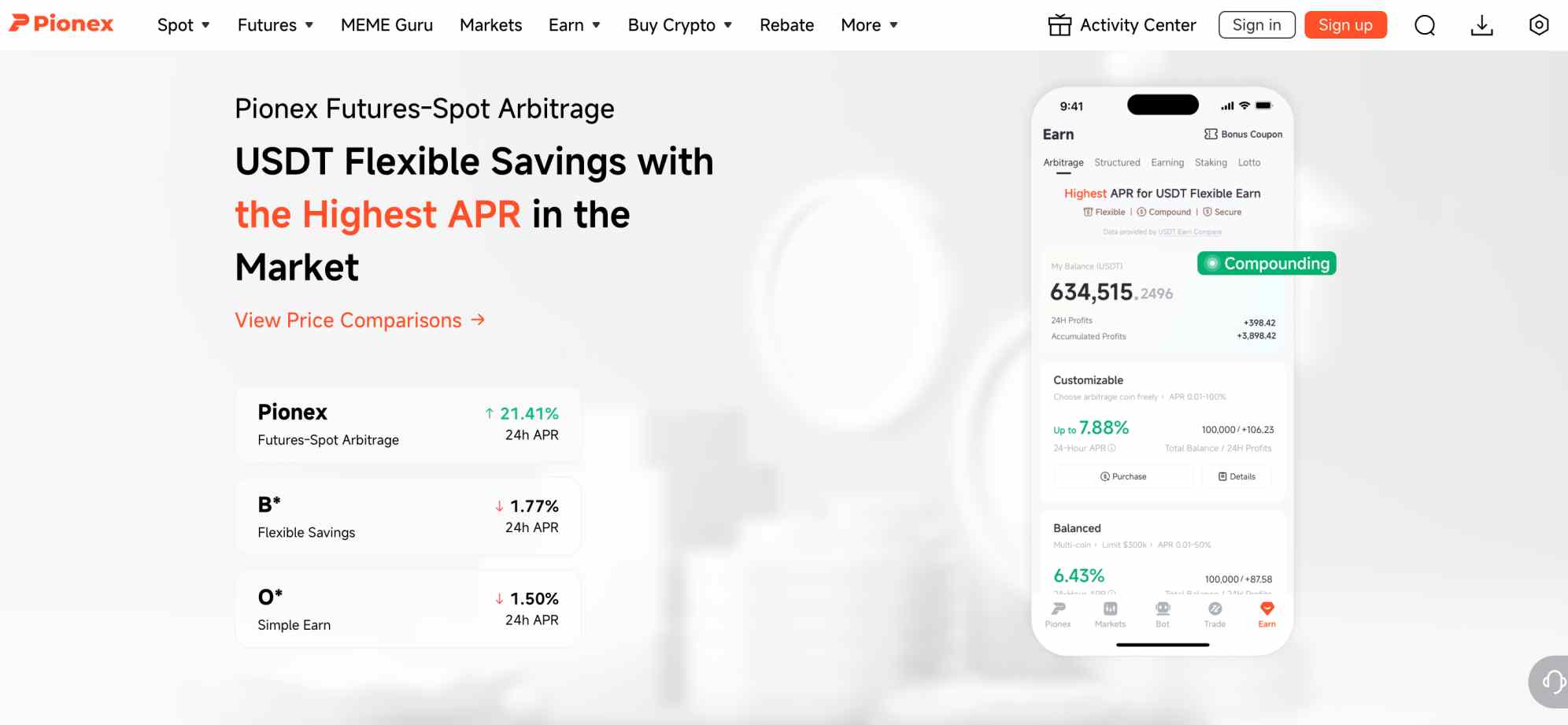
Other bot systems are also available, including long-term strategies like dollar-cost averaging.
Getting started takes minutes. Users open an account, upload ID documents, and deposit or buy USDT with traditional payment methods. The platform has a small minimum investment stake of just 10 USDT per bot, making Pionex ideal for casual investors.
Platform users pay standard trading commissions of 0.05% on spot trades and 0.05% on futures. Commission discounts are offered on higher volumes and when bots place limit orders.
Pros
-
The USDT coin arbitrage bot averages APYs of over 21%
-
Get started with just 10 USDT per bot
-
One of the lowest-risk bot strategies available
-
Accepts fiat money, including fee-free bank account deposits
-
Also offers dollar-cost averaging bots for long-term investors
Cons
-
High deposit fees on non-major currencies
-
Liquidity levels are substantially lower than tier-one exchanges
5. WunderTrading – Top-Rated Bot Provider With Multiple Crypto Arbitrage Strategies
WunderTrading was founded in 2019 and offers three arbitrage trading strategies for crypto investors.
The first option uses the cross-exchange arbitrage system, where the bot buys and sells cryptocurrencies when it discovers price discrepancies. The bot also supports spatial arbitrage; this strategy takes advantage of varying prices in different countries. For example, Bitcoin may trade at $101,000 on Coinbase and $103,000 on a local exchange in South Korea. Another option is the triangular arbitrage strategy, which exploits price differences between three trading pairs.
All available strategies are compatible with tier-one exchanges like Kraken, Binance, MEXC, and Gate.io, and users safely connect their accounts via an API key.
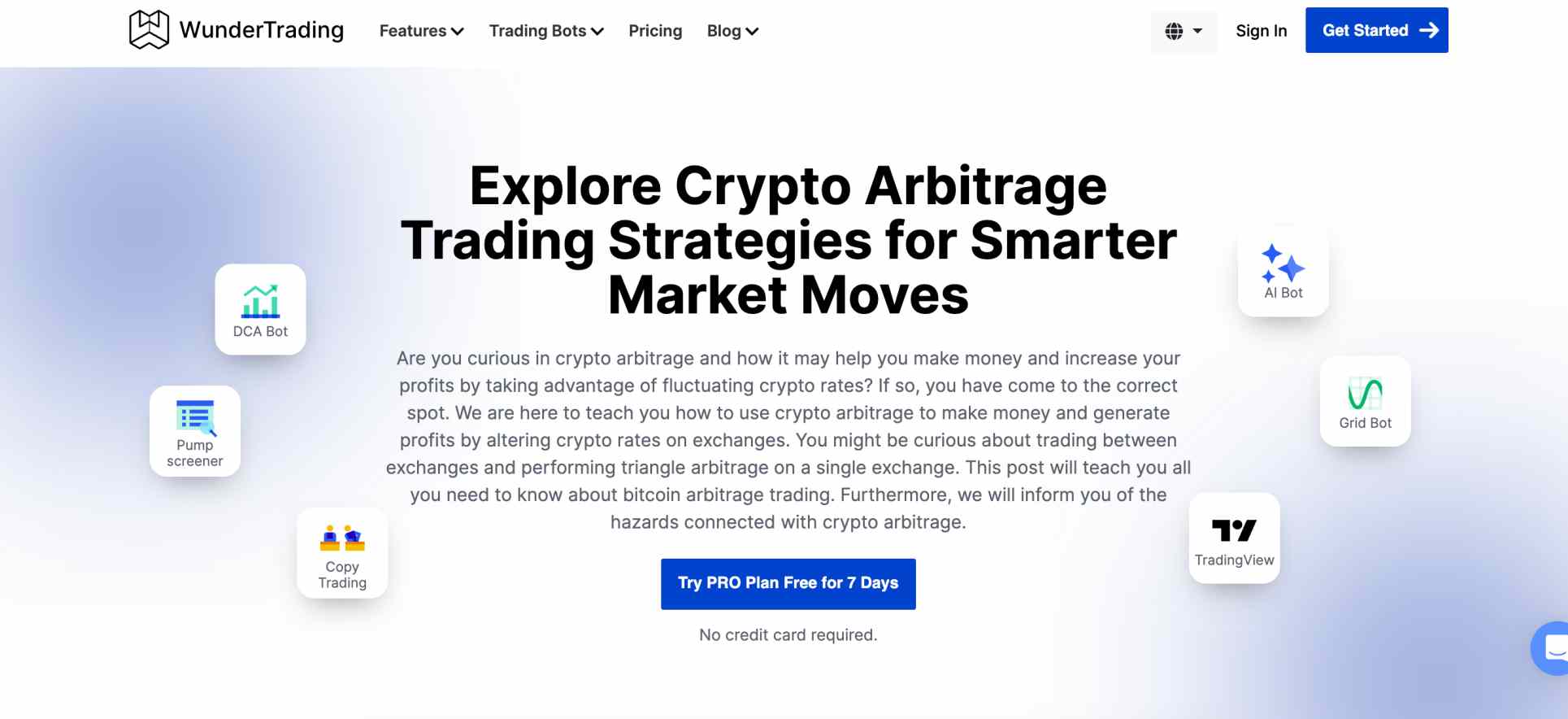
WunderTrading offers a free plan that supports arbitrage positions, yet users are limited to just one active bot. Premium plans, which offer between five and unlimited bots, cost $19.95 to $89.95 per month, depending on the requirements. The provider also has a seven-day free trial, and no credit card is needed.
Pros
-
Supports cross-exchange, spatial, and triangular arbitrage bots
-
Compatible with most tier-one exchanges
-
Offers a free paper trading account
-
New customers get a seven-day free trial on premium plans
Cons
-
The free plan is limited to one active bot
-
Unlimited bot usage costs $89.95 per month
6. Crypto.com – Earn Stable Arbitrage Returns on BTC/USD via the Delta-Neutral System
Crypto.com is a regulated exchange and another good option for traders who prefer the delta-neutral strategy. It provides stable returns on the BTC/USD pair. APYs are modest at 2.61%, yet the arbitrage bot ranks among the most risk-averse in the market. As a tier-one exchange, BTC/USD bots trade 24/7 in a deep-liquid environment.
If you’re happy to take on slightly more risk, altcoin pairs typically offer higher returns. AAVE/USD and ATOM/USD provide average yields of 8.77% and 7.54%, respectively.
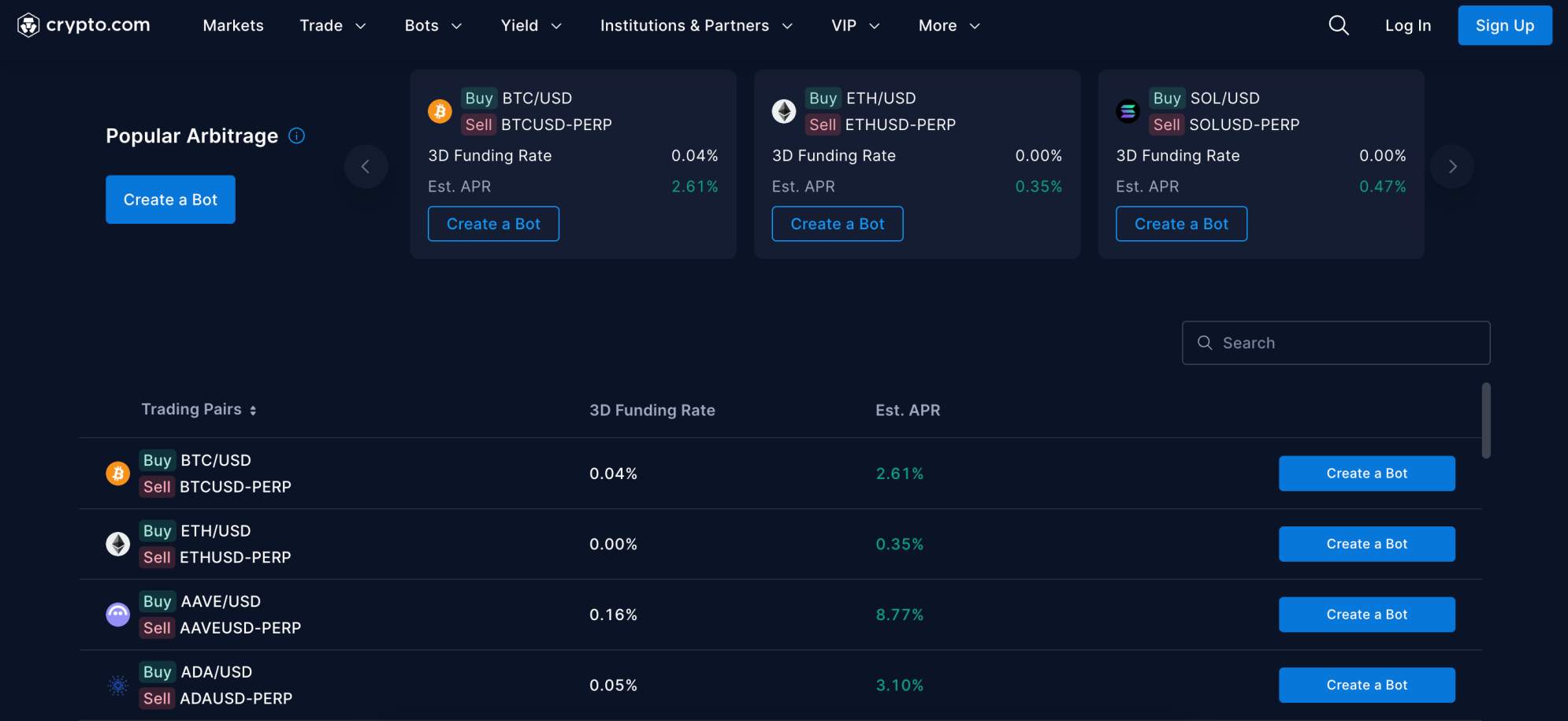
Alongside the arbitrage strategy, Crypto.com also offers automated bots for grid trading and dollar-cost averaging. All built-in bots are free to use, and traders avoid commissions when they hold CRO, the exchange’s native token.
Crypto.com has a strict KYC policy for new users, regardless of whether deposits are made in digital assets or fiat. Once verified, users can manage bot positions via the desktop website or mobile app.
Pros
-
Offers stable returns on the BTC/USD pair
-
More competitive APYs are available when trading altcoins
-
Platform users avoid trading commissions when holding CRO tokens
Cons
-
Strict KYC requirements for new customers
-
Debit/credit card fees are expensive
7. Coinrule – Build Custom Arbitrage Strategies Without Coding Knowledge
Coinrule is the best option to build bespoke arbitrage systems from the ground up. The platform allows users to design the bot’s underlying rules without programming experience. Its visual rule builder is ideal for beginners, as it relies on the IF-THEN concept.
One example is the bot buys Ethereum on Kraken if the price hits $2,600, and simultaneously it sells Ethereum on Binance if it’s greater than $2,620. These trades execute only if both conditions are met.
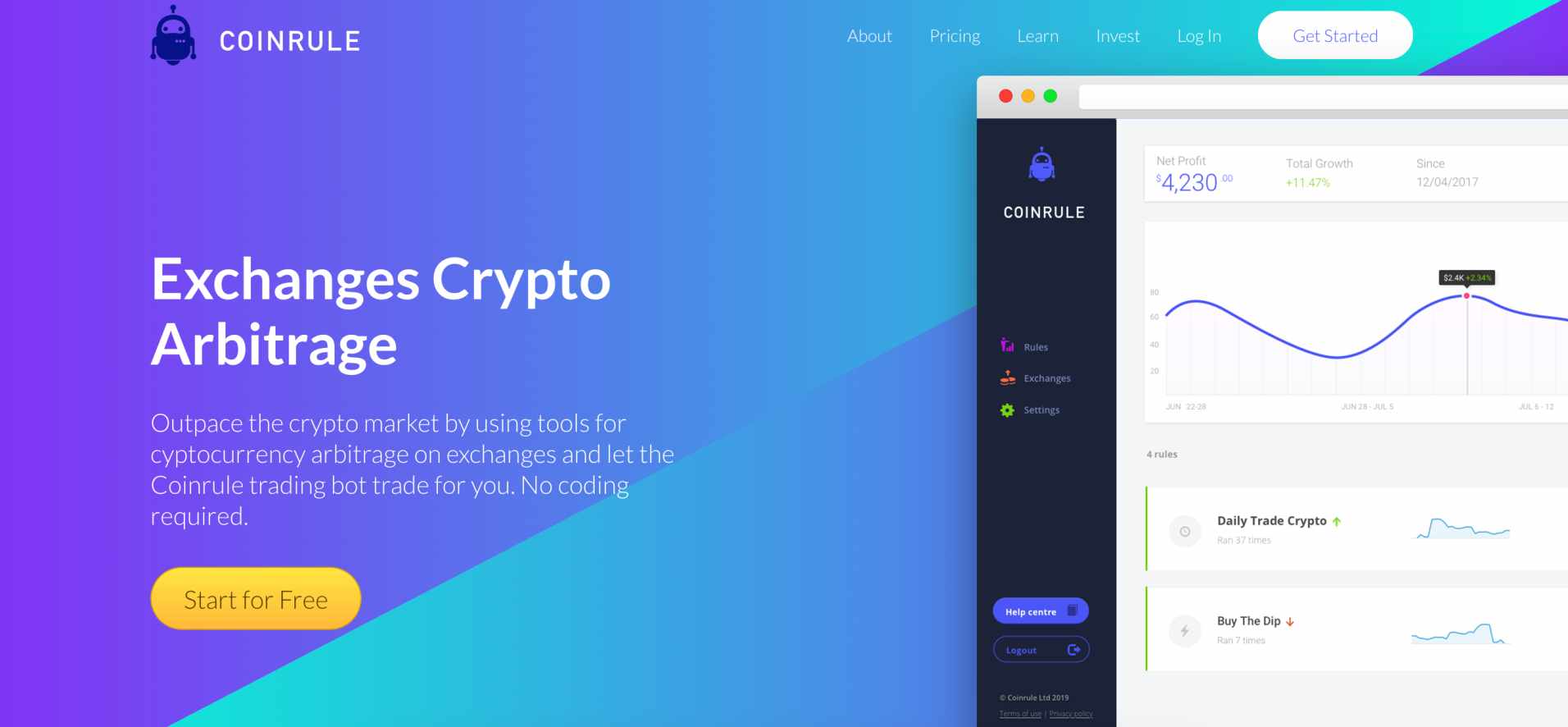
The platform has an extensive backtesting feature, where users assess how arbitrage strategies performed in past market conditions. Users can also deploy their bots risk-free via the demo account.
While Coinrule has a freemium option, the plan limits users to just $3,000 in monthly trading volume. Premium plans range from $39.99 to $995, based on the required features, volume, and active bots.
Pros
-
The best option to build custom arbitrage bots from scratch
-
No coding knowledge is needed
-
Offers comprehensive backtesting and demo trading features
Cons
-
Users must have a basic understanding of arbitrage systems
-
Charges $995 for unlimited active bots
What Is Crypto Arbitrage?
Arbitrage is a popular trading strategy most investment markets use, including crypto, forex, commodities, and indices. The system takes advantage of price discrepancies, usually on the same pair across different exchanges.
Crypto is ideal for arbitrage trading, as digital assets do not operate on a single, centralized exchange like stocks. Instead, market forces determine crypto prices on each exchange, which is why there’s almost always a slight price difference across each platform.
Suppose ETH/USD trades for $2,500 on Binance and $2,507.50 on Coinbase. The best crypto arbitrage bots purchase ETH on Binance and simultaneously sell ETH on Coinbase, making a quick 0.3% profit.
Arbitrage margins are wafer-thin even without factoring in trading commissions. This dilemma means that arbitrage positions often require significant amounts to make the strategy viable. Investors also need a low-fee exchange to reduce trading fees.
In addition to cross-exchange systems, arbitrage bots also support delta-neutral strategies, where they capitalize on derivative funding fees. You may also consider spatial or triangular arbitrage, which explores discrepancies in different countries or across three trading pairs.
How Does Crypto Arbitrage Work: Example
Here’s a more detailed explanation of how crypto arbitrage works:
- The bot finds Solana price discrepancies on Binance ($140) and OKX ($140.42). This reflects a $0.42 gap per SOL, or 0.3%.
- The bot buys 10 SOL on Binance for $1,400 and sells 10 SOL on OKX for $1,404.20.
- The arbitrage trade yields a gross profit of $4.20 and a net profit of $1.40 after paying 0.1% commissions on both platforms.
This example reiterates that arbitrage gains are minute, yet they’re also low risk and potentially suitable for high-frequency trading. The best crypto arbitrage bots operate 24/7 across the top exchanges, so those small profit margins can quickly add up.
The drawback is that cross-exchange arbitrage trading requires pre-funded accounts across each exchange. In the previous example, the bot user required $1,400 on Binance and 10 SOL on OKX just to capture a $1.40 net profit.
Types of Crypto Arbitrage
Several sub-strategies exist when using crypto arbitrage bot platforms. Here are the most common arbitrage systems in the digital asset market.
1. Cross-Exchange Arbitrage
Most people associate crypto arbitrage trading with the cross-exchange strategy, which capitalizes on price discrepancies on two different platforms. It’s the most basic version of the arbitrage system, as bots buy and sell the same pair.
The wider the price difference, the higher the profit margin, yet traders must have sufficient funds in their exchange accounts to maximize opportunities.
2. Delta-Neutral Arbitrage
Delta-neutral arbitrage is a single-sided strategy, so users only need one exchange account. Binance and OKX support the strategy with natively built bots, making them ideal for beginners who seek a plug-and-play solution.
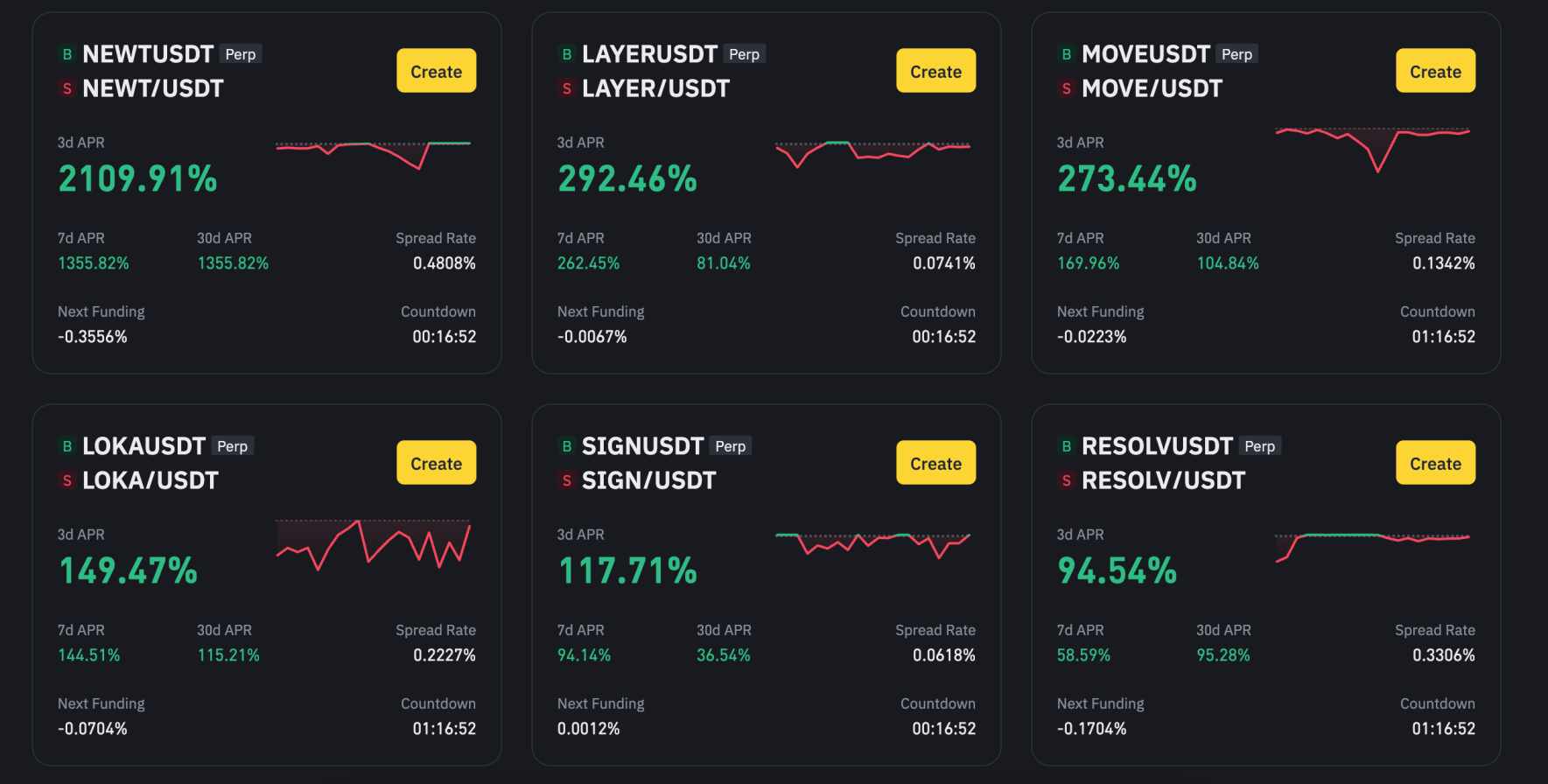
Once the bot identifies an arbitrage opportunity, it buys crypto via the spot markets and short-sells the same asset with perpetual futures. Successful positions profit from funding fee variances, which exchanges charge on leveraged trades.
3. Spatial Arbitrage
This crypto arbitrage strategy looks for price discrepancies between exchanges in different countries, so trading pairs are priced in the local currency. Crypto trading prices in South Korea, for instance, are often much higher compared to U.S. and European markets, making the country ideal for quick arbitrage positions.
The Spatial system relies on highly advanced bots capable of calculating crypto prices, available liquidity, commission fees, and currency exchange rates in real-time.
4. Triangular Arbitrage
The Triangular strategy is one of the most advanced crypto arbitrage systems. It capitalizes on price differences across three independent pairs. For instance, the bot may go long on BTC/USDT, BTC/ETH, and ETH/USDT due to marginal discrepancies on the same exchange.
While more complex than other strategies, the single-sided mechanism is more budget-friendly, as only one exchange needs to be pre-funded.
Arbitrage is one of the lowest-risk trading strategies, as bots place buy and sell orders simultaneously. This minimizes market exposure, with the primary risk being the difference between the two execution prices. However, arbitrage bots do not guarantee profits. Like any trading strategy, some positions may generate losses. This often happens when the identified arbitrage spread is capitalized on by another trader, or trading commissions eat into the gross profit. The good news is that arbitrage bots target ultra-thin margins, so even slight, unfavorable price movements typically yield minute losses. Over time, bots produce long-term growth, as long as winning positions outperform losing ones. Can Crypto Arbitrage Bots Guarantee Profits?
Success Rates of Crypto Arbitrage Bots
There’s no single way to determine arbitrage success rates, as a wide range of factors can influence the bot’s performance.
While the best crypto arbitrage bots have a success rate of at least 70%, net proceeds depend on individual trades, stakes, and platform commissions. The bot’s speed and real-time processing capabilities also play a major role in profitability.
Increased market volatility, such as when exchange traders face unprecedented liquidation, is another core variable. This results in major short-term differences between the spot and futures prices, which can amplify both profits and losses.
The key takeaway is that crypto arbitrage trading is about making small and frequent gains over time in a risk-averse environment.
How Crypto Arbitrage Bots Have Changed
Crypto trading moves fast, and arbitrage bots are no exception. Over the last couple of years, we’ve seen some big changes in how these bots work, where they trade, and what tools people are using.
If you’re still thinking about bots the way they worked in 2022 or 2023, you’re probably missing out. Here’s a quick look at what’s new in 2026 and why it matters.
AI is starting to play a role
Some trading tools now use AI to help you spot good opportunities faster. These tools don’t place trades for you just yet, but they scan markets and show you where you might be able to profit. Platforms like Nansen are working on this kind of tech to make trading more automatic and less time-consuming.
Telegram bots are now everywhere
A lot of traders are now using simple Telegram bots to make trades directly from their phones. These bots are especially popular on Solana and are used for things like fast arbitrage between tokens. BonkBot, Banana Gun, Maestro, and Trojan are among the most notable names. They’ve changed the way many people trade, especially on-chain.
More people are trading across different blockchains
Cross-chain arbitrage is also picking up. A study from early 2025 examined trades between blockchain networks, including Ethereum, BNB Chain, and Arbitrum. It identified over 240,000 successful arbitrage trades in just one year, with a trading volume of approximately $868.64 million. While profits were a lot smaller, the data shows that cross-chain bots are being used more often now.
Spot and futures trading bots are getting better
Bots that trade between spot prices and futures prices are more polished now. OKX, for example, has made it easier to run these kinds of bots. These setups can earn you steady returns if you know what you’re doing. OKX has also started to expand access in the U.S., though what’s allowed still depends on where you live.
Open-source bots are still improving
Hummingbot, a free and open-source tool, receives updates every month. It recently brought back support for PancakeSwap, which shows the team is keeping up with new exchanges. If you like building or running your own bots, this one is still a good option.
Scams are becoming more common
Sadly, scams around fake “AI arbitrage bots” have become a bigger problem. Some of these show up on YouTube or Telegram and promise fast profits. Instead, they steal your funds. Always vet bot providers carefully, avoid giving withdrawal permissions, and beware of promises that sound too good to be true.
Key Features to Look for in a Crypto Arbitrage Bot
Consider these factors when exploring automated arbitrage bots for crypto:
- Success Rate: Some trading platforms provide the success rate (in percentage terms) for their native bots. Assess what period the stated rate is based on. Top bots perform well consistently over many months, while others have only been active for days, significantly skewing the performance figures.
- Exchange Integration: To maximize arbitrage profits, bots need access to many exchanges, particularly tier-one platforms like Coinbase, Binance, and OKX. When bots have wide exchange support, they can capitalize on a higher number of arbitrage opportunities.
- Latency and Speed: Latency is crucial to make consistent arbitrage profits, as price discrepancies often last for seconds, or even milliseconds in some instances. Even a slight delay between the bot and the exchange can turn a profitable trade into a losing one.
- Smart Order Routing: Advanced arbitrage bots leverage smart order routing to maximize profits and reduce pricing risks like slippage and weak liquidity. This strategy divides order values across two or more exchanges to ensure users get the best prices at any given time. If you’re serious about making money from the arbitrage system, routing is a must.
- Custom Strategy Scripting: Experienced algorithmic traders seek arbitrage bots that support complete customization. They create bespoke arbitrage strategies via a custom script (e.g., JavaScript or Python), which integrates into exchange API systems.
- Low Fees: Arbitrage margins are often a small fraction of a percentage. This makes competitive fees more important than ever. In addition to the bot provider’s fees (if applicable), consider exchange commissions, spreads, and payments.
- Free Trial: Look for crypto arbitrage bots with free trials and paper trading facilities, which allow you to test-drive the algorithm before risking funds. Ensure the free trial offers full functionality so you can try all available features.
- Community Reviews: Publicly-accessible reviews are often the best way to assess an arbitrage bot, especially on third-party platforms like Trustpilot. Top-performing bots have great ratings, while subpar providers consistently receive negative reviews.
Evaluate these best practices before getting involved with crypto arbitrage bots:Tips for Using Cryptocurrency Arbitrage Bots
Potential Downsides of Using Crypto Arbitrage Bots
Arbitrage trading won’t be suitable for everyone. Here are the main drawbacks of arbitrage bots in crypto.
Thin Profit Margins
Even successful arbitrage trading bots target thin margins, with profitable trades rarely exceeding 1%. These market dynamics imply that arbitrage strategies may not be viable unless you’ve got significant capital to invest.
Widespread Account Funding
Most arbitrage bots deploy the cross-exchange strategy, so users must ensure they have pre-funded accounts with each platform. Otherwise, the bot can’t open the contrasting arbitrage position, leaving the original trade exposed to market risk.
This drawback also relates to affordability. Sufficient capital must be deposited into multiple accounts.
Bot vs Bot Competition
Thousands of users rely on public-facing bots, meaning the same algorithms compete against each other to capitalize on the same arbitrage opportunities.
In addition, you’re also against institutional-grade investors with access to vast resources and more powerful algorithms.
Technical Failure
No single bot is completely immune to technical risks, such as API failures, latency, and outages. Malfunction is the biggest threat, where the bot purchases the wrong asset or enters an incorrect trade size.
Opportunity Risk
Even the best crypto arbitrage bots target small returns, which leads to opportunity risks. Other automated strategies, like grid trading, may offer different risk/reward profiles. They can provide more upside in trending or range-bound markets, but come with their own risks, such as drawdowns during volatility.
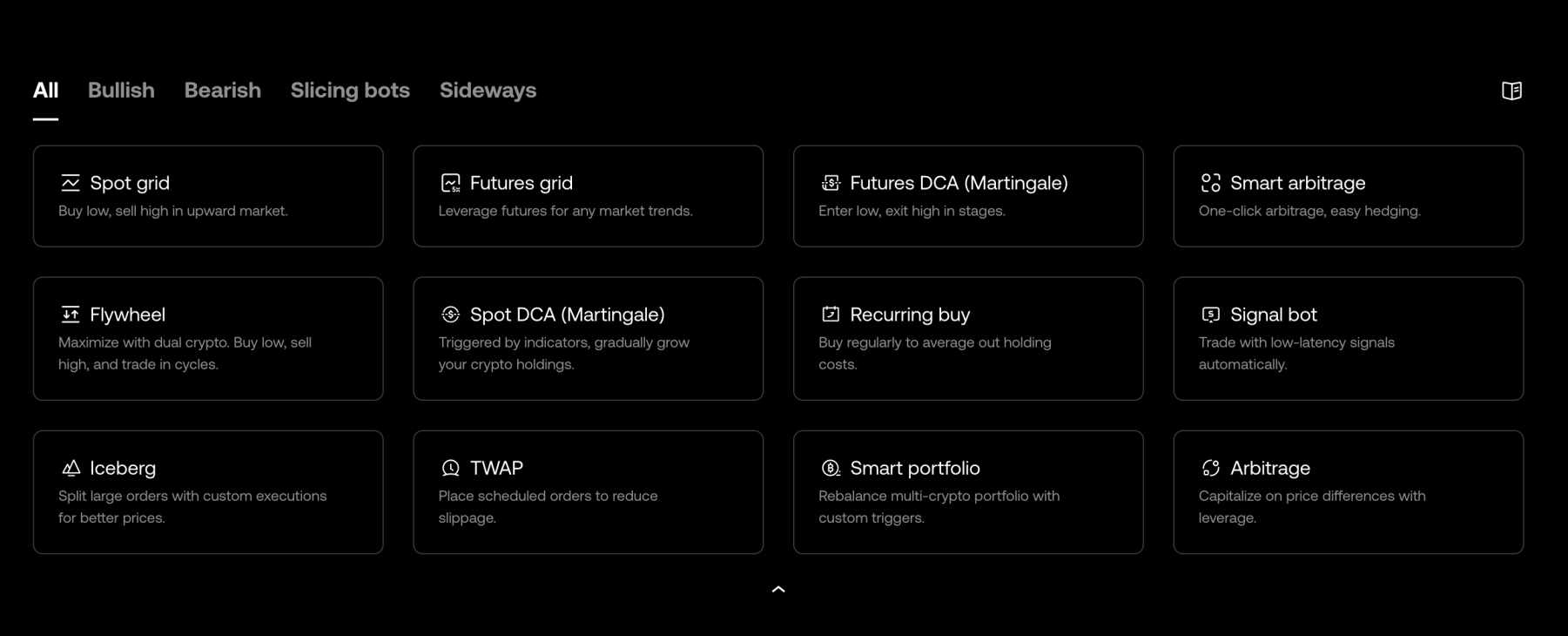
Consider your financial goals and risk tolerance before you choose the arbitrage strategy; more suitable systems may exist.
Conclusion
Arbitrage trading is a low-risk, low-return strategy used in most asset sectors, including crypto. It’s ideal to capitalize on price discrepancies on the same exchange, as bots buy and sell via spot and futures markets simultaneously. Cross-exchange arbitrage strategies also remain popular, where bots take advantage of price differences on two or more platforms.
The best crypto arbitrage bots factor in real-time prices, exchange commissions, and available liquidity before they deploy orders. Users must conduct independent research when selecting a provider, although the arbitrage strategy is low risk, profits are not guaranteed.
See also: The Beginner’s Guide to Bitcoin Arbitrage
FAQs
Which coins are best for arbitrage?


In general, the best coins for arbitrage are large-caps like Bitcoin and Ethereum. These cryptocurrencies attract deep liquidity and significant market action, which are crucial factors for the arbitrage strategy.
Can you lose money in arbitrage trading?
Yes, while arbitrage trading is low-risk, trades must be executed in milliseconds to secure the opportunity identified. A volatile movement after placing the initial position can lead to losses.
Is arbitrage legal in crypto?
Yes, the arbitrage strategy is generally legal in most asset arenas, including crypto, bonds, and commodities. Arbitrage traders should explore regulations in their home country to ensure legality.
How do I start crypto arbitrage?
Use an automated arbitrage bot to get started, like those available on Binance, OKX, and Cryptohopper. Choose a pair, activate the bot, and watch it place buy and sell orders to lock in arbitrage opportunities.
Can you make a living off crypto arbitrage?
Making a living from crypto arbitrage trading is difficult unless you have access to substantial capital. Arbitrage profit margins are wafer-thin, and you need pre-funded accounts with multiple exchanges.
References:
- What Is Arbitrage? 3 Strategies to Know (Harvard Business School)
- Cryptocurrency Trading Is Now Bigger Than Stocks in South Korea (Bloomberg)
- Potential Profit From U.S. ‘Latency Arbitrage’ Trading May be $3 Billion -study (Reuters)

Why you can trust 99Bitcoins
Established in 2013, 99Bitcoin’s team members have been crypto experts since Bitcoin’s Early days.
Weekly Research
100k+Monthly readers
Expert contributors
2000+Crypto Projects Reviewed