




In This Article
A lot of people hear about Bitcoin ETFs and want something simple, so it makes sense to look at What Fidelity Wise Origin Bitcoin Fund (FBTC) is and how it fits into the bigger Fidelity ecosystem.
The fund is built on the same custody setup used by Fidelity Digital Assets, and it connects naturally with everything offered through Fidelity Crypto, which keeps things familiar if you already invest through Fidelity.
In this guide, you’ll see what FBTC actually does, how it holds Bitcoin for you, and why so many people prefer this approach over handling wallets and private keys themselves.
Quick Facts About FBTC
Key Takeaways
- FBTC lets you access Bitcoin through a regular brokerage account without handling private keys
- The fund holds real Bitcoin in cold storage and updates its value using Fidelity’s benchmark
- You trade FBTC during stock market hours, with spreads and liquidity similar to other spot Bitcoin ETFs
- Tax reporting is straightforward because brokers handle it the same way they handle other investment products
- FBTC will suit long-term investors and traders who want regulated, familiar Bitcoin exposure
Fidelity Bitcoin Fund: Summary
In this guide, we’ll walk you through how FBTC will work inside a normal brokerage account. You’ll see how the fund will hold real Bitcoin on your behalf, how your Bitcoin per share will be calculated, and why that number will change over time as the trust updates its holdings and pays its fees.
We’ll also walk you through how FBTC will compare to holding Bitcoin directly, how taxes will show up depending on the type of account you use, and what risks you’ll need to keep in mind before you buy. By the time you’re done, you’ll know exactly how FBTC will fit into your own plan, whether you want long-term exposure, a smaller side position, or an easy way to add Bitcoin without dealing with crypto wallets or private keys.
What is FBTC (Fidelity Wise Origin Bitcoin Fund)?
FBTC is the Fidelity Wise Origin Bitcoin Fund, which many people first hear about when they ask what is FBTC or look into Fidelity Investments and its role in the Bitcoin space. The fund trades in the United States on the Cboe BZX Exchange under the ticker symbol FBTC.
It offers a familiar investment structure that lets you gain exposure to Bitcoin inside regular brokerage accounts and other tax-advantaged accounts without needing to handle private keys or manage Bitcoin trades directly. The fund’s assets consist of actual Bitcoin held by a third-party custodian, and everything is structured as an exchange-traded product that behaves like a spot Bitcoin ETF.

FBTC attempts to track Bitcoin’s price by using the Fidelity Bitcoin Reference Rate, which is Fidelity’s own benchmark for Bitcoin market data. The benchmark relies on volume-weighted median price calculations over rolling sixty-minute increments, and it pulls information from eligible Bitcoin spot markets that meet specific standards. These rules help maintain transparent pricing and reduce noise during volatile periods in the Bitcoin market.
The rate updates every fifteen seconds and uses VWMP spot market data to form a more stable Bitcoin price feed. The idea is to reflect market conditions while keeping the underlying asset valuation consistent. The goal is to match Bitcoin performance as closely as possible after the expense ratio and normal management fees are taken into account.
Since this is a spot Bitcoin ETF, the fund holds Bitcoin directly. It does not rely on futures, swaps, or other digital assets. NAV comes from dividing total Bitcoin holdings by the number of FBTC shares. As Bitcoin moves, the NAV moves. You get indirect exposure to the cryptocurrency while still trading through the stock market hours of a regulated environment.
Premiums and discounts work the same way they do for other spot Bitcoin ETFs. If FBTC trades above its NAV, it is at a premium. If it trades below, it is at a discount. Market makers and authorized participants help keep these gaps tight. This setup aims to shield investors from large deviations that sometimes happen in closed-end funds or mutual funds that lack redemptions.
FBTC fills a space for investors who want Bitcoin investments without the technical complexity of holding actual Bitcoin. You stay inside the traditional investment system while still gaining exposure to the underlying asset.
How FBTC Works?
FBTC works like a physically backed ETF where the trust’s Bitcoin is the core asset. Authorized participants monitor price movements in the Bitcoin market and help keep the fund aligned with the underlying asset value.
When FBTC trades at a premium, APs buy Bitcoin in eligible spot markets, deliver it to the trust’s Bitcoin custodian, and receive new shares. When it trades at a discount, APs can redeem shares and take Bitcoin out. This helps maintain the same methodology across creations and redemptions.

Custody is handled by Fidelity Digital Asset Services, which is part of Fidelity Digital Assets. This group focuses on asset management for digital assets and runs cold storage systems built to prevent a security breach. They follow strict procedures to protect private keys, and they operate under regulatory oversight as a New York trust company. Investors rely on this structure to hold Bitcoin safely.
Liquidity comes from Bitcoin’s global trading activity and from the ETF’s own market on the Cboe BZX Exchange. Spreads adjust depending on market conditions. During calm periods, spreads are tight. During highly volatile periods, spreads can widen as market makers manage risk. This happens across the Bitcoin space and affects other Bitcoin ETFs in similar ways.
The reliance on rolling sixty-minute VWMP windows means price updates can be smoother than raw exchange data. These windows help reduce sudden jumps that come from thin markets or unusual Bitcoin trades. The data is updated often enough to match Bitcoin movements while keeping things predictable.
When everything works normally, you simply see FBTC quotes on your brokerage accounts the same way you see any other investment products. You place orders, buy or sell shares, and track performance using standard tools.
FBTC Ticker, “Stock,” and Where to Trade?
FBTC shows up on most U.S. broker platforms as you would expect. The ticker is FBTC, and the main listing is on the Cboe BZX Exchange in U.S. dollars. Quote pages on sites like TradingView, Yahoo Finance, and MarketWatch display the data the same way they do for equity ETFs.
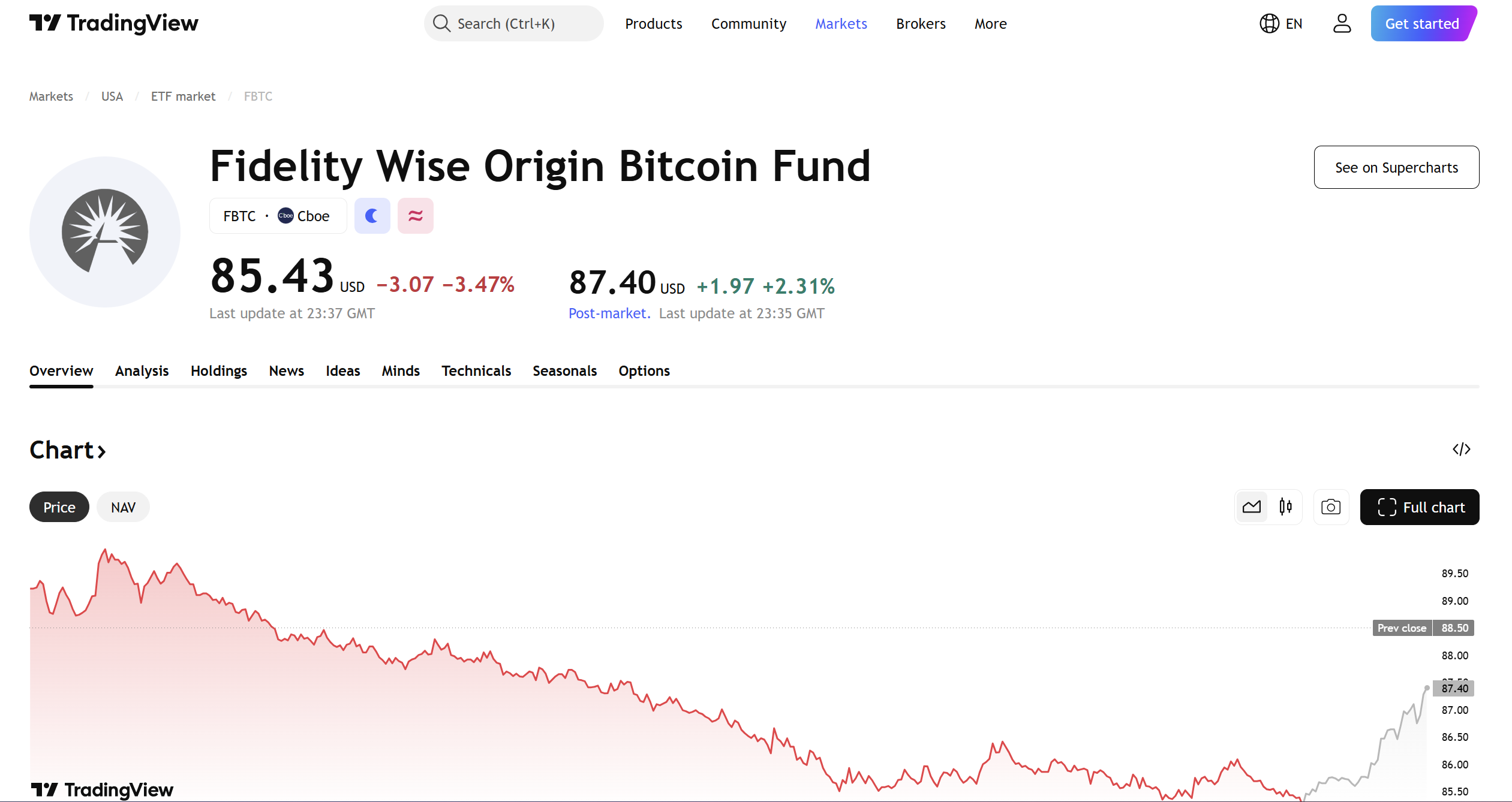
You will see price, volume, fund size, NAV, and basic fund statistics. You may also notice the symbol written as $FBTC in news feeds and on social media. The dollar sign is simply a convention that indicates it is a ticker.
Some data providers display additional tags like FBTC:BTQ for the Cboe BZX listing or FBTC.US for global listings. The fund itself is the same US-domiciled Fidelity product with ISIN US3159481098 and a net expense ratio of roughly 0.25%.
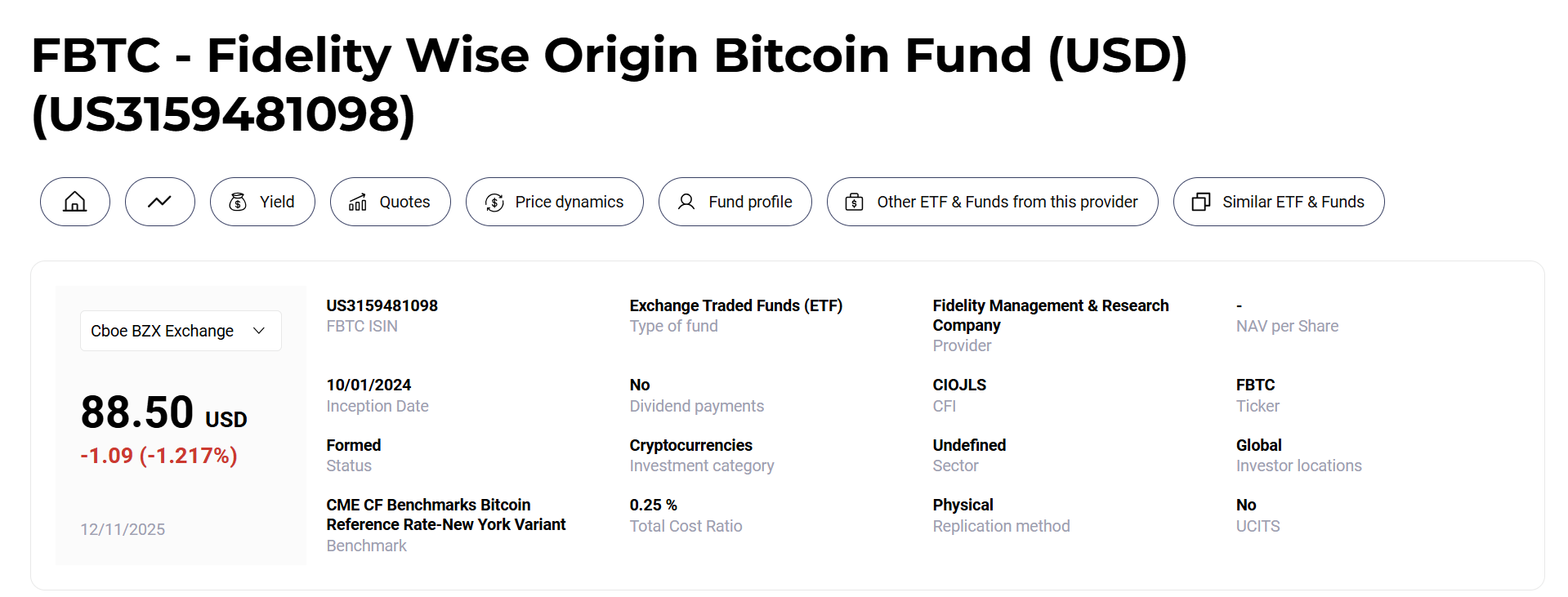
There are several look-alike products in other countries that sometimes use similar tickers. For example, Fidelity runs a separate European Bitcoin ETP that also appears on some platforms under a similar name. You might also see over-the-counter tickers or foreign listings from different issuers. To make sure you have the correct FBTC, confirm the ISIN or CUSIP inside your broker’s details and verify that the listing exchange is Cboe BZX.
Once you have the correct one, you can trade FBTC during normal U.S. market hours. Some brokers let you trade before or after the main session, although spreads tend to widen during those periods.
FBTC: ETF vs. Token – Which Suits You?
Some investors prefer buying FBTC through a brokerage account, while others choose to hold native Bitcoin in a wallet. Both give you exposure to Bitcoin, but the way you access it, store it, and manage it can feel very different.
The table below shows how each approach works across custody, control, fees, trading hours, and general usage so you can compare them easily.
Aspect
FBTC (Spot Bitcoin ETF)
Native Bitcoin Token (BTC in a wallet)
What you hold
Shares in a U.S.-domiciled trust that owns Bitcoin
Actual Bitcoin units recorded on the blockchain
Custody
Fidelity Digital Asset Services as institutional custodian
Self-custody or third-party custody
Access path
Brokerage account, including many tax-advantaged accounts
Crypto exchange, on-ramp service, P2P trade, or mining
Trading hours
Stock market hours with some pre and post-market availability
Full 24-hour global trading on exchanges and P2P markets
Use cases
Portfolio allocation, tax-advantaged accounts, investment exposure
Payments, DeFi, cross-border transfers, on-chain activity, and general investment
Fees
Annual 0.25% management fee plus spreads and any brokerage commission
Exchange fees, network fees, and spread costs. No annual management fee
Control over coins
You control ETF shares but not the underlying Bitcoin
Full or partial control over private keys, depending on wallet choice
Security model
Custodial risk focused on the fund and the custodian
Self-custody risk or exchange custody risk, depending on your setup
Tax and reporting
Broker reporting, such as 1099 forms, plus ETF tax rules
Crypto tax reporting that may require manual tracking or dedicated software
Operational complexity
Similar to using any other ETF
Requires learning wallet setup, seed backup, exchanges, and on-chain transaction management
FBTC usually suits investors who want Bitcoin exposure inside the traditional financial system. It works well if you want to combine Bitcoin with stocks and funds inside one portfolio and avoid private key management. It is also practical for tax-advantaged accounts.
Native Bitcoin suits people who want direct control of their coins and the freedom to use on-chain features. It is necessary if you want to make payments, interact with DeFi, or run your own wallet. Many investors use both approaches depending on their needs.
When to Use Each?
FBTC tends to fit investors who want a simple way to blend Bitcoin into long-term portfolios. It works well for RIAs, institutions, and individuals who prefer established custodians and traditional reporting systems.
Native Bitcoin fits people who value direct ownership, on-chain activity, and full control over private keys. It requires more personal responsibility but allows you to access features that ETF shares cannot provide. Both methods can work together depending on your goals.
FBTC Chart and Price Tracking
FBTC charts look just like charts for regular ETFs, but there are a few things worth knowing. You can use candlesticks or line charts and switch between short intraday periods or long-term timeframes.
Platforms like TradingView and broker research screens let you view price, volume, and common technical indicators.

Overlays such as moving averages help you see longer trends. Bollinger Bands show how volatile the market has been. Volume indicators help you see where buyers and sellers are most active. Since Bitcoin can move quickly, FBTC charts can be more volatile than traditional equity ETFs.
Premium or discount data can also be plotted. This tells you how far the market price sits above or below the NAV. Most of the time the line stays close to zero because authorized participants arbitrage away large gaps. During fast markets or when Bitcoin moves outside U.S. trading hours, temporary blips can appear.
Intraday data is useful if you want to track how FBTC responds to quick Bitcoin moves or how spreads behave at the open and close. End-of-day data is better for studying long-term tracking accuracy, correlations, or performance comparisons. NAV only updates once per day, so daily data gives you the cleanest view of how well the ETF reflects Bitcoin over time.
When you compare FBTC with Bitcoin directly, you can place both on the same chart or use a ratio chart. Over time, the two should move almost in sync with small adjustments for the annual fee and normal ETF trading costs.
FBTC Holdings
FBTC keeps everything simple by holding only Bitcoin. There are no futures, no swaps, and no other coins. Any small amount of cash usually comes from normal operations.
The trust’s Bitcoin is held in segregated addresses managed by the custodian. Auditors and regulators can confirm balances using on-chain data and internal records. NAV is calculated daily by matching the Bitcoin balances with the number of shares outstanding, and any mismatch triggers a review.
The NAV is published daily, and some platforms show Bitcoin-per-share estimates, which decline slowly over time because of the fund’s fee. If you hold FBTC, your exposure is simply Bitcoin stored in a regulated wrapper.
FBTC Expense Ratio and Fees
FBTC charges a 0.25% yearly expense ratio that covers custody and operations. The fee is paid by selling small amounts of Bitcoin from the fund over time, which slowly reduces Bitcoin per share.

You may also face normal trading costs like spreads or commissions. Spreads usually stay tight during normal hours and widen during volatile periods or thin trading sessions.
Managed accounts or retirement accounts may add additional fees. FBTC’s fee sits in the middle of the current market, while IBIT charges around 0.12% and some competitors charge more.
Over many years, fees compound slowly. If Bitcoin stays flat, the fee matters more. If Bitcoin rises, the fee grows in dollar terms but remains part of the trade-off for regulated custody and simpler reporting.
FBTC vs. Bitcoin
FBTC and native Bitcoin both give you Bitcoin exposure, but they function differently. FBTC sits in your brokerage account like a normal ETF, and you never handle private keys or blockchain transactions. Native Bitcoin requires buying coins through an exchange and storing them yourself or through a service.
Security is a key difference. FBTC relies on the custodian, while native Bitcoin relies on how well you manage your own wallet or how much you trust your exchange. Self-custody gives full control but requires careful backups and device security. If you want a good non-custodial wallet, you can check out Best Wallet or the likes of MetaMask.
Tax reporting tends to be easier with FBTC because brokers generate the necessary forms. Native Bitcoin usually requires more detailed tracking, especially if you move coins or use them in apps. FBTC offers simplicity, and native Bitcoin offers full control and on-chain access.
IBIT vs. FBTC
IBIT from iShares and FBTC from Fidelity are the two largest U.S. spot Bitcoin ETFs. Both hold real Bitcoin and track respected benchmarks. IBIT trades on NASDAQ and uses the CME CF Bitcoin Reference Rate New York Variant, while FBTC trades on Cboe BZX and uses the Fidelity Bitcoin Reference Rate.
IBIT charges about 0.12% while FBTC charges about 0.25%, and both launched in January 2024. IBIT is the larger product with more than 80 billion dollars in assets and heavy daily volume, while FBTC sits in the tens of billions. IBIT’s scale usually leads to tighter spreads, although FBTC still offers more than enough liquidity for most investors, especially those using Fidelity platforms.
Both ETFs track Bitcoin closely, and premiums or discounts stay small except during extreme volatility. Differences in tracking mostly come from intraday flows rather than design choices. Investors usually choose based on the platform they use, the importance of low fees, and the tools they prefer. Both ETFs sit at the center of the U.S. spot Bitcoin ETF market.
Is FBTC a Good Investment?
FBTC is Fidelity’s spot Bitcoin ETF. It basically gives you exposure to Bitcoin without needing a wallet, an exchange account, or anything technical. You buy it the same way you buy a stock, and behind the scenes, the fund holds real Bitcoin on your behalf.

This works well for people who want Bitcoin in the simplest, most familiar format. If you already use a normal brokerage account, FBTC feels natural because everything sits in one place. You don’t manage private keys, you don’t move coins around, and you don’t worry about losing access to your wallet. Whether FBTC is a good buy depends on individual investors and their risk appetite and investment goals.
FBTC usually suits:
In a portfolio, FBTC often plays a side role rather than sitting in the “core” section. Most investors treat Bitcoin exposure as a satellite allocation that adds diversification and long-term upside potential. Others use FBTC for shorter-term trading because it tracks Bitcoin closely enough to react to big moves.
Before buying, it helps to be clear about what you’re getting into. Bitcoin is one of the most volatile assets available, and large swings happen regularly. You also take on ETF-specific details such as small tracking differences, tax quirks, and the possibility of premiums or discounts during fast markets. If you understand those points and size your allocation sensibly, FBTC can be a clean way to add Bitcoin exposure. If you dislike big drops or fast price moves, it may feel uncomfortable.
Overall, FBTC works best for individuals who want long-term Bitcoin exposure without the technical aspects of cryptocurrency. If you want full control of your coins or plan to use Bitcoin on-chain, you might prefer holding it directly.
How to Buy FBTC?
Buying FBTC is basically the same as buying any other ETF. You don’t need special accounts or extra steps. Everything happens through your normal broker.
Here’s the simplest way to do it:
Open the Fidelity website or app and sign in to your brokerage account. Make sure you are in the account where you want to hold FBTC, such as your standard brokerage account or an IRA. Look at your account balance and confirm you have enough settled cash to cover the amount you want to invest in FBTC, plus any possible trading costs. Top up the account first if you need to add funds. From the main menu, go to the Trade, then Stocks/ETFs section. This is where you enter orders for stocks and exchange-traded funds inside Fidelity. In the symbol box, type “FBTC”. When the search result appears, confirm that the name is “Fidelity Wise Origin Bitcoin Fund” and that it is listed as an ETF. For extra confirmation, you can check that the ISIN is US3159481098 in the fund details panel. Look at the current price, the bid and ask, the day’s range, and the recent trading volume. This helps you get a feel for how actively FBTC is trading and where the current market is sitting before you place your order. Make sure the correct Fidelity account is selected in the “From account” or “Account” dropdown. Decide how much FBTC you want to buy, either as a number of shares or as an approximate dollar amount. Keep Bitcoin’s volatility in mind when you choose your size. Select the order type that fits how you want to trade: For more control during fast markets, many investors prefer a limit order. Choose how long the order should stay open, such as “Day” for that trading day only. Aim to trade during normal market hours when trading is active. Avoid the first few minutes after the market opens and the last few minutes before the close if you want to reduce the impact of sudden price moves. Before you click “Preview order” or “Place trade,” read through every field. Confirm: Catching mistakes here saves you from having to fix them later. Click “Preview order” to see the estimated cost, then confirm the trade. After you submit, check the Orders or Activity tab to see the status. Once the order fills, you will see FBTC listed in your Positions or Holdings screen. After the trade settles, open your Fidelity portfolio view and confirm: Every major U.S. broker lists FBTC, and most allow it in retirement accounts because it’s a standard U.S.-listed product. A few simple habits make trading smoother, especially during fast price movement: These small habits help you avoid getting filled at a price you didn’t expect. FBTC works by holding a big pool of Bitcoin, and every share you buy represents a small slice of that pool. You’re not buying a full Bitcoin. You’re buying a piece of one that matches whatever the fund currently holds. By November 2025, the fund held about 202,053.3 Bitcoin. That number comes straight from public reporting of the fund’s holdings. The AUM around late October 2025 sat near $22.50 billion, which gives you a sense of how large the fund has become. Figuring out how much Bitcoin you personally get per share is simple. You take the total amount of Bitcoin the fund owns and divide it by the total number of shares in existence. FBTC publishes that share count in its filings, but the most recent public data puts it in the same range as before, which makes the math look something like this: That number tells you what your share is “worth” in Bitcoin terms. So owning something like 10 shares of FBTC isn’t 10 Bitcoin. It’s about 0.0098 BTC, based on this example. NAV per share comes from the same basic idea. The fund totals up all the Bitcoin it owns, checks the value of those coins using Fidelity’s pricing method, adjusts for tiny bits of cash or expenses, and then divides by the number of shares. That’s the number you see on broker screens when they show you the official NAV. This Bitcoin-per-share amount doesn’t stay frozen forever. It slowly changes over time because: So the slice of Bitcoin that each share represents naturally drifts little by little. When you want to see exactly how much Bitcoin your own shares represent, checking the fund’s latest filing or daily holdings update is the best move. You can divide the total Bitcoin by the total shares and instantly see your real exposure. Many people like doing this because it helps them understand how their FBTC position compares to holding Bitcoin directly. FBTC does not pay dividends because Bitcoin itself doesn’t generate any income. Bitcoin doesn’t pay interest or cash flow, so the fund simply mirrors that profile. As a result, you won’t see regular dividend payouts or yield numbers the way you would with a bond fund or an equity ETF. There are only two situations where small taxable items can appear. First, the fund may hold tiny amounts of cash for liquidity, and if that cash earns interest, it can lead to a small distribution, although this is rare and usually inconsequential. Second, when the trust sells a sliver of Bitcoin to cover its annual fee, that sale can create a proportionate capital gain or loss that passes through to shareholders on their tax documents. From the investor’s perspective, this means your return is almost completely driven by Bitcoin’s price movement. You don’t buy FBTC for income. You buy it for exposure. Options on FBTC give you more control over your Bitcoin exposure. They trade on major U.S. options exchanges, and most brokers show full option chains just like they do for stock ETFs. If you can trade calls and puts on your platform, you can trade FBTC options with the same tools and layout. People mainly use these options for two reasons. One is hedging. Buying a put can limit losses if Bitcoin drops sharply, which helps when the market turns fast. The other is income, so if you already hold FBTC, you can sell covered calls to collect premiums. You give up some upside above your strike, but you earn extra income while holding the ETF. Some investors combine the two by buying a put and selling a call to create a simple collar, which puts clear boundaries around both the upside and downside. Before placing any trade, it’s important to look at liquidity. Some strikes and expiries trade actively, while others barely move. Wider spreads can lead to worse fills if you’re not careful. Checking recent volume, open interest, and the size of the bid and ask helps you avoid surprises. Using limit orders instead of market orders usually leads to better execution when spreads widen. Since Bitcoin is already volatile, starting with smaller contract sizes is a sensible way to learn how these options behave. When used thoughtfully, FBTC options can help you shape your exposure rather than reacting to price swings, but they only make sense if you already understand how options work and how quickly Bitcoin can move. FBTC behaves differently from most ETFs because it is structured as a grantor trust. For tax purposes, the IRS treats you as if you directly own the Bitcoin inside the trust rather than shares of a traditional fund. In a taxable account, selling FBTC creates capital gains or losses. Holding for more than a year normally leads to long-term capital gains treatment, and holding for a year or less leads to short-term treatment. The trust also sells tiny amounts of Bitcoin to cover fees, and those sales pass through to you. Even if you do not sell shares during the year, these internal sales can show up on your tax form as small gains or losses. In retirement accounts like IRAs, the process is simpler. You can usually hold FBTC inside an IRA without any yearly tax reporting. Internal trust-level activity stays inside the account, and you only deal with taxes when you take withdrawals under IRA rules. This makes IRAs a convenient place to hold volatile assets for long periods. For clean reporting, you should keep: Because crypto tax rules continue to evolve, many investors check with a tax professional at least once to ensure everything is set up correctly. FBTC carries the same core risk as Bitcoin itself. If Bitcoin rises or falls quickly, the ETF will follow. Large swings are common, and there is no built-in protection because the ETF holds actual Bitcoin. There are also timing risks. Bitcoin trades around the clock, but FBTC trades only during stock market hours. This creates overnight gaps, where the ETF opens at a price that is far from the previous close. These gaps can work in your favour or against you, but they are a normal part of trading any Bitcoin-linked ETF. During volatile periods, the ETF can briefly trade at a premium or discount to its net asset value. This usually happens when liquidity tightens or spreads widen. Market makers step in to correct these gaps, but they can still appear during fast moves. The quality of the ETF’s liquidity also depends on the stability of its custodians and authorized participants, which adds operational risk to the picture. If you are comfortable with Bitcoin’s volatility and the mechanics of ETFs, these risks are manageable. If you prefer slower-moving assets, FBTC will feel unstable. FBTC is one option in a growing list of ways to gain Bitcoin exposure. You have other spot Bitcoin ETFs with slightly different fees, assets under management, and custodians. Some people choose the cheapest fund, while others prefer a brand they trust or one that has deeper liquidity. Futures-based Bitcoin ETFs also exist, but they behave differently. They don’t hold Bitcoin directly and instead roll futures contracts every month. This creates extra costs over time and can lead to performance that drifts away from the spot price. Traders sometimes use them, but long-term investors usually prefer the spot ETFs. Then there’s self-custody, where you buy and hold actual Bitcoin in your own wallet. This gives you full control and the ability to use Bitcoin directly on the blockchain. It also puts the responsibility of security and backup entirely on you. Many people combine approaches by keeping some exposure through an ETF for convenience and part of their allocation as native Bitcoin for long-term storage. Each approach solves a different need. The right one comes down to how hands-on you want to be and how much control you want over your Bitcoin. FBTC keeps things simple. You get Bitcoin exposure without touching private keys, learning wallets, or worrying about losing access. You just open your broker, type in the ticker, and you’re done. The fund holds the actual Bitcoin for you, and you follow your position like any other ETF you already own. This setup works well if you want Bitcoin in your portfolio but don’t want the hassle that comes with handling it yourself. As long as you’re comfortable with the price moves and you know how ETFs work, FBTC gives you an easy, familiar way to stay invested. DISCOVER: FBTC charges a 0.25% yearly fee, which covers custody and fund operations. It’s automatically taken from the Bitcoin fund it holds. You only deal with your broker’s normal trading costs, like the spread or any commission they charge. FBTC doesn’t add its own separate trading fee. No, FBTC doesn’t pay dividends because Bitcoin doesn’t generate income. Your return comes purely from Bitcoin’s price movement. You read it just like any ETF chart, watching how the price moves during market hours. Since Bitcoin trades 24/7, you may see price gaps based on what happened overnight. Yes, many retirement accounts like IRAs allow you to hold FBTC. It appears in your portfolio the same way as any other ETF. FBTC is better if you want a simple, hands-off way to hold Bitcoin. Holding actual Bitcoin suits you more if you want full control and plan to use it on-chain. You can check the fund’s daily holdings report, which shows how much Bitcoin the trust owns. The Bitcoin is stored by Fidelity’s regulated custodian, and the numbers are updated regularly. Established in 2013, 99Bitcoin’s team members have been crypto experts since Bitcoin’s Early days. Weekly Research Monthly readers Expert contributors Crypto Projects Reviewed
Log into your Fidelity account
Check your available cash
Open the Trade screen
Search for FBTC by ticker
Review the quote and basic details
Choose the account and position size
Pick your order type at Fidelity
Set time-in-force and timing
Double-check all order details
Submit the order and review the confirmation
Check your new FBTC holding
FBTC to BTC Conversion

FBTC Dividends and Distributions
FBTC Options

Taxes and Account Types
Risks

Alternatives to Consider
Conclusion
FAQs
What is the expense ratio of FBTC?

What are FBTC fees when trading?
Does FBTC pay dividends?
How to read an FBTC chart?
Can I trade FBTC in my retirement account?
FBTC vs. Bitcoin, which one is better as a long-term investment?
How do I verify that FBTC (token) is properly backed by Bitcoin?
References

Why you can trust 99Bitcoins