







In This Article
Mycelium is one of the longest-standing Bitcoin wallet apps in the crypto space, having been part of the ecosystem since the early days of mobile Bitcoin use. Known for its advanced security, open-source code, and robust privacy features, Mycelium is a mobile-first, self-custody wallet designed primarily for Bitcoin and related assets.
In this updated Mycelium wallet review, we look at what Mycelium offers in 2026, what has stayed the same, what’s changed, and how it compares to competitor wallets today.
Pros:
- Full Control of Private Keys: Because it is non-custodial, users retain full key ownership.
- Open Source & Auditable: Mycelium’s code is public, allowing developers and security researchers to audit it.
- Hardware Wallet Support: Works with Ledger, Trezor, and KeepKey for enhanced cold storage security.
- Advanced Bitcoin Tools: HD wallets, watch-only accounts, and address management tools offer power user options.
- Private Transactions: Uses hierarchical deterministic (HD) accounts and optional Tor network connectivity for enhanced privacy.
- Mobile-First Experience: Easy setup and QR-based sending/receiving make it convenient for on-the-go users.
Cons:
- Mobile Only: There is no native desktop or web wallet version, which limits usability for some users.
- Limited Asset Support: Mycelium supports Bitcoin, Ethereum, and ERC-20 tokens but doesn’t natively support many other chains (e.g., BNB, Solana).
- Overwhelming Advanced Settings: Some features (HD keys, watch-only accounts) are powerful but not beginner-friendly.
- No Built-In Buy/Sell: Unlike some modern wallets, Mycelium does not provide integrated fiat on/off ramps or exchange access for direct trading in the app.
- Limited Customer Support: Official support is primarily email-based, with many users relying on community forums for troubleshooting.
What is Mycelium Wallet?
Mycelium is a non-custodial mobile wallet that gives users full control over their private keys and cryptocurrency holdings. It began as a Bitcoin-only wallet and remains strongest in that niche, though recent app versions also support Ethereum and ERC-20 tokens such as USDT and USDC.
It’s available on Android and iOS devices and is popular among users who prioritize security and privacy. Unlike many wallets in 2026, Mycelium does not offer a desktop version or web interface—all interactions happen through the mobile app.
Notable Changes and Recent Developments
In this section of our Mycelium wallet review, we will look at Mycelium’s notable changes and latest developments.
Multi-Asset Support Expands
Originally Bitcoin-only, Mycelium has expanded to support Ethereum and a range of ERC-20 tokens directly in the app, bringing it closer in functionality to modern mobile wallets, even if it still doesn’t match broad multi-chain wallets like Trust Wallet or MetaMask.
Hardware Wallet Integration
Mycelium supports integration with hardware wallets, including Ledger, Trezor, and KeepKey, allowing users to use their phone as an interface to securely manage offline keys.
New Protocol Features
Mycelium has been experimenting with FIO (Foundation for Interwallet Operability) address support, allowing users to send/receive crypto using human-readable names instead of long public addresses.
Next Level Bitcoin Key Management
The Mycelium wallet arguably has the best and most advanced Bitcoin key management system on Android. These features can only be enabled by going into settings and enabling Expert Mode. Once switched on, though, it allows streamlined management of many different Bitcoin addresses.
It’s easy to create a new address for personal use or import existing private keys to spend Bitcoin from Mycelium. There are several different methods for importing keys; Mycelium can scan a QR code or copy an address from the device’s clipboard. It can also import a backup from the “Bitcoin Wallet” client by Andreas Schildbach.
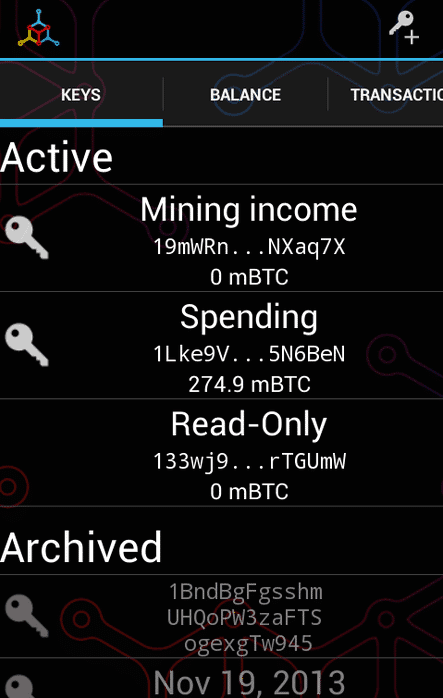
Mycelium even has support for Bitcoin watch-only addresses whose balances can be monitored, but not spent from. This allows the interesting ability to “stalk” someone else’s Bitcoin address and keep track of their money. Alternatively, you could keep track of your own address without needing to spend the money from Mycelium.
However, the most innovative feature in terms of key management is the aggregate view of all addresses. By default, Mycelium only operates on one address at a time, which can be switched at the Active Keys screen. Once aggregate view is enabled, however, the Balance shown on Mycelium’s main screen includes all of the Bitcoin from the current active addresses.
For people who use many different Bitcoin addresses for different purposes, this feature is invaluable. It’s possible to have up to 10 active addresses included in MyCelium’s aggregated balance. Some of them could even be watch-only addresses whose private keys never have to be imported. This feature makes it a breeze to manage multiple personal addresses.
Local Bitcoin Trading and Bitcoin Price
Another innovative feature of Mycelium is the inclusion of GPS-assisted local Bitcoin trading. As a mini-version of Local Bitcoins built right into Mycelium, the app will find nearby traders who want to buy or sell digital currency. Each trader has a Bitcoin price, a desired range of volume, and a reputation score.
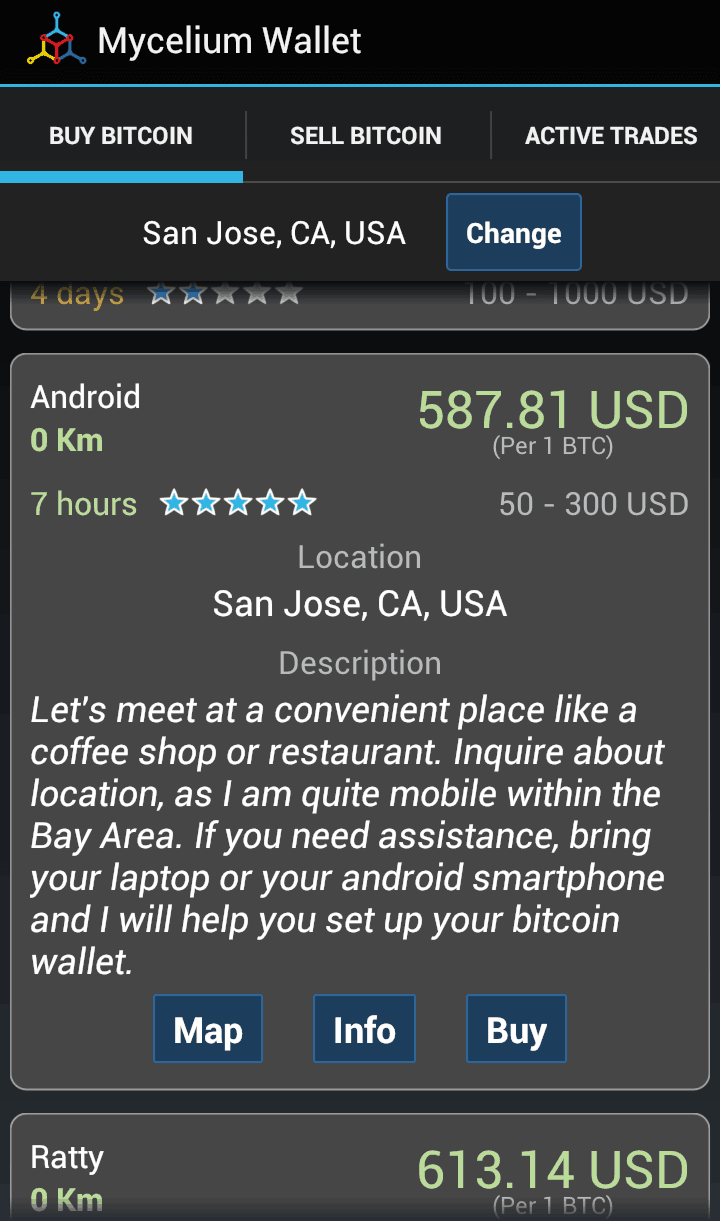
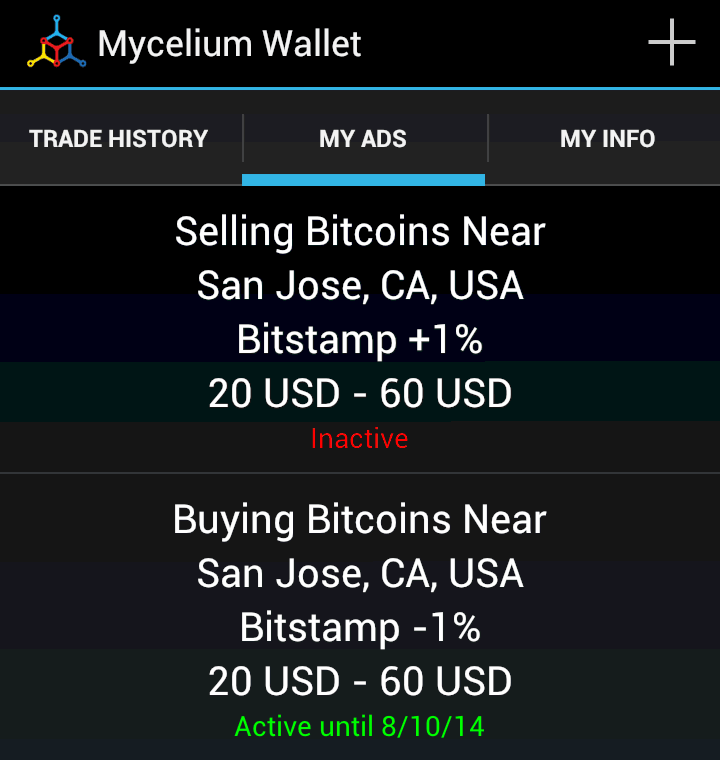
When creating a buy or sell advertisement, there’s a ton of freedom in choosing how the price is calculated. The price can be based on the exchange rate from Bitstamp, Coinbase, Kraken, BTC-e, BTC China, or BitcoinAverage, and modified by negative or positive percentage points.
For instance, let’s say you want to buy Bitcoin as fast as possible. You can open up Mycelium and not only find a reliable seller nearby, but also create an advertisement for future buys as well. Setting the price at Bitstamp +10% would ensure that you get many eager sellers who want a good deal on USD.
In terms of local trading, Mycelium is a step above its closest competitor, the Hive Bitcoin wallet for Android. As we mentioned in our review of Hive, it has a native app for Local Bitcoins. Still, only online trading is currently functional. There’s no way to actually search for traders geographically nearby. In that respect, Mycelium is superior.
Unfortunate Gripes with the Mycelium Bitcoin Wallet
That said, the Mycelium Bitcoin wallet isn’t without its flaws. There are no Android push notifications for incoming payments, which means you have to open up the app to check whether someone paid you. This feature should be a no-brainer for all mobile Bitcoin wallets, but it’s conspicuously absent in Mycelium.
The fee structure is also too simplistic. The mandatory mining fee is 0.0001 BTC (about 6 cents) per transaction. This ensures the payment gets processed promptly, but it can be impractical when moving small amounts of Bitcoin between your own addresses. This was an especially annoying feature when the value of Bitcoin was above $1,000. It meant the Mycelium mining fee was a dime for every transaction, no matter how small. The developers should add an option to reduce this fee for low-priority transactions, especially if the Bitcoin price continues to rise.
It would also be nice to have more customization options for entries in the address book. Currently, it’s only possible to add custom names for each Bitcoin address. Perhaps in the future, Mycelium will allow custom pictures as well (like Hive does), or even the ability to group addresses into categories.
Not Sure About Mycelium? Try Best Wallet
If the points we’ve outlined above make you feel a little wary of this brand, Best Wallet is a top alternative in the same category of product. This wallet truly stands out with its broad asset support and user-friendly interface. You also have the bonus of buying, selling, and swapping crypto directly within the app. What’s more, it has seamless support for airdrops, making it an ideal all-in-one platform for crypto enthusiasts.
Best Wallet offers a smooth, secure way to manage your assets. High-level security features like biometrics and multi-factor authentication keep your funds safe, while a customizable backup passphrase offers peace of mind for wallet recovery.
Pros
- Access to market updates
- Prominent blockchains such as Ethereum and BNB Smart Chain
- Simple to use, with great UX/UI
- Very secure
- Comes with plenty of payment options
Cons
- Active trading is not possible as technical analysis is unavailable
- Lack of support across blockchains
Conclusion: Is Mycelium Wallet Worth It in 2026?
Mycelium remains a trusted, secure mobile wallet, especially for Bitcoin and Ethereum users who prioritize self-custody, privacy, and advanced features. Its open-source nature and hardware wallet support keep it relevant among serious crypto users.
However, its lack of integrated trading, desktop support, and broad multi-chain coverage means it is no longer the best choice for most mainstream users. For those users, modern wallets with built-in swaps and wider asset support may be better alternatives.
Still, if your goal is self-custody with control, privacy, and a long track record, Mycelium deserves a spot in your crypto toolkit.
See also:
FAQs
What is Mycelium Wallet and how does it work?

Mycelium Wallet is a mobile-first Bitcoin wallet app that allows users to securely store, send, receive, and manage BTC. It offers strong privacy, open-source code, and advanced features such as hardware wallet support, address book, and local trader integration. The wallet is available for both Android and iOS devices.
Is Mycelium Wallet safe to use?
Yes. Mycelium is considered a secure Bitcoin wallet because it is non-custodial (you control your private keys), has a solid security track record, and supports additional safeguards like PIN protection and integration with hardware wallets (Ledger vs. Trezor). Always back up your seed phrase and keep it offline.
Can I store cryptocurrencies other than Bitcoin in Mycelium?
Mycelium Wallet is primarily designed for Bitcoin (BTC). While earlier versions supported a few other assets, its focus today is on providing a robust, Bitcoin-centric experience. For multi-asset support, consider wallets that explicitly support other coins and tokens.
How do I restore my Mycelium Wallet if I lose my phone?
You can restore your Mycelium Wallet by using the 12-word seed phrase you were given during setup. Enter this phrase in the Mycelium app on a new device to recover your Bitcoin balance and transaction history. Always keep your seed phrase private and secure.
Does Mycelium have a desktop version?
No. Mycelium Wallet is mobile-only. However, it supports connectivity to desktop hardware wallets and some third-party tools for enhanced functionality. For a full desktop wallet experience, other wallet types may be better suited.
Are there fees for using Mycelium Wallet?
Sure. Mycelium itself doesn’t charge fees for storing or transferring Bitcoin, but you will pay network (miner) fees when sending Bitcoin. The wallet allows you to choose between different fee levels (e.g., low, medium, high) based on how quickly you want your transaction confirmed.

Why you can trust 99Bitcoins
Established in 2013, 99Bitcoin’s team members have been crypto experts since Bitcoin’s Early days.
Weekly Research
100k+Monthly readers
Expert contributors
2000+Crypto Projects Reviewed