








In This Article
A cryptocurrency network uses a consensus mechanism to validate transactions. Unlike traditional payment providers, such as a bank, there is no central authority to determine if transactions are valid.
Instead, a crypto network utilizes decentralized nodes (computers running specialized software) to ensure that each transaction is valid and that no double-spending occurs. In short, all the nodes, or a designated subset of nodes, must agree on the state of the network and the account balances of individual wallet addresses.
In this guide, we’ll discuss the various types of consensus mechanisms, including Proof of Work (PoW) and Proof of Stake (PoS), as well as some variants.
Let’s begin with some key takeaways before we explore consensus mechanisms in more detail.
Key Takeaways on Consensus Mechanisms
- Consensus mechanisms allow blockchain networks to determine the state of the network without using a trusted intermediary.
- Decentralization, achieved by not relying on specific third parties or centralized servers, promotes the freedom to transact without censorship.
- Most consensus mechanisms use both incentives and disincentives to ensure honest behavior by miners, validators, and delegates.
- Risks to consensus mechanisms, such as 51% attacks and centralization by cartels, could jeopardize the long-term viability of the project.
Consensus Mechanism: Defined
Consensus mechanisms refer to a method of validating transactions without using a trusted intermediary, such as a bank. Decentralized crypto networks are designed to validate transactions by following a set of rules that ensure no double-spending occurs. However, they must also make it nearly impossible for anyone to reverse a transaction or change the order of transactions. This structure makes cryptocurrency networks trustless, meaning there is no need to trust a third party.
Proof of Work (e.g., Bitcoin) and Proof of Stake (e.g., Ethereum) are the two primary types of consensus mechanisms. However, several variants and hybrids also exist. In both cases, a financial incentive encourages consensus participation, while a financial disincentive discourages dishonest behavior by nodes used to reach consensus.
How Do Consensus Mechanisms Work?
Blockchain consensus mechanisms operate by establishing a set of rules that all network participants must adhere to in order to validate and secure transactions. For example, if Alice sends one bitcoin to Bob, the network must record the transaction in its public ledger, deducting the bitcoin from Alice’s account and crediting Bob’s account. The network also needs to be sure that Alice hasn’t already spent the same bitcoin. All this is accomplished by a network of computers, called validator nodes, that follow a strict protocol (a set of rules).
The network must also ensure that the transaction cannot be reversed and that the order of transactions can’t be changed. Without this security, the value of the cryptocurrency would be at risk, as it would lose its fundamental properties as a reliable form of money.
For example, the Ethereum network uses a Proof of Stake (PoS) consensus mechanism. To participate, validator nodes must pledge Ethereum (ETH) as collateral. This process, known as staking, acts as a security deposit to ensure the nodes behave honestly. If a dishonest node is detected trying to approve an invalid transaction, its staked ETH can be slashed (removed from the validator). That’s the financial disincentive. The incentive to operate a validator comes in the form of staking rewards, where the network mints new ETH and pays it out to honest validators. They also receive priority transaction fees paid by users. This two-layer system of incentives and disincentives ensures the network’s honesty while making transactions immutable (tamper-proof).
Consensus Mechanism vs. Traditional Trust Systems
Traditional finance (TradFi) uses a trusted intermediary. For example, if you use your debit card to make a purchase, the bank acts as an intermediary, approving or disapproving your transactions. Although ubiquitous, this structure comes with some drawbacks.
- How do we know we can trust the “trusted” intermediary?
- The trusted intermediary might decline transactions it doesn’t like.
- The trusted intermediary might also freeze the account entirely.
- Trusted intermediaries can sometimes reverse transactions, even in error.
Bitcoin solved these problems when it launched in 2009, creating a censorship-resistant network that utilized financial incentives and disincentives to develop a decentralized validation network.
Earlier digital currencies, such as e-gold (1996), used a centralized server, which didn’t offer any meaningful advantage to banks in terms of censorship or the ability to change transactions. Modern crypto networks solve these problems by allowing anyone to access the network and then using a decentralized consensus mechanism to validate transactions and record them to an immutable ledger.
Types of Consensus Mechanisms in Crypto
While Proof of Work and Proof of Stake are the most common consensus mechanisms, several variants also exist. Let’s explore how each of these works, beginning with the oldest blockchain consensus mechanism: Bitcoin’s Proof of Work consensus.
Proof of Work (PoW)
Bitcoin, the largest cryptocurrency by market capitalization, uses a consensus mechanism called Proof of Work. Dozens of other crypto networks, including Litecoin, Monero, and Kaspa, also use PoW to secure transactions.
Proof of Work dates back to 1993, when Cynthia Dwork and Moni Naor authored a paper (PDF) that explored the concept of using computational work to combat email spam. Adam Back, still a key figure in the Bitcoin community, later adopted the PoW concept for his 2002 Hashcash paper, also aimed at combating email spam with PoW. While neither of these directly targeted digital currencies, Satoshi Nakamoto, the creator of Bitcoin, used the PoW concept as a way to secure the Bitcoin network.
Bitcoin’s PoW uses computational resources to add new blocks of transactions to the blockchain and prevent changes to the distributed ledger. Miners, which are computers running specialized software, compete to solve a puzzle.
- Miners generate a proposed block from the mempool, which holds pending transactions.
- The PoW consensus process uses hashing, turning block transaction data into a hash, which is a fixed-length alphanumeric string.
- Miners compete to solve for a nonce (a number used only once), a process that involves millions of computations until a miner solves the nonce.
- The winning miner broadcasts the new block to the network and receives a reward paid in Bitcoin.

Bitcoin’s consensus requires that other miners agree that the block and nonce are valid. If both are valid, they add the new block to their copies of the blockchain. PoW comes at the cost of computational power (electricity costs). Additionally, the Bitcoin network always accepts the longest chain, making it prohibitively expensive to change the transactions in an existing block. Any attempts to do so would require a dishonest miner to continue mining blocks faster than the rest of the network.
Pros
- Higher security compared to other consensus mechanisms
- Anyone can participate in consensus through mining
- Economic incentives drive security
Cons
- High energy usage
- Often, higher transaction costs and slower transactions
- Centralization risks, particularly for networks that utilize ASICs
Proof of Stake (PoS)
Proof of Stake emerged as an alternative to PoW with the launch of Peercoin (2012). Other projects later adopted this consensus mechanism, including Ethereum, which transitioned from PoW to PoS in 2022.
PoS leverages collateral as a way to secure network transactions. For example, Ethereum requires validators to stake 32 ETH, a commitment of $144,000, assuming an ETH price of $4,500. If a validator is found to be dishonest (adding invalid transactions), a portion of the stake is slashed, and the slashed ETH is burned by sending it to an unrecoverable wallet address.

Slashing penalties begin at 1 ETH and increase in relation to the number of correlated incidents on the network. This structure effectively prevents collusion by increasing the slashing penalty if more than one validator approves invalid transactions.
Cardano (ADA), Algorand (ALGO), and Tezos (XTZ) also use PoS to validate transactions and secure their respective networks. PoS is much more energy efficient. By some estimates, Ethereum reduced its energy consumption related to consensus by 99.988% when the protocol switched to PoS from PoW.
Pros
- Significantly lower energy consumption
- Faster transaction speeds
- Typically, lower equipment requirements
Cons
- Centralization risks due to high staking requirements
- Security concerns (lower vulnerability threshold than PoW)
Delegated Proof of Stake (DPoS)
In a Delegated Proof of Stake consensus mechanism, stakers choose one or more validators, often referred to as witnesses, and then delegate their staked tokens. In effect, the structure works like voting for a representative. Typically, stakers can sort validators by uptime, yield, and other key metrics to make a more informed decision, reducing slashing risks and maximizing yield.
DPoS networks typically use a smaller number of validator nodes, often fewer than 100, creating greater centralization concerns. As a trade-off, the smaller validator network results in faster transaction times in many cases.
Delegates earn staking rewards for validating transactions. Stakers who delegate their tokens earn a proportional share of these staking rewards. This structure also allows for easier on-chain voting (governance).
While DPoS offers faster transactions, its structure also comes with some risks. A smaller number of delegates raises concerns about centralization. Additionally, the structure is more vulnerable to Sybil attacks than PoS. A single entity could control the network by holding a large enough stake in multiple delegates. Economic barriers make this type of attack less viable with PoS networks.
Popular chains that use DPoS include TRON and EOS.
Pros
- Highly energy efficient
- Faster transactions than PoW and PoS
- Built-in governance support
Cons
- Centralization due to a small number of validators
- Sybil attack risks
- Lower voter engagement
Byzantine Fault Tolerance (BFT) Variants
Byzantine fault tolerance refers to a challenge in distributed systems, such as blockchain networks, known as the Byzantine Generals Problem. The problem is simple in concept but challenging to resolve: How does the network achieve consensus if some of the participants may be unreliable or malicious?
Several strategies exist, including Practical Byzantine Fault Tolerance (PBFT), Tendermint BFT, and Algorand’s Byzantine Agreement. Let’s explore some of the popular solutions in more detail.
- Practical Byzantine Fault Tolerance (PBFT): Hyperledger Fabric uses PBFT to achieve consensus. This BFT variant uses a primary node to propose a block. The other validators vote on its validity, with a two-thirds majority required for finality.
- Tendermint BFT: Many projects in the Cosmos ecosystem, including Cosmos Hub and Celestia, utilize the Tendermint BFT. This fast consensus method uses a round-robin system to choose a validator that will propose the next block, weighted by staked value. The other validators vote on the proposed block, requiring a two-thirds supermajority to commit the proposed block to the chain.
- Algorand’s Byzantine Agreement: The Algorand network uses Pure Proof of Stake, in which a committee of validators is secretly and randomly selected to validate each block. Because this committee changes for each block, gaining control of the network becomes more challenging. This also addresses concerns about decentralization, despite using a relatively small number of validators.
Hybrid Consensus Models
Hybrid consensus models use two or more strategies in consensus, often aiding scalability or security. For example, Solana uses PoS combined with Proof of History (PoH) to enhance scalability. In other cases, projects might use different consensus mechanisms for various types of transactions. For example, Dash uses PoW for standard transactions but uses Dash Masternodes that stake Dash as collateral to validate Dash’s PrivateSend transactions.
Why Consensus Mechanisms Matter in Crypto
Consensus mechanisms provide an alternative to centralized servers and trusted intermediaries. Instead of trusting a third party, transactions can be validated using a decentralized network that performs validation based on a defined set of rules. Even these rules become decentralized, as the community has a voice in any changes to consensus rules. However, without a strong consensus mechanism that solves the Byzantine Generals Problem (the possibility of bad actors passing bad information), a cryptocurrency network cannot ensure that the blockchain transactions remain secure.
Let’s discuss some of the key factors that might determine which consensus mechanism may be the best for a given use case.
Security
The level of security (the inability to reverse transactions or double-spend) varies by consensus mechanism. PoW is often considered to be the most secure due to the cost involved in mining and the improbable logistics of mining faster than the rest of the network if the goal is to change a historical transaction. PoW networks select the longest fork of the chain, which is the one with the most proof of work.
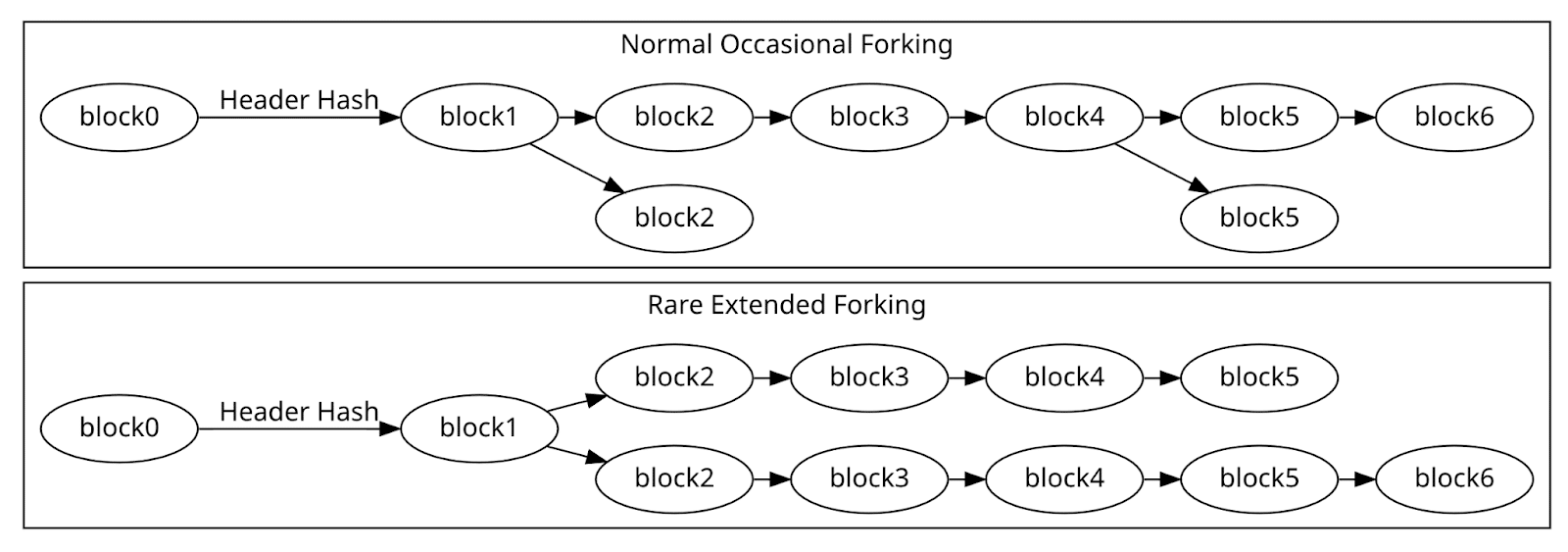
PoS and variants may not provide the same level of security, but the size of the network and the investment of validators can also play a role. Ethereum’s security can be attributed to the size of the stake required by validators and the safeguards against collusion (higher slashing penalties) discussed earlier.
Decentralization
Crypto networks like Bitcoin and Ethereum achieve higher levels of decentralization due to their size. In practice, it becomes extremely difficult for one entity to control the network, although we’ll discuss exceptions to this rule in a later section. This decentralization allows the networks to be trustless (no trusted intermediary needed) and censorship-resistant. Anyone can transact directly with anyone else for any reason.
Scalability and Speed
While prominent PoW networks like Bitcoin prioritize security over speed, some newer networks offer blazingly fast transaction speeds due to more efficient, although possibly more centralized, consensus mechanisms.

For example, Solana boasts theoretical speeds of up to 65,000 transactions per second (TPS), whereas Ethereum typically sees 15 to 22 TPS, with a theoretical maximum of 119 TPS. Although Ethereum is working toward better scalability and speed, Solana’s current speed advantage can be largely attributed to its PoH, which is used as a time stamp to speed transactions.
Energy Efficiency
PoW has come under scrutiny due to its higher energy consumption, with some estimates putting Bitcoin’s worldwide energy consumption higher than that of Finland. PoS, DPoS, and other variants offer much better energy efficiency, although they may introduce more centralization risk.

Risks and Limitations of Consensus Mechanisms
Although most crypto networks aim to provide permissionless, trustless, and censorship-resistant transactions, several potential challenges threaten the promise of digital autonomy. Let’s examine some of the risks and limitations of consensus mechanisms, as well as some of the innovations meant to address these considerations.
51% Attacks
One of the most prominent risks to crypto networks centers on 51% attacks and affects both PoW and PoS networks. When a single entity or group controls more than 50% of the network, it can double-spend or alter the order of transactions.
In an August 2025 incident, Qubic successfully reordered six blocks in the Monero PoW blockchain. In the ongoing attack through the Qubic mining pool, the group triggered an 18-block reorganization in September 2025. The incident orphaned the existing blocks, creating a new fork in the chain. While Monero is a well-established blockchain, making it expensive to attack, the incident demonstrated the vulnerabilities of smaller networks to 51% attacks.
Validator Cartels
PoS and DPoS networks face a vulnerability to validator cartels. In effect, validator operators can collude to control a larger percentage of the network than they could independently. For example, in a DPoS network, a handful of larger holders, such as exchanges, could conceivably hold enough staked tokens to greatly influence voting. This increased voting power could tip the scales in favor of specific delegates, potentially giving the group (cartel) control over transaction censorship and protocol governance votes.
Energy Costs
Bitcoin’s PoW has led many people outside the industry to associate all cryptocurrencies with high energy usage. However, PoS networks and other consensus mechanisms use considerably less power than Bitcoin and similar PoW networks. Still, Bitcoin remains the most prominent cryptocurrency in the space, and some estimates put Bitcoin’s energy usage as high as 80 to 160 terawatt-hours (TWh) per year.
Without intervention, excess energy usage becomes a valid criticism of the PoW consensus mechanism, specifically. Tighter regulation and outright bans could result due to environmental concerns. However, energy usage statistics that compare Bitcoin’s energy footprint to entire developed countries don’t tell the full story.
The Bitcoin mining industry has taken proactive steps to become greener. These measures include utilizing “trapped and stranded energy” that would otherwise be impractical to use or transport, such as flared methane gas and stranded renewable energy. More than 50% of Bitcoin’s energy usage comes from renewable sources, making Bitcoin more sustainable than many of today’s leading industries.
Governance Challenges
In many cases, consensus mechanisms also become a conduit for governance. Earlier, we discussed how single entities or groups could gain undue influence over voting by holding a larger stake or controlling more delegates in DPoS networks. Ultimately, this structure adds to the centralization risks that could sideline a project’s stated goals. Tokens act like votes, in a democratic fashion, but one party or group may control a disproportionate amount of the votes.
Some prominent projects identified this risk early on and structured their governance accordingly. For example, Ethereum utilizes community discussions for its Ethereum Improvement Proposals (EIPs), but holding or staking more Ethereum does not earn anyone more votes, unlike in a DPoS network. Ultimately, developers determine what’s feasible, and the community decides on EIPs without using tokens for voting.
Bitcoin uses community-based governance as well. In effect, changes to the Bitcoin protocol require adoption by full node operators. When the community splits, the chain sees a hard fork. Bitcoin continues to exist, but a new cryptocurrency is born with the fork, marking the split from the rest of the nodes.
The way each crypto network integrates governance with its consensus mechanism – or chooses not to – could determine the long-term viability of the project.
Conclusion
We tend to focus on the cryptocurrency itself, particularly its value in the trading market. However, the consensus mechanism for a crypto project is an intrinsic part of its value and key to the promise of digital autonomy. Less robust consensus strategies could make the network vulnerable to centralization risks, including majority control in voting. They could even lead to compromised networks in which a group could double-spend or reorder the blockchain at whim.
While there is no consensus mechanism that is universally best, some are better suited to specific use cases. PoW remains the favored choice for security, whereas PoS is a favorite for improved scalability and energy efficiency. Still, size and decentralization matter, and larger decentralized networks have proven more secure than smaller networks or more centralized networks.
FAQs
What are the types of consensus mechanisms?

The most common types of consensus mechanisms include Proof of Work (i.e., Bitcoin) and Proof of Stake (i.e., Ethereum). Variants include Delegated Proof of Stake (i.e., TRON), and BFT variants, such as Cosmos Hub.
What is the Solana consensus mechanism?
Solana uses Proof of Stake, but augments its consensus mechanism with Proof of History, which provides a time-stamp-like functionality to help the network achieve faster transaction speeds.
How many consensus mechanisms exist currently?
The number of consensus mechanisms is in flux due to the fast-moving nature of blockchain technology. However, established consensus mechanisms typically fall into four categories: Proof-based (proof of work, proof of stake), Voting-based BFT variants, such as Cosmos Hub, and Hybrid networks, such as Dash, which use multiple types of consensus.
What is PoS vs PoW vs PoA?
PoS refers to Proof of Stake, which uses collateral to ensure honest validators. PoW stands for Proof of Work, which uses computational work to secure the network. PoA refers to Proof of Authority, which uses trusted validators to validate transactions.
What consensus mechanism does XRP use?
The XRP Ledger uses a byzantine fault-tolerant (BFT) mechanism called the XRP Ledger Consensus Protocol, which utilizes trusted validators to secure network transactions.
References
- Pricing via Processing or Combatting Junk Mail (ac.il)
- Hashcash – A Denial of Service Counter-Measure (ecsb.edu)
- Ethereum’s energy expenditure (ethereum.org)
- The Byzantine Generals Problem (wisc.edu)
- Solana: A new architecture for a high-performance blockchain v0.8.13 (solana.com)
- How Masternodes Work (dash.org)
- Bitcoin energy consumption worldwide (statista.com)
- Most Energy-Efficient Ways to Mine Bitcoin (blockchain-council.org)

Why you can trust 99Bitcoins
Established in 2013, 99Bitcoin’s team members have been crypto experts since Bitcoin’s Early days.
Weekly Research
100k+Monthly readers
Expert contributors
2000+Crypto Projects Reviewed