






Account Abstraction (AA) isn’t just another upgrade to Ethereum and smart contract wallets. It’s a shift in how we use crypto. Instead of relying on traditional accounts (EOAs) tied to private keys, wallets can now act like programmable smart contracts. Thus, features like social recovery, paying gas fees in any token, and advanced automation become possible. This means that blockchain becomes safer, more flexible, and a lot easier to use.
Account Abstraction Key Takeaways
- AA turns wallets into programmable smart contracts instead of depending only on private keys.
- It improves security, simplifies recovery, enables gas payments in any token, and supports automation.
- AA is built on the Ethereum standard ERC-4337 and works without changing the network’s core protocol.
- Its real-world use cases include DeFi (e.g., batch trades, gasless swaps), NFTs (e.g., easy onboarding, recovery), gaming (automatic in-game transactions), as well as enterprise wallets (permissions and compliance).
What Is Account Abstraction?
Account Abstraction is a blockchain innovation that allows smart contracts to function as user wallets, replacing traditional private key-based accounts known as Externally Owned Accounts (EOAs).
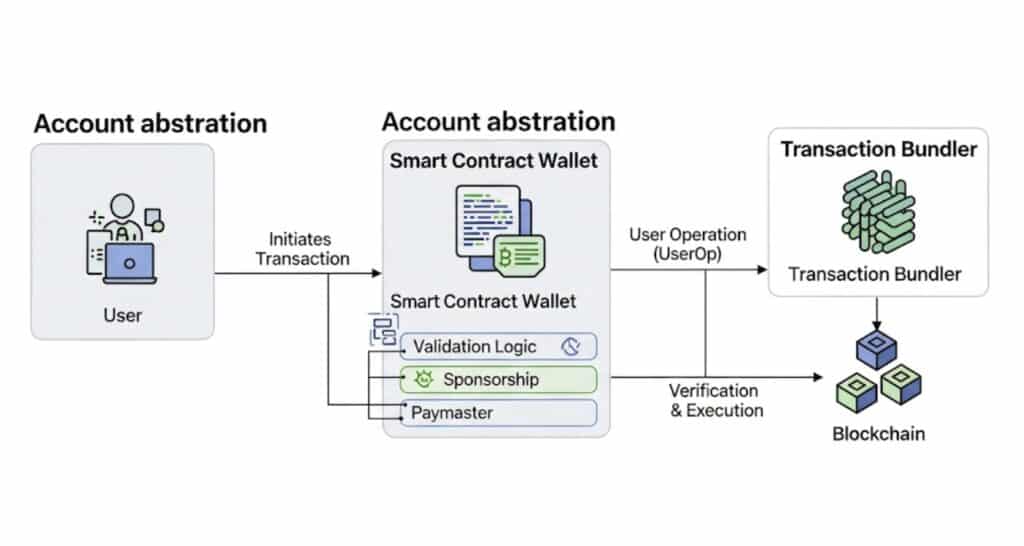
With this development, wallets can now execute programmed logic for transactions, e.g., spending limitations, recovery techniques, multi-signature authorization, and gas payment requirements, without requiring users to hold Ether (ETH) to pay fees or provide private keys.
Why It’s Needed
Historically, EOAs have come with limitations that make using Ethereum less secure and less convenient. The biggest issue is key management: if you lose your private key, you permanently lose access to your funds, with no way to recover them.
EOAs also lack spending controls, meaning there’s no native way to set daily limits, require multiple approvals, or create recovery options in case of mistakes. Finally, every EOA must hold some ETH to cover transaction fees, even if the user only wants to interact with dApps (decentralized applications) using other tokens. These restrictions have made onboarding new users harder and left many of them vulnerable to costly errors.
AA addresses these friction points, making wallets safer, more user-friendly, and resilient.
The Key Mechanism of Account Abstraction: ERC-4337
ERC-4337 is the Ethereum upgrade that makes AA possible without touching the network’s core protocol. Instead of relying on the old transaction model tied to private keys, ERC-4337 introduces a new transaction type called “UserOperation.” These UserOperations are collected by special actors called “bundlers” and then passed through an EntryPoint contract, which verifies the rules set by the user’s smart contract wallet.
In practice, this means wallets can function like mini-programs: they can set up custom security checks, let apps cover gas fees, and allow gas to be paid in tokens other than ETH.
Account Abstraction: Real-World Use Cases
AA opens the door to real-world use cases across the crypto-verse:
- DeFi: Instead of juggling multiple steps, you can bundle actions like approve + swap into a single transaction. Sometimes, the protocol will cover your gas fees.
- NFT Marketplaces: Buying an NFT (non-fungible token) can be as easy as a single click. Plus, features like social recovery and sponsored gas make it far smoother for newcomers.
- Web3 Gaming: Smart wallets can take care of in-game actions like moving assets or staking automatically, so you’re not stuck confirming every single step.
- Enterprise Wallets: Businesses can set up wallets with fine-tuned permissions, compliance rules, and layered access, making them both secure and practical for large teams.
Pros and Cons of Account Abstraction
Pros:
- Better Security: Features like multi-signature approval, 2FA (two-factor authentication), and social recovery help protect funds even if a private key is lost or stolen.
- Gas Flexibility: You can pay gas fees in tokens other than ETH or even let dApps cover transaction costs for you.
- User-Friendly Onboarding: Wallets feel more like familiar Web2 apps, with simple logins and recovery options.
- Programmability: Wallets can include custom rules (spending limits, recurring payments, role-based access).
- Batch Transactions: Multiple actions can be combined into a single transaction, saving both time and fees.
Cons:
- Complexity: Smart contract wallets are harder to design and audit than traditional EOAs.
- Higher Costs: Extra contract logic can mean higher gas fees, though ERC-4337 helps reduce this.
- Adoption Barriers: Not all dApps and blockchains support AA yet, limiting its reach.
- Smart Contract Risks: Bugs in wallet code could put funds at risk if not properly audited.
Bottom Line
Account Abstraction is a real game-changer for crypto wallets. It combines advanced programmability with everyday practicality, making blockchain safer, easier, and more accessible for everyone.
See Also:
FAQ
How is Account Abstraction different from a traditional Ethereum account?


Traditional Ethereum accounts (Externally Owned Accounts, or EOAs) rely only on private keys. Losing the key results in losing your funds. With AA, your account becomes a programmable smart contract wallet, which can include recovery options, flexible gas payments, and extra security layers.
What is ERC-4337, and why is it important?
ERC-4337 is the Ethereum standard that enables AA without modifying Ethereum’s core protocol. It introduces new transaction types (UserOperations) and an EntryPoint contract that allows features like gas sponsorship and batch transactions.
Can I pay gas fees without ETH using Account Abstraction?
Yes. One of the biggest advantages of AA is that it allows gas fees to be paid in ERC-20 tokens like USDC or DAI. Some wallets also support gas sponsorship, meaning the app or protocol pays the transaction fees for you.
Is Account Abstraction safe to use?
Yes. In fact, AA improves security by supporting multi-signature wallets, 2FA-style approvals, and recovery mechanisms. However, as with any smart contract, safety depends on how well the wallet’s contract code is audited and implemented.
What are the real-world applications of Account Abstraction?
AA is used in DeFi (one-click swaps, gasless trades), NFT marketplaces (simpler onboarding, social recovery), gaming (automatic in-game transactions), and enterprise wallets (role-based access, compliance rules).
References:
“Account abstraction.” Ethereum, https://ethereum.org/roadmap/account-abstraction/.

Why you can trust 99Bitcoins
Established in 2013, 99Bitcoin’s team members have been crypto experts since Bitcoin’s Early days.
Weekly Research
100k+Monthly readers
Expert contributors
2000+Crypto Projects Reviewed