






In This Article
XRP (Ripple) is the native digital asset of the XRP Ledger, a decentralized blockchain technology that was specifically designed for payments and money transfers. It is known for its low cost, speed, and efficiency in facilitating cross-border transactions and payments. The demand for owning XRP tokens has grown over the years, and many investors are wondering, how high will XRP go? You have come to the right place if you are on the same quest.
This article will explore predictions for XRP prices. We will take into account views from various experts, noting that forecasts can differ as each analyst has their own methods and criteria. By partnering with financial institutions and payment providers, XRP aims to enhance the global financial system by making transactions quicker, more affordable, and more secure.
While XRP has been at the center of regulatory scrutiny, particularly in the U.S., it has maintained a strong presence in international markets and continues to push forward with developments.
Rising Crypto- Editor’s Choice

- New Bitcoin L2 presale offering massive staking rewards
- By using a SVM Bitcoin Hyper is revolutionizing Bitcoin's potential
- Early buyers can use $HYPER tokens for transactions, staking, and ecosystem governance
 Bank Card
 BNB
BNB ETH
ETH- +1 more



Key Takeaways
- U.S. interest rate cuts, global payment upgrades, and steady remittance demand could boost XRP adoption in 2026.
- The end of the SEC lawsuit removes a major barrier to institutional participation, though Ripple still faces rules on direct sales.
- Institutional access is improving through European ETPs, with speculation about a U.S. ETF adding to market optimism.
- XRP Ledger upgrades, including the AMM and EVM sidechain, expand its functionality and developer appeal.
- Ripple’s partnerships with central banks and private companies give XRP a foothold in real-world payments, supporting long-term utility.
- Strong resistance zones remain near $3.30-$3.80, and technical indicators suggest price peaks often align with high RSI readings.
How High XRP Will Go: Summary
This XRP market analysis covers how high can XRP realistically go, how high will XRP go in 2026, and how high can XRP go in 5 years.
We’ll look at what could influence XRP’s price in 2026, including U.S. interest rate cuts, upgrades to global payment systems, Ripple’s expanding partnerships, and the latest XRP Ledger developments.
With the SEC case settled and market conditions looking better, XRP starts the year in a stronger position. We’ll also look at XRP growth potential, a likely XRP price target, and the overall XRP investment outlook.
In this XRP price prediction, we will show you what the future of XRP may look like and provide a forecast for its price from 2026 to 2030. Alongside the predictions, we’ll also discuss what XRP is, its core use cases, and why it continues to be a prominent asset in the cryptocurrency space.
XRP Price Prediction
XRP enters 2026 with a significantly cleared regulatory path, enhanced network fundamentals, and rising institutional interest. For example, Japanese gaming and blockchain firm GUMI Inc. recently partnered with Ripple Labs and SBI Group in the Evernorth XRP treasury initiative, a sign that Asia-Pacific corporates are doubling down on XRP’s cross-border settlement use case. At the same time, regulatory clarity took a leap forward as Ripple’s victory over the U.S. Securities and Exchange Commission (SEC) in August 2025 re-classified XRP as a non-security in secondary sales, removing a long-standing overhang and unlocking institutional capital. Meanwhile, network activity on the XRP Ledger (XRPL) is gaining momentum, with Ripple reporting over $1.3 trillion processed through its On-Demand Liquidity (ODL) product in Q2 2025 alone.
With U.S. two .25 basis points interest-rate cuts in 2025 and improving global liquidity conditions, XRP is well positioned to benefit from both macro headwinds turning favorable and structural network growth. The combination of institutional adoption, global remittance corridor expansion, and real-world blockchain use-case maturation makes the outlook bullish heading into 2026.
XRP’s Price Prediction for 2025 Review
In 2025, XRP outpaced many large-cap altcoins following its regulatory breakthrough and network expansion. Having begun the year around $2.10, the token saw a strong rally backed by renewed institutional flows, growing ODL-use, and increasing demand for utility-focused crypto assets. Looking ahead, if the U.S. Federal Reserve continues its rate-cut cycle in early 2026, global crypto markets could see a strong leg up. Under that scenario, XRP’s price could average between $3.80 and $4.20, with potential peaks near $4.50 by the end of the year, provided Bitcoin maintains its post-halving momentum and broader sentiment remains constructive.
Long-Term XRP Price Forecast (2026-2030)
By 2030, XRP’s price could range between $8 and $12 per token, fueled by three major structural drivers like real-world utility, institutional adoption, and macro policy tailwinds.
2026 Outlook
XRP could consolidate within the $5–$7 range, averaging around $6, as the market digests rapid appreciation and liquidity flows normalize. The introduction of more regulated investment products, such as ETPs and potential U.S. ETFs, will likely enhance institutional access. At the same time, XRP’s role in CBDC interoperability and real-time cross-border settlements could drive further use cases.
If global inflation reaccelerates or rate cuts extend deeper into 2026, safe-haven crypto assets with real utility, such as XRP, could outperform purely speculative tokens.
2030 Outlook
By 2030, Ripple’s partnerships with financial institutions and central banks could reshape global settlement infrastructure. With XRPL’s AMM functionality maturing and EVM compatibility attracting developers, XRP is positioned to capture value as the backbone of cross-chain payment systems.
Under strong adoption scenarios, XRP could climb to $10–$12, with upside extensions toward $15 possible if stablecoin and tokenized asset settlement volumes accelerate. However, the base case remains an $8–$12 range, assuming moderate institutional inflows and steady global adoption of blockchain payment rails.
Our XRP Price Prediction Methodology
For our XRP forecast, we conducted a comprehensive analysis of the Ripple network. We considered recent developments within the XRP ecosystem, including network upgrades and partnerships, along with user growth and adoption trends. We also assessed XRP’s competitive position relative to other digital payment solutions and blockchain platforms. Historical data and technical indicators were integrated into our analysis for a thorough price evaluation.
Additionally, we examined broader market conditions and their potential impact on XRP, particularly for long-term predictions. As the cryptocurrency market continues to expand, XRP may benefit from increased demand for cross-border payment solutions and blockchain-based financial services.
XRP Price History
XRP has had a storied journey in the crypto space since its inception in 2012. It initially gained prominence as a digital currency for financial institutions to facilitate cross-border payments, boasting faster settlement times and lower fees compared to traditional payment systems.

XRP’s price saw significant spikes during the 2017-2018 crypto boom, reaching an all-time high of $3.84 in January 2018, followed by a correction. In recent years, its performance has been influenced by legal battles with regulatory bodies, particularly the U.S. SEC, but XRP remains a key player in the global payments industry.
Between late 2020 and early 2021, XRP saw dramatic swings, initially rising from around $0.22 in November 2020 to a high of $1.96 in April 2021, largely driven by the surge in cryptocurrency adoption and speculation. However, legal issues surrounding Ripple’s ongoing SEC lawsuit resulted in sharp corrections, with prices plummeting back to the $0.50 range by mid-2021.
The period from mid-2021 to 2024 was characterized by periodic rallies and downturns. XRP experienced significant ups and downs, such as the surge to $0.92 in mid-2023 amid optimism in the crypto market and the subsequent decline back to the $0.40 and $0.65 range in the better part of the year, reflecting a mix of market corrections and fluctuating trading volumes.
In November, XRP prices shot higher, breaking $1 and rallying to nearly $3 in early January. As of October 19, 2026, XRP is trading at , reflecting a over the past 24 hours.
XRP is down from its all-time-high of , recorded in July 2025 but has increased over the past 12 months. The market capitalization of XRP stands at .
Factors That Could Influence XRP’s Price in 2026
The price of XRP will depend on several factors, real-world cross border payments, how quickly smart contract functionality takes off on the new EVM sidechain, and how easy it becomes for institutional investors and major financial institutions to gain regulated exposure. This kind of institutional adoption could help drive demand, boost market capitalization, and give the digital asset more stability over time.
We also have to think about current price, interest rate cuts, upgrades to blockchain technology in payment systems, and Ripple Labs expanding partnerships with both central banks and private companies.
These factors could significantly expand real-world use and drive XRP toward widespread adoption as a bridge currency for international settlements and fiat currencies. Ripple CEO Brad Garlinghouse has expressed optimism about the growth potential, especially with regulatory clarity improving and regulatory uncertainty easing in key regions.
XRP Fundamental Factors
The next twelve months will hinge on whether monetary easing and institutional access continue to expand. Brazil’s spot XRP ETF launch and the CME’s XRP futures in mid-2025 deepened market liquidity and gave professional traders new tools to hedge exposure. Ripple’s RLUSD stablecoin is already improving cross-chain liquidity on both XRPL and Ethereum, tying XRP closer to real-world payment rails.
With the Federal Reserve expected to continue cutting rates in 2026, the macro backdrop is turning friendlier for risk assets. Lower borrowing costs and rising global liquidity tend to favor utility tokens like XRP that already have institutional infrastructure in place.
Global economic conditions affecting crypto adoption
Inflation in the U.S. has cooled to around 2.8 percent, and futures markets now priced in the second 25-basis-point Fed cut in Q4 2025. Cheaper credit and a weaker dollar often increase investor appetite for alternative assets. Risk assets have lagged behind rate cuts in 2025, setting the stage for an interesting 2026.
Global payment systems are also changing. The G20 and the Bank for International Settlements are working on plans to make international payments faster and cheaper by linking different instant payment systems. Projects like these put the spotlight on digital assets that can act as a bridge between currencies, which is exactly what XRP is designed for.
Beyond the U.S., BRICS and ASEAN nations are accelerating plans to settle cross-border trade without relying on the dollar. Ripple’s payment corridors are already active in several of those regions, positioning XRP as a neutral bridge asset between local currencies. As global settlement systems modernize, the network’s speed and compliance features give it a credible foothold in the next generation of international payments.
XRP’s legal battle and what to expect next
The long-running court case between Ripple and the SEC has finally come to an end. A judge ruled in 2023 that XRP sales on public exchanges were not securities transactions, but some sales to institutions were. Ripple now has to pay a $125 million fine and follow strict rules on how it can sell to institutions.
This is it – the moment we’ve been waiting for. The SEC will drop its appeal – a resounding victory for Ripple, for crypto, every way you look at it.
The future is bright. Let's build. pic.twitter.com/7WsD0C92Cm
— Brad Garlinghouse (@bgarlinghouse) March 19, 2025
For the market, this is mostly good news. The legal uncertainty that hung over XRP for years is gone, which should make it easier for institutions to feel comfortable holding it. That said, Ripple still has to stick to the court’s guidelines for direct sales to big buyers.
Institutional asset-allocation trends toward XRP
Institutional demand has climbed steadily throughout 2025 and into 2026. CoinShares reported multiple consecutive weeks of positive XRP inflows, often topping tens of millions of dollars. Europe now hosts several regulated XRP products, including 21Shares’ flagship ETP and WisdomTree’s expanded suite.
In Brazil, the first spot XRP ETF launched in Q2 2025, followed by CME-listed XRP futures that attracted heavy open interest from hedge funds. The U.S. SEC is still reviewing preliminary filings from 21Shares and WisdomTree subsidiaries for a potential 2026 spot XRP ETF, keeping sentiment constructive among professional investors seeking compliant exposure.
Governance model and treasury system
Changes to the XRP Ledger don’t happen overnight. Any proposed upgrade has to be supported by more than 80% of trusted validators for two weeks in a row before it goes live. Instead of a mining or staking system, the network relies on a “trust list” model, where each participant chooses which validators they believe will act honestly.
Ripple also manages a large part of XRP’s supply through escrow accounts. Originally, 55 billion XRP were locked away with a set amount, up to 1 billion, released each month. Any unused XRP goes back into escrow. This makes it easy for the market to see how much XRP could enter circulation at any given time.
Development roadmap milestones
The XRP Ledger’s roadmap matured rapidly in 2025. The EVM sidechain went live in June, and since launch more than 120 decentralized apps have deployed to it. Combined AMM liquidity has surpassed $200 million TVL, showing early but healthy adoption.
Network engineers continue to focus on scalability and reliability, while the RLUSD stablecoin, live on both XRPL and Ethereum, has helped deepen on-chain liquidity for institutional payment flows. Regular core software updates in 2025 also improved validator coordination and reduced transaction finality to under two seconds on average.
Ripple’s own U.S. dollar stablecoin, RLUSD, launched in late 2024 and grew steadily throughout 2025. It works on both the XRP Ledger and Ethereum, giving businesses and individuals more ways to settle transactions while keeping value stable.
Partnerships with governments, NGOs, and enterprises
Ripple’s technology is being used in central bank digital currency pilots around the world. Countries like Bhutan, Palau, Montenegro, Georgia, and Colombia have all worked with Ripple on different stages of their digital currency projects. These partnerships give XRP’s underlying technology more credibility in official circles.
In the private sector, XRP is already powering live remittance corridors. SBI Remit is using it for money transfers in parts of Southeast Asia, and Tranglo offers fast, on-demand liquidity payments across borders. These real-world uses mean XRP isn’t just a speculative asset, it’s actually moving money for people and businesses.
What this means for the XRP price in 2026
The mix of potential U.S. rate cuts, steady remittance growth, and upgrades to payment systems could create a better environment for XRP this year. The end of the SEC case removes a major barrier and gives the market more confidence, even though Ripple still has to follow rules for selling to institutions.
Institutional access is improving through investment products, and technical upgrades like the AMM and EVM sidechain are adding more ways for XRP to be used. On top of that, partnerships in both government and private sectors give XRP a practical role in real-world payments, which can help support its value over the long term.
XRP’s On-Chain Factors
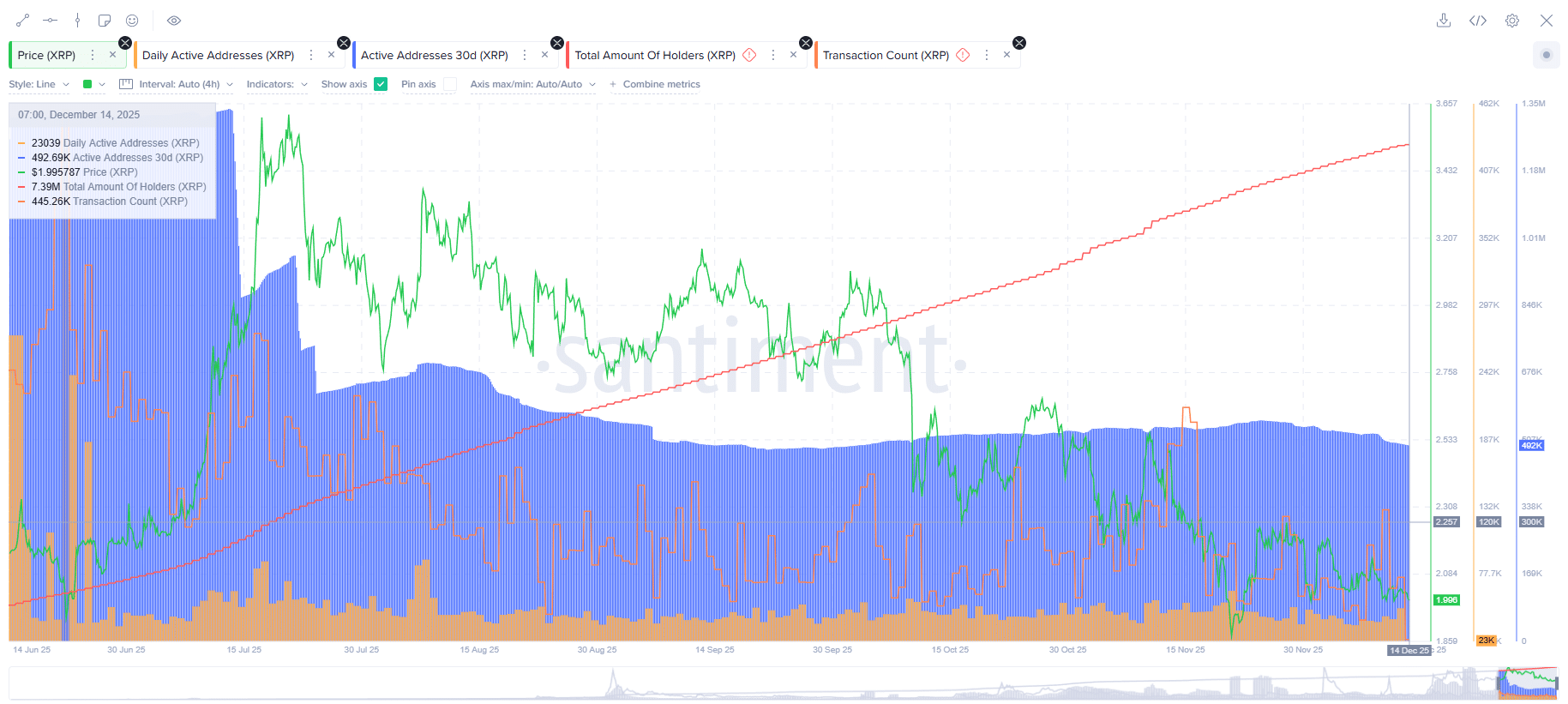
To evaluate XRP’s current on-chain health, we analyzed five core metrics from Santiment: price action, daily active addresses, 30-day active addresses, total holders, and transaction count. Together, these metrics show how network usage evolved before, during, and after XRP’s major mid-2025 price expansion.
Price Action vs Network Activity
XRP experienced a sharp price acceleration in mid-July 2025, when price rapidly moved above the $3.00 level. This breakout coincided with a visible surge in both daily active addresses and transaction count, confirming that the move was supported by broad on-chain participation rather than thin liquidity.
Following the July peak, XRP’s price entered a prolonged corrective phase through Q4 2025, gradually declining toward the $2.00 area. Importantly, this price retracement did not trigger a collapse in network usage, suggesting distribution and cooling momentum rather than panic-driven exits.
Key takeaway: Price corrected faster than on-chain activity, a sign that XRP’s rally reset valuation without fully resetting participation.
Daily Active Addresses
Daily active addresses spiked aggressively, reaching the highest levels on the chart. This surge reflects a sharp increase in short-term user engagement, consistent with speculative trading, arbitrage, and heightened market attention.
After the peak, daily active addresses declined steadily through August and September, stabilizing at lower levels by late 2025. While activity cooled substantially from the highs, it did not fall back to pre-breakout lows, indicating that some portion of new users remained active on the network.
Key takeaway: XRP saw a classic “event-driven usage spike,” followed by normalization rather than abandonment.
30-Day Active Addresses (Network Baseline)
The 30-day active address metric tells a more structural story. While short-term activity surged and faded, the 30D active address line declined much more gradually, forming a relatively stable plateau through Q4 2025.
This divergence between daily activity and 30-day activity suggests that XRP retained a broader base of recurring users even as speculative intensity faded. By December 2025, the 30D active address count remained elevated compared to early-2025 levels.
Key takeaway: Despite reduced momentum, XRP maintained a higher baseline of sustained network usage heading into 2026.
Total Amount of Holders
One of the most notable trends in the chart is the consistent, uninterrupted growth in total XRP holders. The holder count increased steadily throughout the entire period, including during price declines and reduced transaction activity.
This steady accumulation suggests long-term confidence among holders, with new wallets continuing to enter the ecosystem regardless of short-term volatility. The lack of sharp drawdowns in holder count implies minimal capitulation during the late-2025 correction.
Key takeaway: XRP’s holder base continued to expand even as price cooled, signaling structural accumulation rather than distribution.
Transaction Count
Transaction count closely tracked daily active addresses. It surged dramatically during the July breakout, then declined into a lower, more stable range through Q4 2025.
While transaction volume fell from peak levels, it remained active enough to indicate continued usage rather than network stagnation. By December 2025, transaction counts appeared compressed but stable, matching XRP’s broader consolidation phase.
Key takeaway: Transaction activity normalized alongside price, reinforcing the view that XRP entered a consolidation phase rather than a usage downturn.
Overall On-Chain Read for 2026
Based strictly on the Santiment data provided:
- XRP’s mid-2025 rally was participation-driven, not purely speculative.
- Post-rally price weakness outpaced declines in on-chain engagement.
- Long-term holder growth remained intact throughout volatility.
- Network usage stabilized into a higher baseline than earlier in 2025.
Bottom line: XRP enters 2026 in a structurally healthier position than it entered 2025, but without the explosive momentum seen during the July breakout. Any renewed upside will likely require fresh catalysts to reaccelerate activity beyond this stabilized base.
What is XRP?
XRP is a cryptocurrency and the native token of the XRP Ledger, an open-source blockchain designed to facilitate global financial transfers and currency exchanges. Developed in 2012 by Jed McCaleb, Arthur Britto, and David Schwartz, XRP was created to address the limitations of Bitcoin, offering faster, cheaper, and more energy-efficient transactions.
You can learn more about XRP in our in-depth XRP Beginner’s Guide. If you want to own XRP tokens, check out our “How to buy XRP” guide. After buying it, consider moving your holdings to a safer crypto wallet or top XRP wallets.
Also, below are options you may want to explore:




Can XRP Reach $1000?
With the SEC case finally behind Ripple, experts are feeling a lot more confident about XRP’s short-term outlook. The general consensus? 2025 wont be the year, but if the network continues improving and Ripple keeps engraining itself in global web 2 settlement solutions, XRP can see some serious adoption and momentum within the coming years.
Experts’ Take
- CoinCodex expects XRP to trade between $2.11 and $3.39, with an average of $2.52.
If you’re searching for a realistic XRP price prediction in 2026, most forecasts settle somewhere in the $2.50 to $6 range. The more bullish XRP price prediction models lean on Ripple’s growing global partnerships and the rollout of new tech like its AMM and stablecoin. It’s not “to the moon” just yet, but it’s no longer stuck on the launchpad either.
Now for the long game, 2030. This is where things get interesting. If Ripple’s vision plays out, CBDCs, real-world asset tokenization, global payment rails, then the upside for XRP could be massive. Still, predictions vary based on just how much adoption actually happens.
- CoinCodex gives a grounded range: $5.40 to $5.83. by 2030.
- Changelly is more bullish, forecasting XRP at a range of $13.95 to $16.97 if adoption accelerates.
- InvestingHaven thinks XRP could go even higher, past $10, if institutional money starts flowing in post-regulation.
Grzegorz Drozdz, a market analyst at Conotoxia, recognizes XRP’s well-established role in the cryptocurrency market, stating that “love it or loathe it, XRP has cemented itself as a prominent player.” He explains that XRP is more than just a cryptocurrency; it represents a potential shift in how financial transactions are conducted worldwide. While Drodz does not give a price figure, he simply states:
The end of the SEC case in the coming months, especially if the penalties for the institutional sales of XRP are light, could boost XRP’s price, but whether the price will stay high or fall afterwards is yet to be seen. Beyond the legal realm, the general state of the cryptocurrency market can significantly impact XRP. A large-scale upswing in the crypto world could be a boon for XRP. If other cryptocurrencies rise, XRP could well ride the wave.
Crypto hedge fund manager Thomas Krawlow also gave a bullish price prediction, but we need to mention that his prediction is likely too bullish. He stated that he believed XRP could hit $30. While we would like to see this, its a simply mathematically unlikely as in order for XRP to hit $30, its market cap would need to be $3 trillion dollars, which is more than the current market cap of the entire crypto industry. We feel this is a stretch.
Crypto Expert Anthony Pompliano also stated on Twitter:
If you think Bitcoin went on a tear once @CNBC and institutional investors learned about it, just wait till they discover Ripple (XRP)
— Anthony Pompliano 🌪 (@APompliano) August 31, 2017
99Bitcoins’ Investigation
To understand what $1000 per XRP looks like, we start with the basic formula: market cap equals price times circulating supply.
Right now, there are about 59.308 billion XRP in circulation. At $1000 each, XRP’s market cap would be roughly $59.31 trillion. If we use the full maximum supply of 100 billion, that number jumps to $100 trillion.
So how big is that? Gold’s total market value is around $22.7 trillion. Even if XRP matched gold’s entire value, it would come out to about $383 per coin using today’s supply, not $1000. For even more context, all global stocks combined were worth about $126.7 trillion in 2024. If XRP somehow captured half that value, it would hit roughly $1,068 per coin. That’s an extremely high hurdle for any single asset.
What Kind of Adoption Would Be Needed
For XRP to come anywhere close to $1000, there would need to be massive demand across different areas. This section breaks down what that would look like, from payments and savings to large-scale financial use, and explains why some paths are more likely than others.
XRP’s Role in Payments Is Not Enough on Its Own
XRP is fast. It settles transactions on the ledger in about 3 to 5 seconds. But when it comes to payments, that speed works against the need for a large float. You don’t need to keep a massive amount of XRP locked up to process high volumes.
For example, in 2023, global cross-border payments were estimated to reach about $190 trillion, which averages out to roughly $0.52 trillion per day. Because XRP moves so quickly, only a small amount needs to be sitting on the network at any given moment, just tens of millions of dollars, not trillions. So even if XRP played a big role in global payments, that alone would not justify a market cap anywhere near $59 trillion.
Store-of-Value and Collateral Use Would Have to Dominate
To get anywhere close to a $1000 price, XRP would need to be widely used as a store of value, something people and institutions hold like gold, or as collateral in large-scale finance. Let’s walk through a few numbers:
If XRP matched gold’s market value of $22.7 trillion, the price would be around $383 per coin at the current supply. If it captured just 10 percent of the combined value of global stocks and bonds, which totals about $271.8 trillion, that would mean $458 per XRP. Reaching $1000 would mean XRP would have to take up close to 20 percent of that market, not realistic with current adoption levels.
What If Retirement Funds Could Buy XRP?
Let’s say U.S. 401(k) retirement plans, which hold about $8.9 trillion in assets, were allowed to invest in crypto. If 5 percent of that went into XRP, and XRP got every dollar of that allocation, it would create $445 billion in demand. Spread over the current circulating supply, that comes out to only about $7 to $8 per coin. It’s a meaningful boost, but still nowhere near $1000.
Supply Does Not Get Scarce Enough
Ripple placed 55 billion XRP in escrows that release up to 1 billion per month. Any leftover tokens are locked back in. This system gives the market predictability, but it doesn’t cause major scarcity. A small amount of XRP is destroyed with each transaction to prevent spam, but the burn rate is too low to significantly reduce the total supply. Ripple still has about 37.13 billion XRP in escrow and 4.56 billion in company wallets. These numbers are updated regularly.
Events That Could Spark a Big Price Spike
Some key moments could give XRP a strong push, even if they don’t get it all the way to $1000:
Reaching $1000 per XRP is technically possible, but highly unlikely under any current or near-future conditions. A price that high would require XRP to be worth about $59 trillion, which is nearly three times the value of all the gold in the world and almost half the value of all global stocks. That level of demand simply doesn’t line up with how XRP is used today.
Risks That Could Limit XRP’s Growth
XRP has made meaningful progress over the past year, including legal clarity in the U.S., steady product development, and a growing number of institutional partnerships. But that doesn’t mean it’s all smooth sailing. There are still quite a few things that could hold it back. Let’s break them down in simple terms.
Legal and regulatory pressure: Even though Ripple won key parts of its legal battle in the U.S., the final court ruling still limits how the company can sell XRP to institutions. That puts a cap on how they can expand certain partnerships or bring in big buyers. Outside the U.S., crypto rules are getting stricter too. In Europe and other regions, new regulations make it more expensive and complex for exchanges to support tokens like XRP. All of this adds friction. Too much XRP in Ripple’s hands: Ripple still owns a large chunk of XRP. It holds over 4.5 billion XRP directly and more than 37 billion in escrow, which gets unlocked in monthly batches. While Ripple has been careful about how it sells, the market always worries that too much XRP could flood in and pull prices down, especially when demand is weak. Tech issues and reliability: For the most part, XRP’s network has been solid. But there have been a few hiccups. In late 2024 and early 2025, there were bugs that briefly disrupted the network. The new AMM feature also had to be patched shortly after launch. These kinds of problems don’t happen often, but when they do, they shake trust, especially for businesses that rely on stability. Alternatives that don’t need XRP: Traditional payment systems are getting better. SWIFT is faster now, BIS is working on linking national systems together, and upgrades like ISO 20022 make data sharing easier. These improvements mean banks and governments can move money across borders more efficiently, without needing XRP at all. Even Ripple’s own CBDC platform doesn’t require XRP by default. Stablecoins are taking over the payments space: More and more, companies are using stablecoins like USDC or PYUSD for payments. They don’t fluctuate in price and are supported by major players like Visa and PayPal. Ripple launched its own stablecoin, RLUSD, which is being used.
If you’re asking how high can XRP go this bull run or looking into Ripple’s XRP potential price, it’s all about how these key factors work together. Many who wonder how high can Ripple XRP go by 2030 consider price stability, the next Bitcoin halving, and how digital assets like XRP can tap into real world assets markets. These same trends shape every XRP price prediction, and any investment decisions should be based on your risk tolerance, own research, and the current value compared to market trends.
When thinking about XRP future value, you need to look at more than just technical analysis, you have to consider the crypto industry as a whole, other factors like cross border transactions, low fees, mass adoption, and even whether XRP ETFs get approved.
That’s why any XRP long-term prediction mixes hard data with expectations for price growth and price appreciation. In short, XRP could benefit from strong fundamentals, growing institutional adoption, and a healthier cryptocurrency market in the near future, but unlike Bitcoin, it’s tied to a unique digital currency use case that might play out very differently.
Is XRP a Buy?
XRP has a market cap of and is one of the most valuable crypto projects. Despite being down from its all-time high, XRP’s recent performance could suggest a good buying opportunity if the momentum continues.
XRP’s primary use case is for cross-border payments, aiming to make transactions faster and more cost-effective. It functions as a bridge currency on the Ripple network, where users can convert money into XRP and transfer it internationally at a minimal cost, with settlement in seconds. Given the massive global remittance market, if XRP can capture even a small portion, its demand and value could increase significantly.
However, investing in XRP comes with risks. The ongoing regulatory scrutiny with the SEC raises concerns about future legal challenges. Additionally, competition from traditional financial institutions, new technologies, and other cryptocurrencies could impact XRP’s growth prospects.
If XRP catches your fancy, we recommend the following exchanges as we’ve reviewed, tested, and personally used the mentions below:



Best Wallet is our top pick for users looking for the easiest way to buy XRP from directly within a wallet. Best Wallet allows users to buy, sell, and swap crypto from directly within the wallet using the built-in DEX-aggregator.
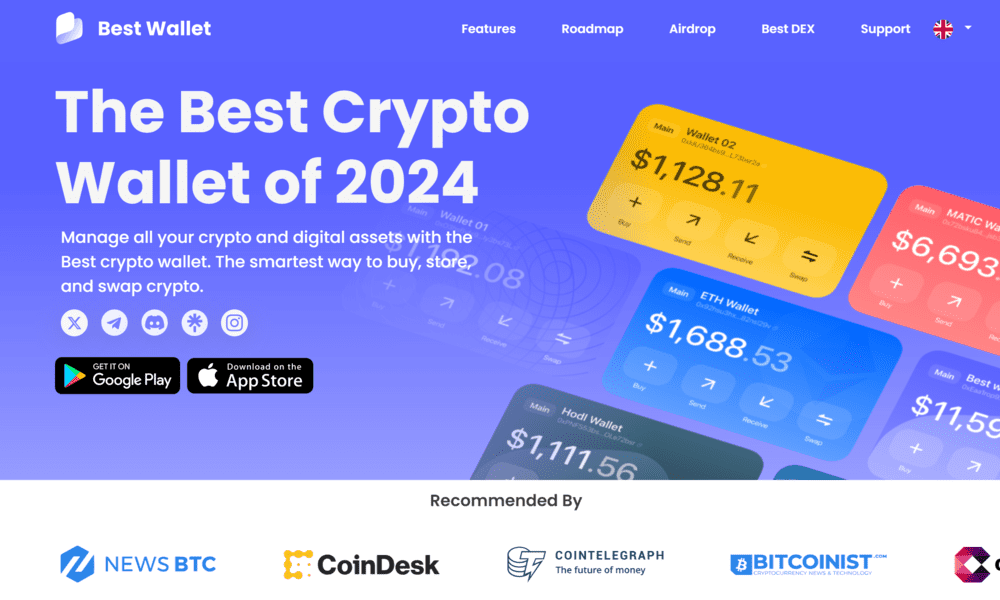
The reason we recommend Best Wallet for new users and those looking for the most friction-free way to buy XRP is that by purchasing crypto from directly within a wallet, users lower their risk of exposing themselves to exchange hacks, third-party risks, and the possibility of sending to incorrect addresses when withdrawing from a traditional crypto exchange.
The Best Wallet DEX aggregator sources the best rates for users’ swaps, supporting 50+ chains, connecting to over 200 decentralized exchanges, and using up to 20 cross-chain bridges. Users can make both same-chain and cross-chain swaps.
Conclusion: XRP Price Prediction
XRP stands at a defining moment in its evolution. Once weighed down by regulatory uncertainty, it now leads the charge in bridging traditional banking and blockchain finance. The launch of institutional products, growing developer activity, and real-world remittance adoption have positioned XRP as one of the most credible payment-layer assets heading into 2030.
If global monetary easing resumes and Ripple’s technology continues to integrate with central banks and major payment networks, XRP could realistically trade in the $8–$12 range by 2030. The asset’s combination of speed, compliance, and expanding interoperability gives it staying power in a market increasingly focused on utility over hype.
While it’s unlikely XRP will ever reach speculative price targets like $1000, its steady institutional integration suggests it could outperform most altcoins over the next cycle. For investors seeking a balance of liquidity, adoption, and resilience, XRP remains one of the most fundamentally grounded digital assets in the space.
See Also:
- What are XRP Meme Coins? Top Coins to Watch!
- XRP Futures: Ripple Trading Guide for 2026
- How to Buy RLUSD: Beginner’s Guide to Ripple’s Stablecoin
FAQs
Is XRP a good investment?


Our XRP price prediction suggests the token could experience significant growth by 2026. Potential developments and partnerships may contribute to driving its value higher. However, since cryptocurrency remains a high-risk asset class, whether XRP is a good investment ultimately depends on your risk tolerance and portfolio strategy.
What is our XRP price prediction for 2030?
The price could rise to an average of $10 with highs of around $12.
Can XRP reach $10 in this bull run?
It’s not impossible, but it’s a stretch. For XRP to hit $10, we’d need a perfect mix of strong market sentiment, heavy institutional buying, and a big wave of adoption. More realistic targets right now are closer to $4–$5 if conditions stay bullish.
What is XRP’s all-time high?
XRP’s highest price on record was around $3.84 in January 2018. It came close again in mid-July 2025, briefly pushing above $3.40.
How has the SEC lawsuit affected XRP’s price?
The lawsuit triggered big price drops and led to XRP being delisted from several exchanges. When Ripple scored legal wins and the case was finally dismissed, the price jumped and trading volumes spiked.
Can XRP overtake Ethereum in market cap?
Probably not anytime soon. Ethereum powers a huge ecosystem of apps, DeFi, and NFTs, while XRP’s focus is mainly on payments.
References:
- “What Is Ripple?” Linqto, https://www.linqto.com/blog/what-is-ripple/.
- “SWIFT vs Ripple.” BVNK, https://www.bvnk.com/blog/swift-vs-ripple#5-text.
- U.S. Securities and Exchange Commission. “SEC Issues Statement on the Role of Intermediaries in the Cryptocurrency Markets.” SEC.gov, 23 Dec. 2020, www.sec.gov/newsroom/press-releases/2020-338.
- XRPL.org. “XRPL: The XRP Ledger.” XRPL.org, https://xrpl.org/.
- XRPL.org. “What Is XRP?” XRPL.org, https://xrpl.org/docs/introduction/what-is-xrp.
- U.S. Securities and Exchange Commission. “Statement on Staff White Paper on Crypto-Asset and Their Future.” SEC.gov, 12 Mar. 2025,
https://www.sec.gov/files/ctf-input-staudinger-2025-03-12.pdf. - Financial Crimes Enforcement Network (FinCEN). “Ripple Facts.” fincen.gov, https://www.fincen.gov/system/files/shared/Ripple_Facts.pdf.

Why you can trust 99Bitcoins
Established in 2013, 99Bitcoin’s team members have been crypto experts since Bitcoin’s Early days.
Weekly Research
100k+Monthly readers
Expert contributors
2000+Crypto Projects Reviewed