





In This Article
1000x leverage crypto trading platforms sound like sci-fi. But they’re not, they’re real, and they’re being used. Traders chase the razor-thin line between glory and ruin. If you can handle chopped volatility, maps of liquidation, and funding fees that flirt with absurdity, you’ll want to know about crypto exchanges that provide 1000x leverage. Because when every basis point matters, you need precision.
In this article, we dig into the truth behind trade signals, risk models, and platforms offering maximum leverage. We’ll contrast their claims with reality. You’ll see who actually lets you open leveraged positions at 1000x leverage, what safeguards exist, where verification is required, and how platform users manage margin, slippage, and counterparty risk in the perpetual futures markets.
Best 1000x Leverage Crypto Trading Sites Compared
| Exchange | Number of Tradable Coins (with Leverage) | Maximum Leverage | Min. Margin Requirement | Best For |
| PrimeXBT | 50+ | Up to 1000x | 0.20% |
Advanced traders using multiple markets
|
| BIoFin | 525+ | 150× | 0.66% |
Leverage trading on a mobile app
|
| MEXC | 950+ | 500× | 0.20% |
Wide asset support
|
| Margex | 55+ | 100× | 1% |
Avoiding KYC verification
|
Crypto Platforms That Allow 1000x Leverage: Summary
This is the survival manual for anyone eyeing 1000x leverage crypto trading platforms. We’ll strip the show you the steel underneath with things like margin math, funding fees, and how fast your liquidation price can hit when you’re trading perpetual futures markets.
We’re walking through the crypto exchanges that actually dangle four-digit leverage and laying out what they really offer: supported markets, leverage multiples, minimum deposit requirements, trading tools, and how they handle client funds.
You’ll see why market makers set the tone, why market takers pay more, and what seasoned traders look for when sizing leveraged positions: deep liquidity, clean execution, and no hidden traps. By the end, you’ll know which cryptocurrency leverage trading platforms deserve a test run and which belong in the “maybe later” folder.
Key Takeaways
- 1000x leverage crypto trading platforms exist, but only a handful actually offer real four-digit leverage on live markets.
- Extreme leverage magnifies gains and losses; a 0.1% move can wipe an entire position, including the initial margin.
- Not all crypto exchanges that advertise high leverage are equal; check the supported markets, margin rules, and funding fees.
- Security of client funds, deep liquidity, and transparent risk controls matter more than flashy leverage numbers.
- Start small, verify the platform, and use strict risk management before opening a leveraged position.
Top 1000x Leverage Crypto Trading Platforms
There’s no shortage of exchanges screaming “high leverage.” But when you scrape away the banners, only a few crypto leverage trading platforms really let you trade crypto with 1000x leverage on live markets. These aren’t memecoin casinos; they’re full-blown perpetual futures markets where technical traders hunt for basis points and seasoned traders live or die by liquidation price math.
In the next section, we’ll tear into the five venues that actually matter: PrimeXBT, BloFin, MEXC, and Margex. You’ll see what they offer, how they handle client funds, what leveraged products are supported, and which trading tools can keep a leveraged position alive when crypto price movements get violent.
Looking Beyond Trading Platforms?
Finding the right platform is step one; finding the right crypto to trade is step two. For insights into the projects that could see massive growth, see our full article on the next 1000x cryptos.
PrimeXBT – Provides Up to 1000× Leverage for Certain Instruments
PrimeXBT is a crossover machine where you can run crypto futures, forex, indices and commodities from the same dashboard. Think BTC/USD alongside S&P500, gold and crude oil, all on one margin account. That’s why the platform attracts technical traders who want to diversify strategies beyond memecoin pumps and still stay inside a crypto leverage trading environment.
Accounts are Bitcoin-funded and borderless; deposits, withdrawals and balances are all in BTC. You can grab BTC inside the platform through a built-in fiat gateway, but once you’re in, you’re trading on a Bitcoin-only exchange account. There’s no intrusive KYC for most users, but U.S. traders are blocked.
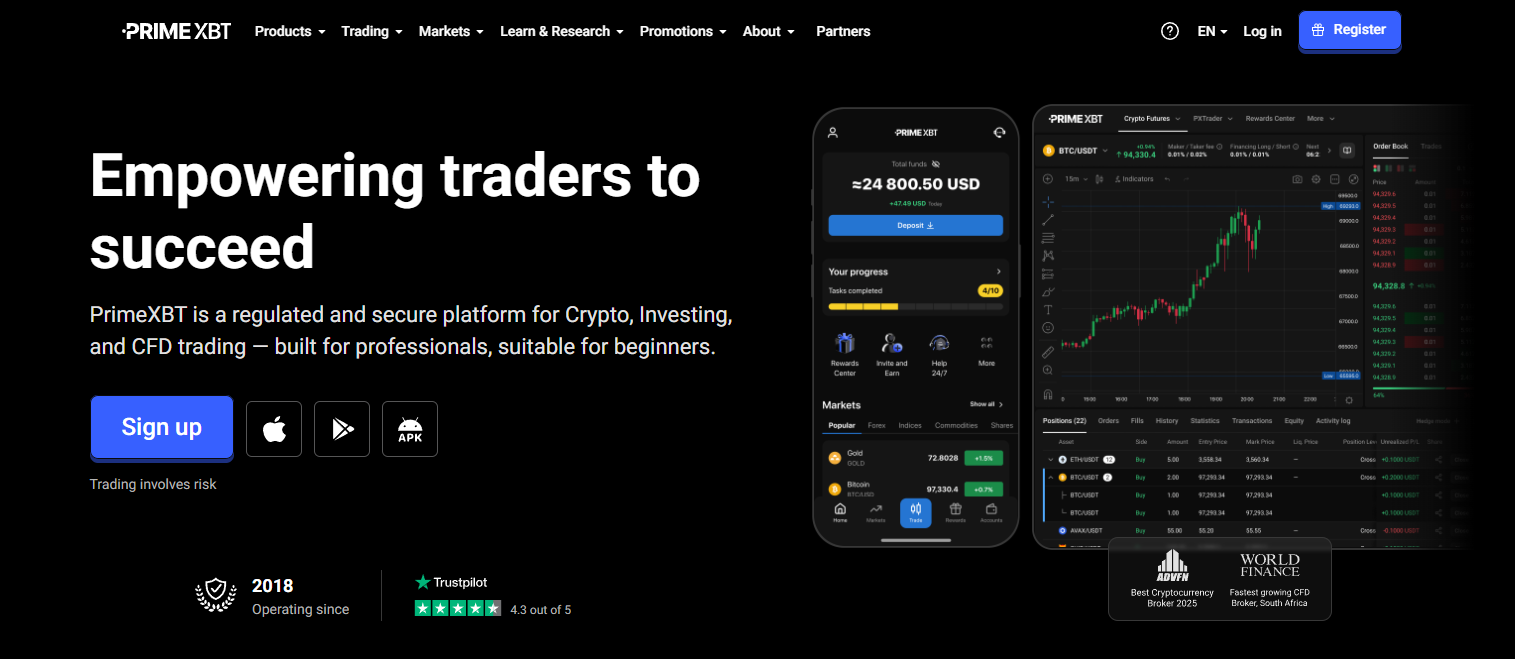
On the crypto side, PrimeXBT offers up to 100× leverage on major pairs and a selection of altcoins. The shocker: certain forex trading markets allow up to 1,000× leverage, a leverage multiple generally seen only on unregulated FX desks. You can build long and short trading exposure across currencies, indices and derivative instruments from one interface.
The platform’s trading tools include customizable widgets, integrated Covesting for social/mirror trading, and MetaTrader 5 integration for seasoned pros. Maker fees start as low as 0.01% and taker fees at 0.02% on crypto futures (accessed Sept 2025), while overnight financing charges vary by asset. That’s competitive, but be careful with time zones, funding ticks at UTC midnight, which has surprised platform users with extra funding fees.
PrimeXBT’s downside is baked into its freedom: it’s unregulated, Bitcoin-only, and allows high leverage. That’s a cocktail for opportunity and disaster. Traders increase their market exposure fast, but also hit their liquidation price faster than they expect. Keep balances lean, and don’t leave more than you’re actively using for leveraged positions.
Learn more about this in our comprehensive PrimeXBT review.
PrimeXBT Pros & Cons
Pros
-
Multi-asset platform, trade crypto, Forex, indices, and commodities from one account
-
Up to 1,000× leverage on certain Forex markets and 100× on major crypto pairs
-
Bitcoin-funded accounts with fast deposits and minimal KYC for most regions
-
Competitive fees with maker rates as low as 0.01% and taker rates at 0.02%
-
Customizable trading interface plus Covesting and MetaTrader 5 integration for technical traders
Cons
-
Unregulated exchange, no investor protection if things go wrong
-
U.S. traders blocked and fiat withdrawals not supported
-
Overnight funding fees vary by asset and tick at UTC midnight, surprising some users
-
All balances held in BTC, requiring conversions for other assets
BloFin – Offers High Leverage Options up to 1000×
BloFin positions itself as the clean, high-liquidity end of the crypto leverage trading spectrum. Instead of being a memecoin casino, it’s a full trading platform with spot, futures, and copy trading under one roof. The draw: professional-grade trading tools, deep liquidity, and a security stack you usually see in institutional custody rather than retail exchanges.
The platform uses Fireblocks for secure client funds custody and Chainalysis for real-time monitoring to flag suspicious flows. It also offers Merkle Tree verification and bi-monthly audits, rare transparency in a market where “verify you are human” pop-ups sometimes feel like the only compliance layer.
On the futures side, BloFin offers USDT-margined perpetual contracts across more than 100 pairs, with leverage up to 150× on select contracts. Hedge Mode lets you hold long and short trading positions simultaneously on the same contract; One-Way Mode keeps you restricted to a single side. There’s no spot margin trading yet, so traders need to manage risk and liquidation price carefully.

BloFin supports over 400 cryptocurrencies, from Bitcoin and Ethereum to the latest memecoins like WIF, PEPE, and TURBO. You can buy crypto with over 90 fiat currencies via third-party processors such as Simplex and Alchemy Pay. However, there are no direct fiat deposits or withdrawals, so platform users must transfer funds elsewhere to cash out, and third-party fees can be steep.
The copy-trading feature is polished, letting new users mirror experienced traders’ positions automatically. A demo environment with 50,000 virtual USDT lets you practice simulated crypto futures trading without risking real assets. Bot trading exists but is still basic, with more functions promised.
Fees are competitive: 0.10% for spot, 0.02% maker, 0.06% taker for futures, with a VIP tier that can cut maker fees to zero. Maker orders add liquidity; market takers pay more, so structure orders accordingly.
BloFin is available in 150+ countries but not the U.S. Despite registering as a Money Services Business with FinCEN and holding a VASP license in South Korea, it still lacks major regulatory approvals compared to Binance or Kraken. For serious traders, though, it’s a compelling mix of high-end security, leveraged products, and flexible trading crypto options. Get to know this platform in detail in our BIoFin review.
BloFin Pros & Cons
Pros
-
Offers spot, futures, and copy trading plus up to 150× leverage on select futures contracts
-
Fireblocks custody and Chainalysis real-time monitoring for top-tier asset protection
-
User-friendly interface with demo mode for risk-free practice
-
Supports over 400 cryptocurrencies, including major coins and trending memecoins
-
Competitive fee structure with VIP tiers reducing maker fees to zero
Cons
-
No direct fiat deposits or withdrawals, must use third-party providers
-
Leadership details lack transparency compared to bigger competitors
-
Bot trading feature is still limited and in early development
-
Not available to U.S. users
MEXC – Known for Ultra-High-Leverage Futures Trading
MEXC is the workhorse exchange for crypto traders who want range, speed, and high leverage without babysitting fees. Its matching engine claims 1.4 million transactions per second, so market orders don’t feel like throwing darts in a wind tunnel. The venue is packed: 2,800+ coins, 3,000+ spot pairs, and 760+ futures pairs. If there’s a ticker you’ve never heard of, odds are it’s here.
Fees are the headline. Spot: 0.000% maker, up to 0.050% taker. Futures: 0.000% maker, 0.020% taker. That’s why market makers set up shop and market takers pay less pain than elsewhere. Leverage runs hot, up to 400× on selected contracts, so traders increase market exposure fast, but the liquidation price snaps just as fast. Use reducing leverage and a small initial margin until you’ve mapped how their perpetual futures books behave.
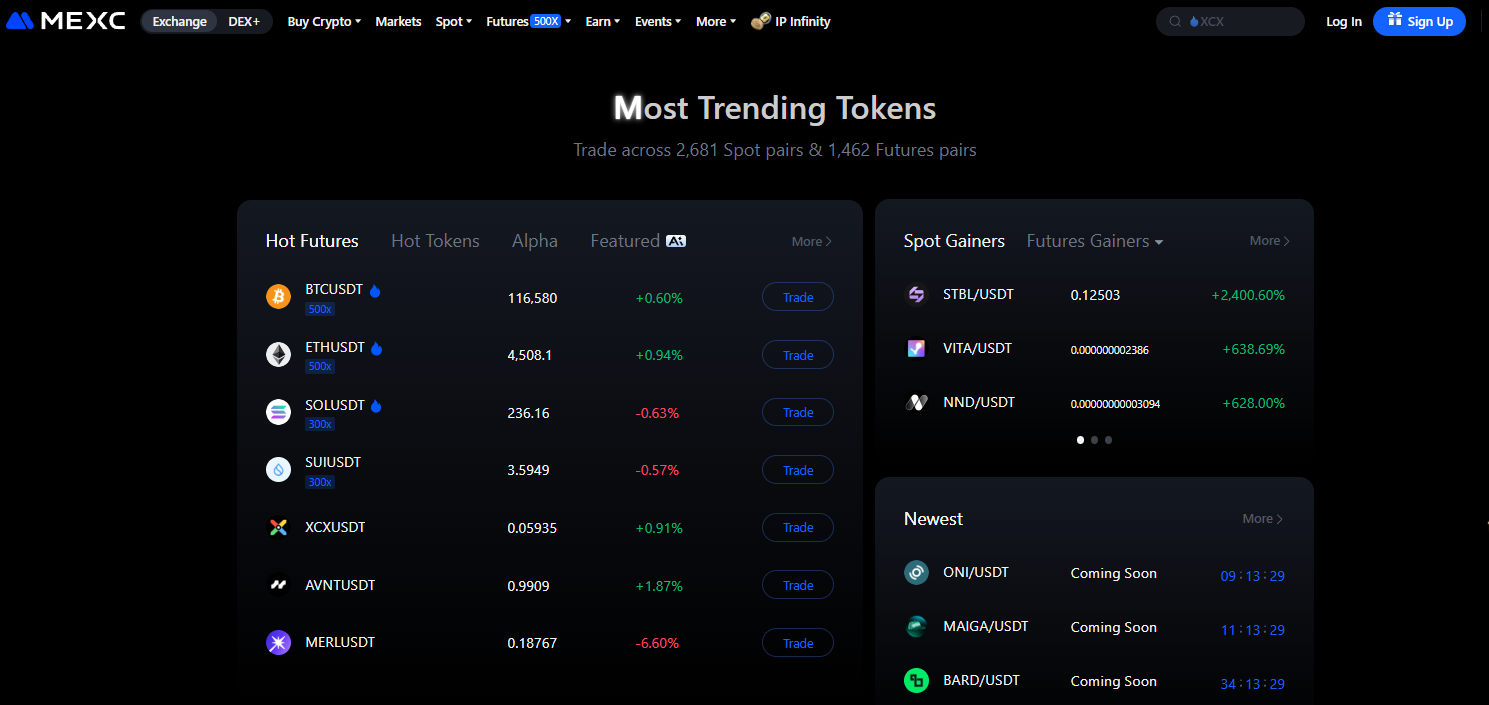
Product range is sprawling: spot, perpetual futures markets, copy trading, P2P, demo, savings, loans, even a wallet and virtual card. Onboarding is simple, with broad payment types through third-party processors; just note higher purchase spreads than bank rails. The platform pushes multilingual support and a big global footprint, but it doesn’t serve U.S. users and has a history of regulatory friction in several regions. That’s the trade: massive supported markets and deep liquidity versus compliance noise and mixed user reviews around withdrawals and support.
Bottom line: for leverage trading on a vast menu of underlying assets, MEXC is a serious tool. Treat it like one. Size small, respect funding fees, and never let a 10-bp wick turn your day into a leveraged trade obituary. Take a look at our MEXC review to learn more.
MEXC Pros & Cons
Pros
-
Massive selection of 2,800+ coins, 3,000+ spot pairs, and 760+ futures pairs
-
Ultra-high leverage up to 400× on selected contracts
-
Low fees, 0.000% maker and up to 0.050% taker on spot; 0.000% maker and 0.020% taker on futures
-
High-performance matching engine capable of 1.4 million transactions per second
-
Multiple trading products, spot, futures, copy trading, P2P, demo, savings, loans, and even a wallet/card
Cons
-
Not available to U.S. users and facing regulatory challenges in multiple regions
-
Mixed user reviews citing withdrawal issues and poor customer support
-
No direct fiat withdrawals; relies on third-party providers with higher fees
Margex – Popular Because of Beginner-Friendly Interface
Margex sits at the opposite end of the noise spectrum from the mega-exchanges. It’s a smaller, more focused crypto futures platform that sweetens the pitch with aggressive promos like a 20% deposit bonus (“MARGEXBONUS”) and a $50 sign-up bonus for new users. Those incentives can offset up to 50% of trading and funding fees, useful when every tick matters in a leveraged trade.
Under the hood, Margex supports over 55 tokens and 50 perpetual pairs with leverage up to 100×, offering both cross and isolated margin modes. Its interface is tuned for speed and clarity; setting up a position with stop, take profit, and indicators like RSI, MA, or VWAP is straightforward even for new users. Deep liquidity and a solid matching engine keep execution reliable.
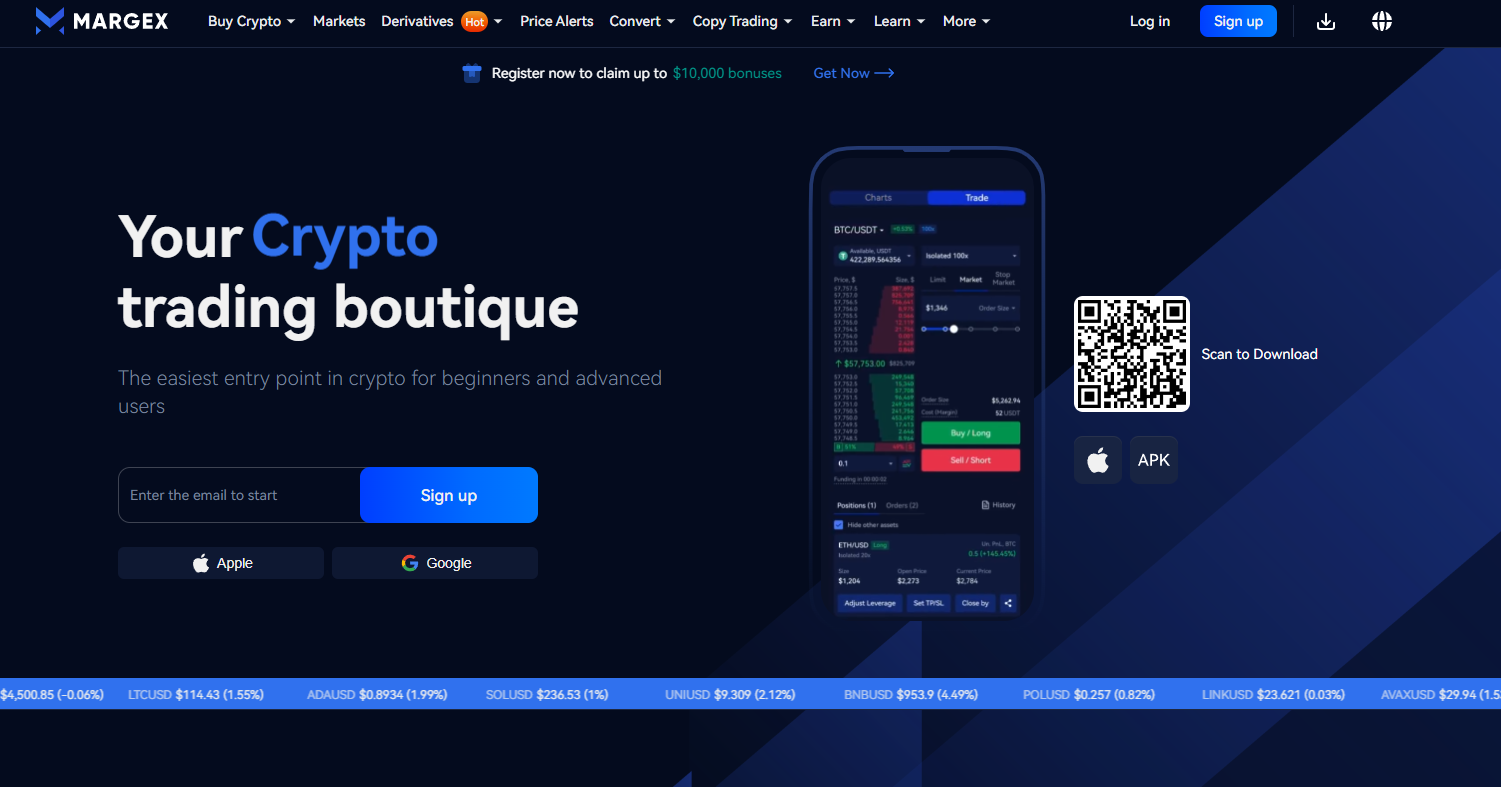
Security is a highlight. Margex keeps client funds offline in multi-signature wallets requiring more than one private key, adding an extra layer of protection. Combined with a transparent bonus system and daily referral payouts, it’s positioned as one of the more approachable leverage platforms for traders who want crypto futures exposure without feeling lost in a giant exchange.
The flip side: Margex is capped at 100× leverage, not 400× or 1000×. Funding fees around 0.12% per eight-hour window can eat into small accounts. And while the bonuses help, they don’t erase risk; high leverage and small margin still lead to rapid liquidations. Treat the promos as a cost reducer, not free money. Read our Margex review to get a detailed perspective.
Margex Pros & Cons
Pros
-
Supports 55+ tokens and 50 perpetual pairs with leverage up to 100×
-
20% deposit bonus plus $50 sign-up bonus offset up to 50% of fees
-
User-friendly interface with advanced trading indicators
-
Cross and isolated margin modes for flexible risk management
-
Top-tier security with offline multi-signature wallet storage for client funds
Cons
-
Maximum leverage capped at 100×, lower than some competitors’ ultra-high leverage
-
Funding fees around 0.12% per 8-hour window can erode small accounts
-
Bonus offers reduce costs but don’t eliminate high-leverage risk
Other 1000x Crypto Leverage Trading Platforms
Not every high-octane venue is inside a big centralized exchange. Two names in the “off-Wall Street” league are Rollbit and Aark.
Rollbit is essentially a hybrid between a casino and a leverage platform, famous for its perpetual futures markets and gamified UX. It dangles leverage multiples up to 1,000× on micro-contracts and lets users trade crypto price movements alongside NFT floor prices and even sports bets. The upside is speed and novelty: instant onboarding, no KYC, and a playground of derivative products. The downside is obvious: unregulated jurisdiction, no clear insurance fund disclosures, and a history of customer complaints about withdrawals and platform risk. Treat it as high-risk entertainment, not a vault.
Aark (marketed as a decentralized perpetual DEX) flips the script. It’s non-custodial, built on smart contracts, and integrates with your private wallet instead of holding client funds centrally. Traders interact directly with underlying assets through liquidity pools, making it attractive to DeFi natives. Pros: permissionless access, on-chain transparency, and the ability to self-custody while taking leveraged positions. Cons: liquidity is thinner than centralized venues, funding rates can spike, and smart-contract exploits remain a standing risk. In short, Aark gives you control but hands you the full weight of DeFi’s operational hazards.
How We Ranked the Top 1000x Leverage Platforms?
Every venue on this list was picked using the same hard-nosed checklist. Flashy banners claiming “1,000×” don’t make the cut. We went into each platform’s help centers, fee schedules, and legal pages to confirm what leverage multiples are real, which markets they apply to, and what strings are attached.
We graded platforms on seven key factors:
- Maximum leverage by pair and whether it’s live, promotional, or simulated.
- Depth and liquidity, how much you can size without slipping 50 bps.
- Funding fees and hidden costs beyond headline maker/taker rates.
- Risk controls like insurance funds, auto-deleveraging, and margin modes.
- Custody and security of client funds (proof-of-reserves, cold storage, or smart-contract custody).
- Jurisdictional restrictions and KYC rules, which determine who can legally trade there.
- UX and tools, order types, APIs, copy trading, demo modes, and support.
This mix favors crypto leverage trading platforms that actually deliver their advertised leverage, protect user assets, and give traders enough trading tools to manage risk, not just hype.
What is 1000x Leverage in Crypto Trading?
In plain terms, 1000x leverage means you control $1,000 of position size for every $1 of your own capital. It’s the financial equivalent of a hair-trigger rifle, every tiny move in crypto price movements is magnified a thousandfold. A 0.1% tick against you will nuke the entire margin; a 0.1% tick in your favor doubles your stake.

Most crypto leverage trading platforms only offer 50×-125× on major pairs. True 1000x crypto leverage trading platforms are rare and usually apply it to micro-contracts or promotional products. Some even run simulated crypto futures rather than real contracts. Understanding that distinction is key: marketing 1,000× leverage is not the same as live, liquid 1,000× on BTC/USDT with a real underlying asset.
High leverage also multiplies hidden costs. Funding fees, spread wideners, and latency wicks can push you to your liquidation price before you have time to react. That’s why seasoned traders use 1,000× not to “bet big” but to size micro-risk positions or scalp a few basis points with technical indicators and surgical stops. For everyone else, 1,000× is a short road to zero.
How Does 1000x Leverage Work in Crypto?
At 1,000×, the math stops being intuitive. Your initial margin is tiny, so the liquidation price is practically glued to your entry. A 0.05% move against you can wipe the position. This isn’t “high risk, high reward”, it’s a scalpel.
Most perpetual futures markets that advertise 1,000× are running micro-contracts or simulated crypto futures, where the dollar notional is small. They’ll still use the same machinery as real leverage platforms:
The trick isn’t just “get more leverage.” It’s how you handle it. Tight stops, reducing leverage on volatile underlying assets, and understanding index composition (especially with memecoins) are what keep technical traders alive. Without that discipline, 1,000× leverage is just a fast-track to giving your collateral to the next person in line.
Benefits & Risks of 1000x Leverage Crypto Trading
The upside: 1,000× lets a trader magnify small crypto price movements into meaningful P&L. Seasoned traders can size micro-positions, scalp a few basis points, and exit before the funding fees kick in. Done right, it’s a way to hedge or capture short-term market direction without tying up huge collateral. Platforms offering this much leverage also tend to come with deep liquidity, advanced trading tools, and fast matching engines, ideal for technical traders who know their edge. The downside: the margin for error is effectively zero. Liquidation price sits inches from your entry, and one bad wick will take your entire stake. Funding fees on high leverage accumulate fast. Index manipulations, thin books on exotic underlying assets, and latency spikes can lead to instant liquidations. Even with the best leverage platforms, a small gap or depeg in a Stablecoin can wipe out a highly leveraged position before you can click “reduce.” Add to that the jurisdictional issues. Many of the most leveraged platforms are unregulated or banned in key markets. They may have weak disclosure on client funds, limited recourse in disputes, and no investor protection. 1,000× is not a shortcut to wealth; it’s a specialized tool for traders who already know how to lose small and survive.
How to Select the Top 1000x Leverage Trading Platform
When choosing a venue, look at these key factors before opening an exchange account:
Pick a platform the way a pilot picks a plane: not for the color of the paint, but for the instruments, maintenance record, and runway. At 1,000×, your margin for error is a rounding error.
How to Start 1000x Leverage Trading in Crypto?
This walkthrough shows how to execute a leverage crypto trading setup on MEXC, one of the simplest crypto leverage trading platforms for beginners. The mechanics are the same across most leverage platforms, so mastering them here transfers everywhere.
-
Create an account on MEXC
Go to MEXC and open a free account. Complete registration and KYC.
-
Deposit Trading Funds
MEXC allows users to deposit crypto such as BTC, SOL, ETH, POL, TRX, BNB, USDT, and USDC, along with fiat via bank card, bank transfer, and Google/Apple Pay. -
Select a Futures Market to Trade
Click “Crypto Futures” and pick a market offering leverage. Beyond BTC/USDT, you’ll see DOGE, SOL, ADA, LTC, and more. Choosing BTC reduces volatility risk; altcoins swing harder. -
Set the Trade Requirements
Enter your amount in USD. This is your initial margin, the max you can lose if the trade hits its liquidation price. Select your leverage level. Choose “Buy” if you’re going long, “Sell” if short. Check the bust price the platform calculates; that’s where you’re out. -
Select the Stop-Loss and Take-Profit Prices
Click “Auto” to pre-set your exit rules. Enter a stop-loss to cut losses before liquidation, and a take-profit to secure gains automatically. -
Place the Trade
Review everything: position size, leverage multiple, market direction, stop and target. Place the trade, and the position stays open until your stop or take-profit triggers, whichever hits first.At high leverage, you’re essentially scalping with a loaded spring. Keep positions small, watch funding fees, and don’t assume a banner bonus or “simulated” market removes risk. Even on the best platforms, leverage cuts both ways.

Remember: leverage magnifies both gains and losses; so trade carefully.
Conclusion
Leverage isn’t a lifestyle, it’s a weapon. The platforms above hand you the kind of firepower that can turn a basis-point move into a week’s P&L or a smoking crater. PrimeXBT, BloFin, MEXC, and Margex each have their own quirks, spreads, funding charges, and custody models. None will save you from your own bad sizing.
The only edge at 1,000× leverage is discipline. Read the docs, know where the bust price sits, and size like you’re already wrong. Trade small until you’ve mapped the terrain. Keep excess collateral off-platform. When you’re playing at this speed, survival is alpha.
DISCOVER:
- Crypto Exchange Promos & Discounts
- Crypto Wallet Promos & Discounts
- 100x Leverage Crypto Trading Platforms
- Top-Rated Crypto Day Trading Platforms in 2026
FAQs
Which crypto platforms actually offer 1000× leverage?


A handful of niche venues offers 1,000× is rare, Rollbit advertises 1,000× on micro-contracts. True 1,000× on major pairs is rare and usually pair-specific or promotional.
Do major exchanges like Binance or ByBit offer 1000× leverage?
No. As of late 2025, Binance caps at 125× and ByBit also at 125×. MEXC goes up to 400× on select contracts, but none of the major regulated exchanges touch 1,000×.
Is it safe to use 1000× leverage trading platforms?
Safety is limited. These platforms are mostly unregulated, liquidations occur almost instantly, and there’s little recourse if something breaks. Even with strong custody partners you’re still exposed to platform risk and your own sizing.
Do 1000× leverage platforms require KYC?
Often not for crypto deposits, but many enforce verification once you use fiat or try to withdraw large sums. Always read the terms before trading.
What cryptos can I trade with 1000× leverage?
Usually only the most liquid pairs like BTC and ETH. Ultra-high leverage on smaller alts or memecoins is rare due to thin order books.
Are 1000× leverage platforms regulated?
Almost never. Extreme leverage is mainly offered by offshore entities or DeFi protocols with minimal licensing, unlike major exchanges which cap leverage far lower.
References
- Aaron S. “What is Leverage Trading in Crypto: A Risk Management Guide.” BitDegree, 14 Mar. 2025, www.bitdegree.org/crypto/tutorials/what-is-leverage-trading-crypto
- Gorton, Gary B., et al. Leverage and Stablecoin Pegs. Yale University & NBER, 25 Apr. 2023, cowles.yale.edu/sites/default/files/2023-04/Leverage%20and%20Stablecoin%20Pegs_April%202023.pdf.
- Texas A&M University. “RM2-1.” Risk Management Series, Texas A&M Agriculture Extension, Oct. 2013, agecoext.tamu.edu/wp-content/uploads/2013/10/rm2-1.pdf
- United States Commodity Futures Trading Commission. “Economic Purpose of Futures Markets and How They Work.” CFTC, www.cftc.gov/LearnAndProtect/AdvisoriesAndArticles/economicpurpose.html
- United States Commodity Futures Trading Commission. “Futures Market Basics.” CFTC, www.cftc.gov/LearnAndProtect/AdvisoriesAndArticles/FuturesMarketBasics/index.htm

Why you can trust 99Bitcoins
Established in 2013, 99Bitcoin’s team members have been crypto experts since Bitcoin’s Early days.
Weekly Research
100k+Monthly readers
Expert contributors
2000+Crypto Projects Reviewed