

In This Article
The Great Decoupling: 2026’s Quiet Outlier
The Macro Contrast
2026 has been an unforgiving environment for digital assets relying on speculative momentum. With the US Federal Reserve pinning the funds rate at a sticky 3.50% to 3.75%, the anticipated flood of cheap liquidity simply never materialized. Capital carries a real cost again, and the market has ruthlessly penalized networks built on empty blockspace and future promises. The benchmark numbers tell the story of a protracted bleed. Bitcoin has ground downward, sitting roughly 6% lower year-to-date. Ethereum has taken a heavier beating, shedding 18% as network revenue stagnates and attention fragments. Across the broader Layer-1 landscape, the overriding theme is one of capital flight and compressing multiples. In a tight macroeconomic regime, if a protocol isn’t generating measurable cash flow, institutional capital won’t bid it.
The Performance Anchor
Then there is NEAR, which looks completely out of place on the screen. While the rest of the market spent 2026 in the doldrums, NEAR broke away, outperforming the pack. It started January at $1.51, dumped to roughly 85 cents during the February flush, and then ripped straight upward. That move peaked after a 604% run off the bottom. Sitting around $5.02 as October wraps up, the token is still up 232% on the year. That sustained push brought its market cap to $6.6 billion and dragged it right back into the top 20. In an otherwise sluggish tape, it’s one of the few charts that actually looks alive.

Sidelined traders want to brush this off as a fluke, chalking it up to retail chasing whatever AI buzzword is trending this week. That misses what is actually happening on the tape. You don’t put up a 5x off the lows in a market this tight on leveraged perps alone; that kind of run takes real, relentless spot accumulation. NEAR overhauled how its business model actually functions, and the market finally caught up.
Redefining the L1 Playbook
NEAR basically quit playing the standard Layer-1 turf war. Trying to out-muscle Ethereum or Solana for walled-garden liquidity is a meat grinder, so the team routed right around it. Instead of begging people to park capital on another isolated network, NEAR retooled itself into a fee-skimming clearinghouse. Through chain signatures and intent routing, other blockchains became simple execution endpoints. You can trade native assets across Bitcoin, Ethereum, and Solana without ever touching a sketchy third-party bridge, and NEAR takes a small toll on every leg.
Here is what actually pushed this over the edge: autonomous AI agents. If you are running an AI model inside a secure hardware enclave, it can’t click a MetaMask pop-up, baby-sit a seed phrase, or bridge gas tokens every time it rebalances. It needs a headless rail that can sign transactions across any chain from a single balance. NEAR built that exact pipe while everyone else was still busy farming token incentives. Turning other chains’ transaction volume into your own protocol revenue sounds obvious in hindsight, but watching it work in a dead market is wild.
Fixing the Leaky Bucket: The Tokenomics Pivot
The Pre-2026 Hangover
To understand why NEAR ran so hard in 2026, look at the broken playbook of almost every Layer-1 launched between 2020 and 2022. They were built like leaky buckets. In the zero-rate era, teams prioritized rapid network security and developer hand-outs over basic sustainability. The model was everywhere: mint tokens at 5% to 8% inflation to pay validators, promise early VCs massive allocations behind vesting cliffs, and pray that future user demand would magically bail out the dilution.
That bet failed. When rates went up and the market rolled over, the math caught up with everyone. Without real transaction fees to burn supply, constant minting and venture fund unlocks created a steady wall of sell pressure. You cannot run a marketing campaign that outpaces millions of fresh tokens dumping onto thin books every week. Early investors cashed out like it was an ATM, leaving retail holding the bill. NEAR spent 2024 and 2025 stuck in that exact cycle. The tech was solid, but the token model belonged to an era of cheap money that was already gone.
The Inflation Halving
That bleed stopped on February 24, 2026. NEAR governance cut maximum annual inflation from 5.0% down to 2.5%. There is even a proposal on the table now targeting 1.6% over the next two years. That drop pushes gross staking yield from around 5.3% down toward 3.4%, which stings in the short term, but it actually plugs the leak. Halving new issuance stopped the chronic supply overhang that kept smothering rallies.
Cutting inflation only gets you back to baseline, though. A 600% run needs actual buying pressure behind it.
The Fee Switch and the Supply Squeeze
The real shift came when NEAR turned on the fee switch for NEAR Intents. Before that change, third-party solvers and infrastructure teams pocketed all the spread from cross-chain order routing. NEAR ran the security and handled the execution, but gave away the margin while token holders saw zero upside.
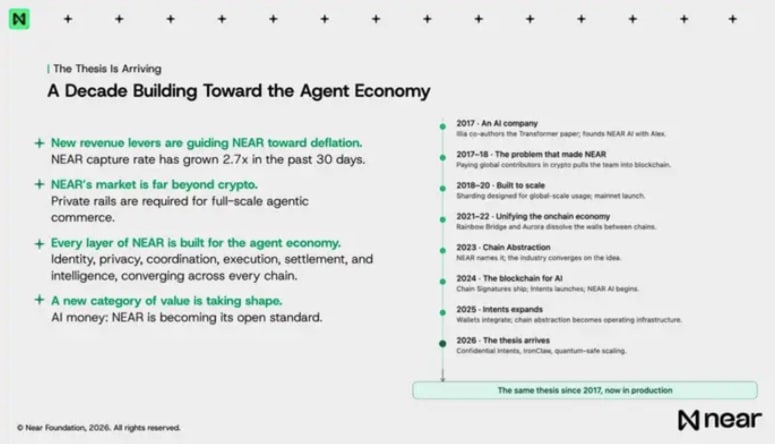
The fee switch rerouted those cuts into the treasury. Instead of parking that cash in a reserve fund or handing out opaque ecosystem grants, the protocol started running programmatic open-market spot buybacks.
The timing made this explosive. Unlike newer Layer-2s dealing with endless unlock schedules, NEAR’s early venture cliffs were already done. The float was completely circulating. On top of that, roughly 43% of all coins were staked with validators, taking them off the market.
When the buyback engine started hitting order books, it wasn’t buying into deep liquidity. It was buying into a dry market where original seed investors had either already sold or locked up their stake. The buy orders had nowhere to go but straight up the book.
The numbers show just how tight that squeeze got:
- August 2026: The protocol bought 723,000 NEAR directly on the open market.
- September 2026: Buybacks jumped 154% to 1.84 million NEAR in a single month, taking roughly $9.2 million in supply off the board.
This wasn’t retail chasing green candles or hedge funds playing narrative rotations. It was pure, price-inelastic demand. The contracts don’t care about chart patterns or macro news; when volume runs through the router, the engine buys spot.
Cut daily issuance in half, lock away 43% of the coins, and then run a programmatic buyer that pulls nearly two million tokens off an illiquid market every month. That is not marketing magic. It is just supply and demand working the way it is supposed to.
The Engine Room: Intents and Margin Expansion
Escaping the Liquidity Trap
For five years, alternative Layer-1s ran the exact same dead-end playbook: launch a fast chain, print millions in token incentives to prop up yield farming, and pray that liquidity bridges over from Ethereum. Everyone knows how that story ends. Mercenary capital shows up for the handout, drains the incentives, and dumps the farm token on the way out to the next subsidized network, leaving behind ghost-town DEXs and underwater retail bags.
Trying to fight Ethereum or Solana in a war of attrition for isolated TVL is exhausting and pointless. Juggling gas tokens, dodging bridge hacks, and hopping between centralized exchanges created an experience so tedious that many users gave up.
NEAR survived the 2026 bear market by walking away from that fight. Instead of begging capital to move onto its chain, the team built pipes to control capital wherever it already sat.
That came down to chain signatures and intent routing. NEAR validators use decentralized multi-party computation (MPC) to hold key shards, meaning a single NEAR account can sign transactions on foreign chains. If a user or an autonomous AI agent wants to swap native Bitcoin for native Solana, they don’t have to touch a wrapped-asset bridge or manage separate wallets. You broadcast an intent stating what trade you want, off-chain solvers race to find the best route across 35 connected chains, and the final cryptographic proof settles back on NEAR. It turned NEAR from another isolated island into an execution rail for the rest of crypto.
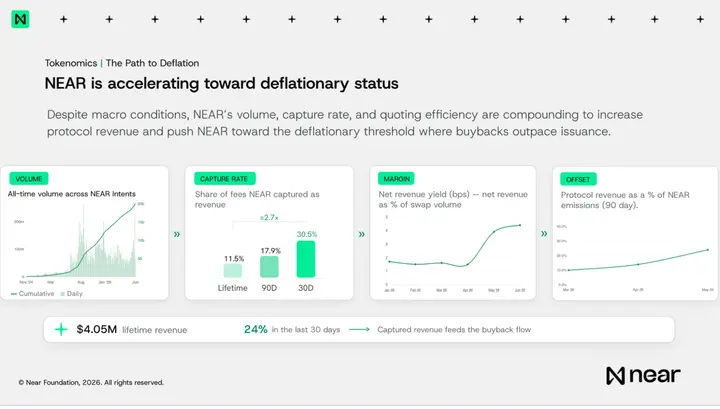
The volume followed faster than expected. Cumulative settlement volume on NEAR Intents cleared $10 billion early in 2026, hit $20 billion by July, and passed $30 billion by late September. As October wrapped up, it sat past $34 billion.
Q3 was especially wild: $10.41 billion settled in that quarter alone, up 891% year-over-year. Monthly run rate doubled between July ($2.40 billion) and September ($4.80 billion). And unlike the circular wash trading of the 2021 DeFi cycle, this was actual cross-chain arbitrage and retail swaps clearing through decentralized solvers.
Operating Leverage and Confidentiality Execution
Still, in crypto, gross volume is mostly a vanity stat. If a network moves tens of billions of dollars without taking a cut, it is running an expensive public charity.
The real economic turning point for NEAR was margin expansion. Historically, the Intents system took a lifetime average fee cut of roughly 11.5%. That take-rate took a hit on third-party integrations; when someone swapped inside a partner interface like a Ledger wallet, NEAR split the fee 50/50.
Throughout 2026, order flow concentrated straight onto the near.com native portal. Because the protocol owns that front end, it keeps 100% of the take-rate. By the third quarter, the blended fee capture jumped to 30.5%, nearly tripling its historical cut.
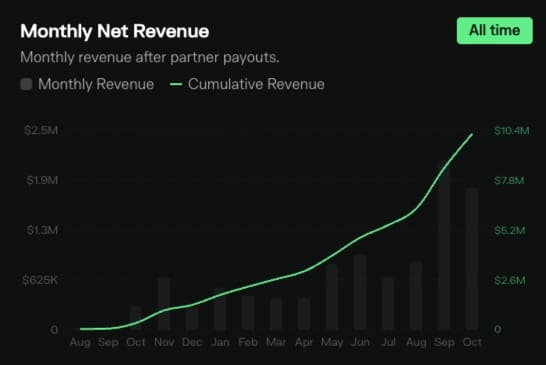
That shift gave the network massive operating leverage. Securing the chain costs a fixed amount (and governance was already halving validator inflation), while variable revenue per trade tripled. Every billion dollars routed suddenly produced three times the cash flow it did twelve months earlier. Thanks to the fee switch turned on in February, that extra margin funneled straight into open-market spot buybacks of the token.
Retail swaps and fat margins are great, but institutional order flow and big prop desks run on different rules. On a public chain, broadcast orders get murdered by MEV. If a desk drops an eight-figure cross-chain intent into a transparent mempool, sandwich bots will tear the trade apart and bleed the fill price dry. Real institutional capital will never touch an execution venue that leaks its order book to front-runners.
NEAR plugged that leak in mid-2026 with Confidential Intents. By moving order execution into hardware-isolated Trusted Execution Environments (TEEs), traders can settle big cross-chain size privately. The trade parameters stay encrypted, solvers run their routes inside the enclave, and only the finished settlement posts to the public chain.
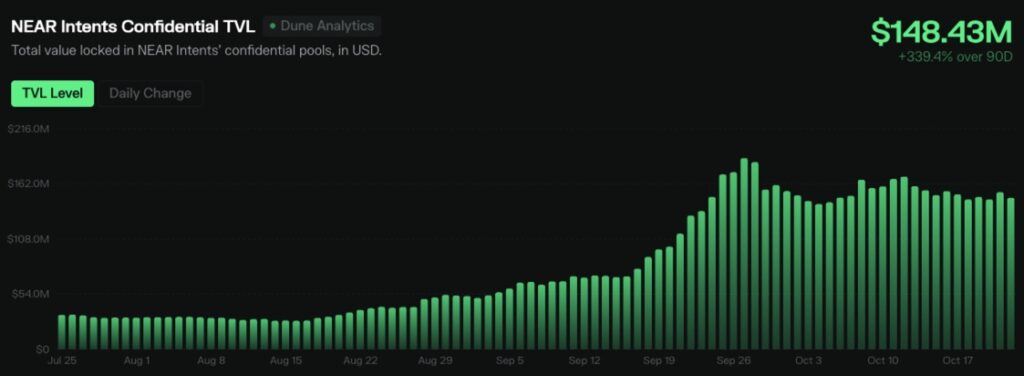
The reaction from smart money was immediate. TVL in Confidential Intents grew fivefold inside three months, climbing from $30 million in Q2 to $171.36 million by September. This wasn’t idle yield farming; it was active settlement capital. By late September, 42% of all swap volume on near.com routed through these private pools.
By taking MEV front-running out of the equation, NEAR managed to build an on-chain dark pool that handles cross-chain size without leaking alpha. It gave trading desks a reason to trade cross-chain without handing free lunch to arbitrage bots.
Architecture That Delivers: Stateless Validation and Resharding
The Usability Prerequisite
Crypto history is full of dead projects that had mathematically gorgeous whitepapers, but crashed the second real traffic hit the RPCs. If using a chain forces you to paste a 42-character hex address, buy three different volatile gas tokens, and click through browser pop-ups just to swap assets, you will never get serious volume. People give up, and automated systems break.
NEAR built around that reality from day one. Instead of raw public keys, accounts use simple names like trader.near. More importantly, the protocol supports native meta-transactions, meaning an app or a trading desk can cover gas behind the scenes. That invisible plumbing is the only reason the 2026 volume run didn’t fall apart. High-frequency arbitrageurs and autonomous AI agents pushing thousands of micro-transactions a minute cannot stop to manage gas balances every time they execute. They just need the trade to clear.
Scaling Under Pressure and Quantum Hardening
Smooth UX is useless, though, if the validators melt under heavy load. When a chain processes tens of billions of transactions, its state blows out into the terabytes. On standard monolithic Layer-1s, every node has to keep that whole history on expensive local SSDs. That dynamic quickly prices out independent validators and concentrates the network into a handful of venture-funded data centers.
NEAR avoided that trap through Nightshade 2.0 and stateless validation. Nodes no longer need to store the entire chain history to verify blocks. Instead, they check incoming transaction chunks against compact state witnesses: tiny cryptographic proofs containing only the specific data needed for that batch.
That shift keeps the hardware footprint lean enough for more than 400 active validators to run nodes without massive overhead. At the same time, block times sit around 600 milliseconds, and the Doomslug consensus locks finality in roughly 1.2 seconds. When a solver settles an eight-figure cross-chain order, it isn’t sweating in mempool limbo or worrying about an orphaned block. The fill is deterministic and done.
The real test came in June 2026 during the v2.13 upgrade. Most chains buckle when network activity spikes; fees go through the roof, RPCs fall over, or the chain halts while validators coordinate a restart on Discord. As NEAR Intents volume pushed the network to its limits over the summer, the protocol ran a live, dynamic resharding on mainnet.
It split the congested state from six shards into nine with zero downtime, no manual hard forks, and no splintered liquidity pools. That gave the network an actual proof-of-concept for horizontal scaling. It showed the system could expand dynamically under genuine load instead of relying on theoretical benchmark tests.
The v2.13 release also quietly handled an issue that usually gets ignored: post-quantum cryptography. By adopting ML-DSA-65 signatures during the resharding rollout, the network began protecting its ledger against quantum decryption well before it becomes an emergency.
Most retail traders couldn’t care less about quantum computing; it sounds like distant sci-fi when you’re just hunting volatility. But institutional allocators, corporate treasuries, and ETF custodians have to run risk models on 10-to-20-year horizons. Addressing quantum attack vectors ahead of time crossed off a major line item for institutional compliance teams, making it much easier to justify parking long-term capital on the network.
The Agentic Substrate: Why Autonomous AI Runs on NEAR
The Infrastructure Bottleneck
Every cycle gets hitched to an unavoidable buzzword, and in 2026 it was “AI Crypto.” Predictably, dozens of dying projects slapped “LLM” onto their roadmaps or promised decentralized GPU farms that existed entirely in slide decks. Retail piled into anything with the right ticker, but underneath the pump-and-dump noise, engineers were hitting a wall: crypto rails are terribly built for software agents.
Real autonomous finance has nothing to do with asking a Telegram bot for trading calls. It means software agents executing complex trades across different chains without a human in the loop. The problem is that current blockchains assume a person is sitting at a screen. An autonomous script can’t click through MetaMask alerts, memorize a 24-word seed phrase, or bridge gas tokens back and forth between three chains just to rebalance a portfolio.
For an agent to actually trade, it needs a headless setup that controls capital across multiple networks from one balance.
The Default Rail for Machine Capital
NEAR stumbled into fixing this through its account architecture. Instead of tying an account strictly to a private-public key pair, NEAR uses hierarchical accounts with granular permissions. A developer can spin up limited session keys for an agent, letting it execute specific actions, like buying an asset or staking yield, without giving it access to master keys or letting it drain the wallet.
Things got genuinely interesting once they paired those accounts with chain signatures and Trusted Execution Environments. Frameworks like Shade Agents and IronClaw run agent code inside encrypted hardware enclaves. From a single NEAR account, an IronClaw agent can read off-chain data, decide on a trade, and sign transactions straight onto Bitcoin, Ethereum, or Solana through decentralized MPC. It handles multi-leg arbitrage across separate chains as if they were just one balance sheet.
It helps that the narrative didn’t feel completely manufactured. Co-founder Illia Polosukhin didn’t suddenly pivot to AI in 2026 to save a dying token; he was one of the co-authors on Google’s 2017 “Attention Is All You Need” paper that launched the transformer model in the first place. When NEAR started pitching “User-Owned AI,” the dev community actually listened instead of laughing them out of the room.
While other Layer-1s were announcing vague hackathon partnerships, NEAR already had the execution rails running. Devs moving into the space picked it because it worked out of the box: an agent could sign on Ethereum, rebalance on Solana, and settle on Bitcoin from one script without bridging nightmares. By fixing the basic plumbing, NEAR stopped trying to win an outdated Layer-1 popularity contest and quietly became the default backend for machine-to-machine capital.
Institutional Inflows: The Staking Yield Differentiator
Beyond Vanilla Spot Exposure
The institutional adoption of digital assets in 2026 evolved far beyond simple spot price exposure. Wall Street has already digested the novelty of Bitcoin and Ethereum ETFs; the basic wrapper of simply holding a digital commodity no longer commands an automatic premium. In a macroeconomic regime where the risk-free rate (interest you can earn on cash) sits stubbornly between 3.50% and 3.75%, institutional allocators demand yield. This was the exact structural vacuum that NEAR filled in the third quarter, completely separating itself from the broader Layer-1 pack.
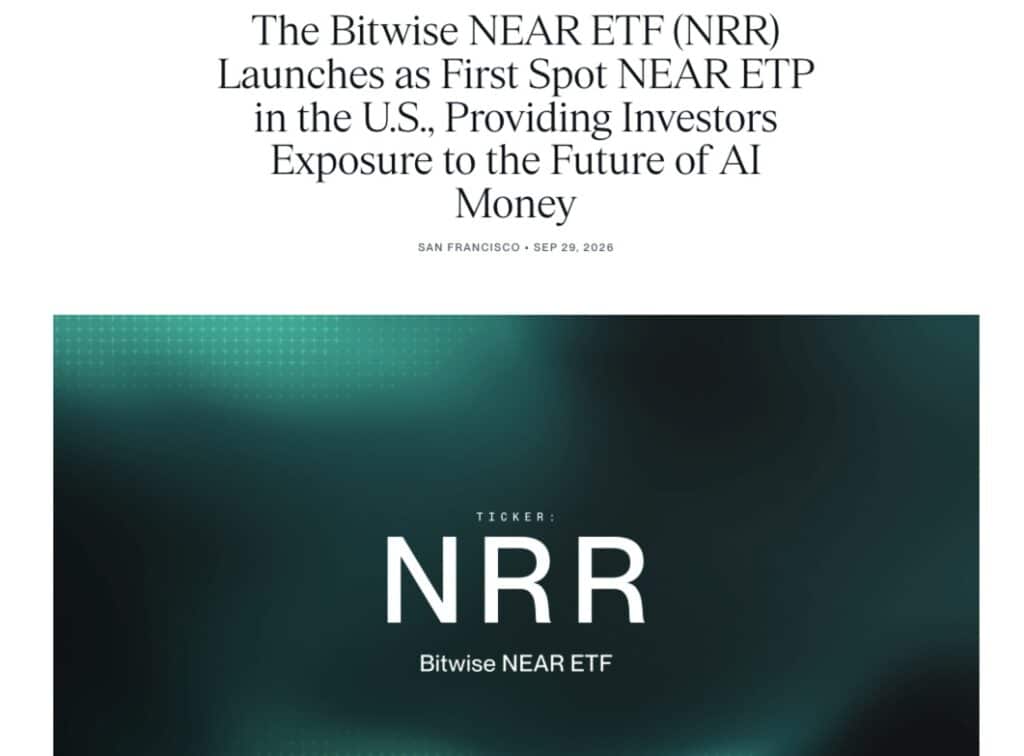
On September 29, Bitwise launched the first Spot NEAR ETF (NRR) on the NYSE Arca, carrying a highly competitive 0.75% management fee. But the fee structure wasn’t the headline; the yield was. Unlike plain-vanilla spot Ethereum ETFs, which were forced by early SEC regulatory hesitation to strip out their native staking mechanics, NRR crossed the Rubicon. The fund actively stakes its underlying NEAR holdings and passes the native protocol yield, historically hovering around 5%, directly through to its shareholders.
For a fiduciary managing a traditional 60/40 portfolio or an alternative asset sleeve, this distinction is important. A non-yielding crypto asset requires pure capital appreciation to justify its volatility drag. NRR, however, operates more like a high-growth sovereign bond or a dividend-paying tech equity. It offers exposure to NEAR’s cross-chain settlement thesis while generating a real yield that confidently outpaces US Treasury notes. In a yield-starved traditional finance environment, this dynamic transformed NEAR from a purely speculative altcoin into a cash-flowing asset class suitable for conservative institutional mandates.
Corporate Accumulation and the Inflow Engine
But passive ETF inflows represent only one side of the institutional equation. The latter half of 2026 witnessed the emergence of aggressive, targeted corporate accumulation. The most decisive move came from Sovereign (ticker: SVRN), a NASDAQ-listed corporate treasury accumulator that effectively ripped a page straight out of Michael Saylor’s MicroStrategy playbook.
Sovereign initiated a formal mandate to accumulate up to 10% of NEAR’s total circulating supply. This is not fleeting trading capital; this is a permanent treasury lockup designed to weaponize NEAR’s deflationary supply curve and corner a measurable percentage of the network’s settlement bandwidth.
Sovereign’s buying pressure was backstopped by a mature, deeply entrenched European institutional footprint. While US markets were just waking up to the NRR launch, European ETP issuers had already laid the groundwork. Regulated products from 21Shares, Virtune, and Valour provided a steady, compliant bid across EU exchanges throughout the year’s accumulation phases. Furthermore, Grayscale’s dedicated GSNR Trust remains aggressively positioned for an imminent spot ETF conversion, a move that would unlock yet another massive pool of trapped, traditional brokerage capital.
When you combine these disparate capital pipelines, you fundamentally alter the asset’s market microstructure. By late October, the Bitwise NRR ETF was logging consecutive net-inflow sessions, establishing a daily run rate north of $2.6 million. In a vacuum, $2.6 million a day might sound modest compared to Bitcoin’s multi-billion-dollar liquidity pools. But applied to NEAR’s tightly staked, fully unlocked float, it operates as a relentless, price-agnostic vacuum.
This daily inflow mechanic is precisely what allowed NEAR to absorb the inevitable profit-taking that follows a 600% trough-to-peak rally. When early buyers or residual venture operators sought to exit during the October volatility shakeouts, the institutional bid simply swallowed the sell pressure, cementing a concrete floor in the mid-$4.00 range. The combination of protocol-level fee buybacks and institutional ETF inflows has engineered a market structure where the buy-side is entirely automated, and the sell-side is rapidly running out of inventory.
The Immediate Bull Case (Next 6-18 Months)
The Valuation Disconnect
Valuing crypto in a higher-rate world comes down to comparing real cash flow against actual token float. For NEAR, the bull case over the next 6 to 18 months isn’t about vague narrative hype; it is a straightforward supply squeeze.
If the latest governance vote passes to cap annual inflation at 1.6%, new issuance drops to around 21 million NEAR a year. Put that next to the protocol’s buyback engine: assuming Intents volume keeps anywhere near its current pace, monthly open-market purchases should easily top $15 million. At $5 a coin, that pulls more than 35 million tokens off the market each year. The math speaks for itself. NEAR is slipping into outright net deflation, where programmatic buying eats up more supply than the network mints.
Despite the 600% run off the bottom, the market still hasn’t priced this correctly. At $5.02, NEAR trades at roughly 85x to 120x annualized Q3 revenue. Look at the competition: Ethereum sits near a 190x multiple, largely carried by brand inertia while its fee revenue slows down. Solana trades cheaper at roughly 40x, but it is bleeding capital, down 56% in USD-denominated TVL from its cycle peak. NEAR is widening its margins while the majors stall out, yet it still trades at a steep discount to Ethereum.
The gap looks even stranger against NEAR’s own history. The token is still down roughly 75% from its $20.44 high in January 2022. Back then, it was mostly early-stage vaporware propped up by venture capital checks. Today, it clears ten times the economic activity, has spot ETF exposure trading on the NYSE, and runs a massive cross-chain settlement pipeline. Paying less for the profitable, working version than the zero-revenue beta prototype makes no sense.
Key Technical Objectives
That mispricing sets up three clear technical zones to track over the next year and a half:
- The accumulation floor ($4.40 to $4.60): The key task right now is holding the summer breakout level. Old overhead resistance flipped to support here, backed by steady ETF creations and corporate treasury buying. As long as price holds this band, the trend stays up.
- The mid-term target ($7.00 to $9.50): As broker-dealers ramp up distribution for the Bitwise ETF and treasuries like Sovereign add to their holdings, this is the natural target. It doesn’t need a retail craze to get there. It just needs the network’s 30.5% fee-capture rate to hold while routing volume grows.
- The macro expansion ($14.00 to $18.50): Getting back toward old highs needs two specific drivers to deliver. Confidential Intents has to take real market share from institutional OTC desks, and autonomous AI agents have to move from GitHub repos into live production trading. If NEAR locks down cross-chain settlement and becomes the main rail for agent capital, retesting $20 stops looking like a pipe dream.
Stress Testing the Thesis: Counter Arguments and Risks
Solver Commoditization and the Thin Chain Dilemma
Any honest bull case needs a sanity check, and NEAR has some real structural fault lines that could easily derail this run.
The most obvious pressure point is solver margins. The entire 2026 valuation story hangs on the protocol pocketing a 30.5% cut on routed volume. But intent routing is turning into a race to the bottom. If UniswapX, CoW Protocol, or aggressive aggregators on Solana launch their own cross-chain threshold setups, fee compression will hit fast. If solver competition forces NEAR’s take-rate back toward its old 11.5% baseline, the treasury’s buyback engine, the whole mechanical driver behind this supply squeeze basically runs out of gas.
There is also the “thin chain” problem. NEAR routes tens of billions across foreign ledgers, yet native base-layer TVL sits at a meager $244 million. The uncomfortable risk here is that NEAR ends up as cheap public utility plumbing rather than an economic hub. If retail and AI agents treat the network strictly as an invisible routing hop without ever leaving sticky capital behind on native DEXs, the market will eventually price the token like commoditized middleware, stripping away any monetary premium.
Yield Traps and Technical Attack Surfaces
Then there is the macro math around the 1.6% inflation vote. Lower issuance helps the float, but it drops gross staking yields down to roughly 3.37%. With the Fed holding the funds rate near 3.50% to 3.75%, staking NEAR suddenly pays less than risk-free cash. Institutional desks holding the Bitwise NRR ETF are going to ask why they should swallow smart-contract and crypto beta for a yield that trails short-term Treasuries. If those allocators pull capital, the validator set takes the hit.
Underneath all of this sits catastrophic technical risk. Chain signatures and confidential intents depend heavily on MPC threshold networks and hardware-isolated TEEs. Intel SGX and other secure enclaves have a long history of side-channel vulnerabilities. A single cryptographic slip-up in the MPC layer or a real-world exploit inside an enclave processing billions in agent flow wouldn’t just be an expensive bug. It would instantly vaporize whatever institutional goodwill NEAR managed to build this year.

Why You Can Trust 99Bitcoins
Established in 2013, 99Bitcoins' team members have been crypto experts since Bitcoin’s early days.
Weekly Research
100k+Monthly Readers
Expert Contributors
2000+Crypto Projects Reviewed