







In This Article
Much like blue whales, which create their own currents due to their size, crypto whales have the ability to move market prices for individual cryptocurrencies. In this guide, we’ll answer, “What is a crypto whale?” and learn how these top holders affect the market.
Let’s start with some key takeaways before diving into the details.
Key Takeaways
- Definitions for crypto whales vary, ranging from owning 1,000+ bitcoins to owning 1% of the supply on altcoins; in practical application, a whale owns enough of the supply to influence a market.
- Whales concentrate voting power in decentralized governance structures and can affect blockchain security in proof-of-stake (PoS) blockchains.
- Whale activity contributes to volatility, but can also act as a stabilizing force by holding a floor price and aiding recovery when the market turns positive.
- Market sentiment often follows money flow from whales, with exchange inflows seen as a bearish indicator and outflows seen as a bullish indicator.
What Is a Crypto Whale?
A crypto whale is a wallet address (or group of addresses) that owns an outsized portion of the supply. The wallet address or addresses in question might belong to an individual, a company, or a group. However, the definition of a whale depends on the context relative to the supply rather than the dollar value of their holdings. It’s also a bit subjective.
For example, by some measurements, someone who owns 1,000 BTC would be considered a whale. However, this amount pales in comparison to wallets suspected to belong to Satoshi Nakamoto, which exceed 1 million bitcoins. For small projects, someone who holds 1% or more of the supply would likely be considered a whale, despite a relatively low total value in dollars.
A whale is generally defined in either a fixed quantity, such as holding 1,000 BTC, or a percentage of the supply, such as 1% of the supply for altcoins. In either case, a whale is a person or entity that controls a significant amount of the supply, thereby influencing the market.
How Do Crypto Whales Influence the Market?
Whales can move markets in either direction. However, their effect on markets is observed differently depending on the type of exchange. Decentralized exchanges (DEXs) make identifying whale activity much easier because DEX tools show the wallet address for every trade, and blockchain explorers make wallet holdings an open book.
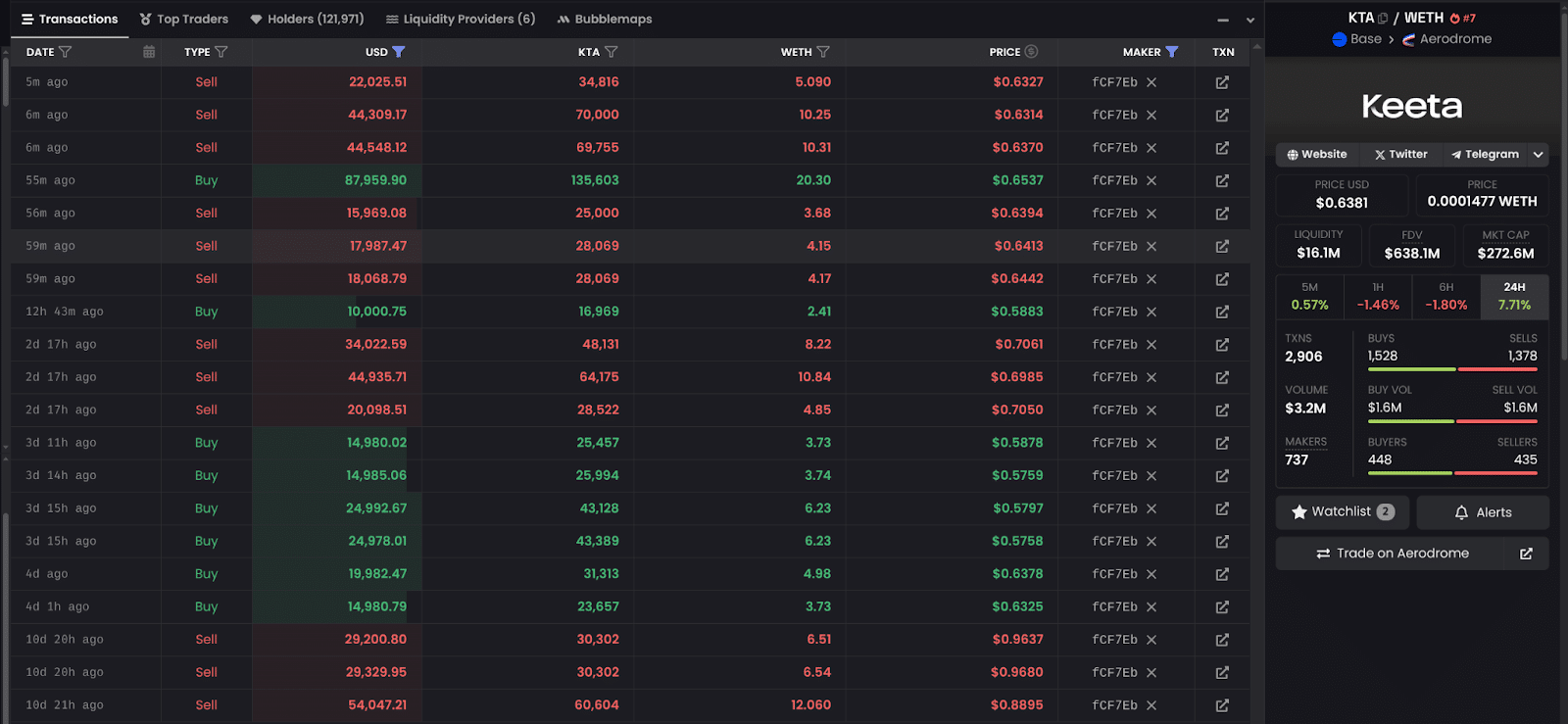
By contrast, centralized exchanges (CEXs) conceal individual wallet addresses. However, whales on centralized platforms still make big waves. Let’s examine how whales influence volatility, liquidity, and market sentiment.
Price Volatility
Whether on a CEX or DEX, whales can pump or dump markets, particularly for assets with a smaller market cap. On a CEX, a large market order will consume multiple limit orders on the exchange, instantly pumping the chart on buys or dumping the chart on sells.
Altcoins with thinner liquidity become more vulnerable to whale activity because the comparatively low number of open orders causes dramatic price movements. A whale trading Bitcoin or Ethereum might move the market by a small amount, with a short-lived ripple effect. However, a disproportionately large trade on a small altcoin can send prices surging or plunging by 20% or more, a tidal wave by comparison.
Liquidity and Order Books
Whales have a massive impact on the liquidity for a given platform. One whale might represent more liquidity than hundreds of other small buyers and sellers. As a result, whales impact liquidity and order books in several ways.
When a whale withdraws a sizable amount of cryptocurrency from an exchange, the asset becomes scarcer. Similarly, when a whale deposits a sizable amount of crypto to a trading platform, the supply increases. Crypto market analysis firms and services, such as Whale Alert, monitor known exchange hot wallets for large withdrawals or deposits. Subscribers to these services act upon that information.
- Withdrawing liquidity suggests a bullish short-term trend because less supply is available.
- Adding liquidity by making a deposit creates short-term jitters for the market as new trading inventory may hit the market.
Inflows and outflows create actionable data points. However, when a whale creates a large order in the order book by placing a limit order, the resulting buy or sell wall creates support or resistance. Notably, these buy or sell walls may not be real, but their effect on markets is real. We’ll discuss spoofing (fake orders) in a later section.
Whales have an even more pronounced effect on DEXs. A whale removing liquidity from a liquidity pool (LP) could signal a sale. Buying can slow, and nervous sellers might dump tokens, expecting a significant price dip. The liquidity provided by whales also reduces slippage for DEX trading. When a substantial amount of liquidity is removed, trading becomes less efficient.
Market Sentiment
We’ve already hinted at the practice of whale watching. Various services provide real-time data on whale wallet transactions to or from exchanges. Trading bots can also act on this information, creating buy or sell pressure in response to whale activity before retail investors have a chance to read the alert. In short, deposits or withdrawals to or from exchanges affect market sentiment.
- Inflows: Whale deposits are viewed as an intent to sell. Bots and retail traders often sell before the expected increase in supply.
- Outflows: Withdrawals to a cold wallet signal an intent to HODL. The market views large withdrawals from an exchange to a cold wallet as a bullish indicator. Less supply leads to higher short-term prices.
Whale Manipulation (Pump-and-Dump, Spoofing)
While some of the earlier examples of the waves crypto whales make were innocuous, whales can also intentionally manipulate crypto markets. These tactics are more often seen on crypto assets with a smaller market cap, particularly on decentralized exchanges, and may be accompanied by a social media post from an influencer.
Pump and Dump
In a pump-and-dump, large buys from whales pump the chart. Other market participants, who notice the pump or see a post on social media, also buy in. FOMO (fear of missing out) takes over, and the parabolic rise continues. However, much like a plane that ascends at too steep an angle, volume stalls, and the whales dump their tokens. Traders who bought the top might never recover their losses on that specific asset. In a short amount of time, the price returns to the range at which it started before the pump.
Depth Chart Spoofing
Spoofing is another common manipulation technique. Centralized crypto exchanges use an order book that displays limit orders. Many advanced trading platforms also offer depth charts, which provide a visual representation of the order book. Whales can use the depth chart to manipulate the price on a specific exchange by placing large buy or sell orders at specific prices that display as a wall on the depth chart.
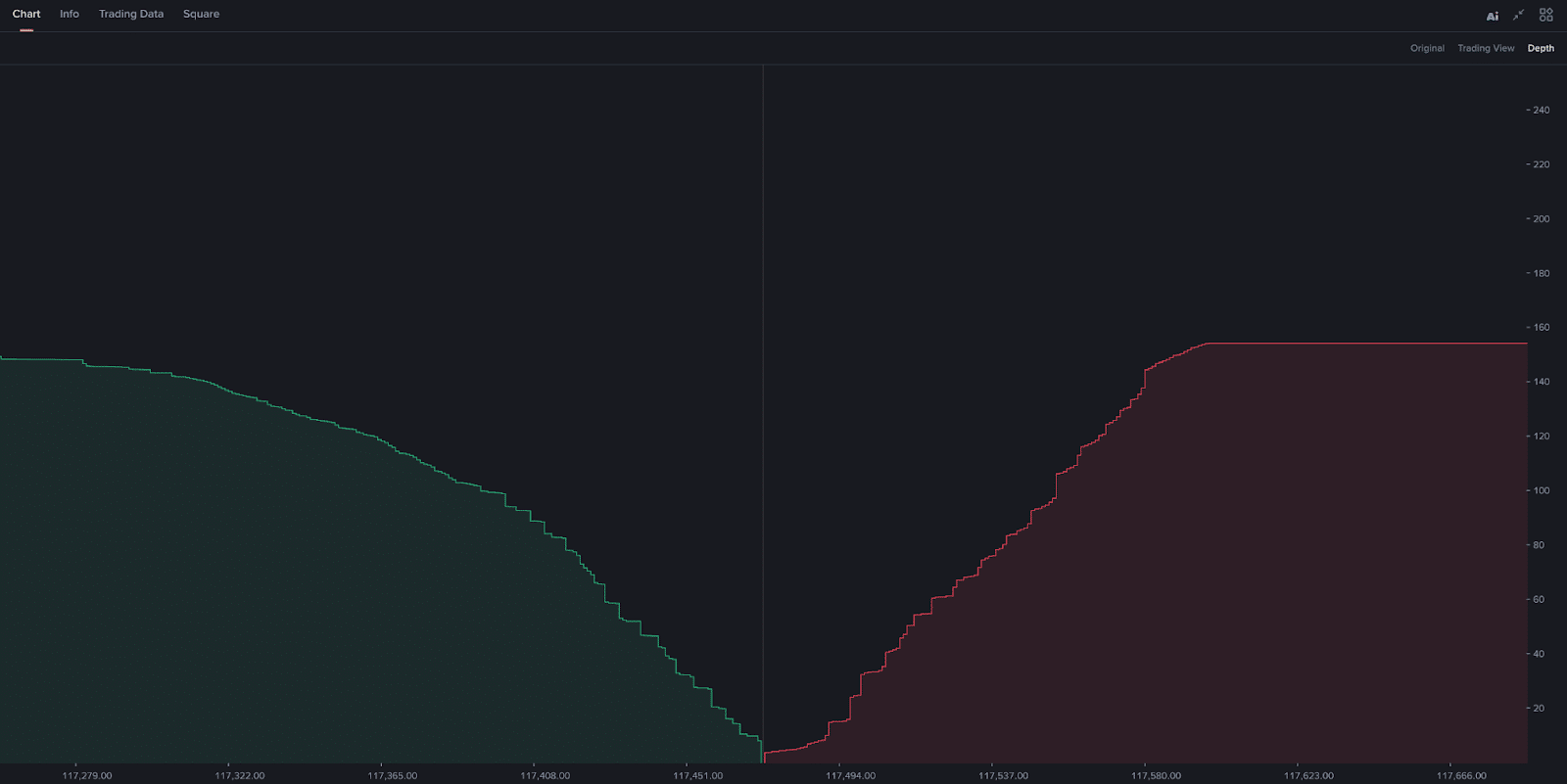
In many cases, these orders aren’t real, but rather an attempt to manipulate short-term trading prices.
Wash Trading
Whales can also use wash trading to manipulate trading volume and draw attention to specific cryptocurrencies. Wash trading consists of buying and selling simply to increase trading volume, and the practice is prevalent on both CEX and DEX platforms. The practice is also illegal in many jurisdictions. The US Department of Justice prosecuted a market maker firm for wash trading in 2025.
Types of Crypto Whales
There are several ways one can become a crypto whale, ranging from early adoption to having sufficient funds to take a large position regardless of the price. Let’s explore the types of whales typically seen in crypto markets.
Early Adopters
Miners, pre-sale buyers, ICO buyers, and other early adopters can acquire large positions with a comparatively small amount of cash. For example, early Bitcoin miners accumulated hundreds or even thousands of bitcoins when mining was still possible without specialized hardware. Similarly, early Ethereum investors were able to buy ETH for less than $1 in 2015. Today, ETH trades for over $4,000.
Exchanges and Custodians
Trading platforms like Binance and Coinbase maintain hot and cold crypto wallets to power trading on the exchange. These wallets are generally well-known, but the exchanges themselves aren’t the buyers or sellers. Similarly, cryptocurrency custodians provide safekeeping for crypto assets. These services range from custodial services for large holders to custodial services for crypto exchange-traded funds (ETFs). For example, Coinbase Prime provides custodial services for BlackRock’s iShares Bitcoin ETF and several other large funds.
Institutional Investors
Institutional investors, such as corporate treasuries, and funds, such as ETFs and investment trusts, often represent the most impactful whales in the crypto ecosystem. When these entities take a position, it tends to be long-lasting, removing supply from the market indefinitely.
Notably, MicroStrategy has accumulated more than 640,000 BTC at the time of writing, with the company’s CEO, Michael Saylor, vowing never to sell any of its holdings. Similarly, BitMine holds more than 2.4 million ETH, putting its holdings on par with some Ethereum ETFs.
Exchange-traded funds collectively make up the largest corporate crypto holdings, with the iShares Ethereum Trust ETF valued at over $15 billion and the iShares Bitcoin Trust ETF valued at over $85 billion. Crypto ETFs buy and sell in response to deposits and withdrawals from the fund, but have grown significantly since their launch in 2024.
High-Net-Worth Individuals
Celebrities, company or project founders, and other individuals with substantial financial means can become crypto whales in a relatively short period. Trading tools like OTC (over-the-counter) trades allow large buyers to take a sizeable position without disrupting the charts. However, many in this group were early adopters of cryptocurrencies.
High-Net-Worth Individuals (HNWIs) whose crypto holdings are publicly known can move markets with a single social media post. Examples include Vitalik Buterin (Ethereum co-founder), Tim Draper (venture capitalist), and Elon Musk (entrepreneur).
How to Track Crypto Whales
Tracking whale activity has become easier over the years, with several tools now available that automate the process. Most blockchains remain transparent, meaning that anyone can observe the activity of specific crypto wallets. Blockchain explorers enable anyone to track the movement of tokens and see where they originate or are transferred to.
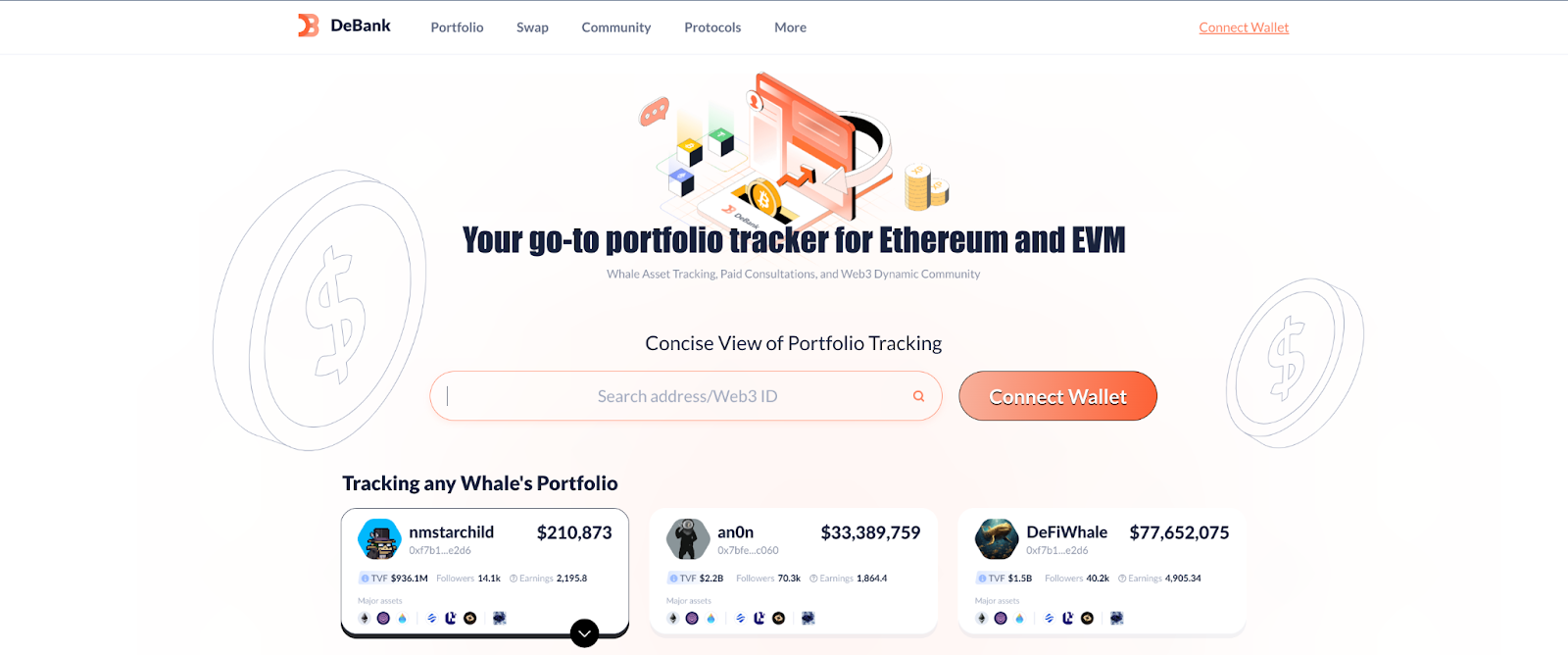
While it’s possible to track whale addresses manually, tools make the process much easier. To investigate whales found on smaller DEX altcoins, portfolio viewers like DeBank and Zerion offer a simpler way to view holdings and transactions. These tools make blockchain explorer data for Ethereum Virtual Machine (EVM) chains more accessible. However, to discover whales, more powerful tools like Nansen and Arkham Intelligence offer better ways to screen for whales, as well as pre-defined lists (wallet labeling).
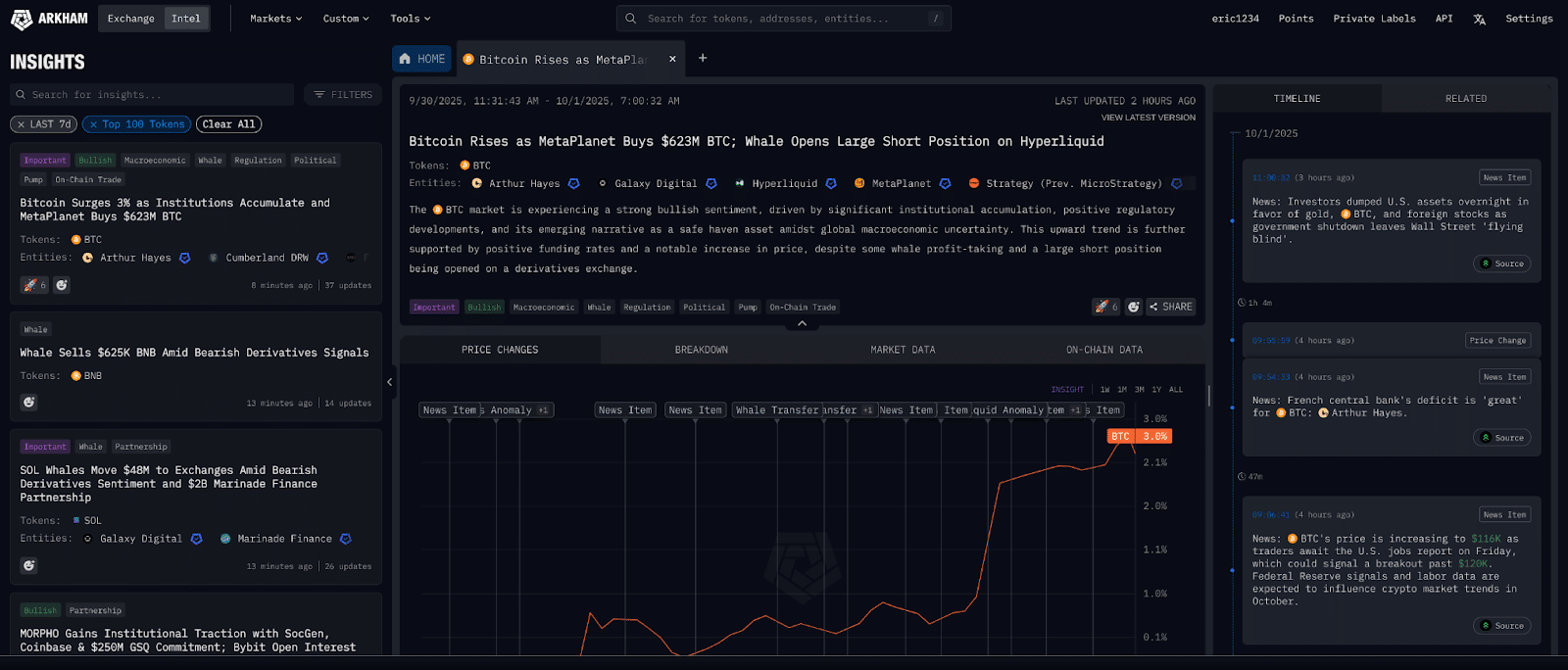
Tools like Glassnode and CryptoQuant offer insight into exchange inflows and outflows. Large inflows suggest a bearish short-term outlook as supply increases. Conversely, significant outflows suggest bullish price action as supply decreases.
Data Points to Watch
Alert services such as Whale Alert can provide early warnings on crypto whale movements. Several key data points can guide trades.
- Dormant Wallet Activation: A crypto wallet that has been dormant for years and suddenly becomes active can significantly impact market sentiment. Transfers to another wallet might not cause concern, but transfers to an exchange suggest an intent to sell.
- Repetitive Activity: While a one-off transfer may not cause many waves in markets, repeated transfers, sales, or purchases warrant close attention. Consistent outflows to a non-custodial wallet indicate accumulation, whereas consistent inflows to an exchange suggest planned selling.
- Profitable Selling (SOPR): Spent Output Profit Ratio (SOPR) estimates the profit or loss on transactions to help traders distinguish between profit-taking and panic selling or forced selling. Tools like Nansen, CryptoQuant, and Whale Alert offer versions of this metric for tracked wallets. TradingView can also integrate SOPR data in its charts.
Why Do Crypto Whales Matter to Investors?
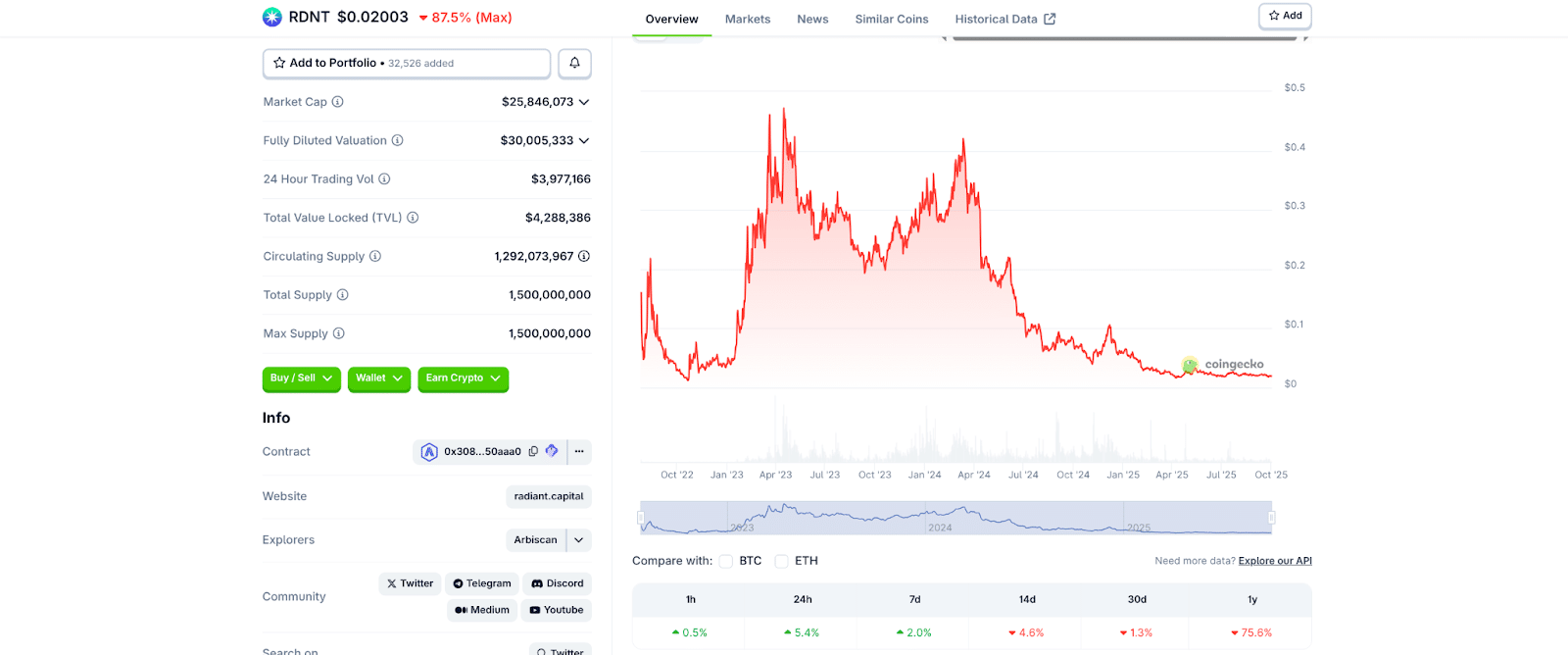
Whales can impact prices and even the direction of projects in many ways. In fact, whales often highlight one of the flaws of decentralized autonomous organizations (DAOs): they aren’t always that decentralized. For example, when Radiant Capital (RDNT) put a proposal to increase supply (mint new tokens) to a vote, another protocol (Magpie XYZ) that held a massive amount of supply through locked tokens dominated the vote. Ultimately, the proposal passed. One-token, one-vote governance favors whales and their interests over the broader community.
On the other hand, whales offer liquidity that would be difficult to gather through smaller investors. When markets dip, whales stop the freefall, adding to their stack or reentering the market after having taken profits earlier. Whales also cast a long shadow over markets with their holdings. By some estimates, BTC whales (1,000+ BTC) and humpback whales (10,000+ BTC) control as much as 50% of the supply.
These figures can be even higher in altcoins and memecoins as whales accumulate supply through various wallet addresses. Again, while this higher concentration brings risks, it’s also fair to say that whales offer price stability when they hold. The comparatively small sales by retail traders do not significantly affect the chart while whales continue to hold.
Risks Associated With Whale Activity
We’ll focus on risks associated with whale activity in this section. However, it’s important to take a balanced view. Arguably, the success of cryptocurrencies like BTC, ETH, SOL, and others can be attributed to the conviction of whales, many of whom held throughout market downturns due to lower average costs and who helped power market recoveries.
Flash Crashes
A flash crash occurs when a single large market order is executed by a single trader, consuming all the immediate demand. Imagine an order book stacked with small buy orders at progressively lower price points. A large market sell order uses the highest bid prices first, but then slips into the following order and its lower bid price. This continues down the list of orders until the large sell order is filled. The effect on the chart resembles a red cliff and can lead to increased selling or forced liquidations for leveraged trades.
In trading for smaller coins, a single whale can wipe out 20% of the market cap in a single trade. Recovering from this setback will be difficult with only smaller traders buying the dip.
Overconcentration
Whales that control more than 1% of the supply of altcoins and especially memecoins bring considerable risk. The risk for memecoins is amplified by the fact that most use decentralized exchanges. The algorithms that power these exchanges often make the impact of sales larger in comparison to a centralized exchange with healthy liquidity.
Overconcentration also contributes to decentralization risks, particularly for projects that utilize a DAO governance structure. The one-token, one-vote structure favors the whims of large token holders, effectively creating a plutocracy rather than the democracy many investors expect.
Lastly, whales can threaten the security of the protocol itself. For example, if a group of whales colluded to control a smaller PoS network, they could reorder the blocks or engage in double-spending if they collectively controlled more than 51% of the network’s staked tokens. A lower threshold of 33% control could halt the chain.
Retail Investor Disadvantage
The old saying, “It takes money to make money,” proves true in cryptocurrency trading, giving whales an asymmetrical advantage. Many of the tools used to trade more effectively can be costly, making them more accessible to wealthy investors than retail investors.
Whales also have better access to influencers on social media, or may be able to influence markets on their own if they are well-known. These manipulation techniques, as well as pump-and-dump schemes, make crypto trading a playground for whales who can bully retail traders in smaller markets whenever they please.
Famous Examples of Crypto Whales
Whales include early investors, founders, corporate treasuries, and investment funds. Let’s examine some famous crypto whales and how much crypto they hold:
- Satoshi Nakamoto: The still-anonymous founder of Bitcoin is thought to own an estimated 1.1 million bitcoins. This represents approximately 5% of the world’s largest digital asset.
- Vitalik Buterin: As a co-founder of Ethereum, Vitalik remains one of the largest ETH whales, despite having donated generously over the years.
- Michael Saylor: The personal holdings of MicroStrategy’s Michael Saylor in Bitcoin are unknown, but his company holds more than 640,000 bitcoins. Blockchain analysts closely monitor the company’s wallets, and Saylor’s comments in the press and on social media carry considerable weight within the Bitcoin market.
- The Winklevoss Twins: Tyler and Cameron Winklevoss were early investors in Bitcoin, amassing a war chest of approximately 70,000 BTC, according to some estimates. The twins went on to found the Gemini crypto exchange.
- Tim Draper: Venture capitalist Tim Draper famously purchased nearly 30,000 BTC from the US government, which represented cryptocurrency seized by US authorities. His 2014 investment and continued bullish support for Bitcoin, in particular, have helped bring Bitcoin to the public’s attention.
- Jack Dorsey, a co-founder of Twitter, is also a prominent Bitcoin advocate and has gone on to found Block, Inc., which owns Cash App and Square. Block owns more than 8,500 bitcoins. Jack’s holdings are unknown, but thought to be considerable given his early involvement in crypto.
Conclusion
Although the definition of a crypto whale can vary, a whale controls enough of the supply to influence market dynamics. This influence often centers on asset price, with whales (intentionally or unintentionally) shifting market sentiment with their trades and wallet movements.
However, the effects of whales can reach far beyond day-to-day price action. Whales can also influence on-chain voting in decentralized protocols or even threaten transaction security for proof-of-stake blockchains.
Although much of the conversation regarding whales centers on the risks, in practice, whales play a vital role in the cryptocurrency ecosystem. They create a floor under market uncertainty and help to jump-start the price recovery for volatile crypto assets.
FAQs
What is the defining characteristic of a crypto whale?


A crypto whale controls enough of the supply to influence the price. Many define a crypto whale as someone who owns 1,000+ bitcoins or 1% or more of the supply for altcoins.
Are crypto whales always individual wealthy people?
No. Whales can include early adopters whose meaningful wealth is tied up in the asset. Institutions, investment funds, and even governments can also be characterized as crypto whales.
How do you track a whale's private activity on a centralized exchange?
Services like Whale Alert provide data on whale inflows and outflows on crypto exchanges. However, once the funds are transferred to the exchange, there is no transparency that would allow individuals to track whale activity on the platform.
Does whale concentration make decentralized projects less secure?
Yes, it can. Whales can influence voting in decentralized voting structures and proof-of-stake blockchains can be susceptible to manipulation with as little as 33% control over the staked tokens that secure the chain.
How can retail traders benefit from tracking whale movements?
Using tools like Nansen enables retail traders to track the movements of whales, potentially allowing them to frontrun market reactions to whale activity. This means getting ahead of uptrends and downtrends that may result from whales buying or selling.
References
- What is an order book? (coinbase.com)
- Cryptocurrency Financial Services Firm Sentenced for Cryptocurrency “Wash Trading” (justice.gov)
- iShares Bitcoin Trust ETF (blackrock.com)
- MSTR Metrics (strategy.com)
- The 7 Largest Publicly Traded Ethereum Treasury Firms (finance.yahoo.com)
- Venture capitalist Draper wins U.S. bitcoin auction (reuters.com)

Why you can trust 99Bitcoins
Established in 2013, 99Bitcoin’s team members have been crypto experts since Bitcoin’s Early days.
Weekly Research
100k+Monthly readers
Expert contributors
2000+Crypto Projects Reviewed