





By now, you know the basics of cryptocurrency and how blockchain works. But to truly understand the crypto world, you need to meet the two giants that shaped it: Bitcoin and Ethereum.
Think of Bitcoin, often referred to as digital gold, which introduced the world to the idea of money that banks or governments don’t control. It’s simple, elegant, and focused on one core mission: to be a decentralized form of value and payment.
Ethereum, on the other hand, took Bitcoin’s foundation and asked: What if we could do more than just send money? What if we could create entire applications, contracts, games, and marketplaces directly on the blockchain? That’s how Ethereum became the “world computer,” powering thousands of decentralized apps and forming the backbone of Web3.
In this chapter, we’ll explore how these two cryptocurrencies work, what makes them different, and why both play critical, but very different, roles in the future of blockchain technology.
Bitcoin: The Original Pioneer
Bitcoin is a form of digital money that isn’t controlled by any government or bank. It runs on a technology called blockchain, which acts like a public notebook where every transaction is recorded permanently and transparently. Unlike regular money that can be printed endlessly, Bitcoin is limited to 21 million coins, making it scarce, similar to digital gold.

People use it both as an investment, hoping its value will grow, and as a way to send money globally without needing banks. In simple terms, Bitcoin is money built for the internet, secure, scarce, and independent.
A Satoshi (sat) is the smallest unit of Bitcoin, equivalent to one hundred-millionth (0.00000001) of a full Bitcoin, similar to how one cent is one hundredth of a U.S. dollar. Just as a hundred cents make a dollar, 100 million satoshis make one Bitcoin, making Bitcoin appropriate for small purchases.
People often mistakenly believe that they don’t have enough money to buy Bitcoins, as they believe they need to buy one full coin, which comes with a hefty price tag. This is not the case, and many investors buy fractions of a Bitcoin (Satoshis) in increments as small as $5 or less.
Why It’s Called “Digital Gold”?
Bitcoin is often described as “digital gold” because it shares many of the qualities that make gold valuable, but in a digital form. Like gold, Bitcoin is scarce; there will never be more than 21 million coins in existence. This fixed supply gives it a sense of permanence and rarity, which stands in contrast to traditional money that can be printed in unlimited amounts by governments.
While Bitcoin was originally designed to be used as a medium of exchange, a form of digital cash, it has increasingly become known as a store of value. Many people buy and hold Bitcoin not to spend it daily, but to protect their wealth over time.
What Makes Bitcoin Unique?
How Bitcoin Works?
Before you invest in Bitcoin, you have to know how it works. At the heart of Bitcoin is a system called Proof of Work (PoW). In simple terms, thousands of computers around the world, called miners, compete to solve complex math problems. The first to solve it gets to add a new “block” of transactions to the blockchain and earns a reward in Bitcoin. This process makes the network secure and ensures that transactions are verified fairly. Check out our in-depth article on Proof of Work if you want to go deeper on that topic.
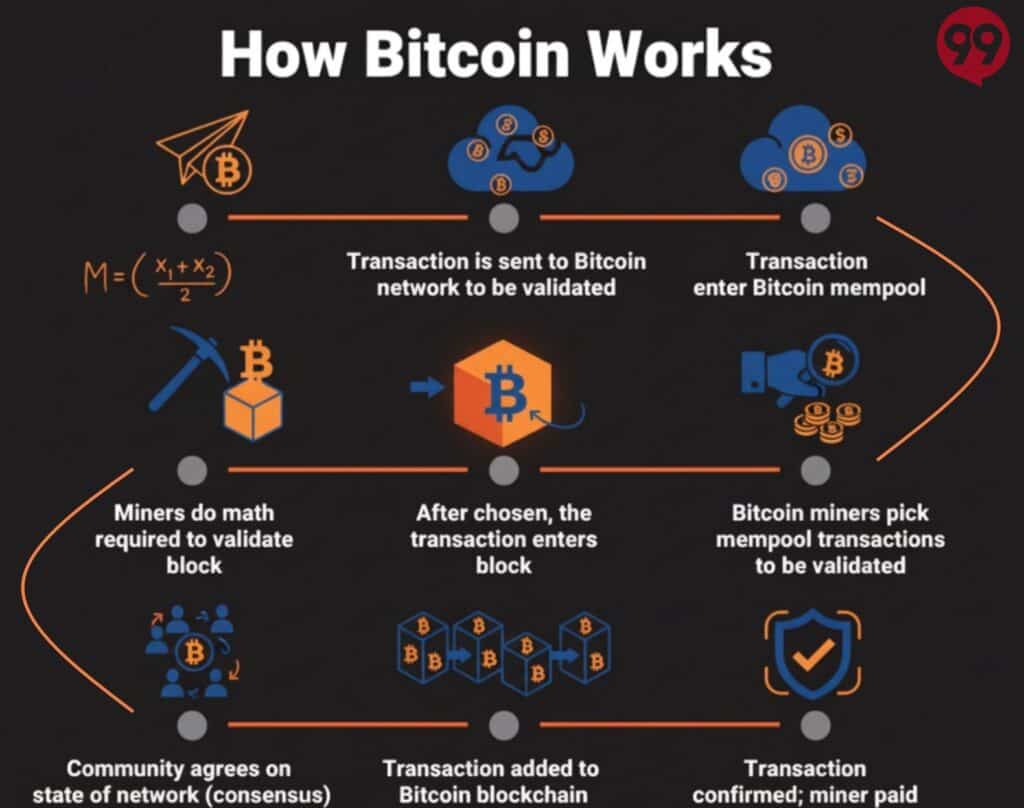
Bitcoin’s security comes from two main factors: the massive computing power protecting the network and its decentralization. Because thousands of miners operate independently around the globe, no single person, company, or government controls Bitcoin.
If you want to know more about this king coin, head straight to our dedicated “What is Bitcoin” explainer. In case you are interested in purchasing it, you should take a look at our “How to buy Bitcoin” guide.
If you prefer video format, here is our video explaining what Bitcoin is:
Ethereum: The World Computer
While Bitcoin was designed mainly as a digital form of money, Ethereum, launched in 2015 by Vitalik Buterin and a team of developers, aimed to take cryptocurrency further than Bitcoin was capable of due to technical limitations on the Bitcoin blockchain.
If anything, Buterin could have been described as a huge Bitcoin fan, and he did not create Ethereum as a challenger to Bitcoin, but rather a complement with many other functionalities.

Ethereum isn’t just about sending or storing value; it’s a platform that allows developers to build programmable contracts and applications directly on the blockchain. This ability to support more than payments is what makes Ethereum unique and why it’s often called a “world computer.”
On Ethereum, developers can build apps and create smart contracts, programs that run exactly as they’re written in programming code, without banks or middlemen. For example, you can use Ethereum to trade digital art (NFTs), borrow or lend money, or even play games, all in a decentralized way.
Its native currency, Ether (ETH), is the second-largest crypto and is used to pay for using the network. In short, Ethereum is both digital money and a platform for building apps on the blockchain. Want a deep dive? You should give our “What is Ethereum” article a quick read.
Ethereum’s Main Component – Smart Contracts
Ethereum’s core feature is smart contracts, self-executing agreements written in code. Instead of relying on a lawyer, bank, or middleman, the contract enforces itself automatically once certain conditions are met.
Example: If you send funds to a smart contract that represents a ticket sale, the contract will automatically deliver your digital ticket once payment is received. No human approval is needed.
Real-World Uses:
To learn more about this, take a quick look at our educational article “What are smart contracts?”
Here is our video breaking down all the concepts you need to know about Ethereum:
How is Ethereum Different From Bitcoin?
Bitcoin and Ethereum are often mentioned together, but they serve very different purposes. Bitcoin was built with a narrow, focused vision: to be a decentralized, censorship-resistant form of money and a secure store of value. It changes slowly and carefully, prioritizing stability and security above all else. The consensus mechanisms of these networks are also different. Bitcoin operates on a Proof of Work consensus mechanism, as Ethereum originally used before migrating to Proof of Stake. The technicals are outside the scope of this course, but we have dedicated articles on Proof of Work and Proof of Stake if you want to learn more.
Metric
Bitcoin
Ethereum
Launch Year
2009
2015
Founder(s)
Satoshi Nakamoto
Vitalik Buterin & others
Primary Purpose
Digital money / store of value
Decentralized apps & smart contracts
Native Currency
BTC (Bitcoin)
ETH (Ether)
Maximum Supply
21 million
No fixed cap
Consensus Mechanism
Proof of Work (PoW)
Proof of Stake (PoS)
Block Time
≈ 10 minutes
≈ 12 seconds
Smart Contracts
No
Yes
Main Use Cases
Digital gold, peer-to-peer payments
DeFi, NFTs, apps, smart contracts
Bitcoin and Ethereum: Bottomline
Bitcoin and Ethereum may look like rivals, but in reality, they play complementary roles in the crypto ecosystem. Bitcoin remains the foundation, trusted as digital gold and valued for its security, scarcity, and independence from traditional finance. It dominates as the primary store of value, especially for those seeking protection against inflation or government control.
Ethereum, meanwhile, is the engine of innovation. By enabling smart contracts and decentralized applications, it has become the backbone of entire industries like DeFi and NFTs. It’s where most of the experimentation and growth in blockchain technology happens today.
Understanding both is essential for anyone entering crypto. Bitcoin teaches us the power of decentralized money, while Ethereum shows us how blockchains can reshape industries beyond finance.
Chapter Quiz