Crypto is a high-risk asset class. This article is provided for informational purposes and does not constitute investment advice. You could lose all of your capital.
99Bitcoins may receive advertising commissions for visits to a suggested operator through our affiliate links, at no added cost to you. All our recommendations follow a thorough review process.
Crypto is a high-risk asset class. This article is provided for informational purposes and does not constitute investment advice. You could lose all of your capital.
99Bitcoins may receive advertising commissions for visits to a suggested operator through our affiliate links, at no added cost to you. All our recommendations follow a thorough review process.
Crypto businesses today often face challenges in offering a broad suite of services. It’s almost impossible to create a full crypto exchange functionality just so your client can complete a transaction on your site. APIs fix this problem by operating as communication layers between two systems, allowing for secure and scalable crypto products.
Crypto APIs effectively allow businesses to integrate an exchange function into their site, and it’s precisely why the demand for them is on the rise among companies, institutional traders, and developers. In this guide, I’ll tell you all about the best crypto APIs, what they are and how they work, which benefits they boast, and how to get started with one of these services.
Top Five Best Crypto Exchange API Solutions in 2026
Let’s quickly review what my top picks for the five best crypto APIs are and what makes each of these platforms stand out from the crowd:
Binance — Overall best pick with the biggest liquidity and ecosystem size
OKX — Offers a robust selection of business-friendly support and features
CEX.io — Lots of API documentation and examples that make it easy to use
KuCoin — Great API for spot and margin with excellent altcoin diversity
Five Best Crypto Exchange API Providers for Business Reviewed
You’ve seen what makes each of 99bitcoins’ top picks stand out, but if you want to learn more about them, keep reading these brief yet informational reviews.
1. Binance — Best Crypto Exchange API Provider for Business in 2026
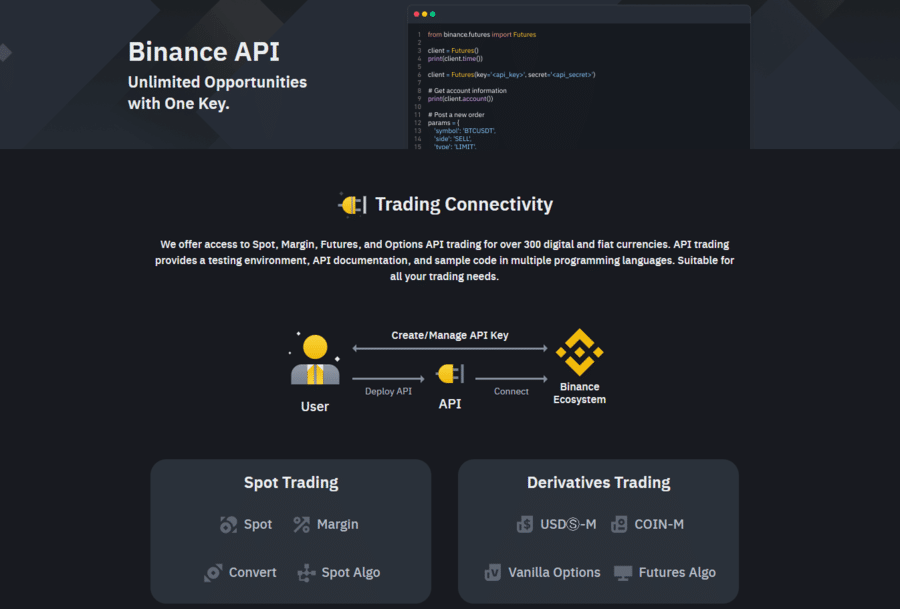
Binance is the top pick for many businesses in need of a crypto API due to the exchange’s unprecedented size of liquidity and daily trading volume. In essence, this popularity results in virtually unparalleled access to global trading and liquidity infrastructure.
The exchange’s API supports a broad range of features, like trading capabilities and real-time market data. It’s easy to use and implement, thanks to its detailed documentation.
Binance API is built on WebSocket Streams for real-time market data and RESTful API for standard requests. Institutional traders can also benefit from a FIX API that’s on offer.
Pros:
Unparalleled volume and liquidity
Robust security features
Crypto trading and management are fully covered
Detailed documentation and resources for developers
Widely used and available in most countries
Cons:
Lots of regulatory challenges
Slow customer support for API problems
Number of supported coins
350+
Fee and spread for buying BTC
0.10% maker/taker fees for non-VIP users. Holding BNB can reduce this, and there are no fees on select BTC pairs.
Liquidity and daily trading volume
Very high liquidity and over $210 billion daily trading volume
Mobile app
iOS and Android
API rate limit
6,000 requests per minute for spot API (100 per sec);
2,400 per minute rate limit for futures API (40 per second)
Subscription cost
Free access to the API
Fiat support
Extensive support (varies per country)
Compliance
Full compliance with global data protection laws and regulations
Historical K-line data
Supports 500–1,000 entries per request; provides both trade history and order book data; retains a significant amount of market data.
2. OKX — Lots of Business-Friendly Features and Full Support
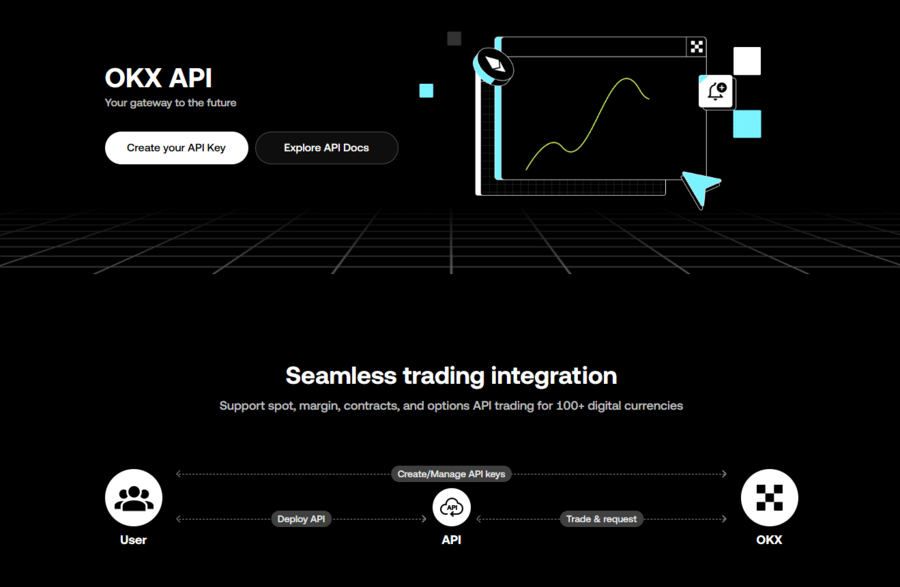
OKX is one of the most reputable and biggest crypto exchanges and web3 platforms, offering an API tailored for advanced traders and businesses. It’s also among the best crypto derivatives platforms.
Businesses can get a trading, data, or services API. The platform uses REST API for account management and historical data, while operating on WebSocket connections for real-time info.
However, OKX API is one of the best crypto exchange API providers for businesses because it’s also designed for institutional traders and VIPs, through programs like Market Maker and Broker. OKX offers incentive programs, as well, like a referral program with rewards up to 10,000 USDT and an affiliate program with commissions up to 50%.
Pros:
Competitive fees with a tiered structure
Lots of trading features, including 12 pre-built bots
Support for 350+ cryptos and 500+ trading pairs
An integrated web3 wallet
Cons:
Highly complex for new users
Compliance issues in the past
Number of supported coins
350+
Fee and spread for buying BTC
Starts at 0.08% maker and 0.10% taker fees
Liquidity and daily trading volume
High liquidity and over $3.1 billion daily trading volume
Mobile app
iOS and Android
API rate limit
20 requests per 2 seconds on public endpoints (10 per sec); 6 requests per 2 seconds on private endpoints (3 per sec); 100 WebSocket connections per API key
Subscription cost
Free access to the API
Fiat support
Various payment options depending on the country; support for over 100 fiat currencies through third-party services
Compliance
Regulated in various jurisdictions, such as MiCA registration in Europe
Historical data
1,000 entries per request; trade history available; order book data accessible via WebSocket; retains long-term historical market data
3. CEX.io — Lots of API Documentation That Makes It Easy to Use
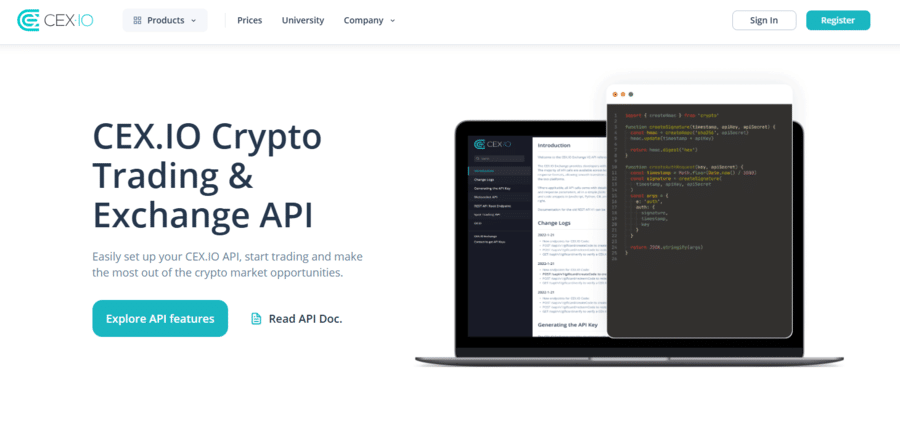
CEX.io is another famous centralized crypto exchange that provides its services to both individual traders and businesses. It’s one of the best cryptocurrency exchange API services, as it offers a comprehensive API suite.
The brand offers REST API for all general requests, FIX API for institutional trading, and a crypto market data API in the form of a WebSocket API.
The API suite is primarily designed for developers, but it’s excellent for businesses that need to integrate exchange functions into their service.
It’s important to add that CEX.io is one of the more established exchanges with excellent compliance. It’s registered in the UK and has an MSB (Money Services Business) status in the US FinCEN.
Pros:
REST API, WebSocket API, and FIX API
A reputable exchange regulated in the US
Strong support for fiat on/off ramps
Full data encryption and PCI DSS compliance
Cons:
Fewer cryptos than competitors
Somewhat restrictive API rate limits
Number of supported coins
200+
Fee and spread for buying BTC
Starts at 0.15% maker and 0.25% taker fees (can be lowered significantly with higher trading volumes)
Liquidity and daily trading volume
Great liquidity and over $23 million in daily trading volume
Mobile app
iOS and Android
API rate limit
600 requests every 10 minutes (1 per sec)
Subscription cost
Free access to the API
Fiat support
Strong support for fiat currencies, especially EUR, USD, and GBP.
Compliance
Registered in the UK and in the US through FinCEN
Historical data
Provides historical K-line data for various intervals and decent historical depth; trade history and real-time order book data available; data retained according to internal policies and regulations
4. KuCoin — API for Spot and Margin With Excellent Altcoin Diversity
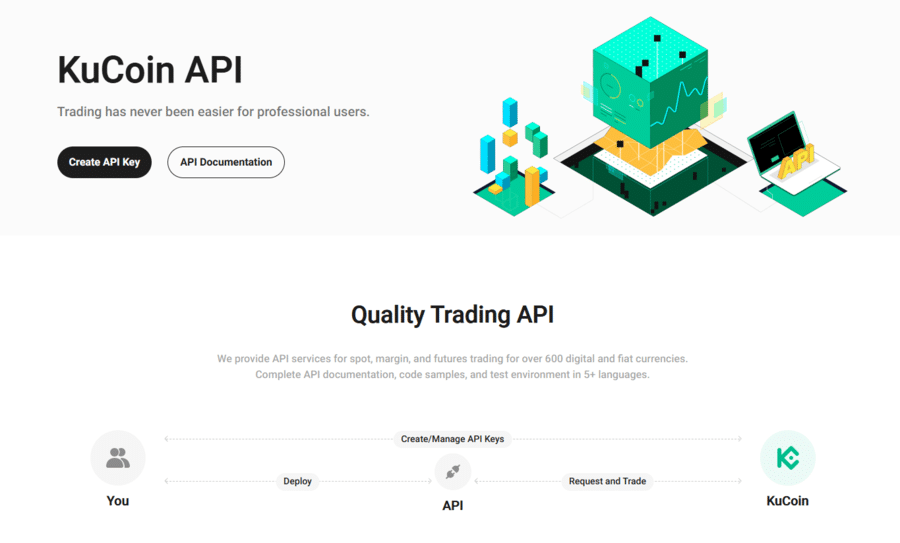
KuCoin is a prominent global crypto exchange that’s known for its broad range of trading features and a large selection of cryptocurrencies. There’s both spot and derivatives trading, and the site supports over 700 coins.
As for KuCoin’s API, it’s commonly used by companies and traders in need of automated operations. Businesses can also implement it for spot, futures, and margin trading and get both REST and WebSocket APIs.
The service that the exchange offers comes with a low-fee trial period, referral commissions, and a dedicated account manager.
The exchange is home to over 1,200 trading pairs and often lists newer coins and cryptos with small market caps much earlier than other major exchanges.
Pros:
Over 700 cryptos and 1,200 trading pairs
Low-fee trial periods for API users
High liquidity on many major pairs
Dedicated technical support for API
Cons:
Limitations on fiat on/off ramps
Security breaches in the past
Number of supported coins
700+
Fee and spread for buying BTC
Start at 0.10% maker/taker fees (can be lowered by 20% by holding native tokens); more decreases through higher VIP tiers
Liquidity and daily trading volume
High liquidity and over $1.6 billion in daily trading volume
Mobile app
iOS and Android
API rate limit
General endpoints 1,000 units per 30 seconds (33 per sec)
Subscription cost
Free access to the API
Fiat support
Not much direct support, but a large selection of payment methods and support for over 70 fiat currencies through third-party services
Compliance
Strict KYC/AML compliance, but it had some issues in the US in the past
Historical data
Provides historical K-line data; trade history and real-time order book data available; historical records on market data retained
Crypto Application Programming Interfaces (APIs) are protocol sets that allow apps and other pieces of software to interact and communicate with crypto exchanges and blockchain networks.
In plain words, crypto APIs are essentially digital translators that are crucial for connecting to the complex technical aspects of exchanges and blockchains.
Crypto APIs come in various forms, depending on the data they are designed to pool, which primarily includes:
Exchange API
Market data API
Blockchain data API
Crypto wallet API
Payment API
NFT API
How Does a Crypto Trading API Provider Work?
All the best crypto API providers are designed to work as a form of bridge between apps and complex cryptocurrencies and blockchains. Through them, this process is entirely simplified, making it easier for developers to access the types of crypto data and services they need for their own apps and software solutions.
Here’s how that normally works:
Your app sends a specific request to the API endpoint that states the data or action it requires.
The API verifies that your app has the necessary permissions to receive this information.
The API server gets the request and processes it.
The API server interacts with the underlying system, i.e., the exchange, blockchain, or another crypto service from which you’re requesting the information.
The API sends the response in a standardized format to your app, carrying with it the data or action confirmation you require.
Crypto Exchange API Providers vs. Standard Exchanges
Even though many standard exchanges often offer crypto API integration, thereby blurring the line between the two, there are fundamental differences between these services.
Liquidity
With standard exchanges, users get access to the aggregated liquidity via the UI. APIs are there to provide real-time access to the exchange’s order book data, but API also allows businesses to connect to multiple exchanges, pulling liquidity from all of them, which results in better prices.
Prices
Access to the API is free, so the main comparison of prices comes in terms of trading fees and spreads. Standard exchanges use the maker/taker model, and the same goes for API providers. However, given the high transaction volume, fees are notably lower, as most exchanges apply tiered pricing models that reduce fees as volume increases.
There are also paid API providers, such as CoinGecko. Their API is often used for price feeds used in different widgets, charts, etc.
Speed
At standard exchanges, speed is determined by the pace of manual trading. APIs operate on a whole different level because systems are optimized to handle large amounts of trades or transactions in a matter of milliseconds.
Automation
Standard exchanges are made for manual trading, while crypto APIs allow for automated trading, rebalancing, performance tracking, and risk management. It’s one of the main benefits of using crypto APIs.
Scale
Standard exchanges are made for individual transactions, while the best exchange API allows for a high volume of requests and transactions. This makes crypto API providers more suitable for institutional trading and businesses that need to handle thousands of transactions per second.
Benefits of Using Crypto APIs
The best crypto APIs, like the ones covered here, offer a large number of advantages for businesses. Let’s take a look at the main ones.
Automation at Scale
Crypto APIs enable businesses to automate repetitive and time-sensitive tasks such as price tracking, transaction verification, wallet balance monitoring, and payment processing. They are essential for running trading bots, managing portfolios, and handling crypto payments without manual intervention, saving both time and operational costs.
Backtesting, Analytics, and Data Insights
Access to extensive real-time and historical market data allows businesses and developers to backtest trading strategies, evaluate performance, and refine algorithms. APIs also help identify market trends, volatility patterns, and liquidity shifts, supporting data-driven decision-making.
Real-Time Trading and Low-Latency Execution
Crypto APIs deliver live market data and order book updates with minimal latency, making them critical for high-frequency trading, arbitrage strategies, and fast-moving markets. This ensures near-instant order execution and better price efficiency.
Reduced Human Error
By automating processes that would otherwise be handled manually, crypto APIs significantly reduce the risk of mistakes such as incorrect trade entries, missed signals, or faulty calculations—especially important in high-volume or high-speed environments.
Scalability and System Integration
APIs enable seamless integration of crypto functionality into existing platforms, apps, and internal systems. As a business grows, APIs make it easier to scale operations, add new features, or support additional blockchains and exchanges.
Customizable and Flexible Infrastructure
Unlike off-the-shelf tools, crypto APIs give developers full control over how data is processed and used. This flexibility allows businesses to build tailored solutions that match their exact trading, analytics, or payment needs.
Improved Security and Monitoring
Many crypto APIs include built-in safeguards such as rate limits, secure authentication, and alert systems. These features help monitor unusual activity, manage risk, and enhance overall operational security.
Are Crypto APIs Safe?
As long as you implement APIs correctly and use only the ones from reputable exchanges (like those reviewed here), there’s not much to worry about when it comes to security. Reputable sites have robust security systems with strong encryption and industry-standard certificates.
You get API keys that act as credentials, and you can set specific permissions for who gets access to what. You can also restrict access to a predefined list of IP addresses with IP whitelisting, which reduces the risk of security breaches and attacks.
How to Get Started With a Crypto API Provider?
Let’s take a quick look at how you can get started with Binance, our top pick crypto API provider:
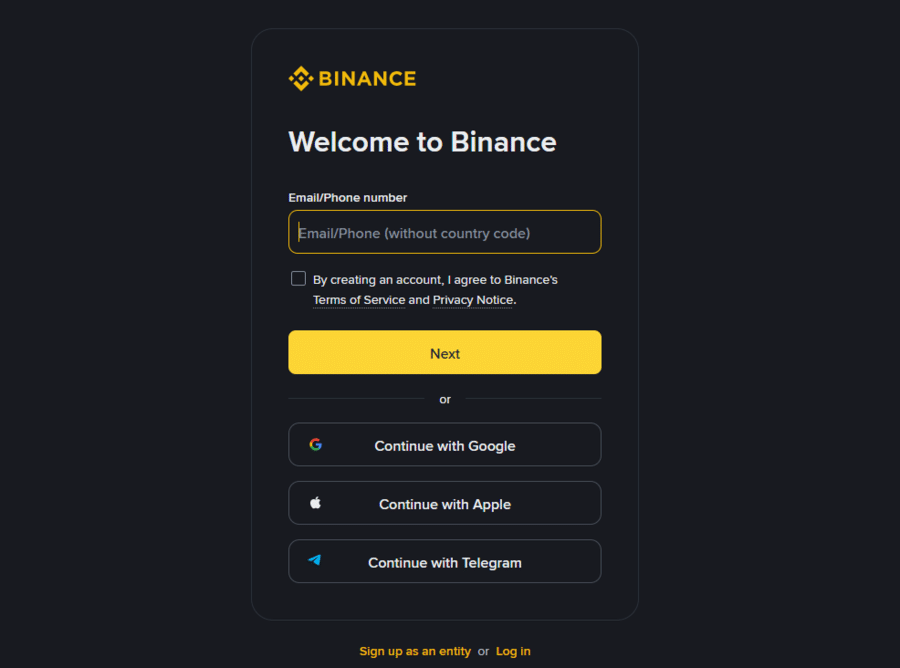
Step 1: Create an account on Binance.
Visit the official Binance website and start the registration process. Provide the necessary data, follow the steps, and complete the procedure.
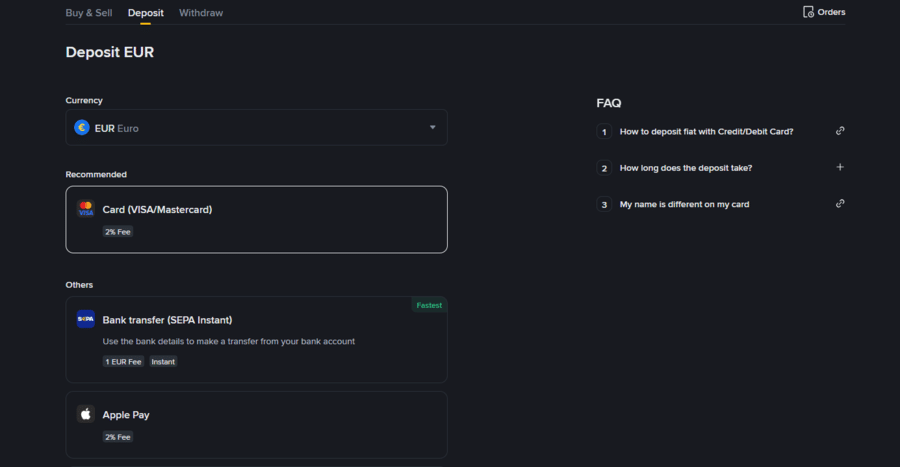
Step 2: Complete identity verification and make a deposit.
To get access to the Binance API, you must first complete your account by undergoing identity verification. Then deposit to your Spot Wallet to activate it fully. Bear in mind that you also need to enable two-factor authentication (2FA) in your account to create your first API key.
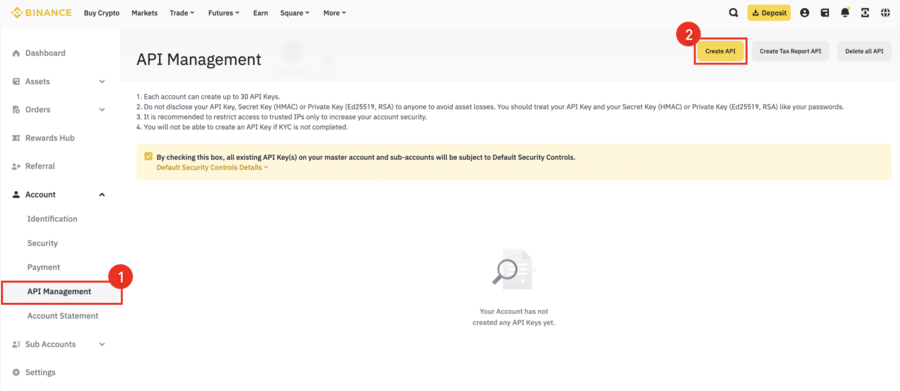
Step 3: Create an API Key.
Go to API Management in your account. Click on Create Key and choose the preferred API Key type. Give your API Key a label and verify it. Your API Key will be immediately created.
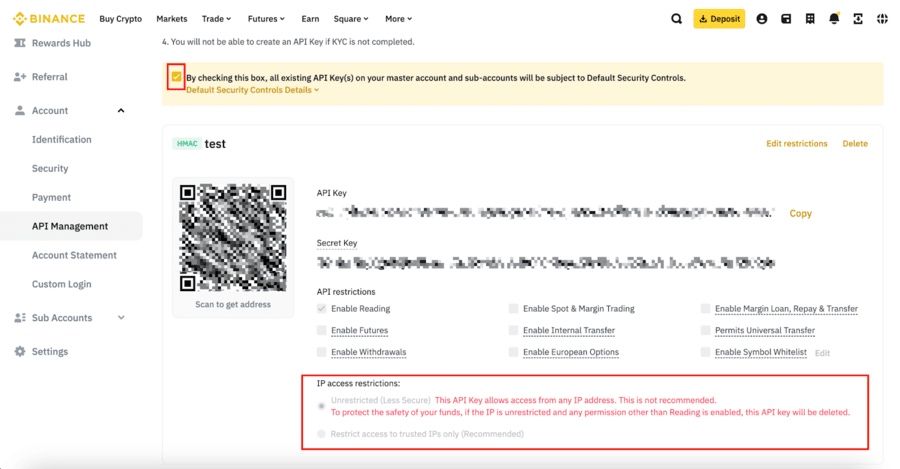
Step 4: Set permissions.
Binance recommends restricting access to trusted IPs only. To enable other permissions, you need to add IP access restrictions in IPv4 format, disable default security controls, or use self-generated keys.
Step 5: Use Binance Testnet to conduct tests.
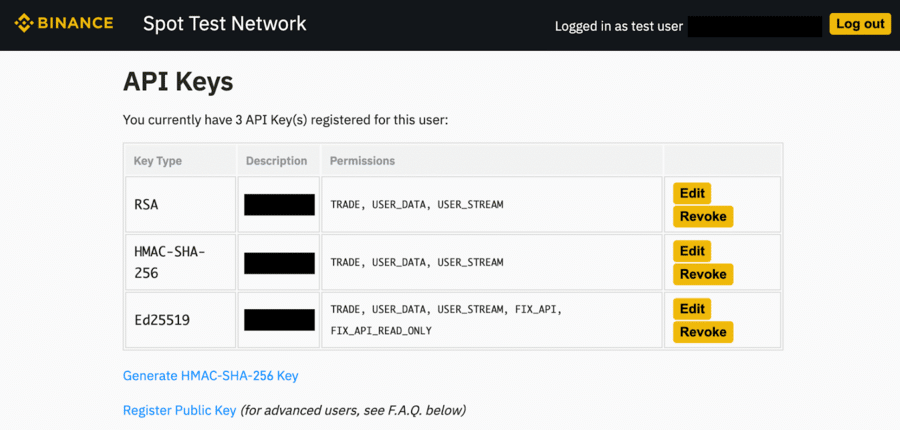
To use the Binance Spot Testnet, log in to it with GitHub. On the Binance Spot Test Network page, you’ll see a list of your testing API Keys. Alternatively, you can generate a new one. Follow Binance’s Spot API documentation to conduct a test with virtual assets.
Conclusion
Businesses need robust and reliable APIs not only because they provide full access to real-time data and trading options but also because they enable the automation of various tasks. With the best crypto APIs, you can also backtest using the extensive market data APIs provide.
Binance API is the best choice here, as it’s designed for scalability, liquidity, and compliance. With this API, a business can build sophisticated apps that handle rising demand.
Each crypto API provider has its advantages, but Binance is our top pick. It’s the biggest crypto exchange on the planet, and its APIs, which are made for scalability, can handle large transaction numbers and trading volumes.
What is the best crypto payment gateway API?
The best crypto APIs on our list are primarily designed for trading and managing crypto. Our top picks include Binance, OKX , CEX.io, and KuCoin.
Is Binance API free?
Yes, access to the Binance API is entirely free. However, it does come with rate limits that are there to prevent server overloads. Every crypto API provider has these limits, and Binance’s are among the highest.
What is an API in a crypto exchange?
A crypto exchange API is the interface that lets you connect your software to the crypto exchange, even if the two systems are entirely unrelated.
Jose Rafael Aquino is a Filipino writer and entrepreneur that specializes in finance, technology, cryptocurrency, and sports. Versed in the startup tech space, he has written for websites such as The GUIDON, TradingPlatforms, StockApps, and BuyShares.
Read More