




In This Article
Solana is the 3rd-largest smart contract blockchain and a major hub for DeFi, consumer apps, and meme coin activity. It’s earned its reputation for high throughput and low fees, but SOL’s price has also delivered the kind of volatility that can humble even experienced traders.
So, how much will Solana increase from here? That’s the question investors want to know. In this Solana price forecast for 2026 and beyond, we look at what was significant in 2025, what is driving demand now, and what elements could affect SOL’s price until 2030.
Let’s take a look at our Solana price prediction for 2026 and the next few years to know more.
Rising Crypto- Editor’s Choice

- New Bitcoin L2 presale offering massive staking rewards
- By using a SVM Bitcoin Hyper is revolutionizing Bitcoin's potential
- Early buyers can use $HYPER tokens for transactions, staking, and ecosystem governance
 Bank Card
 BNB
BNB ETH
ETH- +1 more

Key Takeaways
- Solana’s price prediction depends on fundamentals, technical analysis, and on-chain data.
- Institutional adoption and demand for Solana’s high-performance blockchain platform could drive significant growth.
- Short-term SOL price predictions hinge on market sentiment, while long-term outlook depends on adoption rates and technological upgrades.
- Solana’s on-chain analysis highlights strong network activity, making it an attractive option for many investors.
- Can Solana reach $1000? Analysts remain divided, but widespread adoption and favorable market conditions could push SOL far higher.
- Risks such as regulatory pressure, security concerns, and competition from key players may limit Solana’s future potential.
How High Solana (SOL) Will Go: Summary
When analyzing Solana’s price forecast, it’s useful to break things into short-term, medium-term, and long-term scenarios. Each outlook depends on adoption rates, institutional interest, and broader crypto market conditions. Instead of exact point targets, the ranges below highlight where Solana’s price could land if certain factors align.
In summary, Solana’s price predictions hinge on adoption, market conditions, and its ability to deliver consistent long-term growth. Many investors see Solana’s future potential as tied to its transaction speeds, low fees, and its expanding role in decentralized finance and Web3 applications.
| Year | Potential Low | Average Price | Potential High |
| 2026 | $120 | $300 | $500 |
| 2027 | $450 | $560 | $800 |
| 2030 | $670 | $750 | $1,200 |
Solana Price Prediction
 Solana
1.04%
Solana
SOL
Price
$118.66
1.04% /24h
Volume in 24h
$2.01B
Price 7d
Buy with Best Wallet
has earned its reputation as a high-performance blockchain platform by combining blistering transaction speeds with low fees. Two ingredients that fuel mass adoption in decentralized finance (DeFi) and NFTs. The Solana ecosystem is no longer just another “Ethereum killer” narrative; it’s a growing hub for builders, liquidity, and serious institutional interest.
Solana
1.04%
Solana
SOL
Price
$118.66
1.04% /24h
Volume in 24h
$2.01B
Price 7d
Buy with Best Wallet
has earned its reputation as a high-performance blockchain platform by combining blistering transaction speeds with low fees. Two ingredients that fuel mass adoption in decentralized finance (DeFi) and NFTs. The Solana ecosystem is no longer just another “Ethereum killer” narrative; it’s a growing hub for builders, liquidity, and serious institutional interest.
But price is always the battleground. Solana’s price history has shown brutal volatility, yet every major cycle has left SOL trading at a higher average price range than previous years. That raises the question: how high can Solana realistically go if market conditions turn bullish? And, more importantly, what fundamental and on-chain factors could drive Solana’s future value over the coming years?

This article looks at the basics, technical details, and expert predictions for Solana. It covers possible short-term price changes for SOL, estimates how much the Solana coin could grow in the medium term, and assesses the effects of long-term growth if adoption keeps rising.
With new development underway on Solana and more competition from blockchains like Toncoin and Avalanche, what does the future hold for Solana’s native $SOL token?
Short-Term (Current Cycle)
- Range: Could reach $250-$500 if market sentiment remains bullish.
- Conditions: Continued inflows from retail and institutional adoption, positive Solana on-chain analysis showing network growth, and resilience in the broader crypto market.
- Risks: Macro headwinds, liquidity shocks, or technical breakdowns could cap Sol’s price closer to the lower bound.
Medium-Term (2–3 Years)
- Range: Could trade in the $500–$800 range if the Solana ecosystem scales and solidifies its place as an attractive alternative to Ethereum.
- Conditions: Growth in decentralized finance (DeFi) and non-fungible tokens (NFTs), rising adoption rates, and sustained low transaction costs. Institutional adoption of Solana as a high-performance blockchain platform could further validate this scenario.
Long-Term (5–10 Years)
- Range: Could climb toward $800-$1,200+ if Solana achieves widespread adoption and cements itself as a key competitor in the blockchain ecosystem.
- Conditions: Technological upgrades, security improvements, and further decentralization to support massive scale. Widespread adoption of Solana’s innovative approach in DeFi applications, decentralized applications, and enterprise-level use cases would be required.
- Risks: Security vulnerabilities, regulatory pressure, and competing high-performance blockchains could limit Solana’s future potential.
The bullish movement in $SOL’s price has been accompanied by relative stability in Solana’s total value locked (TVL). Money is still flowing into Solana, thanks to the broader market growth and Solana’s popularity among builders.
Furthermore, recent gains in $SOL can be attributed to specific, somewhat short-lived catalysts. For example, PayPal’s $PYUSD stablecoin was launched on Solana and has driven adoption of that chain through incentives. These incentives aren’t meant to be permanent, so the pace of growth in $PYUSD on Solana could taper off sharply once they’re removed.
Solana also got a boost from Robinhood, which added support for $SOL to its crypto wallet. This makes $SOL more accessible for Robinhood users, but the number of Robinhood users who are likely to buy Solana because of this move is low.
It’s also notable that meme coin trading on Solana has grown significantly. The two largest Solana meme coins by market cap, $WIF, and $BONK have also been getting a lot of traction of late.
Solana Price Prediction 2025 Review
In 2025, SOL traded through a cycle defined by sharp rotations: meme coin bursts, liquidity waves, and fast sentiment shifts. The important takeaway for 2026 isn’t “what we predicted,” but what 2025 revealed:
- Solana still pulls liquidity fastest when traders chase speed, low fees, and quick execution.
- Breakouts were often followed by aggressive mean reversion, typical of a maturing large-cap asset.
- Key technical levels acted like magnets. Zones around prior highs and major supports repeatedly defined where buyers and sellers fought.
Solana is likely to benefit from growth in several sectors where the blockchain excels. Increased interest in crypto is generally likely to cause a surge in meme coin trading, for which Solana remains the preferred hub. This will translate into an increase in traders buying $SOL .

In addition, Solana is likely to grab the lion’s share of new value in DeFi applications, potentially led by the Solayer restaking protocol, which raised $12 million from Ethereum Layer-2 Polygon.
Solana could also benefit from the SOON Layer-2 solution , which has the potential to help top Solana projects match the speed and cost of transactions on Ethereum Layer-2 networks or up-and-coming blockchains like TON Network.
All of this development and growth will create a bullish environment around Solana. If Solana buyers push past $265, SOL might surge, reaching new all-time highs in 2026. On the downside, $125 is an important support level for investors to watch closely. Historically, levels like $125–$150 (support region) and $230–$265 (major resistance region) mattered because they defined whether SOL was consolidating or entering trend continuation.
Solana Price Forecast Long-Term Outlook: 2026-2030 Predictions
Our $SOL price forecast for 2026-2030 indicates that the token will keep rising gradually, though its growth may not be as fast as that of other Layer-1 blockchain tokens. We anticipate that Solana will continue to evolve, but it might be surpassed by other blockchains in terms of TVL, user base, and developer expansion.
The biggest direct competitor we see to Solana is TON Network , a relatively new Layer-1 chain that’s deeply integrated with the Telegram messaging app.

TON Network boasts far faster transaction speeds than Solana, and its Telegram integration means that it has access to a global community of more than 900 million active users. TON Network has also moved into meme coins, with tokens like $REDO and $DOGS taking off in the wave of Telegram founder Pavel Durov’s arrest in France.
In the long run, we expect that Solana will continue to attract developers and TVL will increase, but at a slower pace, as things like meme coin trading will move to other networks, such as TON. Solana will continue to experience net growth thanks to development in the overall cryptocurrency market, but the price of $SOL will underperform tokens like $TON and see slower growth as the market cap grows, similar to Ethereum.
Our Solana price prediction for 2030 indicates an average price of $750 by the end of the decade. The takeaway? There’s still risk in crypto, but solana prediction models across the board are getting more confident. Whether you’re eyeing the short term or thinking long game, most solana crypto price prediction outlooks point to one thing: the potential for big gains if the network keeps evolving the way it has.
Our $SOL price forecast is based primarily on fundamental analysis of the Solana blockchain. We considered recent developments on Solana, the blockchain’s growth in users and developers, and the chain’s competitive position relative to other Layer-1 and Layer-2 networks. We also factored in historical data and technical indicators. Additionally, we considered the impact that broader crypto market conditions are likely to have on Solana. This was especially important for long-term predictions since $SOL could benefit from overall growth in the number of crypto users.Our Solana Price Prediction Methodology
Solana Price History
Solana launched in March 2020 with an initial $SOL price of around $0.9511. The token exploded in price in 2021, in part because of backing from crypto exchange FTX and its CEO, Sam Bankman-Fried. By November 2021, just before FTX collapsed, $SOL reached an all-time high of $260.06.
FTX’s collapse took Solana with it, and the $SOL token fell to a price of $12.25 by November 2022, a loss of more than 95%. However, in November 2023, Solana began to climb again rapidly as meme coins began launching on the blockchain. In December, Solana reached $121, and in March 2024, $SOL hit a high of $202.
Since March, the price of $SOL has experienced a series of peaks and troughs, never trading below $125 or above $187. The overall price trend has been sideways, generally in a range from $137 to $145. By December 2024, $SOL rallied, printing all-time highs of $264. After that, in late 2024 and early 2025, the price started going down after Donald Trump launched his memecoin.
Currently, as of October 7, 2026, Solana (SOL) is trading at , which is a change over the past 24 hours.
Solana is down from its all-time high of , set in 2025, but has decreased over the past 12 months. It has a market cap of .
Factors That Could Influence Solana’s Price in 2026
The Solana price forecast for the coming year will depend on a blend of fundamentals, technical analysis, and on-chain activity. While the Solana blockchain is known for high transaction speeds and low fees, the SOL price will ultimately be shaped by broader market sentiment and how Solana continues to position itself as a high-performance blockchain platform. Below are the key factors that could move SOL prices in either direction.
SOL’s Fundamental Factors
Solana’s price is tightly linked to the health of the global economy and the appetite for risk assets. If macroeconomic conditions favour crypto adoption, such as declining interest rates or a weaker U.S. dollar, many investors may allocate more capital into the Solana ecosystem. As per Solana Foundation,
A core feature of the Solana network is the ability for everyone to have equal access to all information written to the blockchain ledger. Similarly, anyone should have equal and fair access to make changes to the ledger by submitting transactions at any time.
Institutional adoption is another critical factor. As Solana transforms into an attractive alternative for decentralized finance (DeFi) applications, its long-term potential becomes clearer. Growing demand from funds, family offices, and hedge funds looking for exposure to a high-performance blockchain platform could significantly influence SOL price predictions.
Other fundamentals include:
Technical Analysis of Solana (SOL)
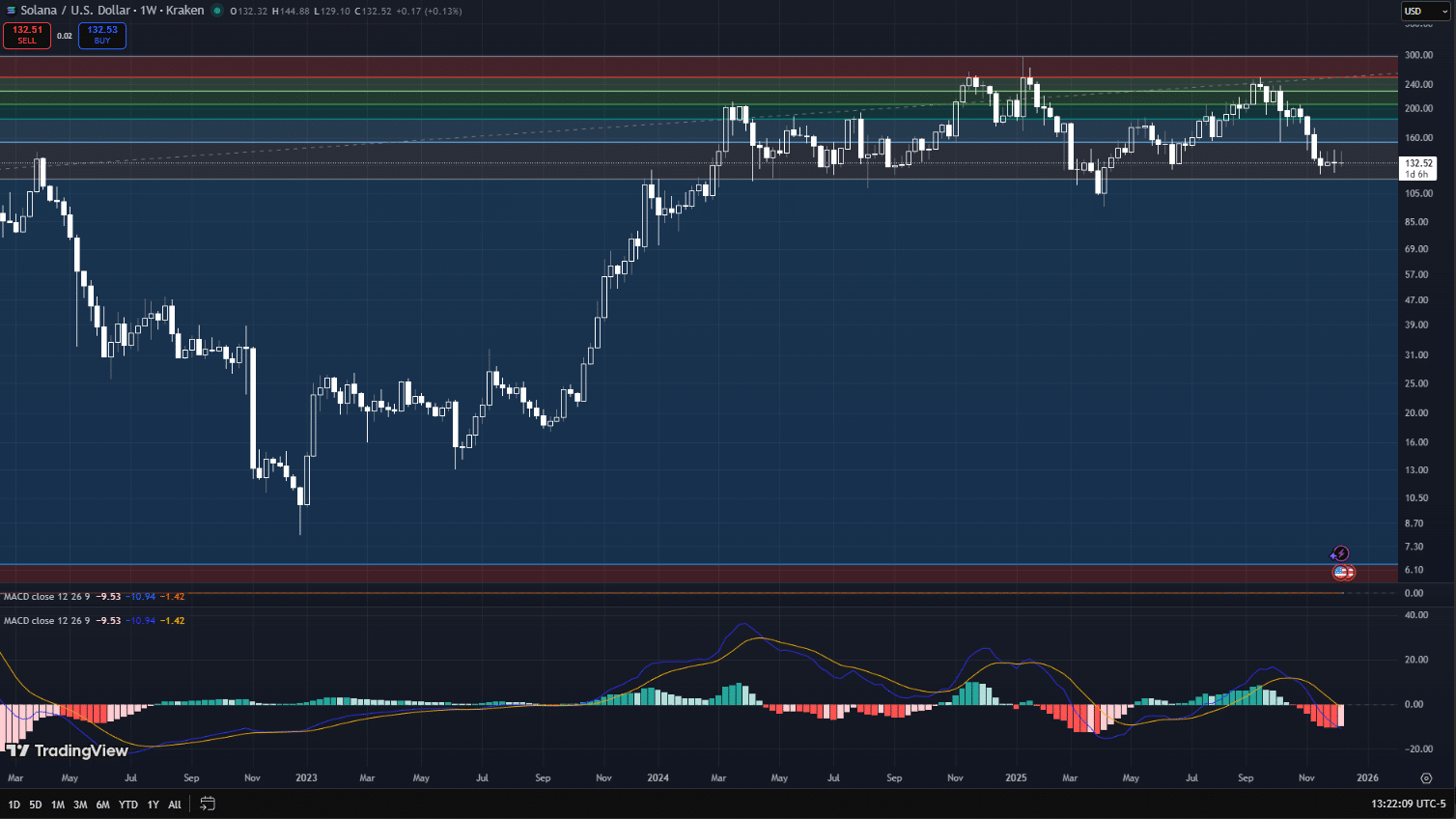
The weekly SOL/USD chart (Kraken) shows Solana is currently trading around the $130 area, after a sharp rejection from the $230–$260 region earlier in the cycle. This matters because the chart now looks less like “breakout continuation” and more like range rotation with bulls trying to defend the lower demand zone.
Support and Resistance Zones
Major Support (must hold): $120–$135
This is the current battleground. If SOL holds this zone on weekly closes, it keeps a base-case alive for a broader consolidation and a potential recovery rally.
Next Support (if $120 breaks): ~$105
Your chart highlights a lower band near ~$105. If SOL loses $120 decisively, price can slide into that zone quickly before buyers step back in.
Key Resistance: ~$160
This is the “first reclaim level.” If SOL can’t reclaim ~$160, rallies are more likely to be sold as relief bounces.
Upper Resistance / Supply: $200–$240
This is the heavy supply stack on your chart. It’s where prior rallies failed and where sellers have repeatedly defended.
Cycle-Level Resistance: $240–$265
This is the major “bull vs bear” zone. Reclaiming and holding it would signal a meaningful regime shift back toward trend continuation.
Trend Structure
The weekly structure suggests SOL is working through a lower-high / pullback phase after failing near the upper supply zone. For the chart to turn convincingly bullish again, SOL needs to:
- Hold $120–$135, then
- Reclaim $160, then
- Start closing weekly candles back inside $200–$240.
Momentum Indicators (MACD)
The MACD panel is currently bearish:
- Histogram is red (negative momentum).
- MACD lines are below the zero line and still trending down.
Translation: momentum is still pointed lower, so any upside move should be treated as a bounce until proven otherwise. A cleaner bullish signal would be the histogram shrinking toward zero and the MACD lines curling upward—ideally alongside a reclaim of $160.
Takeaway
Right now, SOL is in a “prove it” zone. Bulls need to defend $120–$135 and reclaim $160 to shift the chart from downside control to recovery mode. Until then, the technical picture favors range-bound chop with downside risk if support fails.
Solana’s On-Chain Factors
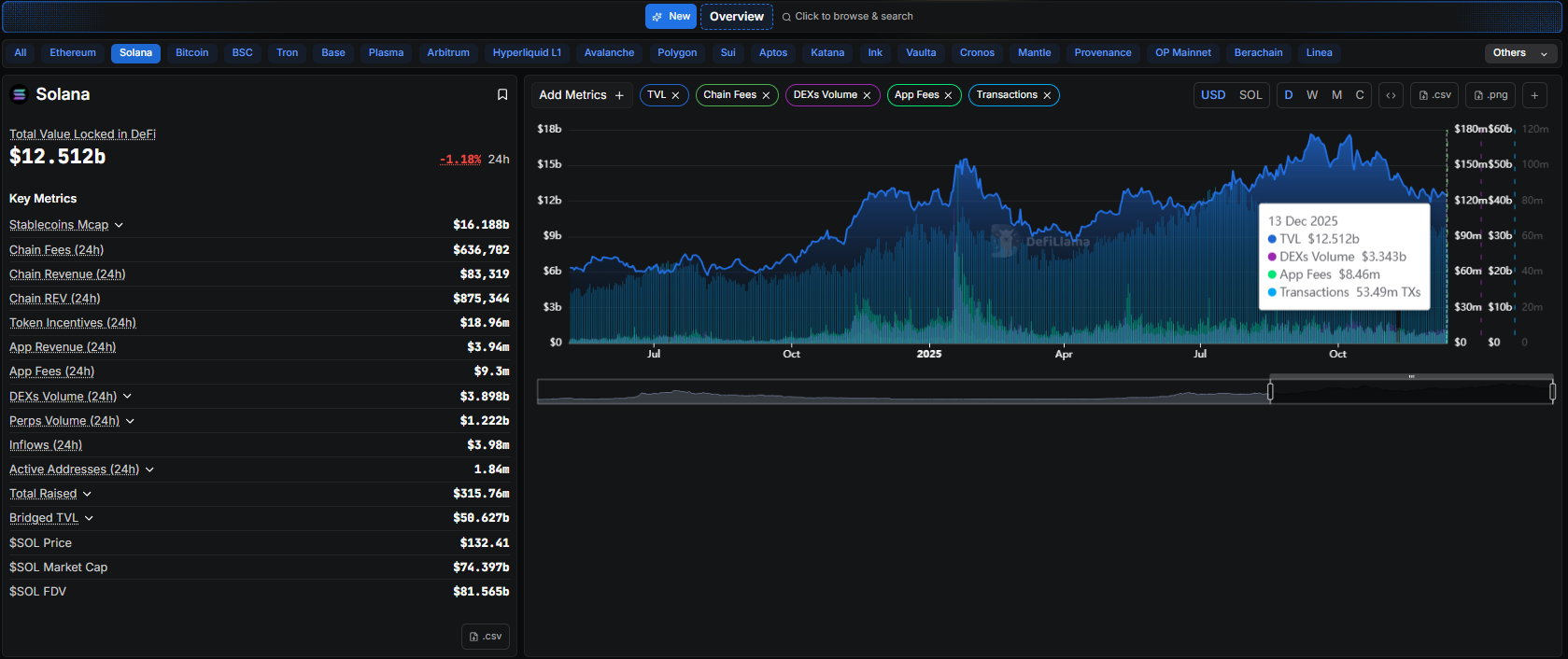
On-chain data offers a clearer picture of Solana’s real usage, economic activity, and network health beyond price speculation. Based on current DeFiLlama metrics, several indicators stand out when evaluating Solana’s outlook heading into 2026.
Total Value Locked (TVL)
Solana currently holds approximately $12.5 billion in total value locked (TVL), reinforcing its position as one of the largest DeFi ecosystems in crypto. While TVL has cooled slightly from peak levels earlier in the cycle, it remains structurally elevated compared to prior years. This suggests Solana has retained a meaningful base of DeFi liquidity even during periods of price consolidation. Historically, sustained TVL at these levels supports long-term adoption and provides a foundation for future SOL demand when market conditions improve.
Transactions
Solana continues to process an exceptionally high volume of transactions, with roughly 53 million transactions per day. Although this figure fluctuates with market activity, it highlights Solana’s core value proposition: high throughput at low cost. Even during quieter market phases, Solana’s transaction count remains far above most Layer-1 competitors, reinforcing its reputation as a high-performance blockchain suitable for consumer-scale applications.
Chain Fees & Revenue
Daily chain fees are currently around $600K, while app-level fees exceed $9 million per day, showing that economic activity on Solana is increasingly driven by applications rather than base-layer fee extraction.
This dynamic is important. Solana’s model favors low base fees paired with high usage, allowing applications like DEXs, trading platforms, and consumer apps, to capture value while keeping user costs minimal. As long as activity remains high, this structure supports sustainable ecosystem growth even without aggressive fee pressure.
Active Addresses & Capital Flows
Solana is seeing roughly 1.8 million active addresses per day, signaling continued engagement from users and developers alike. At the same time, net inflows of around $4 million daily suggest fresh capital is still entering the ecosystem, albeit at a more measured pace than peak speculative phases. This combination of high activity and moderate inflows aligns with a consolidation period rather than a demand collapse.
Takeaway
Solana’s on-chain data paints the picture of a network that has moved beyond hype-driven usage and into a phase of sustained, high-volume activity. While growth has cooled from cycle highs, metrics like TVL, transactions, app fees, and active addresses remain strong. If broader market conditions turn favorable again, this base of real usage positions Solana well for renewed upside in the years ahead.
Solana’s Expert Predictions & Price Targets
Below you will find expert predictions of how high can Solana go.
Mid term (2026–2029). Long term (2030). Contrarian notes (risk-aware views). Even bullish shops caution on relative underperformance vs. ETH and overreliance on memecoin activity in the near term. Both could cap upside until new demand verticals scale. What it means:
Can Solana Crypto Reach $1000? 99Bitcoins’ Investigation
The question: How high will Solana go in this cycle and beyond? Here’s a sober, data-first framework you can use alongside Solana’s on-chain analysis and broader market conditions. What $1,000 implies, let’s do some math.
Market cap = price × circulating supply. Because SOL supply expands over time, let’s use a range:
- $1,000 × 450M–650M SOL ≈ $450B–$650B market cap
- Fully-diluted value (FDV) could approach $600B–$800B as the Solana blockchain issues more tokens.
Hitting $1,000 needs more than hype. It needs sustained demand that justifies a top-tier crypto asset valuation:
Events that could trigger a parabolic move
- Major ETP/ETF inflows after the ETF approval in October 2025 and index inclusion (driving systematic bids).
- A breakout consumer app on SOL crossing 10M+ MAUs.
- Large stablecoin or fintech partner migrating meaningful flow to SOL.
- Network upgrade(s) that cut latency or fees further cementing the high performance blockchain platform narrative.
- Clear, favorable regulatory guidance that de-risks investing for institutions.
99Bitcoins’ take
Bullish scenario: If institutional adoption accelerates, flagship apps scale, and fees remain minimal, Solana’s price could compress risk premia and re-rate toward a $450B–$650B cap over time. In that path, can Solana reach $1000? It becomes plausible, though not guaranteed.
Base case: As the blockchain ecosystem evolves, expect an average price that steps higher with growth, new highs possible, but Solana price prediction bands should reflect execution risk and market sentiment swings.
Bear case: If growth stalls, competitors win share, or macro turns, Solana’s future reverts to lower price predictions with a wide range and lower maximum price.
Bottom line: How high can SOL go this bull run depends on adoption rates and liquidity. A $1,000 Sol price would require significant growth across users, fees, and institutional flows yet SOL’s low transaction costs, speed, and expanding ecosystem keep it an attractive option for many investors. It’s a long-term, execution-heavy path, not a foregone conclusion.
Risks That Could Limit Solana’s Growth
While Solana’s potential remains strong, investors must weigh the risks that could impact Solana’s price forecast and long-term outlook. Even with strong fundamentals and bullish scenarios, several headwinds could slow adoption and limit price appreciation.
Security & Network Stability
Solana has faced past network outages and performance bottlenecks. Although upgrades have improved resilience, further disruptions could erode confidence in Solana’s blockchain technology and reduce institutional adoption. In a market that prizes uptime and reliability, repeated downtime would limit Solana’s future potential.
Regulatory Pressures
As global regulators tighten rules around crypto assets, Solana may face scrutiny. If SOL were classified as a security in major jurisdictions, it could restrict listings on exchanges and dampen investor demand. Regulatory overhang remains a critical factor in shaping Solana’s market outlook.
Competitive Pressure
Ethereum, Avalanche, and newer entrants like Monad or Sui are all key competitors with strong ecosystems. If Solana fails to differentiate itself in speed, cost, or developer experience, it risks losing market share in DeFi applications, NFTs, and broader blockchain adoption.
Overreliance on Certain Use Cases
Recent spikes in activity have been fueled by memecoins and high-volume trading apps. While they showcase Solana’s high throughput and low fees, they don’t necessarily reflect sustainable adoption. Without deeper, more durable use cases (payments, gaming, enterprise apps), Solana’s growth trajectory could flatten.
Market Cyclicality
SOL’s price, like all crypto assets, is tied to broader crypto market conditions and market sentiment. A downturn in liquidity, macroeconomic tightening, or risk-off cycles could suppress SOL prices even if adoption rates remain strong.
Solana continues to show significant growth potential as an attractive option in the blockchain ecosystem, but risks from regulation, stability, and competition cannot be ignored. Long-term investors should consider both the bullish scenario of widespread adoption and the possibility that Solana’s innovative approach could face hurdles along the way.
What Is Solana?
Solana is a Layer-1 smart contract blockchain that is similar to Ethereum in many ways. It uses a similar proof-of-stake validation mechanism, offers staking rewards for token holders, and has a wide range of dApps for DeFi, crypto gaming, trading, and more. Solana is faster than Ethereum, supporting around 3,000 transactions per second, although it is slower than many Ethereum Layer-2 networks. To know more about this altcoin, check out our dedicated Solana review.
Our SOL price predictions indicate a bullish outlook for the $SOL token. While that may be attractive, we forecast bullish conditions across the crypto market in 2026, so investors may be able to find bigger gains in other tokens.
Over the long term, we expect Solana to continue to grow, but at a slower pace and possibly even lag behind other Layer-1 blockchain coins like $ETH, $TON, and $AVAX. If you are looking to pick up some Solana, we recommend using a safe and reputable exchange such as the ones listed below:




Best Wallet is our top pick for users looking for the easiest way to buy Solana directly from within a wallet. In fact Best Wallet is one of our favorite ways to buy and store crypto, and we prefer it over many centralized exchanges.

We recommend Best Wallet for new users and those looking for the most friction-free way to buy Solana because purchasing crypto from directly within a wallet lowers users’ risk of exposing themselves to exchange hacks, third-party risks, and the possibility of sending to incorrect addresses when withdrawing from a traditional crypto exchange. To know more about this non-custodial wallet, check out our dedicated Best Wallet review.
Conclusion: How High Can Solana Go?
Our Solana price prediction indicates that $SOL has solid growth potential and may perform well in the near term. However, it could trail behind smaller-cap tokens that often generate more hype, assets that carry higher risk but also the possibility of higher rewards. We feel Solana is one of the best bets, joining the ranks of Bitcoin and Ethereum in terms of being a “blue-chip” crypto asset. Solana had an amazing run in 2023 and 2024, but is unlikely to continue to outperform now that it has reached the current big market cap it has. Investors in search of higher returns may want to consider $TON or $AVAX as alternative Layer-1 blockchain coins.
For additional cryptocurrency ideas and alternatives to $SOL, check out our guide to the best cryptocurrencies to buy now.
See Also:
- Kaito AI (KAITO) Price Prediction 2026–2030
- Ket (KET) Price Prediction 2026–2030
- Solana Futures: SOL Trading Guide for 2026
- Best Solana Wallets Review 2026
- Solana Staking: How to Stake SOL in 2026
- 7 High-Risk High-Reward Cryptos for 2026
FAQs
Is Solana a good investment?

Our Solana price prediction suggests that the $SOL token could reach $380 in 2026. However, we think investors will have to wait through sideways trading for this gain and that Solana’s return could lag behind returns for other Layer-1 blockchain tokens in 2026.
How high can Solana go?
Solana has strong growth potential thanks to its fast transactions, scalability, and growing ecosystem. Analysts suggest it could retest its previous all-time high if bullish market conditions return. However, long-term growth will depend on adoption, competition, and overall crypto market trends.
How high will Solana go by 2030?
By 2030, we estimate, Solana could reach a high of $1,200 if bullish market sentiment prevails.
References
- “Solana.” Solana, https://solana.org/.
- Schär, Fabian. DeFi Beyond the Hype. Wharton Initiative on Financial Policy and Regulation, May 2021, https://wifpr.wharton.upenn.edu/wp-content/uploads/2021/05/DeFi-Beyond-the-Hype.pdf.
- Chen, Xudong, et al. “Blockchain Scalability: Layer-1 vs Layer-2 Solutions.” arXiv, 24 June 2024, https://arxiv.org/html/2406.13855v1.
- “Layer One and Layer Two Blockchain Scaling Solutions.” CoreDAO, https://coredao.org/core-academy/layer-one-and-layer-two-blockchain-scaling-solutions.
- GeeksforGeeks. “What Is Solana?” GeeksforGeeks,https://www.geeksforgeeks.org/ethical-hacking/what-is-solana/.
- Solana Foundation. “About Solana.” solana.org, https://solana.org/about

Why you can trust 99Bitcoins
Established in 2013, 99Bitcoin’s team members have been crypto experts since Bitcoin’s Early days.
Weekly Research
100k+Monthly readers
Expert contributors
2000+Crypto Projects Reviewed