




In This Article
Hedera (HBAR) is a distributed ledger network launched in 2018 by Dr. Leemon Baird and Mance Harmon. Instead of a traditional blockchain, it uses Hashgraph, a DAG-based consensus system designed for fast transactions, high throughput, and low energy usage.
The network operates on Proof-of-Stake, enabling HBAR holders to stake their tokens and receive rewards. Hedera is managed by a council of up to 39 global organizations, including companies like Google and IBM. This setup is designed for enterprise use but is often criticized for being centralized.
In this Hedera (HBAR) price prediction, we assess how its technology, governance, and adoption could impact long-term value.
Rising Crypto- Editor’s Choice

- New Bitcoin L2 presale offering massive staking rewards
- By using a SVM Bitcoin Hyper is revolutionizing Bitcoin's potential
- Early buyers can use $HYPER tokens for transactions, staking, and ecosystem governance
 Bank Card
 BNB
BNB ETH
ETH- +1 more

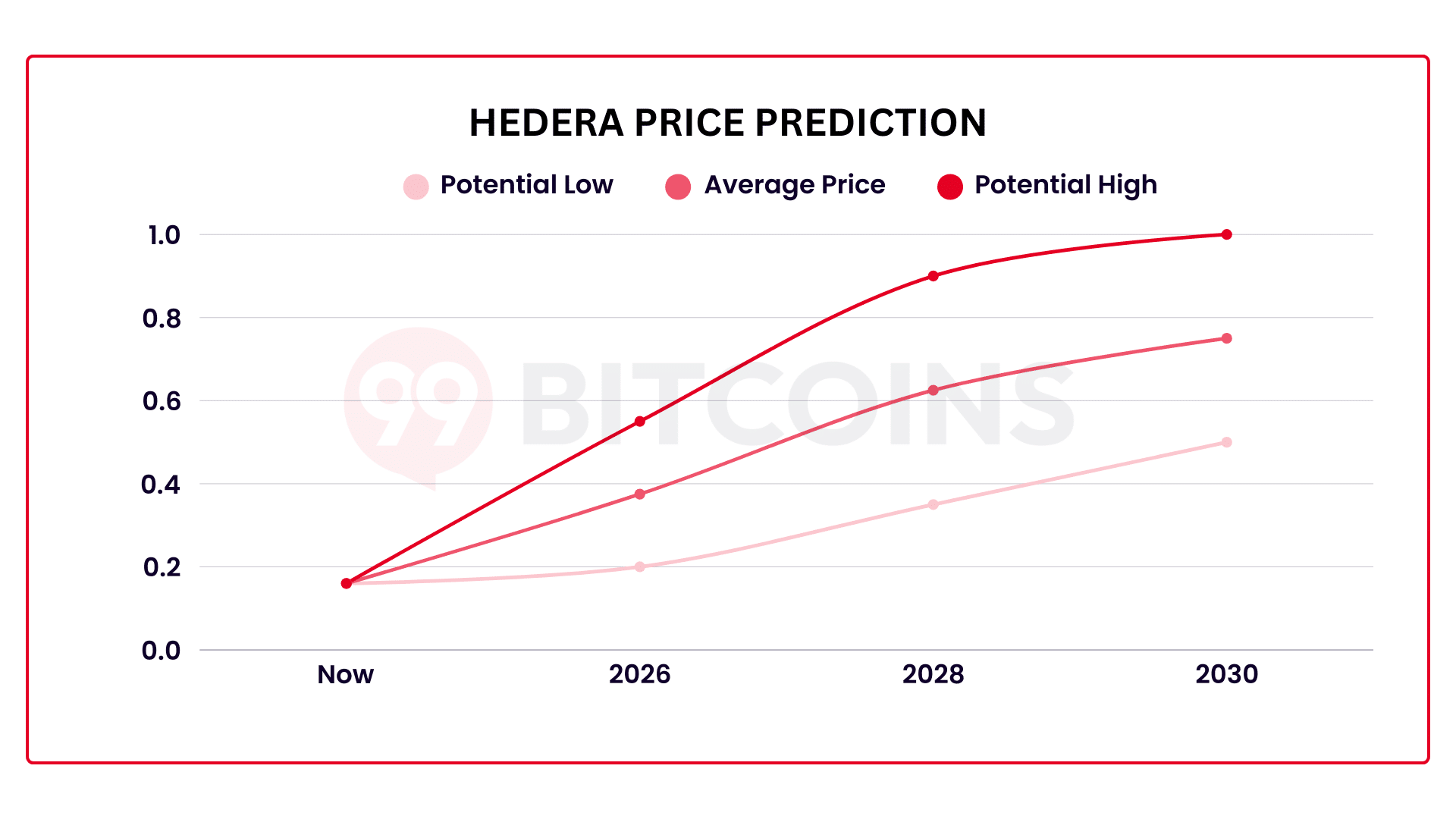
HBAR entered 2026 after a sharp late-2024 recovery and a failed continuation attempt in early 2025. While price briefly approached the $0.40 area, momentum faded and HBAR spent the remainder of the year consolidating, confirming 2025 as a reset rather than a breakout year. HBAR’s 2026–2027 outlook hinges on adoption, not hype. For any sustained move above $0.55, the token must continue holding the $0.20 support zone, which defined the post-2025 base and prevented a return to 2024 lows. Enterprise adoption remains the primary upside catalyst. Hedera’s role in the FedNow pilot via Dropp reinforced its positioning as enterprise-grade infrastructure, while integrations such as LayerZero expanded cross-chain access. These developments strengthen Hedera’s credibility but must translate into consistent on-chain usage to materially impact price. Sustainability is another differentiator. As a carbon-negative Proof-of-Stake network, Hedera remains attractive to ESG-focused institutions seeking scalable, compliant infrastructure. Broader wallet support, including MetaMask, has also lowered the barrier to entry and improved accessibility for users and developers. Tokenization and regulated finance could provide additional tailwinds. Archax’s tokenization of a BlackRock treasury fund on Hedera highlighted its readiness for real-world assets, even without direct issuer involvement. Meanwhile, spot HBAR ETF filings submitted by Nasdaq remain under regulatory review. While approval is not guaranteed, progress on this front would materially expand institutional access. Taken together, these factors support a $0.20–$0.55 trading range through 2026–2027, with upside dependent on measurable enterprise adoption rather than speculative market cycles. By 2030, HBAR could break $1, but the pace of this growth over the years will depend on several factors. Besides the impact of competitors and evolving regulations, HBAR prices will be shaped by: This Hedera (HBAR) price prediction is based on both technical and fundamental analysis. On the technical side, our analysts look at past price trends, how HBAR behaves around key support and resistance levels, and patterns in the charts that might signal future price movements. From a fundamental perspective, we consider things like the growth of the Hedera network, overall market conditions, adoption by users and businesses, and how staking affects supply and demand. We also take into account Hedera’s unique features and how its advantages over other blockchain platforms could help support its price over the long term. In early 2018, Hedera developers began crowdfunding, raising funds from various investors, including the Digital Currency Group (DCG) and Strobe. According to CryptoRank, HBAR was sold for between $0.001 and $0.096. In their August 2018 ICO, HBAR sold for $0.12. When HBAR started trading on multiple exchanges in 2019, its price dropped to $0.0101 by January 2020. However, it later surged to an all-time high of $0.56 in September 2021. Since then, HBAR has remained highly volatile, falling to a low of $0.04 in January 2023 before rebounding to $0.40 by January 2025. Currently, as of August 24, 2026, Hedera is trading at
, which is a
change over the past 24 hours. Hedera is down from its all-time high of
, set in 2019, but has increased
over the past 12 months. It has a market cap of
. Hedera is a decentralized blockchain primarily targeting institutions. It is unique and has the following key features: HBAR is the utility coin used for paying gas, which is low and predictable, unlike Ethereum and Solana. Every time there is a transfer, smart contract deployment, or logging via the HCS, a fee must be paid in HBAR. Holders can also stake HBAR via nodes operated by the Governing Council and receive a yield. Later, once Hedera opens up to community nodes, anyone can run a node and stake. As a proof-of-stake network, HBAR has a role in governance. At the moment, governance is through the Governing Council, which votes on proposals. The Hedera Foundation also uses HBAR to fund grants, including the $500 million in HBAR allocated in 2024 to drive dApp development and build core projects like HashSphere. If you want to learn more about this blockchain project, check out our separate Hedera Review for 2026. The increasing real-world usage of Hedera is one of the primary factors contributing to analysts’ continued optimism over its price forecast in 2026. In the Middle East, where companies in Saudi Arabia and Dubai are investigating Hedera for Sharia-compliant tokenization, supply chain transparency, and digital identification solutions, the network has experienced a surge in usage across government and enterprise projects. Hedera also introduced Agent Kit v3 in 2025, a significant update intended to facilitate communication between automated systems and AI agents on the network. This innovation is in line with the expanding convergence of blockchain and AI. These advancements, along with continued collaborations and experiments in institutional finance and stablecoin infrastructure, provide Hedera with a solid basis for sustainable value creation. Hedera is popular, especially due to its partnership with the Federal Reserve. Its ecosystem is expanding, and the team is actively building. As such, HBAR is popular among investors, given the impressive ROI since its ICO. Whether Hedera crypto will rise (or fall) in the future depends on the market and fundamental factors. The decision to buy HBAR now depends on your due diligence. If you want to buy Hedera, consider using any of these exchanges.
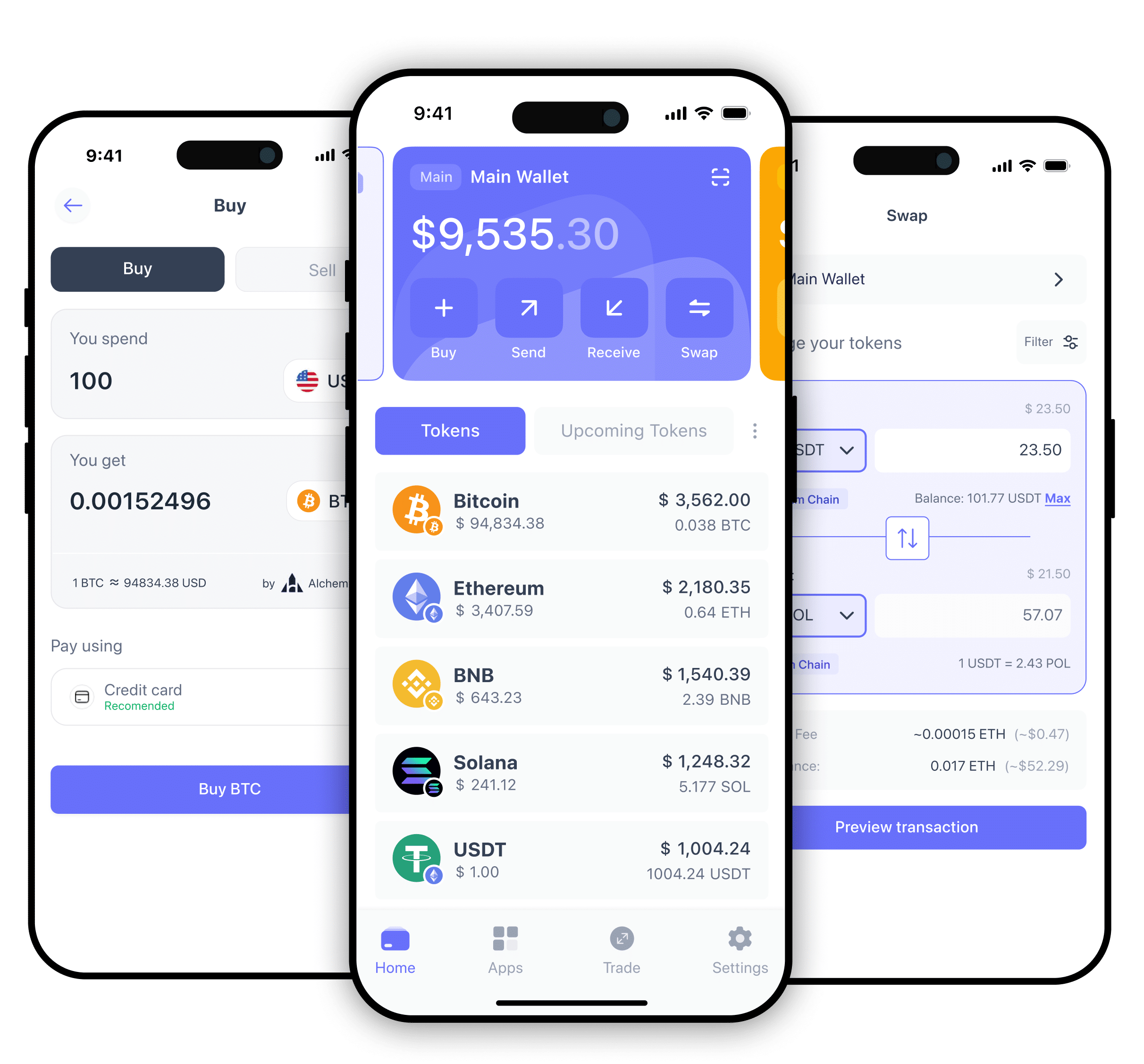
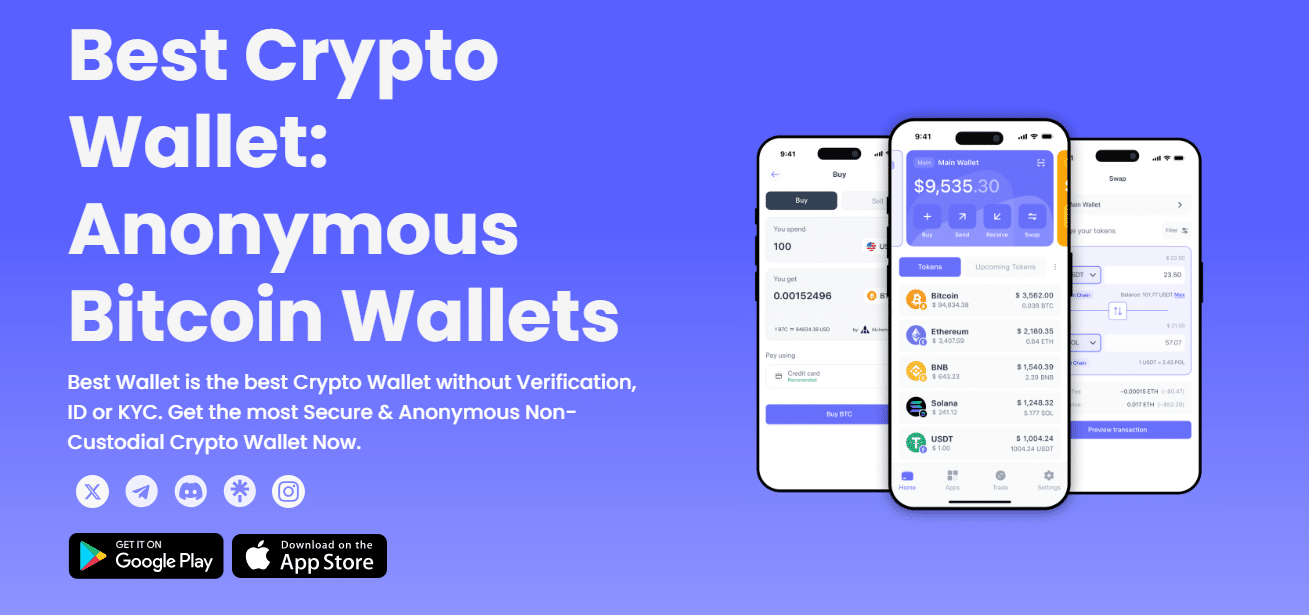
Later, you can move your tokens to a secure non-custodial wallet like Best Wallet. This isn’t just a normal wallet where you hold a coin; it’s one of the best web3 wallets where you can buy, sell, swap, and even stake various cryptocurrencies. The wallet has strong security features and is trusted by industry veterans. Best Wallet has useful features, including a built-in decentralized exchange (DEX). One standout feature is the “Upcoming Tokens” section, which makes it easy for investors to join top crypto presales with just a single click. Hedera is building and plans to decentralize in the coming years. With support from Fortune 500 companies and solid fundamentals, it can be attractive to investors. That support can carry a project pretty far, and as long as Hedera remains in favor of those large players, it should continue to stay in the spotlight. However, only time will tell if HBAR will break above $1. Token demand will depend on multiple factors, including mass adoption, market cycles, and quality partnerships. See also: The Federal Reserve, the central bank of the U.S., chose Hedera tech because of its low, predictable fees and regulatory compliance. The network is also secure, and this is crucial when powering critical financial infrastructure. Hedera nodes run on Proof-of-Stake, just like Ethereum and Algorand. However, Hedera uses a more energy-efficient and powerful hashgraph to process transactions. Through this consensus system, fees are predictably low, and transactions are processed quickly. HBAR has the potential to rally and break past the $1 mark. If it does, Hedera could emerge as a leading blockchain, hosting some of the biggest DeFi projects and tokenization platforms in the space. As of early 2026, Hedera was still under the control of the Governing Council. They plan to decentralize gradually, allowing community members to run nodes. Established in 2013, 99Bitcoin’s team members have been crypto experts since Bitcoin’s Early days. Weekly Research Monthly readers Expert contributors Crypto Projects ReviewedHedera (HBAR) Price Prediction 2026–2030
Year
Price Range (USD)
Key Highlights
2026
$0.20 – $0.55
Post-consolidation phase; upside depends on reclaiming $0.40 resistance
2027
$0.35 – $0.75
Adoption-driven expansion possible if enterprise usage accelerates
2030
$0.50 – $1.00
Long-term value tied to regulation, enterprise adoption, and network utility
 Hedera Price Prediction 2026–2027
Hedera Price Forecast: Long-Term Outlook 2027–2030
Our Hedera Price Prediction Methodology
Hedera Price History
What Is Hedera (HBAR)?
Real-World Adoption Strengthens Hedera’s Outlook
Is Hedera (HBAR) a Buy?
Conclusion
FAQs
Why did the Federal Reserve choose Hedera?

How is Hedera different from Ethereum?
Can HBAR reach $1?
Is Hedera centralized?
References:

Why you can trust 99Bitcoins