




Cosmos is a popular platform for building a decentralized web of scalable, independent, and interoperable blockchains. In its quest to create the “internet of blockchains,” Cosmos aims to permanently resolve fragmentation in the blockchain ecosystem.
Cosmos developers launched the InterBlockchain Communication (IBC) protocol, Cosmos SDKs, and the Tendermint consensus mechanism to achieve this.
Cosmos has become a foundational layer for many blockchains, including Cronos, through these solutions. It is committed to promoting interoperability while remaining secure, scalable, developer-friendly, and interoperable.
Rising Crypto- Editor’s Choice

- New Bitcoin L2 presale offering massive staking rewards
- By using a SVM Bitcoin Hyper is revolutionizing Bitcoin's potential
- Early buyers can use $HYPER tokens for transactions, staking, and ecosystem governance
 Bank Card
 BNB
BNB ETH
ETH- +1 more

Key Takeaways
- Cosmos (ATOM) spent most of 2025 consolidating near cycle lows, reflecting broader altcoin weakness rather than Cosmos-specific failures.
- ATOM’s long-term value depends on whether Cosmos can convert its interoperability leadership (IBC and Cosmos SDK) into sustained token demand.
- Under neutral market conditions, ATOM is expected to trade between $1.5 and $6 in 2026, with upside tied to real ecosystem usage.
- By 2030, ATOM could average around $10, though reclaiming 2021 highs would require a major adoption catalyst.
- Cosmos remains a foundational infrastructure layer, but ATOM’s price performance will continue to track broader market cycles and modular blockchain adoption trends.
Cosmos (ATOM) Price Prediction 2026–2030
In this Cosmos price prediction, we will explore the project’s potential, review its technological advancements, and break down its future outlook and possible position in the industry.
End of 2025 (Retrospective): Cosmos (ATOM) began 2025 on a stronger note after finishing 2024 positively, but that momentum quickly diminished. The first half of 2025 saw significant selling pressure, wiping out the gains from late 2024 and pushing ATOM back toward its previous cycle lows. Throughout the year, the price movements mirrored general weakness in altcoins rather than issues specific to Cosmos, as ATOM struggled to maintain the $5 level consistently. Consequently, 2025 turned out to be a year of consolidation, with ATOM mostly fluctuating between $2 and $7, highlighting the need for renewed demand linked to actual ecosystem usage.
End of 2026: How ATOM closed 2025 set a cautious tone for 2026. Without a decisive recovery, capital flows into the broader Cosmos ecosystem remained selective. That said, Cosmos’ role as an interoperability layer and sovereign-chain framework continues to attract developers deploying application-specific blockchains. If broader market conditions stabilize and adoption of Cosmos SDK–based chains expands, ATOM could regain strength. Under neutral conditions, we expect ATOM to trade between $5 and $10 in 2026, with upside dependent on sustained network activity rather than speculative rotation alone.
End of 2030: Over the longer term, ATOM’s valuation will hinge on whether Cosmos can translate its technical advantages like interoperability, modular design, and sovereign chains, into consistent economic value accrual. Cosmos does not operate in isolation, and demand for ATOM remains closely linked to broader Layer-1 and modular-blockchain trends across the industry. By 2030, a more mature multi-chain environment could support an average ATOM price near $20, though reclaiming the 2021 highs would likely require a major shift in adoption or a defining role for Cosmos among leading smart contract ecosystems.
| Year | Potential Low | Average Price | Potential High |
|---|---|---|---|
| 2026 | $1.80 | $3.50 | $6.00 |
| 2027 | $2.50 | $5.50 | $9.00 |
| 2030 | $4.00 | $9.00 | $15.00 |
Cosmos ATOM Price Prediction 2026–2027
Cosmos (ATOM) enters 2026 after an extended period of weakness, with prices failing to sustain the momentum seen briefly in late 2024. Rather than a broad recovery, ATOM spent most of 2025 consolidating near cycle lows, reflecting softer demand across the altcoin market and a shift in capital toward fewer dominant ecosystems.
From a fundamentals standpoint, Cosmos continues to make progress, but that progress has not yet translated into consistent price strength. The Inter-Blockchain Communication (IBC) protocol remains a core differentiator, connecting 100+ blockchains and enabling cross-chain transfers of assets and data. Interoperability initiatives, such as efforts to improve connections between the Cosmos Hub and Ethereum, support Cosmos’ long-term positioning, but adoption remains incremental rather than explosive.
Cosmos SDK adoption also continues to expand, with hundreds of projects building application-specific chains using the framework, including high-profile examples like Celestia and dYdX. Features such as Partial Set Security (introduced in 2024) allow validators to selectively secure consumer chains, while CosmWasm has expanded smart contract functionality across the ecosystem. These developments strengthen Cosmos’ technical foundation, but ATOM’s value accrual still depends on whether network activity translates into sustained demand for the token itself.
Looking ahead to 2026 and 2027, ATOM’s price trajectory will remain closely tied to broader market conditions and the pace of real ecosystem usage. Without a strong resurgence in adoption, upside is likely to be gradual rather than dramatic. Under neutral conditions, we expect ATOM to trade between roughly $2 and $6 in 2026, with the potential to push toward $9–$10 in 2027 if sentiment improves and Cosmos-based chains gain traction. Any move materially beyond those levels would likely require a clear shift in how the market values Cosmos within the modular blockchain landscape.
At this point, if you are wondering how to purchase Cosmos coins, then check out our ‘How to Buy Cosmos (ATOM)‘ guide.
Cosmos Price Forecast: Long-Term Outlook 2027–2030
By 2030, ATOM could average $15 and even reclaim 2021 highs in the months following, but this depends on the following:
- Bull Market Cycles: Although Cosmos is building, releasing new updates, and seeking to slash ATOM inflation to zero, the pace at which ATOM prices grow will depend on general market conditions. For example, rising Bitcoin, Ethereum, and Solana prices will also lift ATOM, as historical correlations show.
- Adoption: When ATOM rose to $44, demand for DeFi and NFTs was high. The collapse of crypto prices crushed these industries, and NFTs have yet to recover. Overall, DeFi remains a shadow of its former self, though it has been stabilizing. Cosmos-based blockchains didn’t host a viral memecoin in the last bull cycle, explaining why ATOM prices remain under pressure. ATOM may benefit if IBC becomes the standard for blockchain interoperability, powering hundreds—if not thousands—of chains serving various industries, including memecoins, DeFi, NFTs, blockchain gaming, and even tokenization platforms.
- Regulations and Macroeconomic Conditions: The focus is also on rules and how countries and regions interpret blockchain and crypto. In the United States, regulations are improving under Donald Trump, and with a crypto reserve that might include ATOM, the future looks bright for the coin. If the global economy improves over the next five years and central banks continue slashing rates, capital might flow to risky assets and altcoins like ATOM.
This Cosmos ATOM price prediction considers technical analysis, where we examine historical trends. At the same time, we conduct fundamental analysis, where our analysts break down the project’s parameters—such as the stage of the market cycle, on-chain statistics (e.g., wallet activity), technology adoption, and partnerships. Under this lens, we also explore regulations and macroeconomic factors, including the state of the economy and other key data that continue to impact crypto prices.Our Cosmos Price Prediction Methodology
Cosmos Price History
Between 2017 and 2019, Cosmos raised funds and sold ATOM for between $0.08 and $0.10. The ICO in April 2017 raised $16 million, and ATOM traded at $0.10. By 2021, ATOM broke $44 before sliding sharply in 2022 to as low as $5.5.
Prices have yet to recover as of Q1 2026. Currently, as of October 15, 2026, ATOM is trading at , which is a change over the past 24 hours. Well, ATOM is down from its all-time high of , set on 20 September 2021, and it has a market cap of .
What Are the Use Cases of ATOM?
Cosmos is a decentralized ecosystem comprising interoperable, independent blockchains using a Proof-of-Stake (PoS) consensus via the Cosmos Hub.
Central to Cosmos is Tendermint BFT, a consensus engine offering instant finality for its blockchain—crucial when making governance decisions—and playing a key role in validator coordination.
The combination of PoS and Tendermint BFT allows for on-chain governance and staking. The Cosmos Hub is the central blockchain that secures the network and facilitates cross-chain transactions executed via the IBC.
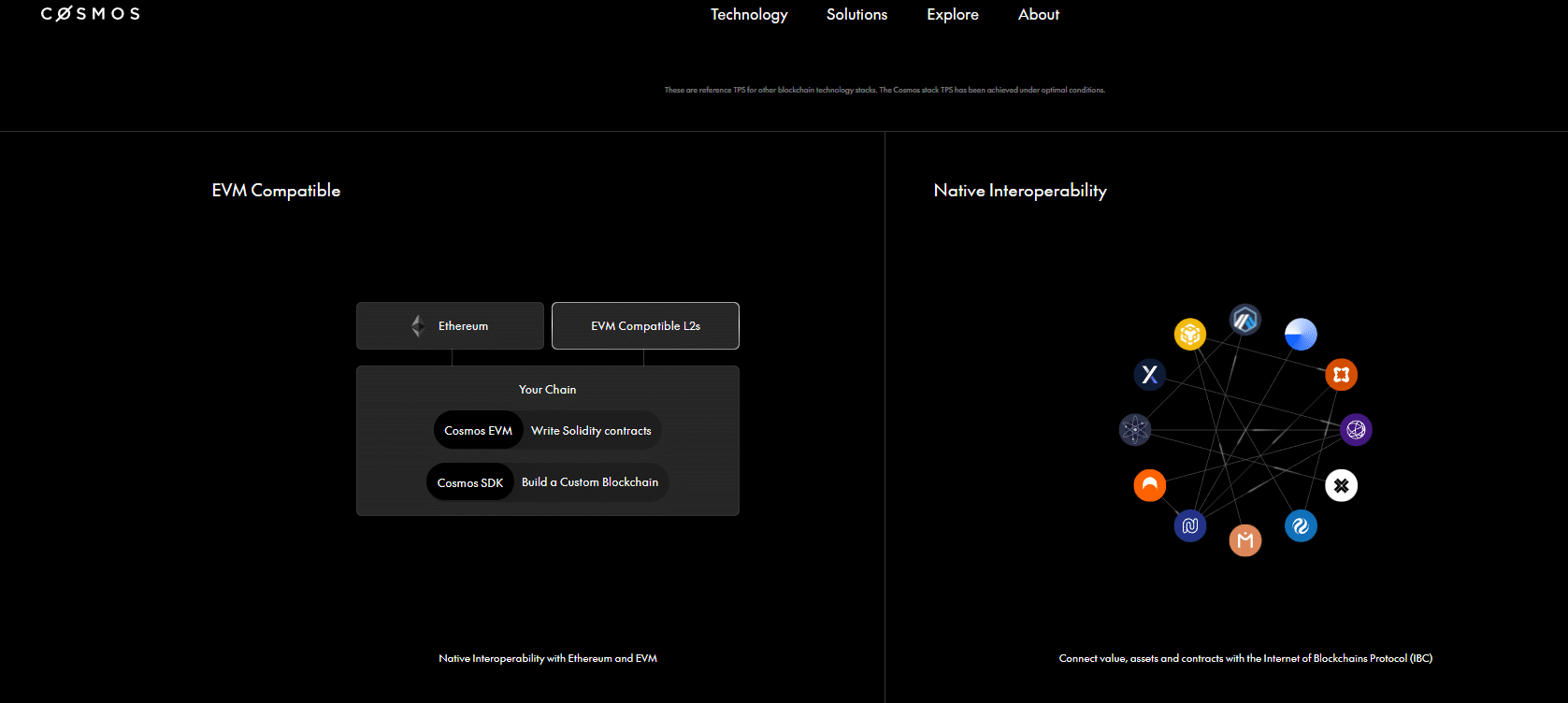
In this “hub-and-spoke” architecture, the IBC acts as a connector, linking independent chains and creating a decentralized network without a centralized bridge.
Meanwhile, the Cosmos SDK is a modular framework for developers to build custom chains. ATOM, the utility currency, is used for paying gas fees on Cosmos. The coin can also be staked for a varying annual yield, allowing holders to earn passive income.
At the same time, ATOM holders can participate in governance, helping shape how the project develops over the years. The more ATOM held or staked, the stronger the voting power. Users can also use ATOM to move value across borders, just as they would with Bitcoin. All ATOM transactions are censorship-resistant and executed on a scalable, low-fee layer.
Is Cosmos (ATOM) a Good Investment?
Cosmos is a popular ecosystem powering many chains, including Cronos. ATOM is available on nearly all top crypto exchanges, making it liquid and appealing to both traders and investors.
The IBC is also emerging as a go-to protocol for cross-chain communication. Factoring in these solid fundamentals, ATOM may be attractive to investors. Still, like other altcoins, ATOM is volatile, and if bears strike as they did in 2022, the coin might slide. For this reason, do your due diligence. If you choose to buy, consider these exchanges:




Later, move your ATOM to the Best Wallet.

The wallet is secure and non-custodial and has features catering to both beginners and advanced users. One of the standout features is its ‘Upcoming Tokens’ section, where users can participate in the best crypto presale projects. It also has a Decentralized Exchange aggregator that finds the best prices for your coins, and the wallet ensures the best security practices to keep your funds safe.
Conclusion
Cosmos could become the “internet of blockchains” per its vision by the decade’s end. If ATOM emerges successfully, it could be one of the best cryptos to buy.
As of Q1 2026, ATOM is struggling under the weight of determined sellers, but our medium- and long-term Cosmos price predictions are bullish. We expect Cosmos to find adoption, drawing developers and users into its ecosystem.
See also:
- Gold (XAU) Price Prediction 2026-2030
- Silver (AUG) Price Prediction 2026-2030
- Raydium (RAY) Price Prediction: 2026–2030
FAQs
What is Cosmos (ATOM)?

Cosmos is a decentralized ecosystem of scalable and interoperable blockchains. ATOM is central to Cosmos and serves various uses, including staking, governance, and paying transaction fees
How does IBC work?
Inter-blockchain communication (IBC) is central to Cosmos, and through this protocol, users can move assets and data trustlessly and securely between Cosmos chains.
What makes Cosmos unique?
Cosmos differs from Ethereum and Solana due to its emphasis on interoperability. All Cosmos chains are modular and scalable, setting them apart from other single-chain solutions.
Is Cosmos better than Polkadot?
While Cosmos and Polkadot focus on interoperability, Cosmos is more flexible, consisting of independent chains that don’t depend on a central hub for security.
Is ATOM a good investment?
ATOM is a popular coin and has had its share of volatility. While prices are down, they might recover, but only time will tell if bulls will breach $44. Before buying ATOM, do your due diligence before investing.
References:
- Gavriilidis, Dimitrios, et al. Blockchain Interoperability: Challenges and Opportunities. CEUR Workshop Proceedings, vol. 3407, https://ceur-ws.org/Vol-3407/paper4.pdf
- Alonso-Monsalve, Saúl, et al. Blockchain Interoperability: A Systematic Literature Review. Journal of Network and Computer Applications, U.S. National Library of Medicine, https://pmc.ncbi.nlm.nih.gov/articles/PMC9329659/
- Association for Computing Machinery. A Brief History of Blockchain Interoperability. Communications of the ACM, https://cacm.acm.org/research/a-brief-history-of-blockchain-interoperability/
- Belchior, Rafael, et al. Blockchain Interoperability: A Feature-Based Classification Framework and Challenges Ahead. ResearchGate, https://www.researchgate.net/publication/369364274_Blockchain_Interoperability_a_Feature-based_Classification_Framework_and_Challenges_Ahead
- Hardjono, Thomas, et al. Interoperable Blockchains. Sheffield Hallam University, https://shura.shu.ac.uk/29863/1/Book%20chapter%20interoperable_clean_version%20copy%20edited.pdf

Why you can trust 99Bitcoins
Established in 2013, 99Bitcoin’s team members have been crypto experts since Bitcoin’s Early days.
Weekly Research
100k+Monthly readers
Expert contributors
2000+Crypto Projects Reviewed