




So far, we’ve looked at crypto mainly as digital money, why it exists, what makes it possible, coins you can buy, sell, or trade, and how to buy them. But there’s more going on beneath the surface than we think. New systems are being built that reimagine how we manage money, ownership, and business operations.
In this module, we’ll look at three of the biggest areas where crypto is breaking new ground: Decentralized Finance (DeFi), Non-Fungible Tokens (NFTs), and Decentralized Autonomous Organizations (DAOs).
Decentralized Finance (DeFi)
In simple words, DeFi (Decentralized Finance) is like online banking without banks, it uses blockchain to let people borrow, lend, trade, and earn interest directly. Everything runs on smart contracts, so no middlemen are needed, just code and transparency.
Since DeFi runs on public blockchains, anyone with internet access can join in. There’s no need for paperwork, the fees are usually lower, and no authority can block or censor your transactions.
Components of DeFi
DeFi works like a full financial ecosystem, and these components are what make it practical and useful. From trading and lending to earning rewards and using stablecoins, each piece solves a real need that traditional banks usually handle. Together, they allow people to access financial services globally, without middlemen, making money more open, flexible, and innovative.
With all these features, DeFi is expanding what’s possible in finance, making it more accessible, flexible, and open. Want a full scoop? Check out our ‘What is DeFi’ guide.
How You Can Lend & Borrow Crypto on a DeFi Platform?
This guide shows beginners how they can lend their crypto to earn interest or borrow crypto using collateral through a DeFi platform. Download a Web3 wallet like Best Wallet or Zengo and fund it with the crypto you want to lend or use as collateral.
Visit a trusted DeFi platform (like Aave or Compound) and connect your wallet directly.
Select the option to lend crypto and start earning interest, or borrow crypto by depositing collateral.
Approve the transaction in your wallet, the smart contract will handle everything automatically.
With just a wallet and internet, you can access lending and borrowing without paperwork, banks, or intermediaries.
Get a Crypto Wallet
Connect to a DeFi Platform
Choose Lend or Borrow
Confirm the Transaction
Here is our video guide to DeFi if you would like more information:
Non-Fungible Tokens (NFTs)
NFTs are like digital collectibles that people sometimes spend a lot of money on. But there’s more to them than just being pricey images. Let’s break down what NFTs actually are, how they work, and the key things you should know before getting involved.
Most crypto coins and tokens are fungible: say, one Bitcoin is the same as another Bitcoin. NFTs, on the other hand, are unique: each one has its own identity, metadata, and something distinct that sets it apart from other NFTs. Think of a trading card or an antique piece; those are non-fungible: unique and not interchangeable.
Creators mint an NFT by deploying a smart contract on a blockchain like Ethereum or Solana. That contract stores info like the token ID, ownership history, and metadata, including a link to the artwork or file itself. The actual digital file (image, video, etc.) is often not stored directly on-chain because that’s expensive. Instead, the NFT points to where the file can be found, for example, a server or some storage solution.
What Makes NFTs Special?
NFTs Use Cases Beyond Art
NFTs aren’t just about digital art, they have many practical uses in everyday life. From gaming and tickets to digital identity and real-world assets, NFTs are opening new doors for how we own and trade things online. Here are some of the top use cases beyond art –
Pros & Cons of Owning NFTs
Pros
Cons
The bigger picture? NFTs push us to rethink what ownership and value mean in the digital age. Read more about it in our dedicated NFT guide for beginners.
Decentralized Autonomous Organizations (DAOs)
Imagine running a company without a CEO and no physical headquarters, just rules coded into smart contracts, and collective decisions made by everyone in the community. That’s a Decentralized Autonomous Organization (DAO).
Every major decision, like how money in the treasury is spent, which new features to introduce, or how the project grows, is voted on by token holders. Once the vote passes, it’s the code that executes the outcome. But let’s have a closer look at how things work.
The very first DAO, launched in 2016, was groundbreaking but collapsed due to security flaws in its code. That failure served as a lesson on what not to do. Since then, DAOs have evolved into far more sophisticated systems with stronger governance, clearer incentives, and built-in checks and balances.
Modern DAOs power new forms of collaboration: venture groups pooling funds, NFT communities managing their own projects, and DeFi protocols where users can vote on upgrades. To avoid centralization, many DAOs experiment with innovative voting models such as delegation, quadratic voting, or reputation-based systems.
How DAOs Work?
You join a DAO by holding governance tokens. Generally, the more tokens you hold, the more voting power you have. Some DAOs use advanced voting models (like quadratic voting, delegated voting, or reputation systems) to balance influence. The downside? Big token holders can dominate votes, which goes against the idea of being truly decentralized.
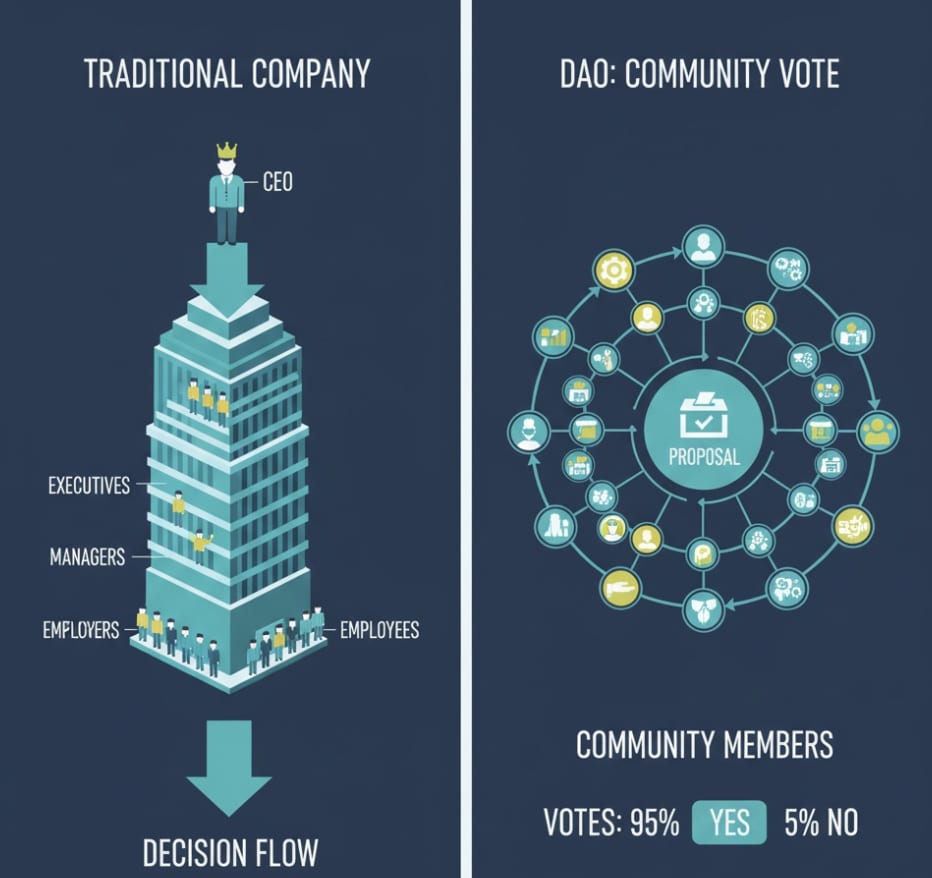
Anyone can propose an idea, and the community votes on it. If the required threshold is met, smart contracts automatically carry out the decision. DAOs also manage a shared treasury of crypto, with transparent rules deciding how funds are used. The risk? Smart contracts can have bugs or flaws that may lead to lost funds. You can read more about it in our comprehensive ‘What is a DAO?’ guide.
Bottom Line
DeFi, NFTs, and DAOs prove that crypto goes beyond the concept of digital money. It’s about building new systems for finance, ownership, and governance, systems that are open, global, and community-driven. These ideas come with certain risks, but they also carry enormous potential. Exploring them gives you a front-row seat to how crypto is shaping what we call the digital economy of the future. The concepts explored in this chapter are part of the greater “Web3” narrative, the building blocks creating the future of the internet of things (IoT). See our Guide to Web3 to explore this concept further.
Chapter Quiz