





In This Article
IOST is a highly scalable blockchain platform with its very own consensus algorithm, Proof of Believability (PoB). It uses sharding to process thousands of transactions per second, making it suitable for running decentralized applications (dApps).
In this post, I’ll cover what makes IOST unique and where you can purchase it from.
How to Buy IOST Summary
- Get a IOST-compatible wallet (Cobo Vault, Guarda).
- Find your IOST address. Sign up to Binance.
- Buy IOST with another cryptocurrency.
- Withdraw your IOST tokens (or leave them on Binance if you plan on trading them)
If Binance doesn’t work for you, consider one of these other top-rated exchanges:




That’s the basics of how to buy IOST! For a more detailed review and step-by-step guide, keep on reading below. I’ll be going covering the following:
What is IOST?
IOST has the same name for both its platform and the token that powers the platform. Before diving into what the IOST token does, we should understand what the IOST platform is, as a whole.
The “IOS” in IOST stands for “Internet Of Services”. The platform is designed to provide the foundation for a service-oriented blockchain ecosystem, which can handle the high traffic required for mass adoption.
By using a special type of sharding (efficient distributed sharding, or EDS) and a new consensus algorithm (Proof-of-Believability), IOST charges zero transaction fees and up to 8,000 transactions per second without sacrificing security. The network is decentralized, with more than 400 nodes in its ecosystem. It’s also developer-friendly, due to its adoption of the widely-popular programming language, Javascript.
The end goal of the platform is to support decentralized alternatives to the popular applications we use and love today, such as Facebook, Amazon and digital asset exchanges.
The Architecture Behind IOST
IOST is built on a modular blockchain architecture designed for high performance and future scalability. At its core is a microservice framework that separates components like consensus, contract execution, storage, and governance. This allows the network to evolve and scale without needing disruptive protocol upgrades.
The system is designed with flexibility in mind. Smart contract execution, state storage, and validator functions all operate independently, enabling rapid upgrades and horizontal scaling. This architecture lays the groundwork for seamless integration of features like Layer 2 protocols, decentralized identity, and real-world asset tokenization—all of which are now part of IOST’s long-term roadmap.
What is the IOST token used for?
The IOS Token (IOST) is the native token of the IOST platform, serving as a medium of exchange for all transactions and fees. It’s also crucial for powering the Proof-of-Believability (PoB) consensus mechanism.
Let’s look at each of the uses in more detail:
- Payments: IOST is the platform’s “money”. It’s the primary medium of exchange on the network for goods and services.
- Rewards and fees: Validators are rewarded in IOST for upholding the network, while users are charged fees in IOST for their use of the network.
- Proof-of-Believability: IOST is used to calculate the believability scores for validators of the network. A validator is more likely to be elected if they have a significant IOST balance and contribution to the community.
As of 2025, IOST has a total supply of 90 billion tokens, with around 22 billion currently in circulation.
Layer 2 and Cross-Chain Innovation on IOST
IOST now supports a Layer 2 framework built to improve scalability, lower transaction costs, and enable real-world adoption. Layer 2 rollups aggregate transactions off-chain, then verify them on the mainnet, making the system faster without compromising on-chain security.
Beyond scale, IOST’s Layer 2 also powers its cross-chain infrastructure. With seamless bridges to BNB Chain and other ecosystems, developers can build cross-chain apps, users can transfer assets across networks, and enterprises can access more liquidity. This makes IOST an extensible hub in the multi-chain future.
Real-World Assets (RWA) on IOST
IOST is building native infrastructure to tokenize real-world assets such as real estate, securities, and collectibles. The goal is to make these assets tradable, divisible, and accessible on-chain without losing legal or regulatory compliance.
This RWA layer includes support for identity binding, legal documentation, and programmable logic, enabling secure on-chain representation of off-chain assets. Combined with DID and payment modules, IOST can support full asset lifecycle management, from issuance and compliance to transfer and redemption.
Decentralized Identity (DID) on IOST
IOST integrates a native decentralized identity system, giving users full control over how their data is used and verified. DIDs allow users to create a blockchain-native identity that can interact with smart contracts, verify credentials, and serve as a login for dApps—without relying on centralized platforms like Google or Facebook.
This system supports self-sovereign access and integrates smoothly with IOST’s tokenized real-world asset platform, payment infrastructure, and staking modules. It also enables verifiable credentials that can be used for KYC-compliant asset issuance or on-chain DAO voting.
Web3 Payments with PayFi and PayPIN
IOST now supports a full payment stack, built with real-world usage in mind. PayFi enables secure, low-fee, and scalable crypto payments. It supports peer-to-peer transfers, on-chain merchant solutions, and retail adoption—making it possible for everyday users to buy goods and services using IOST or other compatible tokens.
PayPIN acts as the user-facing payment tool. Think of it like a Web3-native Apple Pay or Google Pay, designed for crypto. With QR scanning, NFC compatibility, and gas-free transfers, PayPIN lowers the barrier to everyday crypto usage without sacrificing security or control.
How to buy IOST
Step 1: Get an IOST-compatible wallet
Assuming that you want to buy and hold your IOST for the long-term, you’ll want to make sure you have a safe and compatible wallet to store it in.
Leaving your coins on an exchange is risky, since they’re left online and in the hands of a third party (the exchange).
IOST Hardware Wallets
The most secure way to store your IOST is in a hardware wallet. Hardware wallets are physical devices that keep your private keys stored securely offline. This keeps your coins away from an internet connection, where they’re vulnerable to an online attack.
The Cobo Vault is one well-known hardware wallet which claims to support IOST. There are three versions of the Cobo Vault available, ranging in price and features. All models have a touch screen and open-source software.
Unfortunately, our favorite hardware wallets – the Ledger and Trezor – do not yet support IOST.
IOST Software Wallets
Guarda – A non-custodial wallet which is available on iOS, Android and desktop. It supports coins from over 45 blockchains, including IOST. Guarda allows you to customize the fees for the transactions you send, as well as trade coins in their built-in exchange.
TokenPocket – A highly popular multi-chain wallet which supports IOST and several other major blockchains. It allows users to create an IOST account and use DApps, as well as participate in IOST voting. Available on iOS and Android.
Jetstream – A Chrome browser extension wallet, which allows users to interact with IOST decentralized applications in their web browser. It supports 4 languages including English, Korean, Chinese and Japanese.
IWallet Chrome – A Chrome extension wallet made by IOST developers, similar to Ethereum’s Metamask. It allows you to connect directly to IOST dApps within your web browser. The wallet also has an official tutorial on their website, to help you get set up.
For more information and tutorials for setting up an IOST wallet and account, you can visit their official blog on Medium.
Locate Your IOST Address
Once you have your wallet ready to go, you’ll need to create an IOST wallet account/address. Your IOST mainnet address will look like an account name, usually between 5 and 11 characters long. These addresses are much easier to remember than the traditional random string of numbers and letters. An example of this could be “99_bitcoin”.
Step 2: Find an IOST Exchange
Buy IOST Through Best Wallet
Best Wallet is our top pick for users looking for the easiest way to buy crypto directly within a wallet. Best Wallet allows users to buy, sell, and swap crypto from directly within the wallet using the built-in DEX-aggregator.
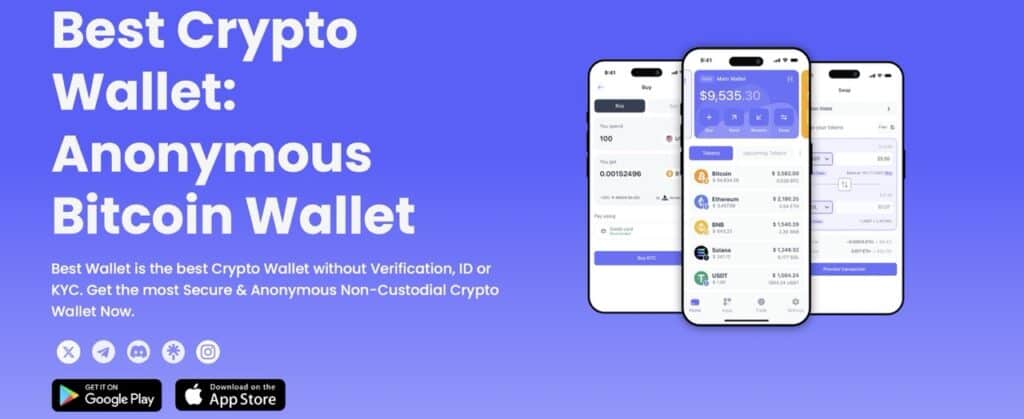
The reason we recommend Best Wallet for new users and those looking for the most friction-free way to buy cryptocurrencies is that by purchasing crypto from directly within a wallet, users lower their risk of exposing themselves to exchange hacks, third-party risks, and the possibility of sending to incorrect addresses when withdrawing from a traditional crypto exchange. The Best Wallet DEX aggregator sources the best rates for users’ swaps, supporting 50+ chains, connecting to over 200 decentralized exchanges, and using up to 20 cross-chain bridges. Users can make both same-chain and cross-chain swaps.
Visit Best WalletBuy IOST through Binance
Binance has been one of the largest cryptocurrency exchanges for several years, known for its wide range of available assets and high trading volumes. Binance has IOST trading pairs with BTC, ETH, BNB and USDT, but you can deposit any of the exchange’s supported currencies to trade your way to IOST.
You can find more information in our complete Binance review.
Buy IOST through OKX
OKX is a cryptocurrency exchange that’s been around since 2017, with headquarters in Malta. They have great trading volume and a huge range of supported cryptocurrencies, including IOST. You can buy IOST by depositing any supported asset and converting it to IOST via BTC or ETH.
Check out our full OKX review to learn more.
Step 3: Withdrawing your IOST Tokens
After you’ve purchased your IOST tokens, you’ll want to take them off the exchange and store them in your wallet for safekeeping.
To do this, copy your IOST wallet address that you located in Step 1 above. Paste this into the address field when you make the withdrawal from the exchange.
This way, you’ll have complete control of your IOST tokens, without the vulnerability of an online hack.
Why Developers Are Choosing IOST
While Ethereum and Solana dominate the dApp conversation, IOST quietly offers one of the most developer-friendly platforms in the industry. Developers can write smart contracts using JavaScript, one of the most accessible and widely used programming languages. This eliminates the steep learning curve associated with Solidity and Rust.
The modular microservice design also means developers can work on scalable dApps without worrying about network congestion or high gas fees. Combined with its built-in support for DID, payments, and cross-chain bridges, IOST is no longer just another alt-L1 — it’s a full-service framework for real-world Web3 deployment.
IOST Account Naming System: A UX Upgrade
Unlike most blockchains that use long, unreadable wallet addresses, IOST uses human-readable account names by default. These usernames typically range from 5 to 11 characters (e.g., john_doe123), making them easier to use, share, and remember. This is especially helpful in Web3 environments where UX still lags behind Web2 apps.
It also aligns with IOST’s focus on real-world usability—when paired with DID, it creates a frictionless login and payment experience across dApps and services.
What’s Next for IOST?
IOST’s roadmap in 2025 and beyond focuses on five pillars: scalability, real-world asset adoption, cross-chain interoperability, decentralized identity, and global payments. As regulators crack down on opaque DeFi and Web3 experiments, IOST is positioning itself as an enterprise-grade blockchain that’s developer-friendly but still compliant-ready.
With active updates, increasing dApp integration, and an infrastructure stack that mirrors real-world financial systems, IOST is now a serious contender in the Web3 race — not just for users and developers, but for institutions too.
Conclusion
IOST is a viable alternative to slower blockchain networks for running high-speed decentralized applications. Its unique scaling techniques (Efficient Distributed Sharding) and consensus algorithm (Proof-of-Believability) make it one of the more interesting blockchain networks available today.

Why you can trust 99Bitcoins
Established in 2013, 99Bitcoin’s team members have been crypto experts since Bitcoin’s Early days.
Weekly Research
100k+Monthly readers
Expert contributors
2000+Crypto Projects Reviewed