




After we explored Bitbase in our Bitbase review, we were particularly impressed with the platform’s fee structure – arguably the best in the market – and thought we would take a deeper dive into Bitbase’s fees and how the VIP program plays into that.
At the base level, Bitbase uses a relatively simple base-fee structure, charging 0.1% for standard spot trades and 0.02% / 0.06% for futures maker and taker orders.
Trading costs then fall across seven VIP levels, with the lowest rates reaching 0.01% / 0.02% on spot trades and 0.005% / 0.02% on USDT-margined futures.
Deposits are generally free, and while crypto withdrawal fees and minimums depend on the asset and blockchain network selected, we found them extremely competitive, especially for traders who move large volumes.
To that end, we explore the fee structures in detail, with all figures correct as of August 2026.
Key Takeaways
- Bitbase’s standard spot trading fee is 0.1% for both makers and takers, equivalent to 1 USDT on a 1,000 USDT trade.
- Standard USDT-M futures fees are lower at 0.02% for makers and 0.06% for takers, rewarding traders whose limit orders add liquidity to the order book.
- Bitbase offers 7 VIP tiers that reduce spot and futures fees according to trading volume or qualifying account balances.
- Crypto deposits are free on the networks listed in Bitbase’s fee schedule, while withdrawal charges vary by asset and blockchain.
- Choosing the correct withdrawal network can make a substantial difference to the final cost, especially when moving stablecoins.
About Bitbase
Bitbase is a centralized cryptocurrency exchange that offers spot markets, USDT-margined perpetual futures, and TradFi trading through one trading account. The platform is an excellent choice for active traders and users who simply want to buy, hold, and sell crypto with low fees.
The exchange’s standard spot market supports limit, market, and conditional orders, while its futures platform offers cross and isolated margin settings, as well as bidirectional positions and leverage limits.
Futures are settled in USDT, making collateral, trading fees, profit, and loss pretty straightforward to track.
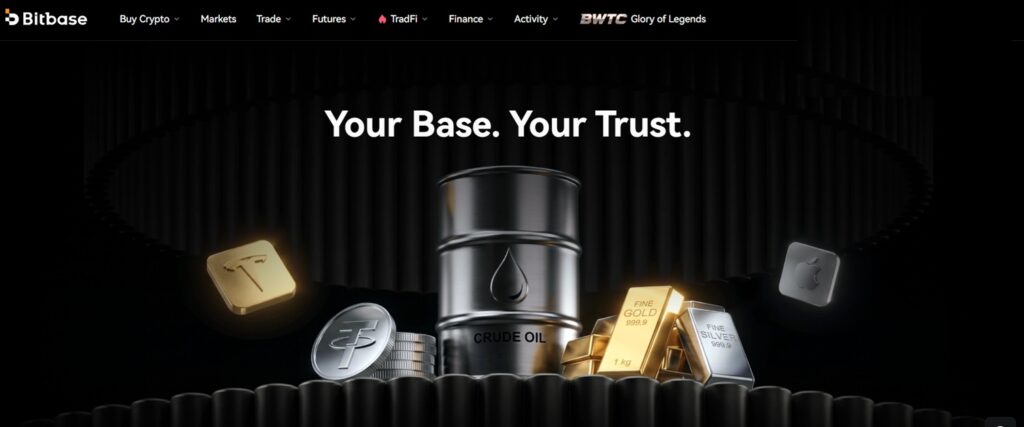
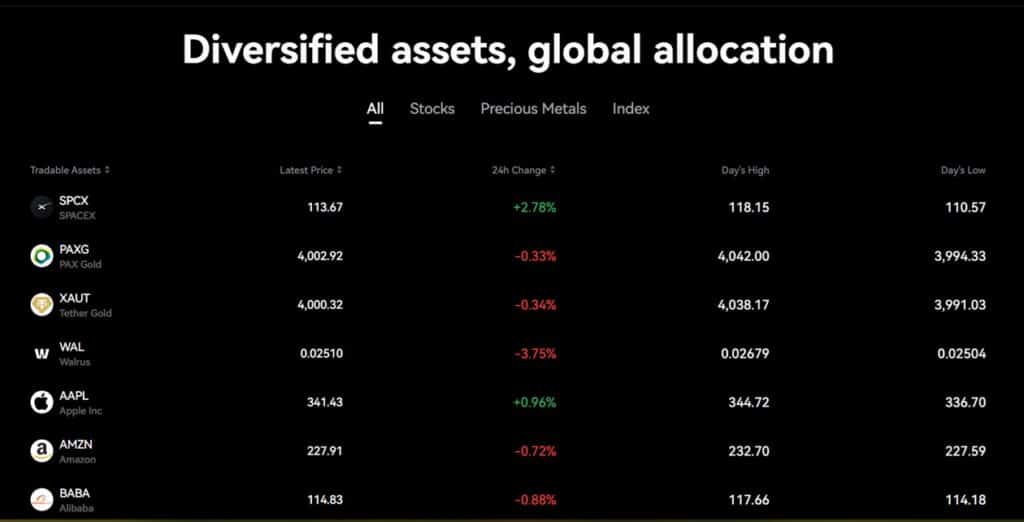
Bitbase also has a live TradFi section with products linked to stocks, precious metals, foreign exchange, crude oil, indices, and digital assets. The platform offers more than 100 TradFi trading pairs, with leverage up to 200x on supported products.
These instruments provide exposure to changes in the price of the asset without requiring a separate conventional brokerage account – they should not be confused with direct ownership of the underlying shares, commodities, or currencies, but are a simple way to get exposure to price movements.
One advantage of Bitbase is that the initial account registration does not necessarily require users to complete the full KYC identity-verification process before they start trading. It’s not completely anonymous trading, however – verification may still be required for fiat purchases, withdrawals, higher limits, and so forth, but it makes for an easier way to get started.
In our full review, we also assessed Bitbase’s security, including hot- and cold-wallet separation, MPC-based multi-signature controls, and other institutional-grade measures.
How Fees Work on Bitbase
Bitbase divides its main fees into trading fees, funding payments, crypto withdrawal charges, and fees by third-party fiat providers.
Trading fees are applied when an order executes, and are calculated against the value of the completed trade rather than the amount deposited into the account.
The amount paid depends on whether the order is classified as a maker or taker:
- A maker order enters the order book without immediately matching an existing order. It adds liquidity and normally receives the lower futures fee.
- A taker order matches immediately against liquidity already available in the order book. Market orders will generally be taker orders, along with aggressively priced limit orders.
At the standard VIP0 level, spot makers and takers both pay 0.1% – so a completed 1,000 USDT spot trade would therefore incur a 1 USDT trading fee.
The corresponding futures fees are 0.02% for makers and 0.06% for takers, so a futures order with a notional value of 10,000 USDT would equal 2 USDT as a maker or 6 USDT as a taker.
Futures traders should remember that notional trade value is not the same as the collateral committed. Leverage may allow a trader to control a larger position with a smaller margin balance, but the trading fee is still based on the full position value.
Fee Structure
Bitbase Futures Fees
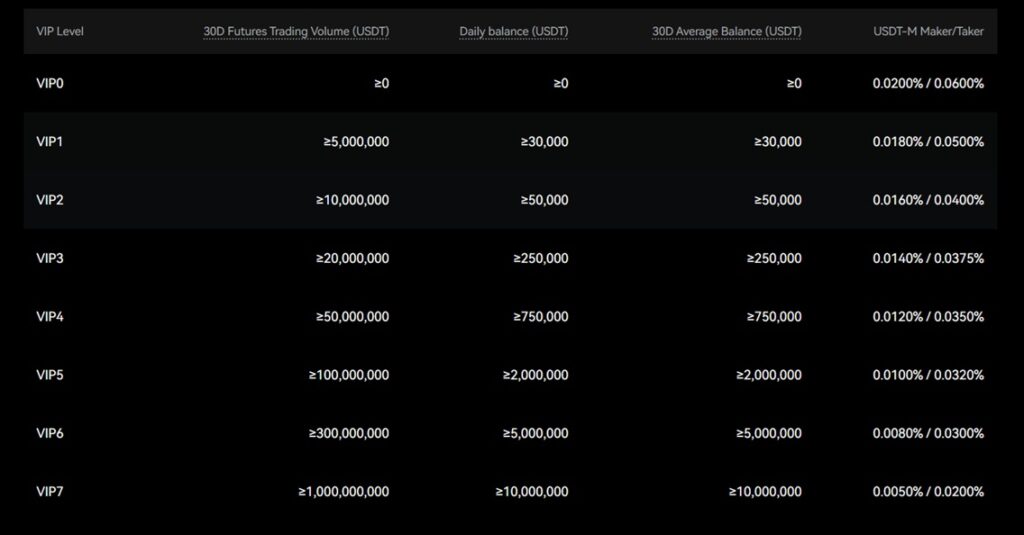
Bitbase’s standard USDT-M futures fees begin at 0.02% for makers and 0.06% for takers. The maker rate decreases with each VIP level, reaching an excellent 0.005% at VIP7.
| VIP Level | 30D Futures Trading Volume (USDT) | Daily Balance (USDT) | 30D Average Balance (USDT) | USDT-M Maker Fee | USDT-M Taker Fee |
| VIP0 | ≥0 | ≥0 | ≥0 | 0.020% | 0.060% |
| VIP1 | ≥500,000 | ≥30,000 | ≥30,000 | 0.018% | 0.050% |
| VIP2 | ≥2,000,000 | ≥50,000 | ≥50,000 | 0.016% | 0.040% |
| VIP3 | ≥8,000,000 | ≥250,000 | ≥250,000 | 0.014% | 0.0375% |
| VIP4 | ≥30,000,000 | ≥750,000 | ≥750,000 | 0.012% | 0.035% |
| VIP5 | ≥50,000,000 | ≥2,000,000 | ≥2,000,000 | 0.010% | 0.032% |
| VIP6 | ≥75,000,000 | ≥5,000,000 | ≥5,000,000 | 0.008% | 0.030% |
| VIP7 | ≥100,000,000 | ≥10,000,000 | ≥10,000,000 | 0.005% | 0.020% |
The standard maker fee is already reasonably tight for a derivatives exchange, and then VIP discounts become even better for high-frequency traders – futures volume can accumulate quickly when positions are opened, adjusted, and closed.
The difference between maker and taker pricing also becomes big at scale. At VIP0, a 1 million USDT futures order costs 200 USDT as a maker or 600 USDT as a taker. At VIP7, the equivalent fees fall to 50 USDT and 200 USDT.
Bitbase Spot Fees
Bitbase charges the same 0.1% rate to spot makers and takers at VIP0. Discounts begin at VIP1, where makers pay 0.08% and takers pay 0.09%.
| VIP Level | 30D Spot Trading Volume (USDT) | Daily Balance (USDT) | 30D Average Balance (USDT) | Maker Fee | Taker Fee |
| VIP0 | ≥0 | ≥0 | ≥0 | 0.100% | 0.100% |
| VIP1 | ≥500,000 | ≥30,000 | ≥30,000 | 0.080% | 0.090% |
| VIP2 | ≥2,000,000 | ≥50,000 | ≥50,000 | 0.070% | 0.080% |
| VIP3 | ≥8,000,000 | ≥250,000 | ≥250,000 | 0.050% | 0.060% |
| VIP4 | ≥30,000,000 | ≥750,000 | ≥750,000 | 0.040% | 0.050% |
| VIP5 | ≥50,000,000 | ≥2,000,000 | ≥2,000,000 | 0.030% | 0.040% |
| VIP6 | ≥75,000,000 | ≥5,000,000 | ≥5,000,000 | 0.020% | 0.030% |
| VIP7 | ≥100,000,000 | ≥10,000,000 | ≥10,000,000 | 0.010% | 0.020% |
The flat 0.1% starting rate makes Bitbase easy to calculate – a 100 USDT trade costs 0.10 USDT, a 1,000 USDT trade costs 1 USDT, and a 10,000 USDT trade costs 10 USDT.
VIP7 cuts those figures substantially, where a 10,000 USDT spot order costs 1 USDT as a maker or 2 USDT as a taker.
Bitbase says VIP levels are updated daily, and our figures are correct at publication – you can check the latest figures on the rates page. Users can qualify through their spot volume, futures volume, current asset balance, or 30-day average asset balance, with the highest qualifying level applied. Eligible balances can include assets held across spot, futures, and Earn accounts, converted to a USDT equivalent.
This is especially useful for traders whose activity is split across different products, who may qualify for a higher tier through futures volume and then receive the corresponding lower spot rate.
Bitbase Deposit and Withdrawal Fees
Bitbase does not charge a deposit fee for many crypto assets and networks – we’ve taken a sprinkling of them below as examples.
Withdrawal costs are more complicated because each blockchain has its own fees, minimum withdrawal amounts, and account limits.
| Coin | Network | Deposit Fee | Withdrawal Fee | Minimum Withdrawal |
| BTC | Bitcoin | Free | 0.000015 BTC | 0.00008 BTC |
| BTC | BNB Smart Chain | Free | 0.00000028 BTC | 0.00002 BTC |
| ETH | Ethereum | Free | 0.00002 ETH | 0.002 ETH |
| ETH | Arbitrum | Free | 0.0000016 ETH | 0.001 ETH |
| USDT | TRON | Free | 1 USDT | 3 USDT |
| USDT | TON | Free | 0.1 USDT | 0.1 USDT |
| USDT | Ethereum | Free | 0.39 USDT | 10 USDT |
| USDT | BNB Smart Chain | Free | 0.01 USDT | 5 USDT |
| USDT | Arbitrum | Free | 0.05 USDT | 1 USDT |
| USDT | Solana | Free | 0.25 USDT | 10 USDT |
| BNB | BNB Smart Chain | Free | 0.00001 BNB | 0.004 BNB |
| SOL | Solana | Free | 0.000374 SOL | 0.1 SOL |
| USDC | Ethereum | Free | 0.5 USDC | 5 USDC |
| USDC | BNB Smart Chain | Free | 0.01 USDC | 10 USDC |
| USDC | Solana | Free | 0.23 USDC | 20 USDC |
| DOGE | Dogecoin | Free | 0.32 DOGE | 120 DOGE |
Key Reasons We Like Bitbase
Bitbase’s base trading fees are one of its best strengths – the 0.1% spot rate is transparent and easy to calculate, while the 0.02% futures maker fee is particularly attractive for active derivatives traders using resting limit orders.
The VIP program also offers frequent traders an excellent way to reduce costs, and Bitbase does not limit qualification to a single metric. The platform compares spot volume, futures volume, current assets, and average assets, then assigns the highest VIP tier for which the account qualifies.
The combination of spot and USDT-margined futures is another strong point, meaning everything is under one roof, but also in its own room. Spot users can purchase crypto assets, while experienced derivatives traders can use perpetual contracts to take long or short positions.
Fiat on-ramping makes the exchange accessible to users who do not already hold crypto, although these purchases can involve separate provider fees, payment method charges, conversion costs, and identity checks, so they should not be confused with Bitbase’s spot trading fee.
The live TradFi section is excellent – now you can access products linked to stocks, indices, precious metals, forex, crude oil, and digital assets alongside their crypto positions. Bitbase has more than 100 TradFi pairs, so traders do not need to move funds between a crypto exchange and a separate conventional trading platform.
We also like the onboarding process, which doesn’t immediately need the full KYC process. Verification is still relevant for withdrawals, fiat purchases, and some other features, but delaying it until necessary means you can get going quickly.
Overall, Bitbase presents a very competitive fee structure without making the entry-level rates difficult to understand. Standard spot fees are predictable, futures makers receive a substantial discount over takers, and higher-volume users can reduce both through the VIP system.
Sign Up to BitbaseFAQs
What are Bitbase’s spot trading fees?

Bitbase charges 0.1% for both maker and taker spot trades at VIP0. Fees fall to 0.01% for makers and 0.02% for takers at VIP7.
What are Bitbase’s futures trading fees?
Standard USDT-M futures fees are 0.02% for makers and 0.06% for takers. VIP7 rates fall to 0.005% and 0.02%, respectively.
How does the Bitbase VIP program work?
Bitbase has seven VIP tiers based on trading volume or qualifying account balances. The highest eligible tier is applied and updated daily.
Does Bitbase charge crypto deposit fees?
Bitbase generally does not charge fees for supported crypto deposits. Users should still confirm that they are sending funds through the correct blockchain network.
How much does Bitbase charge for withdrawals?
Bitbase withdrawal fees vary by cryptocurrency and network. Choosing a lower-cost supported network can significantly reduce the fee.

Why you can trust 99Bitcoins
Established in 2013, 99Bitcoin’s team members have been crypto experts since Bitcoin’s Early days.
Weekly Research
100k+Monthly readers
Expert contributors
2000+Crypto Projects Reviewed