




In This Article
- Cryptocurrencies to Watch in 2026
- Next Crypto to Explode in 2026
- Comparison of the Next Crypto Coins to Explode
- How We Picked the Next Crypto to Explode (Methodology)
- Early Stage Access: How to Buy The Next Crypto to Explode Before CEX Listings
- What Drives Major Crypto Price Surges?
- How to Spot Crypto Coins Ready to Surge?
- Factors to Consider Before Investing in High-Potential Coins
- Conclusion: Next Crypto to Explode
Finding the next crypto to explode in 2026 is no longer about hype threads or viral memes; it comes down to data: rising on-chain activity, accelerating developer commits, growing liquidity, and alignment with the narratives currently pulling capital, including Bitcoin Layer-2 scaling, AI-linked tokens, tokenized real-world assets, and onchain derivatives trading.
Most new tokens never gain lasting traction. This guide tracks the small number of projects showing measurable adoption and improving token economics, and we revisit the list and each project’s presale progress on an ongoing basis, so what you’re reading reflects where things stand now. This update also adds coverage of the onchain-derivatives and real-world-asset narratives, two of the fastest-growing segments of the current cycle, alongside the Layer-2 and AI angles we already track
Cryptocurrencies to Watch in 2026

- New Bitcoin L2 presale offering massive staking rewards
- By using a SVM Bitcoin Hyper is revolutionizing Bitcoin's potential
- Early buyers can use $HYPER tokens for transactions, staking, and ecosystem governance
 Bank Card
 BNB
BNB ETH
ETH- +1 more

- Unified liquidity across Bitcoin, Ethereum, and Solana
- Faster trading, deeper liquidity, and secure cross-chain capital flow
- Potential to increase interconnectivity for developers
- ETH
 USDT
USDT USDC
USDC- +3 more


- The "Final Form" of Doge- The Ultimate Evolution of Dog-Themed Memecoins
- 25% of Supply Goes to Future Partnerships & Events
- Proof of Workout/Proof of Winning- Maximum Meme Embodiment
- ETH
- BNB
- USDC
- +2 more

- Native token of a leading crypto interest platform
- Earn 19%-25% APR by depositing into compound interest accounts
- Governance token that gives holders voting rights
- Bank Card
- ETH
- USDT

- First AI-Focused Content Creation & Premium Platform
- 250M+ Combined Following
- Staking + Creator Benefits
- Bank Card
- USDT
- ETH
- +2 more

- AI-driven platform that aims to deliver next-gen forex trading strategies
- The project acts as the broker itself, sustaining its model through rebates and buybacks from trades
- VFX token is used for staking, rebates, card access, and governance rights
- USDC
Key Takeaways
- There is no guaranteed “next crypto to explode,” but projects with rising on-chain activity, liquidity, and real usage tend to outperform over time.
- Early-stage presale tokens can offer upside, but they also carry higher risk due to limited track records and unproven execution.
- Strong use cases, clear token utility, and active development are more reliable indicators than social media hype.
- Established cryptocurrencies can still see meaningful gains when network usage, adoption, or ecosystem growth accelerates.
- Diversification and risk management matter, especially when investing in volatile or early-stage crypto assets.
Next Crypto to Explode in 2026
The cryptocurrencies on this list were selected based on on-chain activity, liquidity trends, and real-world use cases, the same criteria outlined above. Each project showed early signs of momentum that set it apart from the broader market, and we’ve focused on options that appear well-positioned heading into 2026.
| Crypto Project | Main Benefit | Why It Could Explode! |
| Bitcoin Hyper | Bitcoin L2 Scaling Solution |
Nobody has created a good scaling solution for Bitcoin yet. First project to succeed will likely do very well
|
| LiquidChain | Unified Liquidity Between BTC, ETH, SOL |
Fragmented liquidity is a problem for all crypto ecosystems. Unlocking liquidity between the three largest networks would be a massive benefit
|
| Maxi Doge | Early Stage Ethereum Presale |
Gym/leverage-themed meme brand with staking and contest mechanics aimed at the next meme-coin cycle
|
| SUBBD | AI Agent Creator Platform |
AI agents are huge, creator platforms like OnlyFans are massive, this combines both and runs on crypto rails
|
| VortexFX | Automated Forex and tokenization trading platform | Providing the ability to trade multiple different tokenized assets autonomously on one platform |
| SpaceXRP | Meme Coin Project on Ripple |
Meme coins are popular, XRP is popular- Do we need to say more?
|
| Gassed Token | Solana Based Meme Coin |
Next meme coin supercycle could see this project explode thanks to its small market cap
|
| Uniswap | #1 DEX In the World |
Massive utility and huge adoption. Will likely increase with institutional and retail adoption
|
| Solana | #1 Ethereum Competitor |
Home of meme coins and trading. Could capture a fraction of ETH’s market share
|
| Jupiter | Decentralized Exchange Aggregator |
Aggregators like 1Inch are massive, Jupiter is a next-gen aggregator
|
| Chainlink | #1 Oracle |
LINK has massive institutional adoption and is the #1 oracle in the world with hundreds of partnerships from RWA to DePIN
|
| Hyperliquid | Layer 1 for decentralized trading | Hyperliquid is the fastest growing and highest TVL decentralized exchange for the trading of multiple different assets. |
Which Crypto Will Rise in 2026: 99Bitcoins’ Research
Trying to predict which crypto will explode in 2026 is exciting, but also challenging. With hundreds of new projects launching every month, only a few will deliver real growth. The biggest winners are usually the ones solving real problems, building strong communities, and gaining real-world adoption. In this section, we’ll look at the cryptocurrencies with the best chance of breaking out and delivering strong returns this year.
1. Bitcoin Hyper (HYPER): Unlocking DeFi For Bitcoin Holders
- Presale project: Bitcoin Hyper (HYPER)
- Presale price: $0.01368720
- Raised so far: $33.17M
- Number of participants: 114,588
- Blockchain: Ethereum
- Token type: ERC-20
- Accepted payment methods: ETH, BTC, BNB, USDT, Card
- Round ends: Ended
- Audits: Bitcoin Hyper has been audited by SolidProof, Coinsult, and SpyWolf and found to have no major vulnerabilities.
Bitcoin Hyper (HYPER) is a proposed Layer-2 network designed to address Bitcoin’s limits around speed, fees, and programmability. The project keeps Bitcoin as the settlement layer while shifting execution to a faster Layer-2 blockchain.
Bitcoin Hyper plans to use the Solana Virtual Machine (SVM) to support smart contracts and decentralized applications with low latency, and intends to settle final transaction data back on Bitcoin.
This structure is intended to preserve Bitcoin’s security model while enabling DeFi use cases such as trading, payments, lending, staking, and other on-chain applications that are not natively supported on Bitcoin due to its lack of smart contracts.
Bitcoin Hyper has not launched its mainnet yet, with a release targeted for 2026. Until then you can read our Bitcoin Hyper review where we break down the token’s presale structure, audits, and roadmap in more detail.
Should You Consider Investing in Bitcoin Hyper (HYPER)?
- Proposed Bitcoin Scaling Approach: Designed to improve transaction speed and flexibility by moving execution to a Layer-2 network while settling back to Bitcoin.
- Layer-2 Architecture: Planned as a Bitcoin-focused Layer-2, with performance and functionality dependent on successful mainnet delivery.
- SVM-Based Execution: Intends to use the Solana Virtual Machine to support smart contracts and decentralized applications.
- Bridge Design: Outlines a decentralized canonical bridge to allow BTC to be used within the Layer-2 ecosystem.
- Expanded Use Case Scope: Aims to support DeFi-style applications such as payments, trading, and staking once the network is live.
- Roadmap-Driven Development: Includes presale, testnet, mainnet, and exchange listing milestones extending into 2026.
- Public Presale Structure: Tokens are distributed through a public presale with no private or insider rounds disclosed at the time of writing.
- Staking Mechanism: Includes a staking feature scheduled to begin after token generation, subject to network rollout.
Expert Summary: Pros and Cons of Bitcoin Hyper (HYPER)?
Pros
-
Targets a clear Bitcoin limitation by adding faster execution and smart contract support via a Layer-2 design.
-
Uses the Solana Virtual Machine (SVM), which is already proven in high-throughput blockchain environments.
-
Proposes a non-custodial bridge model, aiming to reduce reliance on centralized BTC wrappers.
-
Public presale structure with no private or insider rounds disclosed, which may reduce early sell pressure.
-
Smart contracts have been audited by SolidProof, Coinsult, and SpyWolf with no critical issues reported.
Cons
-
The mainnet has not launched yet, with delivery expected in 2026, increasing execution risk.
-
Adoption is unproven, as there is no live network activity or user traction to evaluate yet.
-
Layer-2 competition on Bitcoin is growing, with multiple projects targeting similar scalability use cases.
-
The value of the HYPER token depends heavily on future network usage that has not materialized yet.
-
Presale investments carry higher risk due to uncertain timelines, regulation, and market conditions.
2. LiquidChain (LIQUID) – Layer-3 Network Focused on Cross-Chain Liquidity
- Presale project: LiquidChain (LIQUID)
- Presale price: $$0.01475
- Raised so far: $988,585
- Number of participants: TBA
- Blockchain: Ethereum
- Token type: ERC-20
- Accepted payment methods: ETH, BNB, SOL, USDT, USDC, Card
- Round ends: TBA
- Audits: LiquidChain has been audited by industry leaders CertiK and SpyWolf, with no critical vulnerabilities found.
LiquidChain (LIQUID) is a proposed Layer-3 liquidity and settlement network designed to enable asset movement across Bitcoin, Ethereum, and Solana from a single execution layer. LiquidChain focuses on blockchain interoperability between major blockchains by offering unified access to liquidity rather than relying on traditional wrapped assets or third-party bridges.
According to its whitepaper, LiquidChain aims to leverage existing consensus and validator infrastructure from connected chains while handling execution at the Layer-3 level. This approach is intended to allow faster cross-chain interactions without requiring users or developers to manually bridge assets between networks.
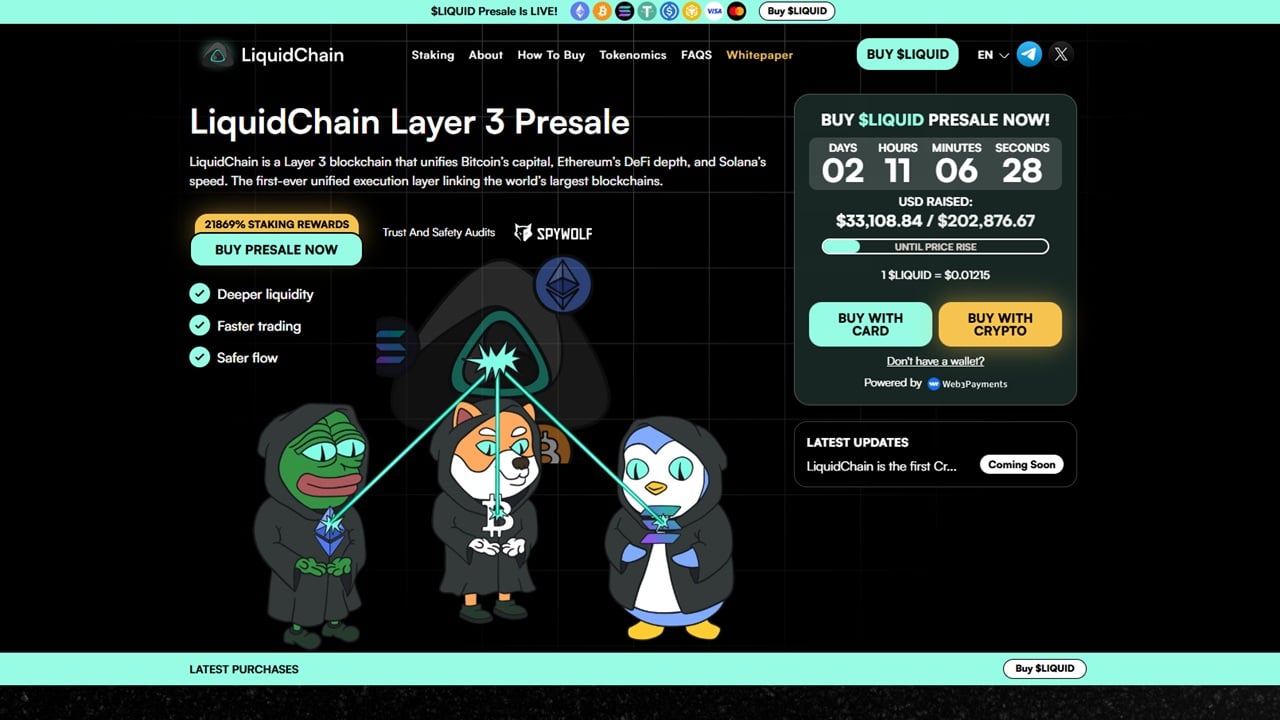
LiquidChain is positioned as a developer-focused platform, offering “build once, deploy everywhere” tooling so applications can serve users across BTC, ETH, and SOL ecosystems simultaneously. Planned use cases include cross-chain DeFi, token swaps, and access to liquidity pools spanning multiple networks.
The network has not launched its mainnet yet. Based on the roadmap, post-launch utility and exchange listings are expected to follow after core infrastructure milestones are completed, with timelines extending into 2026.
Should You Consider Investing in LiquidChain (LIQUID)?
- Cross-Chain Liquidity Focus: Designed to aggregate liquidity across Bitcoin, Ethereum, and Solana without requiring multiple bridges.
- Layer-3 Architecture: Proposes execution above existing Layer-1 and Layer-2 networks, which may reduce congestion and improve composability.
- Developer-Oriented Design: Includes tooling intended to let applications operate across multiple ecosystems from a single deployment.
- Bridge-Minimization Approach: Aims to reduce reliance on traditional wrapped assets, which have historically introduced security risks.
- Roadmap-Based Development: Utility, listings, and broader adoption depend on successful delivery of planned milestones through 2026.
Expert Summary: Pros and Cons of LiquidChain (LIQUID)
Pros
-
Targets a well-known DeFi problem by addressing liquidity fragmentation across major blockchains.
-
Layer-3 design avoids competing directly with Layer-1s while building on their existing security models.
-
Focuses on developer adoption through cross-chain deployment tools rather than consumer speculation alone.
-
Smart contracts have been audited by CertiK and SpyWolf with no critical issues reported at the time of review.
Cons
-
The network is not live yet, so performance and security assumptions remain untested in production.
-
Cross-chain infrastructure is highly competitive, with many protocols pursuing similar interoperability goals.
-
Token value depends on future adoption by developers and liquidity providers, which is not guaranteed.
-
As a presale project, LIQUID carries higher execution and timeline risk than established networks.
3. Maxi Doge (MAXI) – An Early-Stage Ethereum Meme Coin
- Presale project: Maxi Doge (MAXI)
- Presale price: $0.00028425
- Raised so far: $4.87M
- Number of participants: 25,912
- Blockchain: Ethereum
- Token type: ERC-20
- Accepted payment methods: ETH, BTC, BNB, USDT, USDC, Card
- Round ends: 1 days, 13 hours
- Audit: Maxi Doge has been audited by Coinsult and SolidProof and has no critical vulnerabilities or risks found.
Maxi Doge (MAXI) is an Ethereum-based meme coin currently offered through a public presale. The project is built around exaggerated “max leverage” and gym-themed branding.
According to its whitepaper, Maxi Doge is designed as a community-driven token focused on engagement, contests, and speculative participation. It does not aim to introduce new blockchain infrastructure or utility beyond token-based incentives.
MAXI includes a staking mechanism during the presale phase, allowing holders to lock tokens for rewards distributed by smart contract. The long-term sustainability of these rewards depends on post-launch participation and demand.
The project allocates 25% of its total supply to a treasury used for liquidity, marketing, and partnerships. Future integrations, including trading-related promotions, remain dependent on execution after launch.
Should You Consider Investing in Maxi Doge (MAXI)?
- Meme-first Viral Marketing: Gym/bro humor and meme culture are core to the brand, designed to generate organic social virality.
- Clear Hype-driven Roadmap: Staged presale, influencer & PR blitz, then CEX listings to turbocharge volume.
- Community Gamification & Contests: Holder-only competitions and trading leaderboards drive engagement and FOMO.
- Token Utility + Staking: ERC-20 token with staking rewards and contest incentives encourages holding and locks liquidity.
- Treasury & Partnership Strategy: Dedicated treasury for liquidity, marketing and partnerships (energy-drink style tie-ins hinted) to fund growth.
Expert Summary: Pros and Cons of Maxi Doge (MAXI)
Pros
-
Clear meme-first branding that aligns with established dog-themed crypto culture.
-
Public presale with disclosed token allocation and staking mechanics.
-
Includes community features such as contests and leaderboards designed to encourage engagement.
-
Smart contracts have been audited by third-party firms with no critical issues reported at the time of review.
Cons
-
Does not offer a clear utility beyond community participation and speculative trading.
-
Highly dependent on social momentum, which can be short-lived in meme-driven markets.
-
Long-term demand, liquidity, and adoption cannot be assessed until after launch and listings.
-
Like most presale meme coins, carries a higher risk profile than established crypto assets.
4. SUBBD (SUBBD) – Web3 Creator Platform Built Around AI and Tokenized Access
SUBBD (SUBBD) is a content and subscription platform designed to give creators more control over monetization while reducing reliance on traditional platforms. Instead of fixed platform fees, SUBBD uses a token-based system to support subscriptions, access, and rewards.
The project integrates AI-driven tools aimed at helping creators produce and manage content more efficiently. These include AI profile creation, voice generation, image tools, and automated livestream features, all intended to support scalable creator workflows.

SUBBD also introduces tokenized participation for fans. By using SUBBD, users can unlock exclusive content, pay for custom creator requests, and access platform features, allowing fans to participate more directly in creator ecosystems.
The platform and its AI features are still under development. According to the roadmap, the beta platform, token generation event, and exchange listings are planned after the presale phase.
SUBBD tokens can be purchased during the presale through supported wallets such as Best Wallet, which allows users to participate in other top presales, manage tokens, and stake assets from a single interface.
Should You Consider Investing in SUBBD (SUBBD)?
- Creator-Focused Monetization Model: Designed to reduce platform fees and give creators more direct control over income.
- AI-Assisted Content Tools: Plans to integrate AI for content creation, personalization, and automation.
- Token-Gated Access: Uses SUBBD for subscriptions, exclusive content, and creator interactions.
- Staking and Reward Features: Includes staking and incentive mechanisms tied to platform participation.
- Roadmap-Dependent Utility: Platform value depends on successful rollout of AI tools and creator adoption.
Expert Summary: Pros and Cons of SUBBD (SUBBD)
Pros
-
Targets a large and established creator economy with a Web3-native monetization approach.
-
Combines content subscriptions with AI tools intended to improve creator efficiency.
-
Token utility is clearly defined around access, rewards, and platform usage.
-
Smart contracts have been audited by SolidProof and Coinsult with no critical issues reported.
Cons
-
The platform is not fully live yet, so real user adoption cannot be assessed.
-
The creator economy is highly competitive, including both Web2 and Web3 platforms.
-
AI features remain roadmap-based and may take time to reach maturity.
-
As a presale project, SUBBD carries higher execution and delivery risk than established platforms.
5. Vortex FX (VFX) – Automated Forex Trading With Tokenized Revenue Access
- Presale project: Vortex FX (VFX)
- Presale price: $0.355 (final public round)
- Raised so far: $2.21M
- Blockchain: Solana
- Token type: SPL
- Accepted payment methods: USDC, crypto
- Audits: VFX token contracts have been audited by SolidProof.
Vortex FX (VFX) is a brokerage app that uses automated, AI-assisted strategies to execute trades across forex, commodities, indices, and related markets. Unlike platforms that only offer signals or copy trading, Vortex FX operates as the broker itself and manages execution internally.
The platform integrates with MetaTrader 5, allowing users to view managed trading activity through read-only investor access. According to the project, trading is fully automated and runs during defined daily sessions, with periodic maintenance windows.
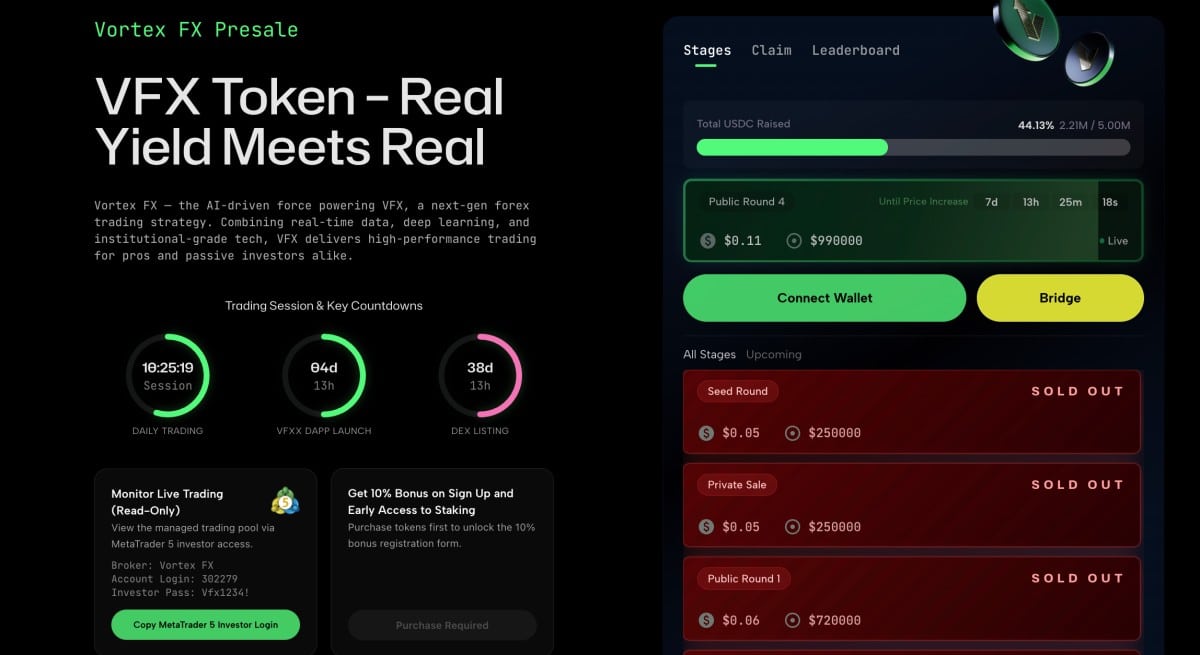
The VFX token is designed as a utility and revenue-linked asset within the Vortex FX ecosystem. Token holders can stake VFX to receive rewards funded by broker trading activity, access platform features, and participate in governance. Returns are described as dependent on actual trading performance rather than fixed emissions.
Vortex FX states that presale funds are deployed into managed trading strategies, with performance data shared periodically. Public liquidity and token trading are scheduled following the planned DEX listing in Q3 2026.
Should You Consider Investing in Vortex FX (VFX)?
- Broker-Operated Model: Vortex FX acts as the broker rather than an intermediary, meaning rebates and rewards are generated internally.
- Automated Trading Strategy: Uses AI-assisted execution designed to operate without manual user intervention.
- Real-Yield Structure: Token rewards are linked to trading activity instead of inflationary token emissions.
- Staking and Utility Access: VFX enables staking, DAO participation, and access to cards and platform features.
- Execution-Dependent Outcomes: Token value and rewards depend on sustained trading performance and platform usage.
Expert Summary: Pros and Cons of Vortex FX (VFX)
Pros
-
Operates as a broker rather than a fee-sharing intermediary, reducing reliance on third parties.
-
Uses automated trading with transparent MetaTrader 5 read-only access for monitoring activity.
-
Token rewards are tied to real trading activity rather than fixed token inflation.
-
Includes multiple utility paths such as staking, governance, and crypto-linked cards.
-
Smart contracts have been audited by SolidProof at the time of review.
Cons
-
Returns are not guaranteed and depend entirely on live trading performance.
-
Forex and automated trading strategies carry inherent financial risk, including drawdowns.
-
Token utility and demand depend on continued broker activity and user participation.
-
Regulatory exposure varies by jurisdiction and may impact availability or operations.
-
As a tokenized trading platform, long-term sustainability cannot be fully assessed pre-listing.
6. SpaceXRP (SPACEXRP) – XRP-Themed Meme Project on Ethereum
- Presale project: SpaceXRP (SPACEXRP)
- Presale price: $0.0003035
- Raised so far: +$700K
- Blockchain: Ethereum
- Token type: ERC-20
- Accepted payment methods: ETH, BNB, USDT, USDC, Card
- Audits: Project states a security audit has been completed.
- Disclaimer: SpaceXRP is community-run and not affiliated with Ripple, XRP, SpaceX, or Elon Musk.
SpaceXRP (SPACEXRP) is a community-driven meme token that positions itself around XRP news cycles. The project turns XRP headlines into themed quests, contests, and “Boosters On” events led by its mascot, Dripple.
The roadmap includes an XRP news ticker (“Barkcaster”), daily quests tied to headlines, and NFT drops for active participants. Token holders can also access community missions and future voting features if governance is launched.
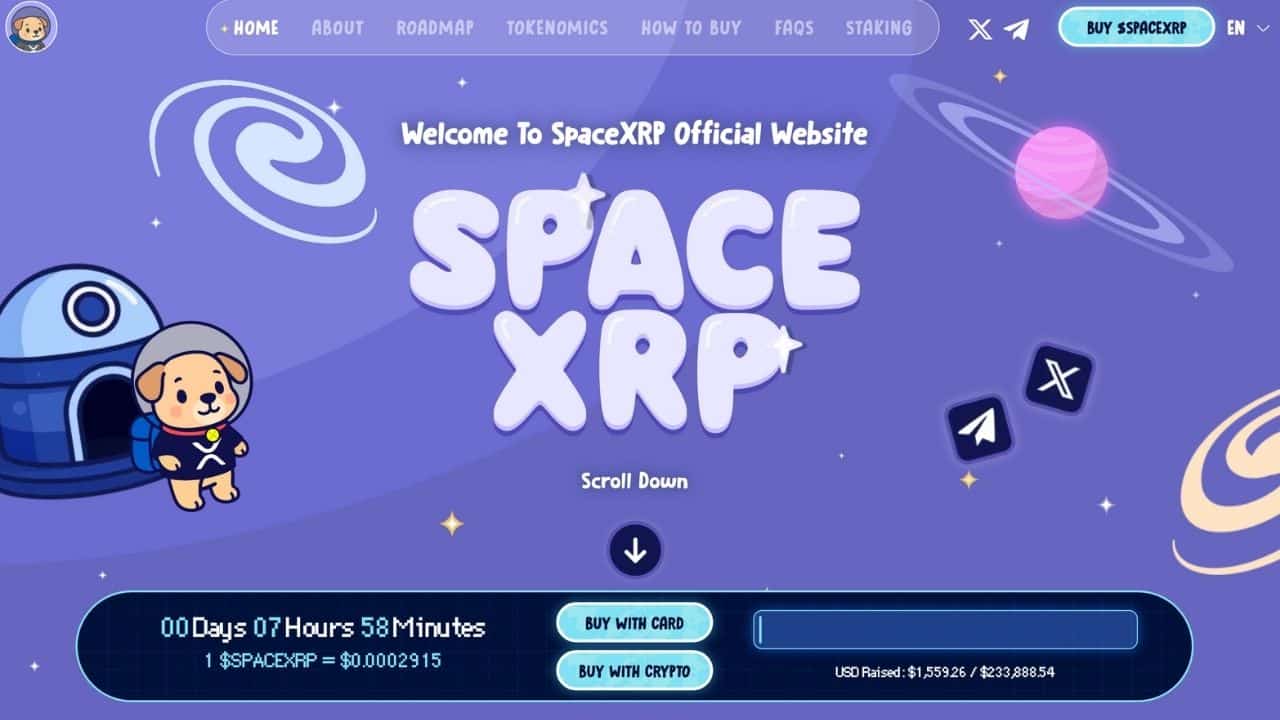
SpaceXRP uses a fixed supply of 100,000,000,000 tokens, with 95% shown as locked and 5% circulating. The allocation includes treasury (30%), marketing (25%), airdrops (15%), community missions (15%), liquidity (10%), and staking (5%).
SpaceXRP’s presale flow supports self-custody wallets such as Best Wallet, which can also be used to buy, track, and claim tokens in one app. If you are comparing early-stage meme coins, our top crypto presales guide can help you benchmark SpaceXRP against other launches.
Should You Consider Investing in SpaceXRP (SPACEXRP)?
- XRP Headline Hook: The project is built around reacting to XRP news with quests and community events.
- Gamified Participation: Includes daily missions, contests, and collectibles designed to keep holders engaged.
- Clear Token Supply Details: Publishes a fixed 100B supply with disclosed allocation and lock information.
- Optional Staking: Offers staking with variable rewards and a defined withdrawal window after claiming.
- Community-Run Model: States it is unaffiliated with Ripple or XRP, which reduces brand confusion but also limits direct ecosystem ties.
Expert Summary: Pros and Cons of SpaceXRP (SPACEXRP)
Pros
-
Clear meme concept tied to a consistent attention driver: XRP headlines.
-
Gamified roadmap includes quests, community events, and NFT drops to support engagement.
-
Token supply and allocation are published, including lock and circulating figures.
-
Presale supports self-custody wallets such as Best Wallet for buying and claiming tokens.
Cons
-
Utility is primarily community engagement, which may not translate into lasting demand.
-
Meme tokens can be highly volatile and driven by sentiment rather than fundamentals.
-
Staking rewards are variable and not guaranteed, and the lock/claim rules may limit flexibility.
-
The project is not affiliated with Ripple or the XRP Ledger. It is XRP-focused but the SPACEXRP token currently runs on Ethereum rather than the XRP ecosystem itself.
7. Gassed Token (GASSED) – Solana Meme Coin Built Around Gamified Community Engagement
- Presale project: Gassed (GASSED)
- Presale status: Launching soon
- Blockchain: Solana
- Token type: SPL
- Use case focus: Meme culture, gamified engagement
- Rewards: Variable, non-guaranteed
Gassed Token (GASSED) is a meme-focused crypto project launching on Solana, designed around humor, low fees, and simple on-chain interactions. The project positions itself as a response to high transaction costs on Ethereum, opting instead for Solana’s low-cost, high-speed environment.
At its core, Gassed leans heavily into community participation through lightweight, gamified mechanics such as Click-to-Fart, a browser-based clicker experience where users compete on leaderboards for token-based rewards. These mechanics are intentionally simple and entertainment-driven, with no claims of yield guarantees or protocol-level innovation.
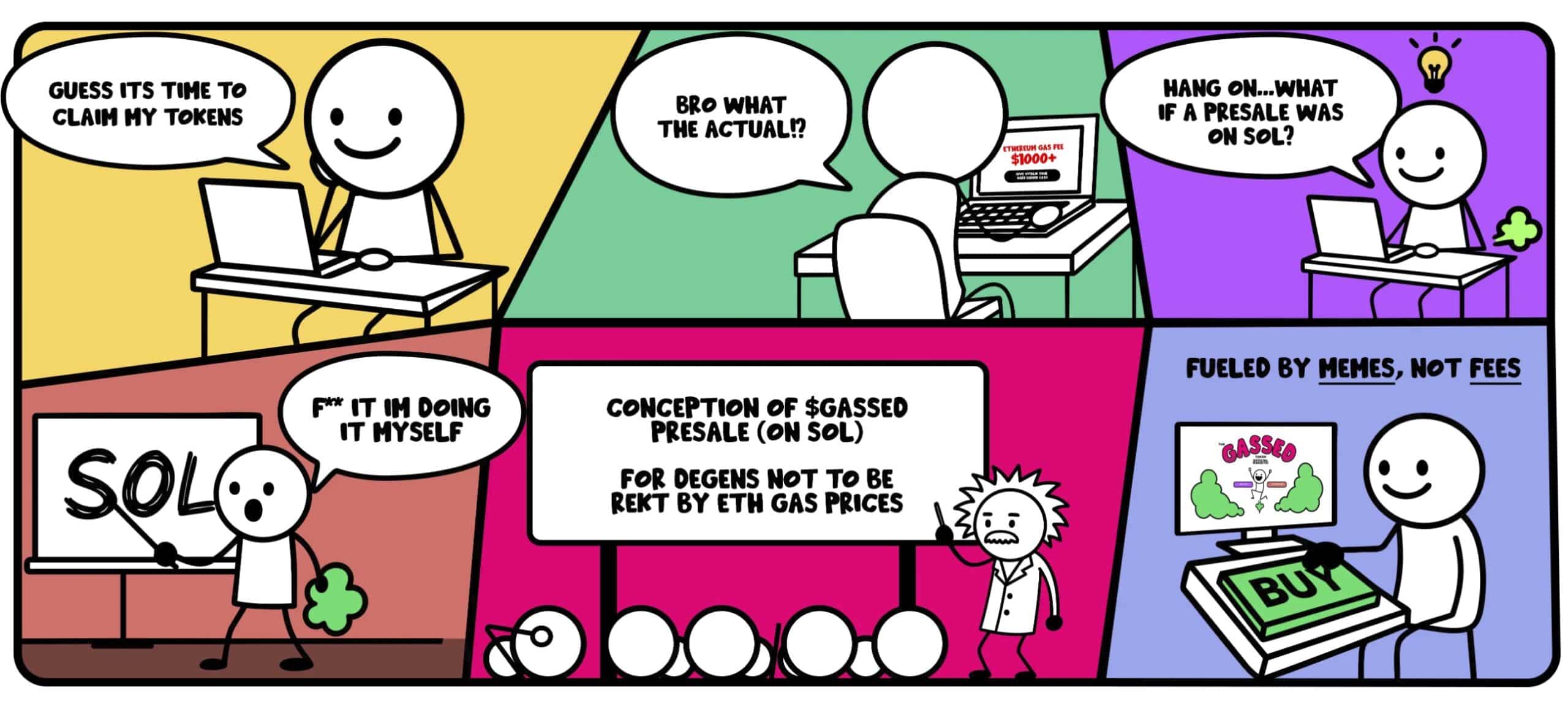
The project emphasizes meme sustainability and community activity over complex token mechanics. Its roadmap focuses on social engagement, experimental “fart-to-earn” concepts, and ongoing meme-driven campaigns rather than formal DeFi development.
At the time of writing, GASSED has not launched its presale yet. Token claiming, staking mechanics, and post-launch liquidity are expected to be announced closer to the presale and token generation event.
Should You Consider Investing in Gassed (GASSED)?
- Community-First Meme Concept: Built around humor, participation, and social engagement rather than financial products.
- Solana-Based Deployment: Low transaction fees and fast execution make frequent on-chain interaction inexpensive.
- Gamified Interaction: Click-to-Fart and leaderboard mechanics encourage short-term community activity.
- Simple Token Design: Avoids complex mechanics, focusing on accessibility and meme culture.
- Early-Stage Presale: Still in pre-launch phase, offering early access for users comfortable with speculative projects.
Expert Summary: Pros and Cons of GASSED (GASSED)
Pros
-
Clear meme-focused positioning that aligns with speculative, community-driven crypto culture.
-
Built on Solana, enabling low transaction costs and fast user interactions.
-
Gamified features are designed to encourage ongoing community participation.
-
Simple narrative and branding may appeal to meme traders during risk-on market phases.
Cons
-
Does not offer functional utility beyond entertainment and speculative participation.
-
No third-party smart contract audit has been disclosed at the time of review.
-
Token value is entirely dependent on social engagement and short-term meme momentum.
-
Long-term sustainability is unclear once novelty-driven interest fades.
-
As an early-stage meme presale, GASSED carries a high risk profile compared to established assets.
8. Uniswap (UNI) – Largest DEX By Trade Volume
Uniswap is the largest decentralized exchange (DEX) protocol in the world by trading volume. Uniswap started on the Ethereum blockchain and has now expanded to cover 38 blockchain networks.
Instead of centralized order books, Uniswap uses an automated market maker model, smart contracts, and liquidity pools to facilitate decentralized and permissionless crypto trading.
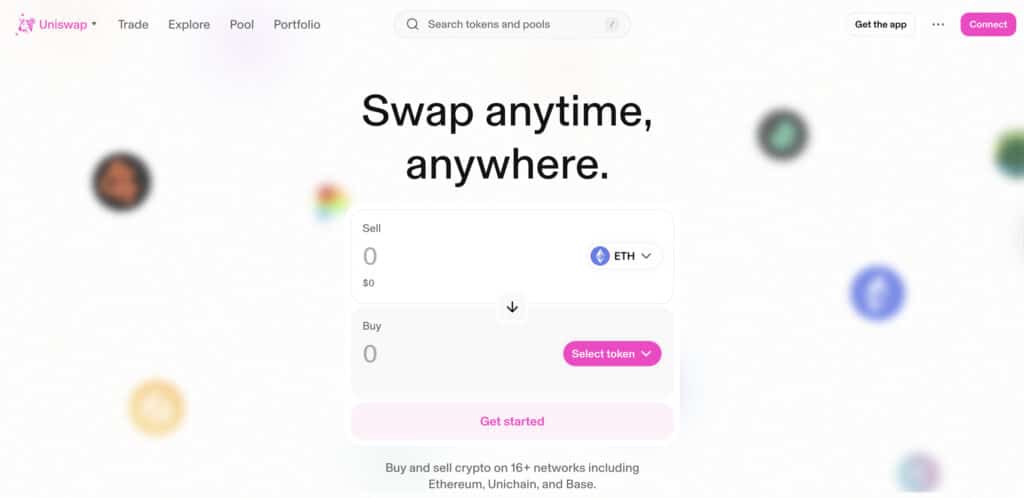
Over time, Uniswap has become core infrastructure for DeFi, powering swaps across wallets, apps, and aggregators. While competition is strong and market cycles affect activity, Uniswap’s scale, usage, and integrations give it a durable position in the decentralized trading ecosystem.
The UNI token is used for governance, allowing holders to vote on protocol upgrades and fee settings. While UNI does not represent ownership or profit rights, Uniswap’s scale, integrations, and usage give the token long-term relevance within the DeFi ecosystem.
Uniswap’s usage has been boosted by new app-chain integrations that route swap volume through the protocol, which has accelerated UNI’s fee-driven token burn, leading to an average UNI token burn of $45 million USD worth of UNI burned daily, according to Dune Analytics.
Should You Consider Investing in Uniswap (UNI)?
- Core DeFi Infrastructure: Operates one of the largest decentralized exchange protocols used for on-chain token swaps.
- Automated Liquidity Model: Uses smart contracts and liquidity pools instead of order books or intermediaries.
- Multi-Chain Presence: Deployed across Ethereum and several Layer-2 networks to reduce fees and improve access.
- Governance Token Role: UNI is primarily used for protocol governance rather than direct fee capture.
- Mature Ecosystem: Widely integrated into wallets, aggregators, and DeFi applications.
Expert Summary: Pros and Cons of Uniswap (UNI)
Pros
-
Established position as a core piece of DeFi infrastructure with strong network effects.
-
High and consistent on-chain usage driven by real trading activity.
-
Open-source protocol with broad developer and ecosystem support.
-
UNI plays a clear governance role in protocol decision-making.
Cons
-
UNI does not currently receive a share of protocol trading fees.
-
Faces increasing competition from other DEXs and aggregators.
-
Protocol governance participation among retail holders remains limited.
9. Solana (SOL) – High-performance Layer-1 Challenging Ethereum
Solana is a high-speed blockchain built to support applications that need fast and cheap transactions. It targets everyday use cases like trading, payments, gaming, and NFTs without high fees or long wait times.
Solana’s design focuses on processing many transactions at once, which keeps costs low even during busy periods. This makes it attractive for apps that rely on frequent on-chain activity.

The network has built a large ecosystem of developers, wallets, and decentralized apps. While Solana has faced stability issues in the past, ongoing upgrades such as Firedancer that is rolling out in phases in 2026 is aiming to improve reliability and performance, with early metrics showing SOL performance hitting an industry-leading 100k TPS.
The SOL token is used to pay transaction fees and secure the network through staking. Demand for SOL is closely tied to network usage, making adoption and developer activity key long-term factors.
Should You Consider Investing in Solana (SOL)?
- High-Performance Layer-1: Designed for fast transaction throughput and low fees.
- Broad Application Support: Hosts DeFi, NFT, gaming, and payment applications.
- Developer-Centric Network: Strong tooling and frequent ecosystem launches.
- Native Token Utility: SOL is used for fees, staking, and network security.
- Scalability Focus: Optimized for consumer-facing applications requiring speed.
Expert Summary: Pros and Cons of Solana (SOL)
Pros
-
Low transaction costs and fast confirmations support high-volume usage.
-
Strong developer activity and expanding application ecosystem.
-
SOL has clear utility for staking, fees, and validator incentives.
-
Growing institutional and retail infrastructure support.
Cons
-
Network stability issues in the past raise reliability concerns.
-
High validator hardware requirements limit decentralization.
-
Competes directly with other scalable Layer-1 blockchains.
We have a Solana price prediction article for anyone who wants to dive into the longer-term outlook for SOL.
Buy Solana on Binance10. Jupiter (JUP) – Popular DEX Aggregator On Solana
Jupiter is a decentralized exchange aggregator built on Solana. It helps users get the best possible swap price by routing trades across multiple liquidity sources.
Instead of checking different exchanges manually, Jupiter finds the most efficient trade path automatically. This reduces slippage and saves time, especially for larger swaps.
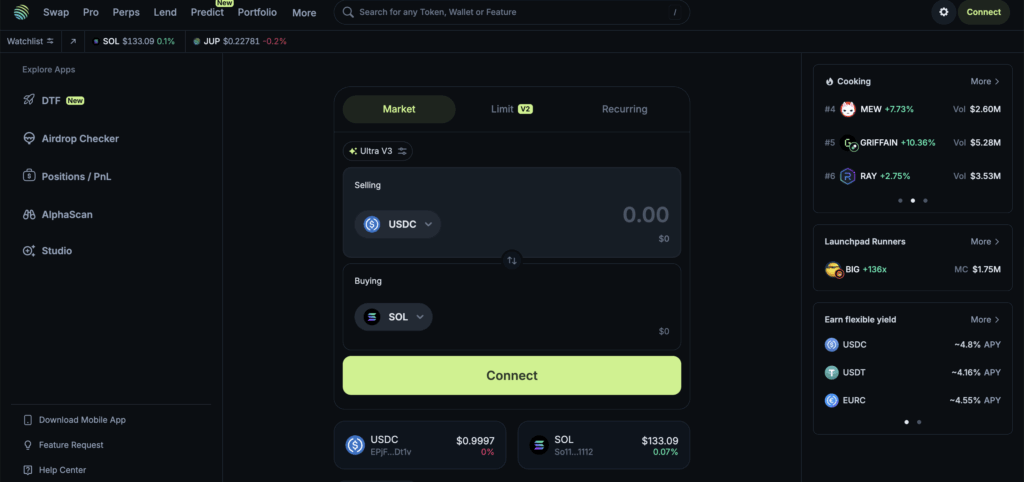
Jupiter also provides tools and APIs that many Solana wallets and apps rely on. As a result, a large share of Solana’s swap volume flows through Jupiter’s infrastructure.
The JUP token is mainly used for governance and community incentives. Its value depends on Jupiter’s role as core trading infrastructure within the Solana ecosystem rather than direct fee ownership.
Should You Consider Investing in Jupiter (JUP)?
- DEX Aggregation Role: Routes trades across Solana liquidity sources to optimize pricing.
- Infrastructure Utility: Powers swaps for wallets and applications across Solana.
- High Transaction Volume: Usage is tied to real trading demand.
- Token Governance Design: JUP is used for governance and incentive programs.
- Solana-Native Focus: Benefits from Solana’s low-cost, high-speed execution.
Expert Summary: Pros and Cons of Jupiter (JUP)
Pros
-
Integral infrastructure component within the Solana DeFi ecosystem.
-
Strong usage metrics linked to actual swap activity.
-
Widely integrated into wallets and on-chain tools.
-
Token governance provides influence over protocol direction.
Cons
-
JUP value is closely tied to Solana ecosystem growth.
-
Aggregator competition may compress long-term margins.
-
Governance participation outcomes remain uncertain.
11. Chainlink (LINK) – Backbone Of Autonomous Smart Contracts
Chainlink is a decentralized oracle network that delivers real-world data to blockchains. Smart contracts rely on Chainlink for price feeds, randomness, and cross-chain messaging.
Without reliable data, many DeFi applications would not function correctly. Chainlink fills this gap by connecting blockchains to off-chain information in a secure way.
The network offers more than just price feeds, including cross-chain connectivity and proof-of-reserve solutions. This wide range of services has made Chainlink a core part of DeFi and other blockchain ecosystems.
The LINK token is used to pay for network services and support security through staking. As more applications rely on Chainlink’s data, demand for LINK is driven by real usage, not just market speculation.
Chainlink’s role has expanded beyond price feeds into cross-chain infrastructure: its CCIP has been adopted by major custodians for moving tokenized assets between blockchains, and the network continues to add institutional integrations as real-world-asset tokenization grows. Chainlink is a goliath in the industry, with over $40 billion dollars secured on the network and CCIP attributing to $2.5 billion directly, according to DeFiLlama.
Should You Consider Investing in Chainlink (LINK)?
- Decentralized Oracle Network: Supplies price data and external inputs to smart contracts.
- Broad Product Suite: Includes price feeds, randomness, proof-of-reserves, and cross-chain messaging.
- Cross-Chain Positioning: CCIP aims to support interoperability across blockchains.
- Token Utility: LINK is used for payments, staking, and network security.
- Enterprise Adoption: Widely used across DeFi and enterprise integrations.
Expert Summary: Pros and Cons of Chainlink (LINK)
Pros
-
Critical infrastructure for DeFi and smart contract ecosystems.
-
High total value secured by Chainlink services.
-
Diverse product offerings beyond basic price feeds.
-
LINK has clear functional demand within the network.
Cons
-
Token value does not directly scale with protocol usage in all cases.
-
Oracle competition continues to increase.
-
Staking and fee dynamics are still evolving.
Hyperliquid (HYPE) – Layer-1 Built for Onchain Perpetual Futures Trading
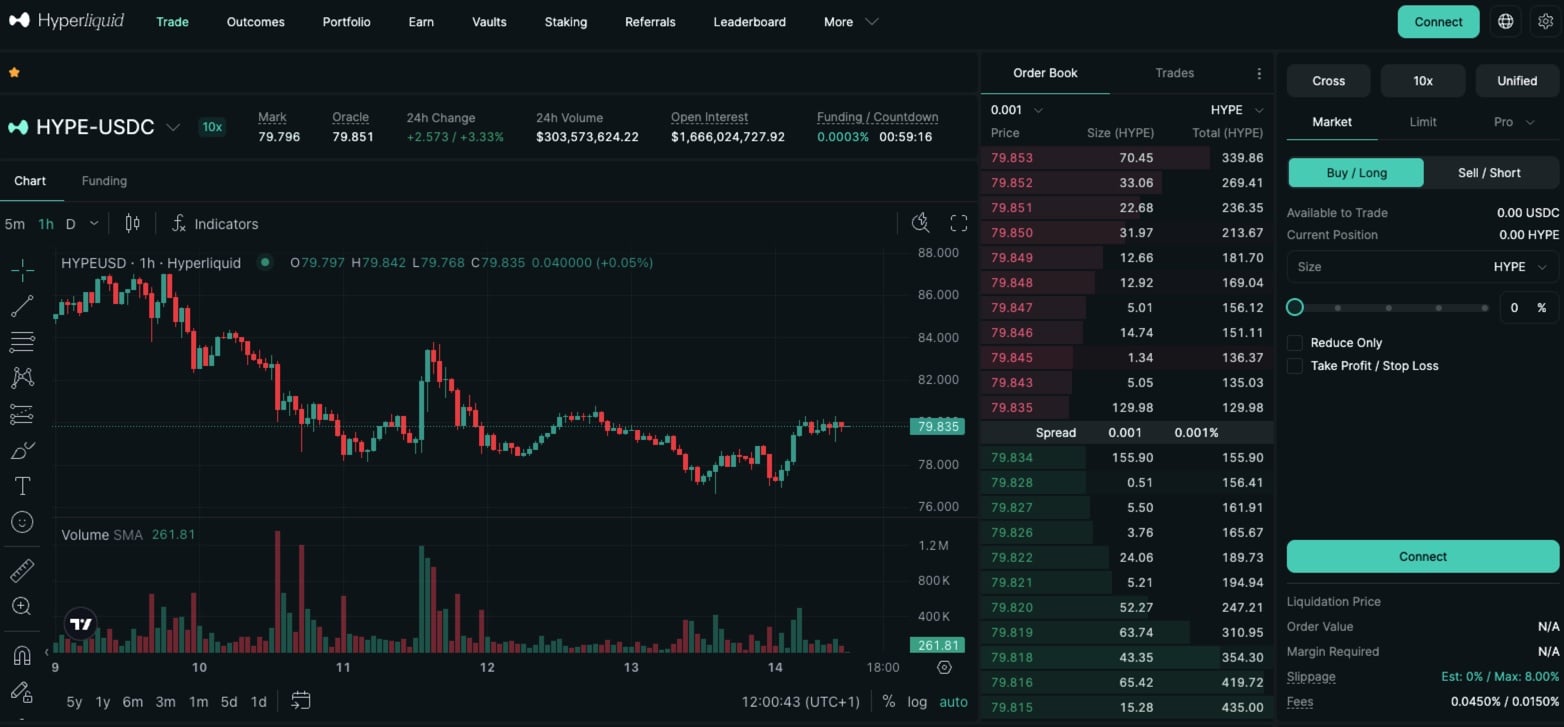
Hyperliquid is a purpose-built Layer-1 blockchain designed to bring centralized-exchange-level speed to decentralized derivatives trading. Its order-book model lets traders open perpetual futures positions directly onchain, with execution speed and liquidity depth that compete with centralized platforms.
The network’s HyperEVM lets developers build applications that share the exchange’s security and liquidity, and HIP-3 lets builders launch new perpetual markets by staking HYPE. The HYPE token pays for gas, secures the network through staking, and is bought back and burned using a share of protocol trading fees — tying token demand directly to trading volume rather than emissions.
Should You Consider Investing in Hyperliquid (HYPE)?
- Live, revenue-generating product: trading fees fund an active buyback-and-burn, unlike most presale or narrative-only tokens.
- Proven scale: one of the highest-volume onchain perpetuals exchanges, competing directly with centralized platforms.
- Expanding utility: HIP-3 opens the network to third-party market builders.
- Regulatory exposure: reported work toward regulated U.S. derivatives access could expand its addressable market if approved
Expert Summary: Pros and Cons of Hyperliquid (HYPE)
Pros
-
Revenue-backed buyback model ties token value to real trading activity
-
Deep liquidity and fast execution.
-
HyperEVM and HIP-3 extend the ecosystem beyond one product
Cons
-
Derivatives revenue is highly cyclical
-
U.S. regulatory approval is pending
-
a large share of HYPE supply remains subject to future vesting
Comparison of the Next Crypto Coins to Explode
To help answer your “What is the next crypto to blow up?” question, we have compiled a quick comparison table of all the projects we discussed above.
Project
Category
Chain
What it does?
Why is it on this list?
Bitcoin Hyper (HYPER)
Bitcoin Layer-2
Ethereum
Proposed Bitcoin L2 using SVM execution with settlement back to Bitcoin
Clear scaling thesis, but mainnet is not live yet and delivery risk is key
Maxi Doge (MAXI)
Meme coin
Ethereum
Meme token built around community engagement and staking
Community-led demand potential, but limited utility and high reliance on sentiment
LiquidChain (LIQUID)
Cross-chain infrastructure
Ethereum
Layer-3 concept for cross-chain liquidity and settlement
Targets liquidity fragmentation, but adoption depends on developer uptake and launch progress
SUBBD (SUBBD)
Creator economy
Ethereum
Tokenized creator platform with AI tools and gated access
Clear product direction, but user adoption and platform delivery are still unproven
Vortex FX (VFX)
Tokenized trading platform
Solana
Token linked to a broker-run automated trading ecosystem
“Real-yield” depends on live performance and operational transparency, which is the core risk
SpaceXRP (SPACEXRP)
Meme + gamified quests
Ethereum
XRP-themed meme project with quests, events, and optional staking
Strong narrative hook, but not affiliated with XRP and token runs on Ethereum
Gassed Token (GASSED)
Meme + gamified engagement
Solana
Meme coin tied to simple games and community interaction
Low-fee chain fit, but utility is entertainment-first and audit details are unclear
Uniswap (UNI)
DeFi DEX
Ethereum + L2s
AMM DEX for swaps and liquidity pools
Core DeFi infrastructure and strong integrations, but UNI is governance-focused
Solana (SOL)
Layer-1
Solana
High-throughput blockchain for apps and payments
Large ecosystem and low fees, but reliability and competition remain key watchpoints
Jupiter (JUP)
DEX aggregator
Solana
Routes swaps across Solana liquidity sources
Important Solana trading infra, but heavily dependent on Solana activity
Chainlink (LINK)
Oracle network
Multi-chain
Data feeds and cross-chain messaging for smart contracts
Widely used infra, but value capture and competition are ongoing factors
Hyperliquid (HYPER)
Decentralized Exchange
Hyperliquid
Offers decentralized trading network for spot, derivatives, tokenized stocks and more
Fasted growing and best performing decentralized trading platform in the world with strong tokenomic incentives for holders
How We Picked the Next Crypto to Explode (Methodology)
Below you will find a set of metrics on which we decided which crypto has the potential to explode in the long-term.
For deeper insights, see our comprehensive guide on How We Review and Rate Crypto Projects.
Early Stage Access: How to Buy The Next Crypto to Explode Before CEX Listings
The process is straightforward. You can use almost any exchange, but we’ll use Best Wallet as an example since it’s a popular non-custodial option known for offering strong security.
-
Download and Install Best Wallet
Visit the official Best Wallet website or app store and download the app on your device. Complete the installation process. -
Complete the Basic Set-Up Process
Launch the app and set up your wallet. Write down your seed phrase and store it securely; you’ll need it to recover your funds. -
Fund Your Wallet
Buy crypto directly in the app using a debit/credit card, or transfer supported tokens (like USDT, ETH, or BNB) from another wallet or exchange. -
Use Market Tools to Discover Trending Coins
Open the “Markets” tab inside Best Wallet to view new, trending, or low-cap crypto projects. Analyze the data and look for strong fundamentals, community interest, or upcoming catalysts. -
Buy the Token
Once you have picked a crypto you believe could explode, click on it, enter the amount you want to buy, and confirm the transaction using your funded wallet. -
Track Your Investment
Monitor your newly purchased token in the wallet’s portfolio tab. Set alerts or track updates about the project using Best Wallet’s integrated tools.
What Drives Major Crypto Price Surges?
Big crypto price jumps don’t happen for just one reason. They’re usually caused by a mix of real demand, new money flowing into the market, and changing market narratives. When you understand these drivers, it becomes easier to judge risk, spot real trends, and make smarter investment decisions. Below are the key factors that often sit behind major cryptocurrency price surges.
How to Spot Crypto Coins Ready to Surge?
Crypto projects with genuine breakout potential tend to share a few common traits, real-world adoption, growing on-chain activity, healthy liquidity, and a token with a clear, defined purpose. Supply dynamics matter too; projects with well-structured tokenomics and alignment with broader market trends are generally better positioned for sustained demand and long-term price growth.
Below, we explain each signal to help you identify high-potential crypto opportunities in 2026:
|
Signal to Watch |
Brief Explainer |
Why Is It Important |
Best Metric to Use |
Where to Find the Metric |
|---|---|---|---|---|
|
Real-World Utility |
Measures actual product demand |
Sustains long-term token value |
Active users, protocol usage |
Project dashboards, Dune |
|
On-Chain Activity |
Tracks real network usage |
Often leads price movement |
Transactions, active wallets |
Etherscan, Solscan, Glassnode |
|
Liquidity & Access |
Shows ease of trading |
Enables faster capital inflows |
Listings, trading volume |
CoinMarketCap, CoinGecko |
|
Token Supply Dynamics |
Monitors supply changes |
Supply shocks move prices |
Unlocks, emissions, vesting |
Token docs, TokenUnlocks |
|
Narrative Strength |
Tracks market themes |
Narratives attract liquidity |
Sector trends, mindshare |
X (Twitter), research blogs |
|
Capital Inflows |
Tracks new money entering |
Drives sustained rallies |
ETF flows, VC funding |
Fund reports, press releases |
|
Team Execution |
Confirms roadmap delivery |
Reduces execution risk |
GitHub commits, releases |
GitHub, project channels |
|
Market Conditions |
Measures risk appetite |
Amplifies or limits upside |
BTC trend, macro signals |
Price charts, macro sites |
Layer 2 Scaling Solutions: The Backbone of the 2026 Bull Run
In 2026, Layer 2 (L2) networks have clearly pulled ahead in the scalability race. Ethereum still acts as the main settlement layer, but most everyday users and businesses now rely on secondary layers that offer very low fees and near-instant transactions.
These networks work like highways for the blockchain ecosystem, easing congestion on the main chain and making large-scale adoption possible. As a result, L2s have grown beyond basic rollups into full ecosystems, with some focused on high-speed gaming and others built for secure, privacy-focused financial use.
Key Growth Drivers for L2s in 2026:
- Interoperability: the fragmentation issue of 2024 has been solved by cross-layer communication protocols, allowing liquidity to flow seamlessly between different L2s.
- Account abstraction: L2s are leading the charge in making crypto invisible. Users can now interact with dApps using email or biometrics, removing the hurdle of seed phrases.
- Data availability layers: new technologies have slashed the cost for L2s to post data to the mainnet, allowing them to remain profitable while charging users fractions of a cent.
Before investing in high-potential cryptocurrencies, you should quickly assess risk versus long-term value using a few core signals. The table below highlights the key factors that help separate sustainable projects from short-term hype.Factors to Consider Before Investing in High-Potential Coins
Category
Risks to Consider
Opportunities to Look For
Market Behavior
Extreme volatility and sharp drawdowns
Strong upside when fundamentals hold
Hype & Sentiment
Short-lived social media pumps
Active communities driving real adoption
Project Credibility
Anonymous teams or unclear roadmaps
Transparent teams with steady delivery
Tokenomics
Uncontrolled supply or heavy unlocks
Fair distribution and supply discipline
Security & Trust
Smart contract exploits or rug risks
Audits and proven security practices
Liquidity & Listings
Thin liquidity and limited access
Deep liquidity and major exchange support
Regulation
Sudden policy or compliance risks
Clear regulatory positioning
Utility & Use Case
No real demand beyond speculation
Real usage that creates ongoing demand
Conclusion: Next Crypto to Explode
Finding the next crypto to explode takes more than chasing hype or short-term price spikes. Smart investors focus on real-world utility, growing adoption, sound token design, and long-term execution, not just momentum.
While no project is guaranteed to succeed, cryptocurrencies with working products, active communities, and clear development roadmaps are better positioned to stand out as the next market cycle unfolds.
See Also:
FAQs:
How do I find trending cryptocurrencies before they go viral?

You can find trending cryptocurrencies early by tracking on-chain data, following developer activity, and checking social platforms like X, Reddit, and Telegram for rising community interest.
Are newly launched cryptocurrencies more likely to explode?
Yes, newly launched cryptocurrencies can explode quickly because they often gain attention through hype, low market caps, and early community excitement. However, they also carry higher risks, including untested technology, low liquidity, and a greater chance of scams.
Is it possible to predict the next crypto to explode?
It’s not possible to predict with certainty which crypto will explode, but you can improve your chances by studying market trends, on-chain data, project utility, team credibility, and community growth. Basically, these signals help identify coins with strong potential, though risks always remain.
What factors influence the price of a cryptocurrency?
Key factors include market sentiment, technological innovation, supply and demand, adoption rate, regulatory news, and social media trends. Macro events and investor sentiment also play significant roles.
Are low-cap coins more likely to explode than large caps?
Yes, low-cap coins often have more explosive upside because they require less capital to move the price. However, they also carry a higher risk compared to large-cap, more established cryptocurrencies.
Are AI cryptos more likely to explode in 2026?
Yes, AI cryptos could be strong contenders to explode in 2026, as demand for AI-driven blockchain tools, automation, and data processing continues to grow. However, success will still depend on real utility, adoption, and market conditions.
Should beginners invest in coins expected to explode?
Beginners can invest in coins expected to explode, but they should do so carefully. These coins can offer high rewards but also come with high risk and volatility.
Do regulatory changes affect which coins can take off?
Yes, regulatory changes can strongly impact which coins take off. Supportive rules can boost adoption, while strict regulations may limit trading, reduce liquidity, or create uncertainty.
References
- National Institute of Standards and Technology. “Blockchain.” NIST, https://www.nist.gov/blockchain.
- Sampath, Jagath, and Lee Reiners. “Tokenomics: Crypto Asset Valuation, Token Design, and the Development of Blockchain Networks.” The FinReg Blog (Duke University School of Law), 16 Nov. 2018, https://sites.duke.edu/thefinregblog/2018/11/16/tokenomics-crypto-asset-valuation-token-design-and-the-development-of-blockchain-networks/.
- University of Michigan. “Introduction to Ethereum.” University of Michigan, https://online.umich.edu/collections/fintech/short/introduction-to-ethereum/.
- Rasmussen University. “What Is Blockchain Technology?” Rasmussen University, https://www.rasmussen.edu/degrees/technology/blog/what-is-blockchain-technology/.

Why you can trust 99Bitcoins
Established in 2013, 99Bitcoin’s team members have been crypto experts since Bitcoin’s Early days.
Weekly Research
100k+Monthly readers
Expert contributors
2000+Crypto Projects Reviewed