







In This Article
Tether (USDT), the world’s most-used stablecoin, stands at the centre of some of crypto’s heaviest debates. While its popularity is huge, so is the scrutiny. In this full guide, we’ll explain what a stablecoin really is, dive into how Tether works, explore the data behind its reserves and controversies, and help you understand why it matters in the broader crypto ecosystem today.
Don’t like to read? Watch this video instead:
What is Tether: Summary
What is USDT? Tether is a stablecoin that is pegged to different fiat currencies. USDT is pegged to the U.S. dollar and is issued by the company known as Tether. This allows traders to transfer the “fiat equivalent” in value between exchanges, without the need for normal fiat currency regulation.
There are serious concerns and controversy about the solvency of the company issuing Tether, which has neither been proven nor disproven so far. People have questioned the legitimacy of Tether for years and years. However, no concrete evidence has ever been found to prove any wrongdoing. Back in 2017 and 2018, Tether was the source of many conspiracy theories, and many people questioned whether or not it had the proper amount of funds to back up each USDT token. While there was certainly a lot of murkiness, there was never any evidence to suggest that Tether didn’t have the funds it claimed to have.
Stablecoins in a Nutshell
A stablecoin is a cryptocurrency that is pegged to a real-world currency, also known as fiat currency (e.g., the U.S. dollar, Euro, etc.).
Stablecoins are issued by centralized companies that maintain the peg, either by putting up collateral or through some sort of algorithm that manipulates the stablecoin’s supply, depending on the demand.
Stablecoins allow exchanges to create fiat currency pairs without actually accepting fiat. For example, you can have a BTC/USDT trading pair, which simulates the BTC/USD market without the need for regulation.
What is Tether?
Tether (USDT) is the world’s largest and most widely used stablecoin, designed to maintain a 1:1 peg with the U.S. dollar. It’s issued by Tether Limited, a company that claims every USDT token is backed by equivalent reserves held in cash, cash equivalents, or other assets.
USDT acts as a digital version of the dollar, allowing traders and investors to move value quickly across exchanges and blockchains without relying on banks or traditional payment rails. This makes it especially useful for crypto trading, cross-border transfers, and DeFi applications where speed and stability are essential.
However, Tether’s dominance has always come with controversy. Questions about the company’s transparency and reserve composition have circulated for years. Critics have long doubted whether every USDT in circulation is fully backed, and while no hard evidence of fraud has ever surfaced, Tether has faced multiple investigations and fines over disclosure issues.
In 2025, Tether remains both indispensable and divisive—an asset trusted by millions for liquidity and stability, yet still viewed with caution by regulators and transparency advocates alike.
The Tether Bitfinex Connection
Tether is directed by some of the same people behind Bitfinex: Philip Potter and Giancarlo Devasini. This leadership was confirmed by the Paradise Papers leak, although the news didn’t come as a surprise to anyone paying attention.
New Tether accounts flow mostly to Bitfinex. In April 2017, Bitfinex and Tether experienced a freeze of their fiat operations when U.S. Bank and Wells Fargo withdrew as banking partners.
As a result, Bitfinex now refuses U.S. customers, and it no longer provides markets denominated in USD. Rather, it exclusively uses USDT.
How Does Tether Work?
At first, all Tether was based on the Omni Platform. This platform is used for various digital assets, which are anchored to the Bitcoin blockchain. Following Bitcoin, Ethereum-based Tether coins were launched as well, which is now their most-utilized network. They haven’t stopped there, however, with Tether tokens now existing on 8+ blockchains, including Tron, OMG Network, and Solana.
The Tether peg is maintained through collateral. They claim that for every 1 USDT in existence, there’s a US Dollar worth of currency or other assets sitting in a deposit.
For 1 USDT to be worth $1, it must be redeemable at any time for $1 of fiat currency. At present, USDT is only directly convertible to USD via a small number of exchanges or through Tether itself (which requires a $100K minimum and charges considerable fees).
To sum it up, for 1 USDT to actually be worth $1, Tether and exchanges must keep a reserve of dollars to back every USDT in existence.
Tether Crypto Advantages
Since the majority of mainstream interest in cryptocurrencies is due to their fluctuation in price, one might question the purpose of a cryptocurrency, which is predicated on maintaining a fixed price. No pumps, no dumps, no bubbles.
Owning Tether crypto is more like a deposit in a (somewhat risky) bank account that pays 0% interest.
So if Tether is riskier than regular cryptocurrencies and provides no possibility of financial gains, why use it at all?
The reality is that Tether is extremely useful to traders and investors as an alternative to fiat. There are several good reasons why:
Transaction Times
Traditional USD deposits and withdrawals through banks or exchanges can be painfully slow, often taking one to four business days to process. Transfers can be delayed even longer if they’re made after business hours, on weekends, or during holidays. For active crypto traders, those delays can mean missing critical market opportunities.
Tether eliminates much of that waiting. Transactions settle within minutes, regardless of the time or day, since they occur directly on blockchain networks like Ethereum, Tron, or Solana. This near-instant speed gives traders a major edge when moving funds between exchanges or reacting to sudden price swings.
For anyone seeking a fast, dollar-pegged digital asset, Tether remains one of the most convenient and liquid options in the crypto market today.
Transaction Fees
SWIFT (Society for Worldwide Interbank Financial Telecommunication) transfers are very expensive. They cost upwards of $20 in fees and average around $30.
Additionally, if you’re using a fiat currency other than those supported by the exchange, the banks will charge an extra foreign exchange conversion fee and percentage on the transfer.
By contrast, Tether charges zero transaction fees between Tether wallets. However, standard blockchain network fees apply.
Price Stability
Cryptocurrencies are notorious for being volatile, and trading one volatile currency for another creates a great deal of complication and extra risk. That’s why a stable base currency is extremely useful.
To understand why, imagine the following scenario, which involves trading Bitcoin for Ethereum:
- You convert BTC to buy ETH;
- ETH rises by 10%;
- You wish to make a profit and sell your ETH for BTC;
- While the trade is being processed, Bitcoin shockingly falls by 15%.
Despite being correct about ETH’s direction, you would take a loss due to the fall of BTC. By using USD₮, your sole concern is the price of Ethereum.
Staying on the Sidelines
Frequently, the best position to take in a market is no position at all. Let’s say you feel that a certain cryptocurrency price, which you own, is unsustainably high. Your best move, in this case, would be to cash out, then wait for a dip or crash to buy back in.
Best Tether Wallets



Ledger
The most secure way to keep your USDT safe would be in a hardware wallet. A hardware wallet keeps your coins offline, making them impossible to steal unless someone gains physical access to the wallet.
Ledger has two wallet models that support Tether and over 1,200 additional cryptocurrency assets. The Model S and Model X both offer USDT support, the main difference being that the Model X can be controlled from your mobile phone as well.
Trezor
TREZOR is another hardware wallet manufacturer that supports Tether. There are two models available from TREZOR: the TREZOR One and the TREZOR Model T. The Model T is the newer model featuring a touch screen.
TREZOR wallets are compatible with desktops only.
Best Wallet
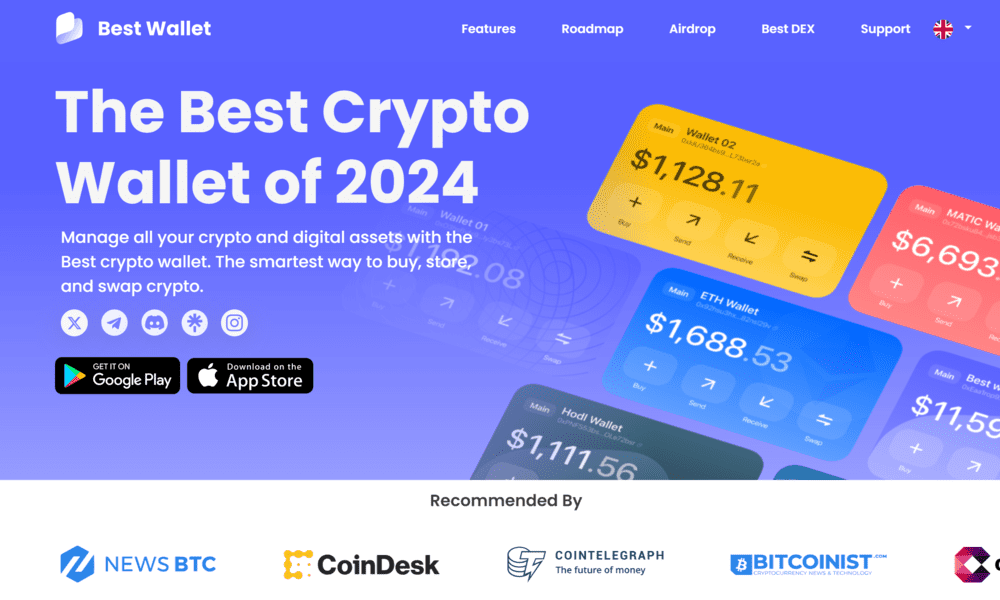
Best Wallet is one of our top-rated multichain wallets with Tether USDT support. One thing we like about Best Wallet is the built-in DEX that allows for the trading and buying of cryptocurrencies directly from within the wallet, meaning users never have to give up control to a third party. You can learn about how to buy USDT in their article How to Buy USDT with Best Wallet.
Best Wallet supports more than 50 different chains and countless different cryptocurrencies. If you’re looking for a one-stop shop for your crypto wallet needs, look no further. Best Wallet is one of our highest graded wallets for many reasons, and is certainly an adequate wallet to store your Tether and other stablecoins.
Visit Best WalletCoinomi
Coinomi is a multicurrency, multiplatform software wallet that allows you to store over 1,500 cryptocurrency assets, including USDT. The wallet is user-friendly, with a built-in exchange function so you can exchange your current holdings into USDT and back.
Coinomi is available for iOS, Android, Windows, Mac, and Linux.
Exodus
Exodus is a beautifully designed cryptocurrency software wallet that can hold over 100 different crypto assets, including Tether. Exodus is extremely recommended if you’re just starting with crypto, as it’s super beginner-friendly.
Exodus is available for iOS, Android, Windows, Linux, and Mac.
Tether
It’s important to note that Tether also supplies its own dedicated web interface for holding Tether. This interface isn’t highly recommended among Tether wallets due to the fact that it supports only Tether and no other cryptocurrency. Additionally, this service has been suspended in the past due to a $30 million USDT hack.
How to Buy Tether?
By far, the most common method of buying USDT is to exchange it for another cryptocurrency. For the full list of USDT crypto markets, check out CoinMarketCap’s list.
How to Buy Tether (USDT) with PayPal?
Unfortunately, it’s not possible to buy USDT directly on PayPal, but you can use PayPal to buy them on platforms that accept it. Here’s how:
Step 1: Pick a Platform That Accepts PayPal
Platforms like Paybis and CEX allow users to buy USDT with PayPal.
Step 2: Sign Up and Verify Your Account
- Create an Account: Register with your email.
- Verify Your Identity: Upload your ID (KYC verification).
Step 3: Add PayPal as a Payment Method
- Go to Settings > Payment Methods
- Select PayPal and connect your account.
Step 4: Deposit Money Using PayPal
- Go to Deposit Funds and choose PayPal
- Enter the amount and confirm.
Step 5: Buy USDT or USDC
- Find USDT on the exchange.
- Enter the amount and confirm the purchase.
How to Buy Tether (USDT) with a Credit or Debit Card?
Buying Tether (USDT) with your credit or debit card is simple. Follow these steps to get started.
Step 1: Choose a Crypto Exchange or Broker
Popular platforms for buying USDT with a card include:
- Best Wallet – Non-custodial wallet with a built-in DEX
- MEXC – User-friendly centralized exchange
- Margex – Another good choice
Tip: Choose a platform that supports your country and offers low fees.
Step 2: Create and Verify Your Account
- Sign up with your email and create a strong password.
- Complete KYC verification by uploading your ID and proof of address.
Step 3: Go to the “Buy Crypto” Section
- Find the option labeled “Buy Crypto” or “Buy USDT.”
- Select Tether (USDT) from the list of available cryptocurrencies.
Step 4: Enter Your Payment Details
- Choose Credit/Debit Card as your payment method.
- Enter your Visa or Mastercard details.
- Input the amount of USDT you want to purchase.
Step 5: Review and Confirm Your Purchase
- Double-check the exchange rate, transaction fees, and total cost.
- Click Confirm to complete the purchase.
- Enter any security codes or approve the transaction through your bank’s two-factor authentication (2FA).
Step 6: Receive USDT in Your Wallet
- Your USDT will be added to your exchange wallet immediately. It’s best to keep your USDT in a personal wallet, especially if you’re holding large amounts.
Tether Controversy
The New York Times, Bloomberg, and Fortune all recently published articles that express concerns about Tether. These articles reflect doubts and fears that have been percolating in certain corners of the crypto community for years.
The true wellspring of skepticism about Tether and Bitfinex skepticism is undoubtedly the writer known as Bitfinex’ed. He is notorious for his ongoing, fervent criticism of Bitfinex’s operations.
Critics accuse Bitfinex and Tether of running a fractional reserve scheme: More USDT are issued than are backed by fiat dollars. Critics further allege that unbacked Tether accounts are used to inflate the price of Bitcoin for the purpose of market manipulation.
Tether’s self-reported finances claim full—and even excess—reserves. However, Tether doesn’t guarantee USD convertibility. Check out Tether’s terms of service:

In March 2019, Tether changed the statement on their website from this:
“Every tether is always backed 1-to-1 by traditional currency held in our reserves. So 1 USDT is always equivalent to 1 USD.”
To this:
“Every Tether is always 100% backed by our reserves, which include traditional currency and cash equivalents and, from time to time, may include other assets and receivables from loans made by Tether to third parties, which may include affiliated entities (collectively, “reserves”). Every tether is also 1-to-1 pegged to the dollar, so 1 USD₮ is always valued by Tether at 1 USD.”
Suggesting that the company is no longer fully backed by US Dollars (if they ever were).
The Growth of Tether
Tether (USDT) has grown from a niche experiment in digital dollars to the single most influential asset in the cryptocurrency ecosystem. After overcoming its early controversies, Tether entered a period of explosive growth during the 2021 bull cycle, when surging demand for liquidity across exchanges and DeFi protocols made stablecoins indispensable. At the height of that cycle, USDT became the default trading pair for Bitcoin and thousands of altcoins, effectively replacing fiat on most exchanges and enabling instant global settlement. Its promise of stability and simplicity helped onboard millions of new users to crypto who might have otherwise been wary of volatility.
Since then, Tether’s scale has only increased. As of 2025, its circulating supply has surpassed $115 billion, giving it a commanding 70 percent share of the stablecoin market. USDT is now available on a wide range of blockchains, including Ethereum, Tron, Solana, Avalanche, Algorand, Polygon, and Bitcoin (via Omni and Liquid), allowing users to transfer value across ecosystems with minimal friction and low fees. Beyond its trading utility, Tether has become a vital payment and remittance tool in emerging markets where access to U.S. dollars is limited. Its dominance illustrates not only the demand for digital dollars but also the degree to which stablecoins have become the backbone of global crypto liquidity.
Conclusion
Tether (USDT) sits in an awkward space between traditional finance and decentralized crypto. Unlike Bitcoin, it’s centralized, permissioned, and reliant on trust, which naturally raises eyebrows in a community built on transparency and autonomy.
Over the years, Tether has faced recurring scrutiny over its reserves and transparency. Yet despite countless investigations and rumors, no conclusive evidence of insolvency has ever surfaced. Much of the anti-Tether narrative still feels like a cycle of FUD (fear, uncertainty, and doubt) that resurfaces every few months.
Still, skepticism isn’t entirely misplaced. Regulatory attention is intensifying, and Tether’s growing dominance means even minor issues could ripple through the entire crypto market. The recent GENIUS Act for stablecoins could set new global standards, potentially encouraging issuers like Tether to move operations to the U.S. and comply with clearer, more transparent frameworks.
If you choose to use Tether, treat it as a tool, not a store of value. It’s best suited for short-term trading, transfers, or bridging between exchanges, not long-term holdings. Splitting large transfers into smaller batches can help minimize exposure and liquidity risks.
In short, Tether combines the convenience of crypto with the vulnerabilities of fiat. Use it wisely, stay informed about its regulatory status, and always remember that stability in crypto is only as solid as the trust that backs it.
See also:
FAQs
Who owns Tether?

Tether Holding LTD controls Tether, a company based in the British Virgin Islands and Hong Kong. The CEO of Tether is JL Van Der Velde, the CFO of the company is Giancarlo Devasini, and Suart Hoegner acts as the general counsel. It’s important to note that both Van Der Velde and Devasini have the same positions at Bitfinex.
Is Tether backed by USD?
Tether is backed by currencies and assets that are equivalent to the number of USDT in circulation. However, the company does not keep a 1:1 dollar-to-USD in deposits.
Is Tether ERC-20?
Initially, Tether was Bitcoin-based, issued via the Omni Layer Protocol. However, today there are also Ethereum-based Tethers for US Dollars and Euros, compatible with the ERC-20 standard.
The Ethereum-based Tether allows for tokenized USD and EUR to be transferred over the Ethereum network. This enables interoperability with Ethereum-based protocols and Decentralised Applications (dApps) whilst allowing users to transact and exchange fiat pegged currencies across the Ethereum Network. Although Tether has since been issued on other blockchains, most of its stablecoins still run on Ethereum.
Can Tether lose its peg to the U.S. dollar?
Yes, although it’s rare. During periods of extreme market stress, USDT has temporarily dipped below $1 before recovering. These short-lived deviations usually reflect liquidity pressures rather than insolvency, but they serve as reminders that even stablecoins can move in turbulent markets.
Is USDT safe to hold long-term?
USDT is generally safe for short-term use, especially for traders moving funds between exchanges or hedging against volatility. However, it’s not designed for long-term storage. Since it depends on centralized management and fiat reserves, holding large sums over time exposes you to both regulatory and counterparty risks.

Why you can trust 99Bitcoins
Established in 2013, 99Bitcoin’s team members have been crypto experts since Bitcoin’s Early days.
Weekly Research
100k+Monthly readers
Expert contributors
2000+Crypto Projects Reviewed